Comsats University Islamabad
Presented to: SANA NASIR
Presented by: Ayesha Abbasi
Saba Batool
What is Network Topology
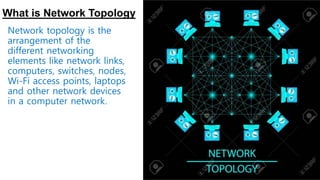
Network topology is the
arrangement of the
different networking
elements like network links,
computers, switches, nodes,
Wi-Fi access points, laptops
and other network devices
in a computer network.
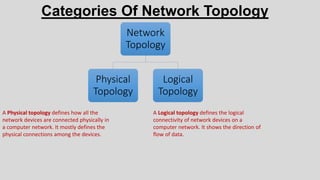
Categories Of Network Topology
Network
Topology
Physical
Topology
Logical
Topology
A Logical topology defines the logical
connectivity of network devices on a
computer network. It shows the direction of
flow of data.
A Physical topology defines how all the
network devices are connected physically in
a computer network. It mostly defines the
physical connections among the devices.
TYPES OF NETWORK TOPOLOGIES
Bus Topology
Ring Topology
Star Topology
Mesh Topology
Tree Topology
Hybrid Topology
Bus Topology:
In a network, when all the nodes are connected by a single physical cable and the
central cable becomes the backbone of the network then, it is called as a Bus topology.
• Simplest Topology
• Two Dimensional Data Flow
• Single Communication Channel
• Terminator at both Ends
• Scalability factor: smaller to medium
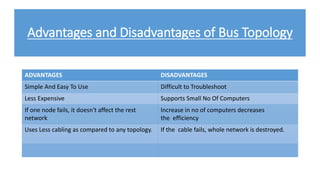
Advantages and Disadvantages of Bus Topology
ADVANTAGES DISADVANTAGES
Simple And Easy To Use Difficult to Troubleshoot
Less Expensive Supports Small No Of Computers
If one node fails, it doesn't affect the rest
network
Increase in no of computers decreases
the efficiency
Uses Less cabling as compared to any topology. If the cable fails, whole network is destroyed.
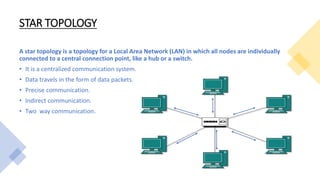
STAR TOPOLOGY
A star topology is a topology for a Local Area Network (LAN) in which all nodes are individually
connected to a central connection point, like a hub or a switch.
• It is a centralized communication system.
• Data travels in the form of data packets.
• Precise communication.
• Indirect communication.
• Two way communication.
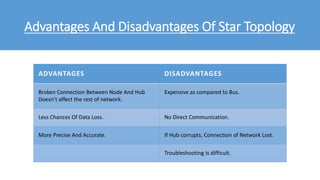
Advantages And Disadvantages Of Star Topology
ADVANTAGES DISADVANTAGES
Broken Connection Between Node And Hub
Doesn’t affect the rest of network.
Expensive as compared to Bus.
Less Chances Of Data Loss. No Direct Communication.
More Precise And Accurate. If Hub corrupts, Connection of Network Lost.
Troubleshooting Is difficult.
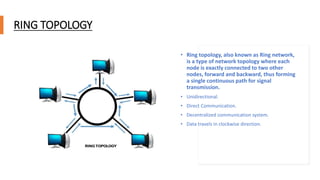
RING TOPOLOGY
• Ring topology, also known as Ring network,
is a type of network topology where each
node is exactly connected to two other
nodes, forward and backward, thus forming
a single continuous path for signal
transmission.
• Unidirectional.
• Direct Communication.
• Decentralized communication system.
• Data travels in clockwise direction.
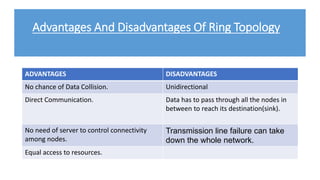
Advantages And Disadvantages Of Ring Topology
ADVANTAGES DISADVANTAGES
No chance of Data Collision. Unidirectional
Direct Communication. Data has to pass through all the nodes in
between to reach its destination(sink).
No need of server to control connectivity
among nodes.
Transmission line failure can take
down the whole network.
Equal access to resources.
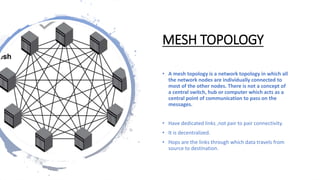
MESH TOPOLOGY
• A mesh topology is a network topology in which all
the network nodes are individually connected to
most of the other nodes. There is not a concept of
a central switch, hub or computer which acts as a
central point of communication to pass on the
messages.
• Have dedicated links ,not pair to pair connectivity.
• It is decentralized.
• Hops are the links through which data travels from
source to destination.
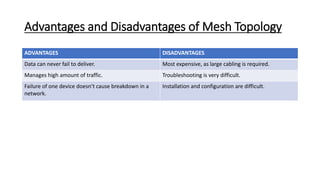
Advantages and Disadvantages of Mesh Topology
ADVANTAGES DISADVANTAGES
Data can never fail to deliver. Most expensive, as large cabling is required.
Manages high amount of traffic. Troubleshooting is very difficult.
Failure of one device doesn’t cause breakdown in a
network.
Installation and configuration are difficult.
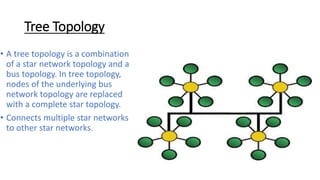
Tree Topology
• A tree topology is a combination
of a star network topology and a
bus topology. In tree topology,
nodes of the underlying bus
network topology are replaced
with a complete star topology.
• Connects multiple star networks
to other star networks.
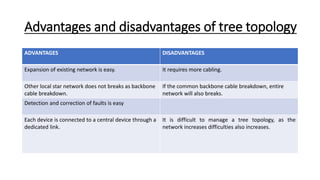
Advantages and disadvantages of tree topology
ADVANTAGES DISADVANTAGES
Expansion of existing network is easy. It requires more cabling.
Other local star network does not breaks as backbone
cable breakdown.
If the common backbone cable breakdown, entire
network will also breaks.
Detection and correction of faults is easy
Each device is connected to a central device through a
dedicated link.
It is difficult to manage a tree topology, as the
network increases difficulties also increases.
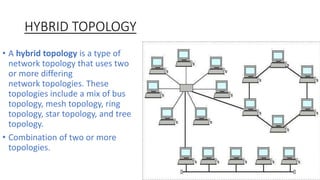
HYBRID TOPOLOGY
• A hybrid topology is a type of
network topology that uses two
or more differing
network topologies. These
topologies include a mix of bus
topology, mesh topology, ring
topology, star topology, and tree
topology.
• Combination of two or more
topologies.
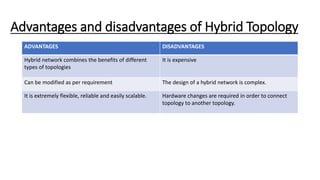
Advantages and disadvantages of Hybrid Topology
ADVANTAGES DISADVANTAGES
Hybrid network combines the benefits of different
types of topologies
It is expensive
Can be modified as per requirement The design of a hybrid network is complex.
It is extremely flexible, reliable and easily scalable. Hardware changes are required in order to connect
topology to another topology.
Which Topology Should I Choose?
Before choosing a topology you’ll want to closely consider the
following:
• Budget
• Hardware Resources
• Ease Of Implementation
• Size of the network
• Reliability
• Scalability
Thankyou

Network Topologies

  • 2.
    Comsats University Islamabad Presentedto: SANA NASIR Presented by: Ayesha Abbasi Saba Batool
  • 3.
    What is NetworkTopology Network topology is the arrangement of the different networking elements like network links, computers, switches, nodes, Wi-Fi access points, laptops and other network devices in a computer network.
  • 4.
    Categories Of NetworkTopology Network Topology Physical Topology Logical Topology A Logical topology defines the logical connectivity of network devices on a computer network. It shows the direction of flow of data. A Physical topology defines how all the network devices are connected physically in a computer network. It mostly defines the physical connections among the devices.
  • 5.
    TYPES OF NETWORKTOPOLOGIES Bus Topology Ring Topology Star Topology Mesh Topology Tree Topology Hybrid Topology
  • 6.
    Bus Topology: In anetwork, when all the nodes are connected by a single physical cable and the central cable becomes the backbone of the network then, it is called as a Bus topology. • Simplest Topology • Two Dimensional Data Flow • Single Communication Channel • Terminator at both Ends • Scalability factor: smaller to medium
  • 7.
    Advantages and Disadvantagesof Bus Topology ADVANTAGES DISADVANTAGES Simple And Easy To Use Difficult to Troubleshoot Less Expensive Supports Small No Of Computers If one node fails, it doesn't affect the rest network Increase in no of computers decreases the efficiency Uses Less cabling as compared to any topology. If the cable fails, whole network is destroyed.
  • 8.
    STAR TOPOLOGY A startopology is a topology for a Local Area Network (LAN) in which all nodes are individually connected to a central connection point, like a hub or a switch. • It is a centralized communication system. • Data travels in the form of data packets. • Precise communication. • Indirect communication. • Two way communication.
  • 9.
    Advantages And DisadvantagesOf Star Topology ADVANTAGES DISADVANTAGES Broken Connection Between Node And Hub Doesn’t affect the rest of network. Expensive as compared to Bus. Less Chances Of Data Loss. No Direct Communication. More Precise And Accurate. If Hub corrupts, Connection of Network Lost. Troubleshooting Is difficult.
  • 10.
    RING TOPOLOGY • Ringtopology, also known as Ring network, is a type of network topology where each node is exactly connected to two other nodes, forward and backward, thus forming a single continuous path for signal transmission. • Unidirectional. • Direct Communication. • Decentralized communication system. • Data travels in clockwise direction.
  • 11.
    Advantages And DisadvantagesOf Ring Topology ADVANTAGES DISADVANTAGES No chance of Data Collision. Unidirectional Direct Communication. Data has to pass through all the nodes in between to reach its destination(sink). No need of server to control connectivity among nodes. Transmission line failure can take down the whole network. Equal access to resources.
  • 12.
    MESH TOPOLOGY • Amesh topology is a network topology in which all the network nodes are individually connected to most of the other nodes. There is not a concept of a central switch, hub or computer which acts as a central point of communication to pass on the messages. • Have dedicated links ,not pair to pair connectivity. • It is decentralized. • Hops are the links through which data travels from source to destination.
  • 13.
    Advantages and Disadvantagesof Mesh Topology ADVANTAGES DISADVANTAGES Data can never fail to deliver. Most expensive, as large cabling is required. Manages high amount of traffic. Troubleshooting is very difficult. Failure of one device doesn’t cause breakdown in a network. Installation and configuration are difficult.
  • 14.
    Tree Topology • Atree topology is a combination of a star network topology and a bus topology. In tree topology, nodes of the underlying bus network topology are replaced with a complete star topology. • Connects multiple star networks to other star networks.
  • 15.
    Advantages and disadvantagesof tree topology ADVANTAGES DISADVANTAGES Expansion of existing network is easy. It requires more cabling. Other local star network does not breaks as backbone cable breakdown. If the common backbone cable breakdown, entire network will also breaks. Detection and correction of faults is easy Each device is connected to a central device through a dedicated link. It is difficult to manage a tree topology, as the network increases difficulties also increases.
  • 16.
    HYBRID TOPOLOGY • Ahybrid topology is a type of network topology that uses two or more differing network topologies. These topologies include a mix of bus topology, mesh topology, ring topology, star topology, and tree topology. • Combination of two or more topologies.
  • 17.
    Advantages and disadvantagesof Hybrid Topology ADVANTAGES DISADVANTAGES Hybrid network combines the benefits of different types of topologies It is expensive Can be modified as per requirement The design of a hybrid network is complex. It is extremely flexible, reliable and easily scalable. Hardware changes are required in order to connect topology to another topology.
  • 18.
    Which Topology ShouldI Choose? Before choosing a topology you’ll want to closely consider the following: • Budget • Hardware Resources • Ease Of Implementation • Size of the network • Reliability • Scalability
  • 19.