IP Routing


 Chapter 6
Chapter Objectives

     Explain Protocols
     Explain Routing Metrics
     Discuss Routing Mechanisms
     Explain Routing Algorithms
     Set up routing


Chapter 6                          2
Recall
    The router configuration files are located in:
      RAM

      NVRAM

      TFTP Server

    Protocol that gives the information about locally
     attached and remote devices in the network is
     termed as Cisco Discovery Protocol (CDP)
    CDP global parameters include:
      CDP timer

      CDP holdtime


Chapter 6                                                3
Goals of Routing
    Routing process ensures that appropriate packets
     are routed from the source to the destination
    Goals of routing include:
      Stability

      Provides with a robust network

      Dynamic update of the network paths

      Information is safe while transmitting


Chapter 6                                               4
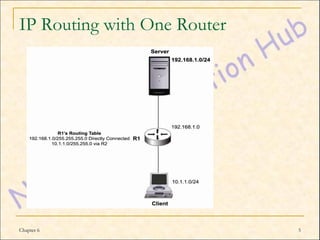
IP Routing with One Router


Chapter 6                    5
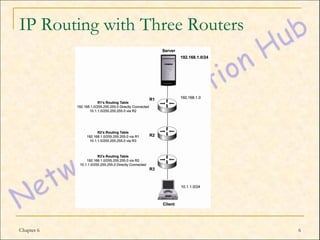
IP Routing with Three Routers


Chapter 6                       6
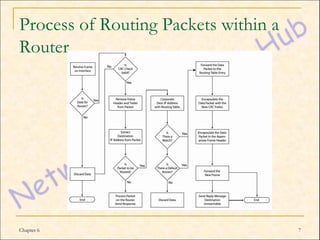
Process of Routing Packets within a
Router


Chapter 6                             7
Routing Metrics
    Routing metrics are values that allow the routers
     decide the best route for the data packet
    Different routing metrics include:
      Hops

      Bandwidth

      Load

      Cost

      Reliability


Chapter 6                                                8
Dynamic Routing
    The phenomena in which the routing protocols are
     assigned the job of finding the path to route the
     packets and update the routing tables
    Two types of dynamic routing protocols include:
      Interior routing protocols

      Exterior routing protocols


Chapter 6                                                9
Administrative Distance
    An integer assigned to every routing protocol, which
     determines the reliability of the routing protocol is
     termed as administrative distance (AD)
    The integer is in the range of 0 to 255
    Lower the AD, more reliable is the routing
     information provided by the routing protocol


Chapter 6                                                10
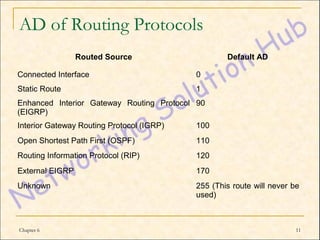
AD of Routing Protocols
                 Routed Source                     Default AD

Connected Interface                        0
Static Route                               1
Enhanced Interior Gateway Routing Protocol 90
(EIGRP)
Interior Gateway Routing Protocol (IGRP)   100
Open Shortest Path First (OSPF)            110
Routing Information Protocol (RIP)         120
External EIGRP                             170
Unknown                                    255 (This route will never be
                                           used)


Chapter 6                                                              11
Interior Routing Protocols
    The protocols used to route the packets inside an
     autonomous system, are termed as Interior Routing
     protocols
    Interior routing protocols include:
      Routing Information Protocol (RIP)

      Open Shortest Path First (OSPF)

      Interior Gateway Routing Protocol (IGRP)

      Enhanced Interior Gateway Routing Protocol

        (EIGRP)
      Intermediate System to Intermediate System (IS – IS)


Chapter 6                                                12
Exterior Routing Protocols
    The routing protocols that communicate between
     the two or more Autonomous Systems (AS) are
     termed as Exterior routing protocols
    Exterior Routing Protocols include:
      Exterior Gateway Protocols (EGP)

      Border Gateway Protocol (BGP)


Chapter 6                                             13
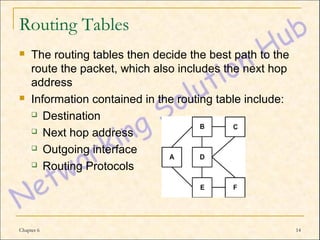
Routing Tables
    The routing tables then decide the best path to the
     route the packet, which also includes the next hop
     address
    Information contained in the routing table include:
      Destination

      Next hop address

      Outgoing interface

      Routing Protocols


Chapter 6                                                  14
Static Routing
    The phenomena of adding routes manually to the
     routing table, is termed as static routing
    This is feasible in small networks, but not in large
     networks


Chapter 6                                                   15
Routing Information Protocol (RIP)
    RIP allows routers to exchange their routing tables
     at a predefined interval
    Characteristics of RIP include:
      Uses hop count metric

      Supports 15 hop-count limit

      Supports six equal-cost paths


Chapter 6                                                  16
Distance Vector concept
    The routers connected to the neighboring networks
     update the list of networks and the hop counts in the
     routing table
    The connected routers update the routing table with
     the network information
    The routers connected to the distant networks
     construct a new routing table
    The network information of the connected routers
     combined with the new routing table entries is
     passed to all the neighboring routing tables


Chapter 6                                                17
RIP Timers
    RIP timers are used to keep a track of the various
     routes connected
    The different RIP timers include:
      Route update timer

      Route invalid timer

      Holddown timer

      Route Flush timer


Chapter 6                                                 18
Enhancements in RIPv2
    RIPv2 was created to overcome the drawbacks of
     RIPv1
    RIPv2 enhancements include:
      Multicasting

      Triggered updates

      Classless protocol

      Authentication


Chapter 6                                             19
Case Study
The Hyderabad branch of the Blue Diamond Steel
Company has 10 routers connected in the network.
Initially, the network administrator had configured the
network to use static routes to route the packets
containing the data and to communicate between the
networks. Now the company has decided employ
more than 100 employees for their operations in
Software Management, Human Resource, Detailing,
Business Development and Sales. This requires the
company to add five more networks to the existing
ones.

Chapter 6                                             20
Problem


            The network administrator has to manually add
             routes to all the networks connected and then
                             send the packets


Chapter 6                                                    21
Solution


  The network administrator decided to use RIP, which
    is a dynamic routing protocol. It can add the routes
   to the network automatically and uses hop count as
     its metric to route the packets and can be used to
                    connect small networks


Chapter 6                                                  22
Summary - I
    Routing occurs at the network layer of the OSI
     model
    Protocols are a set of rules that define data transfer
    The routing protocols can be classified based on
     their routing abilities as:
      Interior Routing Protocols

      Exterior Routing Protocols


Chapter 6                                                     23
Summary - II
    Interior Routing protocols can be classified as:
      Routing Information Protocol (RIP)

      Open Shortest Path First (OSPF)

      Interior Gateway Routing Protocol (IGRP)

      Enhanced Intermediate System to Intermediate

        System (EIGRP)
      Intermediate System to Intermediate System

    Exterior Routing protocols can be classified as:
      Exterior Gateway Protocol (EGP)

      Border Gateway Protocol (BGP)


Chapter 6                                               24
Summary - III
    Routing metrics are cost values that enable routers
     decide the best route for the data packet
    When a router forwards a data packet to a network
     segment, it is counted as a single hop
    Bandwidth measures the amount of data that can
     travel over the network segment in a fixed amount of
     time
    Delay specifies the amount of time that a router takes
     to process and transfer a data packet to the next
     device on the network
    The delay is represented with a µ symbol
Chapter 6                                                     25
Summary - IV
    Load refers to the amount of traffic on a particular link
     relative to the total capacity of the link
    The load value 255 indicates 100% traffic congestion
    Direct interfaces consist of routes that are local to the
     router
    Routed protocols consist of protocols that define
     routing and addressing
    Routing protocols are a set of rules that are
     implemented on a router to determine the best path to
     route the packets


Chapter 6                                                    26
Summary - V
    Routing protocols can be classified into Interior
     Routing Protocols and Exterior Routing Protocols
    Every router has a routing table based on which the
     data packets are forwarded to the destinations
    Static routes are the routes that the administrator
     manually enters in the routing table
    Static routes are used in temporary connections
     such as dial-up networks
    The router automatically collects and stores
     dynamic routes in the routing table

Chapter 6                                                  27
Summary - VI
    Enhancements in RIPv2 include:
      Supports multicast updates against broadcast

       updates
      Uses triggered updates to share its routing

       information with the neighbors, when a change
       occurs
      Supports Variable-Length Subnet Masking

       (VSLM)
      Allows you to select the routers you want to

       participate in RIPv2

Chapter 6                                              28

IP Routing

  • 1.
  • 2.
    Chapter Objectives  Explain Protocols  Explain Routing Metrics  Discuss Routing Mechanisms  Explain Routing Algorithms  Set up routing Chapter 6 2
  • 3.
    Recall  The router configuration files are located in:  RAM  NVRAM  TFTP Server  Protocol that gives the information about locally attached and remote devices in the network is termed as Cisco Discovery Protocol (CDP)  CDP global parameters include:  CDP timer  CDP holdtime Chapter 6 3
  • 4.
    Goals of Routing  Routing process ensures that appropriate packets are routed from the source to the destination  Goals of routing include:  Stability  Provides with a robust network  Dynamic update of the network paths  Information is safe while transmitting Chapter 6 4
  • 5.
    IP Routing withOne Router Chapter 6 5
  • 6.
    IP Routing withThree Routers Chapter 6 6
  • 7.
    Process of RoutingPackets within a Router Chapter 6 7
  • 8.
    Routing Metrics  Routing metrics are values that allow the routers decide the best route for the data packet  Different routing metrics include:  Hops  Bandwidth  Load  Cost  Reliability Chapter 6 8
  • 9.
    Dynamic Routing  The phenomena in which the routing protocols are assigned the job of finding the path to route the packets and update the routing tables  Two types of dynamic routing protocols include:  Interior routing protocols  Exterior routing protocols Chapter 6 9
  • 10.
    Administrative Distance  An integer assigned to every routing protocol, which determines the reliability of the routing protocol is termed as administrative distance (AD)  The integer is in the range of 0 to 255  Lower the AD, more reliable is the routing information provided by the routing protocol Chapter 6 10
  • 11.
    AD of RoutingProtocols Routed Source Default AD Connected Interface 0 Static Route 1 Enhanced Interior Gateway Routing Protocol 90 (EIGRP) Interior Gateway Routing Protocol (IGRP) 100 Open Shortest Path First (OSPF) 110 Routing Information Protocol (RIP) 120 External EIGRP 170 Unknown 255 (This route will never be used) Chapter 6 11
  • 12.
    Interior Routing Protocols  The protocols used to route the packets inside an autonomous system, are termed as Interior Routing protocols  Interior routing protocols include:  Routing Information Protocol (RIP)  Open Shortest Path First (OSPF)  Interior Gateway Routing Protocol (IGRP)  Enhanced Interior Gateway Routing Protocol (EIGRP)  Intermediate System to Intermediate System (IS – IS) Chapter 6 12
  • 13.
    Exterior Routing Protocols  The routing protocols that communicate between the two or more Autonomous Systems (AS) are termed as Exterior routing protocols  Exterior Routing Protocols include:  Exterior Gateway Protocols (EGP)  Border Gateway Protocol (BGP) Chapter 6 13
  • 14.
    Routing Tables  The routing tables then decide the best path to the route the packet, which also includes the next hop address  Information contained in the routing table include:  Destination  Next hop address  Outgoing interface  Routing Protocols Chapter 6 14
  • 15.
    Static Routing  The phenomena of adding routes manually to the routing table, is termed as static routing  This is feasible in small networks, but not in large networks Chapter 6 15
  • 16.
    Routing Information Protocol(RIP)  RIP allows routers to exchange their routing tables at a predefined interval  Characteristics of RIP include:  Uses hop count metric  Supports 15 hop-count limit  Supports six equal-cost paths Chapter 6 16
  • 17.
    Distance Vector concept  The routers connected to the neighboring networks update the list of networks and the hop counts in the routing table  The connected routers update the routing table with the network information  The routers connected to the distant networks construct a new routing table  The network information of the connected routers combined with the new routing table entries is passed to all the neighboring routing tables Chapter 6 17
  • 18.
    RIP Timers  RIP timers are used to keep a track of the various routes connected  The different RIP timers include:  Route update timer  Route invalid timer  Holddown timer  Route Flush timer Chapter 6 18
  • 19.
    Enhancements in RIPv2  RIPv2 was created to overcome the drawbacks of RIPv1  RIPv2 enhancements include:  Multicasting  Triggered updates  Classless protocol  Authentication Chapter 6 19
  • 20.
    Case Study The Hyderabadbranch of the Blue Diamond Steel Company has 10 routers connected in the network. Initially, the network administrator had configured the network to use static routes to route the packets containing the data and to communicate between the networks. Now the company has decided employ more than 100 employees for their operations in Software Management, Human Resource, Detailing, Business Development and Sales. This requires the company to add five more networks to the existing ones. Chapter 6 20
  • 21.
    Problem The network administrator has to manually add routes to all the networks connected and then send the packets Chapter 6 21
  • 22.
    Solution Thenetwork administrator decided to use RIP, which is a dynamic routing protocol. It can add the routes to the network automatically and uses hop count as its metric to route the packets and can be used to connect small networks Chapter 6 22
  • 23.
    Summary - I  Routing occurs at the network layer of the OSI model  Protocols are a set of rules that define data transfer  The routing protocols can be classified based on their routing abilities as:  Interior Routing Protocols  Exterior Routing Protocols Chapter 6 23
  • 24.
    Summary - II  Interior Routing protocols can be classified as:  Routing Information Protocol (RIP)  Open Shortest Path First (OSPF)  Interior Gateway Routing Protocol (IGRP)  Enhanced Intermediate System to Intermediate System (EIGRP)  Intermediate System to Intermediate System  Exterior Routing protocols can be classified as:  Exterior Gateway Protocol (EGP)  Border Gateway Protocol (BGP) Chapter 6 24
  • 25.
    Summary - III  Routing metrics are cost values that enable routers decide the best route for the data packet  When a router forwards a data packet to a network segment, it is counted as a single hop  Bandwidth measures the amount of data that can travel over the network segment in a fixed amount of time  Delay specifies the amount of time that a router takes to process and transfer a data packet to the next device on the network  The delay is represented with a µ symbol Chapter 6 25
  • 26.
    Summary - IV  Load refers to the amount of traffic on a particular link relative to the total capacity of the link  The load value 255 indicates 100% traffic congestion  Direct interfaces consist of routes that are local to the router  Routed protocols consist of protocols that define routing and addressing  Routing protocols are a set of rules that are implemented on a router to determine the best path to route the packets Chapter 6 26
  • 27.
    Summary - V  Routing protocols can be classified into Interior Routing Protocols and Exterior Routing Protocols  Every router has a routing table based on which the data packets are forwarded to the destinations  Static routes are the routes that the administrator manually enters in the routing table  Static routes are used in temporary connections such as dial-up networks  The router automatically collects and stores dynamic routes in the routing table Chapter 6 27
  • 28.
    Summary - VI  Enhancements in RIPv2 include:  Supports multicast updates against broadcast updates  Uses triggered updates to share its routing information with the neighbors, when a change occurs  Supports Variable-Length Subnet Masking (VSLM)  Allows you to select the routers you want to participate in RIPv2 Chapter 6 28