IPv6


Chapter 16
Chapter Objectives

    Explain the benefits and uses of IPv6
    Explain global unicast addressing, routing and subnetting
    Explain IPv6 Protocols and Addressing
    Configure IPv6 Routing and Routing Protocols
    Explain the IPv6 transition options


Chapter 1                                                    2
Recall
    DH-1 has the key length of 768 bits. Similarly, DH2 and
     DH5 have 1024 bits and 1536 bits respectively.
    Message integrity is a process in which a receiving VPN
     device verifies that the data packet is not changed while
     transmission.
    Authentication is a process in which a receiving VPN
     device verifies that the received packet is sent by an
     authorized VPN device.
    VPN can be configured by using the hostname, local
     name or L2TP tunnel password.


Chapter 1                                                        3
Benefits and uses of IPv6 - I
   Supports the features of the security protocol such as
    IPSec to provide secure communication over the
    Internet.
   Provides a way to change addresses that are assigned
    to the hosts for maintaining address assignment within a
    site.


Chapter 1                                                      4
Benefits and uses of IPv6 - II
   Provides globally unicast addressing removes the need
    for NAT/PAT
   IPv6 address assignment allows easier renumbering,
    dynamic allocation and recovery of addresses.
   IPv6 routers do not recalculate a header checksum for
    every packet, reducing overhead per packet.


Chapter 1                                                   5
Global Route Aggregation for
Efficient Routing
    The strategies for IPv6 address assignment are as
     follows:
      Public IPv6 addresses are grouped by major

        geographical area.
      Address space is further sub-divided by ISP inside

        each area.
      Address space inside each ISP in an area is further

        sub-divided for each customer.


Chapter 1                                                    6
Using DHCP for IPv6
   IPv6 hosts use the DHCP protocol, to get the IP
    address, default router IP address, prefix length (mask)
    and the DNS IP address.
   Using DHCP, the host sends the IPv6 packet for
    searching DHCP server.
   The DHCPv4 server is used for IPv4 hosts. The
    DHCPv4 holds information about the client, such as the
    IP leased IP and the time period validity.


Chapter 1                                                      7
Operational modes of DHCPv6 server
    The following are the two operational modes of DHCPv6
     server:
      Stateful mode - In this mode the DHCPv6 server is

       same as DHCPv4 server. It helps in tracking the
       status of the client.
      Stateless mode - In this mode the server does not

       track the status information.


Chapter 1                                                    8
Stateless Auto configuration and
Router Advertisements - I
   The stateless auto configuration, allows the host to
    calculate the IP address according to the prefix length
    used on the subnet.
   It calculates the address using EUI-64 interface ID based
    on its MAC address embedded into Network Interface
    Card (NIC).
   The stateless auto configuration uses the NDP (Neighbor
    Discovery Protocol) to discover the prefix length used on
    LAN.


Chapter 1                                                       9
Stateless Auto configuration and
    Router Advertisements II
     It uses the following two NDP messages to discover the
      IPv6 prefix used on LAN:
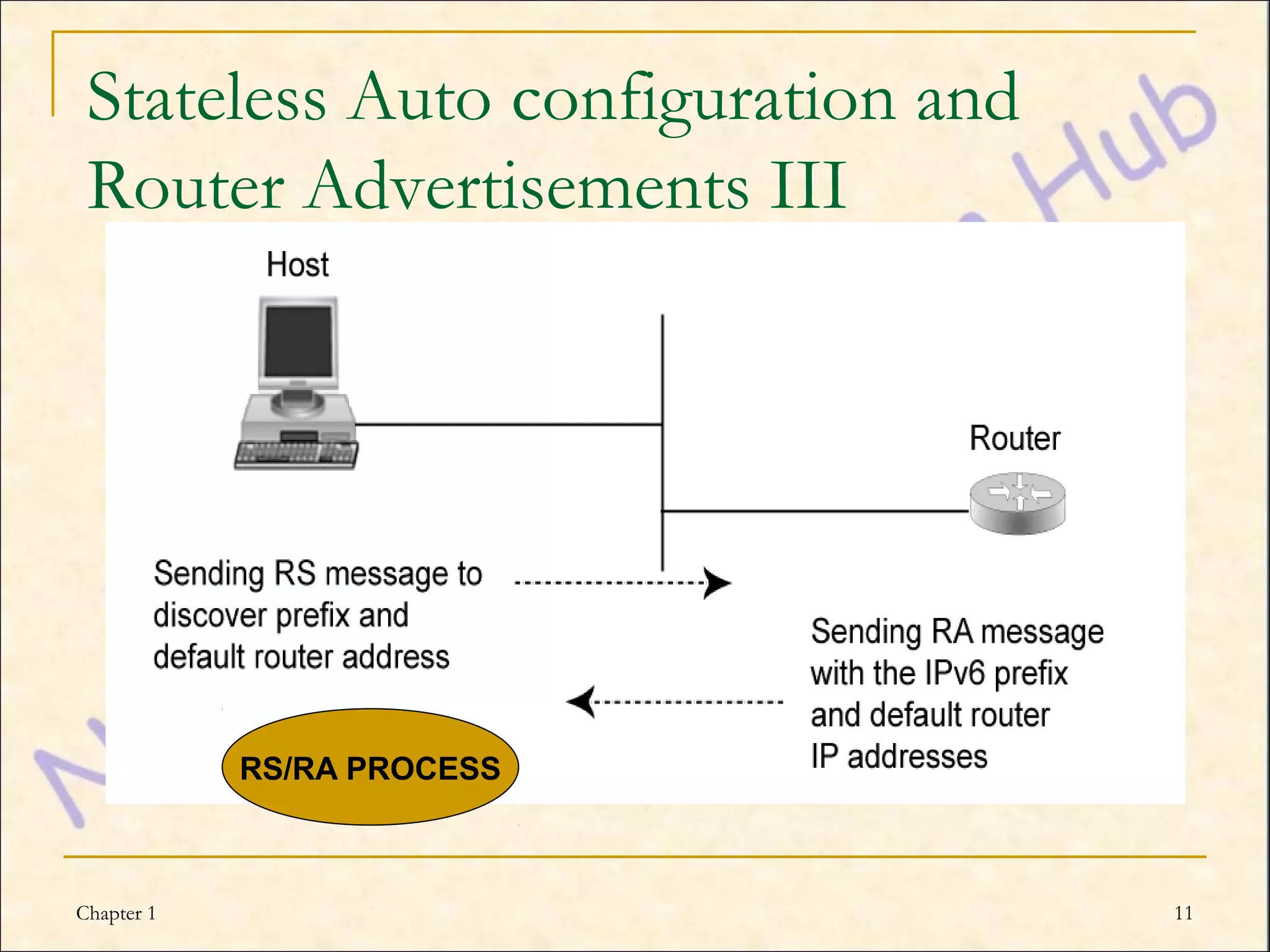
       Router Solicitation (RS) - The host sends an RS
         multicast message to all the routers to identify the IPv6
         prefix used on the subnet.
       Router Advertisement (RA) - The reply message of the
         router is in the form of an RA message.


    Chapter 1                                                        10
Stateless Auto configuration and
 Router Advertisements III


             RS/RA Process
            RS/RA PROCESS


Chapter 1                           11
IPv6 Addresses
    Types of IPv6 addresses:
      Unicast - Assigns IP addresses to a single interface

       that allows one host to send and receive data.
      Multicast - Represents IP addresses for a dynamic

       group of hosts that send packets to all members of
       that group.
      Anycast - They can be used by the server or routers

       having same functionality for receiving the packets
       from the client. The packets will be sent to the closest
       in routing terms. This kind of addressing balances the
       load between different servers.


Chapter 1                                                         12
IPv6 Transition Options - I
    IPv6 resolves the issues of shortage of IP addresses
     and larger routing table. A large number of devices
     use IPv4, this the reason why few devices and their
     software's do not support IPv6.


Chapter 1                                               13
IPv6 Transition Options - II
     The approaches are developed to migrate from IPv4 to
      IPv6 are as follows:
       IPv6 Dual Stacks - IPv4 and IPv6 together can be used

        by the host or router at the same time. This is known
        as Dual stacks.
       Tunneling - Tunneling is used for migrating from IPv4

        to IPv6. This function takes the IPv6 packet sent by
        host, encapsulate it in IPv4 packet and forwards it over
        the Internet. After the IPv4 header is removed the IPv6
        packet is revealed.


Chapter 1                                                     14
Summary - I
    IPv6 is an Internet protocol that supports much larger
     addresses space than IPv4.
    Global unicast addresses are public and globally unique
     IPv6 addresses that allow the hosts to communicate
     over Internet.
    IPv6 is represented by 32 hexadecimal numbers
     organized into 8 blocks, each block containing 4
     hexadecimal (hex) digits separated by a colon.


Chapter 1                                                      15
Summary - II
    You can abbreviate the IPv6 address using the following
     rules:
      Neglecting the leading 0's in every block

      Putting (::) in place of continuous hex 0s

    IPv6 addressing supports classless addressing. It uses
     prefixes to represent a range of consecutive IPv6
     addresses.
    DHCP servers are used in two operational modes:
      Stateful

      Stateless


Chapter 1                                                  16
Summary - III
    In stateful DHCPv6, IPv6 hosts use Dynamic Host
     configuration (DHCP) protocol, to get the IP address,
     default router IP address, prefix length (mass) and the
     DNS IP address.
    IPv6 use the following routing protocols:
      RIPng

      OSPFv3

      MP-BGP4

      EIGRP for IPv6


Chapter 1                                                      17
Summary - IV
    Two approaches are that can be used to migrate from
     IPv4 to IPv6 are:
      IPv6 Dual Stacks

      Tunneling

    Some IPv6-to-IPv4 tunnels that can be used for
     transition are given as follows:
      Manually Configured Tunnel (MCT)

      Dynamic 6to4 tunnels

      Intra-site automatic tunneling addressing protocol

        (ISATAP)
      Teredo tunneling


Chapter 1                                                   18

IPv6

  • 1.
  • 2.
    Chapter Objectives  Explain the benefits and uses of IPv6  Explain global unicast addressing, routing and subnetting  Explain IPv6 Protocols and Addressing  Configure IPv6 Routing and Routing Protocols  Explain the IPv6 transition options Chapter 1 2
  • 3.
    Recall  DH-1 has the key length of 768 bits. Similarly, DH2 and DH5 have 1024 bits and 1536 bits respectively.  Message integrity is a process in which a receiving VPN device verifies that the data packet is not changed while transmission.  Authentication is a process in which a receiving VPN device verifies that the received packet is sent by an authorized VPN device.  VPN can be configured by using the hostname, local name or L2TP tunnel password. Chapter 1 3
  • 4.
    Benefits and usesof IPv6 - I  Supports the features of the security protocol such as IPSec to provide secure communication over the Internet.  Provides a way to change addresses that are assigned to the hosts for maintaining address assignment within a site. Chapter 1 4
  • 5.
    Benefits and usesof IPv6 - II  Provides globally unicast addressing removes the need for NAT/PAT  IPv6 address assignment allows easier renumbering, dynamic allocation and recovery of addresses.  IPv6 routers do not recalculate a header checksum for every packet, reducing overhead per packet. Chapter 1 5
  • 6.
    Global Route Aggregationfor Efficient Routing  The strategies for IPv6 address assignment are as follows:  Public IPv6 addresses are grouped by major geographical area.  Address space is further sub-divided by ISP inside each area.  Address space inside each ISP in an area is further sub-divided for each customer. Chapter 1 6
  • 7.
    Using DHCP forIPv6  IPv6 hosts use the DHCP protocol, to get the IP address, default router IP address, prefix length (mask) and the DNS IP address.  Using DHCP, the host sends the IPv6 packet for searching DHCP server.  The DHCPv4 server is used for IPv4 hosts. The DHCPv4 holds information about the client, such as the IP leased IP and the time period validity. Chapter 1 7
  • 8.
    Operational modes ofDHCPv6 server  The following are the two operational modes of DHCPv6 server:  Stateful mode - In this mode the DHCPv6 server is same as DHCPv4 server. It helps in tracking the status of the client.  Stateless mode - In this mode the server does not track the status information. Chapter 1 8
  • 9.
    Stateless Auto configurationand Router Advertisements - I  The stateless auto configuration, allows the host to calculate the IP address according to the prefix length used on the subnet.  It calculates the address using EUI-64 interface ID based on its MAC address embedded into Network Interface Card (NIC).  The stateless auto configuration uses the NDP (Neighbor Discovery Protocol) to discover the prefix length used on LAN. Chapter 1 9
  • 10.
    Stateless Auto configurationand Router Advertisements II  It uses the following two NDP messages to discover the IPv6 prefix used on LAN:  Router Solicitation (RS) - The host sends an RS multicast message to all the routers to identify the IPv6 prefix used on the subnet.  Router Advertisement (RA) - The reply message of the router is in the form of an RA message. Chapter 1 10
  • 11.
    Stateless Auto configurationand Router Advertisements III RS/RA Process RS/RA PROCESS Chapter 1 11
  • 12.
    IPv6 Addresses  Types of IPv6 addresses:  Unicast - Assigns IP addresses to a single interface that allows one host to send and receive data.  Multicast - Represents IP addresses for a dynamic group of hosts that send packets to all members of that group.  Anycast - They can be used by the server or routers having same functionality for receiving the packets from the client. The packets will be sent to the closest in routing terms. This kind of addressing balances the load between different servers. Chapter 1 12
  • 13.
    IPv6 Transition Options- I  IPv6 resolves the issues of shortage of IP addresses and larger routing table. A large number of devices use IPv4, this the reason why few devices and their software's do not support IPv6. Chapter 1 13
  • 14.
    IPv6 Transition Options- II  The approaches are developed to migrate from IPv4 to IPv6 are as follows:  IPv6 Dual Stacks - IPv4 and IPv6 together can be used by the host or router at the same time. This is known as Dual stacks.  Tunneling - Tunneling is used for migrating from IPv4 to IPv6. This function takes the IPv6 packet sent by host, encapsulate it in IPv4 packet and forwards it over the Internet. After the IPv4 header is removed the IPv6 packet is revealed. Chapter 1 14
  • 15.
    Summary - I  IPv6 is an Internet protocol that supports much larger addresses space than IPv4.  Global unicast addresses are public and globally unique IPv6 addresses that allow the hosts to communicate over Internet.  IPv6 is represented by 32 hexadecimal numbers organized into 8 blocks, each block containing 4 hexadecimal (hex) digits separated by a colon. Chapter 1 15
  • 16.
    Summary - II  You can abbreviate the IPv6 address using the following rules:  Neglecting the leading 0's in every block  Putting (::) in place of continuous hex 0s  IPv6 addressing supports classless addressing. It uses prefixes to represent a range of consecutive IPv6 addresses.  DHCP servers are used in two operational modes:  Stateful  Stateless Chapter 1 16
  • 17.
    Summary - III  In stateful DHCPv6, IPv6 hosts use Dynamic Host configuration (DHCP) protocol, to get the IP address, default router IP address, prefix length (mass) and the DNS IP address.  IPv6 use the following routing protocols:  RIPng  OSPFv3  MP-BGP4  EIGRP for IPv6 Chapter 1 17
  • 18.
    Summary - IV  Two approaches are that can be used to migrate from IPv4 to IPv6 are:  IPv6 Dual Stacks  Tunneling  Some IPv6-to-IPv4 tunnels that can be used for transition are given as follows:  Manually Configured Tunnel (MCT)  Dynamic 6to4 tunnels  Intra-site automatic tunneling addressing protocol (ISATAP)  Teredo tunneling Chapter 1 18