Course Title
Computer Networks
Topic
Network Topology
Submitted By
Name: Joty Akhter
ID: 1834902551
Network Topology
A network topology refers to the way in which nodes in a network are connected to
one another. The network structure defines how they communicate.
Types of Networking Topologies
Two main type of networking topologies are
1) Physical topology
2) Logical topology
1. Physical –
The physical network topology refers to the actual connections (wires,
cables, etc.) of how the network is arranged.
2. Logical –
The logical network topology is an idea of how the network is set up,
including which nodes connect to each other and in which ways, as well as
how data is transmitted through the network.
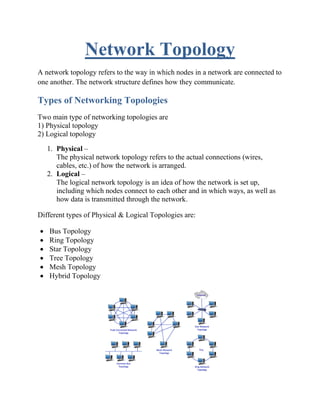
Different types of Physical & Logical Topologies are:
• Bus Topology
• Ring Topology
• Star Topology
• Tree Topology
• Mesh Topology
• Hybrid Topology
BUS Topology
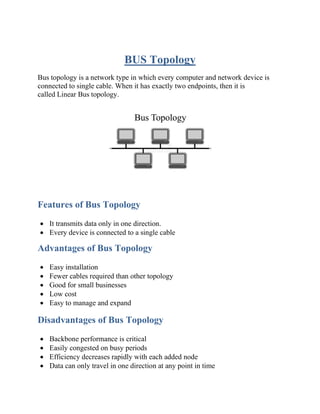
Bus topology is a network type in which every computer and network device is
connected to single cable. When it has exactly two endpoints, then it is
called Linear Bus topology.
Features of Bus Topology
• It transmits data only in one direction.
• Every device is connected to a single cable
Advantages of Bus Topology
• Easy installation
• Fewer cables required than other topology
• Good for small businesses
• Low cost
• Easy to manage and expand
Disadvantages of Bus Topology
• Backbone performance is critical
• Easily congested on busy periods
• Efficiency decreases rapidly with each added node
• Data can only travel in one direction at any point in time
RING Topology
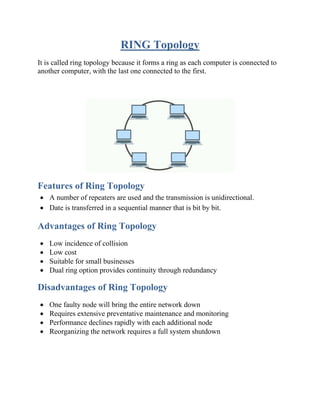
It is called ring topology because it forms a ring as each computer is connected to
another computer, with the last one connected to the first.
Features of Ring Topology
• A number of repeaters are used and the transmission is unidirectional.
• Date is transferred in a sequential manner that is bit by bit.
Advantages of Ring Topology
• Low incidence of collision
• Low cost
• Suitable for small businesses
• Dual ring option provides continuity through redundancy
Disadvantages of Ring Topology
• One faulty node will bring the entire network down
• Requires extensive preventative maintenance and monitoring
• Performance declines rapidly with each additional node
• Reorganizing the network requires a full system shutdown
STAR Topology
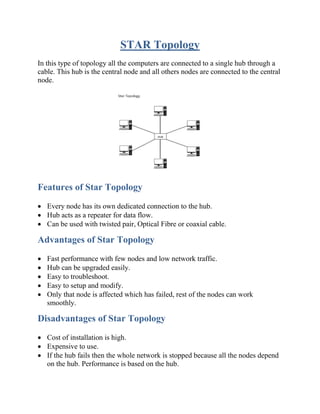
In this type of topology all the computers are connected to a single hub through a
cable. This hub is the central node and all others nodes are connected to the central
node.
Features of Star Topology
• Every node has its own dedicated connection to the hub.
• Hub acts as a repeater for data flow.
• Can be used with twisted pair, Optical Fibre or coaxial cable.
Advantages of Star Topology
• Fast performance with few nodes and low network traffic.
• Hub can be upgraded easily.
• Easy to troubleshoot.
• Easy to setup and modify.
• Only that node is affected which has failed, rest of the nodes can work
smoothly.
Disadvantages of Star Topology
• Cost of installation is high.
• Expensive to use.
• If the hub fails then the whole network is stopped because all the nodes depend
on the hub. Performance is based on the hub.
MESH Topology
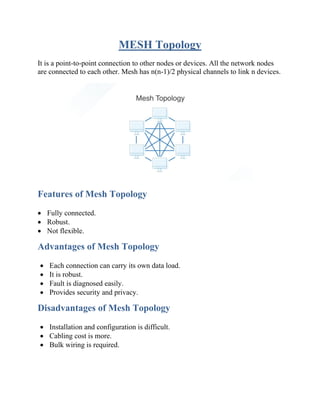
It is a point-to-point connection to other nodes or devices. All the network nodes
are connected to each other. Mesh has n(n-1)/2 physical channels to link n devices.
Features of Mesh Topology
• Fully connected.
• Robust.
• Not flexible.
Advantages of Mesh Topology
• Each connection can carry its own data load.
• It is robust.
• Fault is diagnosed easily.
• Provides security and privacy.
Disadvantages of Mesh Topology
• Installation and configuration is difficult.
• Cabling cost is more.
• Bulk wiring is required.
TREE Topology
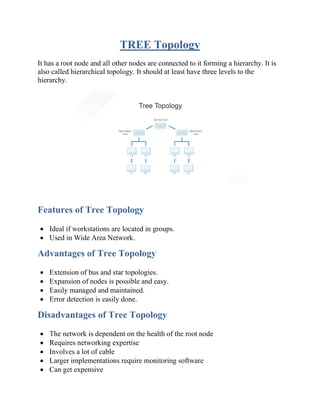
It has a root node and all other nodes are connected to it forming a hierarchy. It is
also called hierarchical topology. It should at least have three levels to the
hierarchy.
Features of Tree Topology
• Ideal if workstations are located in groups.
• Used in Wide Area Network.
Advantages of Tree Topology
• Extension of bus and star topologies.
• Expansion of nodes is possible and easy.
• Easily managed and maintained.
• Error detection is easily done.
Disadvantages of Tree Topology
• The network is dependent on the health of the root node
• Requires networking expertise
• Involves a lot of cable
• Larger implementations require monitoring software
• Can get expensive
HYBRID Topology
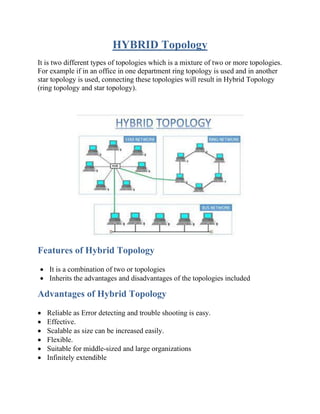
It is two different types of topologies which is a mixture of two or more topologies.
For example if in an office in one department ring topology is used and in another
star topology is used, connecting these topologies will result in Hybrid Topology
(ring topology and star topology).
Features of Hybrid Topology
• It is a combination of two or topologies
• Inherits the advantages and disadvantages of the topologies included
Advantages of Hybrid Topology
• Reliable as Error detecting and trouble shooting is easy.
• Effective.
• Scalable as size can be increased easily.
• Flexible.
• Suitable for middle-sized and large organizations
• Infinitely extendible
Disadvantages of Hybrid Topology
• Complex in design.
• Needs monitoring software
• Requires professional management
• Equipment costs are high
Here are the main factors when choosing which topology to use. Before choosing a
topology we need to closely consider the following:
• No of cable
• No of ports
• Length of cable needed
• Cable type
• Cost
• Reliability
• Security

Network topology

  • 1.
    Course Title Computer Networks Topic NetworkTopology Submitted By Name: Joty Akhter ID: 1834902551
  • 2.
    Network Topology A networktopology refers to the way in which nodes in a network are connected to one another. The network structure defines how they communicate. Types of Networking Topologies Two main type of networking topologies are 1) Physical topology 2) Logical topology 1. Physical – The physical network topology refers to the actual connections (wires, cables, etc.) of how the network is arranged. 2. Logical – The logical network topology is an idea of how the network is set up, including which nodes connect to each other and in which ways, as well as how data is transmitted through the network. Different types of Physical & Logical Topologies are: • Bus Topology • Ring Topology • Star Topology • Tree Topology • Mesh Topology • Hybrid Topology
  • 3.
    BUS Topology Bus topologyis a network type in which every computer and network device is connected to single cable. When it has exactly two endpoints, then it is called Linear Bus topology. Features of Bus Topology • It transmits data only in one direction. • Every device is connected to a single cable Advantages of Bus Topology • Easy installation • Fewer cables required than other topology • Good for small businesses • Low cost • Easy to manage and expand Disadvantages of Bus Topology • Backbone performance is critical • Easily congested on busy periods • Efficiency decreases rapidly with each added node • Data can only travel in one direction at any point in time
  • 4.
    RING Topology It iscalled ring topology because it forms a ring as each computer is connected to another computer, with the last one connected to the first. Features of Ring Topology • A number of repeaters are used and the transmission is unidirectional. • Date is transferred in a sequential manner that is bit by bit. Advantages of Ring Topology • Low incidence of collision • Low cost • Suitable for small businesses • Dual ring option provides continuity through redundancy Disadvantages of Ring Topology • One faulty node will bring the entire network down • Requires extensive preventative maintenance and monitoring • Performance declines rapidly with each additional node • Reorganizing the network requires a full system shutdown
  • 5.
    STAR Topology In thistype of topology all the computers are connected to a single hub through a cable. This hub is the central node and all others nodes are connected to the central node. Features of Star Topology • Every node has its own dedicated connection to the hub. • Hub acts as a repeater for data flow. • Can be used with twisted pair, Optical Fibre or coaxial cable. Advantages of Star Topology • Fast performance with few nodes and low network traffic. • Hub can be upgraded easily. • Easy to troubleshoot. • Easy to setup and modify. • Only that node is affected which has failed, rest of the nodes can work smoothly. Disadvantages of Star Topology • Cost of installation is high. • Expensive to use. • If the hub fails then the whole network is stopped because all the nodes depend on the hub. Performance is based on the hub.
  • 6.
    MESH Topology It isa point-to-point connection to other nodes or devices. All the network nodes are connected to each other. Mesh has n(n-1)/2 physical channels to link n devices. Features of Mesh Topology • Fully connected. • Robust. • Not flexible. Advantages of Mesh Topology • Each connection can carry its own data load. • It is robust. • Fault is diagnosed easily. • Provides security and privacy. Disadvantages of Mesh Topology • Installation and configuration is difficult. • Cabling cost is more. • Bulk wiring is required.
  • 7.
    TREE Topology It hasa root node and all other nodes are connected to it forming a hierarchy. It is also called hierarchical topology. It should at least have three levels to the hierarchy. Features of Tree Topology • Ideal if workstations are located in groups. • Used in Wide Area Network. Advantages of Tree Topology • Extension of bus and star topologies. • Expansion of nodes is possible and easy. • Easily managed and maintained. • Error detection is easily done. Disadvantages of Tree Topology • The network is dependent on the health of the root node • Requires networking expertise • Involves a lot of cable • Larger implementations require monitoring software • Can get expensive
  • 8.
    HYBRID Topology It istwo different types of topologies which is a mixture of two or more topologies. For example if in an office in one department ring topology is used and in another star topology is used, connecting these topologies will result in Hybrid Topology (ring topology and star topology). Features of Hybrid Topology • It is a combination of two or topologies • Inherits the advantages and disadvantages of the topologies included Advantages of Hybrid Topology • Reliable as Error detecting and trouble shooting is easy. • Effective. • Scalable as size can be increased easily. • Flexible. • Suitable for middle-sized and large organizations • Infinitely extendible
  • 9.
    Disadvantages of HybridTopology • Complex in design. • Needs monitoring software • Requires professional management • Equipment costs are high Here are the main factors when choosing which topology to use. Before choosing a topology we need to closely consider the following: • No of cable • No of ports • Length of cable needed • Cable type • Cost • Reliability • Security