Plant physiology
Shantal Al Habib
IB Bio
Mrs. Mariam Ohanyan
18 October 2016
Plants’ Tissue Structure
Xylem Structure
● Elongated lignin tubes
● Arranged end-to-end
● Non-living cells
● Rigid structures which
withstands low pressure
● Pressure lower than
atmospheric
● One way movement Source: Britannica.com
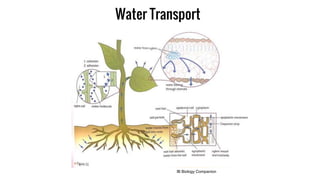
Water Transport
IB Biology Companion
Phloem Structure
● Sieve tube cells
● With sieve plates
● Companion cells (numerous
mitochondria)
● 2-way movement
● Reduced cytoplasm
● No nucleus
Source: Britannica.com
Phloem Loading
Apoplast route
Through cell walls (mesophyll cells to
companion or sieve cells)
Active transport:
H+ ions transported out of companion cells
=> sucrose concentration
gradient
Co-transport protein:
H+ flow down the gradient
=> energy is released
=> used to carry sucrose into the
Symplast route
Through connections called plasmodesmata in
the cytoplasm
Sucrose -> oligosaccharide in companion cells
Build up of carbohydrate
=> water enters companion cells by osmosis
Pressure build up:
=> water moves from high to low
After sucrose is withdrawn at the sink, amount
of solute decreases
=> decrease in osmotic pressure -> water
drawn back into transpiration stream
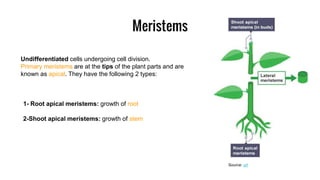
Meristems
Undifferentiated cells undergoing cell division.
Primary meristems are at the tips of the plant parts and are
known as apical. They have the following 2 types:
1- Root apical meristems: growth of root
2-Shoot apical meristems: growth of stem
Source: url
Auxins
Hormones that:
❏Control and initiate growth
❏Influence and regulate leaf and fruit development
❏Inhibit the growth of auxillary buds
Cytokinins
Produced in the root
❏ Promotes auxillary bud growth
Ratio determines
whether the bud
will develop or not
Tropisms
Directional growth response
1.Absorption of light by
phototropins
2.Bind to receptors (PIN 3)
3.Light intensity detection
4.Auxin is transported to the
shady part
5.Growth is in a curve towards
light
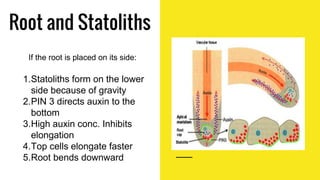
Root and Statoliths
If the root is placed on its side:
1.Statoliths form on the lower
side because of gravity
2.PIN 3 directs auxin to the
bottom
3.High auxin conc. Inhibits
elongation
4.Top cells elongate faster
5.Root bends downward
Puberty in plants?
Vegetative -> reproductive
phase
When meristems produce flowers rather than leaves
=> allow sexual reproduction
PR
PFR
660 nm
Rapid
730 nm
Slow
Length of dark period:
Phytochrome
Transcription of Flowering time (FT)
FT mRNA => translated to FT protein
Binds to transcription factor => activation of flowering genes
Sexual reproduction
Source:
THANK YOU FOR YOUR
ATTENTION!

Topic 9 plant physiology

  • 1.
    Plant physiology Shantal AlHabib IB Bio Mrs. Mariam Ohanyan 18 October 2016
  • 2.
  • 5.
    Xylem Structure ● Elongatedlignin tubes ● Arranged end-to-end ● Non-living cells ● Rigid structures which withstands low pressure ● Pressure lower than atmospheric ● One way movement Source: Britannica.com
  • 6.
  • 7.
    Phloem Structure ● Sievetube cells ● With sieve plates ● Companion cells (numerous mitochondria) ● 2-way movement ● Reduced cytoplasm ● No nucleus Source: Britannica.com
  • 8.
    Phloem Loading Apoplast route Throughcell walls (mesophyll cells to companion or sieve cells) Active transport: H+ ions transported out of companion cells => sucrose concentration gradient Co-transport protein: H+ flow down the gradient => energy is released => used to carry sucrose into the Symplast route Through connections called plasmodesmata in the cytoplasm Sucrose -> oligosaccharide in companion cells Build up of carbohydrate => water enters companion cells by osmosis Pressure build up: => water moves from high to low After sucrose is withdrawn at the sink, amount of solute decreases => decrease in osmotic pressure -> water drawn back into transpiration stream
  • 9.
    Meristems Undifferentiated cells undergoingcell division. Primary meristems are at the tips of the plant parts and are known as apical. They have the following 2 types: 1- Root apical meristems: growth of root 2-Shoot apical meristems: growth of stem Source: url
  • 10.
    Auxins Hormones that: ❏Control andinitiate growth ❏Influence and regulate leaf and fruit development ❏Inhibit the growth of auxillary buds Cytokinins Produced in the root ❏ Promotes auxillary bud growth Ratio determines whether the bud will develop or not
  • 11.
    Tropisms Directional growth response 1.Absorptionof light by phototropins 2.Bind to receptors (PIN 3) 3.Light intensity detection 4.Auxin is transported to the shady part 5.Growth is in a curve towards light
  • 12.
    Root and Statoliths Ifthe root is placed on its side: 1.Statoliths form on the lower side because of gravity 2.PIN 3 directs auxin to the bottom 3.High auxin conc. Inhibits elongation 4.Top cells elongate faster 5.Root bends downward
  • 13.
    Puberty in plants? Vegetative-> reproductive phase When meristems produce flowers rather than leaves => allow sexual reproduction
  • 14.
    PR PFR 660 nm Rapid 730 nm Slow Lengthof dark period: Phytochrome Transcription of Flowering time (FT) FT mRNA => translated to FT protein Binds to transcription factor => activation of flowering genes
  • 17.
  • 18.
    THANK YOU FORYOUR ATTENTION!