LATENT LIFE-DORMANCY
 PRESENTED BY :
• CHAUHAN IRSHADKHAN .N.
• M.SC.BOTANY SEM-3
• PAPER - CBO – 501
• DEPARTMENT OF LIFE
SCIENCE H.N.G.U . , PATAN .
CONTENTS
Introduction
Classification of dormancy
Types of seed dormancy
Causes of seed dormancy
Overcoming of seed dormancy
INTRODUCTION
The growth of a seed is completely arrested after it
is fully developed.
In some cases the growth is suspended because of
the lack of favourable conditions in the
environment.
Such seeds will germinate if they are supplied with
water and suitable temperature.
In many other cases, however, the seeds would not
germinate, even if they are provided with water
etc.
This failure of seeds to germinate even under
favourable conditions is termed dormancy.
In such cases, the completely dry ripe seed is
physiologically inactive and is said to be in a resting
stage.
The seed is called dormant and the phenomenon is
termed dormancy.
Dormancy incidentally helps in overcoming
unfavorable conditions.
In majority of the cases, true dormancy helps the
seed to survive through an unfavorable season e.g.,
a very cold winter or a very hot summer.
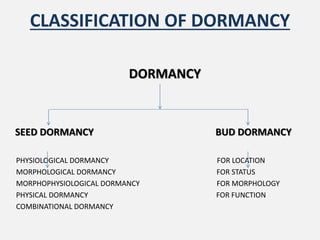
CLASSIFICATION OF DORMANCY
DORMANCY
SEED DORMANCY BUD DORMANCY
PHYSIOLOGICAL DORMANCY FOR LOCATION
MORPHOLOGICAL DORMANCY FOR STATUS
MORPHOPHYSIOLOGICAL DORMANCY FOR MORPHOLOGY
PHYSICAL DORMANCY FOR FUNCTION
COMBINATIONAL DORMANCY
What is seed dormancy ?
• Non – germination of seeds due to absence of
suitable condition is termed as dormancy.
SEED DORMANCY
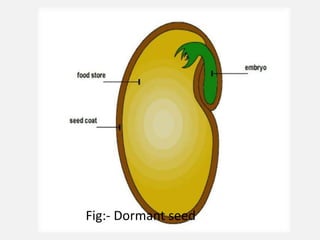
• Seed dormancy refers to a state in which viable seeds fail to
germinate when provided with conditions normally
favourable to germination i.e adequate moisture, appropriate
temperature , a normal atmosphere and in some cases light.
• Dormancy has evolved as a strategy to avoid germination
under condition where seedling survival is likely to be low.
• Dormancy in seeds may be advantageous or problematic
during seed handling.
• The advantage is that it prevents seeds from germinating
during storage and other handling procedures, and induction
of dormancy, for example by drying and dark storage
generally promotes storability.
Fig:- Dormant seed
Types of dormancy
• Main two types of dormancy:-
1.) Seedcoat dormancy
2.) Internal dormancy (embryo)
• The molecular mechanisms for dormancy involve the
seedcoat and the embryo.
• An embryo that is not dormant that is exposed to favorable
conditions when its seedcoat comes out of dormancy will
grow.
• Primary dormancy is when seeds are released from a plant
that is in a dormant state.
• Secondary dormancy is when seeds are released from a
plant that is in a non-dormant state, but later become
dormant.
• Secondary dormancy is not understood as well as primary
dormancy.
TYPES OF SEED DORMANCY
 Main types of seed dormancy:
1.Physiological dormancy
2.Morphological dormancy
3.Morphophysiological dormancy
4.Physical dormancy
5.Combinational dormancy
The molecular mechanisms for dormancy involve
the seedcoat and the embryo.
An embryo that is not dormant that is exposed to
favorable condition when its seedcoat comes out of
dormancy will grow.
Primary dormancy is when seeds are released from
a plant that is in a dormant seed.
Secondary dormancy is when seeds are released
from a plant that is in a non-dormant state, but
later become dormant.
Secondary dormancy is not understood as well as
primary dormancy.
1.Physiological dormancy:
This is the most abundant of seed dormancy in
angiosperms plants.
Physiological dormancy is divided into three lavels:
deep, intermediate and non-deep.
2.Morphological dormancy:
This class of seed dormancy refers to seed with
underdeveloped and differentiated embryos, this
includes embryos in which the cotyledons and
hypocotyl, radicle axis are differentiated, but small
in size.
These embryos do not have physiological dormancy
and only require additional time to grow and
germinate.
Commonly, under favorable conditions, embryos in
such seeds begin growth within a period from a few
days to several weeks, and seeds germinate within
30 days.
3. Morphophysiological dormancy:
In this class, seeds have embryos that are
underdeveloped and differentiated as well as a
physiological component to their dormancy.
Thus, to germinate, these seeds require time for
embryo growth and a dormancy-breaking
treatment.
Morphophysiological dormancy can be divided into
eight levels with possible dormancy breaking
treatments.
4. Physical dormancy:
This class of seed dormancy is caused by one or
more water – impermeable layers of palisade cells
in the seed coat that impede germination because
the seed cannot complete imbibition.
Chemical or physical abrasion of these water
impermeable layer can break physical seed
dormancy.
5. Combinational dormancy:
This class groups seeds with simultaneous
physiological and physical dormancy.
In this case, physiological dormancy is generally
characterized as non-deep.
A cold stratification treatment of seed after
scarification to permit imbibition is a common
dormancy- breaking treatment in this class of seeds.
CAUSES OF SEED DORMANCY
• Dormancy prevents seeds from germinating until the
conditions are favorable for their growth.
• In seedcoat dormancy , hard seedcoats prevent water or
oxygen from reaching the embryo.
• In internal dormancy , the embryo is too immature to grow.
OVERCOMING OF SEED DORMANCY
• Two types of overcoming :-
1) Natural overcoming of seed dormancy
2) Artificial overcoming of seed dormancy
NATURAL OVERCOMING OF SEED DORMANCY
 Weakening of tough and impermeable seed coats by
microbial action.
 Rupturing of weakening of seed coats by mechanical
abrasions.
 Action of digestive enzymes present in alimentary canals
of birds and other animals which happen to feed on their
fruits.
 Leaching of inhibitors present in the seedcoat.
 Inactivation or oxidation of inhibitors by heat, cold and
light.
 Production of growth hormones which can counteract the
effect of inhibitors.
Completion of over-ripening period.
 Attainment of maturity of embryo in case the dormancy is
due to incomplete development of embryo.
ARTIFICIAL OVERCOMING OF SEED
DORMANCY
Rupturing of seed coats or scarification by abrasion through
machine threshing, filing, chipping.
Hydraulic pressure of up to 2000 kg for 5 – 20 minutes for
weakening the tough seed coats.
Treatment with hot water or fat solvents for dissolution of
surface inhibitors, waxes.
 Treatment with concentrated sulphuric acid for a short
period followed by thorough washing to remove all traces of
the mineral acid.
 Stratification or subjecting the moist seeds in the presence
of oxygen to periods of low or high temperature.
 Counteracting the effect of growth inhibitors by soaking the
seeds in potassium nitrate, ethylene chlorohydrin, thiourea,
gibberellins.
REFERENCES
Seed science and technology:-
By M.B. Mcdonald and L.O.Copland
Figure reference - www.slideshare.com
Seed dormancy

Seed dormancy

  • 1.
    LATENT LIFE-DORMANCY  PRESENTEDBY : • CHAUHAN IRSHADKHAN .N. • M.SC.BOTANY SEM-3 • PAPER - CBO – 501 • DEPARTMENT OF LIFE SCIENCE H.N.G.U . , PATAN .
  • 2.
    CONTENTS Introduction Classification of dormancy Typesof seed dormancy Causes of seed dormancy Overcoming of seed dormancy
  • 3.
    INTRODUCTION The growth ofa seed is completely arrested after it is fully developed. In some cases the growth is suspended because of the lack of favourable conditions in the environment. Such seeds will germinate if they are supplied with water and suitable temperature. In many other cases, however, the seeds would not germinate, even if they are provided with water etc. This failure of seeds to germinate even under favourable conditions is termed dormancy.
  • 4.
    In such cases,the completely dry ripe seed is physiologically inactive and is said to be in a resting stage. The seed is called dormant and the phenomenon is termed dormancy. Dormancy incidentally helps in overcoming unfavorable conditions. In majority of the cases, true dormancy helps the seed to survive through an unfavorable season e.g., a very cold winter or a very hot summer.
  • 5.
    CLASSIFICATION OF DORMANCY DORMANCY SEEDDORMANCY BUD DORMANCY PHYSIOLOGICAL DORMANCY FOR LOCATION MORPHOLOGICAL DORMANCY FOR STATUS MORPHOPHYSIOLOGICAL DORMANCY FOR MORPHOLOGY PHYSICAL DORMANCY FOR FUNCTION COMBINATIONAL DORMANCY
  • 6.
    What is seeddormancy ? • Non – germination of seeds due to absence of suitable condition is termed as dormancy.
  • 7.
    SEED DORMANCY • Seeddormancy refers to a state in which viable seeds fail to germinate when provided with conditions normally favourable to germination i.e adequate moisture, appropriate temperature , a normal atmosphere and in some cases light. • Dormancy has evolved as a strategy to avoid germination under condition where seedling survival is likely to be low.
  • 8.
    • Dormancy inseeds may be advantageous or problematic during seed handling. • The advantage is that it prevents seeds from germinating during storage and other handling procedures, and induction of dormancy, for example by drying and dark storage generally promotes storability.
  • 9.
  • 10.
    Types of dormancy •Main two types of dormancy:- 1.) Seedcoat dormancy 2.) Internal dormancy (embryo) • The molecular mechanisms for dormancy involve the seedcoat and the embryo. • An embryo that is not dormant that is exposed to favorable conditions when its seedcoat comes out of dormancy will grow.
  • 11.
    • Primary dormancyis when seeds are released from a plant that is in a dormant state. • Secondary dormancy is when seeds are released from a plant that is in a non-dormant state, but later become dormant. • Secondary dormancy is not understood as well as primary dormancy.
  • 12.
    TYPES OF SEEDDORMANCY  Main types of seed dormancy: 1.Physiological dormancy 2.Morphological dormancy 3.Morphophysiological dormancy 4.Physical dormancy 5.Combinational dormancy
  • 13.
    The molecular mechanismsfor dormancy involve the seedcoat and the embryo. An embryo that is not dormant that is exposed to favorable condition when its seedcoat comes out of dormancy will grow. Primary dormancy is when seeds are released from a plant that is in a dormant seed. Secondary dormancy is when seeds are released from a plant that is in a non-dormant state, but later become dormant. Secondary dormancy is not understood as well as primary dormancy.
  • 14.
    1.Physiological dormancy: This isthe most abundant of seed dormancy in angiosperms plants. Physiological dormancy is divided into three lavels: deep, intermediate and non-deep. 2.Morphological dormancy: This class of seed dormancy refers to seed with underdeveloped and differentiated embryos, this includes embryos in which the cotyledons and hypocotyl, radicle axis are differentiated, but small in size.
  • 15.
    These embryos donot have physiological dormancy and only require additional time to grow and germinate. Commonly, under favorable conditions, embryos in such seeds begin growth within a period from a few days to several weeks, and seeds germinate within 30 days.
  • 16.
    3. Morphophysiological dormancy: Inthis class, seeds have embryos that are underdeveloped and differentiated as well as a physiological component to their dormancy. Thus, to germinate, these seeds require time for embryo growth and a dormancy-breaking treatment. Morphophysiological dormancy can be divided into eight levels with possible dormancy breaking treatments.
  • 17.
    4. Physical dormancy: Thisclass of seed dormancy is caused by one or more water – impermeable layers of palisade cells in the seed coat that impede germination because the seed cannot complete imbibition. Chemical or physical abrasion of these water impermeable layer can break physical seed dormancy.
  • 18.
    5. Combinational dormancy: Thisclass groups seeds with simultaneous physiological and physical dormancy. In this case, physiological dormancy is generally characterized as non-deep. A cold stratification treatment of seed after scarification to permit imbibition is a common dormancy- breaking treatment in this class of seeds.
  • 19.
    CAUSES OF SEEDDORMANCY • Dormancy prevents seeds from germinating until the conditions are favorable for their growth. • In seedcoat dormancy , hard seedcoats prevent water or oxygen from reaching the embryo. • In internal dormancy , the embryo is too immature to grow.
  • 20.
    OVERCOMING OF SEEDDORMANCY • Two types of overcoming :- 1) Natural overcoming of seed dormancy 2) Artificial overcoming of seed dormancy
  • 21.
    NATURAL OVERCOMING OFSEED DORMANCY  Weakening of tough and impermeable seed coats by microbial action.  Rupturing of weakening of seed coats by mechanical abrasions.  Action of digestive enzymes present in alimentary canals of birds and other animals which happen to feed on their fruits.  Leaching of inhibitors present in the seedcoat.
  • 22.
     Inactivation oroxidation of inhibitors by heat, cold and light.  Production of growth hormones which can counteract the effect of inhibitors. Completion of over-ripening period.  Attainment of maturity of embryo in case the dormancy is due to incomplete development of embryo.
  • 23.
    ARTIFICIAL OVERCOMING OFSEED DORMANCY Rupturing of seed coats or scarification by abrasion through machine threshing, filing, chipping. Hydraulic pressure of up to 2000 kg for 5 – 20 minutes for weakening the tough seed coats. Treatment with hot water or fat solvents for dissolution of surface inhibitors, waxes.
  • 24.
     Treatment withconcentrated sulphuric acid for a short period followed by thorough washing to remove all traces of the mineral acid.  Stratification or subjecting the moist seeds in the presence of oxygen to periods of low or high temperature.  Counteracting the effect of growth inhibitors by soaking the seeds in potassium nitrate, ethylene chlorohydrin, thiourea, gibberellins.
  • 25.
    REFERENCES Seed science andtechnology:- By M.B. Mcdonald and L.O.Copland Figure reference - www.slideshare.com