Plant Physiology
THE RRR’s Mean Good News
Plant Style
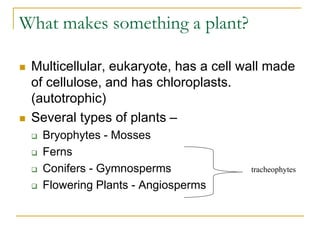
 Multicellular, eukaryote, has a cell wall made
of cellulose, and has chloroplasts.
(autotrophic)
 Several types of plants –
 Bryophytes - Mosses
 Ferns
 Conifers - Gymnosperms
 Flowering Plants - Angiosperms
What makes something a plant?
tracheophytes
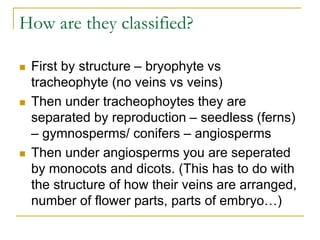
How are they classified?
 First by structure – bryophyte vs
tracheophyte (no veins vs veins)
 Then under tracheophoytes they are
separated by reproduction – seedless (ferns)
– gymnosperms/ conifers – angiosperms
 Then under angiosperms you are seperated
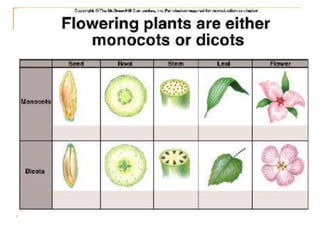
by monocots and dicots. (This has to do with
the structure of how their veins are arranged,
number of flower parts, parts of embryo…)
We will focus on angiosperms
 These are what we think of when you think of
plants.
 Roots, stems, leaves
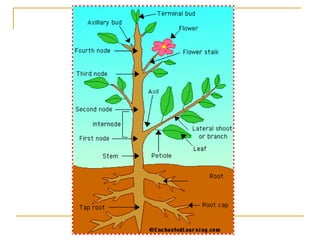
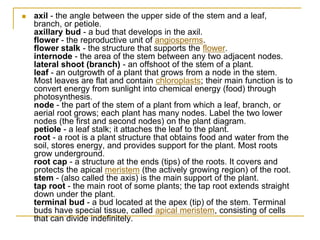
 axil - the angle between the upper side of the stem and a leaf,
branch, or petiole.
axillary bud - a bud that develops in the axil.
flower - the reproductive unit of angiosperms.
flower stalk - the structure that supports the flower.
internode - the area of the stem between any two adjacent nodes.
lateral shoot (branch) - an offshoot of the stem of a plant.
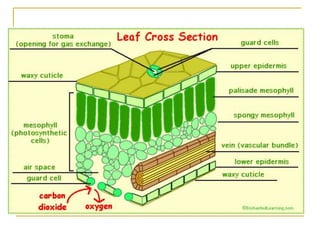
leaf - an outgrowth of a plant that grows from a node in the stem.
Most leaves are flat and contain chloroplasts; their main function is to
convert energy from sunlight into chemical energy (food) through
photosynthesis.
node - the part of the stem of a plant from which a leaf, branch, or
aerial root grows; each plant has many nodes. Label the two lower
nodes (the first and second nodes) on the plant diagram.
petiole - a leaf stalk; it attaches the leaf to the plant.
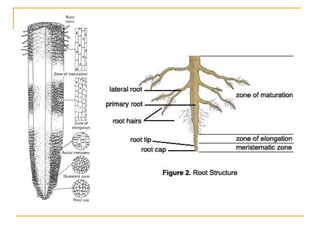
root - a root is a plant structure that obtains food and water from the
soil, stores energy, and provides support for the plant. Most roots
grow underground.
root cap - a structure at the ends (tips) of the roots. It covers and
protects the apical meristem (the actively growing region) of the root.
stem - (also called the axis) is the main support of the plant.
tap root - the main root of some plants; the tap root extends straight
down under the plant.
terminal bud - a bud located at the apex (tip) of the stem. Terminal
buds have special tissue, called apical meristem, consisting of cells
that can divide indefinitely.
Transport
 Definition:
 How do plants move their materials?
 IN VASCULAR PLANTS – the transport
system is made up of two types of tubes -
strong, thick pipes called xylem vessels, and
thinner tubes called phloem vessels. The
cells of these vessels are modified to make
them suited to performing their special
functions.
Transport Tubes
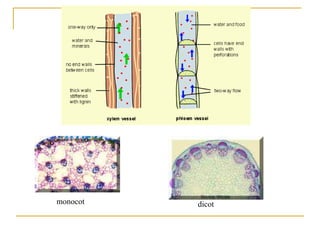
 Xylem consists of dead cells with no end
walls, which contain lignin to form stiff tubes.
They are impermeable, and are
strengthened with fibres.
 Phloem consists of living cells lined with
cytoplasm, with walls made of cellulose and
perforated end walls called sieve plates. They
are permeable, and are surrounded by
companion cells.
monocot dicot
Transport
 How does water move through the xylem?
 This is a combination of root pressure, capillary
action, and transpiration.
 Capillary action – water is attracted to itself and to the
sides of the tube (graduated cylinder – meniscus)
(remember cohesion and adhesion)
 Transpiration – like plant sweating – this is water
evaporation out of the openings in the leaves – so that
evaporation pulls the water up. To control transpiration
a plant uses guard cells to open and close it’s stomates
Homeostasis
 Remember – all parts of a multicellular
organisms
Excretion
 Getting rid of metabolic wastes…
 Wastes a plant make?
 O2 – this is excreted through the stomates
(controlled by the guard cells)
 Water – again excreted through the stomates
Respiration
 Exchange of gases with the environment
 Plants take in CO2 and let out O2
 However they do use some of their O2 for
cellular respiration, and the waste CO2 for
photosynthesis. However, it is not enough to
keep the plant alive.
 Plants keep their stomate open just enough
to allow photosynthesis to take place, but not
so much that they lose an excessive amount
of water.
Regulation
 Responding to the environment…
 So are plants able to respond to the
environment?
 They use Tropisms and hormones
 Tropisms – Indicates growth or turning movement
of a biological organism in response to an
environmental stimulus.
 Phototropism – movement is response to lights or colors
of lights.
 Geotropism/ gravitropism – movement in response to
gravity
Tropisms/ Hormones
 Hydrotropisms – movement in response to
moisture or water
 Thigmotropism – movement in response to
touch or contact (memosa plant – venus fly
trap – this is also how vines grow up the side
of buildings)
Hormones
 AUXINS – plant hormones
 For plant growth, cell differentiation, mediates tropistic
response for gravity and light, fruit ripening, stimulates
flowering, etc
 Cytokines
 Stimulates cell division, stomate opening for some species,
shoot and bud formation
 Gibberellins
 Stimulates stem elongation by stimulating cell division,
breaks seed dormancy, enzyme production, causes
seedless fruit development
Reproduction
 Asexual
 Vegetative propagation – undifferentiated tissue
(meristem) in plants provides a source of cells from
which a new plant can develop (natural occurring)
 Bulbs - parts of a root that split to form several new bulbs
 Tubers – modified underground stems that have buds (like
potatoes)
 Runners – plant stem that run above and along the ground,
that produce new roots
 Rhizomes- woody underground stems that appear at
intervals (iris/ ginger)
Artificial reproduction
 Cutting – when cut, a piece of stem of some
plants will develop new roots in water
 Layering – the stems of certain plants, when
bent into the ground and covered by soil, will
take root. (blackberry and raspberry bushes)
 Grafting – the stem of one plant is attached to
the rooted stem of another closely related
plant. No mixing of hereditary characteristics
occur they remain genetically destinct
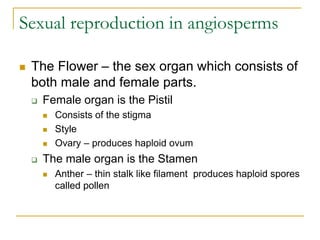
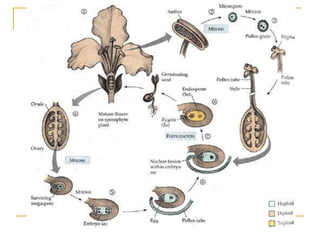
Sexual reproduction in angiosperms
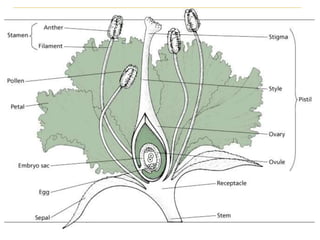
 The Flower – the sex organ which consists of
both male and female parts.
 Female organ is the Pistil
 Consists of the stigma
 Style
 Ovary – produces haploid ovum
 The male organ is the Stamen
 Anther – thin stalk like filament produces haploid spores
called pollen
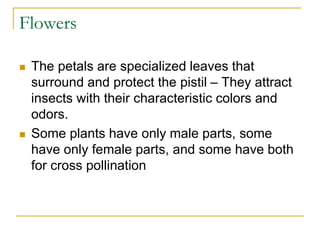
Flowers
 The petals are specialized leaves that
surround and protect the pistil – They attract
insects with their characteristic colors and
odors.
 Some plants have only male parts, some
have only female parts, and some have both
for cross pollination
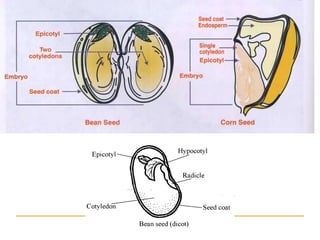
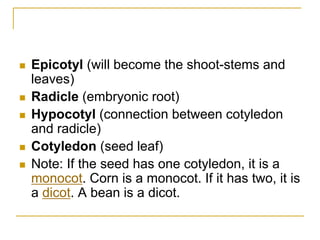
 Epicotyl (will become the shoot-stems and
leaves)
 Radicle (embryonic root)
 Hypocotyl (connection between cotyledon
and radicle)
 Cotyledon (seed leaf)
 Note: If the seed has one cotyledon, it is a
monocot. Corn is a monocot. If it has two, it is
a dicot. A bean is a dicot.
Plant Physiology in Brief.ppt

Plant Physiology in Brief.ppt

  • 1.
    Plant Physiology THE RRR’sMean Good News Plant Style
  • 2.
     Multicellular, eukaryote,has a cell wall made of cellulose, and has chloroplasts. (autotrophic)  Several types of plants –  Bryophytes - Mosses  Ferns  Conifers - Gymnosperms  Flowering Plants - Angiosperms What makes something a plant? tracheophytes
  • 3.
    How are theyclassified?  First by structure – bryophyte vs tracheophyte (no veins vs veins)  Then under tracheophoytes they are separated by reproduction – seedless (ferns) – gymnosperms/ conifers – angiosperms  Then under angiosperms you are seperated by monocots and dicots. (This has to do with the structure of how their veins are arranged, number of flower parts, parts of embryo…)
  • 4.
    We will focuson angiosperms  These are what we think of when you think of plants.  Roots, stems, leaves
  • 6.
     axil -the angle between the upper side of the stem and a leaf, branch, or petiole. axillary bud - a bud that develops in the axil. flower - the reproductive unit of angiosperms. flower stalk - the structure that supports the flower. internode - the area of the stem between any two adjacent nodes. lateral shoot (branch) - an offshoot of the stem of a plant. leaf - an outgrowth of a plant that grows from a node in the stem. Most leaves are flat and contain chloroplasts; their main function is to convert energy from sunlight into chemical energy (food) through photosynthesis. node - the part of the stem of a plant from which a leaf, branch, or aerial root grows; each plant has many nodes. Label the two lower nodes (the first and second nodes) on the plant diagram. petiole - a leaf stalk; it attaches the leaf to the plant. root - a root is a plant structure that obtains food and water from the soil, stores energy, and provides support for the plant. Most roots grow underground. root cap - a structure at the ends (tips) of the roots. It covers and protects the apical meristem (the actively growing region) of the root. stem - (also called the axis) is the main support of the plant. tap root - the main root of some plants; the tap root extends straight down under the plant. terminal bud - a bud located at the apex (tip) of the stem. Terminal buds have special tissue, called apical meristem, consisting of cells that can divide indefinitely.
  • 9.
    Transport  Definition:  Howdo plants move their materials?  IN VASCULAR PLANTS – the transport system is made up of two types of tubes - strong, thick pipes called xylem vessels, and thinner tubes called phloem vessels. The cells of these vessels are modified to make them suited to performing their special functions.
  • 10.
    Transport Tubes  Xylemconsists of dead cells with no end walls, which contain lignin to form stiff tubes. They are impermeable, and are strengthened with fibres.  Phloem consists of living cells lined with cytoplasm, with walls made of cellulose and perforated end walls called sieve plates. They are permeable, and are surrounded by companion cells.
  • 11.
  • 12.
    Transport  How doeswater move through the xylem?  This is a combination of root pressure, capillary action, and transpiration.  Capillary action – water is attracted to itself and to the sides of the tube (graduated cylinder – meniscus) (remember cohesion and adhesion)  Transpiration – like plant sweating – this is water evaporation out of the openings in the leaves – so that evaporation pulls the water up. To control transpiration a plant uses guard cells to open and close it’s stomates
  • 13.
    Homeostasis  Remember –all parts of a multicellular organisms
  • 14.
    Excretion  Getting ridof metabolic wastes…  Wastes a plant make?  O2 – this is excreted through the stomates (controlled by the guard cells)  Water – again excreted through the stomates
  • 15.
    Respiration  Exchange ofgases with the environment  Plants take in CO2 and let out O2  However they do use some of their O2 for cellular respiration, and the waste CO2 for photosynthesis. However, it is not enough to keep the plant alive.  Plants keep their stomate open just enough to allow photosynthesis to take place, but not so much that they lose an excessive amount of water.
  • 16.
    Regulation  Responding tothe environment…  So are plants able to respond to the environment?  They use Tropisms and hormones  Tropisms – Indicates growth or turning movement of a biological organism in response to an environmental stimulus.  Phototropism – movement is response to lights or colors of lights.  Geotropism/ gravitropism – movement in response to gravity
  • 17.
    Tropisms/ Hormones  Hydrotropisms– movement in response to moisture or water  Thigmotropism – movement in response to touch or contact (memosa plant – venus fly trap – this is also how vines grow up the side of buildings)
  • 18.
    Hormones  AUXINS –plant hormones  For plant growth, cell differentiation, mediates tropistic response for gravity and light, fruit ripening, stimulates flowering, etc  Cytokines  Stimulates cell division, stomate opening for some species, shoot and bud formation  Gibberellins  Stimulates stem elongation by stimulating cell division, breaks seed dormancy, enzyme production, causes seedless fruit development
  • 19.
    Reproduction  Asexual  Vegetativepropagation – undifferentiated tissue (meristem) in plants provides a source of cells from which a new plant can develop (natural occurring)  Bulbs - parts of a root that split to form several new bulbs  Tubers – modified underground stems that have buds (like potatoes)  Runners – plant stem that run above and along the ground, that produce new roots  Rhizomes- woody underground stems that appear at intervals (iris/ ginger)
  • 20.
    Artificial reproduction  Cutting– when cut, a piece of stem of some plants will develop new roots in water  Layering – the stems of certain plants, when bent into the ground and covered by soil, will take root. (blackberry and raspberry bushes)  Grafting – the stem of one plant is attached to the rooted stem of another closely related plant. No mixing of hereditary characteristics occur they remain genetically destinct
  • 22.
    Sexual reproduction inangiosperms  The Flower – the sex organ which consists of both male and female parts.  Female organ is the Pistil  Consists of the stigma  Style  Ovary – produces haploid ovum  The male organ is the Stamen  Anther – thin stalk like filament produces haploid spores called pollen
  • 23.
    Flowers  The petalsare specialized leaves that surround and protect the pistil – They attract insects with their characteristic colors and odors.  Some plants have only male parts, some have only female parts, and some have both for cross pollination
  • 27.
     Epicotyl (willbecome the shoot-stems and leaves)  Radicle (embryonic root)  Hypocotyl (connection between cotyledon and radicle)  Cotyledon (seed leaf)  Note: If the seed has one cotyledon, it is a monocot. Corn is a monocot. If it has two, it is a dicot. A bean is a dicot.