Organic
Compounds
1/21/2018By Mariam Ohanyan
Carbohydrates
Three Types of Carbohydrates :
• Monosaccharides
• Disaccharides
• Polysaccharides
1/21/2018By Mariam Ohanyan
Monosaccharides
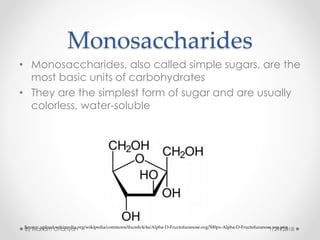
• Monosaccharides, also called simple sugars, are the
most basic units of carbohydrates
• They are the simplest form of sugar and are usually
colorless, water-soluble
Source: upload.wikimedia.org/wikipedia/commons/thumb/4/4a/Alpha-D-Fructofuranose.svg/500px-Alpha-D-Fructofuranose.svg.png
1/21/2018By Mariam Ohanyan
Disaccharides
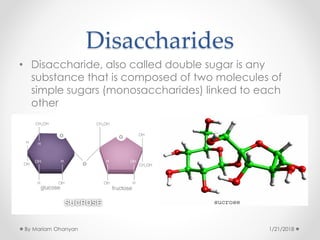
• Disaccharide, also called double sugar is any
substance that is composed of two molecules of
simple sugars (monosaccharides) linked to each
other
1/21/2018By Mariam Ohanyan
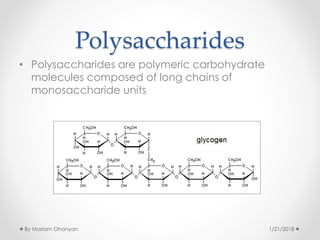
Polysaccharides
• Polysaccharides are polymeric carbohydrate
molecules composed of long chains of
monosaccharide units
1/21/2018By Mariam Ohanyan
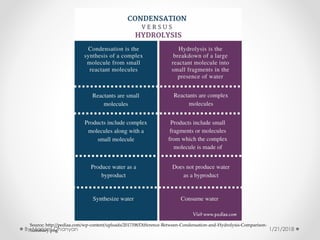
Source: http://pediaa.com/wp-content/uploads/2017/08/Difference-Between-Condensation-and-Hydrolysis-Comparison-
Summary.png 1/21/2018By Mariam Ohanyan
Lipids
• The lipids are a large and diverse group of naturally
occurring organic compounds that are related by
their solubility in nonpolar organic solvents and
general insolubility in water.
1/21/2018By Mariam Ohanyan
Types Of Lipids
Types :
• Monoglycerides
• Diglycerides
• Triglycerides
• Phospholipids
• Sterols (Cholesterol)
1/21/2018By Mariam Ohanyan
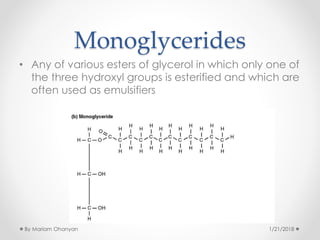
Monoglycerides
• Any of various esters of glycerol in which only one of
the three hydroxyl groups is esterified and which are
often used as emulsifiers
1/21/2018By Mariam Ohanyan
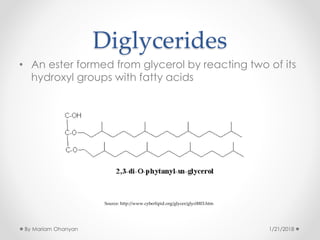
Diglycerides
• An ester formed from glycerol by reacting two of its
hydroxyl groups with fatty acids
Source: http://www.cyberlipid.org/glycer/glyc0003.htm
1/21/2018By Mariam Ohanyan
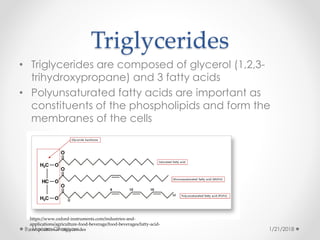
Triglycerides
• Triglycerides are composed of glycerol (1,2,3-
trihydroxypropane) and 3 fatty acids
• Polyunsaturated fatty acids are important as
constituents of the phospholipids and form the
membranes of the cells
https://www.oxford-instruments.com/industries-and-
applications/agriculture-food-beverage/food-beverages/fatty-acid-
composition-of-triglycerides 1/21/2018By Mariam Ohanyan
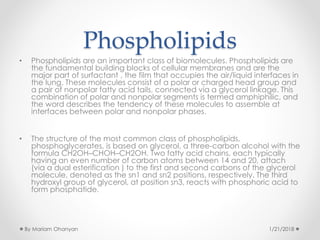
Phospholipids
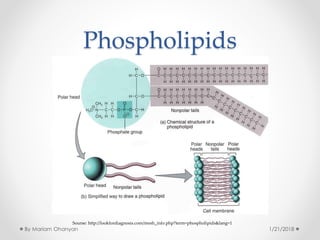
• Phospholipids are an important class of biomolecules. Phospholipids are
the fundamental building blocks of cellular membranes and are the
major part of surfactant , the film that occupies the air/liquid interfaces in
the lung. These molecules consist of a polar or charged head group and
a pair of nonpolar fatty acid tails, connected via a glycerol linkage. This
combination of polar and nonpolar segments is termed amphiphilic, and
the word describes the tendency of these molecules to assemble at
interfaces between polar and nonpolar phases.
• The structure of the most common class of phospholipids,
phosphoglycerates, is based on glycerol, a three-carbon alcohol with the
formula CH2OH–CHOH–CH2OH. Two fatty acid chains, each typically
having an even number of carbon atoms between 14 and 20, attach
(via a dual esterification ) to the first and second carbons of the glycerol
molecule, denoted as the sn1 and sn2 positions, respectively. The third
hydroxyl group of glycerol, at position sn3, reacts with phosphoric acid to
form phosphatide.
1/21/2018By Mariam Ohanyan
Phospholipids
Sourse: http://lookfordiagnosis.com/mesh_info.php?term=phospholipids&lang=1
1/21/2018By Mariam Ohanyan
Sterols
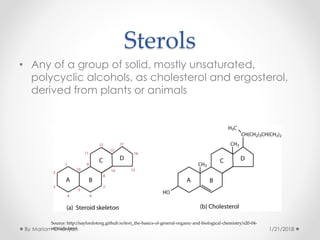
• Any of a group of solid, mostly unsaturated,
polycyclic alcohols, as cholesterol and ergosterol,
derived from plants or animals
Source: http://saylordotorg.github.io/text_the-basics-of-general-organic-and-biological-chemistry/s20-04-
steroids.html 1/21/2018By Mariam Ohanyan
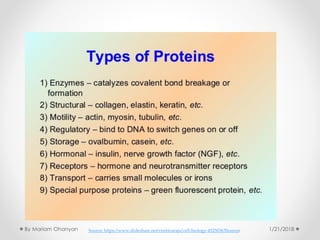
Proteins
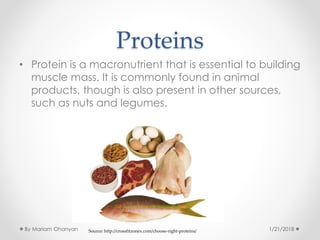
• Protein is a macronutrient that is essential to building
muscle mass. It is commonly found in animal
products, though is also present in other sources,
such as nuts and legumes.
Source: http://crossfitzonex.com/choose-right-proteins/ 1/21/2018By Mariam Ohanyan
Proteins Structure
Source: https://biochemandi.wordpress.com/tag/tertiary-structure/
1/21/2018By Mariam Ohanyan
Types Of Amino Acids
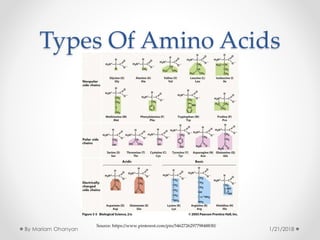
• Amino acids are organic compounds which
contain at least one amino group (-NH2) and a
carboxyl (-COOH) group. In the human genome, 20
amino acids are created to build proteins and
therefore termed proteinogenic. Besides this, there
are approximately 250 amino acids which do not
form proteins. These are used to form sugar for
example.
• The 20 proteinogenic amino acids are also called
standard amino acids, which can be divided into
three groups: essential, semi-essential and non-
essential
1/21/2018By Mariam Ohanyan
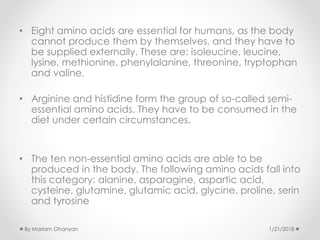
• Eight amino acids are essential for humans, as the body
cannot produce them by themselves, and they have to
be supplied externally. These are: isoleucine, leucine,
lysine, methionine, phenylalanine, threonine, tryptophan
and valine.
• Arginine and histidine form the group of so-called semi-
essential amino acids. They have to be consumed in the
diet under certain circumstances.
• The ten non-essential amino acids are able to be
produced in the body. The following amino acids fall into
this category: alanine, asparagine, aspartic acid,
cysteine, glutamine, glutamic acid, glycine, proline, serin
and tyrosine
1/21/2018By Mariam Ohanyan
Types Of Amino Acids
Source: https://www.pinterest.com/pin/546272629779848830/
1/21/2018By Mariam Ohanyan
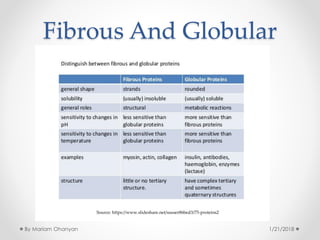
Fibrous And Globular
Source: https://www.slideshare.net/ssuser86bed3/75-proteins2
1/21/2018By Mariam Ohanyan
Source: https://www.slideshare.net/rimbiosraju/cell-biology-45250363Source: 1/21/2018By Mariam Ohanyan
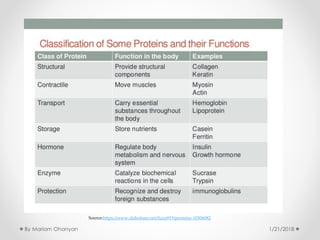
Source:https://www.slideshare.net/lizza919/proteins-10306082
1/21/2018By Mariam Ohanyan
Question
• 1- Describe the two major functions of
monosaccharides .
1/21/2018By Mariam Ohanyan
Answer
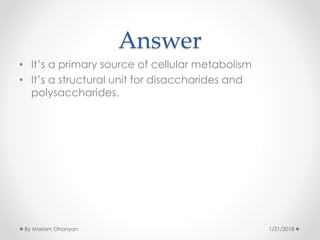
• It’s a primary source of cellular metabolism
• It’s a structural unit for disaccharides and
polysaccharides.
1/21/2018By Mariam Ohanyan
Question
• Define the term structural isomer , using glucose
molecules as examples.
1/21/2018By Mariam Ohanyan
Answer
• Structural isomer have the same chemical formula
but their atoms are arranged in a different
sequence.
1/21/2018By Mariam Ohanyan
Question
• Why is glucose such a versatile molecule ?
1/21/2018By Mariam Ohanyan
Answer
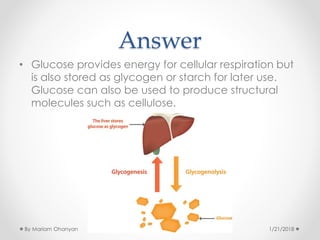
• Glucose provides energy for cellular respiration but
is also stored as glycogen or starch for later use.
Glucose can also be used to produce structural
molecules such as cellulose.
1/21/2018By Mariam Ohanyan
Question
• Explain briefly how disaccharides are formed and
broken down.
1/21/2018By Mariam Ohanyan
Answer
• Disaccharide sugars are formed by condensation
reactions and broken down by hydrolysis .
Condensation reaction join two monosaccharide
molecules by a glyosidic bond with the release of a
water molecule . Hydrolysis reactions use water to
split a disaccharide molecule into two . The Water
Molecule provides a hydrogen atom and a hydroxyl
group
1/21/2018By Mariam Ohanyan
Question
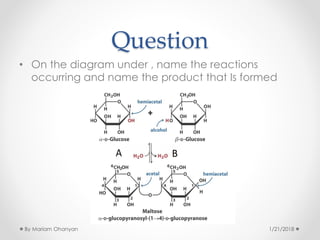
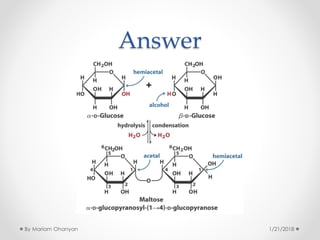
• On the diagram under , name the reactions
occurring and name the product that Is formed
1/21/2018By Mariam Ohanyan
Answer
1/21/2018By Mariam Ohanyan
Question
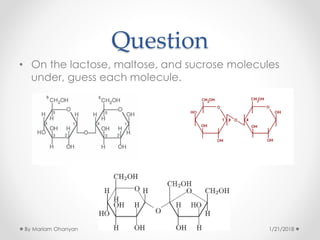
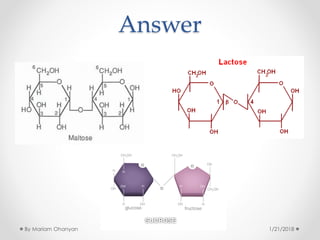
• On the lactose, maltose, and sucrose molecules
under, guess each molecule.
1/21/2018By Mariam Ohanyan
Answer
1/21/2018By Mariam Ohanyan
Question
• How are polysaccharides a good source of energy ?
1/21/2018By Mariam Ohanyan
Answer
• They are a good source of energy because they
are easily hydrolyzed into monosaccharides.
Monosaccharides are the primary source of cellular
fuel.
1/21/2018By Mariam Ohanyan
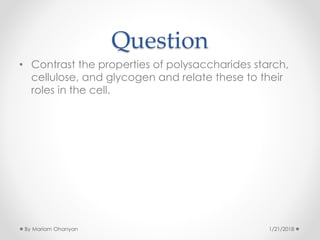
Question
• How is the energy stored in polysaccharides
mobilized ?
1/21/2018By Mariam Ohanyan
Answer
• Polysaccharides are hydrolyzed to produce simples
carbohydrates like glucose which can be
transported to other parts of the organism.
1/21/2018By Mariam Ohanyan
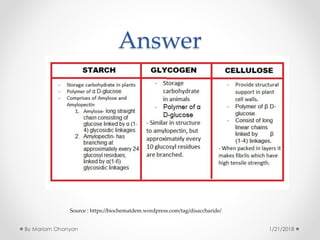
Question
• Contrast the properties of polysaccharides starch,
cellulose, and glycogen and relate these to their
roles in the cell.
1/21/2018By Mariam Ohanyan
Answer
Source : https://biochematdem.wordpress.com/tag/disaccharide/
1/21/2018By Mariam Ohanyan
Question
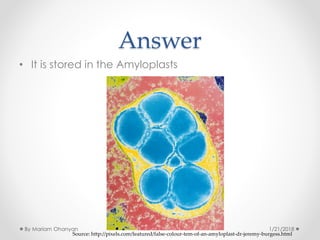
• Where is starch stored in plants ?
1/21/2018By Mariam Ohanyan
Answer
• It is stored in the Amyloplasts
Source: http://pixels.com/featured/false-colour-tem-of-an-amyloplast-dr-jeremy-burgess.html
1/21/2018By Mariam Ohanyan
Question
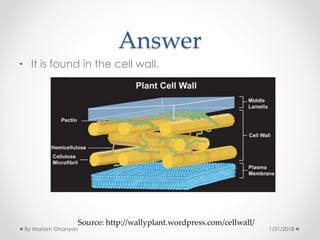
• Where is cellulose found in plants ?
1/21/2018By Mariam Ohanyan
Answer
• It is found in the cell wall.
Source: http://wallyplant.wordpress.com/cellwall/
1/21/2018By Mariam Ohanyan
Question
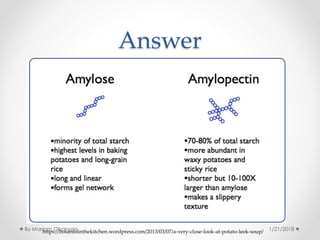
• Compare and contrast the structure of amylose
and amylopectin.
1/21/2018By Mariam Ohanyan
Answer
https://botanistinthekitchen.wordpress.com/2013/03/07/a-very-close-look-at-potato-leek-soup/ 1/21/2018By Mariam Ohanyan
Question
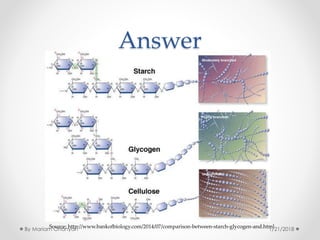
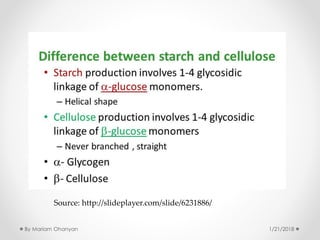
• What are the differences in structure between
cellulose and starch.
1/21/2018By Mariam Ohanyan
Answer
Source: http://www.bankofbiology.com/2014/07/comparison-between-starch-glycogen-and.html
1/21/2018By Mariam Ohanyan
Source: http://slideplayer.com/slide/6231886/
1/21/2018By Mariam Ohanyan
Question
• Why are lipids such a good fuel for metabolic
reactions?
1/21/2018By Mariam Ohanyan
Answer
• Fats need more oxidation per gram to form CO2
than other molecules so more usable energy can
be extracted.
1/21/2018By Mariam Ohanyan
Question
• How are lipids broken down before they are
respired?
1/21/2018By Mariam Ohanyan
Answer
• Hydrolysis of neutral fats produce free fatty acids
which undergo B-oxidation to release 2C units
which can enter the Krebs cycle to be respired.
1/21/2018By Mariam Ohanyan
Question
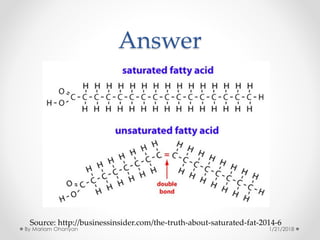
• Distinguish between saturated and unsaturated
fatty acids.
1/21/2018By Mariam Ohanyan
Answer
Source: http://businessinsider.com/the-truth-about-saturated-fat-2014-6
1/21/2018By Mariam Ohanyan
Works Cited
• The Editors of Encyclopædia Britannica. “Disaccharide.”
Encyclopædia Britannica, Encyclopædia Britannica,
Inc., 1 June 2015,
www.britannica.com/science/disaccharide
• Mandal, MD Dr Ananya. “Types of Lipids.” News-
Medical.net, 17 Sept. 2014, www.news-medical.net/life-
sciences/Types-of-Lipids.aspx.
• Using NMR to Determine the Fatty Acid Composition of
Triglycerides.” Oxford Instruments, www.oxford-
instruments.com/industries-and-applications/agriculture-
food-beverage/food-beverages/fatty-acid-
composition-of-triglycerides.
• Szalay, Jessie. “What Is Protein?” LiveScience, Purch, 10
Dec. 2015, www.livescience.com/53044-protein.html.
1/21/2018By Mariam Ohanyan

Organic compounds