PLANT PHYSIOLOGY 
Stomatal Regulators 
Maham Naveed 
M.Sc Roll # 05 
M.Sc Botany 
12 Nov,2014
Cuticle 
Prevents 
water loss 
Cuticle 
Mesophyll 
Stomata Guard cells 
Site of 
photosynthesis 
Openings allow gases 
and water to move in 
and out of leaf 
Open and close 
the stomata 
Leaf structure
Air boundary layer 
• A thin film of still air on the surface of leaf 
and its resistance to water vapor diffusion is 
proportional to its thickness. The thickness 
of the boundary layer is determined 
primarily by wind speed.
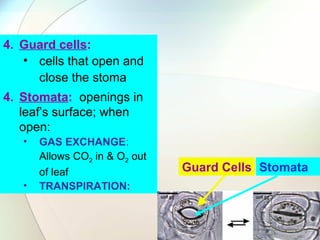
Guard Cells 
4. Guard cells: 
• cells that open and 
close the stoma 
4. Stomata: openings in 
leaf’s surface; when 
open: 
• GAS EXCHANGE: 
Allows CO2 in & O2 out 
of leaf 
• TRANSPIRATION: 
Stomata
Function of Guard Cells 
How do the 
guard cells react 
to the availability 
of water? 
 Dry – guard 
cells CLOSE 
 lots of H2O – 
guard cells 
OPEN 
http://www.ualr.edu/~botany/images.html
Guard cell properties and their 
relationship with stomatal control 
• Thickness of cell wall varies in the 
ventral(0.5μm) and thicker dorsal part of the 
guard cells. 
• Contains chloroplast and can perform light 
reaction. (not dark reaction for the lack of key 
enzymes) 
• Structurally isolated from epidermal cells for the 
lack of plasmodesmata (water and ions transmit 
only through cellular pathway, thus helps to build 
up water gradient) 
• Little volume, little amount of water absorption or 
loss controls stomtal aperture.
Stomata frequency upper and lower epidermis
History 
• The recent theory rejected the old classical 
theory of mechanism proposed by 
Scarth(1932). 
• Its replacement by Fujino's theory (1959) 
concept of active K+ transport. 
• Solution accumulation especially of K+ , Cl-and 
malate is principally responsible.
Mechanism of stomata opening 
K+ absorption theory 
H+ light 
H+ K + 
K + 
Mal 
Mal - 
 +H+ 
V 
PM 
H+ 
H+ 
Cl- Cl- 
H+-ATPase in PM is light activated 
Its function is out-pumping H+ 
Inward rectifier K+ channel is 
voltage dependent, PM 
hyperpolarization activates 
the channel and carry K+ 
inward 
Cl- is transported through 
Cl- /H+ symport or Cl-/OH-antiport 
HCO3 
-+PEP
When the stomatum is opening, the [K+] rises to 0.5M, anions 
rise to 0.2-0.5M, the osmotic potential drops 2MPa, thus bring 
water in.
Changes in ionic concentrations, pH and membrane 
potential for epidermal cells, subsidiary cells and guard cells. 
O = open stomata; C = closed stomata
Driving force -> osmotic uptake of water -> increase 
of hydrostatic pressure -> push the thin dorsal walls 
outward into the neighboring epidermal cells. -> cause 
cell to arch. 
In dumbbell-shape guard cells, the bulbous ends of the 
cells push against each other as they swell, driving the 
central handles apart in parallel and widening the 
pore. 
In 1960, it became evident that K+ levels are high in 
open guard cells and very low in closed guard cells. 
Upon opening, large amounts of K+ move from the 
subsidiary and epidermal cells into the guard cells.
• Ion and organic molecules 
• Guard cell 
" ys Decrease 
" yw decrease 
• Water moves into the guard cell 
" yp increase 
• Stoma open
• Osmotic potential decrease 
• Water potential decrease 
• Water enter into vacuole 
• Increase turgor 
• Stomata open
Mechanism for stomatal close 
Uptake of Ca+2 into the cytosol 
Depolarize the membranes 
Anion channel opened and Cl- and malate 
released from the vacuole. 
K+ channel opened and K+ released from 
vacuole and subsequently into subsidiary 
cells.
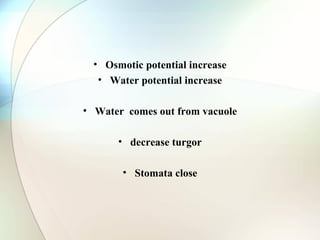
• Osmotic potential increase 
• Water potential increase 
• Water comes out from vacuole 
• decrease turgor 
• Stomata close
Role of ABA 
• Seed development 
• Dormancy 
• Germination 
• Stomatal closure 
• Leaf senescence 
• Environmental stress response 
• During drought ABA triggers a signaling in guard cells that 
result stomata closure and inhibiting stomata opening.
• In guard cells of Arabidopsis thaliana ABA induced 
calcium oscillations occur in 10.3 min & therefore too 
slow to encode a signal that’s activate anions 
channels with a lag time of 2 min. 
• Calcium cytology activates 2 different types of anions 
channels. 
• S Type (slow activating sustained) 
• R Type (Rapid transient )
• Both mediate Anions release from guard cells causing 
Depolarization. 
• This change in membrane potential deactivates K+ 
inward and activate K+ outward channels,resulting in 
K+ efflux from guard cells. 
• ABA causes an alkalization of guard cells cytosol 
which directly enhance K+ outward channels. 
• Anions and K+ contribute loss of guard cell turgor 
and leads stomata close.
Factors influencing stomata 
aperture 
• Light 
• Temp 
• CO2 
• Water content
(1). Light 
Stomata of most plant open in the day and 
close at night, while CAM plants are just the 
opposite. 
Stomata opening are sensitive to red light and 
blue light, and blue light is more effective, it 
stimulates opening by a blue-light receptor: 
zeaxanthin.
Blue light has direct effect on stomatal opening. 
At low fluence rate, blue light causes stomatal 
opening, but not red light. 
At high fluence rate, stomatal opening under blue 
light is consistently higher than under red light. 
Blue light -> blue/UV-A cytochrome -> proton 
extrusion -> photosynthesis -> ATP production -> 
stomatal opening.
(2) Temperature 
Stomatal aperture increase with Temp, within 20- 
30℃ (the optimal). 
Temp increase -> stimulate respiration and impair 
photosynthesis -> CO2 conc. increase -> stomata 
close 
Midday closure 
temp increase -> photosynthesis reduced 
water deficit occur -> photosynthesis reduced
(3). CO2 
Low CO2 conc. promotes stomatal opening, 
while high CO2 conc. inhibits stomatal opening 
through its acidification of the guard cell thus 
inhibits PM hyperpolarization.
Effect of CO2 on stomatal movement 
CO2 conc. decrease => stomata open => to uptake more 
CO2 
CO2 conc. increase => stomata close 
The response of the stomata is to the intracellular conc. of CO2 
in the guard cells. 
When CO2 level decrease or photosynthesis is needed, guard 
cells will take up water and swell to open the pores, in order to 
take more CO2. 
When CO2 level increase or the water stress override the 
photosynthesis, the guard cells will close.
(4) Water content 
Stomata open when the leaf contain enough 
water. When there is a water shortage, they 
close. 
At night, no photosynthesis 
Stomata close, preventing unnecessary loss of 
water. 
Sunny morning, photosynthesis is demanding, 
supply of water is abundant.
 Hydro passive closure 
Water loss from the guard cells exceeds the rate of 
movement into the guard cells. => decrease in 
turgidity of the guard cells => stomata closure 
Hydro active closure 
ABA (abscisic acid,) referred to as an antitranspirant. 
Plants sense water deficit => ABA is released into the 
apoplast and then transferred to the guard cells => 
stomata close => ABA conc. is increased => more 
stomata close
References 
• F.B Salisbury:ross “Plant Physiology” 3rd 
Edition. 
• Taiz & Zeiger “plant Physiology” 5th Edition. 
• Cowan, I. R. and Farquhar, G. D. (1977). 
Stomatal function in relation to leaf 
metabolism and environment:471-505. 
• http://www.wikipedia.stoamatal regulation.
Any Question?

Stomatal regulation

  • 1.
    PLANT PHYSIOLOGY StomatalRegulators Maham Naveed M.Sc Roll # 05 M.Sc Botany 12 Nov,2014
  • 2.
    Cuticle Prevents waterloss Cuticle Mesophyll Stomata Guard cells Site of photosynthesis Openings allow gases and water to move in and out of leaf Open and close the stomata Leaf structure
  • 3.
    Air boundary layer • A thin film of still air on the surface of leaf and its resistance to water vapor diffusion is proportional to its thickness. The thickness of the boundary layer is determined primarily by wind speed.
  • 4.
    Guard Cells 4.Guard cells: • cells that open and close the stoma 4. Stomata: openings in leaf’s surface; when open: • GAS EXCHANGE: Allows CO2 in & O2 out of leaf • TRANSPIRATION: Stomata
  • 5.
    Function of GuardCells How do the guard cells react to the availability of water?  Dry – guard cells CLOSE  lots of H2O – guard cells OPEN http://www.ualr.edu/~botany/images.html
  • 8.
    Guard cell propertiesand their relationship with stomatal control • Thickness of cell wall varies in the ventral(0.5μm) and thicker dorsal part of the guard cells. • Contains chloroplast and can perform light reaction. (not dark reaction for the lack of key enzymes) • Structurally isolated from epidermal cells for the lack of plasmodesmata (water and ions transmit only through cellular pathway, thus helps to build up water gradient) • Little volume, little amount of water absorption or loss controls stomtal aperture.
  • 9.
    Stomata frequency upperand lower epidermis
  • 10.
    History • Therecent theory rejected the old classical theory of mechanism proposed by Scarth(1932). • Its replacement by Fujino's theory (1959) concept of active K+ transport. • Solution accumulation especially of K+ , Cl-and malate is principally responsible.
  • 11.
    Mechanism of stomataopening K+ absorption theory H+ light H+ K + K + Mal Mal -  +H+ V PM H+ H+ Cl- Cl- H+-ATPase in PM is light activated Its function is out-pumping H+ Inward rectifier K+ channel is voltage dependent, PM hyperpolarization activates the channel and carry K+ inward Cl- is transported through Cl- /H+ symport or Cl-/OH-antiport HCO3 -+PEP
  • 12.
    When the stomatumis opening, the [K+] rises to 0.5M, anions rise to 0.2-0.5M, the osmotic potential drops 2MPa, thus bring water in.
  • 13.
    Changes in ionicconcentrations, pH and membrane potential for epidermal cells, subsidiary cells and guard cells. O = open stomata; C = closed stomata
  • 14.
    Driving force ->osmotic uptake of water -> increase of hydrostatic pressure -> push the thin dorsal walls outward into the neighboring epidermal cells. -> cause cell to arch. In dumbbell-shape guard cells, the bulbous ends of the cells push against each other as they swell, driving the central handles apart in parallel and widening the pore. In 1960, it became evident that K+ levels are high in open guard cells and very low in closed guard cells. Upon opening, large amounts of K+ move from the subsidiary and epidermal cells into the guard cells.
  • 15.
    • Ion andorganic molecules • Guard cell " ys Decrease " yw decrease • Water moves into the guard cell " yp increase • Stoma open
  • 16.
    • Osmotic potentialdecrease • Water potential decrease • Water enter into vacuole • Increase turgor • Stomata open
  • 17.
    Mechanism for stomatalclose Uptake of Ca+2 into the cytosol Depolarize the membranes Anion channel opened and Cl- and malate released from the vacuole. K+ channel opened and K+ released from vacuole and subsequently into subsidiary cells.
  • 18.
    • Osmotic potentialincrease • Water potential increase • Water comes out from vacuole • decrease turgor • Stomata close
  • 19.
    Role of ABA • Seed development • Dormancy • Germination • Stomatal closure • Leaf senescence • Environmental stress response • During drought ABA triggers a signaling in guard cells that result stomata closure and inhibiting stomata opening.
  • 20.
    • In guardcells of Arabidopsis thaliana ABA induced calcium oscillations occur in 10.3 min & therefore too slow to encode a signal that’s activate anions channels with a lag time of 2 min. • Calcium cytology activates 2 different types of anions channels. • S Type (slow activating sustained) • R Type (Rapid transient )
  • 21.
    • Both mediateAnions release from guard cells causing Depolarization. • This change in membrane potential deactivates K+ inward and activate K+ outward channels,resulting in K+ efflux from guard cells. • ABA causes an alkalization of guard cells cytosol which directly enhance K+ outward channels. • Anions and K+ contribute loss of guard cell turgor and leads stomata close.
  • 22.
    Factors influencing stomata aperture • Light • Temp • CO2 • Water content
  • 23.
    (1). Light Stomataof most plant open in the day and close at night, while CAM plants are just the opposite. Stomata opening are sensitive to red light and blue light, and blue light is more effective, it stimulates opening by a blue-light receptor: zeaxanthin.
  • 24.
    Blue light hasdirect effect on stomatal opening. At low fluence rate, blue light causes stomatal opening, but not red light. At high fluence rate, stomatal opening under blue light is consistently higher than under red light. Blue light -> blue/UV-A cytochrome -> proton extrusion -> photosynthesis -> ATP production -> stomatal opening.
  • 26.
    (2) Temperature Stomatalaperture increase with Temp, within 20- 30℃ (the optimal). Temp increase -> stimulate respiration and impair photosynthesis -> CO2 conc. increase -> stomata close Midday closure temp increase -> photosynthesis reduced water deficit occur -> photosynthesis reduced
  • 27.
    (3). CO2 LowCO2 conc. promotes stomatal opening, while high CO2 conc. inhibits stomatal opening through its acidification of the guard cell thus inhibits PM hyperpolarization.
  • 28.
    Effect of CO2on stomatal movement CO2 conc. decrease => stomata open => to uptake more CO2 CO2 conc. increase => stomata close The response of the stomata is to the intracellular conc. of CO2 in the guard cells. When CO2 level decrease or photosynthesis is needed, guard cells will take up water and swell to open the pores, in order to take more CO2. When CO2 level increase or the water stress override the photosynthesis, the guard cells will close.
  • 29.
    (4) Water content Stomata open when the leaf contain enough water. When there is a water shortage, they close. At night, no photosynthesis Stomata close, preventing unnecessary loss of water. Sunny morning, photosynthesis is demanding, supply of water is abundant.
  • 30.
     Hydro passiveclosure Water loss from the guard cells exceeds the rate of movement into the guard cells. => decrease in turgidity of the guard cells => stomata closure Hydro active closure ABA (abscisic acid,) referred to as an antitranspirant. Plants sense water deficit => ABA is released into the apoplast and then transferred to the guard cells => stomata close => ABA conc. is increased => more stomata close
  • 31.
    References • F.BSalisbury:ross “Plant Physiology” 3rd Edition. • Taiz & Zeiger “plant Physiology” 5th Edition. • Cowan, I. R. and Farquhar, G. D. (1977). Stomatal function in relation to leaf metabolism and environment:471-505. • http://www.wikipedia.stoamatal regulation.
  • 32.