
Topic 4.2 Energy Flow
"Shirakatsy Lyceum"
International Scientific Educational Complex
The International Baccalaureate Diploma Programme
Understandings:
 Most ecosystems rely on a supply of energy from sunlight
 Light energy is converted to chemical energy in carbon compounds by
photosynthesis
 Chemical energy in carbon compounds flows through food chains by
means of feeding
 Energy released from carbon compounds by respiration is used in living
organisms and converted to heat
 Living organisms cannot convert heat to other forms of energy
 Heat is lost from ecosystems
 Energy losses between trophic levels restrict the length of food chains
and the biomass of higher trophic levels
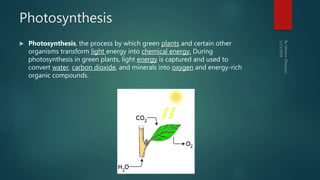
Photosynthesis
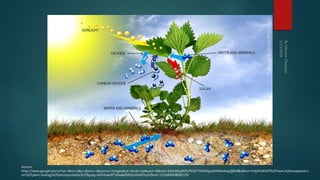
 Photosynthesis, the process by which green plants and certain other
organisms transform light energy into chemical energy. During
photosynthesis in green plants, light energy is captured and used to
convert water, carbon dioxide, and minerals into oxygen and energy-rich
organic compounds.
Source:
https://www.google.am/url?sa=i&rct=j&q=&esrc=s&source=images&cd=&cad=rja&uact=8&ved=0ahUKEwjW5cPVsO7YAhXGjywKHb0wAegQjRwIBw&url=http%3A%2F%2Fwww.myhouseplants.c
om%2Fplant-biology%2Fphotosynthesis%2F&psig=AOvVaw3P7sDaakXMGUxXb4e5hylY&ust=1516806998982256
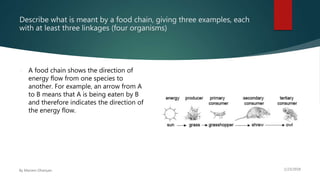
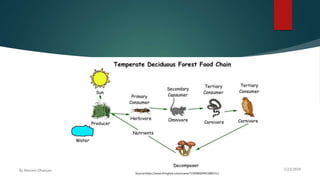
Describe what is meant by a food chain, giving three examples, each
with at least three linkages (four organisms)
 A food chain shows the direction of
energy flow from one species to
another. For example, an arrow from A
to B means that A is being eaten by B
and therefore indicates the direction of
the energy flow.
Source:https://www.thinglink.com/scene/723096604415885312
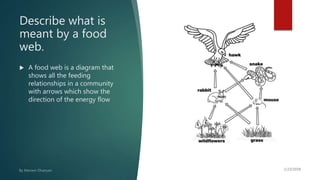
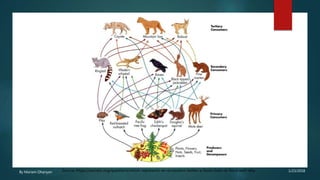
Describe what is
meant by a food
web.
 A food web is a diagram that
shows all the feeding
relationships in a community
with arrows which show the
direction of the energy flow
1/23/2018By Mariam Ohanyan Source: https://socratic.org/questions/which-represents-an-ecosystem-better-a-food-chain-or-food-web-why
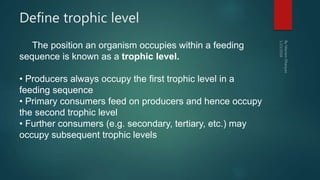
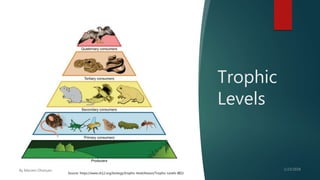
Define trophic level
The position an organism occupies within a feeding
sequence is known as a trophic level.
• Producers always occupy the first trophic level in a
feeding sequence
• Primary consumers feed on producers and hence occupy
the second trophic level
• Further consumers (e.g. secondary, tertiary, etc.) may
occupy subsequent trophic levels
Trophic
Levels
Source: https://www.ck12.org/biology/trophic-level/lesson/Trophic-Levels-BIO/
Explain the energy flow in a food
chain.
 Energy flows from producers to primary consumers, to secondary
consumers, to tertiary consumers...
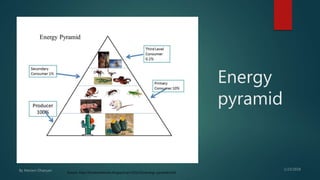
 Energy is lost between trophic levels in the form of heat through cell
respiration, faeces, tissue loss and death.
 Some of this lost energy is used by detritivores and saprotrophs. These in
turn also lose energy in the form of heat through cell respiration.
Energy
pyramid
Source: http://timdesertbiome.blogspot.am/2016/01/energy-pyramid.html
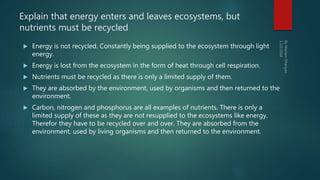
Explain that energy enters and leaves ecosystems, but
nutrients must be recycled
 Energy is not recycled. Constantly being supplied to the ecosystem through light
energy.
 Energy is lost from the ecosystem in the form of heat through cell respiration.
 Nutrients must be recycled as there is only a limited supply of them.
 They are absorbed by the environment, used by organisms and then returned to the
environment.
 Carbon, nitrogen and phosphorus are all examples of nutrients. There is only a
limited supply of these as they are not resupplied to the ecosystems like energy.
Therefor they have to be recycled over and over. They are absorbed from the
environment, used by living organisms and then returned to the environment.
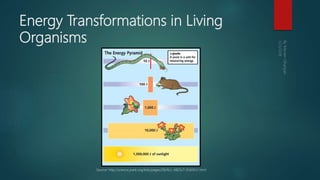
Energy Transformations in Living
Organisms
Source: http://science.jrank.org/kids/pages/59/ALL-ABOUT-ENERGY.html
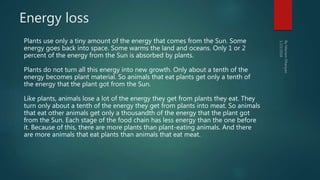
Energy loss
Plants use only a tiny amount of the energy that comes from the Sun. Some
energy goes back into space. Some warms the land and oceans. Only 1 or 2
percent of the energy from the Sun is absorbed by plants.
Plants do not turn all this energy into new growth. Only about a tenth of the
energy becomes plant material. So animals that eat plants get only a tenth of
the energy that the plant got from the Sun.
Like plants, animals lose a lot of the energy they get from plants they eat. They
turn only about a tenth of the energy they get from plants into meat. So animals
that eat other animals get only a thousandth of the energy that the plant got
from the Sun. Each stage of the food chain has less energy than the one before
it. Because of this, there are more plants than plant-eating animals. And there
are more animals that eat plants than animals that eat meat.
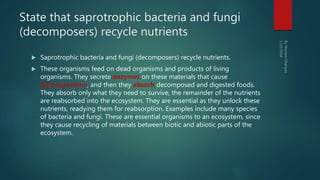
State that saprotrophic bacteria and fungi
(decomposers) recycle nutrients
 Saprotrophic bacteria and fungi (decomposers) recycle nutrients.
 These organisms feed on dead organisms and products of living
organisms. They secrete enzymes on these materials that cause
decomposition, and then they absorb decomposed and digested foods.
They absorb only what they need to survive, the remainder of the nutrients
are reabsorbed into the ecosystem. They are essential as they unlock these
nutrients, readying them for reabsorption. Examples include many species
of bacteria and fungi. These are essential organisms to an ecosystem, since
they cause recycling of materials between biotic and abiotic parts of the
ecosystem.
Ecological productivity
 In ecology, production (or productivity) refers to the
rate of generation of biomass in an ecosystem
 It is usually expressed in units of mass per area per
time (e.g. kg m–2 day–1)
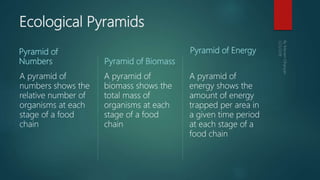
Primary Production
 Primary production describes the
production of chemical energy in organic
compounds by producers
 The main source of energy for primary
production is sunlight, but a fraction may
be driven by chemosynthesis by lithotrophs

Primary production may be categorized as
one of two types:
 Gross primary production (GPP) is the
amount of chemical energy as biomass that
a producer creates in a given length of time
 Net primary production (NPP) is the
amount of chemical energy that is not
consumed by respiration (NPP = GPP –
respiration)
Secondary Production
 Secondary production describes the
generation of biomass by
heterotrophic organisms (consumers)
 This biomass generation is driven by
the transfer of organic compounds
between trophic levels via feeding
 Secondary production may also be
categorized according to gross (total)
and net (usable) amounts of biomass
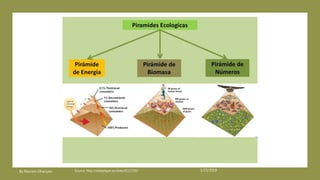
Ecological Pyramids
Pyramid of
Numbers
A pyramid of
numbers shows the
relative number of
organisms at each
stage of a food
chain
Pyramid of Biomass
A pyramid of
biomass shows the
total mass of
organisms at each
stage of a food
chain
Pyramid of Energy
A pyramid of
energy shows the
amount of energy
trapped per area in
a given time period
at each stage of a
food chain
1/23/2018By Mariam Ohanyan Source: http://slideplayer.es/slide/4115799/
Biomagnification
 Because energy transformations are only ~10% efficient, higher trophic
levels must consume more prey to meet energy needs
 If a pollutant is ingested by living organisms, it will become concentrated
at higher trophic levels as they eat more exposed prey
 The increase of a substance (such as a pollutant) in a particular organisms
is called bioaccumulation
 The increase in the concentration of a substance at a particular trophic
level is called biomagnification
Bioaccumulation
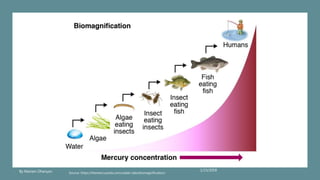
 Refers to how pollutants enter a food chain, whereas biomagnification
refers to the tendency of pollutants to concentrate as they move from one
trophic level to the next
 Because pollutants become concentrated by
biomagnification, higher trophic levels are more
susceptible to their toxic effects
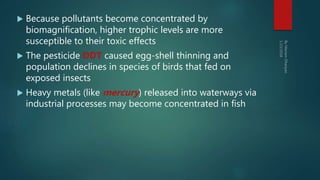
 The pesticide DDT caused egg-shell thinning and
population declines in species of birds that fed on
exposed insects
 Heavy metals (like mercury) released into waterways via
industrial processes may become concentrated in fish
1/23/2018By Mariam Ohanyan Source: https://themercurysite.com/caddo-lake/biomagnification/
THANK YOU

Topic 4.2 Energy Flow

  • 1.
    Topic 4.2 EnergyFlow "Shirakatsy Lyceum" International Scientific Educational Complex The International Baccalaureate Diploma Programme
  • 2.
    Understandings:  Most ecosystemsrely on a supply of energy from sunlight  Light energy is converted to chemical energy in carbon compounds by photosynthesis  Chemical energy in carbon compounds flows through food chains by means of feeding  Energy released from carbon compounds by respiration is used in living organisms and converted to heat  Living organisms cannot convert heat to other forms of energy  Heat is lost from ecosystems  Energy losses between trophic levels restrict the length of food chains and the biomass of higher trophic levels
  • 3.
    Photosynthesis  Photosynthesis, theprocess by which green plants and certain other organisms transform light energy into chemical energy. During photosynthesis in green plants, light energy is captured and used to convert water, carbon dioxide, and minerals into oxygen and energy-rich organic compounds.
  • 4.
  • 5.
    Describe what ismeant by a food chain, giving three examples, each with at least three linkages (four organisms)  A food chain shows the direction of energy flow from one species to another. For example, an arrow from A to B means that A is being eaten by B and therefore indicates the direction of the energy flow.
  • 6.
  • 7.
    Describe what is meantby a food web.  A food web is a diagram that shows all the feeding relationships in a community with arrows which show the direction of the energy flow
  • 8.
    1/23/2018By Mariam OhanyanSource: https://socratic.org/questions/which-represents-an-ecosystem-better-a-food-chain-or-food-web-why
  • 9.
    Define trophic level Theposition an organism occupies within a feeding sequence is known as a trophic level. • Producers always occupy the first trophic level in a feeding sequence • Primary consumers feed on producers and hence occupy the second trophic level • Further consumers (e.g. secondary, tertiary, etc.) may occupy subsequent trophic levels
  • 10.
  • 11.
    Explain the energyflow in a food chain.  Energy flows from producers to primary consumers, to secondary consumers, to tertiary consumers...  Energy is lost between trophic levels in the form of heat through cell respiration, faeces, tissue loss and death.  Some of this lost energy is used by detritivores and saprotrophs. These in turn also lose energy in the form of heat through cell respiration.
  • 12.
  • 13.
    Explain that energyenters and leaves ecosystems, but nutrients must be recycled  Energy is not recycled. Constantly being supplied to the ecosystem through light energy.  Energy is lost from the ecosystem in the form of heat through cell respiration.  Nutrients must be recycled as there is only a limited supply of them.  They are absorbed by the environment, used by organisms and then returned to the environment.  Carbon, nitrogen and phosphorus are all examples of nutrients. There is only a limited supply of these as they are not resupplied to the ecosystems like energy. Therefor they have to be recycled over and over. They are absorbed from the environment, used by living organisms and then returned to the environment.
  • 14.
    Energy Transformations inLiving Organisms Source: http://science.jrank.org/kids/pages/59/ALL-ABOUT-ENERGY.html
  • 15.
    Energy loss Plants useonly a tiny amount of the energy that comes from the Sun. Some energy goes back into space. Some warms the land and oceans. Only 1 or 2 percent of the energy from the Sun is absorbed by plants. Plants do not turn all this energy into new growth. Only about a tenth of the energy becomes plant material. So animals that eat plants get only a tenth of the energy that the plant got from the Sun. Like plants, animals lose a lot of the energy they get from plants they eat. They turn only about a tenth of the energy they get from plants into meat. So animals that eat other animals get only a thousandth of the energy that the plant got from the Sun. Each stage of the food chain has less energy than the one before it. Because of this, there are more plants than plant-eating animals. And there are more animals that eat plants than animals that eat meat.
  • 16.
    State that saprotrophicbacteria and fungi (decomposers) recycle nutrients  Saprotrophic bacteria and fungi (decomposers) recycle nutrients.  These organisms feed on dead organisms and products of living organisms. They secrete enzymes on these materials that cause decomposition, and then they absorb decomposed and digested foods. They absorb only what they need to survive, the remainder of the nutrients are reabsorbed into the ecosystem. They are essential as they unlock these nutrients, readying them for reabsorption. Examples include many species of bacteria and fungi. These are essential organisms to an ecosystem, since they cause recycling of materials between biotic and abiotic parts of the ecosystem.
  • 17.
    Ecological productivity  Inecology, production (or productivity) refers to the rate of generation of biomass in an ecosystem  It is usually expressed in units of mass per area per time (e.g. kg m–2 day–1)
  • 18.
    Primary Production  Primaryproduction describes the production of chemical energy in organic compounds by producers  The main source of energy for primary production is sunlight, but a fraction may be driven by chemosynthesis by lithotrophs  Primary production may be categorized as one of two types:  Gross primary production (GPP) is the amount of chemical energy as biomass that a producer creates in a given length of time  Net primary production (NPP) is the amount of chemical energy that is not consumed by respiration (NPP = GPP – respiration) Secondary Production  Secondary production describes the generation of biomass by heterotrophic organisms (consumers)  This biomass generation is driven by the transfer of organic compounds between trophic levels via feeding  Secondary production may also be categorized according to gross (total) and net (usable) amounts of biomass
  • 20.
    Ecological Pyramids Pyramid of Numbers Apyramid of numbers shows the relative number of organisms at each stage of a food chain Pyramid of Biomass A pyramid of biomass shows the total mass of organisms at each stage of a food chain Pyramid of Energy A pyramid of energy shows the amount of energy trapped per area in a given time period at each stage of a food chain
  • 21.
    1/23/2018By Mariam OhanyanSource: http://slideplayer.es/slide/4115799/
  • 22.
    Biomagnification  Because energytransformations are only ~10% efficient, higher trophic levels must consume more prey to meet energy needs  If a pollutant is ingested by living organisms, it will become concentrated at higher trophic levels as they eat more exposed prey  The increase of a substance (such as a pollutant) in a particular organisms is called bioaccumulation  The increase in the concentration of a substance at a particular trophic level is called biomagnification
  • 23.
    Bioaccumulation  Refers tohow pollutants enter a food chain, whereas biomagnification refers to the tendency of pollutants to concentrate as they move from one trophic level to the next
  • 24.
     Because pollutantsbecome concentrated by biomagnification, higher trophic levels are more susceptible to their toxic effects  The pesticide DDT caused egg-shell thinning and population declines in species of birds that fed on exposed insects  Heavy metals (like mercury) released into waterways via industrial processes may become concentrated in fish
  • 25.
    1/23/2018By Mariam OhanyanSource: https://themercurysite.com/caddo-lake/biomagnification/
  • 26.