

IBDP core
Topic 5.4
Cladistics
Understandings:
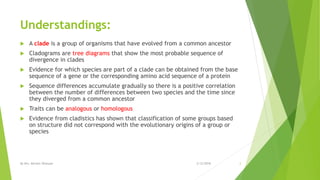
 A clade is a group of organisms that have evolved from a common ancestor
 Cladograms are tree diagrams that show the most probable sequence of
divergence in clades
 Evidence for which species are part of a clade can be obtained from the base
sequence of a gene or the corresponding amino acid sequence of a protein
 Sequence differences accumulate gradually so there is a positive correlation
between the number of differences between two species and the time since
they diverged from a common ancestor
 Traits can be analogous or homologous
 Evidence from cladistics has shown that classification of some groups based
on structure did not correspond with the evolutionary origins of a group or
species
2/12/2018By Mrs. Mariam Ohanyan 2
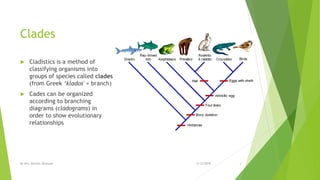
Clades
 Cladistics is a method of
classifying organisms into
groups of species called clades
(from Greek ‘klados' = branch)
 Cades can be organized
according to branching
diagrams (cladograms) in
order to show evolutionary
relationships
2/12/2018By Mrs. Mariam Ohanyan 3
2/12/2018By Mrs. Mariam Ohanyan 4
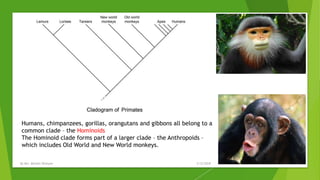
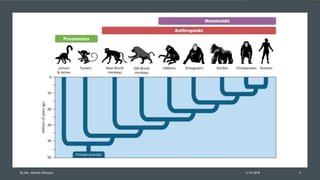
Humans, chimpanzees, gorillas, orangutans and gibbons all belong to a
common clade – the Hominoids
The Hominoid clade forms part of a larger clade – the Anthropoids –
which includes Old World and New World monkeys.
2/12/2018By Mrs. Mariam Ohanyan 5
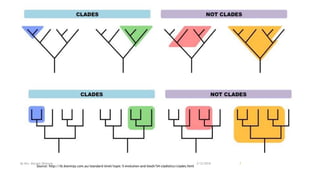
Rectangular tree (left) and diagonal ladder
(right) cladogram formats.
Source: https://my.vanderbilt.edu/lauranovick/treethinking/
2/12/2018By Mrs. Mariam Ohanyan 6
Source: http://ib.bioninja.com.au/standard-level/topic-5-evolution-and-biodi/54-cladistics/clades.html
2/12/2018By Mrs. Mariam Ohanyan 7
Cladograms
 Cladograms are tree diagrams where each branch point represents the
splitting of two new groups from a common ancestor
 Each branch point (node) represents a speciation event by which distinct
species are formed via divergent evolution
 Cladograms show the probable sequence of divergence and hence
demonstrate the likely evolutionary history (phylogeny) of a clade
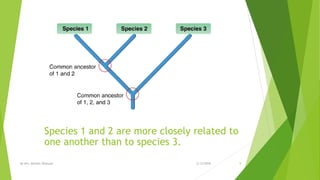
 The fewer the number of nodes between two groups the more closely related
they are expected to be
2/12/2018By Mrs. Mariam Ohanyan 8
Species 1 and 2 are more closely related to
one another than to species 3.
2/12/2018By Mrs. Mariam Ohanyan 9
Phylogenetic Classification
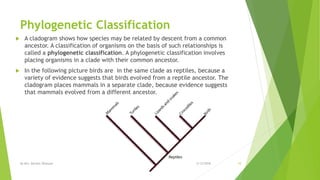
 A cladogram shows how species may be related by descent from a common
ancestor. A classification of organisms on the basis of such relationships is
called a phylogenetic classification. A phylogenetic classification involves
placing organisms in a clade with their common ancestor.
 In the following picture birds are in the same clade as reptiles, because a
variety of evidence suggests that birds evolved from a reptile ancestor. The
cladogram places mammals in a separate clade, because evidence suggests
that mammals evolved from a different ancestor.
2/12/2018By Mrs. Mariam Ohanyan 10
Molecular Evidence
 All organisms use DNA and RNA as genetic material and the genetic code by
which proteins are synthesized is (almost) universal.
 This shared molecular heritage means that base and amino acid sequences
can be compared to ascertain levels of relatedness.
 Over the course of millions of years, mutations will accumulate within any
given segment of DNA.
 The number of differences between comparable base sequences
demonstrates the degree of evolutionary divergence.
 A greater number of differences between comparable base sequences
suggests more time has past since two species diverged.
 Hence, the more similar the base sequences of two species are, the more
closely related the two species are expected to be.
2/12/2018By Mrs. Mariam Ohanyan 11
Molecular Evidence
 Amino acid sequences are typically used to compare distantly related species
(i.e. different taxa), while DNA or RNA base sequences are often used to
compare closely related organisms (e.g. different haplogroups – such as
various human ethnic groups).
2/12/2018By Mrs. Mariam Ohanyan 12
Source: http://www.ganfyd.org/index.php?title=File:Haemoglobin.gif
2/12/2018By Mrs. Mariam Ohanyan 13
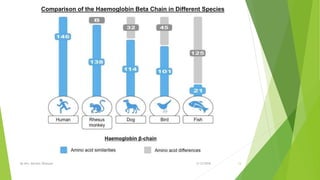
Comparison of the Haemoglobin Beta Chain in Different Species
Molecular clock
 Some genes or protein sequences may accumulate mutations at a relatively
constant rate (e.g. 1 change per million years)
 If this rate of change is reliable, scientists can calculate the time of
divergence according to the number of differences
 Different genes or proteins may change at different rates (e.g. haemoglobin
mutates more rapidly than cytochrome c)
 The rate of change for a particular gene may differ between different groups
of organisms
 Over long periods, earlier changes may be reversed by later changes,
potentially confounding the accuracy of predictions
2/12/2018By Mrs. Mariam Ohanyan 14
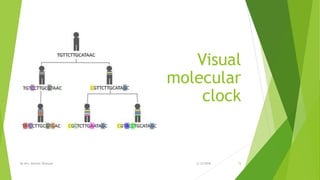
Visual
molecular
clock
2/12/2018By Mrs. Mariam Ohanyan 15
Convergent
evolution
Convergent evolution is the independent
evolution of similar features in species
with distinct lineages
It may occur when different species
occupy the same habitat and are thus
subjected to the same selection pressures
The shared conditions cause common
adaptations to be selected in different
species, resulting in structural similarity
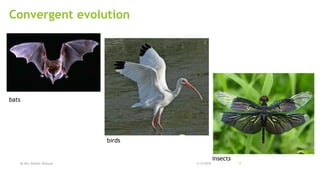
• An example of convergent evolution is the
development of wings in birds, bats and insects
2/12/2018 By Mrs. Mariam Ohanyan 16
Convergent evolution
2/12/2018By Mrs. Mariam Ohanyan 17
birds
bats
insects
Adaptive
radiation
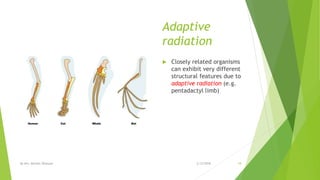
 Closely related organisms
can exhibit very different
structural features due to
adaptive radiation (e.g.
pentadactyl limb)
2/12/2018By Mrs. Mariam Ohanyan 18
Divergent evolution
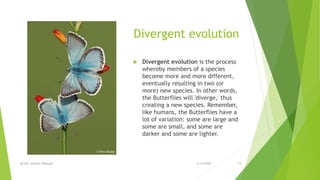
 Divergent evolution is the process
whereby members of a species
become more and more different,
eventually resulting in two (or
more) new species. In other words,
the Butterflies will 'diverge,' thus
creating a new species. Remember,
like humans, the Butterflies have a
lot of variation: some are large and
some are small, and some are
darker and some are lighter.
2/12/2018By Mrs. Mariam Ohanyan 19
Homologous structures
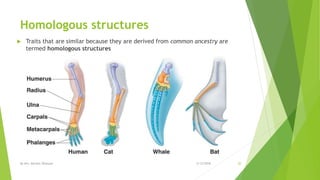
 Traits that are similar because they are derived from common ancestry are
termed homologous structures
2/12/2018By Mrs. Mariam Ohanyan 20
Analogous structures
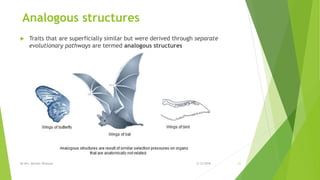
 Traits that are superficially similar but were derived through separate
evolutionary pathways are termed analogous structures
2/12/2018By Mrs. Mariam Ohanyan 21
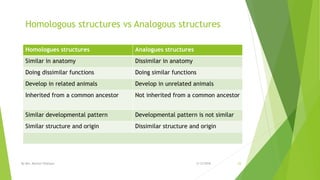
 In evolutionary biology, the term analogous structures pertain to the various
structures in different species having the same function but have evolved
separately, thus do not share common ancestor. In comparison, the
homologous structures pertain to the structures that show similar
morphology and anatomy but have different functions. Moreover, the
homologous structures are believed to have evolved from a common ancestor
since they show similar development pattern during embryonic development.
 The term analogous structures is applied in the concept of convergent
evolution (convergence), which pertains to the evolutionary process wherein
the organisms evolve bodily parts that are analogous in terms of structure and
function despite their ancestors that are very dissimilar or unrelated.
Examples of analogous structures are as follows:
 Wings of insects and birds used for flying
 Jointed legs of insects and vertebrates used for locomotion
 Fins of fish and flippers of whales (mammals)
 These structures show that they have the same function, e.g. flight or
locomotion but have a different origin or that they have evolved separately.
2/12/2018By Mrs. Mariam Ohanyan 22
Homologous structures vs Analogous structures
2/12/2018By Mrs. Mariam Ohanyan 23
Homologues structures Analogues structures
Similar in anatomy Dissimilar in anatomy
Doing dissimilar functions Doing similar functions
Develop in related animals Develop in unrelated animals
Inherited from a common ancestor Not inherited from a common ancestor
Similar developmental pattern Developmental pattern is not similar
Similar structure and origin Dissimilar structure and origin
Clade Reclassification
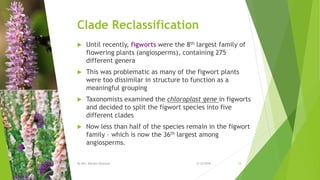
 Until recently, figworts were the 8th largest family of
flowering plants (angiosperms), containing 275
different genera
 This was problematic as many of the figwort plants
were too dissimilar in structure to function as a
meaningful grouping
 Taxonomists examined the chloroplast gene in figworts
and decided to split the figwort species into five
different clades
 Now less than half of the species remain in the figwort
family – which is now the 36th largest among
angiosperms.
2/12/2018By Mrs. Mariam Ohanyan 24
In Situ Hybridization
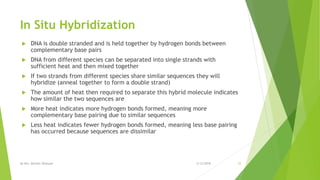
 DNA is double stranded and is held together by hydrogen bonds between
complementary base pairs
 DNA from different species can be separated into single strands with
sufficient heat and then mixed together
 If two strands from different species share similar sequences they will
hybridize (anneal together to form a double strand)
 The amount of heat then required to separate this hybrid molecule indicates
how similar the two sequences are
 More heat indicates more hydrogen bonds formed, meaning more
complementary base pairing due to similar sequences
 Less heat indicates fewer hydrogen bonds formed, meaning less base pairing
has occurred because sequences are dissimilar
2/12/2018By Mrs. Mariam Ohanyan 25
2/12/2018By Mrs. Mariam Ohanyan 26
Source: http://ib.bioninja.com.au/standard-level/topic-5-evolution-and-biodi/54-cladistics/in-situ-hybridisation.html
Mitochondrial DNA
 Mitochondrial DNA (maternal DNA) is an important tool for tracing
evolutionary relationships within a species
 Mitochondrial DNA offers several benefits over nuclear DNA when determining
phylogenetic pathways, including:
2/12/2018By Mrs. Mariam Ohanyan 27
1. Unlike nuclear DNA, which comes from both parents, mitochondrial DNA
comes only from the mother.
2. As maternal DNA is passed from the mother, no recombination occurs,
maintaining sequence fidelity/ճշտություն/.
3. Mitochondria produce reactive oxygen species, which cause sequences
to mutate at a higher rate
4. As every cell has mitochondria, large amounts of maternal DNA can be
gathered for sequencing.
2/12/2018By Mrs. Mariam Ohanyan 28
2/12/2018By Mrs. Mariam Ohanyan 29
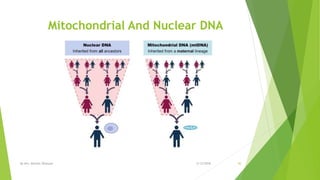
Mitochondrial And Nuclear DNA
2/12/2018By Mrs. Mariam Ohanyan 30

Evolution 5.4 cladistics /IBDP core/

  • 1.
  • 2.
    Understandings:  A cladeis a group of organisms that have evolved from a common ancestor  Cladograms are tree diagrams that show the most probable sequence of divergence in clades  Evidence for which species are part of a clade can be obtained from the base sequence of a gene or the corresponding amino acid sequence of a protein  Sequence differences accumulate gradually so there is a positive correlation between the number of differences between two species and the time since they diverged from a common ancestor  Traits can be analogous or homologous  Evidence from cladistics has shown that classification of some groups based on structure did not correspond with the evolutionary origins of a group or species 2/12/2018By Mrs. Mariam Ohanyan 2
  • 3.
    Clades  Cladistics isa method of classifying organisms into groups of species called clades (from Greek ‘klados' = branch)  Cades can be organized according to branching diagrams (cladograms) in order to show evolutionary relationships 2/12/2018By Mrs. Mariam Ohanyan 3
  • 4.
    2/12/2018By Mrs. MariamOhanyan 4 Humans, chimpanzees, gorillas, orangutans and gibbons all belong to a common clade – the Hominoids The Hominoid clade forms part of a larger clade – the Anthropoids – which includes Old World and New World monkeys.
  • 5.
  • 6.
    Rectangular tree (left)and diagonal ladder (right) cladogram formats. Source: https://my.vanderbilt.edu/lauranovick/treethinking/ 2/12/2018By Mrs. Mariam Ohanyan 6
  • 7.
  • 8.
    Cladograms  Cladograms aretree diagrams where each branch point represents the splitting of two new groups from a common ancestor  Each branch point (node) represents a speciation event by which distinct species are formed via divergent evolution  Cladograms show the probable sequence of divergence and hence demonstrate the likely evolutionary history (phylogeny) of a clade  The fewer the number of nodes between two groups the more closely related they are expected to be 2/12/2018By Mrs. Mariam Ohanyan 8
  • 9.
    Species 1 and2 are more closely related to one another than to species 3. 2/12/2018By Mrs. Mariam Ohanyan 9
  • 10.
    Phylogenetic Classification  Acladogram shows how species may be related by descent from a common ancestor. A classification of organisms on the basis of such relationships is called a phylogenetic classification. A phylogenetic classification involves placing organisms in a clade with their common ancestor.  In the following picture birds are in the same clade as reptiles, because a variety of evidence suggests that birds evolved from a reptile ancestor. The cladogram places mammals in a separate clade, because evidence suggests that mammals evolved from a different ancestor. 2/12/2018By Mrs. Mariam Ohanyan 10
  • 11.
    Molecular Evidence  Allorganisms use DNA and RNA as genetic material and the genetic code by which proteins are synthesized is (almost) universal.  This shared molecular heritage means that base and amino acid sequences can be compared to ascertain levels of relatedness.  Over the course of millions of years, mutations will accumulate within any given segment of DNA.  The number of differences between comparable base sequences demonstrates the degree of evolutionary divergence.  A greater number of differences between comparable base sequences suggests more time has past since two species diverged.  Hence, the more similar the base sequences of two species are, the more closely related the two species are expected to be. 2/12/2018By Mrs. Mariam Ohanyan 11
  • 12.
    Molecular Evidence  Aminoacid sequences are typically used to compare distantly related species (i.e. different taxa), while DNA or RNA base sequences are often used to compare closely related organisms (e.g. different haplogroups – such as various human ethnic groups). 2/12/2018By Mrs. Mariam Ohanyan 12 Source: http://www.ganfyd.org/index.php?title=File:Haemoglobin.gif
  • 13.
    2/12/2018By Mrs. MariamOhanyan 13 Comparison of the Haemoglobin Beta Chain in Different Species
  • 14.
    Molecular clock  Somegenes or protein sequences may accumulate mutations at a relatively constant rate (e.g. 1 change per million years)  If this rate of change is reliable, scientists can calculate the time of divergence according to the number of differences  Different genes or proteins may change at different rates (e.g. haemoglobin mutates more rapidly than cytochrome c)  The rate of change for a particular gene may differ between different groups of organisms  Over long periods, earlier changes may be reversed by later changes, potentially confounding the accuracy of predictions 2/12/2018By Mrs. Mariam Ohanyan 14
  • 15.
  • 16.
    Convergent evolution Convergent evolution isthe independent evolution of similar features in species with distinct lineages It may occur when different species occupy the same habitat and are thus subjected to the same selection pressures The shared conditions cause common adaptations to be selected in different species, resulting in structural similarity • An example of convergent evolution is the development of wings in birds, bats and insects 2/12/2018 By Mrs. Mariam Ohanyan 16
  • 17.
    Convergent evolution 2/12/2018By Mrs.Mariam Ohanyan 17 birds bats insects
  • 18.
    Adaptive radiation  Closely relatedorganisms can exhibit very different structural features due to adaptive radiation (e.g. pentadactyl limb) 2/12/2018By Mrs. Mariam Ohanyan 18
  • 19.
    Divergent evolution  Divergentevolution is the process whereby members of a species become more and more different, eventually resulting in two (or more) new species. In other words, the Butterflies will 'diverge,' thus creating a new species. Remember, like humans, the Butterflies have a lot of variation: some are large and some are small, and some are darker and some are lighter. 2/12/2018By Mrs. Mariam Ohanyan 19
  • 20.
    Homologous structures  Traitsthat are similar because they are derived from common ancestry are termed homologous structures 2/12/2018By Mrs. Mariam Ohanyan 20
  • 21.
    Analogous structures  Traitsthat are superficially similar but were derived through separate evolutionary pathways are termed analogous structures 2/12/2018By Mrs. Mariam Ohanyan 21
  • 22.
     In evolutionarybiology, the term analogous structures pertain to the various structures in different species having the same function but have evolved separately, thus do not share common ancestor. In comparison, the homologous structures pertain to the structures that show similar morphology and anatomy but have different functions. Moreover, the homologous structures are believed to have evolved from a common ancestor since they show similar development pattern during embryonic development.  The term analogous structures is applied in the concept of convergent evolution (convergence), which pertains to the evolutionary process wherein the organisms evolve bodily parts that are analogous in terms of structure and function despite their ancestors that are very dissimilar or unrelated. Examples of analogous structures are as follows:  Wings of insects and birds used for flying  Jointed legs of insects and vertebrates used for locomotion  Fins of fish and flippers of whales (mammals)  These structures show that they have the same function, e.g. flight or locomotion but have a different origin or that they have evolved separately. 2/12/2018By Mrs. Mariam Ohanyan 22
  • 23.
    Homologous structures vsAnalogous structures 2/12/2018By Mrs. Mariam Ohanyan 23 Homologues structures Analogues structures Similar in anatomy Dissimilar in anatomy Doing dissimilar functions Doing similar functions Develop in related animals Develop in unrelated animals Inherited from a common ancestor Not inherited from a common ancestor Similar developmental pattern Developmental pattern is not similar Similar structure and origin Dissimilar structure and origin
  • 24.
    Clade Reclassification  Untilrecently, figworts were the 8th largest family of flowering plants (angiosperms), containing 275 different genera  This was problematic as many of the figwort plants were too dissimilar in structure to function as a meaningful grouping  Taxonomists examined the chloroplast gene in figworts and decided to split the figwort species into five different clades  Now less than half of the species remain in the figwort family – which is now the 36th largest among angiosperms. 2/12/2018By Mrs. Mariam Ohanyan 24
  • 25.
    In Situ Hybridization DNA is double stranded and is held together by hydrogen bonds between complementary base pairs  DNA from different species can be separated into single strands with sufficient heat and then mixed together  If two strands from different species share similar sequences they will hybridize (anneal together to form a double strand)  The amount of heat then required to separate this hybrid molecule indicates how similar the two sequences are  More heat indicates more hydrogen bonds formed, meaning more complementary base pairing due to similar sequences  Less heat indicates fewer hydrogen bonds formed, meaning less base pairing has occurred because sequences are dissimilar 2/12/2018By Mrs. Mariam Ohanyan 25
  • 26.
    2/12/2018By Mrs. MariamOhanyan 26 Source: http://ib.bioninja.com.au/standard-level/topic-5-evolution-and-biodi/54-cladistics/in-situ-hybridisation.html
  • 27.
    Mitochondrial DNA  MitochondrialDNA (maternal DNA) is an important tool for tracing evolutionary relationships within a species  Mitochondrial DNA offers several benefits over nuclear DNA when determining phylogenetic pathways, including: 2/12/2018By Mrs. Mariam Ohanyan 27 1. Unlike nuclear DNA, which comes from both parents, mitochondrial DNA comes only from the mother. 2. As maternal DNA is passed from the mother, no recombination occurs, maintaining sequence fidelity/ճշտություն/. 3. Mitochondria produce reactive oxygen species, which cause sequences to mutate at a higher rate 4. As every cell has mitochondria, large amounts of maternal DNA can be gathered for sequencing.
  • 28.
  • 29.
  • 30.
    Mitochondrial And NuclearDNA 2/12/2018By Mrs. Mariam Ohanyan 30