PRESENTATION BY: Dr. Fahad Shafi
P.G 1ST Year
Deptt of Radiodiagnosis
Dual characteristics of X-rays
 X-rays belong to a group of radiation called
electromagnetic radiation .
 Electromagnetic radiation has dual characteristic,
comprises of both
 Wave
 Particle
Wave concept : Propagated through space in the form of waves.
Waves of all types have associated wavelength and frequency
 Particle concept of EM radiation: Short EM waves such as
X-rays predominantly react with matter as if they were
particles rather than waves.. These particles are actually
discrete bundles of energy and each of these bundles is
called a quantum or photon.
 Particle concept used to describe interaction between
radiation & matter
METHODS OF INTERACTIONS
 Photons : absorbed / scattered.
 Attenuation : Reduction of intensity. Difference in attenuation gives
the radiographic image.
 Absorbed : completely removed from the x-ray beam & cease to exist.
 Scattered : Random course. No useful information. No image only
darkness. Adds noise to the system. Film quality affected : “film fog”.
 About 1% of the x rays that strike a patient's body emerge from the
body to produce the final image. The radiographic image is formed
on a radiographic plate that is similar to the film of a camera.
 Remaining 99% of the x-rays ---
Scattered / Absorbed.
ATOMIC STRUCTURE
X-ray photons may interact either with orbital electrons or
with the nucleus. In the diagnostic energy range, the
interactions are always with orbital electrons.
The molecular bonding energies ,however are too small to
influence the type and number of interactions .
The most important factor is the atomic make up of a
tissue and not its molecular structure.
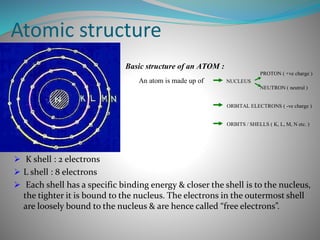
Atomic structure
 K shell : 2 electrons
 L shell : 8 electrons
 Each shell has a specific binding energy & closer the shell is to the nucleus,
the tighter it is bound to the nucleus. The electrons in the outermost shell
are loosely bound to the nucleus & are hence called “free electrons”.
Basic structure of an ATOM :
PROTON ( +ve charge )
An atom is made up of NUCLEUS
NEUTRON ( neutral )
ORBITAL ELECTRONS ( -ve charge )
ORBITS / SHELLS ( K, L, M, N etc. )
 Energy value of electronic shells is also determined by the
atomic number of the atom.
 K-shell electron are more tightly bound in elements of
high atomic number. Pb : 88keV while Ca : 4keV.
 Electrons in the K -shell are at a lower energy level than
electrons in the L-shell. If we consider the outermost
electrons as free ,than inner shell electrons are in energy
debt. The energy debt is greatest when they are close to
nucleus in an element with a high atomic number.
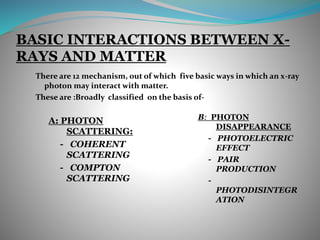
BASIC INTERACTIONS BETWEEN X-
RAYS AND MATTER
There are 12 mechanism, out of which five basic ways in which an x-ray
photon may interact with matter.
These are :Broadly classified on the basis of-
A: PHOTON
SCATTERING:
- COHERENT
SCATTERING
- COMPTON
SCATTERING
B: PHOTON
DISAPPEARANCE
- PHOTOELECTRIC
EFFECT
- PAIR
PRODUCTION
-
PHOTODISINTEGR
ATION
1. COHERENT SCATTERING
Radiation undergoes Only Change in direction. No change in wavelength
thats why sometime called “ unmodified scattering”
Coherent scattering of X-rays is an interaction of the wave
type in which the X-ray is deflected.
Coherent Scattering occurs mainly at low energies.
It is of
two types :Both type described in terms of “ wave Particle Interaction”
( also called “ Classical scattering”)
 Thomson scattering : Single electron involved in the interaction.
 Rayleigh scattering : Co-operative interaction of all the electrons.
1. COHERENT SCATTERING
What happens in coherent scattering ?
Low energy radiation encounters electrons
Electrons are set into vibration
Vibrating electron, emits radiation.
Atom returns to its undisturbed state
Fig : Rayleigh scattering
1. COHERENT SCATTERING
No ionization --- why??? because, no energy transfer. Only
change of direction.
Only effect is to change direction of incident photon.
Less than 5%. Not important in diagnostic radiology.
Produces scattered radiation but of negligible quantity.
2. PHOTOELECTRIC EFFECT
What happens in Photoelectric effect ?
An incident PHOTON encounters a K shell electron and ejects it from the
orbit
The photon disappears, giving up ( nearly) all its energy to the
electron
The electron ( now free of its energy debt) flies off into space as a
photoelectron carrying the excess energy as kinetic energy.
The K shell electron void filled immediately by another electron
and hence the excess energy is released as CHARACTERISTIC
RADIATION.
The atom is ionised.
PHOTOELECTRIC EFFECT
Percentage of photoelectric reactions
Radiation
energy(keV)
Water Compact
bone
Sodium
iodide
20 65 89 94
60 7 31 95
100 2 9 88
Characteristic radiation
How does this happen ?
 After the electron has been ejected, the atom is left with a
void in the K shell & an excess of energy equivalent to the
binding energy.
 This state of the atom is highly unstable & to achieve a low
energy stable state ( as all physical systems seek the lowest
possible energy state ) an electron immediately drops in to fill
the void.
 As the electron drops into the K shell, it gives up its excess
energy in the form of an x-ray photon. The amount of energy
released is characteristic of each element & hence the
radiation produced is called Characteristic radiation.
2. PHOTOELECTRIC EFFECT
Thus the Photoelectric effect yields three end products
:
 Characteristic radiation
 A -ve ion ( photoelectron )
 A+ve ion (atom deficient in one electron )
2. PHOTOELECTRIC EFFECT
Probability of occurrence :
 The incident photon energy > binding energy of the
electron.
 Photon energy similar to electron binding energy
Photoelectric effect  1
(energy)³
 The probability of a reaction increases sharply as the
atomic no. increases
Photoelectric effect  (atomic no.)³
 Low atomic number : interaction mostly at the K shell.
 High atomic number : interaction mostly at L and M shell.
 In summary, Photoelectric reactions are most likely to
occur with low energy photons and elements with high
atomic numbers provided the photons have sufficient
energy to overcome the forces binding the electrons in
their cells.
For eg : I2
K shell :33.2keV
L-shell : 4.9keV
M shell 0.6 Kev.
From L-shell to K-
shell a 28.3 kev(33.2-
4.9=28.3) keV photon
is released.
The void in the L-
shell is then filled
with a photon from
the M shell with the
production of a ( 4.9-
0.6 KeV)4.3 keV
photon.
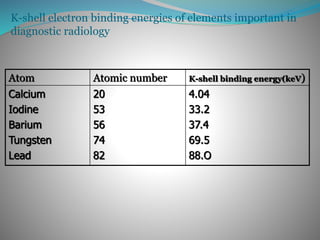
K-shell electron binding energies of elements important in
diagnostic radiology
Atom Atomic number K-shell binding energy(keV)
Calcium
Iodine
Barium
Tungsten
Lead
20
53
56
74
82
4.04
33.2
37.4
69.5
88.O
2. PHOTOELECTRIC EFFECT :
Applications in diagnostic radiology :
Advantages :
Excellent radiographic images :
 No scatter radiation.
 Enhances natural tissue
contrast. Depends on 3rd power
of the atomic no., so it
magnifies the difference in
tissues composed of different
elements, such as bone & soft
tissue
 Lower energy photons : total
absorption. Dominant upto 500
keV.
Disadvantage:
 Maximum radiation exposure.
 All the energy is absorbed by the
patient whereas in other reactions
only part of the incident photon’s
energy is absorbed.
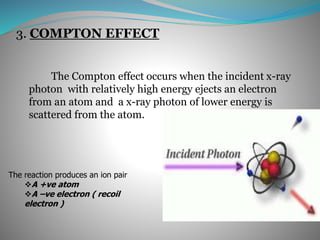
3. COMPTON EFFECT
The Compton effect occurs when the incident x-ray
photon with relatively high energy ejects an electron
from an atom and a x-ray photon of lower energy is
scattered from the atom.
The reaction produces an ion pair
A +ve atom
A –ve electron ( recoil
electron )
COMPTON SCATTERING
Almost all the scatter radiation that we encountered
In diagnostic radiology comes from Compton Scattering
Kinetic energy of recoil electron
 Energy of photon distributed
Retained by the deflected photon.
 Two factors determine the amount of energy the photon transmits :
 The initial energy of the photon.
 Its angle of deflection.
1.Initial energy :- Higher the energy more difficult to deflect.
High energy : Travel straight retaining most of the
energy.
Low energy : Most scatter back at angle of 180º
2. Angle of deflection :- Greater the angle, lesser the energy
trasmitted. With a direct hit, maximum energy is transferred to
the recoil electron. The photon retains some energy & deflects
back along its original path at an angle of 180º.
3. COMPTON EFFECT
ENERGY OF COMPTON SCATTERED PHOTONS
The change in wavelength of a scattered photon is calculated as :
Δλ = 0.024 ( 1 – cos θ ) ,
where Δλ = change in wavelength
θ = angle of photon deflection
3. COMPTON EFFECT
Probability of occurence :
It depends on :-
 Total number of electrons : It further depends on density and
number of electrons per gram of the absorber. All elements contain approx.
the same no. of electrons per gram, regardless of their atomic no. Therefore
the no. of Compton reactions is independent of the atomic no. of the
absorber.
 Energy of the radiation : The no. of reactions gradually diminishes as
photon energy increases, so that a high energy photon is more likely to pass
through the body than a low energy photon.
Disadvantages of Compton reaction :
Scatter radiation : Almost all the scatter radiation that we encounter in diagnostic
Radiology comes from Compton scattering. In the diagnostic energy range, the
photon retains most of its original energy. This creates a serious problem, because
photons that are scattered at narrow angles have an excellent chance of reaching an x-
ray film & producing fog.
Exceedingly difficult to remove –
► cannot be removed by filters because they are too energetic.
► cannot be removed by grids because of narrow angles of deflection.
It is also a major safety hazard. Even after 90˚ deflection most of its
original energy is retained. Scatter radiation as energetic as the primary
radiation.
Safety hazard for the radiologist, personnel and the
patient.
Exceedingly difficult to remove –
► cannot be removed by filters because they are too
energetic.
► cannot be removed by grids because of narrow angles of
deflection.
4. PAIR PRODUCTION
No importance in diagnostic radiology.
What happens in Pair production ?
A high energy photon interacts with the nucleus of an atom.
The photon disappears & its energy is converted into matter in the form
of two particles
 An electron
 A positron (particle with same mass as electron, but with +ve
charge.)
Mass of one electron is 0.51 MeV.
2 electron masses are produced.
So the interaction cannot take place with photon energy less than 1.02
MeV.
4. PAIR PRODUCTION
Positron annihilation.
What happens to the
Positron ?
Slowly moving Positron
combines with a free electron
to produce two photons of
radiation.
2 mass units are converted,
giving a total energy of 1.022
MeV.
To conserve momentum, two
photons each with 0.511 MeV
energy are ejected in opposite
direction.
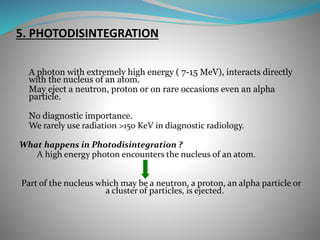
5. PHOTODISINTEGRATION
A photon with extremely high energy ( 7-15 MeV), interacts directly
with the nucleus of an atom.
May eject a neutron, proton or on rare occasions even an alpha
particle.
No diagnostic importance.
We rarely use radiation >150 KeV in diagnostic radiology.
What happens in Photodisintegration ?
A high energy photon encounters the nucleus of an atom.
Part of the nucleus which may be a neutron, a proton, an alpha particle or
a cluster of particles, is ejected.
RELATIVE FREQUENCY OF BASIC INTERACTIONS
Coherent scattering : About 5% .
Minor role throughout the diagnostic energy range.
Compton scattering : Dominant interaction in water.
Water is used to represent tissues with low atomic nos.
such as air, fat and muscle.
Photoelectric reaction : usually seen in the contrast
agents because of their high atomic numbers.
 Bone is intermediate between water & the contrast agents.
At low energies, Photoelectric reactions are more common,
while at high energies, Compton scattering is dominant.
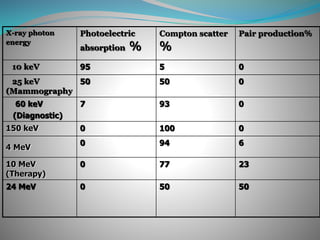
RELATIVE FREQUENCY OF BASIC INTERACTIONS
X-ray photon
energy
Photoelectric
absorption %
Compton scatter
%
Pair production%
10 keV 95 5 0
25 keV
(Mammography
50 50 0
60 keV
(Diagnostic)
7 93 0
150 keV 0 100 0
4 MeV
0 94 6
10 MeV
(Therapy)
0 77 23
24 MeV 0 50 50
SUMMARY
Only two interactions are important in diagnostic radiology, the Photoelectric effect &
Compton scattering.
 The Photoelectric effect
is the predominant interaction with low energy radiation & high atomic
no. absorbers.
It generates no significant scatter radiation & produces high contrast in
the x-ray image.
 But, unfortunately it exposes the patient to a great deal of
radiation.
Compton scattering
 is the most common interaction at higher diagnostic energies.
 responsible for almost all scatter radiation.
 radiographic image contrast is less compared to photoelectric
effect.
 Coherent scattering is numerically unimportant.
 Pair production & Photodisintegration occur at energies above the
useful energy range.
THANK YOU

Ppt

  • 1.
    PRESENTATION BY: Dr.Fahad Shafi P.G 1ST Year Deptt of Radiodiagnosis
  • 2.
    Dual characteristics ofX-rays  X-rays belong to a group of radiation called electromagnetic radiation .  Electromagnetic radiation has dual characteristic, comprises of both  Wave  Particle Wave concept : Propagated through space in the form of waves. Waves of all types have associated wavelength and frequency
  • 3.
     Particle conceptof EM radiation: Short EM waves such as X-rays predominantly react with matter as if they were particles rather than waves.. These particles are actually discrete bundles of energy and each of these bundles is called a quantum or photon.  Particle concept used to describe interaction between radiation & matter
  • 4.
    METHODS OF INTERACTIONS Photons : absorbed / scattered.  Attenuation : Reduction of intensity. Difference in attenuation gives the radiographic image.  Absorbed : completely removed from the x-ray beam & cease to exist.  Scattered : Random course. No useful information. No image only darkness. Adds noise to the system. Film quality affected : “film fog”.  About 1% of the x rays that strike a patient's body emerge from the body to produce the final image. The radiographic image is formed on a radiographic plate that is similar to the film of a camera.  Remaining 99% of the x-rays --- Scattered / Absorbed.
  • 5.
    ATOMIC STRUCTURE X-ray photonsmay interact either with orbital electrons or with the nucleus. In the diagnostic energy range, the interactions are always with orbital electrons. The molecular bonding energies ,however are too small to influence the type and number of interactions . The most important factor is the atomic make up of a tissue and not its molecular structure.
  • 6.
    Atomic structure  Kshell : 2 electrons  L shell : 8 electrons  Each shell has a specific binding energy & closer the shell is to the nucleus, the tighter it is bound to the nucleus. The electrons in the outermost shell are loosely bound to the nucleus & are hence called “free electrons”. Basic structure of an ATOM : PROTON ( +ve charge ) An atom is made up of NUCLEUS NEUTRON ( neutral ) ORBITAL ELECTRONS ( -ve charge ) ORBITS / SHELLS ( K, L, M, N etc. )
  • 7.
     Energy valueof electronic shells is also determined by the atomic number of the atom.  K-shell electron are more tightly bound in elements of high atomic number. Pb : 88keV while Ca : 4keV.  Electrons in the K -shell are at a lower energy level than electrons in the L-shell. If we consider the outermost electrons as free ,than inner shell electrons are in energy debt. The energy debt is greatest when they are close to nucleus in an element with a high atomic number.
  • 8.
    BASIC INTERACTIONS BETWEENX- RAYS AND MATTER There are 12 mechanism, out of which five basic ways in which an x-ray photon may interact with matter. These are :Broadly classified on the basis of- A: PHOTON SCATTERING: - COHERENT SCATTERING - COMPTON SCATTERING B: PHOTON DISAPPEARANCE - PHOTOELECTRIC EFFECT - PAIR PRODUCTION - PHOTODISINTEGR ATION
  • 9.
    1. COHERENT SCATTERING Radiationundergoes Only Change in direction. No change in wavelength thats why sometime called “ unmodified scattering” Coherent scattering of X-rays is an interaction of the wave type in which the X-ray is deflected. Coherent Scattering occurs mainly at low energies. It is of two types :Both type described in terms of “ wave Particle Interaction” ( also called “ Classical scattering”)  Thomson scattering : Single electron involved in the interaction.  Rayleigh scattering : Co-operative interaction of all the electrons.
  • 10.
    1. COHERENT SCATTERING Whathappens in coherent scattering ? Low energy radiation encounters electrons Electrons are set into vibration Vibrating electron, emits radiation. Atom returns to its undisturbed state Fig : Rayleigh scattering
  • 11.
    1. COHERENT SCATTERING Noionization --- why??? because, no energy transfer. Only change of direction. Only effect is to change direction of incident photon. Less than 5%. Not important in diagnostic radiology. Produces scattered radiation but of negligible quantity.
  • 12.
    2. PHOTOELECTRIC EFFECT Whathappens in Photoelectric effect ? An incident PHOTON encounters a K shell electron and ejects it from the orbit The photon disappears, giving up ( nearly) all its energy to the electron The electron ( now free of its energy debt) flies off into space as a photoelectron carrying the excess energy as kinetic energy. The K shell electron void filled immediately by another electron and hence the excess energy is released as CHARACTERISTIC RADIATION. The atom is ionised.
  • 13.
  • 14.
    Percentage of photoelectricreactions Radiation energy(keV) Water Compact bone Sodium iodide 20 65 89 94 60 7 31 95 100 2 9 88
  • 15.
    Characteristic radiation How doesthis happen ?  After the electron has been ejected, the atom is left with a void in the K shell & an excess of energy equivalent to the binding energy.  This state of the atom is highly unstable & to achieve a low energy stable state ( as all physical systems seek the lowest possible energy state ) an electron immediately drops in to fill the void.  As the electron drops into the K shell, it gives up its excess energy in the form of an x-ray photon. The amount of energy released is characteristic of each element & hence the radiation produced is called Characteristic radiation.
  • 16.
    2. PHOTOELECTRIC EFFECT Thusthe Photoelectric effect yields three end products :  Characteristic radiation  A -ve ion ( photoelectron )  A+ve ion (atom deficient in one electron )
  • 17.
    2. PHOTOELECTRIC EFFECT Probabilityof occurrence :  The incident photon energy > binding energy of the electron.  Photon energy similar to electron binding energy Photoelectric effect  1 (energy)³  The probability of a reaction increases sharply as the atomic no. increases Photoelectric effect  (atomic no.)³
  • 18.
     Low atomicnumber : interaction mostly at the K shell.  High atomic number : interaction mostly at L and M shell.  In summary, Photoelectric reactions are most likely to occur with low energy photons and elements with high atomic numbers provided the photons have sufficient energy to overcome the forces binding the electrons in their cells.
  • 19.
    For eg :I2 K shell :33.2keV L-shell : 4.9keV M shell 0.6 Kev. From L-shell to K- shell a 28.3 kev(33.2- 4.9=28.3) keV photon is released. The void in the L- shell is then filled with a photon from the M shell with the production of a ( 4.9- 0.6 KeV)4.3 keV photon.
  • 20.
    K-shell electron bindingenergies of elements important in diagnostic radiology Atom Atomic number K-shell binding energy(keV) Calcium Iodine Barium Tungsten Lead 20 53 56 74 82 4.04 33.2 37.4 69.5 88.O
  • 21.
    2. PHOTOELECTRIC EFFECT: Applications in diagnostic radiology : Advantages : Excellent radiographic images :  No scatter radiation.  Enhances natural tissue contrast. Depends on 3rd power of the atomic no., so it magnifies the difference in tissues composed of different elements, such as bone & soft tissue  Lower energy photons : total absorption. Dominant upto 500 keV. Disadvantage:  Maximum radiation exposure.  All the energy is absorbed by the patient whereas in other reactions only part of the incident photon’s energy is absorbed.
  • 22.
    3. COMPTON EFFECT TheCompton effect occurs when the incident x-ray photon with relatively high energy ejects an electron from an atom and a x-ray photon of lower energy is scattered from the atom. The reaction produces an ion pair A +ve atom A –ve electron ( recoil electron )
  • 23.
    COMPTON SCATTERING Almost allthe scatter radiation that we encountered In diagnostic radiology comes from Compton Scattering
  • 24.
    Kinetic energy ofrecoil electron  Energy of photon distributed Retained by the deflected photon.  Two factors determine the amount of energy the photon transmits :  The initial energy of the photon.  Its angle of deflection. 1.Initial energy :- Higher the energy more difficult to deflect. High energy : Travel straight retaining most of the energy. Low energy : Most scatter back at angle of 180º 2. Angle of deflection :- Greater the angle, lesser the energy trasmitted. With a direct hit, maximum energy is transferred to the recoil electron. The photon retains some energy & deflects back along its original path at an angle of 180º. 3. COMPTON EFFECT
  • 25.
    ENERGY OF COMPTONSCATTERED PHOTONS The change in wavelength of a scattered photon is calculated as : Δλ = 0.024 ( 1 – cos θ ) , where Δλ = change in wavelength θ = angle of photon deflection
  • 26.
    3. COMPTON EFFECT Probabilityof occurence : It depends on :-  Total number of electrons : It further depends on density and number of electrons per gram of the absorber. All elements contain approx. the same no. of electrons per gram, regardless of their atomic no. Therefore the no. of Compton reactions is independent of the atomic no. of the absorber.  Energy of the radiation : The no. of reactions gradually diminishes as photon energy increases, so that a high energy photon is more likely to pass through the body than a low energy photon.
  • 27.
    Disadvantages of Comptonreaction : Scatter radiation : Almost all the scatter radiation that we encounter in diagnostic Radiology comes from Compton scattering. In the diagnostic energy range, the photon retains most of its original energy. This creates a serious problem, because photons that are scattered at narrow angles have an excellent chance of reaching an x- ray film & producing fog. Exceedingly difficult to remove – ► cannot be removed by filters because they are too energetic. ► cannot be removed by grids because of narrow angles of deflection.
  • 28.
    It is alsoa major safety hazard. Even after 90˚ deflection most of its original energy is retained. Scatter radiation as energetic as the primary radiation. Safety hazard for the radiologist, personnel and the patient. Exceedingly difficult to remove – ► cannot be removed by filters because they are too energetic. ► cannot be removed by grids because of narrow angles of deflection.
  • 29.
    4. PAIR PRODUCTION Noimportance in diagnostic radiology. What happens in Pair production ? A high energy photon interacts with the nucleus of an atom. The photon disappears & its energy is converted into matter in the form of two particles  An electron  A positron (particle with same mass as electron, but with +ve charge.) Mass of one electron is 0.51 MeV. 2 electron masses are produced. So the interaction cannot take place with photon energy less than 1.02 MeV.
  • 30.
    4. PAIR PRODUCTION Positronannihilation. What happens to the Positron ? Slowly moving Positron combines with a free electron to produce two photons of radiation. 2 mass units are converted, giving a total energy of 1.022 MeV. To conserve momentum, two photons each with 0.511 MeV energy are ejected in opposite direction.
  • 31.
    5. PHOTODISINTEGRATION A photonwith extremely high energy ( 7-15 MeV), interacts directly with the nucleus of an atom. May eject a neutron, proton or on rare occasions even an alpha particle. No diagnostic importance. We rarely use radiation >150 KeV in diagnostic radiology. What happens in Photodisintegration ? A high energy photon encounters the nucleus of an atom. Part of the nucleus which may be a neutron, a proton, an alpha particle or a cluster of particles, is ejected.
  • 32.
    RELATIVE FREQUENCY OFBASIC INTERACTIONS Coherent scattering : About 5% . Minor role throughout the diagnostic energy range. Compton scattering : Dominant interaction in water. Water is used to represent tissues with low atomic nos. such as air, fat and muscle. Photoelectric reaction : usually seen in the contrast agents because of their high atomic numbers.  Bone is intermediate between water & the contrast agents. At low energies, Photoelectric reactions are more common, while at high energies, Compton scattering is dominant.
  • 33.
    RELATIVE FREQUENCY OFBASIC INTERACTIONS
  • 34.
    X-ray photon energy Photoelectric absorption % Comptonscatter % Pair production% 10 keV 95 5 0 25 keV (Mammography 50 50 0 60 keV (Diagnostic) 7 93 0 150 keV 0 100 0 4 MeV 0 94 6 10 MeV (Therapy) 0 77 23 24 MeV 0 50 50
  • 35.
    SUMMARY Only two interactionsare important in diagnostic radiology, the Photoelectric effect & Compton scattering.  The Photoelectric effect is the predominant interaction with low energy radiation & high atomic no. absorbers. It generates no significant scatter radiation & produces high contrast in the x-ray image.  But, unfortunately it exposes the patient to a great deal of radiation. Compton scattering  is the most common interaction at higher diagnostic energies.  responsible for almost all scatter radiation.  radiographic image contrast is less compared to photoelectric effect.  Coherent scattering is numerically unimportant.  Pair production & Photodisintegration occur at energies above the useful energy range.
  • 36.