Presented by
MISS KAJAL JHA
BSC.MIT
BPKIHS,DHARAN
Presented to
Dr. ARUN GUPTA
Assistant
Professor
BPKIHS,DHARAN
RADIATION PROTECTION-
01
What is radiation?
Radiation is energy that is given off by particular
materials and devices.
• Low-energy radiation is called non-ionizing
radiation.
– Sound waves, visible light, microwaves
• Radiation that can cause specific changes in
molecules is called ionizing radiation (>10ev)
– X-rays, gamma rays and particles (1)
Radiation is
OMNIPRESENT
Natural vs. artificial
• Here we are-
Humans are exposed to ionizing radiation—
about 80% of which is natural—on a regular
basis. Common sources are shown in the
chart below.
RADIATION PROTECTION
Radiation protection, also known as
radiological protection, is defined by the
International Atomic Energy Agency (IAEA)
as "The protection of people from harmful
effects of exposure to ionizing radiation,
and the means for achieving this".
Exposure can be from a source of radiation
external to the human body or due to
internal irradiation caused by the ingestion
of radioactive contamination.
o For radiation protection and dosimetry
assessment the International Commission on
Radiation Protection (ICRP) and International
Commission on Radiation Units and
Measurements (ICRU) publish
recommendations and data.
o Which is used to calculate the biological effects
on the human body of certain levels of radiation,
and thereby advise acceptable dose uptake limits.
What does ionizing radiation do?
-
Too much ionizing radiation may damage tissues
How was X-ray discovered?
X-rays were discovered in 1895 by Wilhelm
Conrad Roentgen (1845-1923) who was a
Professor at Wuerzburg University in Germany.
Working with a cathode-ray tube in his laboratory,
Roentgen observed a fluorescent glow of
crystals on a table near his tube.
A Second Source of Radiation
Shortly after the discovery of X-rays, another form
of penetrating rays was discovered. In 1896,
French scientist Henri Becquerel discovered
natural radioactivity.
Many scientists of the period were working with
cathode rays, and other scientists were
gathering evidence on the theory that the atom
could be subdivided. Some of the new research
showed that certain types of atoms disintegrate
by themselves
Has it ever done any damage?
Given the nearly ubiquitous fascination
of the public with x rays and their immediate
and widespread application to medicine, it
was inevitable that x-ray injuries would soon
appear.
Along with the injuries, came a recognition
of the hazard implicit in the use of x radiation
and of the need for protective measures.
The most important provisions for x-ray
protection were elucidated during the first
decade after Roentgen’s discovery .
The story of the development of radiation
protection methods and their applications in
radiology can be told in terms of four
overlapping chronological periods (Table I). (3)
THE EVIL ASPECT OF
RADIATION(HISTORY)
 Between1911 and 1914, three review articles
identified 54 cancer deaths and 198 cases of
radiation induced maligancy.
 Thomas Edisions’s assistance, Clarence M.
Dally ,died of cancer making it hr first American
radiation fatality in 1904.
Are they always evil?
NO
Has helped to develop the world.
Science
Research
Industry
Medicine
Environment protection
A number of academic and commercial fields
e.t.c.
So how do we know if its curse or
boon?
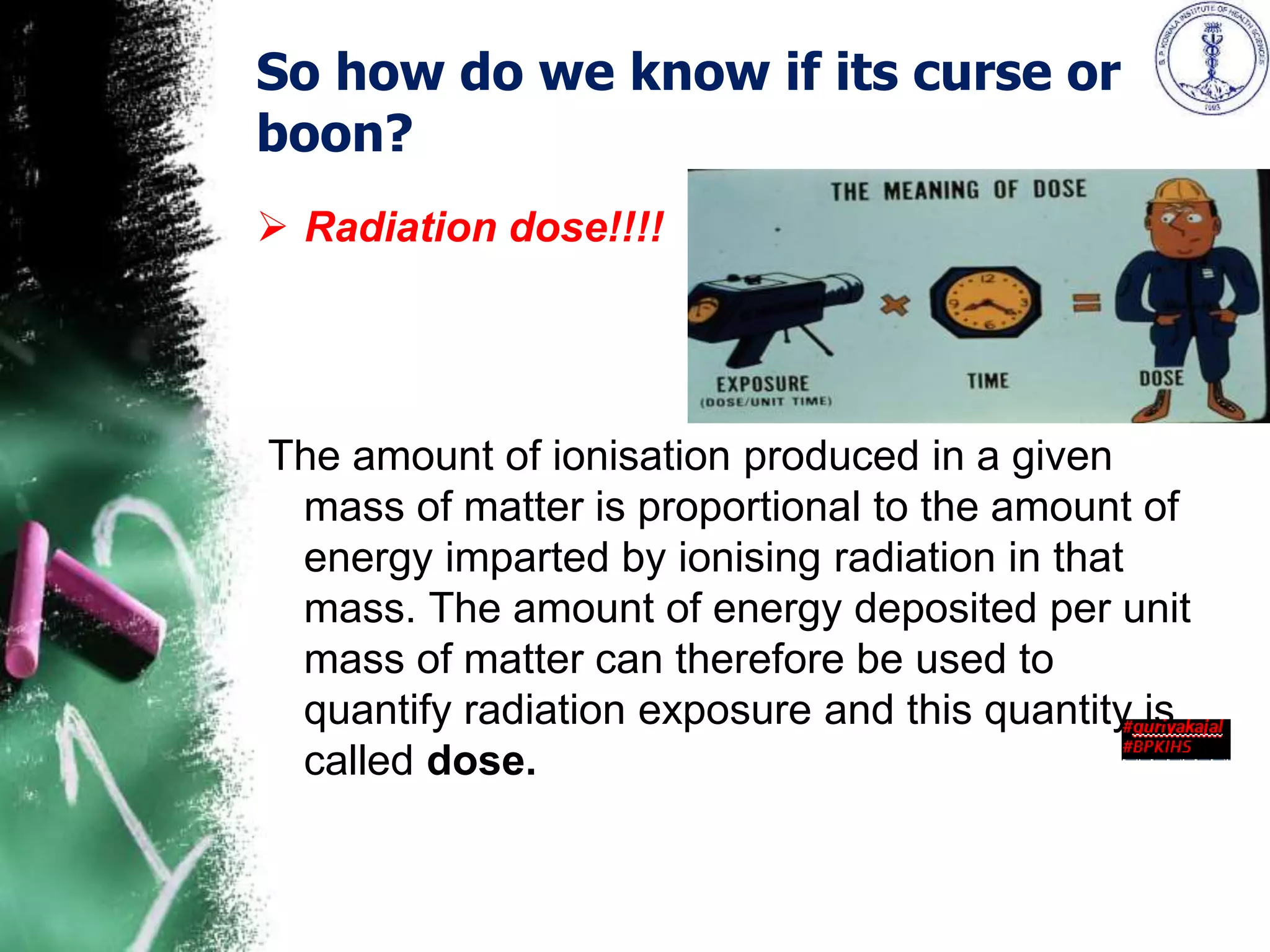
 Radiation dose!!!!
The amount of ionisation produced in a given
mass of matter is proportional to the amount of
energy imparted by ionising radiation in that
mass. The amount of energy deposited per unit
mass of matter can therefore be used to
quantify radiation exposure and this quantity is
called dose.
types of dose
• Exposure
 Exposure rate
• Absorbed dose
• Equivalent dose
 Radiation weighting factor
• Effective Dose
 Tissue weighting factor
Exposure and Exposure rate
• Exposure is a measure of the amount of
ionizations produced in air by photon radiation.
• Exposure is commonly used to refer to being
around a radiation source, e.g., if you have a
chest x ray, you are exposed to radiation
• Exposure rate is the amount of exposure you
are receiving per unit time (e.g., 1 mR/hour)
• (Dose rate is the amount of dose you are receiving
per unit time (e.g., 1 mrem/hour).
Absorbed dose
The fundamental dosimetric quantity in radiation
protection is the absorbed dose.
It is the energy absorbed from radiation per unit
mass of the matter with which the radiation
interacts.
The energy absorbed can be expressed in grays
(Gy), where 1 Gy is one joule per kilogram for
all types of materials.
Equivalent dose
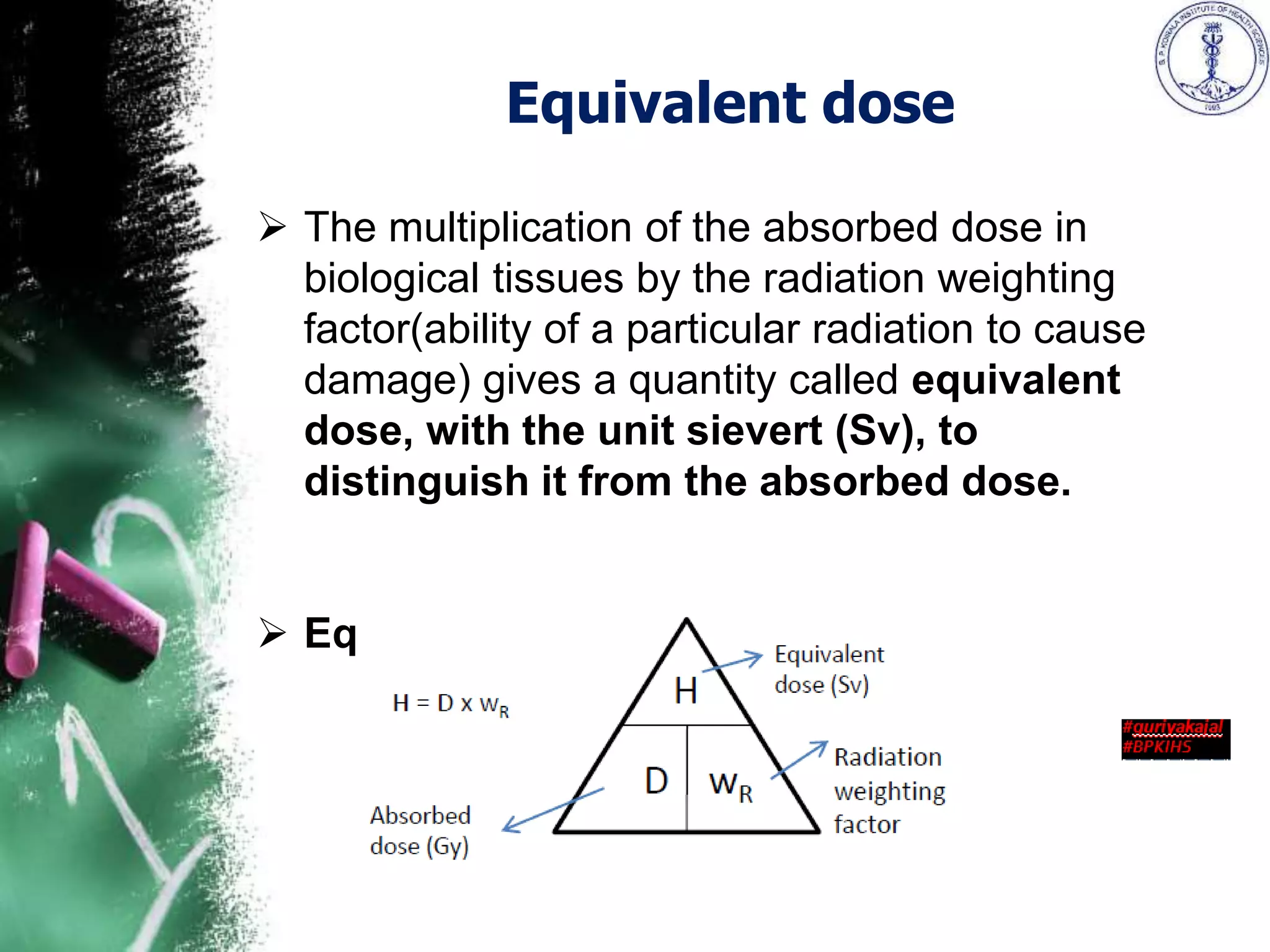
 The multiplication of the absorbed dose in
biological tissues by the radiation weighting
factor(ability of a particular radiation to cause
damage) gives a quantity called equivalent
dose, with the unit sievert (Sv), to
distinguish it from the absorbed dose.
 Equation
Radiation weighting factor
The radiation weighting factor is a dimensionless
factor
 used to obtain the equivalent dose from the
absorbed dose averaged over a tissue or organ and
is based on the type of radiation absorbed
 This allows comparison of the energy deposition
behavior of all types of radiations with X-rays and
gamma rays defined as having a radiation weighting
factor of one.
Tissue weighting factor
• The tissue weighting factor, wT, is
the factor by which the equivalent dose in
a tissue or organ T is weighted to represent
the relative contribution of that tissue or organ
to the total health detriment resulting from
uniform irradiation of the body (ICRP 1991b)
Measuring Radiation
 The amount of radiation being given off, or
emitted, by a radioactive material is measured
using the conventional unit curie (Ci), named
for the famed scientist Marie Curie, or the SI
unit becquerel (Bq).
 The radiation dose absorbed by a person (that
is, the amount of energy deposited in human
tissue by radiation) is measured using the
conventional unit rad or the SI unit gray (Gy).
 The biological risk of exposure to radiation is
measured using the conventional unit rem or
the SI unit sievert (Sv).
Measuring Emitted Radiation
 A radioactive atom gives off or emits radioactivity
because the nucleus has too many particles, too
much energy, or too much mass to be stable. The
nucleus breaks down, or disintegrates, in an attempt
to reach a nonradioactive (stable) state. As the
nucleus disintegrates, energy is released in the form
of radiation.
 The Ci or Bq is used to express the number of
disintegrations of radioactive atoms in a radioactive
material over a period of time. For example, one Ci
is equal to 37 billion (37 X 109) disintegrations per
second. The Ci is being replaced by the Bq. Since
one Bq is equal to one disintegration per second,
one Ci is equal to 37 billion (37 X 109) Bq.
Measuring Radiation Dose
 When a person is exposed to radiation, energy
is deposited in the tissues of the body. The
amount of energy deposited per unit of weight
of human tissue is called the absorbed dose.
Absorbed dose is measured using the
conventional rad or the SI Gy.
 The rad, which stands for radiation absorbed
dose, was the conventional unit of
measurement, but it has been replaced by
the Gy. One Gy is equal to 100 rad.
Measuring Biological Risk
 A person’s biological risk (that is, the risk that a
person will suffer health effects from an exposure
to radiation) is measured using the conventional
unit rem or the SI unit Sv.
 The rem has been replaced by the Sv. One Sv is
equal to 100 rem.
Conversions and units with
combination
 Conversions from the SI units to older units are as
follows:
 1 Gy = 100 rad
 1 mGy = 100 mrad
 1 Sv = 100 rem
 1 mSv = 100 mrem
• Note 1R=2.58*10^-4 C/Kg
1 Bq=3.73*10dps
Radiation Units
 rad or radiation absorbed dose
The amount of radiant energy absorbed in a certain
amount of tissue.
 gray (Gy)
A unit of absorbed radiation equal to the dose of
one joule of energy absorbed per kilogram of
matter, or 100 rad. The unit is named for the British
physician L. Harold Gray (1905-1965), an authority
on the use of radiation in the treatment of cancer.
 milligray (mGy)
A unit of absorbed radiation equal to one
thousandth of a gray, or 0.1 rad.
 rem or roentgen-equivalent-man
A unit of measurement that takes into account
different biological responses to different kinds of
radiation. The radiation quantity measured by the
rem is called equivalent dose.
 millirem
One thousandth of a rem, the unit for measuring
equivalent dose.
 roentgen (R, r) (rent-gen, rent-chen)
The international unit of exposure dose for x-rays or
gamma rays. Roentgens are named after Professor
Wilhelm Konrad Roentgen, the man who discovered
x-rays in 1895.
 sievert (Sv) (see-vert)
The unit for measuring ionizing radiation
effective dose, which accounts for relative
sensitivities of different tissues and organs
exposed to radiation. The radiation quantity
measured by the sievert is called effective
dose.
 millisievert (mSv) (mill-i-see-vert)
One thousandth of a sievert, the unit for
measuring effective dose.
Equipments and patients
effective dose
S/NO EQUIPMENTS PT.EFFECTIVE
DOSE(mSv)
1 General radiography 0.1-1
2 Mammography 0.4
3 CT 2-20
4 Intervantional radiography 1-100
5 Dental radiography 0.005-0.1
6 Dual Emission Xray Absorption/DEXA 0.001
Dose limiting recommendation –
(european nuclear society)
 The effective dose for members of the public
must not exceed 1 mSv/year. The limit for the
lens of the eye is 15 mSv/year and for the skin
50 mSv/year.
Examples of the influence of some
common adjustable CT techniques on
patient radiation dose
Who are the regulating
bodies? (via NCBI)
The principal federal agencies with
responsibilities for radiation protection of the
public are
- the Environmental Protection Agency (EPA),
- EPA was created by Reorganization Plan No. 3 of 1970
- the Nuclear Regulatory Commission,
- The Nuclear Regulatory Commission is an independent regulatory
authority created by the Energy Reorganization Act of 1974
-the Department of Energy (DOE).
DOE was created by the Department of Energy Organization Act of 1977.
Important national organizations that have
developed recommendations on radiation
protection,
-National Council on Radiation Protection (NCRP)
NCRP is a nonprofit corporation chartered by Congress in 1964
--the Health Physics Society
The Health Physics Society was formed in 1956
 The principal international organization
concerned with radiation protection
The International Commission on Radiological
Protection (ICRP)
 ICRP was established in 1928 as the International X-ray and Radium
Protection Committee and was restructured under its present name in
1950.
 International Atomic Energy Agency (IAEA) and
 IAEA is an intergovernmental organization established in 1957 under
the auspices of the United Nations
 the Commission of the European Communities
(CEC).
 CEC is authorized under the Euratom Treaty on Atomic Energy in the
European Communities, which was signed in Rome in 1957.
The ICRP Recommendation
 ( ICRP publication 103 – 2007)
 • The Principle of Justification: Any decision that alters the
radiation exposure situation should do more good than harm.
 • The Principle of Optimisation of Protection: The likelihood of
incurring exposure, the number of people exposed, and the
magnitude of their individual doses should all be kept as low
as reasonably achievable, (ALARA) taking into account
economic and societal factors.
 • The Principle of Application of Dose Limits: The total dose to
any individual from regulated sources in planned exposure
situations other than medical exposure of patients should not
exceed the appropriate limits specified by the Commission.
Socratic questions for referring
clinicians when considering
imaging procedures
Fundamentals of
radiation protection
1. Doses are proportional to the time of exposure
provided the dose rates are the same.
a. Total dose(mSv)=dose rate(mSv/hr) * time
2. Dose rates are inversely proportional to the
distance squared.
a. I=k/d ^2
3. performing portable x-ray exams a tech should
be atleast six feet from the source of the
radiation.
10 day rule
• The “10 day rule” recommended that, in women
of child-bearing potential, non-urgent x ray
examinations that entailed pelvic irradiation
should be restricted to the first 10 days of the
menstrual cycle.
What is a Personnel Monitoring
Program?
• A systematic process for monitoring,
recording, evaluating, and reporting the
radiation doses received by
occupationally exposed individuals
A dosimeter is a device that measures directly or
indirectly -
• exposure
• KERMA (Kinetic Energy Released per unit Mass of air)
measures the amount of radiation energy in air, unit is J/kg.)
• absorbed dose
• equivalent dose
• or other related quantities.
The dosimeter along with its reader is referred to
as a dosimetry system.
Types of dosimeters
• charge collection devices; radiation energy is
converted to electric charge (either directly or
indirectly) and the dosimeter converts this
charge into a signal output
 gas-filled collectors
 scintillation detectors
 solid-state detectors
• other type; devices made of material that
changes on exposure to radiation energy
 photographic film
 thermoluminescent detectors (TLD)
 optically stimulated luminescent detectors
• Film dosimeters
 are used to measure radiation exposure to
workers to monitor radiation safety and ensuring
that they receive doses below the appropriate
limit.
 cheapest and most common
 give a permanent record of exposure, i.e. not re-
usable
 their dependence on photon energy, temperature
and chemicals limit their accuracy.
Thermoluminescent dosimeter (TLD)
• Thermoluminescent dosimeter (TLD)
 passive radiation detection device
 better accuracy than a film dosimeter (its linearity
of response to dose,its relative energy
independence and its sensitivity to low doses.)
 can measure doses from 0.01 mGy to 10 Gy 3.
 No permanent record or re-readability or
immediate on a job read out is not possible.
 Has our names and random number.
 Non transferable and reusable
• Parts
 plastic holder
 nickel-coated aluminum card with TLD discs(d=12mm)
• the discs are made of a thermoluminescent material,
commonly calcium sulphate doped with dysprosium
(CaSO4:Dy) or lithium fluoride (LiF)
• nearly tissue equivalent, although not at all x-ray
energies
• the discs are 0.8 mm thick and have a 1.35 cm diameter
 Three filters against each disc
• top: aluminum and copper (d=1mm , t=1mm))
• middle: perspex (solid transparent plastic made of polymethyl
methacrylate) (d=299mm , t=1.6mm))
• lower: open(d=52.5mm)
a. High energy Xray and Gamma doses can be
measured from the disc 1.
b. Low energy , beta and gamma doses can be
measured from disc 2.
c. Low energy beta can be measured from disc 3.
Process
1. When a TLD is exposed to ionization radiarion
at ambient temperature,the radiation interacts
with the phosphor crystal and deposits all or
part of the incident energy in that material
2. Some of the atoms in the material that absorbs
that energy becomes ionized producing free
electrons, these electrons get trapped in the
crystal lattice itself
How is radiation calculated?
1. Heating (with nitrogen gas up to the temperature 250C )the
crystal causes the crystal lattice to vibrate,
releasing the trapped electrons in the process.
2. As the electrons come back to a ground state,
they release the captured energy from
ionization as light.
3. It is light that is read using photomultiplier
tubes and the photons read is equal to the
radiation stricking the phosphour
(glow curve charts).
Optically stimulated
luminescence (OSL)
a methodology that can be employed in
personnel dosimetry to determine the “dose of
record.”
• It is an alternative to thermoluminescent
dosimetry and film dosimetry.
• Materials suitable for OSL are similar to those
used in thermoluminescent dosimetry, i.e., they
are crystalline solids. In many cases, the same
material can be used either as an OSL
dosimeter or a TLD.
• Radiation energy deposited in the material
promotes electrons from the valence band to
the conduction band.
• These electrons move to traps in the band gap.
• The greater the radiation energy absorbed
(dose), the greater the number of trapped
electrons.
• • When it is time to assess the dose, the
trapped electrons are freed by exposing the
dosimeter to light.
• When the electrons are freed, they fall to a
lower energy level and emit light photons.
• The intensity of the emitted light is measured
and used to calculate the dose.
• Not all the electrons are freed from their traps.
If the light output from the OSL dosimeter is
analyzed over a short period of time, many
electrons will remain trapped. This means that
the dosimeter can be reread many times
without a significant loss of signal.
Advantages of OSL Dosimeters
• OSL dosimeters can be read at room temperature. This
simplifies the design of the equipment.
• No need for nitrogen gas.
• The use of OSL powders deposited in thin layers creates a two-
dimensional detector with imaging capabilities much like film.
• No correction factors are needed for individual elements
• Unlike a TLD, OSL dosimeters can be reread multiple times.
• Depending on the illumination conditions, there will be a
decrease of signal of less than one percent in a second reading.
• Used OSL badges are often archived for several years.
• No fading except in extreme temperatures.
• No annealing required.
Disadvantages of OSL
Dosimeters
• The OSL system is more expensive to use than
TLDs.
• Workers might wonder why doses are being
reported with OSL dosimeters when no dose
was reported with TL dosimeters.
• Uncertainties in background brings into
question the validity of reporting doses of a few
mrem.
By pointing the instrument at a light source, the position of the fiber may
be observed through a system of built-in lenses.The fiber is viewed on a
translucent scale which is graduated in units of exposure.
Typical industrial radiography pocket dosimeters have a full scale reading of
200 milliroentgens but there are designs that will record higher amounts.
Charge leakage, or drift, can also affect the reading of a dosimeter.
Leakage should be no greater than 2 percent of full scale in a 24 hour
period.
The limited range, inability to provide a permanent record, and the
potential for discharging and reading loss due to dropping or bumping are a
few of the main disadvantages of a pocket dosimeter.
Scintillator Detectors
• based on scintillation (light emission) are known
as scintillation detectors..
 ● A photomultiplier tube (PMT) is optically
coupled to the scintillator to convert the light
pulse into an electric pulse. Some survey meters
use photodiodes in place of PMTs.
Properties of scintillation
detectors
1. Conversion efficiency should be high
2. Decay time of excited state should be short
3. Material should be transparent,rugged and
unaffected by moisture
4. Attenuation cofficient should be high as
conversion efficiency.
5. Scintillating phosphors include solid organic
materials such as anthracene, stilbene and
plastic scintillators as well as thallium activated
and inorganic phosphors such as NaI(Tl) or
CsI(Tl).
Ionization chamber
• Simplest of all gass filled detectors
• Works on the principle that charged particles
can ionize gas
• The number of ions paired formed gives the
information of the nature of the incidet particle
(radiation )and its energy
Typical locations for
dosimeters are:
• ▪On forehead (prescription point for children)
• ▪Neck (thinnest point)
• ▪Chest: entrance and exit dose to check lung
block thickness
• ▪Umbilicus (prescription point in adults, since it
is typically the thickest part of the body)
• ▪Optional: extremities, especially upper and
lower legs if compensators are used
• ▪Selected protocols require testes boosts for
pediatric male patients
1.Consol of CT should have 2mm Pb Eq
2.The distance from the Xray table to console
should be 2 mm.
3.9 inches brickwall or 7 inches concreat wall is
used for 1.5mm Pb Eq.
Recent advances
1) significant research efforts are being made to develop
ultra-thin radiation protection gloves with high radiation
attenuation
1) for use by surgeons performing cardiac catheterisation or similar
interventional radiology procedures where tactile sensitivity is of
paramount importance.
2) The worlds leading manufacturers of radiation
protection gloves are able to offer gloves as thin as
0.20mm thickness containing no lead.
3) State of the art material science research has led to the
development of ultra-light functional core materials with
no lead at all using a combination of bismuth, antimony
and tungsten offering the same level of radiation
attenuation as conventional lead containing material.
4) future holds the promise of new generation imaging
technology that may completely eliminate the use
ionising radiation
Where Did the Myth That
Radiation Glows Green Come
From?
By C Stuart Hardwick.
-Probably from radium, which was widely used
in self-luminous paint starting in 1908. When
mixed with phosphorescent copper-doped zinc
sulfide, radium emits a characteristic green
glow
REFERENCES
1. Frederic H. Fahey DSc, What You Should Know About Radiation and Nuclear
Medicine,frederic.fahey@childrens.harvard.edu
2. NDT Research Center, History of Radiography, htps://www.nde-
ed.org/EducationResources/CommunityCollege/Radiography/Introduction/history.htm
3. Allen Brodsky, Sc.D. , Department of Radiation Science,Georgetown University,
Washington, D.C . , Ronald 1. Kathren, M.Sc.Department of Radiologic
Sciences,University of Washington, Historical Development of Radiation Safety
Practices in Radiology.
4. Radiation Safety Training Module: Diagnostic Radiology,Radiation Protection in
Diagnostic Radiology.
5. Surendra Maharajan, Radiation Protection ,September-2016,Tokyo University.
6. Radiation protection and the NRC,United States Nuclear Regulatory Comission.
7. General Principles of Radiation Protection in Fields of Diagnostic Medical Exposure
,http://dx.doi.org/10.3346/jkms.2016.31.S1.S6 • J Korean Med Sci 2016; 31: S6-9
8. Protection Against Ionising Radiation Radiation Protection Series F-1 February 2014
9. Christensen’s Physics of Diagnostic Radiology fourth edition.
10. Evaluation of Guidelines for Exposures to Technologically Enhanced Naturally Occurring
Radioactive Materials. htps://www.ncbi.nlm.nih.gov/books/NBK230640.
THANK
YOU

Ppt on radiation protection 01 final

  • 1.
    Presented by MISS KAJALJHA BSC.MIT BPKIHS,DHARAN Presented to Dr. ARUN GUPTA Assistant Professor BPKIHS,DHARAN RADIATION PROTECTION- 01
  • 2.
    What is radiation? Radiationis energy that is given off by particular materials and devices. • Low-energy radiation is called non-ionizing radiation. – Sound waves, visible light, microwaves • Radiation that can cause specific changes in molecules is called ionizing radiation (>10ev) – X-rays, gamma rays and particles (1)
  • 5.
  • 8.
  • 9.
    Humans are exposedto ionizing radiation— about 80% of which is natural—on a regular basis. Common sources are shown in the chart below.
  • 11.
    RADIATION PROTECTION Radiation protection,also known as radiological protection, is defined by the International Atomic Energy Agency (IAEA) as "The protection of people from harmful effects of exposure to ionizing radiation, and the means for achieving this". Exposure can be from a source of radiation external to the human body or due to internal irradiation caused by the ingestion of radioactive contamination.
  • 12.
    o For radiationprotection and dosimetry assessment the International Commission on Radiation Protection (ICRP) and International Commission on Radiation Units and Measurements (ICRU) publish recommendations and data. o Which is used to calculate the biological effects on the human body of certain levels of radiation, and thereby advise acceptable dose uptake limits.
  • 13.
    What does ionizingradiation do? - Too much ionizing radiation may damage tissues
  • 14.
    How was X-raydiscovered? X-rays were discovered in 1895 by Wilhelm Conrad Roentgen (1845-1923) who was a Professor at Wuerzburg University in Germany. Working with a cathode-ray tube in his laboratory, Roentgen observed a fluorescent glow of crystals on a table near his tube.
  • 15.
    A Second Sourceof Radiation Shortly after the discovery of X-rays, another form of penetrating rays was discovered. In 1896, French scientist Henri Becquerel discovered natural radioactivity. Many scientists of the period were working with cathode rays, and other scientists were gathering evidence on the theory that the atom could be subdivided. Some of the new research showed that certain types of atoms disintegrate by themselves
  • 16.
    Has it everdone any damage? Given the nearly ubiquitous fascination of the public with x rays and their immediate and widespread application to medicine, it was inevitable that x-ray injuries would soon appear. Along with the injuries, came a recognition of the hazard implicit in the use of x radiation and of the need for protective measures.
  • 17.
    The most importantprovisions for x-ray protection were elucidated during the first decade after Roentgen’s discovery . The story of the development of radiation protection methods and their applications in radiology can be told in terms of four overlapping chronological periods (Table I). (3)
  • 19.
    THE EVIL ASPECTOF RADIATION(HISTORY)  Between1911 and 1914, three review articles identified 54 cancer deaths and 198 cases of radiation induced maligancy.  Thomas Edisions’s assistance, Clarence M. Dally ,died of cancer making it hr first American radiation fatality in 1904.
  • 23.
    Are they alwaysevil? NO Has helped to develop the world. Science Research Industry Medicine Environment protection A number of academic and commercial fields e.t.c.
  • 24.
    So how dowe know if its curse or boon?  Radiation dose!!!! The amount of ionisation produced in a given mass of matter is proportional to the amount of energy imparted by ionising radiation in that mass. The amount of energy deposited per unit mass of matter can therefore be used to quantify radiation exposure and this quantity is called dose.
  • 25.
    types of dose •Exposure  Exposure rate • Absorbed dose • Equivalent dose  Radiation weighting factor • Effective Dose  Tissue weighting factor
  • 26.
    Exposure and Exposurerate • Exposure is a measure of the amount of ionizations produced in air by photon radiation. • Exposure is commonly used to refer to being around a radiation source, e.g., if you have a chest x ray, you are exposed to radiation • Exposure rate is the amount of exposure you are receiving per unit time (e.g., 1 mR/hour) • (Dose rate is the amount of dose you are receiving per unit time (e.g., 1 mrem/hour).
  • 27.
    Absorbed dose The fundamentaldosimetric quantity in radiation protection is the absorbed dose. It is the energy absorbed from radiation per unit mass of the matter with which the radiation interacts. The energy absorbed can be expressed in grays (Gy), where 1 Gy is one joule per kilogram for all types of materials.
  • 28.
    Equivalent dose  Themultiplication of the absorbed dose in biological tissues by the radiation weighting factor(ability of a particular radiation to cause damage) gives a quantity called equivalent dose, with the unit sievert (Sv), to distinguish it from the absorbed dose.  Equation
  • 29.
    Radiation weighting factor Theradiation weighting factor is a dimensionless factor  used to obtain the equivalent dose from the absorbed dose averaged over a tissue or organ and is based on the type of radiation absorbed  This allows comparison of the energy deposition behavior of all types of radiations with X-rays and gamma rays defined as having a radiation weighting factor of one.
  • 32.
    Tissue weighting factor •The tissue weighting factor, wT, is the factor by which the equivalent dose in a tissue or organ T is weighted to represent the relative contribution of that tissue or organ to the total health detriment resulting from uniform irradiation of the body (ICRP 1991b)
  • 37.
    Measuring Radiation  Theamount of radiation being given off, or emitted, by a radioactive material is measured using the conventional unit curie (Ci), named for the famed scientist Marie Curie, or the SI unit becquerel (Bq).  The radiation dose absorbed by a person (that is, the amount of energy deposited in human tissue by radiation) is measured using the conventional unit rad or the SI unit gray (Gy).  The biological risk of exposure to radiation is measured using the conventional unit rem or the SI unit sievert (Sv).
  • 38.
    Measuring Emitted Radiation A radioactive atom gives off or emits radioactivity because the nucleus has too many particles, too much energy, or too much mass to be stable. The nucleus breaks down, or disintegrates, in an attempt to reach a nonradioactive (stable) state. As the nucleus disintegrates, energy is released in the form of radiation.  The Ci or Bq is used to express the number of disintegrations of radioactive atoms in a radioactive material over a period of time. For example, one Ci is equal to 37 billion (37 X 109) disintegrations per second. The Ci is being replaced by the Bq. Since one Bq is equal to one disintegration per second, one Ci is equal to 37 billion (37 X 109) Bq.
  • 39.
    Measuring Radiation Dose When a person is exposed to radiation, energy is deposited in the tissues of the body. The amount of energy deposited per unit of weight of human tissue is called the absorbed dose. Absorbed dose is measured using the conventional rad or the SI Gy.  The rad, which stands for radiation absorbed dose, was the conventional unit of measurement, but it has been replaced by the Gy. One Gy is equal to 100 rad.
  • 40.
    Measuring Biological Risk A person’s biological risk (that is, the risk that a person will suffer health effects from an exposure to radiation) is measured using the conventional unit rem or the SI unit Sv.  The rem has been replaced by the Sv. One Sv is equal to 100 rem.
  • 41.
    Conversions and unitswith combination  Conversions from the SI units to older units are as follows:  1 Gy = 100 rad  1 mGy = 100 mrad  1 Sv = 100 rem  1 mSv = 100 mrem • Note 1R=2.58*10^-4 C/Kg 1 Bq=3.73*10dps
  • 43.
    Radiation Units  rador radiation absorbed dose The amount of radiant energy absorbed in a certain amount of tissue.  gray (Gy) A unit of absorbed radiation equal to the dose of one joule of energy absorbed per kilogram of matter, or 100 rad. The unit is named for the British physician L. Harold Gray (1905-1965), an authority on the use of radiation in the treatment of cancer.  milligray (mGy) A unit of absorbed radiation equal to one thousandth of a gray, or 0.1 rad.
  • 44.
     rem orroentgen-equivalent-man A unit of measurement that takes into account different biological responses to different kinds of radiation. The radiation quantity measured by the rem is called equivalent dose.  millirem One thousandth of a rem, the unit for measuring equivalent dose.  roentgen (R, r) (rent-gen, rent-chen) The international unit of exposure dose for x-rays or gamma rays. Roentgens are named after Professor Wilhelm Konrad Roentgen, the man who discovered x-rays in 1895.
  • 45.
     sievert (Sv)(see-vert) The unit for measuring ionizing radiation effective dose, which accounts for relative sensitivities of different tissues and organs exposed to radiation. The radiation quantity measured by the sievert is called effective dose.  millisievert (mSv) (mill-i-see-vert) One thousandth of a sievert, the unit for measuring effective dose.
  • 48.
    Equipments and patients effectivedose S/NO EQUIPMENTS PT.EFFECTIVE DOSE(mSv) 1 General radiography 0.1-1 2 Mammography 0.4 3 CT 2-20 4 Intervantional radiography 1-100 5 Dental radiography 0.005-0.1 6 Dual Emission Xray Absorption/DEXA 0.001
  • 49.
    Dose limiting recommendation– (european nuclear society)
  • 50.
     The effectivedose for members of the public must not exceed 1 mSv/year. The limit for the lens of the eye is 15 mSv/year and for the skin 50 mSv/year.
  • 52.
    Examples of theinfluence of some common adjustable CT techniques on patient radiation dose
  • 53.
    Who are theregulating bodies? (via NCBI) The principal federal agencies with responsibilities for radiation protection of the public are - the Environmental Protection Agency (EPA), - EPA was created by Reorganization Plan No. 3 of 1970 - the Nuclear Regulatory Commission, - The Nuclear Regulatory Commission is an independent regulatory authority created by the Energy Reorganization Act of 1974 -the Department of Energy (DOE). DOE was created by the Department of Energy Organization Act of 1977.
  • 54.
    Important national organizationsthat have developed recommendations on radiation protection, -National Council on Radiation Protection (NCRP) NCRP is a nonprofit corporation chartered by Congress in 1964 --the Health Physics Society The Health Physics Society was formed in 1956
  • 55.
     The principalinternational organization concerned with radiation protection The International Commission on Radiological Protection (ICRP)  ICRP was established in 1928 as the International X-ray and Radium Protection Committee and was restructured under its present name in 1950.  International Atomic Energy Agency (IAEA) and  IAEA is an intergovernmental organization established in 1957 under the auspices of the United Nations  the Commission of the European Communities (CEC).  CEC is authorized under the Euratom Treaty on Atomic Energy in the European Communities, which was signed in Rome in 1957.
  • 56.
    The ICRP Recommendation ( ICRP publication 103 – 2007)  • The Principle of Justification: Any decision that alters the radiation exposure situation should do more good than harm.  • The Principle of Optimisation of Protection: The likelihood of incurring exposure, the number of people exposed, and the magnitude of their individual doses should all be kept as low as reasonably achievable, (ALARA) taking into account economic and societal factors.  • The Principle of Application of Dose Limits: The total dose to any individual from regulated sources in planned exposure situations other than medical exposure of patients should not exceed the appropriate limits specified by the Commission.
  • 58.
    Socratic questions forreferring clinicians when considering imaging procedures
  • 59.
  • 60.
    1. Doses areproportional to the time of exposure provided the dose rates are the same. a. Total dose(mSv)=dose rate(mSv/hr) * time 2. Dose rates are inversely proportional to the distance squared. a. I=k/d ^2 3. performing portable x-ray exams a tech should be atleast six feet from the source of the radiation.
  • 64.
    10 day rule •The “10 day rule” recommended that, in women of child-bearing potential, non-urgent x ray examinations that entailed pelvic irradiation should be restricted to the first 10 days of the menstrual cycle.
  • 65.
    What is aPersonnel Monitoring Program? • A systematic process for monitoring, recording, evaluating, and reporting the radiation doses received by occupationally exposed individuals
  • 66.
    A dosimeter isa device that measures directly or indirectly - • exposure • KERMA (Kinetic Energy Released per unit Mass of air) measures the amount of radiation energy in air, unit is J/kg.) • absorbed dose • equivalent dose • or other related quantities. The dosimeter along with its reader is referred to as a dosimetry system.
  • 68.
    Types of dosimeters •charge collection devices; radiation energy is converted to electric charge (either directly or indirectly) and the dosimeter converts this charge into a signal output  gas-filled collectors  scintillation detectors  solid-state detectors • other type; devices made of material that changes on exposure to radiation energy  photographic film  thermoluminescent detectors (TLD)  optically stimulated luminescent detectors
  • 69.
    • Film dosimeters are used to measure radiation exposure to workers to monitor radiation safety and ensuring that they receive doses below the appropriate limit.  cheapest and most common  give a permanent record of exposure, i.e. not re- usable  their dependence on photon energy, temperature and chemicals limit their accuracy.
  • 70.
    Thermoluminescent dosimeter (TLD) •Thermoluminescent dosimeter (TLD)  passive radiation detection device  better accuracy than a film dosimeter (its linearity of response to dose,its relative energy independence and its sensitivity to low doses.)  can measure doses from 0.01 mGy to 10 Gy 3.  No permanent record or re-readability or immediate on a job read out is not possible.  Has our names and random number.  Non transferable and reusable
  • 71.
    • Parts  plasticholder  nickel-coated aluminum card with TLD discs(d=12mm) • the discs are made of a thermoluminescent material, commonly calcium sulphate doped with dysprosium (CaSO4:Dy) or lithium fluoride (LiF) • nearly tissue equivalent, although not at all x-ray energies • the discs are 0.8 mm thick and have a 1.35 cm diameter  Three filters against each disc • top: aluminum and copper (d=1mm , t=1mm)) • middle: perspex (solid transparent plastic made of polymethyl methacrylate) (d=299mm , t=1.6mm)) • lower: open(d=52.5mm)
  • 72.
    a. High energyXray and Gamma doses can be measured from the disc 1. b. Low energy , beta and gamma doses can be measured from disc 2. c. Low energy beta can be measured from disc 3.
  • 73.
    Process 1. When aTLD is exposed to ionization radiarion at ambient temperature,the radiation interacts with the phosphor crystal and deposits all or part of the incident energy in that material 2. Some of the atoms in the material that absorbs that energy becomes ionized producing free electrons, these electrons get trapped in the crystal lattice itself
  • 74.
    How is radiationcalculated? 1. Heating (with nitrogen gas up to the temperature 250C )the crystal causes the crystal lattice to vibrate, releasing the trapped electrons in the process. 2. As the electrons come back to a ground state, they release the captured energy from ionization as light. 3. It is light that is read using photomultiplier tubes and the photons read is equal to the radiation stricking the phosphour (glow curve charts).
  • 76.
    Optically stimulated luminescence (OSL) amethodology that can be employed in personnel dosimetry to determine the “dose of record.” • It is an alternative to thermoluminescent dosimetry and film dosimetry. • Materials suitable for OSL are similar to those used in thermoluminescent dosimetry, i.e., they are crystalline solids. In many cases, the same material can be used either as an OSL dosimeter or a TLD.
  • 77.
    • Radiation energydeposited in the material promotes electrons from the valence band to the conduction band. • These electrons move to traps in the band gap. • The greater the radiation energy absorbed (dose), the greater the number of trapped electrons. • • When it is time to assess the dose, the trapped electrons are freed by exposing the dosimeter to light.
  • 78.
    • When theelectrons are freed, they fall to a lower energy level and emit light photons. • The intensity of the emitted light is measured and used to calculate the dose. • Not all the electrons are freed from their traps. If the light output from the OSL dosimeter is analyzed over a short period of time, many electrons will remain trapped. This means that the dosimeter can be reread many times without a significant loss of signal.
  • 79.
    Advantages of OSLDosimeters • OSL dosimeters can be read at room temperature. This simplifies the design of the equipment. • No need for nitrogen gas. • The use of OSL powders deposited in thin layers creates a two- dimensional detector with imaging capabilities much like film. • No correction factors are needed for individual elements • Unlike a TLD, OSL dosimeters can be reread multiple times. • Depending on the illumination conditions, there will be a decrease of signal of less than one percent in a second reading. • Used OSL badges are often archived for several years. • No fading except in extreme temperatures. • No annealing required.
  • 80.
    Disadvantages of OSL Dosimeters •The OSL system is more expensive to use than TLDs. • Workers might wonder why doses are being reported with OSL dosimeters when no dose was reported with TL dosimeters. • Uncertainties in background brings into question the validity of reporting doses of a few mrem.
  • 82.
    By pointing theinstrument at a light source, the position of the fiber may be observed through a system of built-in lenses.The fiber is viewed on a translucent scale which is graduated in units of exposure. Typical industrial radiography pocket dosimeters have a full scale reading of 200 milliroentgens but there are designs that will record higher amounts. Charge leakage, or drift, can also affect the reading of a dosimeter. Leakage should be no greater than 2 percent of full scale in a 24 hour period. The limited range, inability to provide a permanent record, and the potential for discharging and reading loss due to dropping or bumping are a few of the main disadvantages of a pocket dosimeter.
  • 83.
    Scintillator Detectors • basedon scintillation (light emission) are known as scintillation detectors..  ● A photomultiplier tube (PMT) is optically coupled to the scintillator to convert the light pulse into an electric pulse. Some survey meters use photodiodes in place of PMTs.
  • 85.
    Properties of scintillation detectors 1.Conversion efficiency should be high 2. Decay time of excited state should be short 3. Material should be transparent,rugged and unaffected by moisture 4. Attenuation cofficient should be high as conversion efficiency. 5. Scintillating phosphors include solid organic materials such as anthracene, stilbene and plastic scintillators as well as thallium activated and inorganic phosphors such as NaI(Tl) or CsI(Tl).
  • 86.
    Ionization chamber • Simplestof all gass filled detectors • Works on the principle that charged particles can ionize gas • The number of ions paired formed gives the information of the nature of the incidet particle (radiation )and its energy
  • 88.
    Typical locations for dosimetersare: • ▪On forehead (prescription point for children) • ▪Neck (thinnest point) • ▪Chest: entrance and exit dose to check lung block thickness • ▪Umbilicus (prescription point in adults, since it is typically the thickest part of the body) • ▪Optional: extremities, especially upper and lower legs if compensators are used • ▪Selected protocols require testes boosts for pediatric male patients
  • 91.
    1.Consol of CTshould have 2mm Pb Eq 2.The distance from the Xray table to console should be 2 mm. 3.9 inches brickwall or 7 inches concreat wall is used for 1.5mm Pb Eq.
  • 94.
    Recent advances 1) significantresearch efforts are being made to develop ultra-thin radiation protection gloves with high radiation attenuation 1) for use by surgeons performing cardiac catheterisation or similar interventional radiology procedures where tactile sensitivity is of paramount importance. 2) The worlds leading manufacturers of radiation protection gloves are able to offer gloves as thin as 0.20mm thickness containing no lead. 3) State of the art material science research has led to the development of ultra-light functional core materials with no lead at all using a combination of bismuth, antimony and tungsten offering the same level of radiation attenuation as conventional lead containing material. 4) future holds the promise of new generation imaging technology that may completely eliminate the use ionising radiation
  • 95.
    Where Did theMyth That Radiation Glows Green Come From? By C Stuart Hardwick. -Probably from radium, which was widely used in self-luminous paint starting in 1908. When mixed with phosphorescent copper-doped zinc sulfide, radium emits a characteristic green glow
  • 97.
    REFERENCES 1. Frederic H.Fahey DSc, What You Should Know About Radiation and Nuclear Medicine,frederic.fahey@childrens.harvard.edu 2. NDT Research Center, History of Radiography, htps://www.nde- ed.org/EducationResources/CommunityCollege/Radiography/Introduction/history.htm 3. Allen Brodsky, Sc.D. , Department of Radiation Science,Georgetown University, Washington, D.C . , Ronald 1. Kathren, M.Sc.Department of Radiologic Sciences,University of Washington, Historical Development of Radiation Safety Practices in Radiology. 4. Radiation Safety Training Module: Diagnostic Radiology,Radiation Protection in Diagnostic Radiology. 5. Surendra Maharajan, Radiation Protection ,September-2016,Tokyo University. 6. Radiation protection and the NRC,United States Nuclear Regulatory Comission. 7. General Principles of Radiation Protection in Fields of Diagnostic Medical Exposure ,http://dx.doi.org/10.3346/jkms.2016.31.S1.S6 • J Korean Med Sci 2016; 31: S6-9 8. Protection Against Ionising Radiation Radiation Protection Series F-1 February 2014 9. Christensen’s Physics of Diagnostic Radiology fourth edition. 10. Evaluation of Guidelines for Exposures to Technologically Enhanced Naturally Occurring Radioactive Materials. htps://www.ncbi.nlm.nih.gov/books/NBK230640.
  • 98.

Editor's Notes

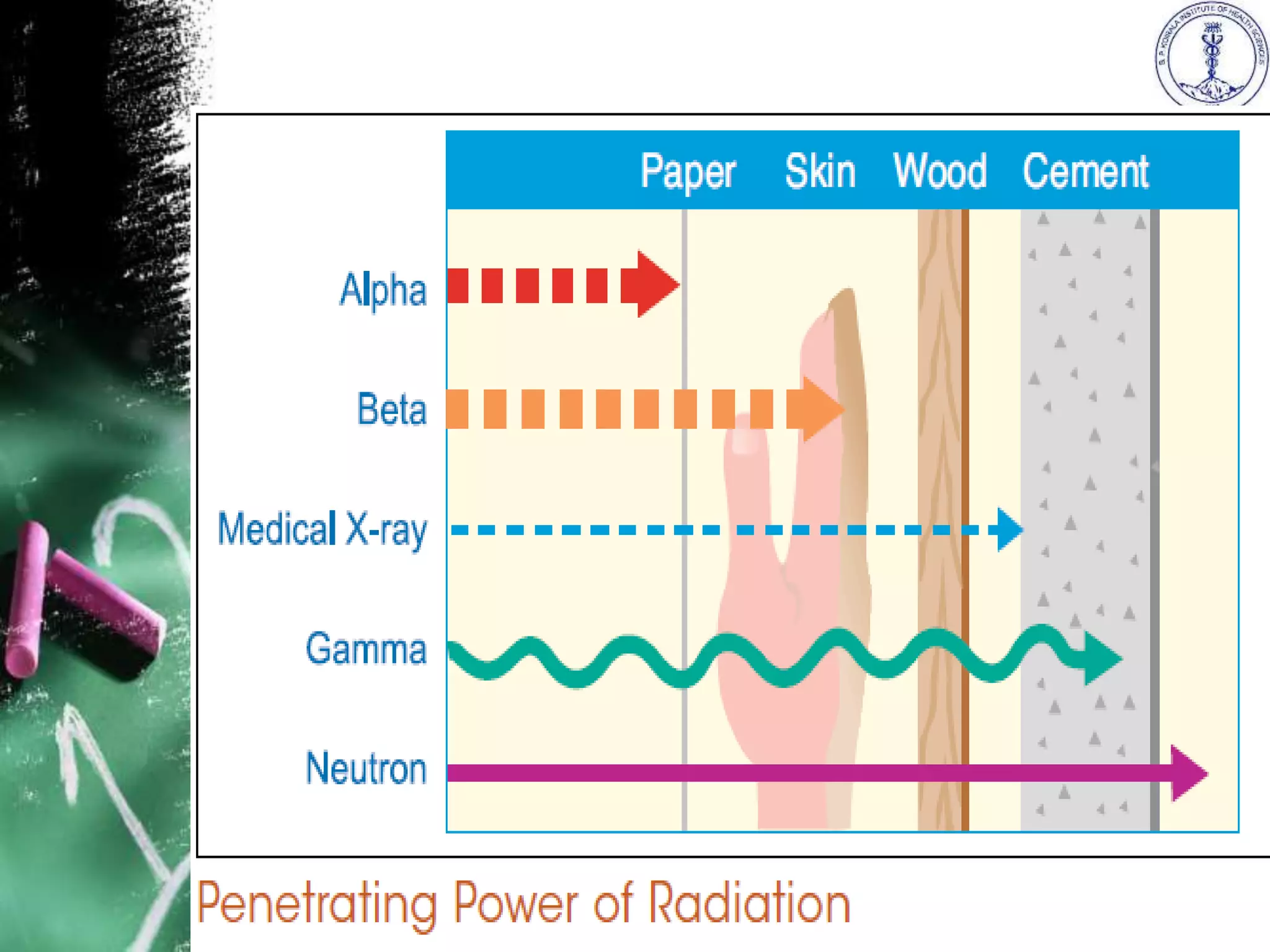
  • #3 In physics, radiation is the emission or transmission of energy in the form of waves or particles through space or through a material medium. This includes: electromagnetic radiation, such as radio waves, microwaves, infrared, visible light, ultraviolet, x-rays, and gamma radiation (γ) particle radiation, such as alpha radiation (α), beta radiation (β), and neutron radiation (particles of non-zero rest energy) acoustic radiation, such as ultrasound, sound, and seismic waves (dependent on a physical transmission medium) gravitational radiation, radiation that takes the form of gravitational waves, or ripples in the curvature of spacetime. Radiation is often categorized as either ionizing or non-ionizing depending on the energy of the radiated particles. Ionizing radiation carries more than 10 eV, which is enough to ionize atoms and molecules, and break chemical bonds.
  • #12 Advancement in medical diagnostics field over the years have led to widespread use of ionising radiation for detection of fractures, infections, tumours, internal injury, blood vessel damage and several other medical conditions.
  • #14 Overexposure to radiation leads to a multitude of severe biological effects, ranging from burns, radiation sickness, to bone-marrow damage, genetic mutation and cancer. The manifestation of such biological effects is dependent on the nature of exposure: the deterministic effect, caused by exposure to high dose of radiation in a short time span may lead to burns and radiation sickness, and the stochastic effect caused by prolonged exposure to low dose of radiation may lead to genetic mutation and cancer.
  • #15 1R=2.58*10^-4 C/Kg 1 Bq=3.73*10dps Wilhelm Roentgen, Professor of Physics in Wurzburg, Bavaria, discovered X-rays in 1895—accidentally—while testing whether cathode rays could pass through glass. ... Roentgen quickly found that X-rays would pass through human tissue too, rendering the bones and tissue beneath visible.
  • #16 He exposed potassium uranyl sulfate to sunlight and then placed it on photographic plates wrapped in black paper, believing that the uranium absorbed the sun’s energy and then emitted it as x-rays. This hypothesis was disproved on the 26th-27th of February, when his experiment "failed" because it was overcast in Paris. For some reason, Becquerel decided to develop his photographic plates anyway. To his surprise, the images were strong and clear, proving that the uranium emitted radiation without an external source of energy such as the sun. Becquerel had discovered radioactivity. Becquerel used an apparatus similar to that displayed below to show that the radiation he discovered could not be x-rays. X-rays are neutral and cannot be bent in a magnetic field. The new radiation was bent by the magnetic field so that the radiation must be charged and different than x-rays. When different radioactive substances were put in the magnetic field, they deflected in different directions or not at all, showing that there were three classes of radioactivity: negative, positive, and electrically neutral. The term radioactivity was actually coined by Marie Curie, who together with her husband Pierre, began investigating the phenomenon recently discovered by Becquerel. The Curies extracted uranium from ore and to their surprise, found that the leftover ore showed more activity than the pure uranium. They concluded that the ore contained other radioactive elements. This led to the discoveries of the elements polonium and radium. It took four more years of processing tons of ore to isolate enough of each element to determine their chemical properties. Ernest Rutherford, who did many experiments studying the properties of radioactive decay, named these alpha, beta, and gamma particles, and classified them by their ability to penetrate matter. Rutherford used an apparatus similar to that depicted in Fig. 3-7. When the air from the chamber was removed, the alpha source made a spot on the photographic plate. When air was added, the spot disappeared. Thus, only a few centimeters of air were enough to stop the alpha radiation. Because alpha particles carry more electric charge, are more massive, and move slowly compared to beta and gamma particles, they interact much more easily with matter. Beta particles are much less massive and move faster, but are still electrically charged. A sheet of aluminum one millimeter thick or several meters of air will stop these electrons and positrons. Because gamma rays carry no electric charge, they can penetrate large distances through materials before interacting–several centimeters of lead or a meter of concrete is needed to stop most gamma rays.
  • #27 The differences in exposure and dose are very subtle. Basically, exposure is the amount of radiation in the area, and dose is the amount of that radiation expected to be absorbed by a person. For gamma rays, there is approximately a one-to-one ratio between exposure rate and dose rate. One (1) milliRoentgen per hour (mR/h) is approximately 10,000 nanoSieverts per hour (nSv/h).
  • #30 In biological materials, cells have a finite size and different types of ionising radiations, if they do not pass freely through, may transfer all their energy to a few cells or may transfer small amounts of energy to a large number of cells, with the former causing more severe biological effects than the latter. This is taken into consideration by the application of a factor related to the type of radiation, called the radiation weighting factor.
  • #32 Definition  tissue-weighted sum of the equivalent doses in all specified tissues and organs of the human body 
  • #41 To determine a person’s biological risk, scientists have assigned a number to each type of ionizing radiation (alpha and beta particles, gamma rays, and x-rays) depending on that type’s ability to transfer energy to the cells of the body. This number is known as the Quality Factor (Q).
  • #57 1)doing more good than harm (the justification principle), keeping doses as low as reasonably achievable (the optimisation principle), and ensuring no person receives an unacceptably high dose (the limitation principle).
  • #59 Socratic questioning is a form of disciplined questioning that can be used to pursue thought in many directions and for many purposes, including: to explore complex ideas, to get to the truth of things, to open up issues and problems, to uncover assumptions, to analyze concepts.
  • #60  Time:  As the length of time a tech is exposed increases, the dose received increases in direct proportion. During fluoroscopic exams a technologists should only be in the room when needed to assist. Otherwise they should be behind the lead wall, dressed in lead apron and thyroid collar in case their assistance is needed. In most cases this is not feasible but there are some exams; such as modified barium swallows that the techs assistance during the exam is rarely needed. Another way to reduce the time we are exposed is to avoid holding patients during exams if possible. If there is another person available to hold such as a patient relative or even a nurse who is rarely exposed utilize them in restraining a patient. Distance: The most effective of the principles is distance. The further a person is from the source the less intense the radiation source is. When the distance from the source is doubled the intensity at the new distance is only 1/4 the original intensity. When performing portable x-ray exams a tech should be atleast six feet from the source of the radiation.  Shielding: When the use of the time and distance principles are not possible shielding should always be used. Wearing protective lead shielding and thyroid collars can protect the radiosensitive areas of the body when it is required for the technologist to be near the source of radiation. Protective aprons, gloves and thyroid collars are usually made of lead impregnated vinyl. The most widely used and recommended is a 0.5 mm lead equivalent for protective apparel.
  • #67 Kerma is a measure of energy transferred from radiation to matter and is an acronym for kinetic energy released to matter. It is related to, but not the same as absorbed dose. Kerma is measured by the SI unit, the gray (joules per kilogram). Kerma measures the amount of energy that is transferred from photons to electrons per unit mass at a certain position. Absorbed dose, on the other hand, measures the energy deposited in a unit mass at a certain position. At radiological energies, transfer and deposition of energy is virtually equal. However, at higher energies, a photon may interact with tissue in one position and create an electron that possesses enough energy to deposit energy at a location away from the interaction point.
  • #70 They consist of a small case with a piece of film situated between filters. The sensitivity to radiation depends on photon energy with better sensitivity at the K-edge of the film. Filters are applied to assess the penetrating power of the radiation source, which provides an estimate of photon energy. The film is subsequently processed and the measured optical density provides an estimated dose based on the average photon energy.  Film badges are the most common dosimeter in use. They are worn on the outer clothing and are used to measure gamma, x-ray, and high-energy beta radiation. A badge consists of a small piece of photographic film wrapped in an opaque cover and held in a metal frame. It can be worn as a ring or pinned to clothing. Radiation interacts with the atoms in the film to expose the film. At periodic intervals, the film is removed and is developed to determine the amount of radiation exposure. A film badge provides a permanent record of radiation exposure.
  • #71 If a radiation worker is wearing a lead apron, the TLD badge can be worn under the lead apron (to reflect body dose) or outside the lead apron (to reflect extremity/thyroid dose). TLDs are used for measuring gamma, x-ray, and beta radiation exposures. They can be worn as rings or body badges. They contain small chips of lithium fluoride, which absorb ionizing radiation energy and displace electrons from their ground state. The electrons then become trapped in a metastable state but can be restored to their original ground state by heating. When heated, the electrons return to their ground state and light is emitted. A TLD readout instrument is used to heat the chips and measure the emitted light. The amount of light emitted is related to the dose of radiation absorbed by the TLD and to the radiation exposure dose of the individual. TLDs are beginning to replace film badges.
  • #72 When the radiation falls on TLD, the electrons are excited and store energy. After a varied period (can be one month, bimonthly, quarterly or even biannual), the TLD badges are sent for reading. The TLD reader consists of a heater. On getting heated, the excited electrons again come back to the ground state and emit light which is then read by a photomultiplier 2. The light output is proportional to the radiation exposure.  TLD has better accuracy than a film dosimeter and do not require an estimate of photon energy. It also has a higher dynamic range and are re-usable 
  • #82 A pocket dosimeter is a direct-reading portable unit shaped like a fountain pen with a pocket clip. It is worn on the trunk of the body and is generally used to measure x-ray and gamma radiation. It should be used in conjunction with a TLD rather than in place of TLD use. The pocket dosimeter consists of a quartz fiber, a scale, a lens to observe movement of the fiber across the scale, and an ionization chamber. The quartz fiber is charged electrostatically until it reaches zero on the scale. When the dosimeter is exposed to radiation, some of the atoms of air in the chamber become ionized. This causes the static electricity charge to leak from the quartz fiber in direct response to the amount of radiation present. As the charge is lost, the fiber moves to some new position on the scale that indicates the amount of radiation exposure. The main advantage of the pocket dosimeter is that it can be read immediately by the wearer, even while working in a radiation-contaminated environment, instead of waiting for processing of a film badge or TLD. However, because pocket dosimeters lose their electrical charge over time, they may give a false indication of radiation exposure. When practicable, use of two dosimeters can prevent false interpretation of a person’s exposure. One should assume that the lower reading is the actual exposure.
  • #83  Pocket Dosimeters Like pocket chambers, pocket dosimeters are known by a number of other names, e.g., direct-reading dosimeters, self-reading pocket dosimeters and pocket electroscopes. They are actually quartz fiber electroscopes the sensing element of which is a movable bow-shaped quartz fiber that is attached at each end to a fixed post. The latter is also shaped like a bow (or horseshoe). The dose is determined by looking through the eyepiece on one end of the dosimeter, pointing the other end towards a light source, and noting the position of the fiber on a scale. Until 1950 or so, the vast majority of pocket dosimeters had a range up to 200 mR, although a few high range versions were available for emergency situations. Higher range versions became more readily available in the 1950s for military and civil defense purposes. Pocket dosimeters tended to be slightly larger than pocket chambers. Their walls might be made of aluminum, bakelite, or some other type of plastic. If the material was not conductive, the inner surface of the chamber was coated with Aquadag (graphite). The central electrode was usually a phosphor bronze rod. This made pocket dosimeters more energy dependent than pocket chambers whose central electrodes were usually aluminum. Some dosimeters (e.g., Keleket Model K-145) employed boron-lined chambers which made them sensitive to thermal neutrons. Pocket dosimeters must be charged (ca. 150 – 200 volts) with some sort of charger, but they do not require another device to read them. This allows the worker to determine his or her exposure at any time, an important advantage when working in high radiation fields. By pointing the instrument at a light source, the position of the fiber may be observed through a system of built-in lenses. The fiber is viewed on a translucent scale which is graduated in units of exposure. Typical industrial radiography pocket dosimeters have a full scale reading of 200 milliroentgens but there are designs that will record higher amounts. During the shift, the dosimeter reading should be checked frequently. The measured exposure should be recorded at the end of each shift. The principal advantage of a pocket dosimeter is its ability to provide the wearer an immediate reading of his or her radiation exposure. It also has the advantage of being reusable. The limited range, inability to provide a permanent record, and the potential for discharging and reading loss due to dropping or bumping are a few of the main disadvantages of a pocket dosimeter. The dosimeters must be recharged and recorded at the start of each working shift. Charge leakage, or drift, can also affect the reading of a dosimeter. Leakage should be no greater than 2 percent of full scale in a 24 hour period.
  • #84 Certain organic and inorganic crystals contain activator atoms, emit scintillations upon absorption of radiation and are referred to as phosphors. High atomic number phosphors are mostly used for the measurement of g rays, while plastic scintillators are mostly used with b particles
  • #85 When ionizing radiation interacts with an organic scintillator, the energy deposited by the electrons generated in the medium excites orbital electrons in higher energy levels. This excitation process is very fast (10-15 s). Through internal conversion and vibrational relaxation, electrons decay to the S10 state within the 10-12 s. It is from the decay of S10 state to the S0x that visible fluorescence light is emitted. The whole process is very fast and takes about 10-9 s. The gap between the S1 and S0 states is usually between 3 to 4 eV thus accounting from the blue-violet light usually seen from most scintillators. Furthermore, this band gap is large enough to ensure some temperature independence (room temperature translating to an energy of about 0.025eV). Finally, due to the differences in excitation and decay processes, the energy emitted as visible light produces an emission spectrum that is of lower energy than the excitation one. This is call the Stokes shift [2]. Thus organic scintillators are mostly transparent to their own emission. It is important to note that a competing de-excitation mechanism is possible in which decays from the S1 states to the triplet T1 states occur followed by further decays from the T1 to the S0 states. This also results in visible light and is called delayed fluorescence and phosphorescence. This process is much less likely and is discarded in most dosimetry applications. Plastic scintillators are composed of 97% of polyvinyltoluene (polystyrene in the case of plastic scintillating fibers) to which an organic fluor, the scintillating materials is added. These fluors are composed of aromatic chain with strong carbon double bonds. This is called a two component systems. To obtain emission of the green or orange light, a third component called a wavelength shifter is added. In addition, scintillating fibers also possesses a cladding that is usually made of PMMA, a material well known in radiation dosimetry.
  • #91 Wt of lead appron is abt 6-8 kgs
  • #95  The level of radiation protection obtained by personal radiation protection gear is quantified through its lead equivalency rating (Pb rating). A 0.5Pb rating apron is expected to provide the same protection as a 0.5mm thick sheet of lead. It has been possible to develop zero lead materials with 0.5Pb rating that offers 99 per cent protection against radiation.