RADIATION RISKS
HISTORY
• X-rays accidentally discovered by
Wilhelm Conrad Roentgen in
1895
• Why the name?
• But he knew they could penetrate
the body
HISTORY
• Roentgen’s discovery was a
bomb shell
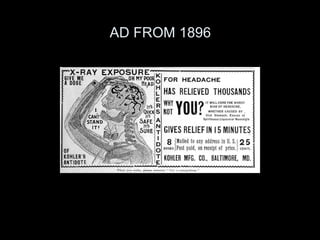
• News papers and magazines
provided interesting stories.
• Advertisers associated their
products with the term “x-ray”
• Headache medicines, stove
polish, golf balls, razors….
AD FROM 1896
PRODUCTION OF X-RAYS
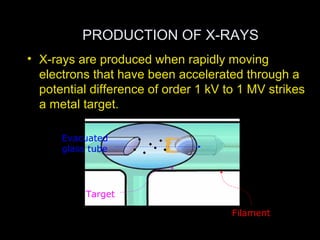
• X-rays are produced when rapidly moving
electrons that have been accelerated through a
potential difference of order 1 kV to 1 MV strikes
a metal target.
Evacuated
glass tube

Target
Filament
NATURAL BACKGROUND RADIATION
•
•
•
•
•

Average 2.4msv per year
Cosmic radiation from sun
Terrestrial: soil, buildings, granite
Body activity: potassium
Radon gas is naturally occuring
decay product of uranium and
thorium
• Skiing at high altitudes and airline
flights
• Return flight from Sydney to LA:
dose 0.16msv
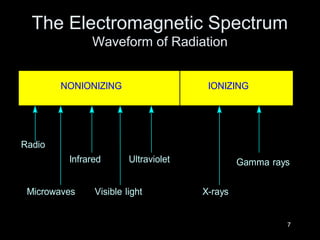
The Electromagnetic Spectrum
Waveform of Radiation
NONIONIZING

IONIZING

Radio
Infrared
Microwaves

Ultraviolet

Visible light

Gamma rays
X-rays

7
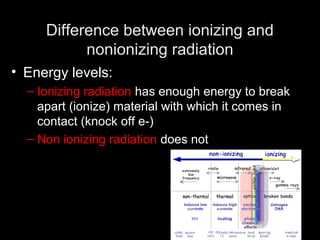
Difference between ionizing and
nonionizing radiation
• Energy levels:
– Ionizing radiation has enough energy to break
apart (ionize) material with which it comes in
contact (knock off e-)
– Non ionizing radiation does not

8
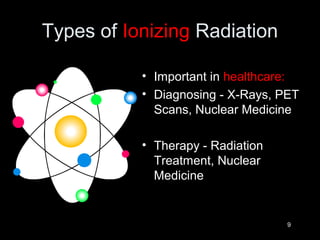
Types of Ionizing Radiation
• Important in healthcare:
• Diagnosing - X-Rays, PET
Scans, Nuclear Medicine
• Therapy - Radiation
Treatment, Nuclear
Medicine

9
Biological Effects of Radiation
• Somatic
– Affects cells originally
exposed (cancer)
– Affects blood, tissues,
organs, possibly entire
body
– Effects range from
slight skin reddening to
death (acute radiation
poisoning)

• Genetic
– Affects cells of future
generations
– Reproductive cells
most sensitive

10
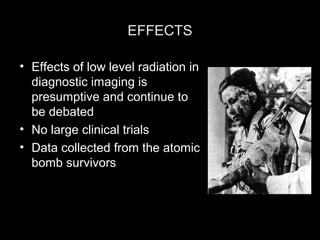
EFFECTS
• Effects of low level radiation in
diagnostic imaging is
presumptive and continue to
be debated
• No large clinical trials
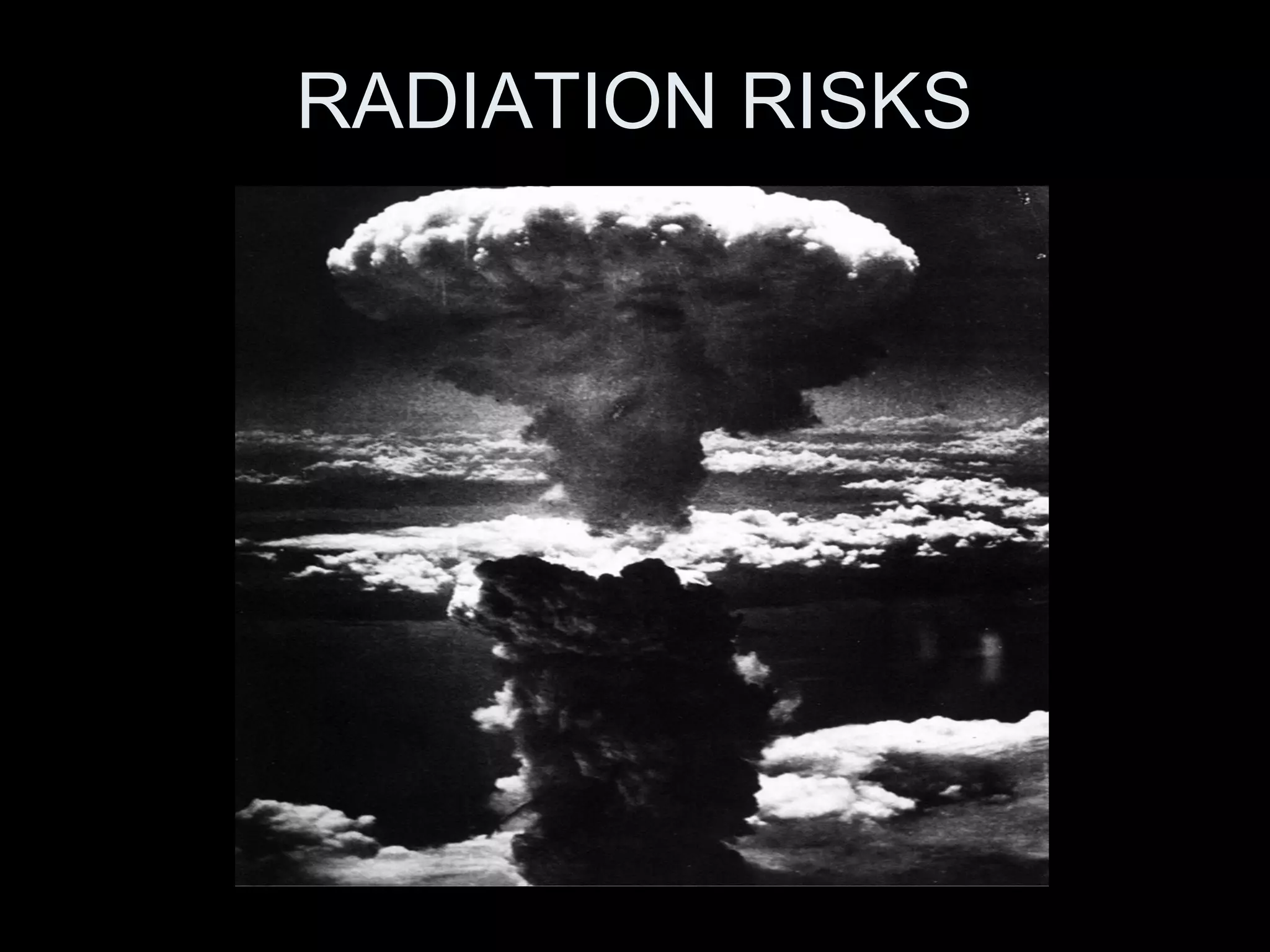
• Data collected from the atomic
bomb survivors
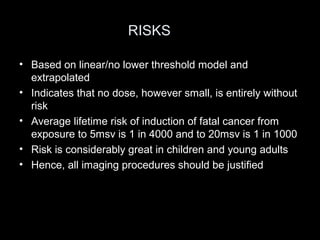
RISKS
• Based on linear/no lower threshold model and
extrapolated
• Indicates that no dose, however small, is entirely without
risk
• Average lifetime risk of induction of fatal cancer from
exposure to 5msv is 1 in 4000 and to 20msv is 1 in 1000
• Risk is considerably great in children and young adults
• Hence, all imaging procedures should be justified
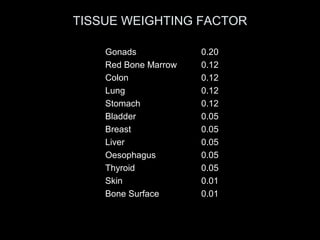
TISSUE WEIGHTING FACTOR
Gonads
Red Bone Marrow
Colon
Lung
Stomach
Bladder
Breast
Liver
Oesophagus
Thyroid
Skin
Bone Surface

0.20
0.12
0.12
0.12
0.12
0.05
0.05
0.05
0.05
0.05
0.01
0.01
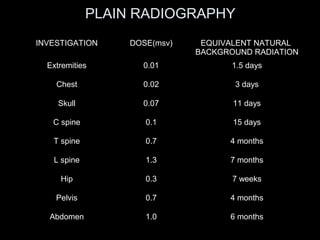
PLAIN RADIOGRAPHY
INVESTIGATION

DOSE(msv)

EQUIVALENT NATURAL
BACKGROUND RADIATION

Extremities

0.01

1.5 days

Chest

0.02

3 days

Skull

0.07

11 days

C spine

0.1

15 days

T spine

0.7

4 months

L spine

1.3

7 months

Hip

0.3

7 weeks

Pelvis

0.7

4 months

Abdomen

1.0

6 months
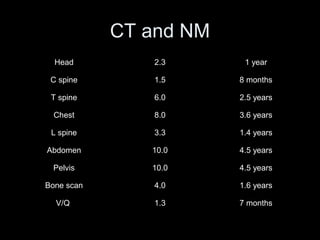
CT and NM
Head

2.3

1 year

C spine

1.5

8 months

T spine

6.0

2.5 years

Chest

8.0

3.6 years

L spine

3.3

1.4 years

Abdomen

10.0

4.5 years

Pelvis

10.0

4.5 years

Bone scan

4.0

1.6 years

V/Q

1.3

7 months
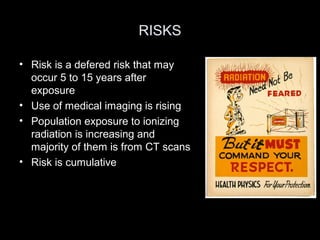
RISKS
• Risk is a defered risk that may
occur 5 to 15 years after
exposure
• Use of medical imaging is rising
• Population exposure to ionizing
radiation is increasing and
majority of them is from CT scans
• Risk is cumulative
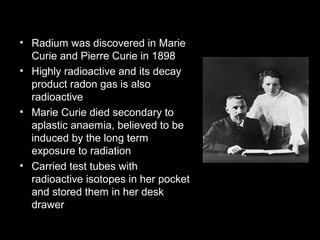
• Radium was discovered in Marie
Curie and Pierre Curie in 1898
• Highly radioactive and its decay
product radon gas is also
radioactive
• Marie Curie died secondary to
aplastic anaemia, believed to be
induced by the long term
exposure to radiation
• Carried test tubes with
radioactive isotopes in her pocket
and stored them in her desk
drawer
APPROPRIATE REQUESTING
• Cannot ignore the increasing use of
ionizing radiation
• All requests should be subject to
Justification and Optimisation
• Radiologist has the knowledge and
experience to determine the radiation
risks and consider alternative
investigations
• Referring doctor who has seen the
patient can best assess the potential
benefits
• Justification should be a joint
responsibility
• Optimisation is to achieve diagnostic
quality images by using low radiation
dose
RESPONSIBILITIES OF REFERRING DOCTOR
• Avoid unnecessary duplication of
tests
• Ensure that test could potentially
change management
• Provide adequate clinical details
• Be aware that many imaging
tests have risks
• Consult with imaging colleagues if
appropriate
• Consider the use of US or MRI
(non ionizing) when appropriate
PREGNANCY AND LACTATION
• Raising the awareness of patients
for the need to inform the
possibility of pregnancy
• 28 day rule. In a young patient who
has missed a period, pregnancy
should be excluded
• If appropriate employ tests that do
not use ionizing radiation
• Foetus more sensitive during 3 to 8
weeks and 1st trimester
EFFECTS ON FOETUS
•
•
•
•

Miscarriage and foetal death in the first few weeks
Malformations within first 8 weeks of implantation
CNS abnormalities during weeks 8 to 25
Carcinogenesis

• IV contrast can be used in exceptional circumstances
• Contrast induced foetal hypothyroidism is not validated
• Current guidelines recommend neonatal thyroid function
testing
PE IN PREGNANCY
• Risks of missing PE in pregnancy far outweighs
the risks of exposing the foetus to radiation
• CXR is useful to exclude conditions that mimic
PE
• D-Dimer is less useful in pregnancy, however
low probability and negative D-Dimer excludes
PE
• Doppler of both lower limbs should be
considered first and treatment commenced if
positive
PE IN PREGNANCY
• CTPA and V/Q scan have equal diagnostic
quality
• CTPA recommended in first 2 trimesters
• Phantom studies have shown less foetal dose
with CTPA in first two trimesters
• MRI is a promising new option but availability
and expertise are the main limitations
Radiation Risks

Radiation Risks

  • 1.
  • 2.
    HISTORY • X-rays accidentallydiscovered by Wilhelm Conrad Roentgen in 1895 • Why the name? • But he knew they could penetrate the body
  • 3.
    HISTORY • Roentgen’s discoverywas a bomb shell • News papers and magazines provided interesting stories. • Advertisers associated their products with the term “x-ray” • Headache medicines, stove polish, golf balls, razors….
  • 4.
  • 5.
    PRODUCTION OF X-RAYS •X-rays are produced when rapidly moving electrons that have been accelerated through a potential difference of order 1 kV to 1 MV strikes a metal target. Evacuated glass tube Target Filament
  • 6.
    NATURAL BACKGROUND RADIATION • • • • • Average2.4msv per year Cosmic radiation from sun Terrestrial: soil, buildings, granite Body activity: potassium Radon gas is naturally occuring decay product of uranium and thorium • Skiing at high altitudes and airline flights • Return flight from Sydney to LA: dose 0.16msv
  • 7.
    The Electromagnetic Spectrum Waveformof Radiation NONIONIZING IONIZING Radio Infrared Microwaves Ultraviolet Visible light Gamma rays X-rays 7
  • 8.
    Difference between ionizingand nonionizing radiation • Energy levels: – Ionizing radiation has enough energy to break apart (ionize) material with which it comes in contact (knock off e-) – Non ionizing radiation does not 8
  • 9.
    Types of IonizingRadiation • Important in healthcare: • Diagnosing - X-Rays, PET Scans, Nuclear Medicine • Therapy - Radiation Treatment, Nuclear Medicine 9
  • 10.
    Biological Effects ofRadiation • Somatic – Affects cells originally exposed (cancer) – Affects blood, tissues, organs, possibly entire body – Effects range from slight skin reddening to death (acute radiation poisoning) • Genetic – Affects cells of future generations – Reproductive cells most sensitive 10
  • 11.
    EFFECTS • Effects oflow level radiation in diagnostic imaging is presumptive and continue to be debated • No large clinical trials • Data collected from the atomic bomb survivors
  • 12.
    RISKS • Based onlinear/no lower threshold model and extrapolated • Indicates that no dose, however small, is entirely without risk • Average lifetime risk of induction of fatal cancer from exposure to 5msv is 1 in 4000 and to 20msv is 1 in 1000 • Risk is considerably great in children and young adults • Hence, all imaging procedures should be justified
  • 13.
    TISSUE WEIGHTING FACTOR Gonads RedBone Marrow Colon Lung Stomach Bladder Breast Liver Oesophagus Thyroid Skin Bone Surface 0.20 0.12 0.12 0.12 0.12 0.05 0.05 0.05 0.05 0.05 0.01 0.01
  • 14.
    PLAIN RADIOGRAPHY INVESTIGATION DOSE(msv) EQUIVALENT NATURAL BACKGROUNDRADIATION Extremities 0.01 1.5 days Chest 0.02 3 days Skull 0.07 11 days C spine 0.1 15 days T spine 0.7 4 months L spine 1.3 7 months Hip 0.3 7 weeks Pelvis 0.7 4 months Abdomen 1.0 6 months
  • 15.
    CT and NM Head 2.3 1year C spine 1.5 8 months T spine 6.0 2.5 years Chest 8.0 3.6 years L spine 3.3 1.4 years Abdomen 10.0 4.5 years Pelvis 10.0 4.5 years Bone scan 4.0 1.6 years V/Q 1.3 7 months
  • 16.
    RISKS • Risk isa defered risk that may occur 5 to 15 years after exposure • Use of medical imaging is rising • Population exposure to ionizing radiation is increasing and majority of them is from CT scans • Risk is cumulative
  • 17.
    • Radium wasdiscovered in Marie Curie and Pierre Curie in 1898 • Highly radioactive and its decay product radon gas is also radioactive • Marie Curie died secondary to aplastic anaemia, believed to be induced by the long term exposure to radiation • Carried test tubes with radioactive isotopes in her pocket and stored them in her desk drawer
  • 18.
    APPROPRIATE REQUESTING • Cannotignore the increasing use of ionizing radiation • All requests should be subject to Justification and Optimisation • Radiologist has the knowledge and experience to determine the radiation risks and consider alternative investigations • Referring doctor who has seen the patient can best assess the potential benefits • Justification should be a joint responsibility • Optimisation is to achieve diagnostic quality images by using low radiation dose
  • 19.
    RESPONSIBILITIES OF REFERRINGDOCTOR • Avoid unnecessary duplication of tests • Ensure that test could potentially change management • Provide adequate clinical details • Be aware that many imaging tests have risks • Consult with imaging colleagues if appropriate • Consider the use of US or MRI (non ionizing) when appropriate
  • 20.
    PREGNANCY AND LACTATION •Raising the awareness of patients for the need to inform the possibility of pregnancy • 28 day rule. In a young patient who has missed a period, pregnancy should be excluded • If appropriate employ tests that do not use ionizing radiation • Foetus more sensitive during 3 to 8 weeks and 1st trimester
  • 21.
    EFFECTS ON FOETUS • • • • Miscarriageand foetal death in the first few weeks Malformations within first 8 weeks of implantation CNS abnormalities during weeks 8 to 25 Carcinogenesis • IV contrast can be used in exceptional circumstances • Contrast induced foetal hypothyroidism is not validated • Current guidelines recommend neonatal thyroid function testing
  • 22.
    PE IN PREGNANCY •Risks of missing PE in pregnancy far outweighs the risks of exposing the foetus to radiation • CXR is useful to exclude conditions that mimic PE • D-Dimer is less useful in pregnancy, however low probability and negative D-Dimer excludes PE • Doppler of both lower limbs should be considered first and treatment commenced if positive
  • 23.
    PE IN PREGNANCY •CTPA and V/Q scan have equal diagnostic quality • CTPA recommended in first 2 trimesters • Phantom studies have shown less foetal dose with CTPA in first two trimesters • MRI is a promising new option but availability and expertise are the main limitations