Types of radiation
• Non Ionizing Radiation
• Ionizing radiation
• Non-ionizing radiation
• People use and are exposed to non-ionizing radiation
sources every day. This form of radiation does not carry
enough energy to ionize atoms or molecules.
• Microwave ovens, global positioning systems, cellular
telephones, television stations, FM and AM radio, baby
monitors, cordless phones, garage-door openers and
ham radios all use non-ionizing radiation. Other forms
include the earth’s magnetic field and magnetic field
exposure from proximity to transmission lines,
household wiring and electrical appliances. These are
defined as extremely low frequency (ELF) waves.
Ionizing radiation
• Some types of radiation have enough energy
that they can knock electrons out of their
orbits around atoms, upsetting the
electron/proton balance and giving the atom a
positive charge. Electrically
charged molecules and atoms are called ions.
The radiation that can produce ions is called
ionizing radiation.
Types of ionizing radiation
• Alpha Radiation
• Beta radiation
• Gamma radiation
Alpha Radiation
• Alpha radiation consists of two protons and
two neutrons; since they have no electrons,
they carry a positive charge. Due to their size
and charge, alpha particles are barely able to
penetrate skin and can be stopped completely
by a sheet of paper.
Beta radiation
• Beta radiation consists of fast-moving
electrons ejected from the nucleus of an
atom. Beta radiation has a negative charge
and is about 1/7000th the size of an alpha
particle, so it is more penetrating. However, it
can still be stopped by a small amount of
shielding, such as a sheet of plastic.
Gamma radiation
• Gamma radiation is a very penetrating type of
radiation. It is usually emitted immediately
after the ejection of an alpha or beta particle
from the nucleus of an atom. Because it has
no mass or charge, it can pass through the
human body, but it is absorbed by denser
materials, such as concrete or lead.
X - rays
• X-rays are a form of radiation similar to
gamma radiation, but they are produced
mainly by artificial means rather than from
radioactive substances.
Neutron radiation
• Neutron radiation occurs when neutrons are
ejected from the nucleus by nuclear fission and
other processes. The nuclear chain reaction is an
example of nuclear fission, where a neutron
being ejected from one fissioned atom causes
another atom to fission, ejecting more neutrons.
Unlike other radiations, neutron radiation is
absorbed by materials with lots of hydrogen
atoms, like paraffin wax and plastics.
• People are constantly exposed to small
amounts of ionizing radiation from the
environment as they carry out their normal
daily activities; this is known as background
radiation. We are also exposed through some
medical treatments and through activities
involving radioactive material.
Sources of ironing radiation
• Natural background radiation
• Cosmic radiation
• Terrestrial radiation
• Inhalation
• Injestion
Natural background radiation
• Natural background radiation
• Radiation has always been present and is all
around us. Life has evolved in a world containing
significant levels of ionizing radiation. Our bodies
are adapted to it.
• The following section outlines sources of natural
background radiation. For information on dose
levels from these sources, visit the Radiation
Doses page and fact sheet on natural background
radiation.
Exposure from cosmic radiation
• The earth's outer atmosphere is continually
bombarded by cosmic radiation. Usually, cosmic
radiation consists of fast moving particles that
exist in space and originate from a variety of
sources, including the sun and other celestial
events in the universe. Cosmic rays are mostly
protons, but can be other particles or wave
energy. Some ionizing radiation penetrates the
earth's atmosphere and becomes absorbed by
humans, which results in natural radiation
exposure.
Exposure from terrestrial radiation
• The composition of the earth's crust is a major
source of natural radiation. The main contributors
are natural deposits of uranium, potassium and
thorium which, in the process of natural decay,
release small amounts of ionizing radiation.
Uranium and thorium are “ubiquitous”, meaning
they are found essentially everywhere. Traces of
these minerals are also found in building
materials, so exposure to natural radiation can
occur indoors as well as outdoors.
Exposure through inhalation
• Most of the variation in exposure to natural radiation results from
inhalation of radioactive gases that are produced by radioactive
minerals found in soil and bedrock. Radon is an odourless and
colourless radioactive gas that is produced by the decay of uranium-
238. It is an inert gas, meaning that it does not react with
surrounding matter. Because radon does not react, it can readily
move up through the ground and into the atmosphere.. Thoron is a
radioactive gas produced by thorium. Radon and thoron levels vary
considerably by location depending on the composition of soil and
bedrock. Once released into the air, these gases normally dilute to
harmless levels in the atmosphere, but sometimes they become
trapped and accumulate inside buildings where they are inhaled by
occupants. Radon gas poses a health risk not only to uranium
miners but also to homeowners if it is left to accumulate in the
home.
Exposure through ingestion
• Trace amounts of radioactive minerals are
naturally found in the contents of food and
drinking water. For instance, vegetables are
typically cultivated in soil and ground water
which contains radioactive minerals. Once
ingested, these minerals result in internal
exposure to natural radiation.
• Naturally occurring radioactive isotopes, such
as potassium-40 and carbon-14, have the
same chemical and biological properties as
their non-radioactive isotopes. These
radioactive and non-radioactive elements are
used in building and maintaining our bodies.
Natural radioisotopes continually expose us to
radiation.
Artificial sources of radiation
• Atmospheric testing
• Medical sources
• Industrial sources
• Nuclear fuel cycle
Atmospheric testing
• The atmospheric testing of atomic weapons
from the end of the Second World War until as
late as 1980 released radioactive material,
called fallout, into the air. As the fallout
settled to the ground, it was incorporated into
the environment. Much of the fallout had
short half-lives and no longer exists, but some
continues to decay to this day. People and the
environment receive smaller and smaller
doses from the fallout every year.
Medical sources
• Radiation has many uses in medicine. The most well known
use is in X-ray machines, which use radiation to find broken
bones and diagnose disease. X-ray machines are regulated
by Health Canada and provincial authorities. Another
example is nuclear medicine, which uses radioactive
isotopes to diagnose and treat diseases such as cancer.
These applications of nuclear medicine, as well as the
related equipment, are regulated by the CNSC. The CNSC
also licenses those reactors and particle accelerators that
produce isotopes destined for medical and industrial
applications.
•
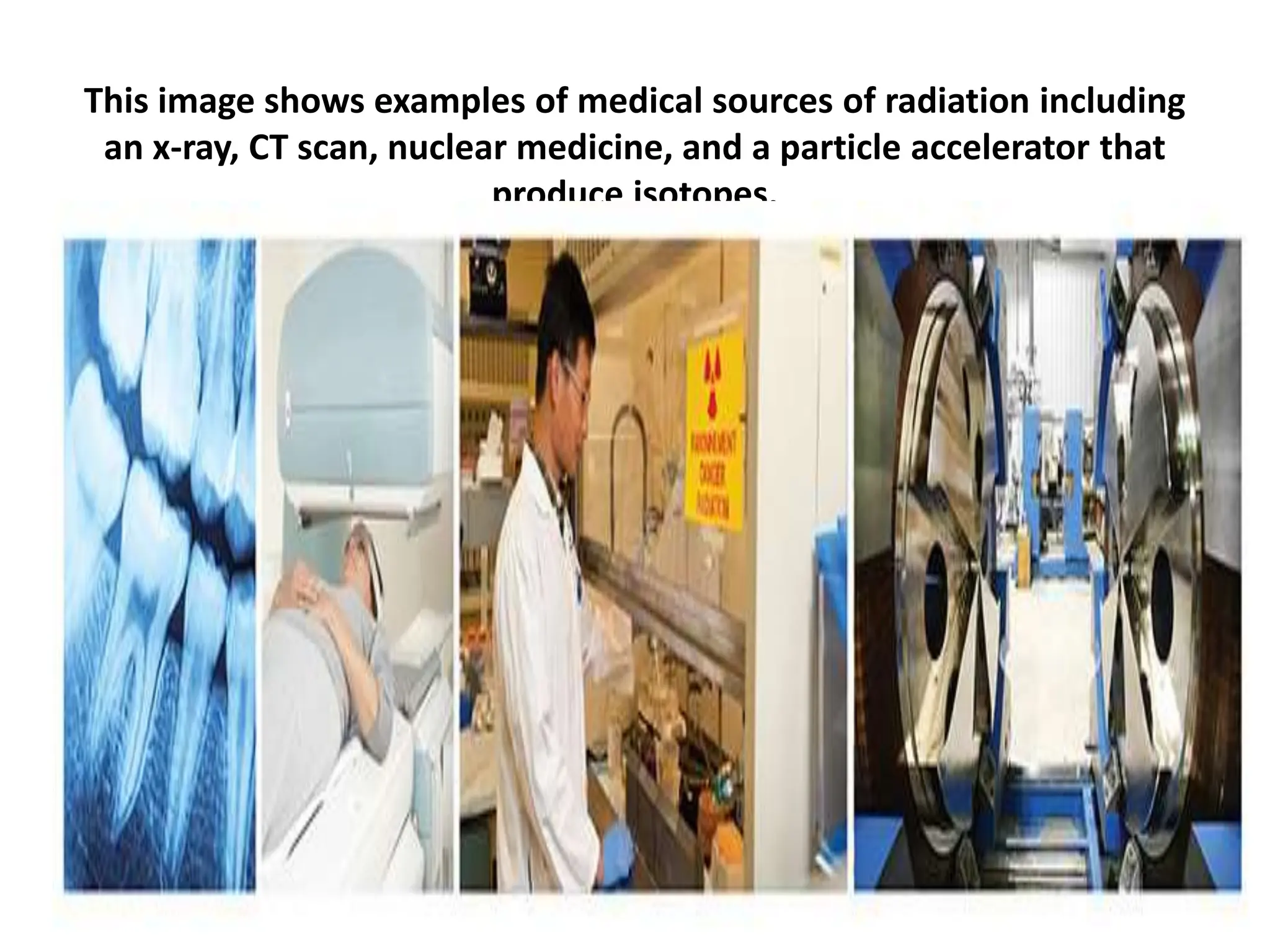
This image shows examples of medical sources of radiation including
an x-ray, CT scan, nuclear medicine, and a particle accelerator that
produce isotopes.
Industrial sources
• Radiation has a variety of industrial uses that
ranges from nuclear gauges used to build roads
to density gauges that measure the flow of
material through pipes in factories. It is also used
in smoke detectors and some glow-in-the dark
exit signs, and to estimate reserves in oil fields.
Radiation is also used for sterilization in which
large, heavily shielded irradiators are used. All of
these uses are licensed by the CNSC.
•
This image shows examples of industrial sources of radiation including
nuclear gauges, a smoke detector, and glow in the dark exit sign.
Nuclear fuel cycle
• Nuclear power plants (NPPs) use uranium to
drive a chain reaction that produces steam,
which in turn drives turbines to produce
electricity. As part of their normal activities,
NPPs release regulated levels of radioactive
material which can expose people to low
doses of radiation. Similarly, uranium mines,
fuel fabrication plants and radioactive waste
facilities release some radioactivity that
contributes to the dose of the public.
This image shows examples of the nuclear fuel cycle including uranium mining,
yellowcake, fuel rods and a nuclear power plant.

Radiation and its types.pptx

  • 3.
    Types of radiation •Non Ionizing Radiation • Ionizing radiation
  • 4.
    • Non-ionizing radiation •People use and are exposed to non-ionizing radiation sources every day. This form of radiation does not carry enough energy to ionize atoms or molecules. • Microwave ovens, global positioning systems, cellular telephones, television stations, FM and AM radio, baby monitors, cordless phones, garage-door openers and ham radios all use non-ionizing radiation. Other forms include the earth’s magnetic field and magnetic field exposure from proximity to transmission lines, household wiring and electrical appliances. These are defined as extremely low frequency (ELF) waves.
  • 5.
    Ionizing radiation • Sometypes of radiation have enough energy that they can knock electrons out of their orbits around atoms, upsetting the electron/proton balance and giving the atom a positive charge. Electrically charged molecules and atoms are called ions. The radiation that can produce ions is called ionizing radiation.
  • 6.
    Types of ionizingradiation • Alpha Radiation • Beta radiation • Gamma radiation
  • 7.
    Alpha Radiation • Alpharadiation consists of two protons and two neutrons; since they have no electrons, they carry a positive charge. Due to their size and charge, alpha particles are barely able to penetrate skin and can be stopped completely by a sheet of paper.
  • 8.
    Beta radiation • Betaradiation consists of fast-moving electrons ejected from the nucleus of an atom. Beta radiation has a negative charge and is about 1/7000th the size of an alpha particle, so it is more penetrating. However, it can still be stopped by a small amount of shielding, such as a sheet of plastic.
  • 9.
    Gamma radiation • Gammaradiation is a very penetrating type of radiation. It is usually emitted immediately after the ejection of an alpha or beta particle from the nucleus of an atom. Because it has no mass or charge, it can pass through the human body, but it is absorbed by denser materials, such as concrete or lead.
  • 10.
    X - rays •X-rays are a form of radiation similar to gamma radiation, but they are produced mainly by artificial means rather than from radioactive substances.
  • 11.
    Neutron radiation • Neutronradiation occurs when neutrons are ejected from the nucleus by nuclear fission and other processes. The nuclear chain reaction is an example of nuclear fission, where a neutron being ejected from one fissioned atom causes another atom to fission, ejecting more neutrons. Unlike other radiations, neutron radiation is absorbed by materials with lots of hydrogen atoms, like paraffin wax and plastics.
  • 13.
    • People areconstantly exposed to small amounts of ionizing radiation from the environment as they carry out their normal daily activities; this is known as background radiation. We are also exposed through some medical treatments and through activities involving radioactive material.
  • 14.
    Sources of ironingradiation • Natural background radiation • Cosmic radiation • Terrestrial radiation • Inhalation • Injestion
  • 15.
    Natural background radiation •Natural background radiation • Radiation has always been present and is all around us. Life has evolved in a world containing significant levels of ionizing radiation. Our bodies are adapted to it. • The following section outlines sources of natural background radiation. For information on dose levels from these sources, visit the Radiation Doses page and fact sheet on natural background radiation.
  • 17.
    Exposure from cosmicradiation • The earth's outer atmosphere is continually bombarded by cosmic radiation. Usually, cosmic radiation consists of fast moving particles that exist in space and originate from a variety of sources, including the sun and other celestial events in the universe. Cosmic rays are mostly protons, but can be other particles or wave energy. Some ionizing radiation penetrates the earth's atmosphere and becomes absorbed by humans, which results in natural radiation exposure.
  • 18.
    Exposure from terrestrialradiation • The composition of the earth's crust is a major source of natural radiation. The main contributors are natural deposits of uranium, potassium and thorium which, in the process of natural decay, release small amounts of ionizing radiation. Uranium and thorium are “ubiquitous”, meaning they are found essentially everywhere. Traces of these minerals are also found in building materials, so exposure to natural radiation can occur indoors as well as outdoors.
  • 19.
    Exposure through inhalation •Most of the variation in exposure to natural radiation results from inhalation of radioactive gases that are produced by radioactive minerals found in soil and bedrock. Radon is an odourless and colourless radioactive gas that is produced by the decay of uranium- 238. It is an inert gas, meaning that it does not react with surrounding matter. Because radon does not react, it can readily move up through the ground and into the atmosphere.. Thoron is a radioactive gas produced by thorium. Radon and thoron levels vary considerably by location depending on the composition of soil and bedrock. Once released into the air, these gases normally dilute to harmless levels in the atmosphere, but sometimes they become trapped and accumulate inside buildings where they are inhaled by occupants. Radon gas poses a health risk not only to uranium miners but also to homeowners if it is left to accumulate in the home.
  • 20.
    Exposure through ingestion •Trace amounts of radioactive minerals are naturally found in the contents of food and drinking water. For instance, vegetables are typically cultivated in soil and ground water which contains radioactive minerals. Once ingested, these minerals result in internal exposure to natural radiation.
  • 21.
    • Naturally occurringradioactive isotopes, such as potassium-40 and carbon-14, have the same chemical and biological properties as their non-radioactive isotopes. These radioactive and non-radioactive elements are used in building and maintaining our bodies. Natural radioisotopes continually expose us to radiation.
  • 22.
    Artificial sources ofradiation • Atmospheric testing • Medical sources • Industrial sources • Nuclear fuel cycle
  • 23.
    Atmospheric testing • Theatmospheric testing of atomic weapons from the end of the Second World War until as late as 1980 released radioactive material, called fallout, into the air. As the fallout settled to the ground, it was incorporated into the environment. Much of the fallout had short half-lives and no longer exists, but some continues to decay to this day. People and the environment receive smaller and smaller doses from the fallout every year.
  • 24.
    Medical sources • Radiationhas many uses in medicine. The most well known use is in X-ray machines, which use radiation to find broken bones and diagnose disease. X-ray machines are regulated by Health Canada and provincial authorities. Another example is nuclear medicine, which uses radioactive isotopes to diagnose and treat diseases such as cancer. These applications of nuclear medicine, as well as the related equipment, are regulated by the CNSC. The CNSC also licenses those reactors and particle accelerators that produce isotopes destined for medical and industrial applications. •
  • 25.
    This image showsexamples of medical sources of radiation including an x-ray, CT scan, nuclear medicine, and a particle accelerator that produce isotopes.
  • 26.
    Industrial sources • Radiationhas a variety of industrial uses that ranges from nuclear gauges used to build roads to density gauges that measure the flow of material through pipes in factories. It is also used in smoke detectors and some glow-in-the dark exit signs, and to estimate reserves in oil fields. Radiation is also used for sterilization in which large, heavily shielded irradiators are used. All of these uses are licensed by the CNSC. •
  • 27.
    This image showsexamples of industrial sources of radiation including nuclear gauges, a smoke detector, and glow in the dark exit sign.
  • 28.
    Nuclear fuel cycle •Nuclear power plants (NPPs) use uranium to drive a chain reaction that produces steam, which in turn drives turbines to produce electricity. As part of their normal activities, NPPs release regulated levels of radioactive material which can expose people to low doses of radiation. Similarly, uranium mines, fuel fabrication plants and radioactive waste facilities release some radioactivity that contributes to the dose of the public.
  • 29.
    This image showsexamples of the nuclear fuel cycle including uranium mining, yellowcake, fuel rods and a nuclear power plant.