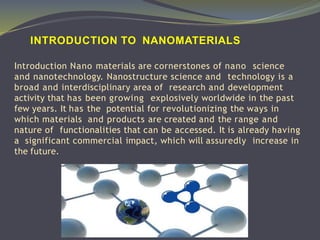
Introduction Nano materials are cornerstones of nano science
and nanotechnology. Nanostructure science and technology is a
broad and interdisciplinary area of research and development
activity that has been growing explosively worldwide in the past
few years. It has the potential for revolutionizing the ways in
which materials and products are created and the range and
nature of functionalities that can be accessed. It is already having
a significant commercial impact, which will assuredly increase in
the future.
INTRODUCTION TO NANOMATERIALS
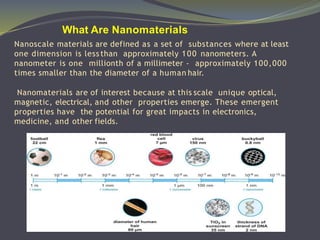
Nanoscale materials are defined as a set of substances where at least
one dimension is less than approximately 100 nanometers. A
nanometer is one millionth of a millimeter - approximately 100,000
times smaller than the diameter of a human hair.
Nanomaterials are of interest because at this scale unique optical,
magnetic, electrical, and other properties emerge. These emergent
properties have the potential for great impacts in electronics,
medicine, and other fields.
What Are Nanomaterials
Classification of nanomaterials
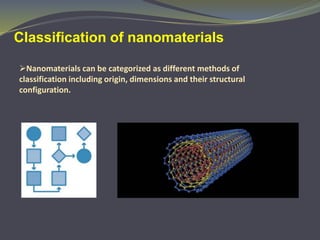
Nanomaterials can be categorized as different methods of
classification including origin, dimensions and their structural
configuration.
A. According to their origin:
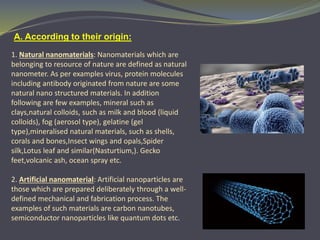
1. Natural nanomaterials: Nanomaterials which are
belonging to resource of nature are defined as natural
nanometer. As per examples virus, protein molecules
including antibody originated from nature are some
natural nano structured materials. In addition
following are few examples, mineral such as
clays,natural colloids, such as milk and blood (liquid
colloids), fog (aerosol type), gelatine (gel
type),mineralised natural materials, such as shells,
corals and bones,Insect wings and opals,Spider
silk,Lotus leaf and similar(Nasturtium,). Gecko
feet,volcanic ash, ocean spray etc.
2. Artificial nanomaterial: Artificial nanoparticles are
those which are prepared deliberately through a well-
defined mechanical and fabrication process. The
examples of such materials are carbon nanotubes,
semiconductor nanoparticles like quantum dots etc.
b.according to the dimensions:
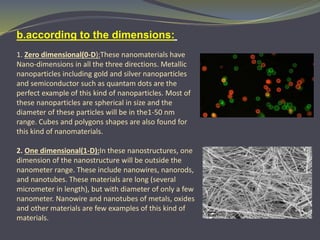
1. Zero dimensional(0-D):These nanomaterials have
Nano-dimensions in all the three directions. Metallic
nanoparticles including gold and silver nanoparticles
and semiconductor such as quantam dots are the
perfect example of this kind of nanoparticles. Most of
these nanoparticles are spherical in size and the
diameter of these particles will be in the1-50 nm
range. Cubes and polygons shapes are also found for
this kind of nanomaterials.
2. One dimensional(1-D):In these nanostructures, one
dimension of the nanostructure will be outside the
nanometer range. These include nanowires, nanorods,
and nanotubes. These materials are long (several
micrometer in length), but with diameter of only a few
nanometer. Nanowire and nanotubes of metals, oxides
and other materials are few examples of this kind of
materials.
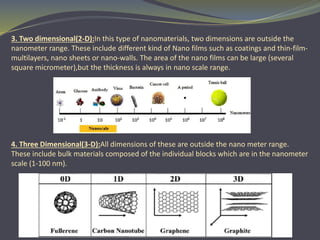
3. Two dimensional(2-D):In this type of nanomaterials, two dimensions are outside the
nanometer range. These include different kind of Nano films such as coatings and thin-film-
multilayers, nano sheets or nano-walls. The area of the nano films can be large (several
square micrometer),but the thickness is always in nano scale range.
4. Three Dimensional(3-D):All dimensions of these are outside the nano meter range.
These include bulk materials composed of the individual blocks which are in the nanometer
scale (1-100 nm).
C. On the basis of structural configuration:
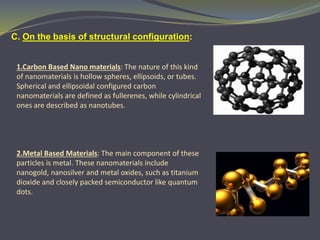
1.Carbon Based Nano materials: The nature of this kind
of nanomaterials is hollow spheres, ellipsoids, or tubes.
Spherical and ellipsoidal configured carbon
nanomaterials are defined as fullerenes, while cylindrical
ones are described as nanotubes.
2.Metal Based Materials: The main component of these
particles is metal. These nanomaterials include
nanogold, nanosilver and metal oxides, such as titanium
dioxide and closely packed semiconductor like quantum
dots.
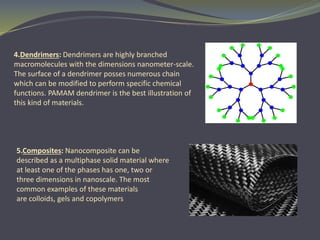
4.Dendrimers: Dendrimers are highly branched
macromolecules with the dimensions nanometer-scale.
The surface of a dendrimer posses numerous chain
which can be modified to perform specific chemical
functions. PAMAM dendrimer is the best illustration of
this kind of materials.
5.Composites: Nanocomposite can be
described as a multiphase solid material where
at least one of the phases has one, two or
three dimensions in nanoscale. The most
common examples of these materials
are colloids, gels and copolymers
nanophase ceramics
 nanostructured semiconductors
 Nanosized metallic powders
 Single nanosized magnetic particles
 Nanostructured metal-oxide thin films
APPLICATIONS
Environmental friendly
Size of substances can be substantially reduced
Effeciency can be greatly improved
Production will be easy and fast
Precise substances can be produced
Strength and densiy factors can be improved
Advantages
Small size and large surface area can lead to particle
aggregation
Physical handling of nano particles is difficult
Impurites
Instability of the particles
Extensive use of poly(vinyl alcohol) as stabilizer
may have toxicity issues
disadvantages
 Well dispersed nano particles increase the viscosity
of the liquid phase, improves the segregation
resistance and workability ofthe system.
Accelerates the hydration.
 Better bond between aggregates and cement paste.
 Improves the toughness,shear,tensile strength
and flexural strength ofconcrete.
conclusion
THANK YOU FOR YOU ATTENTION…

Nanomaterials and nanoparticles

  • 2.
    Introduction Nano materialsare cornerstones of nano science and nanotechnology. Nanostructure science and technology is a broad and interdisciplinary area of research and development activity that has been growing explosively worldwide in the past few years. It has the potential for revolutionizing the ways in which materials and products are created and the range and nature of functionalities that can be accessed. It is already having a significant commercial impact, which will assuredly increase in the future. INTRODUCTION TO NANOMATERIALS
  • 3.
    Nanoscale materials aredefined as a set of substances where at least one dimension is less than approximately 100 nanometers. A nanometer is one millionth of a millimeter - approximately 100,000 times smaller than the diameter of a human hair. Nanomaterials are of interest because at this scale unique optical, magnetic, electrical, and other properties emerge. These emergent properties have the potential for great impacts in electronics, medicine, and other fields. What Are Nanomaterials
  • 4.
    Classification of nanomaterials Nanomaterialscan be categorized as different methods of classification including origin, dimensions and their structural configuration.
  • 5.
    A. According totheir origin: 1. Natural nanomaterials: Nanomaterials which are belonging to resource of nature are defined as natural nanometer. As per examples virus, protein molecules including antibody originated from nature are some natural nano structured materials. In addition following are few examples, mineral such as clays,natural colloids, such as milk and blood (liquid colloids), fog (aerosol type), gelatine (gel type),mineralised natural materials, such as shells, corals and bones,Insect wings and opals,Spider silk,Lotus leaf and similar(Nasturtium,). Gecko feet,volcanic ash, ocean spray etc. 2. Artificial nanomaterial: Artificial nanoparticles are those which are prepared deliberately through a well- defined mechanical and fabrication process. The examples of such materials are carbon nanotubes, semiconductor nanoparticles like quantum dots etc.
  • 6.
    b.according to thedimensions: 1. Zero dimensional(0-D):These nanomaterials have Nano-dimensions in all the three directions. Metallic nanoparticles including gold and silver nanoparticles and semiconductor such as quantam dots are the perfect example of this kind of nanoparticles. Most of these nanoparticles are spherical in size and the diameter of these particles will be in the1-50 nm range. Cubes and polygons shapes are also found for this kind of nanomaterials. 2. One dimensional(1-D):In these nanostructures, one dimension of the nanostructure will be outside the nanometer range. These include nanowires, nanorods, and nanotubes. These materials are long (several micrometer in length), but with diameter of only a few nanometer. Nanowire and nanotubes of metals, oxides and other materials are few examples of this kind of materials.
  • 7.
    3. Two dimensional(2-D):Inthis type of nanomaterials, two dimensions are outside the nanometer range. These include different kind of Nano films such as coatings and thin-film- multilayers, nano sheets or nano-walls. The area of the nano films can be large (several square micrometer),but the thickness is always in nano scale range. 4. Three Dimensional(3-D):All dimensions of these are outside the nano meter range. These include bulk materials composed of the individual blocks which are in the nanometer scale (1-100 nm).
  • 8.
    C. On thebasis of structural configuration: 1.Carbon Based Nano materials: The nature of this kind of nanomaterials is hollow spheres, ellipsoids, or tubes. Spherical and ellipsoidal configured carbon nanomaterials are defined as fullerenes, while cylindrical ones are described as nanotubes. 2.Metal Based Materials: The main component of these particles is metal. These nanomaterials include nanogold, nanosilver and metal oxides, such as titanium dioxide and closely packed semiconductor like quantum dots.
  • 9.
    4.Dendrimers: Dendrimers arehighly branched macromolecules with the dimensions nanometer-scale. The surface of a dendrimer posses numerous chain which can be modified to perform specific chemical functions. PAMAM dendrimer is the best illustration of this kind of materials. 5.Composites: Nanocomposite can be described as a multiphase solid material where at least one of the phases has one, two or three dimensions in nanoscale. The most common examples of these materials are colloids, gels and copolymers
  • 10.
    nanophase ceramics  nanostructuredsemiconductors  Nanosized metallic powders  Single nanosized magnetic particles  Nanostructured metal-oxide thin films APPLICATIONS
  • 11.
    Environmental friendly Size ofsubstances can be substantially reduced Effeciency can be greatly improved Production will be easy and fast Precise substances can be produced Strength and densiy factors can be improved Advantages
  • 12.
    Small size andlarge surface area can lead to particle aggregation Physical handling of nano particles is difficult Impurites Instability of the particles Extensive use of poly(vinyl alcohol) as stabilizer may have toxicity issues disadvantages
  • 13.
     Well dispersednano particles increase the viscosity of the liquid phase, improves the segregation resistance and workability ofthe system. Accelerates the hydration.  Better bond between aggregates and cement paste.  Improves the toughness,shear,tensile strength and flexural strength ofconcrete. conclusion
  • 14.
    THANK YOU FORYOU ATTENTION…