TOOTH RESORPTION
Makerere University
BDS 3
Objectives
 To define tooth resorption
 To describe the causes of tooth resorption
 To classify tooth resorption
 To describe the mechanism involved in tooth resorption
 To outline the complications of tooth resorption
 To outline the management of tooth resorption
INTRODUCTION
 Tooth Resorption is a process by which all or part of a tooth
structure is lost due to activation of the body's innate capacity
to remove mineralized tissue as mediated by cells such as
osteoclasts.
 Tooth resorption can be physiological or pathological
 Physiological tooth resorption affects deciduous teeth
resulting into their loosening and shedding off due to pressure
arising from the underlying successors
 During resorption of deciduous teeth a period of resorption is
followed by one of repair so that the looseness of these teeth
varies before they are shed off
 Resorption of the permanent teeth is always pathological
Causes of tooth resorption
 Periapical periodontitis: is the most cause of tooth resorption but the
effect is usually slight
 Impacted teeth: This results into pressing on the root of an adjacent
tooth
 Neoplasms :usually slow growing tumors like ameloblastoma, giant cell
tumors result into resorption of the related teeth
 Mechanical stimulation for example excessive force in orthodontic
treatment due to pressure
 Chemical irritants like 30% of hydrogen peroxide can result into tooth
resorption
 Idiopathic resorption:usually the cause is unknown
Mechanism of tooth resorption
 Root Resorption occurs when the four protective mechanism
against root Resorption are tampered with: The four protective
mechanism are Malassez epithelial rests, cementoblast cells,
Odontoblast cells, cementoenamel Junction.
 Resorption by cementoblast cell death with maintenance of
Malassez epithelial rests is caused by orthodontic movement,
chronic periapical lesions, contaminated trauma all of which
result into inflammation
 Root Resorption by cementoblast and Malassez epithelial rests
death is caused by replacement in periodontal atrophy of
unerupted teeth especially canines
 Root Resorption by Odontoblast cell death with maintenance of
pulp vitality caused by dental trauma
 Resorption by direct exposure of dentin to the gingival
connective tissue at the cementoenamel Junction usually
caused by trans_operative dental trauma as in Impacted canine
traction
Classification of tooth resorption
 Tooth Resorption is classified basing on two factors:
 Stimulant factors like periapical periodontitis ,
neoplasms, Impacted teeth and are therefore are named
as periapical periodontitis tooth resorption, neoplastic
tooth resorption, Impacted tooth resorption respectively
 Site of the tooth where resorption occurs: that is to say
Internal tooth resorption when this occurs within the pulp
and external when resorption takes place on the surface
of the root near the apex
Internal tooth resorption
 where the dentin and pulpal walls begin to resorb centrally within the
root canal.
 Internal tooth resorption can be Idiopathic but is usually secondary to
pulpitis
 Resorption tends to be localised and usually affects the incisors teeth
and a rounded pink area appears where the vascular pulp has become
visible through the attenuated hard tissue (Pink tooth of Mummery)
 Its usually asymptomatic
 Maybe detected by chance on routine radiograph
 The following are the radiographic appearance of internal resorption:
1. Canal shows enlarged area
2. Margins of lesions are sharp, smooth and clearly defined
3. Walls of the root canal system balloon out
4. Can begin within the clinical crown area that is typically enlarged and
varies in size and location
• Clinically, the presence of a pink spot in the coronal
dentin is due to presence of granulation tissue just under
the enamel
A pulpal sensibility test is likely to be positive, because
the pulp remains (partially) vital.
External resorption
 External resorption refers to an attack of the root's external edges slowly
dissolving it and weakening the tooth base and eventually the tooth will also
weaken and fall victim to resorption
 External root Resorption can be localised or generalised with the major cause
being impaction of the tooth and sometimes the cause is Idiopathic
 Affects the surface of the root near the apex or the crown incase of an
Impacted teeth
 Localised external resorption affects a limited area of the root
 The following are radiographic features of external resorption:
1. Apex shortened flattened or square
2. Foramen is at apex and opening can be seen
3. Margins of the lesions are ragged and irregular
4. Variations in density due to varying rates of resorption and repair
5. Occurs on any external surface of the root
6. Canal can be followed all the way to the apex unaltered and this is an
accurate diagnosis
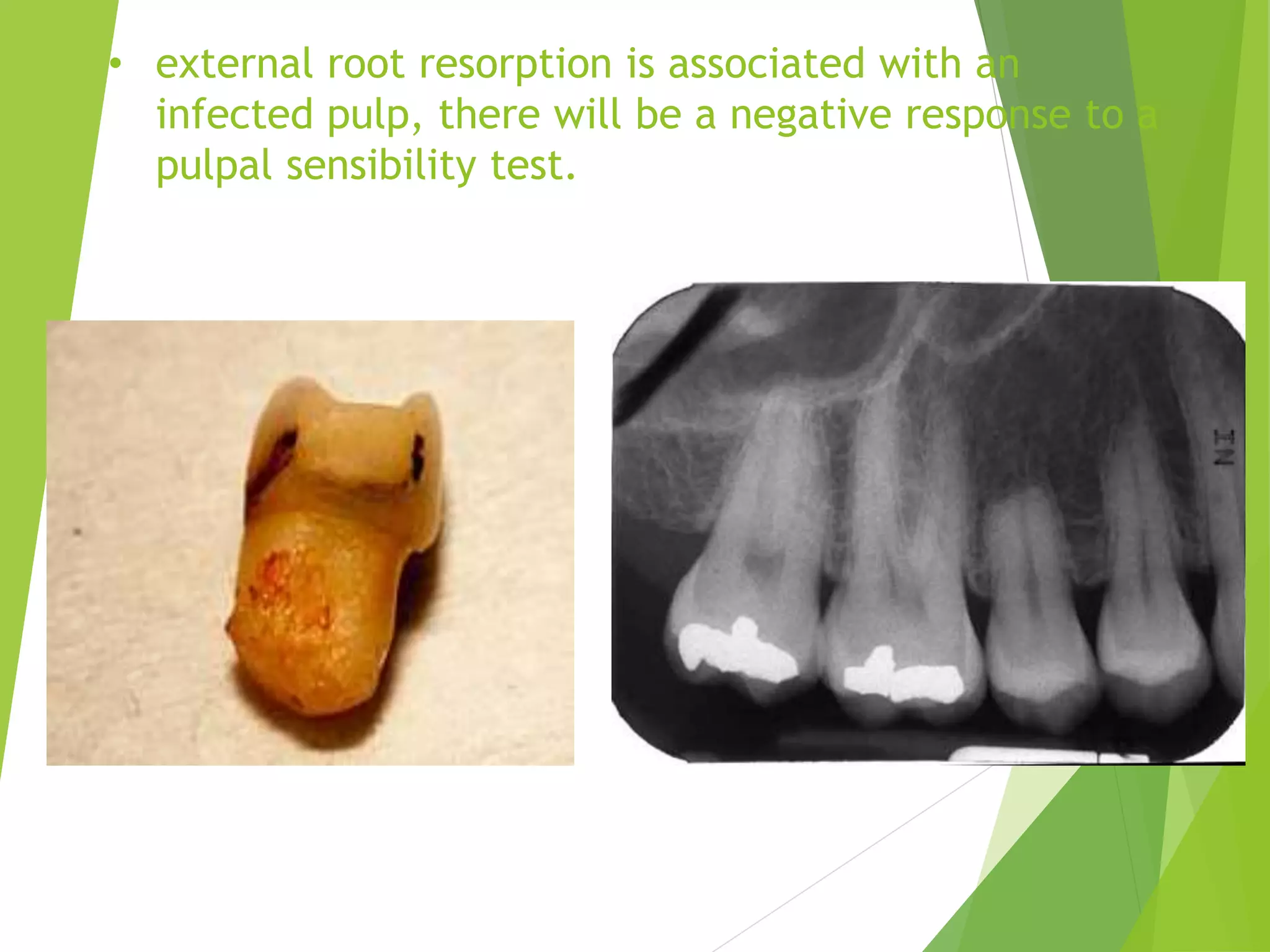
• external root resorption is associated with an
infected pulp, there will be a negative response to a
pulpal sensibility test.
 Invasive cervical resorption
 It is characterized by invasion of the cervical region of the root
 This resorptive process leads to progressive loss of tooth structure and may
eventually invade the pulp space.
 However pulp space is usually spared because its protected by predentin

 In inflammatory root resorption, the necrotic, infected pulp provides the
stimulus for periodontal inflammation
 Most common cause is trauma.
 If the cementum has been damaged, leaving the dentinal tubules exposed, there
is an open communication between the internal and external surfaces of the root.
 Bacteria and their byproducts, diffuse through the dentinal tubules and stimulate
an inflammatory response.
Symptoms of tooth resorption
 The main symptom of dental resorption is loosening of
the damaged tooth and the tooth may be severely
affected and so it falls off
 Dull ache
 Discoloration of the tooth
 Bad breath
Complications of tooth
resorption
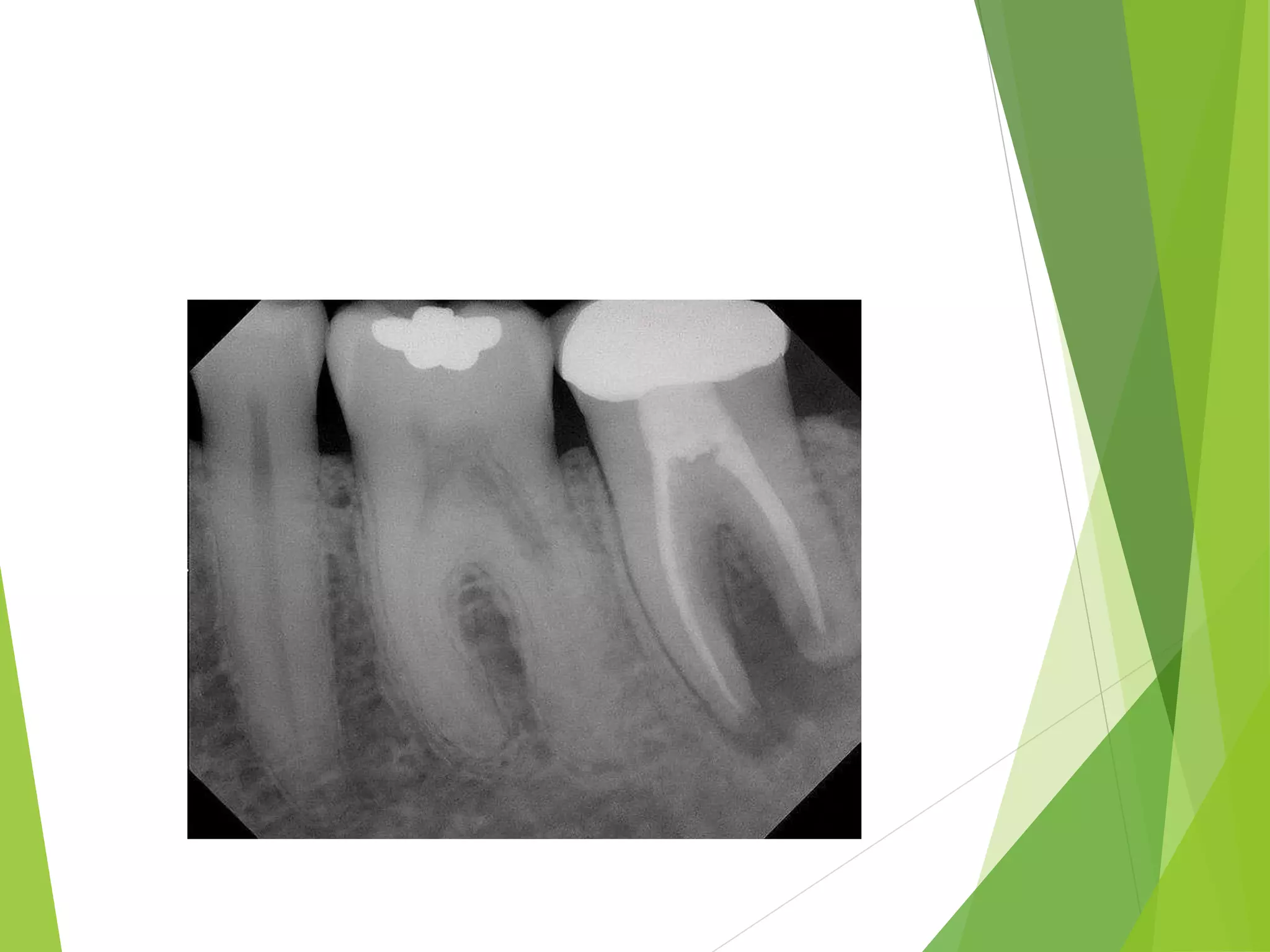
 Ankylosis: This can be defined as the fusion of the root of
the tooth with the adjacent bone due to excessive
deposition of tissue during repair in the resting stages of
resorption: Ankylosis can be diagnosed by lack of mobility
of the tooth and solid sound on percussion compared to
the dull cushioned sound of the normal
 Separation of an apex: Resorption may be irregular so that
part of the tooth is cut off and the fragments may remain
buried or eventually appear on the surface
Management of tooth resorption
 Removal of the Stimulant factor like pressure and infection is the treatment of
choice in root resorption related to pressure due to tumor, Impacted teeth,
orthodontic treatment : for example surgical removal of tumors, withdrawal of
endodontic treatment
 Pulpectomy to remove granulation tissue and blood supply of these cells
 Calcium hydroxide for 6-24months is the intracranial medication of choice for
treatment of external pulpal infection : it has a strong antibacterial effect in the
root canal and has a long duration of action therefore effective over a long period of
time : on addition, it increases the pH of dentine (8-10) and therefore inhibits the
activity of osteoclasts and acid hydrolysis in the periodontal tissues and activates
alkaline phosphatases
 In summary, identification of the Stimulant factor is useful in order to render proper
treatment by removing the etiology factor
#ToothLifeChoseMe
END

Tooth resorption

  • 1.
  • 2.
    Objectives  To definetooth resorption  To describe the causes of tooth resorption  To classify tooth resorption  To describe the mechanism involved in tooth resorption  To outline the complications of tooth resorption  To outline the management of tooth resorption
  • 3.
    INTRODUCTION  Tooth Resorptionis a process by which all or part of a tooth structure is lost due to activation of the body's innate capacity to remove mineralized tissue as mediated by cells such as osteoclasts.  Tooth resorption can be physiological or pathological  Physiological tooth resorption affects deciduous teeth resulting into their loosening and shedding off due to pressure arising from the underlying successors  During resorption of deciduous teeth a period of resorption is followed by one of repair so that the looseness of these teeth varies before they are shed off  Resorption of the permanent teeth is always pathological
  • 4.
    Causes of toothresorption  Periapical periodontitis: is the most cause of tooth resorption but the effect is usually slight  Impacted teeth: This results into pressing on the root of an adjacent tooth  Neoplasms :usually slow growing tumors like ameloblastoma, giant cell tumors result into resorption of the related teeth  Mechanical stimulation for example excessive force in orthodontic treatment due to pressure  Chemical irritants like 30% of hydrogen peroxide can result into tooth resorption  Idiopathic resorption:usually the cause is unknown
  • 6.
    Mechanism of toothresorption  Root Resorption occurs when the four protective mechanism against root Resorption are tampered with: The four protective mechanism are Malassez epithelial rests, cementoblast cells, Odontoblast cells, cementoenamel Junction.  Resorption by cementoblast cell death with maintenance of Malassez epithelial rests is caused by orthodontic movement, chronic periapical lesions, contaminated trauma all of which result into inflammation  Root Resorption by cementoblast and Malassez epithelial rests death is caused by replacement in periodontal atrophy of unerupted teeth especially canines  Root Resorption by Odontoblast cell death with maintenance of pulp vitality caused by dental trauma  Resorption by direct exposure of dentin to the gingival connective tissue at the cementoenamel Junction usually caused by trans_operative dental trauma as in Impacted canine traction
  • 7.
    Classification of toothresorption  Tooth Resorption is classified basing on two factors:  Stimulant factors like periapical periodontitis , neoplasms, Impacted teeth and are therefore are named as periapical periodontitis tooth resorption, neoplastic tooth resorption, Impacted tooth resorption respectively  Site of the tooth where resorption occurs: that is to say Internal tooth resorption when this occurs within the pulp and external when resorption takes place on the surface of the root near the apex
  • 8.
    Internal tooth resorption where the dentin and pulpal walls begin to resorb centrally within the root canal.  Internal tooth resorption can be Idiopathic but is usually secondary to pulpitis  Resorption tends to be localised and usually affects the incisors teeth and a rounded pink area appears where the vascular pulp has become visible through the attenuated hard tissue (Pink tooth of Mummery)  Its usually asymptomatic  Maybe detected by chance on routine radiograph  The following are the radiographic appearance of internal resorption: 1. Canal shows enlarged area 2. Margins of lesions are sharp, smooth and clearly defined 3. Walls of the root canal system balloon out 4. Can begin within the clinical crown area that is typically enlarged and varies in size and location
  • 9.
    • Clinically, thepresence of a pink spot in the coronal dentin is due to presence of granulation tissue just under the enamel A pulpal sensibility test is likely to be positive, because the pulp remains (partially) vital.
  • 10.
    External resorption  Externalresorption refers to an attack of the root's external edges slowly dissolving it and weakening the tooth base and eventually the tooth will also weaken and fall victim to resorption  External root Resorption can be localised or generalised with the major cause being impaction of the tooth and sometimes the cause is Idiopathic  Affects the surface of the root near the apex or the crown incase of an Impacted teeth  Localised external resorption affects a limited area of the root
  • 11.
     The followingare radiographic features of external resorption: 1. Apex shortened flattened or square 2. Foramen is at apex and opening can be seen 3. Margins of the lesions are ragged and irregular 4. Variations in density due to varying rates of resorption and repair 5. Occurs on any external surface of the root 6. Canal can be followed all the way to the apex unaltered and this is an accurate diagnosis
  • 12.
    • external rootresorption is associated with an infected pulp, there will be a negative response to a pulpal sensibility test.
  • 13.
     Invasive cervicalresorption  It is characterized by invasion of the cervical region of the root  This resorptive process leads to progressive loss of tooth structure and may eventually invade the pulp space.  However pulp space is usually spared because its protected by predentin 
  • 14.
     In inflammatoryroot resorption, the necrotic, infected pulp provides the stimulus for periodontal inflammation  Most common cause is trauma.  If the cementum has been damaged, leaving the dentinal tubules exposed, there is an open communication between the internal and external surfaces of the root.  Bacteria and their byproducts, diffuse through the dentinal tubules and stimulate an inflammatory response.
  • 15.
    Symptoms of toothresorption  The main symptom of dental resorption is loosening of the damaged tooth and the tooth may be severely affected and so it falls off  Dull ache  Discoloration of the tooth  Bad breath
  • 16.
    Complications of tooth resorption Ankylosis: This can be defined as the fusion of the root of the tooth with the adjacent bone due to excessive deposition of tissue during repair in the resting stages of resorption: Ankylosis can be diagnosed by lack of mobility of the tooth and solid sound on percussion compared to the dull cushioned sound of the normal  Separation of an apex: Resorption may be irregular so that part of the tooth is cut off and the fragments may remain buried or eventually appear on the surface
  • 18.
    Management of toothresorption  Removal of the Stimulant factor like pressure and infection is the treatment of choice in root resorption related to pressure due to tumor, Impacted teeth, orthodontic treatment : for example surgical removal of tumors, withdrawal of endodontic treatment  Pulpectomy to remove granulation tissue and blood supply of these cells  Calcium hydroxide for 6-24months is the intracranial medication of choice for treatment of external pulpal infection : it has a strong antibacterial effect in the root canal and has a long duration of action therefore effective over a long period of time : on addition, it increases the pH of dentine (8-10) and therefore inhibits the activity of osteoclasts and acid hydrolysis in the periodontal tissues and activates alkaline phosphatases  In summary, identification of the Stimulant factor is useful in order to render proper treatment by removing the etiology factor
  • 19.