Today:
we will talk about all ceramic crown preparation.
DefinitionDefinition
• Non metallic full coverage ceramic
restoration . Restoring the prepared
ant. Teeth functionally & esthetically
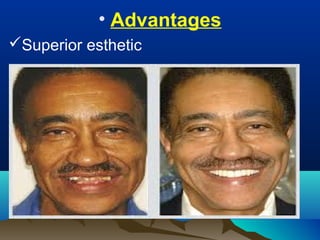
• Advantages
Superior esthetic
Excellent translucency
Good tissue response
Conservative reduction of facial
surface
Appearance of restoration influenced
by color of luting agent
DisadvantagesDisadvantages
 Absence of metal substructure
Reduced strength of the restoration
 Significant tooth reduction is necessary
on proximal & lingual surface
 Difficulty in obtaining well fitting margin
* Not effective as retainer for fixed
prosthesis
* Wear observed on functional surface
of natural tooth
* Wear may occur on functional
surfaces of natural teeth that oppose
porcelain restoration
•
 IndicationsIndications
in ant. Teethin ant. Teeth
** Discolored toothDiscolored tooth
** Tooth with enamel defectsTooth with enamel defects
** Fracture teethFracture teeth
** Bilateral proximal decay with incisalBilateral proximal decay with incisal
angle involved (class 4 ).angle involved (class 4 ).
** Unilateral proximal decayUnilateral proximal decay
• ** Excessive attrition toothExcessive attrition tooth
** at rampant cariesat rampant caries
** malformed and rotated teethmalformed and rotated teeth
*functions:*functions:
**All ceramic is used as foundationAll ceramic is used as foundation
restorationrestoration
** for endodontically treated teeth tofor endodontically treated teeth to
overcome esthetic problem associatedovercome esthetic problem associated
with metal post and core systemwith metal post and core system
•ContraindicationContraindication
** With posterior teethWith posterior teeth
** young patientsyoung patients → large pulp,high epithelium→ large pulp,high epithelium
attachmentattachment
** Deep or heavy bitesDeep or heavy bites
Bad habits ( ex. nail biting )Bad habits ( ex. nail biting )
** If occlusal load is unfavorableIf occlusal load is unfavorable
** At long span bridgeAt long span bridge
** when other more conservative rest. iswhen other more conservative rest. is
indicatedindicated
PrecautionsPrecautions
• Over tapered prepared cingulum
→ ↓ Resistance & Retention
→ exert wedge like force thus ↑
stress causing fracture
•Horizontal surface at the junction of
prepared fossa & lingual wall should be
preserved → reduce stresses
• Lingual ridge of canine not completely
reduced → ↑ rotational resistance
Facial reductionFacial reduction
Placing depth orientation groove
Depth of grooves should be 0.8 mm
as at finishing become 1 mm
Reduce the areas between grooves
Two planes in preparation to provide
adequate esthetics without affecting pulp
. 1st
plane is on incisal two third
. 2nd
plane is on one-third
* facial reduction should extend around the
facial-proximal line angles & fade out on the
lingual aspect of the proximal surface
* end of flat end diamond forms shoulder
finishline
Incisal reductionIncisal reduction
• reduction 1.5 : 2 mm clearance to provide
esthetic & adequate strength restoration
• 45 degrees towards lingual surface
• 3 depth grooves approximately 1.3 mm to
allow additional loss during finishing
• tooth structure between the grooves should
be reduced
• Incisal reduction should be perpendicular to
the plane of incisal half of labial reduction
Lingual reductionLingual reduction
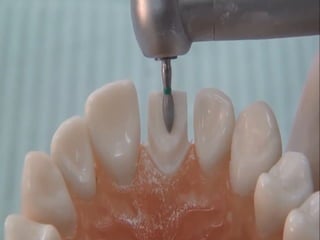
Cingulum reduction is done by FootballCingulum reduction is done by Football
shaped diamondshaped diamond
 care should be taken to prevent over atcare should be taken to prevent over at
the junction between cingulum & lingualthe junction between cingulum & lingual
walwal
ll
A short lingual wall reduces the retentionA short lingual wall reduces the retention
of the restorationof the restoration
Proximal reductionProximal reduction
* The shoulder should be at least 1.0 mm
wide
* care should be taken to avoid undercuts at
the junction of axial walls & the shoulder
finish line
Finishing the preparationFinishing the preparation
** All axial surfaces should be smoothed usingAll axial surfaces should be smoothed using
finishing stones & bursfinishing stones & burs
** Roundation of any remaining sharp lineRoundation of any remaining sharp line
angles to avoid porcelain fractureangles to avoid porcelain fracture
** Uniform width of shoulder finish lineUniform width of shoulder finish line
(approximately 1mm ) to resist forces directed(approximately 1mm ) to resist forces directed
from the incisalfrom the incisal
prepared by :prepared by :
Moataz AbodiefMoataz Abodief
Mostafa El-SadicMostafa El-Sadic
Nour MohammedNour Mohammed
Waleed MohammedWaleed Mohammed
Dentistry College ; Assiut UniversityDentistry College ; Assiut University
thanksthanks

All ceramic crown preparation seminar

  • 2.
    Today: we will talkabout all ceramic crown preparation.
  • 3.
    DefinitionDefinition • Non metallicfull coverage ceramic restoration . Restoring the prepared ant. Teeth functionally & esthetically
  • 4.
  • 5.
    Excellent translucency Good tissueresponse Conservative reduction of facial surface Appearance of restoration influenced by color of luting agent
  • 6.
    DisadvantagesDisadvantages  Absence ofmetal substructure Reduced strength of the restoration  Significant tooth reduction is necessary on proximal & lingual surface  Difficulty in obtaining well fitting margin
  • 7.
    * Not effectiveas retainer for fixed prosthesis * Wear observed on functional surface of natural tooth * Wear may occur on functional surfaces of natural teeth that oppose porcelain restoration •
  • 8.
     IndicationsIndications in ant.Teethin ant. Teeth ** Discolored toothDiscolored tooth ** Tooth with enamel defectsTooth with enamel defects ** Fracture teethFracture teeth ** Bilateral proximal decay with incisalBilateral proximal decay with incisal angle involved (class 4 ).angle involved (class 4 ). ** Unilateral proximal decayUnilateral proximal decay
  • 9.
    • ** Excessiveattrition toothExcessive attrition tooth ** at rampant cariesat rampant caries ** malformed and rotated teethmalformed and rotated teeth *functions:*functions: **All ceramic is used as foundationAll ceramic is used as foundation restorationrestoration ** for endodontically treated teeth tofor endodontically treated teeth to overcome esthetic problem associatedovercome esthetic problem associated with metal post and core systemwith metal post and core system
  • 10.
    •ContraindicationContraindication ** With posteriorteethWith posterior teeth ** young patientsyoung patients → large pulp,high epithelium→ large pulp,high epithelium attachmentattachment ** Deep or heavy bitesDeep or heavy bites Bad habits ( ex. nail biting )Bad habits ( ex. nail biting ) ** If occlusal load is unfavorableIf occlusal load is unfavorable ** At long span bridgeAt long span bridge ** when other more conservative rest. iswhen other more conservative rest. is indicatedindicated
  • 12.
    PrecautionsPrecautions • Over taperedprepared cingulum → ↓ Resistance & Retention → exert wedge like force thus ↑ stress causing fracture •Horizontal surface at the junction of prepared fossa & lingual wall should be preserved → reduce stresses
  • 13.
    • Lingual ridgeof canine not completely reduced → ↑ rotational resistance
  • 14.
    Facial reductionFacial reduction Placingdepth orientation groove Depth of grooves should be 0.8 mm as at finishing become 1 mm Reduce the areas between grooves Two planes in preparation to provide adequate esthetics without affecting pulp . 1st plane is on incisal two third . 2nd plane is on one-third
  • 15.
    * facial reductionshould extend around the facial-proximal line angles & fade out on the lingual aspect of the proximal surface * end of flat end diamond forms shoulder finishline
  • 16.
    Incisal reductionIncisal reduction •reduction 1.5 : 2 mm clearance to provide esthetic & adequate strength restoration • 45 degrees towards lingual surface • 3 depth grooves approximately 1.3 mm to allow additional loss during finishing • tooth structure between the grooves should be reduced • Incisal reduction should be perpendicular to the plane of incisal half of labial reduction
  • 18.
    Lingual reductionLingual reduction Cingulumreduction is done by FootballCingulum reduction is done by Football shaped diamondshaped diamond  care should be taken to prevent over atcare should be taken to prevent over at the junction between cingulum & lingualthe junction between cingulum & lingual walwal ll A short lingual wall reduces the retentionA short lingual wall reduces the retention of the restorationof the restoration
  • 20.
    Proximal reductionProximal reduction *The shoulder should be at least 1.0 mm wide * care should be taken to avoid undercuts at the junction of axial walls & the shoulder finish line
  • 21.
    Finishing the preparationFinishingthe preparation ** All axial surfaces should be smoothed usingAll axial surfaces should be smoothed using finishing stones & bursfinishing stones & burs ** Roundation of any remaining sharp lineRoundation of any remaining sharp line angles to avoid porcelain fractureangles to avoid porcelain fracture ** Uniform width of shoulder finish lineUniform width of shoulder finish line (approximately 1mm ) to resist forces directed(approximately 1mm ) to resist forces directed from the incisalfrom the incisal
  • 22.
    prepared by :preparedby : Moataz AbodiefMoataz Abodief Mostafa El-SadicMostafa El-Sadic Nour MohammedNour Mohammed Waleed MohammedWaleed Mohammed Dentistry College ; Assiut UniversityDentistry College ; Assiut University thanksthanks