KALIISA EDWARD
WHAT IS THE PROBLEM? FACTS
AND FIGURES!
Natural resources:Should the global population reach
9.6 billion by 2050, the equivalent of almost three
planets could be required to provide the natural
resources needed to sustain current lifestyles
Water:Less than 3 per cent of the world’s water is fresh
(drinkable), of which 2.5 per cent is frozen in the
Antarctica, Arctic and glaciers. Humanity must therefore
rely on 0.5 per cent for all of man’s ecosystem’s and
fresh water needs
More than 1 billion people still do not have access to
fresh water. Water is free from nature but the
Food-Each year, an estimated 1/3 of all food
produced – equivalent to 1.3 billion tons worth
around $1 trillion – ends up rotting in the bins of
consumers and retailers, or spoiling due to poor
transportation and harvesting practices
2 billion people globally are overweight or
obese.Land degradation, declining soil fertility,
unsustainable water use, overfishing and marine
environment degradation are all lessening the ability
of the natural resource base to supply food.
TARGETS OF SDG12
1.Implement the 10-year framework of programmes on sustainable consumption and
production
2.By 2030, achieve the sustainable management and efficient use of natural
resources
3.By 2030, halve per capita global food waste at the retail and consumer levels and
reduce food losses along production and supply chains, including post-harvest
losses
4.By 2020, achieve the environmentally sound management of chemicals and all
wastes throughout their life cycle,
5. By 2030, substantially reduce waste generation through prevention, reduction,
recycling and reuse
6. Encourage companies, especially large and transnational companies, to adopt
sustainable practices and to integrate sustainability information into their reporting
cycle
7.Promote public procurement practices that are sustainable, in accordance with
national policies and priorities
12.A Support developing countries to strengthen their
scientific and technological capacity to move towards more
sustainable patterns of consumption and production
12.B Develop and implement tools to monitor sustainable
development impacts for sustainable tourism that creates jobs
and promotes local culture and products
12.CRationalize inefficient fossil-fuel subsidies that encourage
wasteful consumption by removing market distortions, in
accordance with national circumstances, including by
restructuring taxation and phasing out those harmful
subsidies, where they exist, to reflect their environmental
impacts, taking fully into account the specific needs and
conditions of developing countries and minimizing the
possible adverse impacts on their development in a manner
that protects the poor and the affected communities
STRATEGIES TOWARDS ACHIEVING
SDG 121. Government of Uganda with support from the UNDP has trained sectors and local
governments on SDGs and provided technical backstopping to local governments for
quality assurance of development plans
2. Intensify sensitization of rally non-state actors particularly the private sector and
civil society to integrate the SDGs into their investments, programs and plans.
3. Inclusive programming - Uganda’s commitment to ‘ensure that no one is left
behind’
4. Climate Change adaptation and mitigation - The National Climate Change Policy in
pursuit of development along a low carbon development path
5. SE4All - Uganda is among the countries which are implementing the SE4All:
doubling the share of renewable energy in the global energy.
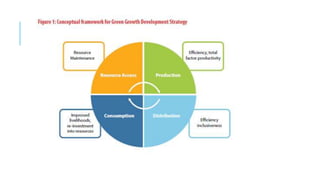
6. Green growth development- sustainable production and consumption patterns,
create green jobs, mitigate and adapt to climate change and decouple economic
growth from environmental degradation
7. Legal and policy frameworks
8. SDGs Integration in the NDP II
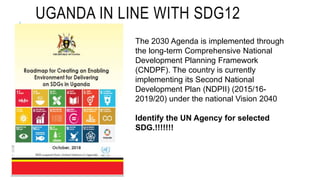
UGANDA IN LINE WITH SDG12
The 2030 Agenda is implemented through
the long-term Comprehensive National
Development Planning Framework
(CNDPF). The country is currently
implementing its Second National
Development Plan (NDPII) (2015/16-
2019/20) under the national Vision 2040
Identify the UN Agency for selected
SDG.!!!!!!!
LEGAL AND POLICY FRAMEWORKS
Uganda’s legal framework is shaped by the 1995 Uganda Constitution
which among other provisions spells out rights for all citizens to peace
and democracy, a clean environment, food security and nutrition, clean
and safe water, national unity and stability and recognition of the role of
women in economic development and the need for balanced and
equitable development. All these issues have been reiterated by the 2030
Agenda and Uganda will continue to adhere to its Constitution thereby
directly contributing to the realization of the 2030 Agenda.
The National Environment Management Act (1995)
The Petroleum (Exploration, Development and Production) Act 2013
The National Climate Change Policy (2014)
The National Agriculture Policy (2013),
The Energy Policy (2002),
The Renewable Energy Policy (2007)
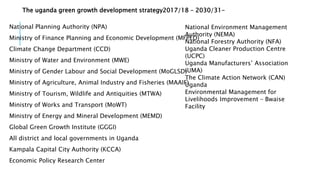
National Planning Authority (NPA)
Ministry of Finance Planning and Economic Development (MFPED)
Climate Change Department (CCD)
Ministry of Water and Environment (MWE)
Ministry of Gender Labour and Social Development (MoGLSD)
Ministry of Agriculture, Animal Industry and Fisheries (MAAIF)
Ministry of Tourism, Wildlife and Antiquities (MTWA)
Ministry of Works and Transport (MoWT)
Ministry of Energy and Mineral Development (MEMD)
Global Green Growth Institute (GGGI)
All district and local governments in Uganda
Kampala Capital City Authority (KCCA)
Economic Policy Research Center
National Environment Management
Authority (NEMA)
National Forestry Authority (NFA)
Uganda Cleaner Production Centre
(UCPC)
Uganda Manufacturers’ Association
(UMA)
The Climate Action Network (CAN)
Uganda
Environmental Management for
Livelihoods Improvement – Bwaise
Facility
The uganda green growth development strategy2017/18 – 2030/31-
REFERENCES
https://www.ndcs.undp.org/content/dam/LECB/docs/pu
bs-reports/undp-ndc-sp-uganda-ggds-green-growth-
dev-strategy-20171204.pdf
https://sustainabledevelopment.un.org/content/docume
nts/10689Uganda%20Review%20Report_CDs1.pdf
https://www.undp.org/content/dam/uganda/docs/UNDP
Ug18%20-%20Uganda%20SDG%20Roadmap.pdf
https://sustainabledevelopment.un.org/sdg12
END

ugandas performance i line with SDG12

  • 1.
  • 2.
    WHAT IS THEPROBLEM? FACTS AND FIGURES! Natural resources:Should the global population reach 9.6 billion by 2050, the equivalent of almost three planets could be required to provide the natural resources needed to sustain current lifestyles Water:Less than 3 per cent of the world’s water is fresh (drinkable), of which 2.5 per cent is frozen in the Antarctica, Arctic and glaciers. Humanity must therefore rely on 0.5 per cent for all of man’s ecosystem’s and fresh water needs More than 1 billion people still do not have access to fresh water. Water is free from nature but the
  • 3.
    Food-Each year, anestimated 1/3 of all food produced – equivalent to 1.3 billion tons worth around $1 trillion – ends up rotting in the bins of consumers and retailers, or spoiling due to poor transportation and harvesting practices 2 billion people globally are overweight or obese.Land degradation, declining soil fertility, unsustainable water use, overfishing and marine environment degradation are all lessening the ability of the natural resource base to supply food.
  • 4.
    TARGETS OF SDG12 1.Implementthe 10-year framework of programmes on sustainable consumption and production 2.By 2030, achieve the sustainable management and efficient use of natural resources 3.By 2030, halve per capita global food waste at the retail and consumer levels and reduce food losses along production and supply chains, including post-harvest losses 4.By 2020, achieve the environmentally sound management of chemicals and all wastes throughout their life cycle, 5. By 2030, substantially reduce waste generation through prevention, reduction, recycling and reuse 6. Encourage companies, especially large and transnational companies, to adopt sustainable practices and to integrate sustainability information into their reporting cycle 7.Promote public procurement practices that are sustainable, in accordance with national policies and priorities
  • 5.
    12.A Support developingcountries to strengthen their scientific and technological capacity to move towards more sustainable patterns of consumption and production 12.B Develop and implement tools to monitor sustainable development impacts for sustainable tourism that creates jobs and promotes local culture and products 12.CRationalize inefficient fossil-fuel subsidies that encourage wasteful consumption by removing market distortions, in accordance with national circumstances, including by restructuring taxation and phasing out those harmful subsidies, where they exist, to reflect their environmental impacts, taking fully into account the specific needs and conditions of developing countries and minimizing the possible adverse impacts on their development in a manner that protects the poor and the affected communities
  • 6.
    STRATEGIES TOWARDS ACHIEVING SDG121. Government of Uganda with support from the UNDP has trained sectors and local governments on SDGs and provided technical backstopping to local governments for quality assurance of development plans 2. Intensify sensitization of rally non-state actors particularly the private sector and civil society to integrate the SDGs into their investments, programs and plans. 3. Inclusive programming - Uganda’s commitment to ‘ensure that no one is left behind’ 4. Climate Change adaptation and mitigation - The National Climate Change Policy in pursuit of development along a low carbon development path 5. SE4All - Uganda is among the countries which are implementing the SE4All: doubling the share of renewable energy in the global energy. 6. Green growth development- sustainable production and consumption patterns, create green jobs, mitigate and adapt to climate change and decouple economic growth from environmental degradation 7. Legal and policy frameworks 8. SDGs Integration in the NDP II
  • 7.
    UGANDA IN LINEWITH SDG12 The 2030 Agenda is implemented through the long-term Comprehensive National Development Planning Framework (CNDPF). The country is currently implementing its Second National Development Plan (NDPII) (2015/16- 2019/20) under the national Vision 2040 Identify the UN Agency for selected SDG.!!!!!!!
  • 8.
    LEGAL AND POLICYFRAMEWORKS Uganda’s legal framework is shaped by the 1995 Uganda Constitution which among other provisions spells out rights for all citizens to peace and democracy, a clean environment, food security and nutrition, clean and safe water, national unity and stability and recognition of the role of women in economic development and the need for balanced and equitable development. All these issues have been reiterated by the 2030 Agenda and Uganda will continue to adhere to its Constitution thereby directly contributing to the realization of the 2030 Agenda. The National Environment Management Act (1995) The Petroleum (Exploration, Development and Production) Act 2013 The National Climate Change Policy (2014) The National Agriculture Policy (2013), The Energy Policy (2002), The Renewable Energy Policy (2007)
  • 9.
    National Planning Authority(NPA) Ministry of Finance Planning and Economic Development (MFPED) Climate Change Department (CCD) Ministry of Water and Environment (MWE) Ministry of Gender Labour and Social Development (MoGLSD) Ministry of Agriculture, Animal Industry and Fisheries (MAAIF) Ministry of Tourism, Wildlife and Antiquities (MTWA) Ministry of Works and Transport (MoWT) Ministry of Energy and Mineral Development (MEMD) Global Green Growth Institute (GGGI) All district and local governments in Uganda Kampala Capital City Authority (KCCA) Economic Policy Research Center National Environment Management Authority (NEMA) National Forestry Authority (NFA) Uganda Cleaner Production Centre (UCPC) Uganda Manufacturers’ Association (UMA) The Climate Action Network (CAN) Uganda Environmental Management for Livelihoods Improvement – Bwaise Facility The uganda green growth development strategy2017/18 – 2030/31-
  • 11.
  • 12.