Introduction


   The periradicular tissue contains :

- apical root cementum.
- periodontal ligaments.
- alveolar bone.
Etiology of periradicular
diseases
Bacterial:
Untreated pulpal infection leading to total pulp
 necrosis if untreated , irritants leak into
 periapical region forming periapical
 pathologies.

   Trauma

Factors related to root canal procedures:
Cause inflammatory response due to the
 extirpation of the pulp, intra canal
 medicaments or the improper manipulation of
 instruments.
CLASSIFICATION OF
PERIRADICULAR PATHOLOGIES
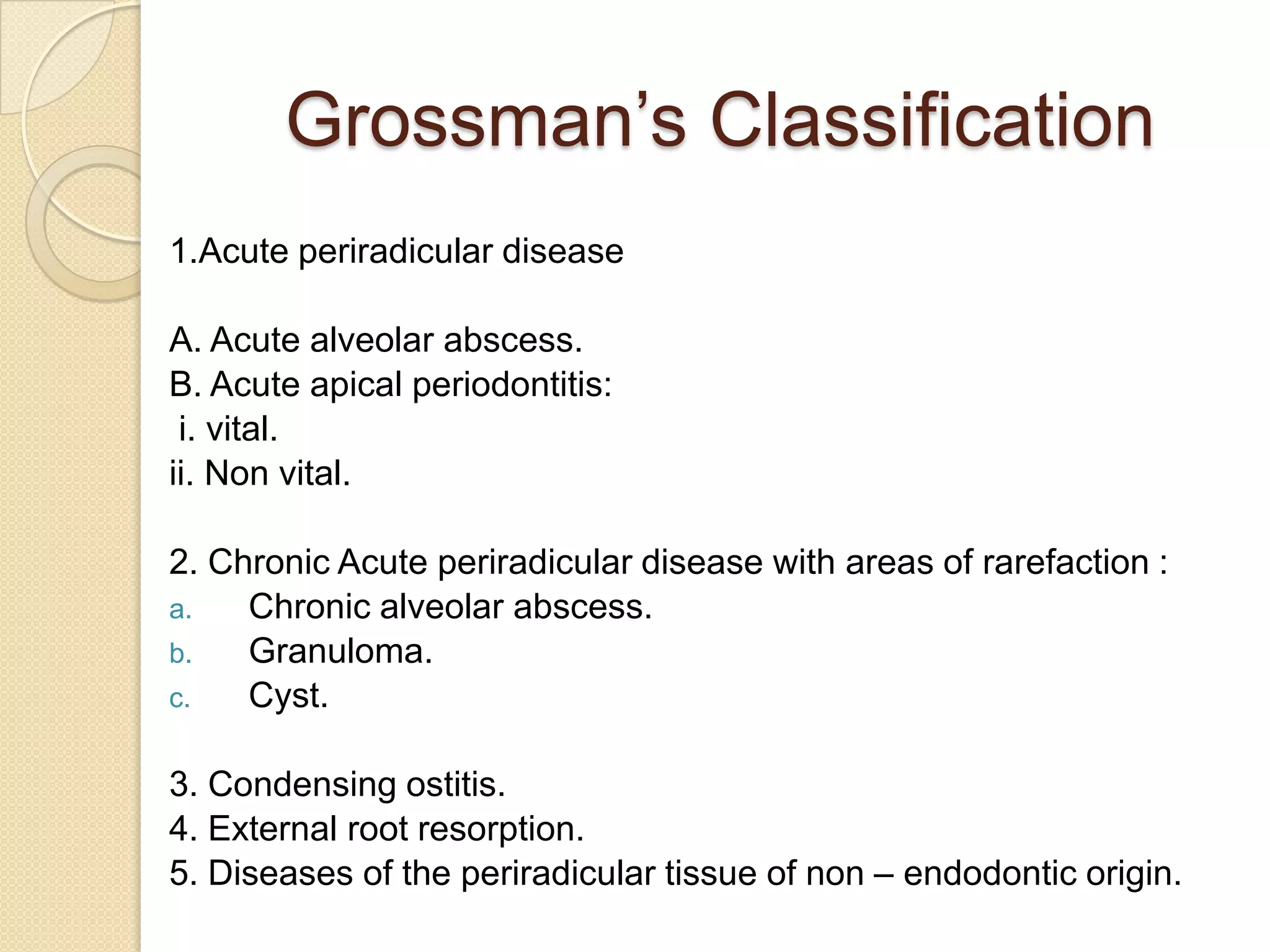
Grossman’s Classification
1.Acute periradicular disease

A. Acute alveolar abscess.
B. Acute apical periodontitis:
 i. vital.
ii. Non vital.

2. Chronic Acute periradicular disease with areas of rarefaction :
a.   Chronic alveolar abscess.
b.   Granuloma.
c.   Cyst.

3. Condensing ostitis.
4. External root resorption.
5. Diseases of the periradicular tissue of non – endodontic origin.
ACUTE APICAL
            PERIODONTITIS
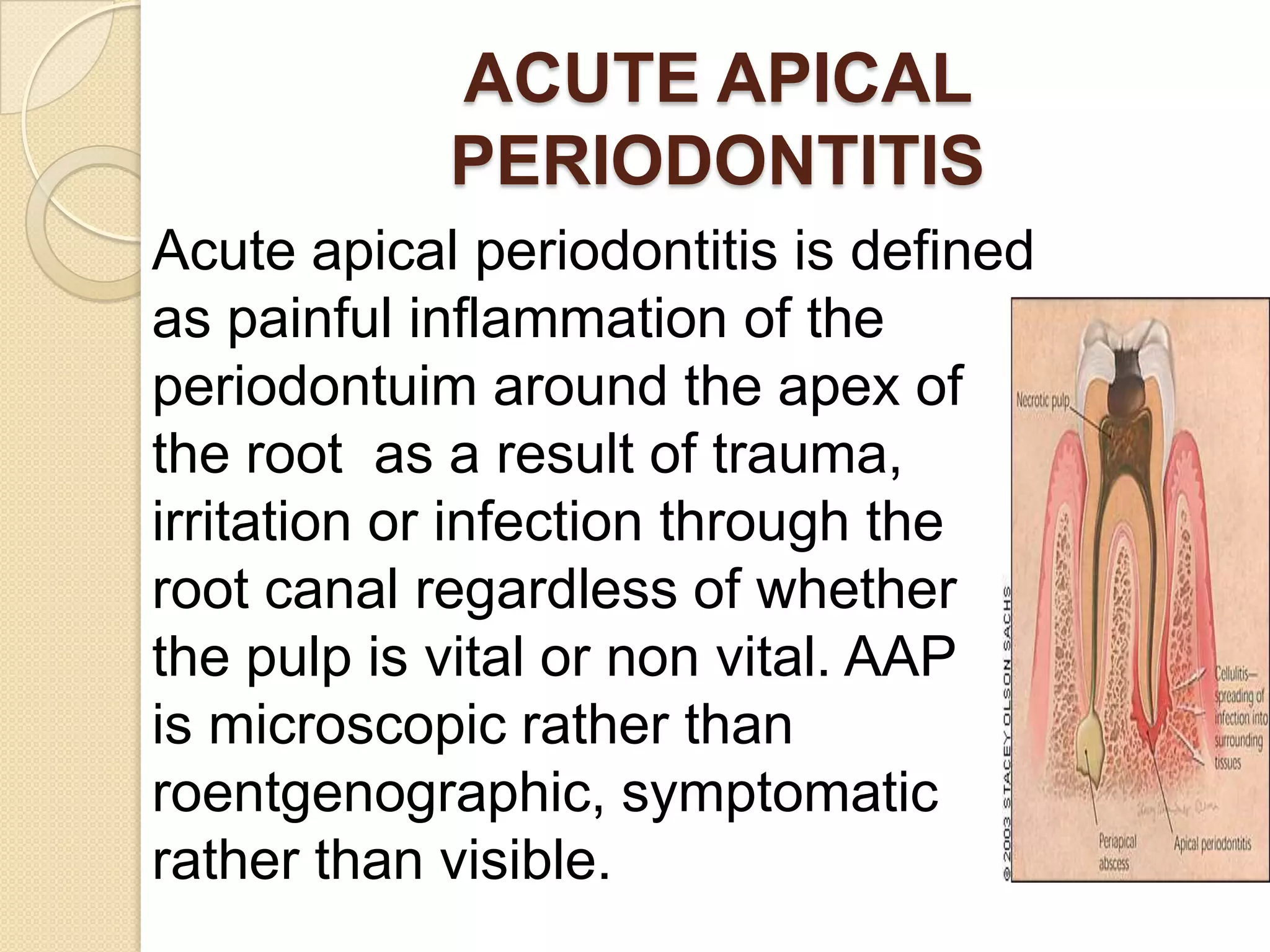
Acute apical periodontitis is defined
as painful inflammation of the
periodontuim around the apex of
the root as a result of trauma,
irritation or infection through the
root canal regardless of whether
the pulp is vital or non vital. AAP
is microscopic rather than
roentgenographic, symptomatic
rather than visible.
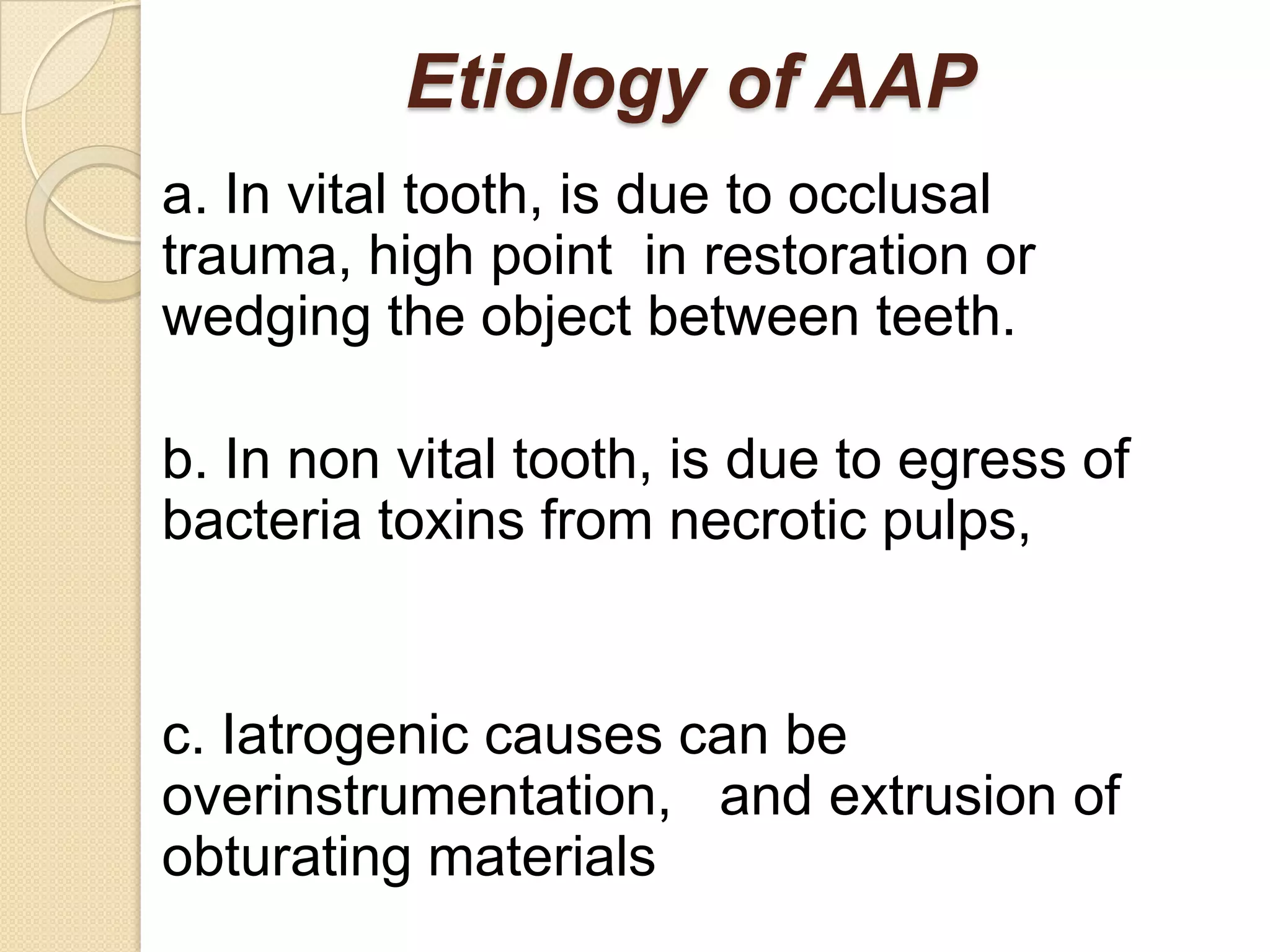
Etiology of AAP
a. In vital tooth, is due to occlusal
trauma, high point in restoration or
wedging the object between teeth.

b. In non vital tooth, is due to egress of
bacteria toxins from necrotic pulps,


c. Iatrogenic causes can be
overinstrumentation, and extrusion of
obturating materials
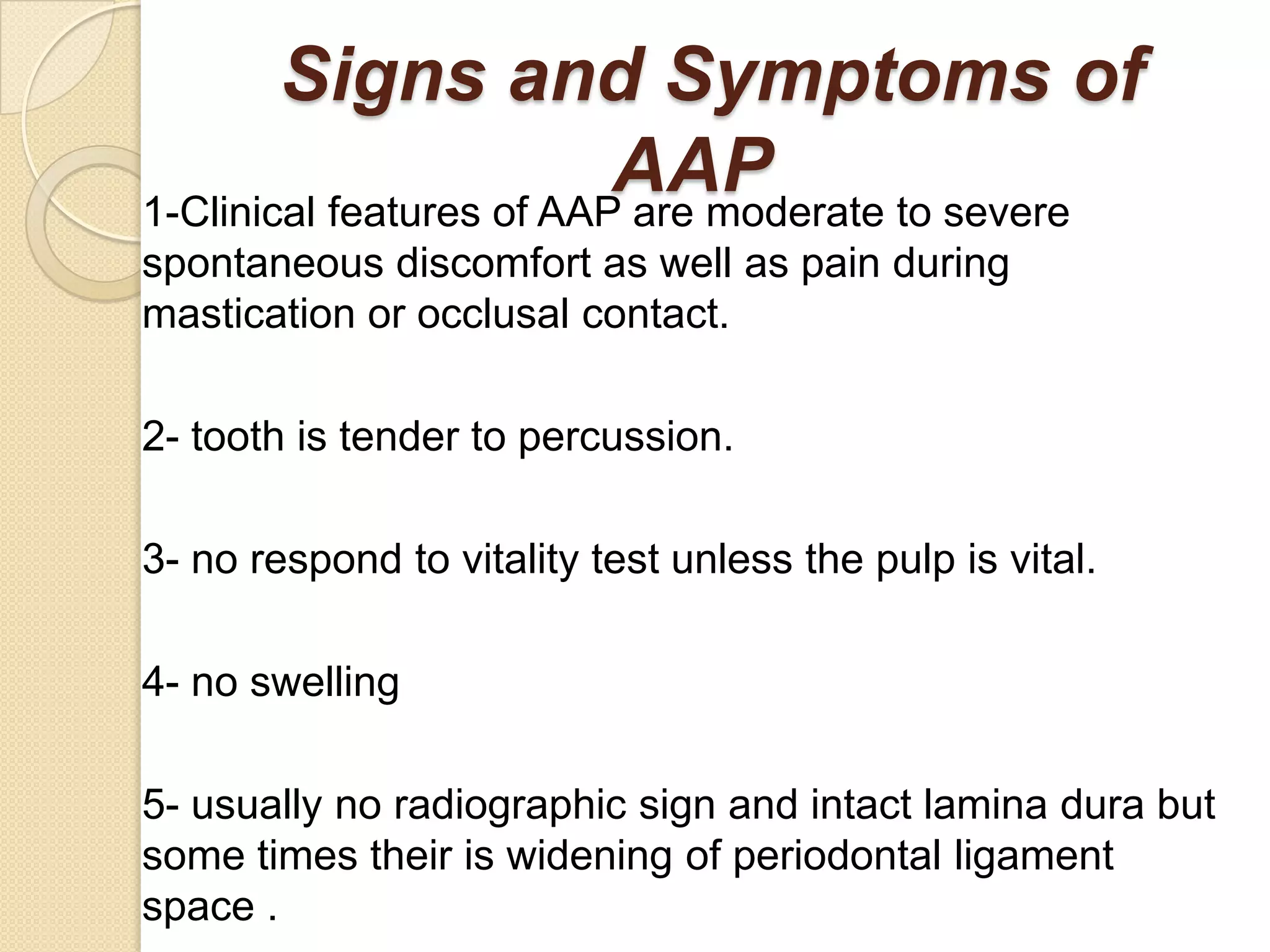
Signs and Symptoms of
                          AAP
1-Clinical features of AAP are moderate to severe
spontaneous discomfort as well as pain during
mastication or occlusal contact.

2- tooth is tender to percussion.

3- no respond to vitality test unless the pulp is vital.

4- no swelling

5- usually no radiographic sign and intact lamina dura but
some times their is widening of periodontal ligament
space .
Treatment of AAP
a-Adjustment of occlusion (when there is
evidence of hyper occlusion),

b-Endodontic therapy to remove the
irritants , a pathologic pulp or release of
exudate usually results in periradicular
relief

c- prescribe analgesics

d- in certain situation extraction is
alternative to endodontic therapy.
Acute periapical abscess
   localized accumulation of pus at the apex of a
    non vital tooth.

Etiology:

 Extension of pulp infection to periapical area.
 Fracture of tooth with pulp exposure.
 Accidental perforation of apical foramen during
  RCT.
 Secondary bacterial invasion into pre-exesting
  periapical granuloma or cyst.
Acute periapical abscess, con’t

Clinical features:
 Tooth is non vital.
 Constant throbbing pain
 Localized as the tooth becomes increasingly
  tender
to percussion.
 Increase pain with chewing.
 Swelling (palpable, fluctuant).
 Mobility may or may not be present.
Acute periapical abscess, con’t-
Clinical features:


   Tooth may be in hyper occlusion; tooth
    feels longer than others

   Gum boil

   Patient may have systemic symptoms(e.g.
    fever, enlarged lymph nodes)
Acute periapical abscess, con’t

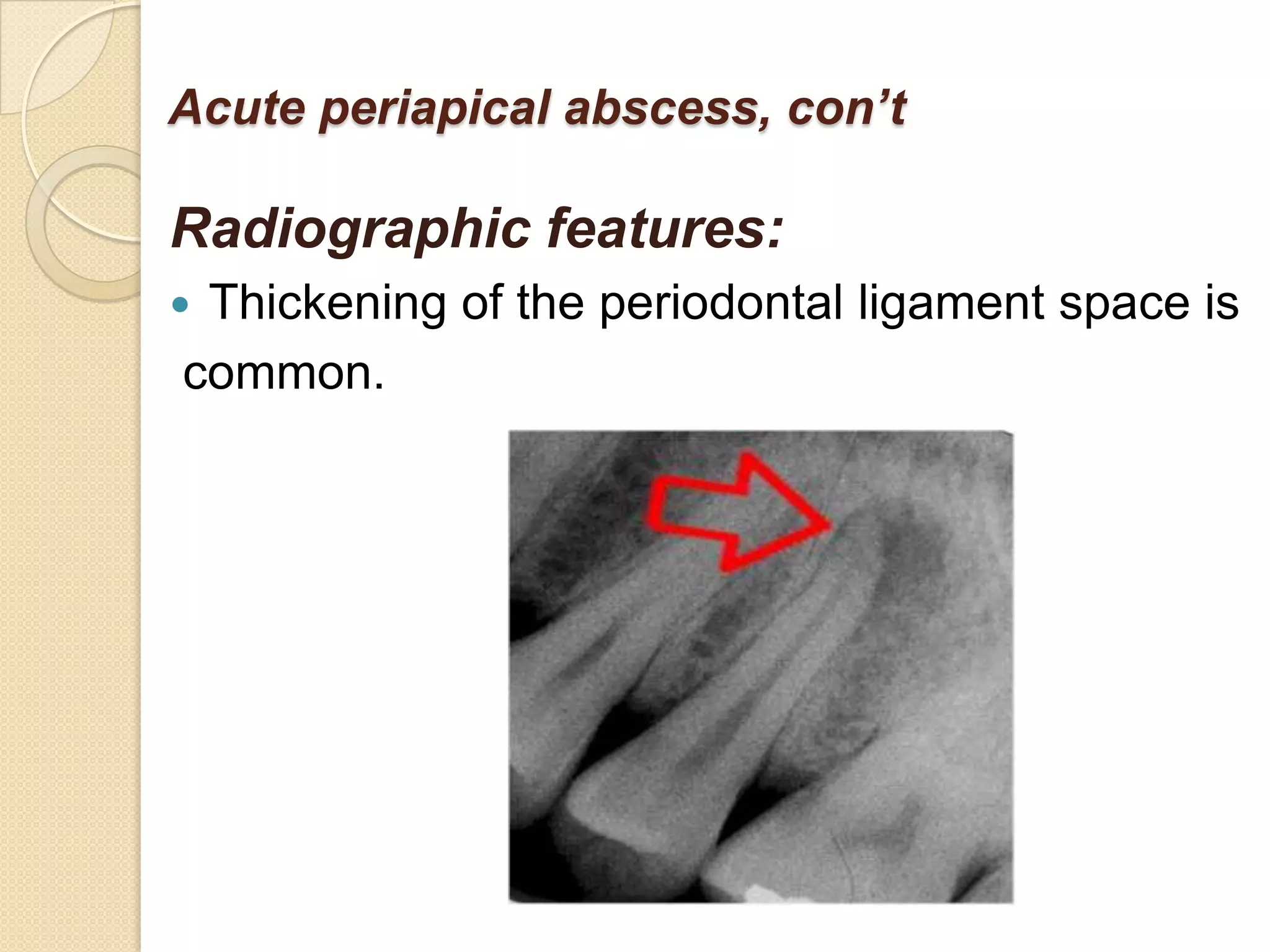
Radiographic features:
Thickening of the periodontal ligament space is
common.
Acute periapical abscess, con’t

Treatment:
   Drainage of the abscess should be initiated as ea
    as possible
    This may include:
   Non surgical RCT.
   Incision and drainage.
   Extraction
   Prescribe antibiotics and analgesics
CHRONIC APICAL
           PERIODONTITIS
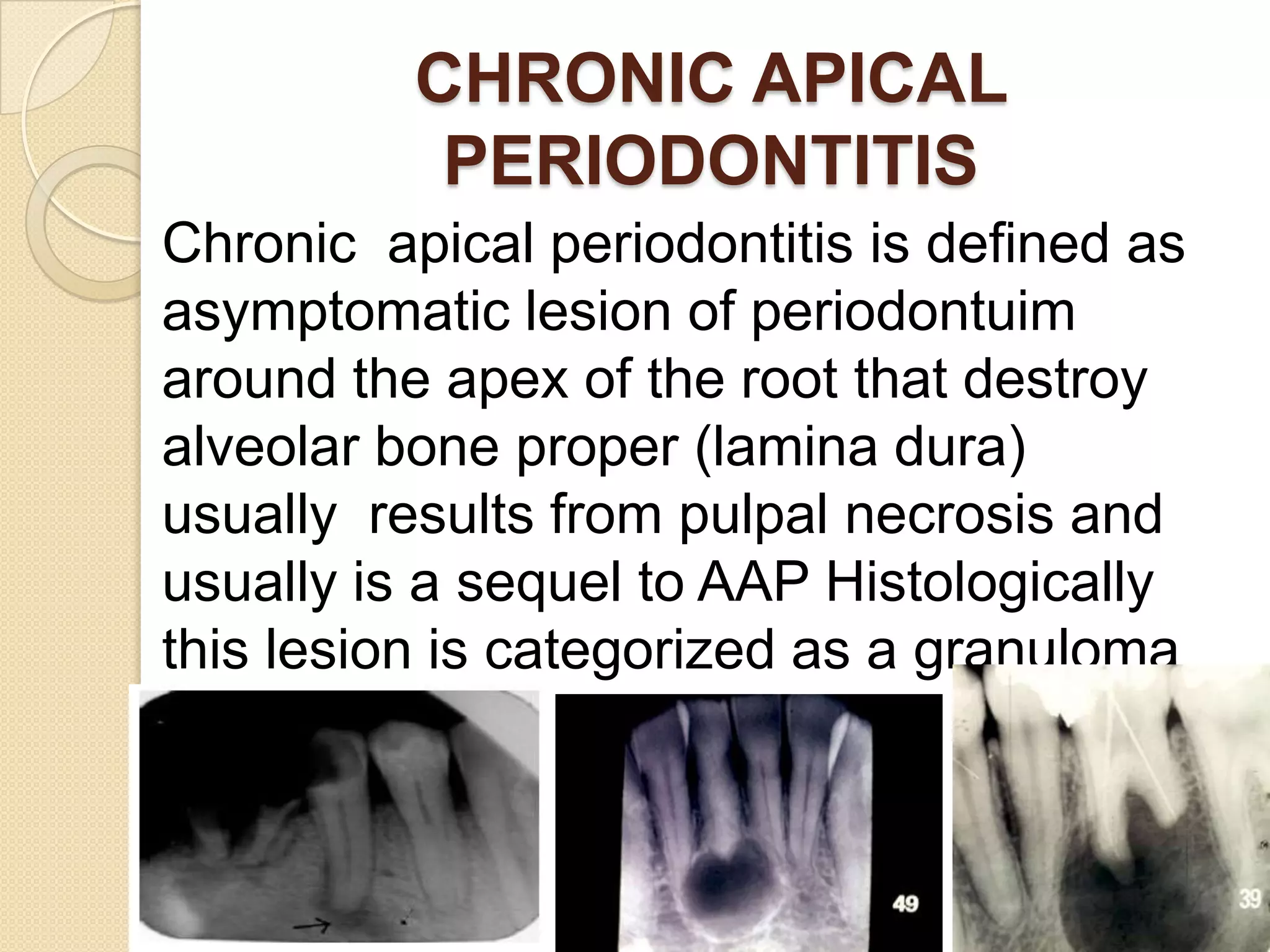
Chronic apical periodontitis is defined as
asymptomatic lesion of periodontuim
around the apex of the root that destroy
alveolar bone proper (lamina dura)
usually results from pulpal necrosis and
usually is a sequel to AAP Histologically
this lesion is categorized as a granuloma
or cyst.
Etiology of CAP

a- is due to egress of bacteria toxins from
necrotic pulps,


b- un treated acute apical periodontitis
Signs and Symptoms of
              CAP
1- usually no pain during mastication or
occlusal contact.
2- little or no sensitivity to percussion.
3- no respond to vitality test
4- no swelling
5- usually no tooth mobility
6-Radiographic features range from
interruption of the lamina dura to
extensive destruction of periradicular and
interradicular tissues.
Treatment of CAP

a-Endodontic therapy to remove inciting
irritants (necrotic pulp) and complete
obturation usually result in resolution of
CAP

b- in the case of unrestorable tooth
extraction followed by curettage of apical
lesion is the best therapy.
Periapical granuloma
It is one of the most sequelae of pulpitis, it is a
   localized mass of granulation tissue around the
   root apex of non vital tooth.
Clinical features:
 Most of cases are asymptomatic but sometimes
  pain and sensitivity are seen when acute
  exacerbation occurs.
 Tooth is not sensitive to percussion.
 No response to electrical or thermal pulp tests.
 Mostly lesions are discovered on routine
  radiographic examination.
Periapical granuloma, con’t

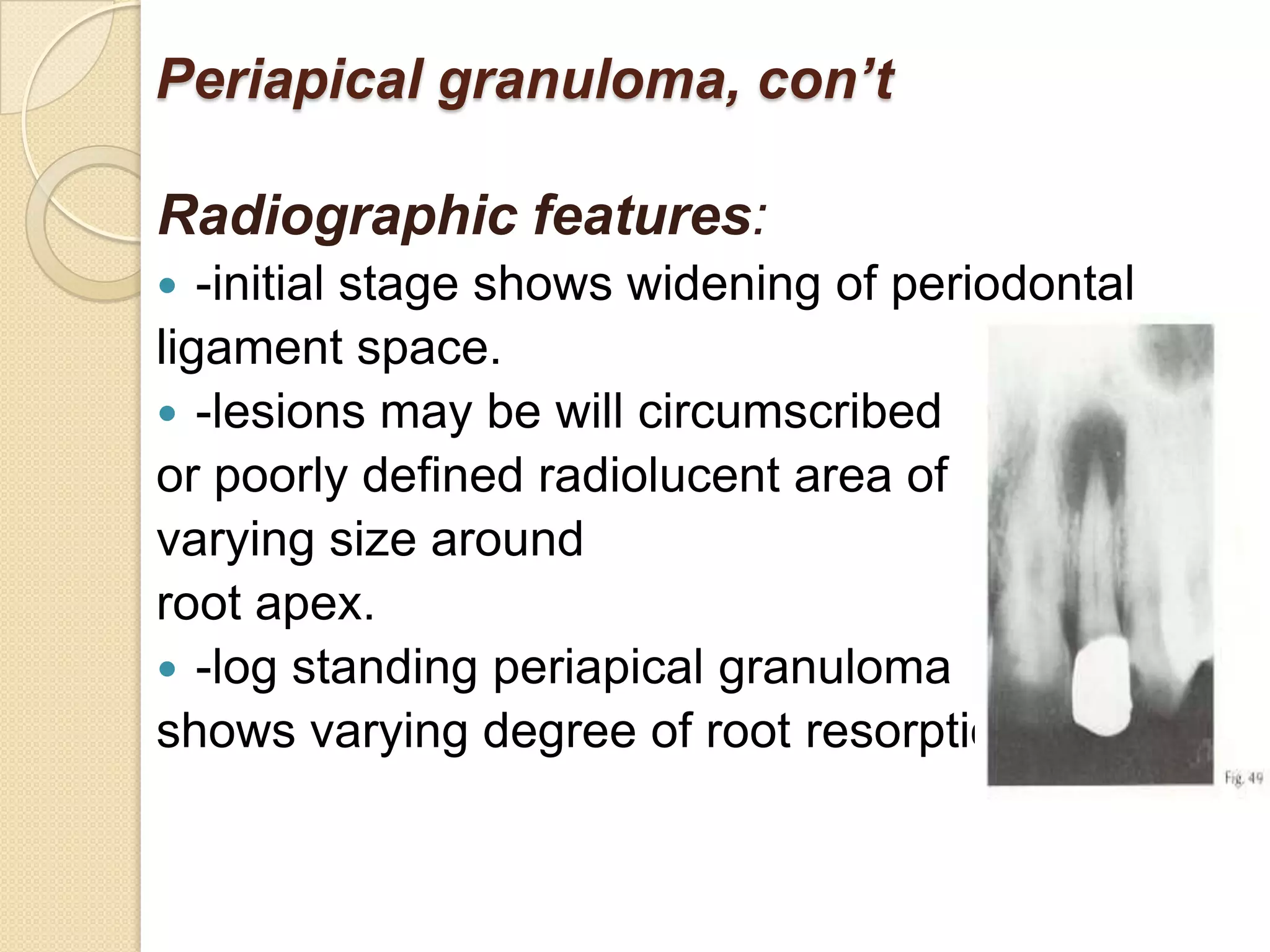
Radiographic features:
  -initial stage shows widening of periodontal
ligament space.
 -lesions may be will circumscribed
or poorly defined radiolucent area of
varying size around
root apex.
 -log standing periapical granuloma
shows varying degree of root resorption.
Periapical granuloma, con’t

Treatment:
   In restorable tooth, root canal therapy.

   In non-restorable tooth, extraction followed by
    curettage of all apical soft tissue.
Radicular Cyst
Radicular cyst:

   It is defined as an odontogenic cyst of
    Inflammatory origin that is preceded by a
    chronic     periapical   granuloma    and
    stimulation of cell rests of malaseez
    present in the periodontal membrane.
Radicular cyst:, con’t

Clinical   features:
 The cyst is frequently asymptomatic and
  sometimes it is discovered when
  periapical radiographs are taken of teeth
  with non-vital pulps.
 These cysts are painless unless infected.
  However, complain of pain is also
  observed in patient without any evidence
  of infection.
Radicular cyst:, con’t
clinical features:
     Occasionally, a sinus may lead from
      cyst cavity to the oral mucosa.

     It may be bony hard if cortex is
      intact, crepitate as the bone thins, or
      rubbery and fluctuant if the bone is
      destroyed.

     The involved tooth usually found to be
      non-vital, discolored, fractured or
      failed root canal.
Radicular cyst: , con’t
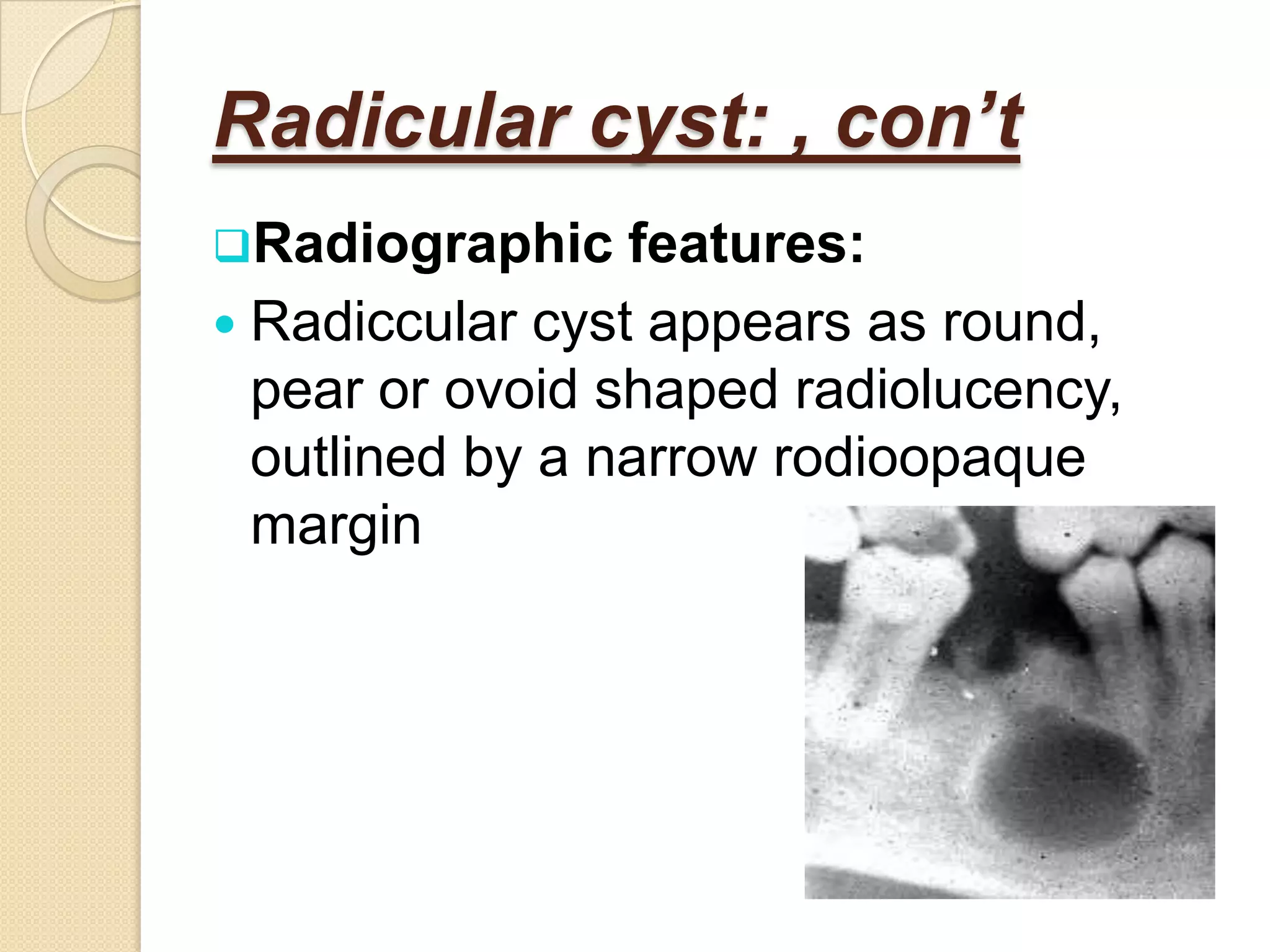
Radiographic    features:
 Radiccular cyst appears as round,
  pear or ovoid shaped radiolucency,
  outlined by a narrow rodioopaque
  margin
Periapical cyst, con’t


       Treatment:
          The source (i.e., necrotic pulp) should
           be removed by full pulpectomy (i.e.,
           root canal therapy) or extraction of the
           offended tooth, and the cyst should be
           enuclated.
Radicular cyst, con’t

    Endodontic Treatment:-


   Peripheral lesions including radicular cysts are
    eliminated once the causative agents are
    removed.           radicular cysts can undergo
    resolutions following Root Canal Treatment &
    don't require surgical intervention. It is suggested
    that insertion of file or other root canal instrument
    beyond the apical foramen (for 1-2mm) produces
    transitory acute inflammation which may destroy
    epithelial lining of radicular cyst & convert it into
    granuloma. Thus, leading to its resolutions.
CHRONIC APICAL ABSCESS
       (SUPPURATIVE APICAL
          PERIODONTITIS)
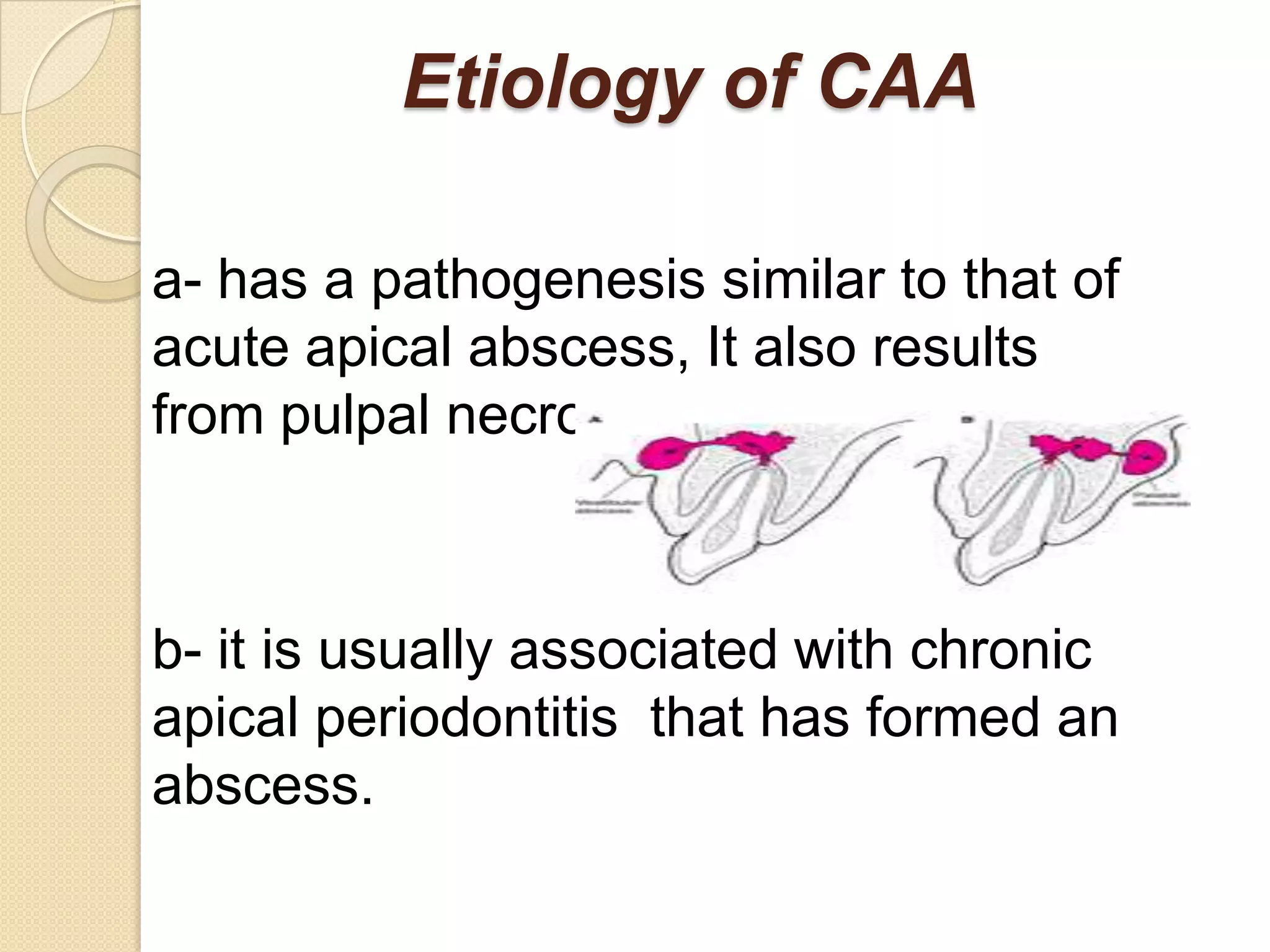
Chronic apical abscess is Also classified as
suppurative apical periodontitis(SAP), it is
chronic (asymptomatic) apical abscess
that penetrate through bone and soft
tissue to form a sinus tract stoma on the
oral mucosa and it is actually results from
a long-standing lesion.
Etiology of CAA

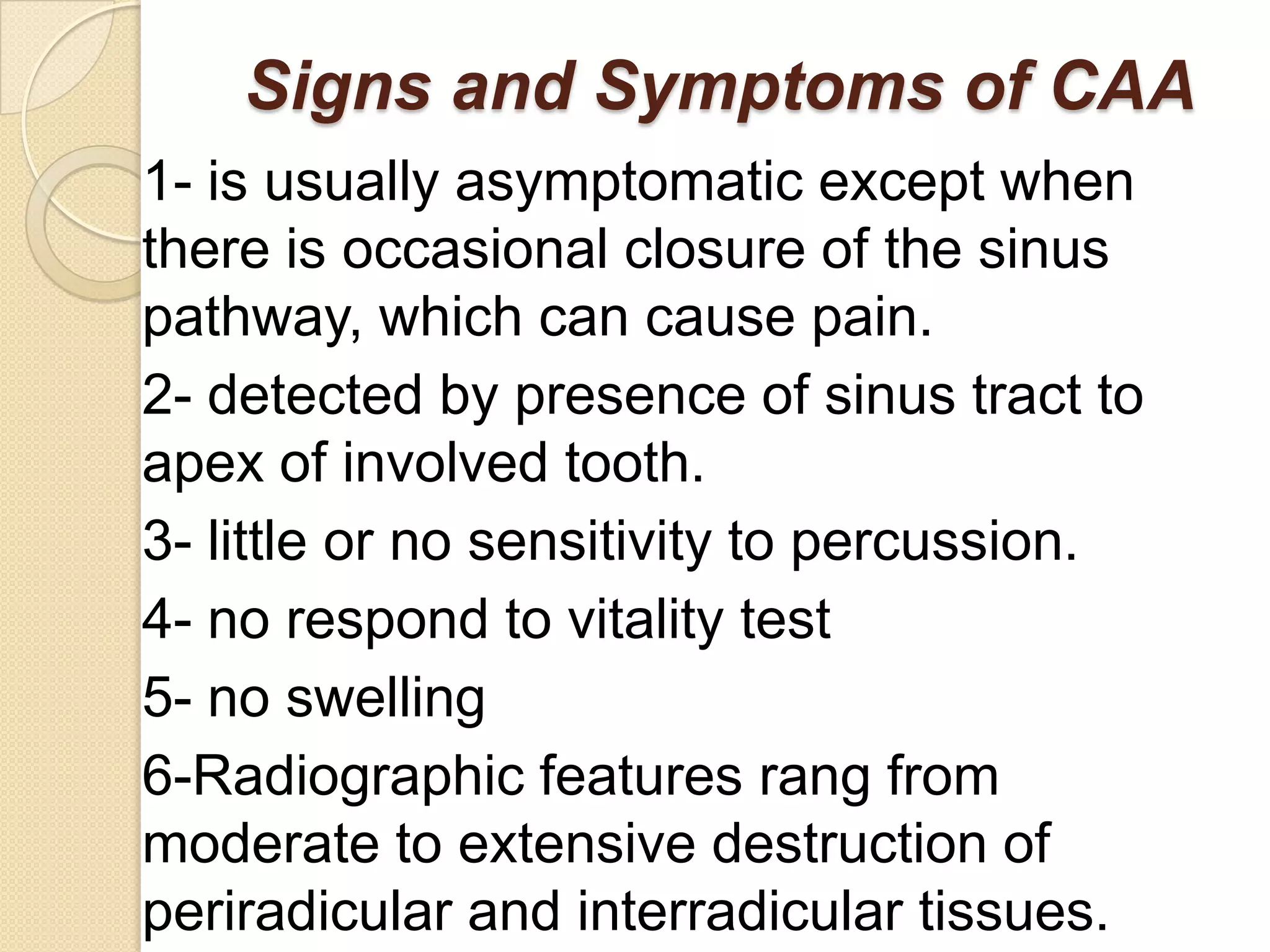
a- has a pathogenesis similar to that of
acute apical abscess, It also results
from pulpal necrosis.


b- it is usually associated with chronic
apical periodontitis that has formed an
abscess.
Signs and Symptoms of CAA
1- is usually asymptomatic except when
there is occasional closure of the sinus
pathway, which can cause pain.
2- detected by presence of sinus tract to
apex of involved tooth.
3- little or no sensitivity to percussion.
4- no respond to vitality test
5- no swelling
6-Radiographic features rang from
moderate to extensive destruction of
periradicular and interradicular tissues.
Treatment of CAA

a-Endodontic therapy to remove inciting
irritants (necrotic pulp) and this will lead to
resolution of sinus tract.

b- in the case of unrestorable tooth
extraction followed by curettage of apical
lesion is the best therapy.
CONDENSING OSTEITIS
Condensing osteitis(focal sclerosing
osteomyelitis) is a rare proliferative
inflammatory response to an irritant and it
is a variant of chronic (asymptomatic)
apical periodontitis represents an increase
in trabecular bone in response to
persistent irritation.
Etiology

a-IRREVERSIBLE PULPITIS

b-PULPAL NECROSIS
Signs and Symptoms
Depending on the cause (pulpitis or pulpal
necrosis),
It’s may be either asymptomatic or
associated with pain.
It’s may or may not respond to vitality test.
It’s may or may not be sensitive to palpation
or percussion.
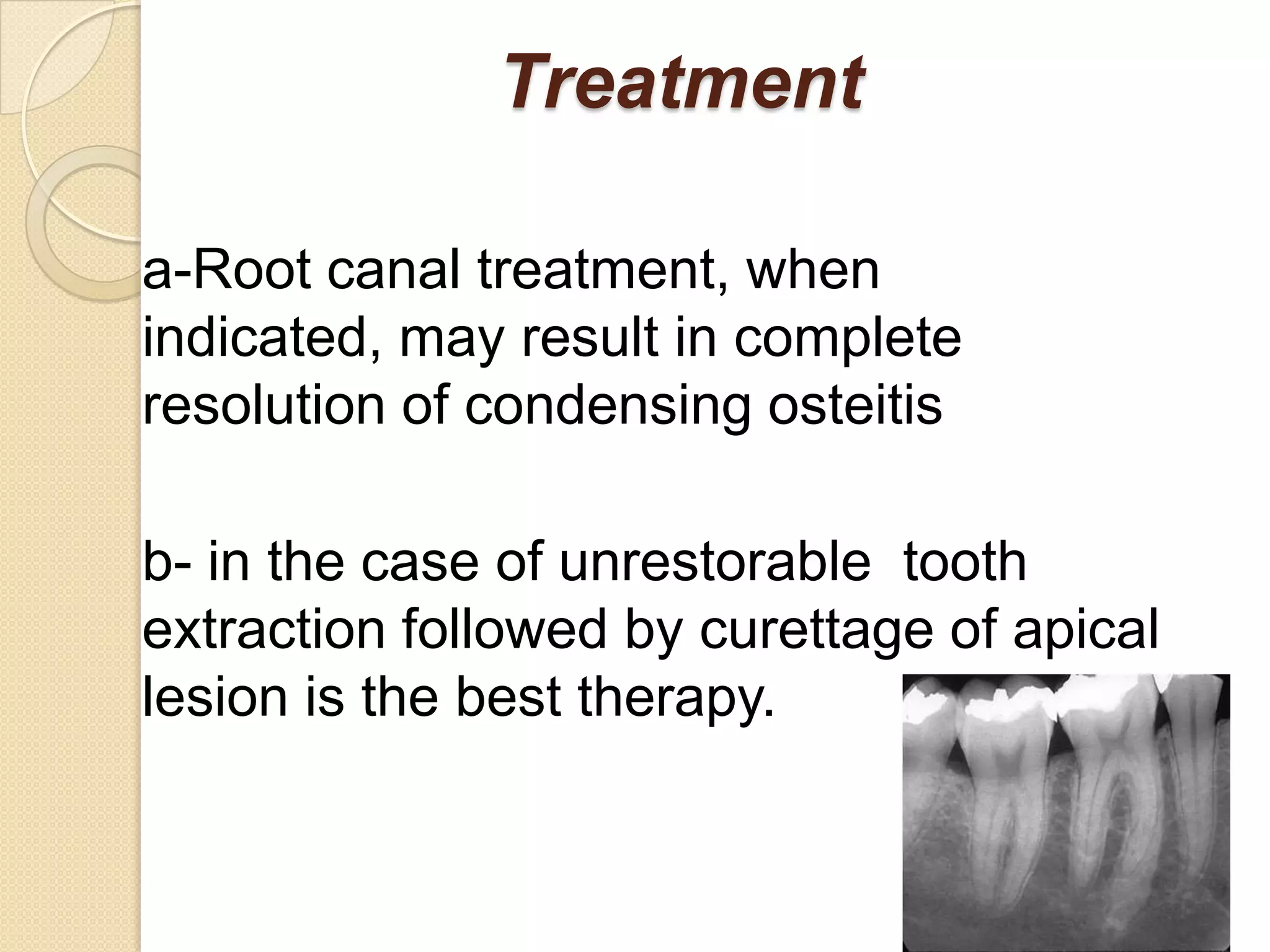
Radiographically, the presence of a diffuse
concentric arrangement of radiopacity
around the root of a tooth is
pathognomonic.
Treatment

a-Root canal treatment, when
indicated, may result in complete
resolution of condensing osteitis

b- in the case of unrestorable tooth
extraction followed by curettage of apical
lesion is the best therapy.
BIBLIOGRAPHY

   Endodontics. Ingle. 2002. 5th edition.

   Textbook of Endodontics. Nisha Garg,
    Amit Garg. 2007.1st edition.

Pathology of the periapex

  • 3.
    Introduction  The periradicular tissue contains : - apical root cementum. - periodontal ligaments. - alveolar bone.
  • 4.
    Etiology of periradicular diseases Bacterial: Untreatedpulpal infection leading to total pulp necrosis if untreated , irritants leak into periapical region forming periapical pathologies.  Trauma Factors related to root canal procedures: Cause inflammatory response due to the extirpation of the pulp, intra canal medicaments or the improper manipulation of instruments.
  • 5.
  • 6.
    Grossman’s Classification 1.Acute periradiculardisease A. Acute alveolar abscess. B. Acute apical periodontitis: i. vital. ii. Non vital. 2. Chronic Acute periradicular disease with areas of rarefaction : a. Chronic alveolar abscess. b. Granuloma. c. Cyst. 3. Condensing ostitis. 4. External root resorption. 5. Diseases of the periradicular tissue of non – endodontic origin.
  • 7.
    ACUTE APICAL PERIODONTITIS Acute apical periodontitis is defined as painful inflammation of the periodontuim around the apex of the root as a result of trauma, irritation or infection through the root canal regardless of whether the pulp is vital or non vital. AAP is microscopic rather than roentgenographic, symptomatic rather than visible.
  • 8.
    Etiology of AAP a.In vital tooth, is due to occlusal trauma, high point in restoration or wedging the object between teeth. b. In non vital tooth, is due to egress of bacteria toxins from necrotic pulps, c. Iatrogenic causes can be overinstrumentation, and extrusion of obturating materials
  • 9.
    Signs and Symptomsof AAP 1-Clinical features of AAP are moderate to severe spontaneous discomfort as well as pain during mastication or occlusal contact. 2- tooth is tender to percussion. 3- no respond to vitality test unless the pulp is vital. 4- no swelling 5- usually no radiographic sign and intact lamina dura but some times their is widening of periodontal ligament space .
  • 10.
    Treatment of AAP a-Adjustmentof occlusion (when there is evidence of hyper occlusion), b-Endodontic therapy to remove the irritants , a pathologic pulp or release of exudate usually results in periradicular relief c- prescribe analgesics d- in certain situation extraction is alternative to endodontic therapy.
  • 11.
    Acute periapical abscess  localized accumulation of pus at the apex of a non vital tooth. Etiology:  Extension of pulp infection to periapical area.  Fracture of tooth with pulp exposure.  Accidental perforation of apical foramen during RCT.  Secondary bacterial invasion into pre-exesting periapical granuloma or cyst.
  • 12.
    Acute periapical abscess,con’t Clinical features:  Tooth is non vital.  Constant throbbing pain  Localized as the tooth becomes increasingly tender to percussion.  Increase pain with chewing.  Swelling (palpable, fluctuant).  Mobility may or may not be present.
  • 13.
    Acute periapical abscess,con’t- Clinical features:  Tooth may be in hyper occlusion; tooth feels longer than others  Gum boil  Patient may have systemic symptoms(e.g. fever, enlarged lymph nodes)
  • 14.
    Acute periapical abscess,con’t Radiographic features: Thickening of the periodontal ligament space is common.
  • 15.
    Acute periapical abscess,con’t Treatment:  Drainage of the abscess should be initiated as ea as possible  This may include:  Non surgical RCT.  Incision and drainage.  Extraction  Prescribe antibiotics and analgesics
  • 16.
    CHRONIC APICAL PERIODONTITIS Chronic apical periodontitis is defined as asymptomatic lesion of periodontuim around the apex of the root that destroy alveolar bone proper (lamina dura) usually results from pulpal necrosis and usually is a sequel to AAP Histologically this lesion is categorized as a granuloma or cyst.
  • 17.
    Etiology of CAP a-is due to egress of bacteria toxins from necrotic pulps, b- un treated acute apical periodontitis
  • 18.
    Signs and Symptomsof CAP 1- usually no pain during mastication or occlusal contact. 2- little or no sensitivity to percussion. 3- no respond to vitality test 4- no swelling 5- usually no tooth mobility 6-Radiographic features range from interruption of the lamina dura to extensive destruction of periradicular and interradicular tissues.
  • 19.
    Treatment of CAP a-Endodontictherapy to remove inciting irritants (necrotic pulp) and complete obturation usually result in resolution of CAP b- in the case of unrestorable tooth extraction followed by curettage of apical lesion is the best therapy.
  • 20.
  • 21.
    Periapical granuloma It isone of the most sequelae of pulpitis, it is a localized mass of granulation tissue around the root apex of non vital tooth. Clinical features:  Most of cases are asymptomatic but sometimes pain and sensitivity are seen when acute exacerbation occurs.  Tooth is not sensitive to percussion.  No response to electrical or thermal pulp tests.  Mostly lesions are discovered on routine radiographic examination.
  • 22.
    Periapical granuloma, con’t Radiographicfeatures:  -initial stage shows widening of periodontal ligament space.  -lesions may be will circumscribed or poorly defined radiolucent area of varying size around root apex.  -log standing periapical granuloma shows varying degree of root resorption.
  • 23.
    Periapical granuloma, con’t Treatment:  In restorable tooth, root canal therapy.  In non-restorable tooth, extraction followed by curettage of all apical soft tissue.
  • 24.
  • 25.
    Radicular cyst:  It is defined as an odontogenic cyst of Inflammatory origin that is preceded by a chronic periapical granuloma and stimulation of cell rests of malaseez present in the periodontal membrane.
  • 26.
    Radicular cyst:, con’t Clinical features:  The cyst is frequently asymptomatic and sometimes it is discovered when periapical radiographs are taken of teeth with non-vital pulps.  These cysts are painless unless infected. However, complain of pain is also observed in patient without any evidence of infection.
  • 27.
    Radicular cyst:, con’t clinicalfeatures:  Occasionally, a sinus may lead from cyst cavity to the oral mucosa.  It may be bony hard if cortex is intact, crepitate as the bone thins, or rubbery and fluctuant if the bone is destroyed.  The involved tooth usually found to be non-vital, discolored, fractured or failed root canal.
  • 28.
    Radicular cyst: ,con’t Radiographic features:  Radiccular cyst appears as round, pear or ovoid shaped radiolucency, outlined by a narrow rodioopaque margin
  • 29.
    Periapical cyst, con’t Treatment:  The source (i.e., necrotic pulp) should be removed by full pulpectomy (i.e., root canal therapy) or extraction of the offended tooth, and the cyst should be enuclated.
  • 30.
    Radicular cyst, con’t Endodontic Treatment:-  Peripheral lesions including radicular cysts are eliminated once the causative agents are removed. radicular cysts can undergo resolutions following Root Canal Treatment & don't require surgical intervention. It is suggested that insertion of file or other root canal instrument beyond the apical foramen (for 1-2mm) produces transitory acute inflammation which may destroy epithelial lining of radicular cyst & convert it into granuloma. Thus, leading to its resolutions.
  • 31.
    CHRONIC APICAL ABSCESS (SUPPURATIVE APICAL PERIODONTITIS) Chronic apical abscess is Also classified as suppurative apical periodontitis(SAP), it is chronic (asymptomatic) apical abscess that penetrate through bone and soft tissue to form a sinus tract stoma on the oral mucosa and it is actually results from a long-standing lesion.
  • 32.
    Etiology of CAA a-has a pathogenesis similar to that of acute apical abscess, It also results from pulpal necrosis. b- it is usually associated with chronic apical periodontitis that has formed an abscess.
  • 33.
    Signs and Symptomsof CAA 1- is usually asymptomatic except when there is occasional closure of the sinus pathway, which can cause pain. 2- detected by presence of sinus tract to apex of involved tooth. 3- little or no sensitivity to percussion. 4- no respond to vitality test 5- no swelling 6-Radiographic features rang from moderate to extensive destruction of periradicular and interradicular tissues.
  • 34.
    Treatment of CAA a-Endodontictherapy to remove inciting irritants (necrotic pulp) and this will lead to resolution of sinus tract. b- in the case of unrestorable tooth extraction followed by curettage of apical lesion is the best therapy.
  • 35.
    CONDENSING OSTEITIS Condensing osteitis(focalsclerosing osteomyelitis) is a rare proliferative inflammatory response to an irritant and it is a variant of chronic (asymptomatic) apical periodontitis represents an increase in trabecular bone in response to persistent irritation.
  • 36.
  • 37.
    Signs and Symptoms Dependingon the cause (pulpitis or pulpal necrosis), It’s may be either asymptomatic or associated with pain. It’s may or may not respond to vitality test. It’s may or may not be sensitive to palpation or percussion. Radiographically, the presence of a diffuse concentric arrangement of radiopacity around the root of a tooth is pathognomonic.
  • 38.
    Treatment a-Root canal treatment,when indicated, may result in complete resolution of condensing osteitis b- in the case of unrestorable tooth extraction followed by curettage of apical lesion is the best therapy.
  • 39.
    BIBLIOGRAPHY  Endodontics. Ingle. 2002. 5th edition.  Textbook of Endodontics. Nisha Garg, Amit Garg. 2007.1st edition.