MICROBIOLOGY OF DENTAL CARIES
BDS YEAR III Makerere University
3RD
NOV 2017
Objectives
Introduction
To define dental caries
To describe the normal flora of the mouth
To describe the chemoparasitic theory
To describe specific and non specific plaque
hypothesis.
To describe role of plaque in caries
Streptococcus mutans in caries development
BDS
Introduction
 Dental caries is the most common chronic
diseases in the world
 Has affected humans since prehistoric times
 Its prevalence has increased greatly in
modern times world wide, an increase
strongly associated with dietary changes.
 Loesche in 1986, described it as the most
expensive infection that most individuals have
to contend with during life. This statement
remains correct today world wide
BDS
Dental
caries
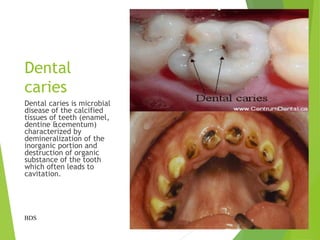
Dental caries is microbial
disease of the calcified
tissues of teeth (enamel,
dentine &cementum)
characterized by
demineralization of the
inorganic portion and
destruction of organic
substance of the tooth
which often leads to
cavitation.
BDS
Normal flora in the mouth
 Gram positive
Streptococci
(viridans,salvarious,sangius,
mutans,mitis)
Enterococci (faecalis,faecium)
Staphylococci
(epidermis,aureus,salvarious
)
Lactobacilli
(acidophilas,brevis,casei,fer
menti)
Coryneibacterium, actinomyces
odontomycus viscosus,
norcardia.
 Gram negative
Neisseria (catarrhalis,
pharyngis)
Bacteriodes(melaninogenicus,
oralis)
Fusobacterium
(nucleatum,polymorphum
Spirochets ( T.
macrodentum,T. denticola,
T.ovalis)
Mycobacterrium (M. salvarium)
Protozoa (entamoeba
gingivalis)
BDS
Chemicoparasitic theory(1890)
 Proposed in 1890 by W. D. Miller in his book
‘’microorganisms of the human mouth" based upon the
work done in Robert Koch’s laboratory in Berlin
 Acid and parasite
 showed that the degradation of carbohydrate-containing
foods resulted in acid formation and was able to
demonstrate this process in vitro with isolated oral
bacteria and extracted teeth.
 Concluded that dental caries was caused by multiple
species of oral bacteria
 No specific bacteria was implicated
 Proper prevention is therefore is to remove or minimize
multiple bacterial species
BDS
Specific and non specific plaque
hypothesis in plaque pathogenicity
Non specific plaque hypothesis:
It assumes that all plaque is pathogenic
It therefore requires a therapeutic goal that completely
eliminates plaque in patients.
This goal is unrealistic and not achievable even in most
dedicated patients
•Specific plaque hypothesis
Recognizes plaque as pathogenic only when signs of
associated disease are present.
Treatment is aimed at eliminating specific pathogenic
organisms (cariogenic plaque) but not total plaque
elimination.
Provides new scientific basis of caries treatment based on
medical model.
BDS
The specific plaque hypothesis
and dental caries.
In 1924, Clark isolated streptococci from human carious
lesions, and named Streptococcus mutans
In 1960, Keyes showed that ‘caries-free’ hamsters
develop dental caries only when caged together with
caries-active’ hamsters
The bacteria previously referred to as S. mutans are
actually seven distinct species now called mutans
MS are the principal etiological agents of dental caries
BDS
Role of plaque in caries
 Plaque is a soft, non mineralized, bacterial deposit which
forms on a teeth that are not adequately cleaned
 Important component of dental plaque is acquired
pellicle  just prior or concomitantly with bacterial
colonization and may facilitate plaque formation
 Microbial in dental plaque
 streptococci
 actinomycetes
 veillonella
 Strep. mutans  chief etiological agent of dental caries
BDS
Microbial etiology of caries
 Strep. mutans
 Requires a relatively high proportion (2-10%) of mutans
 streptococci within dental plaque.
 Possess adherence activity to tooth surface (wall associated
protein A and Glucan binding protein A&C)
 Produce higher amounts of acid(lactate) from sugars than
other bacterial types, and possess acid tolerance (aciduric)
 Produce extracellular polysaccharides (glucans,fructans) from
sucrose
 Lactobacilli
 Dentin, root caries, acidogenic, aciduric
 ● Actinomyces viscosus
 Root caries, acidogenic and aciduric
BDS
The metabolism of s.mutans
 The fermentation of these carbohydrates is the principal
source of energy for S. mutans
 Genome sequence shows that S. mutans can metabolize
a wider variety of carbohydrates than any other G(+)
microorganism
 The glycolytic pathway leads to the production of
pyruvate, which is converted to lactic acid (by LDH
activity), formate, ethanol and acetate
 The acidic environments are responsible for the damage
of
tooth structure
 Acid tolerant – based on a membrane-bound, acid stable,
proton-translocating ATPase
BDS
Virulence of s.mutans
 Production of
 Acid
 Adhesins
 Wall-associated protein A (WapA)
 Glucan-binding proteins A and C
BDS
Methods of attachment
Sucrose independent –using ionic and lectin like
interaction
Adhere to salivary agglutinin glycoprotein (SpaP:
Streptococcal protein antigen P.
Adhere to other bacteria, the extracellular matrix and
epithelial
cell-surface receptors
Sucrose dependent
Adhere to tooth surface by synthesizing glucans by
glucosyltransferases
Glucan promotes cell-cell aggregation by interacting with
surface-associated glucan binding protein
BDS
References
 Oral pathology by CAWSON
 Hand book of operative dentistry
BDS

Caries microbiology

  • 1.
    MICROBIOLOGY OF DENTALCARIES BDS YEAR III Makerere University 3RD NOV 2017
  • 2.
    Objectives Introduction To define dentalcaries To describe the normal flora of the mouth To describe the chemoparasitic theory To describe specific and non specific plaque hypothesis. To describe role of plaque in caries Streptococcus mutans in caries development BDS
  • 3.
    Introduction  Dental cariesis the most common chronic diseases in the world  Has affected humans since prehistoric times  Its prevalence has increased greatly in modern times world wide, an increase strongly associated with dietary changes.  Loesche in 1986, described it as the most expensive infection that most individuals have to contend with during life. This statement remains correct today world wide BDS
  • 4.
    Dental caries Dental caries ismicrobial disease of the calcified tissues of teeth (enamel, dentine &cementum) characterized by demineralization of the inorganic portion and destruction of organic substance of the tooth which often leads to cavitation. BDS
  • 5.
    Normal flora inthe mouth  Gram positive Streptococci (viridans,salvarious,sangius, mutans,mitis) Enterococci (faecalis,faecium) Staphylococci (epidermis,aureus,salvarious ) Lactobacilli (acidophilas,brevis,casei,fer menti) Coryneibacterium, actinomyces odontomycus viscosus, norcardia.  Gram negative Neisseria (catarrhalis, pharyngis) Bacteriodes(melaninogenicus, oralis) Fusobacterium (nucleatum,polymorphum Spirochets ( T. macrodentum,T. denticola, T.ovalis) Mycobacterrium (M. salvarium) Protozoa (entamoeba gingivalis) BDS
  • 6.
    Chemicoparasitic theory(1890)  Proposedin 1890 by W. D. Miller in his book ‘’microorganisms of the human mouth" based upon the work done in Robert Koch’s laboratory in Berlin  Acid and parasite  showed that the degradation of carbohydrate-containing foods resulted in acid formation and was able to demonstrate this process in vitro with isolated oral bacteria and extracted teeth.  Concluded that dental caries was caused by multiple species of oral bacteria  No specific bacteria was implicated  Proper prevention is therefore is to remove or minimize multiple bacterial species BDS
  • 7.
    Specific and nonspecific plaque hypothesis in plaque pathogenicity Non specific plaque hypothesis: It assumes that all plaque is pathogenic It therefore requires a therapeutic goal that completely eliminates plaque in patients. This goal is unrealistic and not achievable even in most dedicated patients •Specific plaque hypothesis Recognizes plaque as pathogenic only when signs of associated disease are present. Treatment is aimed at eliminating specific pathogenic organisms (cariogenic plaque) but not total plaque elimination. Provides new scientific basis of caries treatment based on medical model. BDS
  • 8.
    The specific plaquehypothesis and dental caries. In 1924, Clark isolated streptococci from human carious lesions, and named Streptococcus mutans In 1960, Keyes showed that ‘caries-free’ hamsters develop dental caries only when caged together with caries-active’ hamsters The bacteria previously referred to as S. mutans are actually seven distinct species now called mutans MS are the principal etiological agents of dental caries BDS
  • 9.
    Role of plaquein caries  Plaque is a soft, non mineralized, bacterial deposit which forms on a teeth that are not adequately cleaned  Important component of dental plaque is acquired pellicle  just prior or concomitantly with bacterial colonization and may facilitate plaque formation  Microbial in dental plaque  streptococci  actinomycetes  veillonella  Strep. mutans  chief etiological agent of dental caries BDS
  • 10.
    Microbial etiology ofcaries  Strep. mutans  Requires a relatively high proportion (2-10%) of mutans  streptococci within dental plaque.  Possess adherence activity to tooth surface (wall associated protein A and Glucan binding protein A&C)  Produce higher amounts of acid(lactate) from sugars than other bacterial types, and possess acid tolerance (aciduric)  Produce extracellular polysaccharides (glucans,fructans) from sucrose  Lactobacilli  Dentin, root caries, acidogenic, aciduric  ● Actinomyces viscosus  Root caries, acidogenic and aciduric BDS
  • 11.
    The metabolism ofs.mutans  The fermentation of these carbohydrates is the principal source of energy for S. mutans  Genome sequence shows that S. mutans can metabolize a wider variety of carbohydrates than any other G(+) microorganism  The glycolytic pathway leads to the production of pyruvate, which is converted to lactic acid (by LDH activity), formate, ethanol and acetate  The acidic environments are responsible for the damage of tooth structure  Acid tolerant – based on a membrane-bound, acid stable, proton-translocating ATPase BDS
  • 12.
    Virulence of s.mutans Production of  Acid  Adhesins  Wall-associated protein A (WapA)  Glucan-binding proteins A and C BDS
  • 13.
    Methods of attachment Sucroseindependent –using ionic and lectin like interaction Adhere to salivary agglutinin glycoprotein (SpaP: Streptococcal protein antigen P. Adhere to other bacteria, the extracellular matrix and epithelial cell-surface receptors Sucrose dependent Adhere to tooth surface by synthesizing glucans by glucosyltransferases Glucan promotes cell-cell aggregation by interacting with surface-associated glucan binding protein BDS
  • 14.
    References  Oral pathologyby CAWSON  Hand book of operative dentistry BDS