The Distribution of Oral Diseases

Tooth Loss
PDS 372
Dr. Asim Al-Ansari
History of Tooth Loss
• For centuries, tooth loss was inevitable
• During the 19th century, dentists were still busy
extracting teeth
– Caries was rampant
– Restorative techniques rough and painful
– Prevention unknown

• People expected to loose teeth and dentists
were ready to extract them
History of Tooth Loss
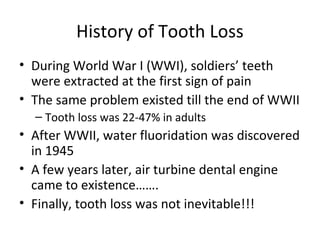
• During World War I (WWI), soldiers’ teeth
were extracted at the first sign of pain
• The same problem existed till the end of WWII
– Tooth loss was 22-47% in adults

• After WWII, water fluoridation was discovered
in 1945
• A few years later, air turbine dental engine
came to existence…….
• Finally, tooth loss was not inevitable!!!
Reasons for Tooth Loss
• It was generally believed
– dental caries is the major cause before age 35
– periodontal disease is the major cause after age 35

• From the mid-1980s, studies from different
countries and populations were consistent in
finding that caries is the “principal” cause of
tooth loss at most ages. The exception are
people above persons above 70 years old
Tooth Loss
• Is the dental equivalent of “death”
• Affects quality of life…
• Reflects on:
– Awareness (patient attitude)
– Availability of services
– Accessibility to services
Reasons for Tooth Loss
• Some believe that when it comes to full
clearance of the mouth, PD is usually the
cause.
Prevalence of Tooth Loss
• NHANES III (National Health and Nutrition
Examination Survey)
– Was conducted 1988-1994
– 11% of people 18 and older were edentulous
• 1% of 25-34 year olds were edentulous
• 44% of 75 or older

– More adults are retaining their teeth
• Mean number of retained teeth was 7.1 in the 60s and
16 in early 90s

– Estimated that in 2024, 10% of 64-74 year old will
suffer from edentulousness
Prevalence of Tooth Loss
• Edentulism is related to socio-economic
status (SES):
– Level of education
• 10% if < 8 years of education
• 1.5% if > 13 years of education

– Income
– Ethnicity
Indicators for Oral Health
• National Oral Health Surveillance System
– Dental visits
– Professional tooth cleaning
– Complete tooth loss
– Fluoridation status
– Caries experience
– Untreated caries
– Sealants
– Oral cancer
Impact of Edentulism
•
•
•
•
•

Compromised ability to chew food
Alteration in food selection and preparation
Overall reduction in dietary intake
Nutritional status and general health status
Alterations in certain perceptual and sensory
measures
• Alteration in taste and texture preferences
• Financial burden of treatment
How to reduce edentulism?
• Prevention of caries
• Prevention of periodontal disease
• Control of systemic risk factors
• Promotion of positive attitudes toward tooth
retention
Summary
• Tooth loss is not inevitable (preventable)
• Edentulism is a preventable health problem
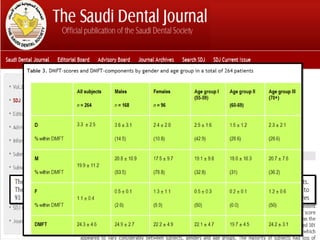
• Caries is the major cause of tooth loss
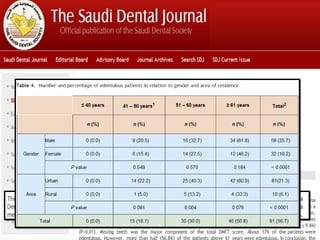
• Edentulism in Saudi Arabia is high
• Edentulism is related to SES

Tooth Loss

  • 1.
    The Distribution ofOral Diseases Tooth Loss PDS 372 Dr. Asim Al-Ansari
  • 2.
    History of ToothLoss • For centuries, tooth loss was inevitable • During the 19th century, dentists were still busy extracting teeth – Caries was rampant – Restorative techniques rough and painful – Prevention unknown • People expected to loose teeth and dentists were ready to extract them
  • 3.
    History of ToothLoss • During World War I (WWI), soldiers’ teeth were extracted at the first sign of pain • The same problem existed till the end of WWII – Tooth loss was 22-47% in adults • After WWII, water fluoridation was discovered in 1945 • A few years later, air turbine dental engine came to existence……. • Finally, tooth loss was not inevitable!!!
  • 4.
    Reasons for ToothLoss • It was generally believed – dental caries is the major cause before age 35 – periodontal disease is the major cause after age 35 • From the mid-1980s, studies from different countries and populations were consistent in finding that caries is the “principal” cause of tooth loss at most ages. The exception are people above persons above 70 years old
  • 5.
    Tooth Loss • Isthe dental equivalent of “death” • Affects quality of life… • Reflects on: – Awareness (patient attitude) – Availability of services – Accessibility to services
  • 6.
    Reasons for ToothLoss • Some believe that when it comes to full clearance of the mouth, PD is usually the cause.
  • 7.
  • 10.
    Prevalence of ToothLoss • NHANES III (National Health and Nutrition Examination Survey) – Was conducted 1988-1994 – 11% of people 18 and older were edentulous • 1% of 25-34 year olds were edentulous • 44% of 75 or older – More adults are retaining their teeth • Mean number of retained teeth was 7.1 in the 60s and 16 in early 90s – Estimated that in 2024, 10% of 64-74 year old will suffer from edentulousness
  • 11.
    Prevalence of ToothLoss • Edentulism is related to socio-economic status (SES): – Level of education • 10% if < 8 years of education • 1.5% if > 13 years of education – Income – Ethnicity
  • 12.
    Indicators for OralHealth • National Oral Health Surveillance System – Dental visits – Professional tooth cleaning – Complete tooth loss – Fluoridation status – Caries experience – Untreated caries – Sealants – Oral cancer
  • 13.
    Impact of Edentulism • • • • • Compromisedability to chew food Alteration in food selection and preparation Overall reduction in dietary intake Nutritional status and general health status Alterations in certain perceptual and sensory measures • Alteration in taste and texture preferences • Financial burden of treatment
  • 14.
    How to reduceedentulism? • Prevention of caries • Prevention of periodontal disease • Control of systemic risk factors • Promotion of positive attitudes toward tooth retention
  • 15.
    Summary • Tooth lossis not inevitable (preventable) • Edentulism is a preventable health problem • Caries is the major cause of tooth loss • Edentulism in Saudi Arabia is high • Edentulism is related to SES