TYPES OF CROWN & 
BRIDGE 
Dr Yumna Shaheen Ali
CROWN
DEFINITION OF CROWN 
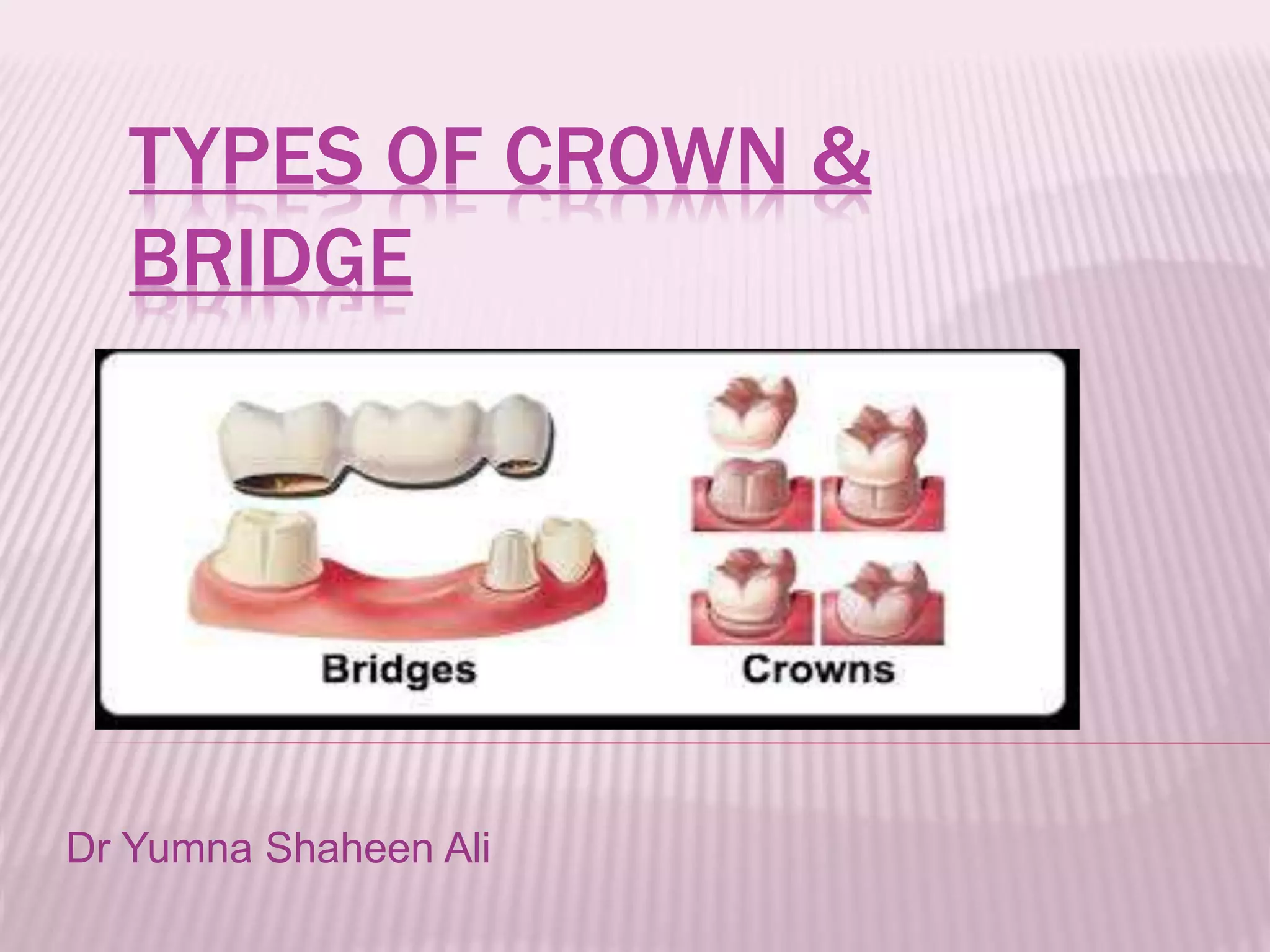
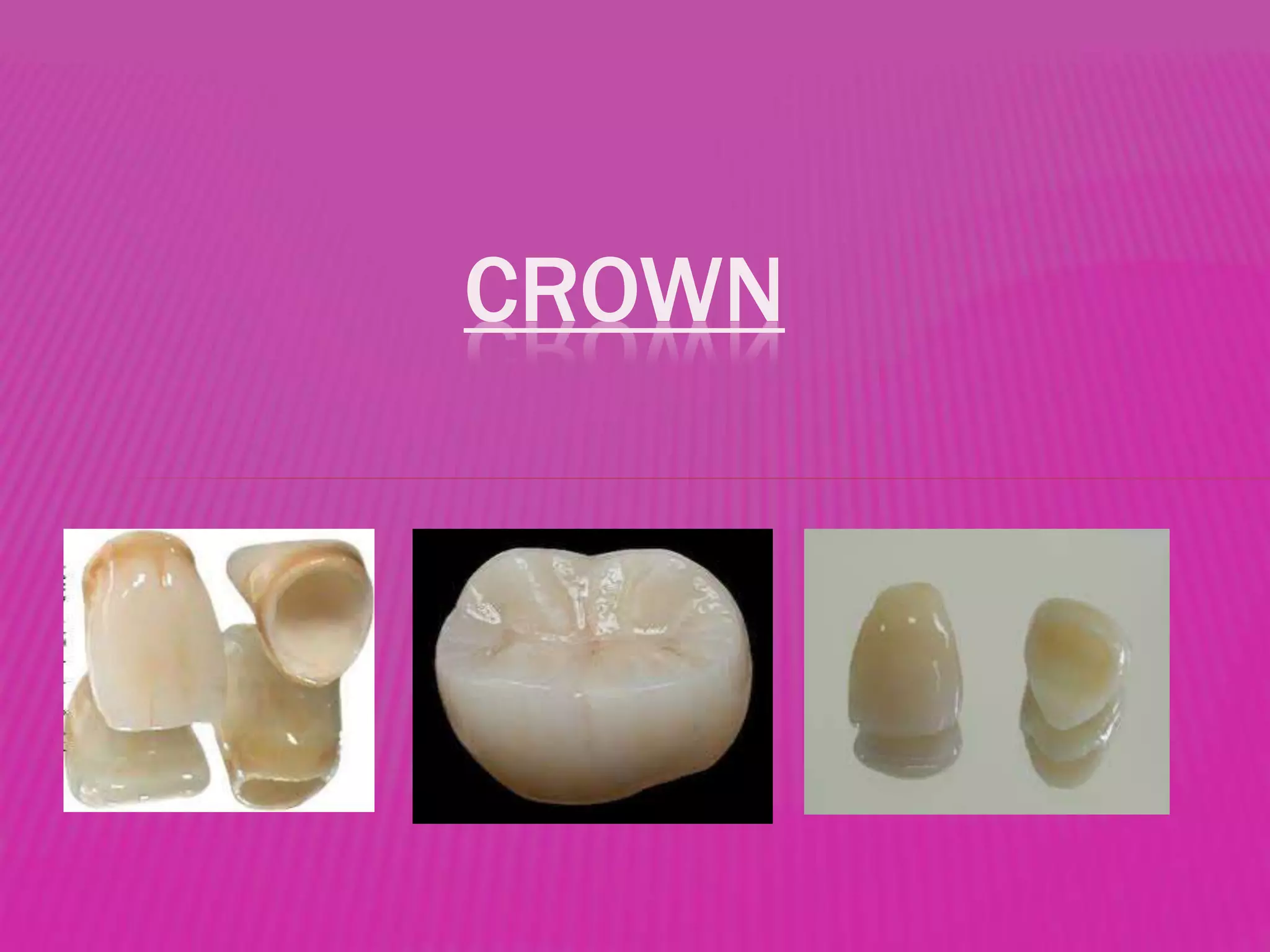
An artificial replacement that restores missing 
tooth structure by surrounding part or all of 
remaining tooth structure with a material 
such as metal, porcelain or combination of 
materials such as metal and porcelain.
DIFFERENT TYPES OF CROWNS 
Anterior complete crowns 
for vital teeth 
Anterior complete crowns 
for root filled teeth 
Posterior complete 
crowns 
Posterior partial crowns
A) ANTERIOR COMPLETE CROWNS FOR 
VITAL TEETH 
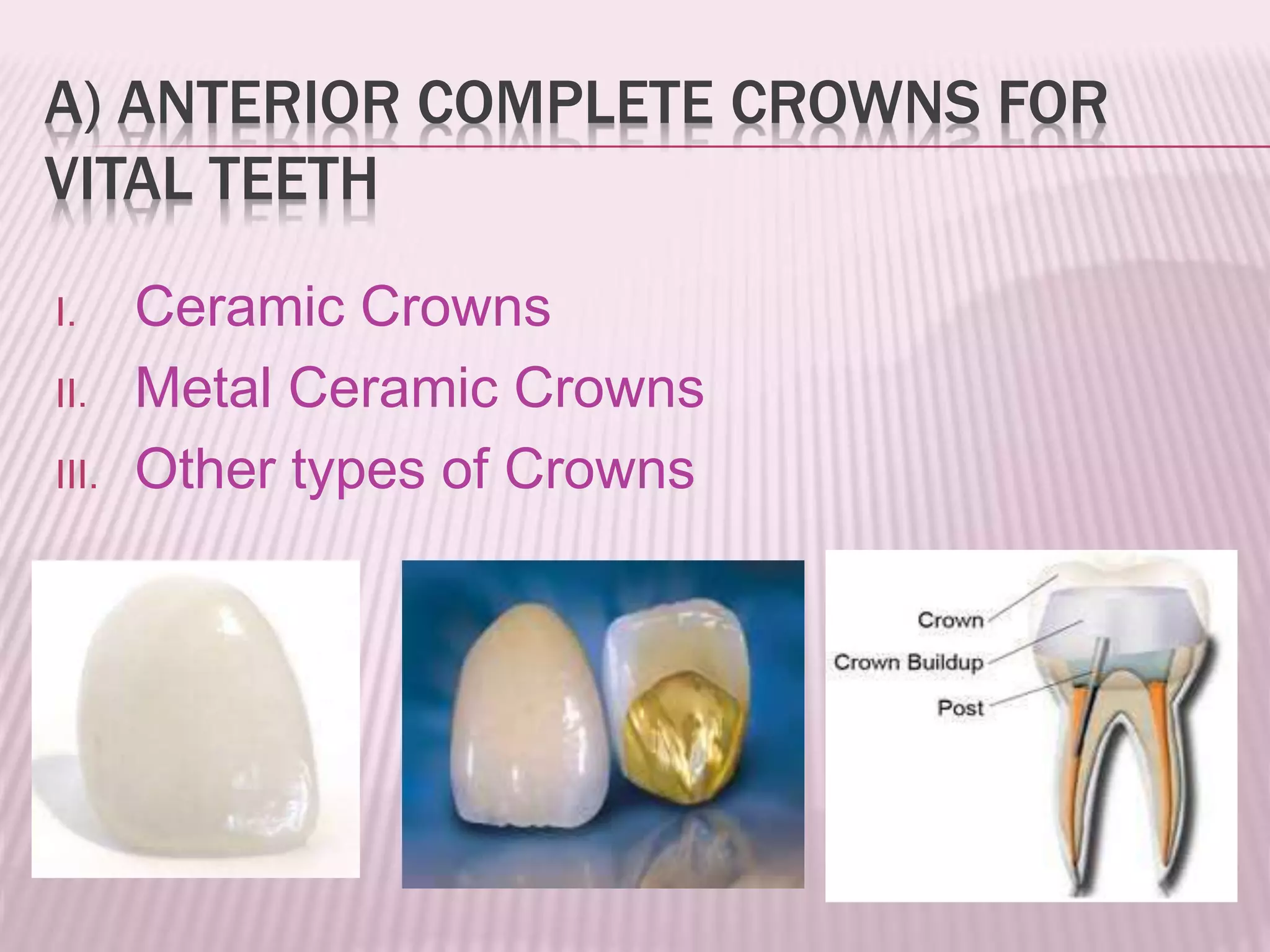
I. Ceramic Crowns 
II. Metal Ceramic Crowns 
III. Other types of Crowns
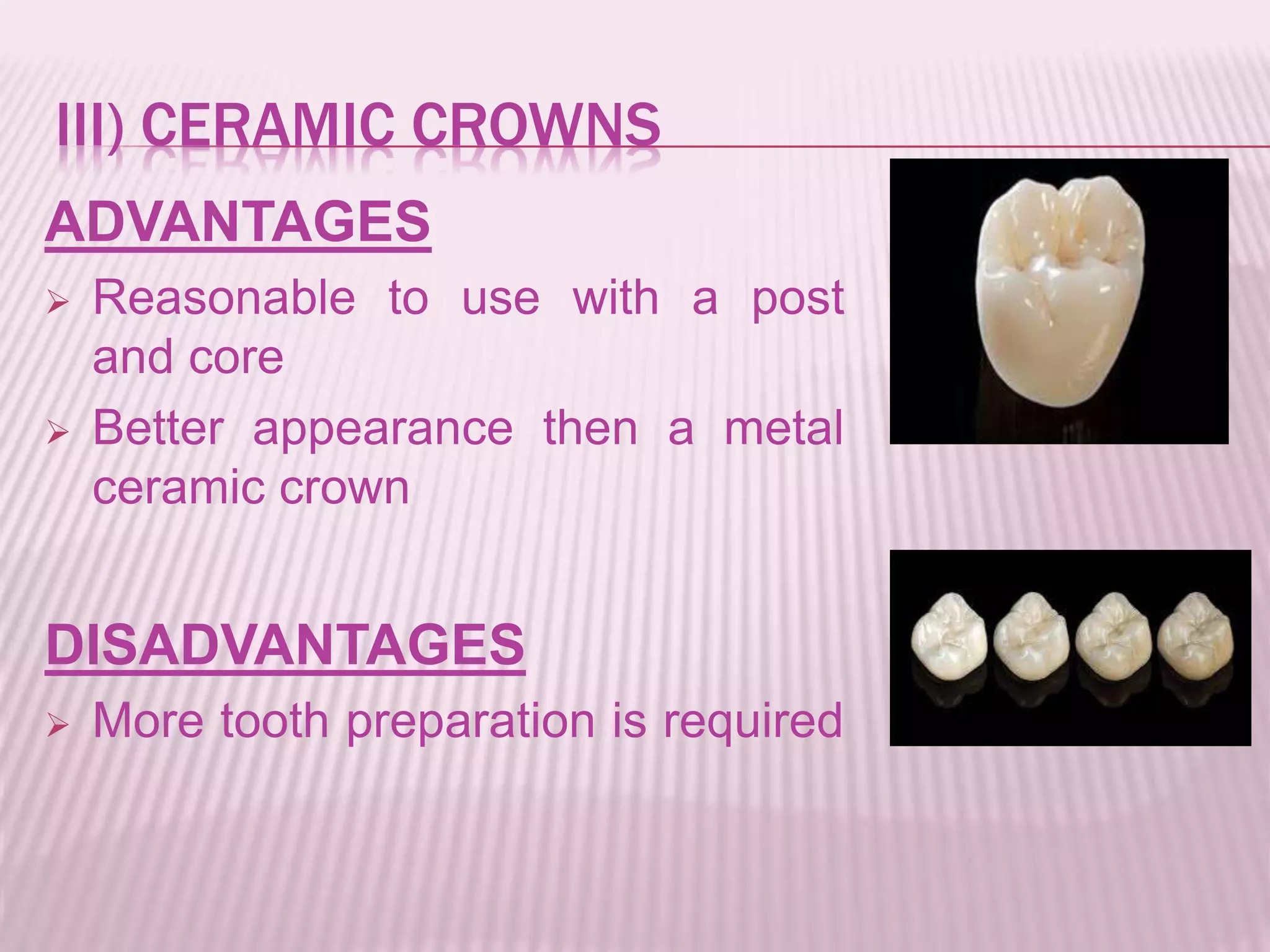
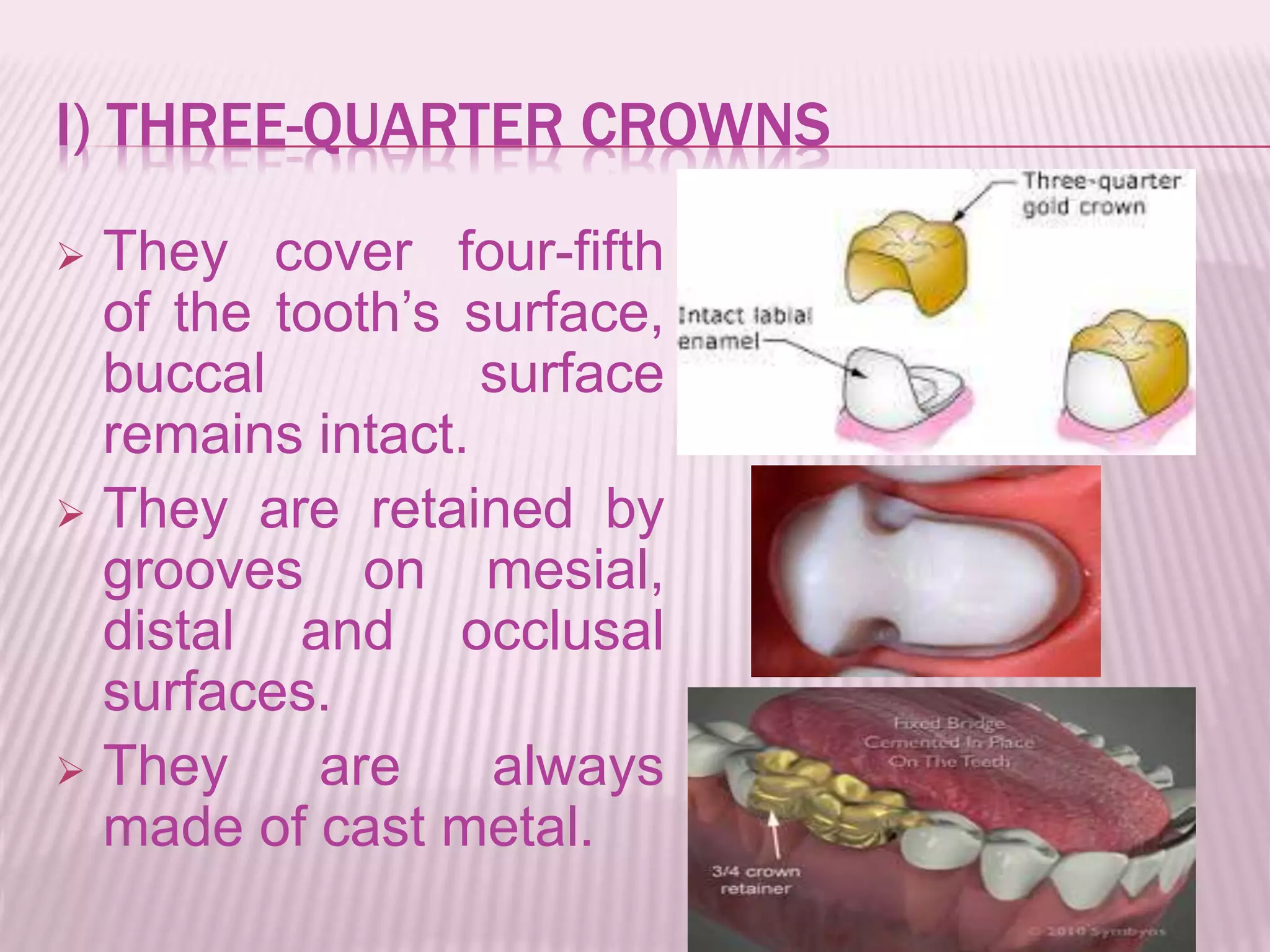
I) CERAMIC CROWNS 
 Most esthetically pleasing 
 No metal to block light transmission 
 Can be virtually indistinguishable from 
unrestored teeth
ADVANTAGES 
 Highly aesthetic and high strength materials 
 Resist plaque accumulation. 
 Relative brittleness can be regarded as an 
advantage specially in class 2 div I patients 
where crown is most likely to fracture rather 
than root. 
DISADVANTAGES 
 More tooth reduction 
 Brittleness, in most cases is a disadvantage
INDICATIONS 
 Where there are high aesthetic demands. 
(particularly in incisal area) 
CONTRAINDICATIONS 
 Where more conservative restoration can be 
carried out.(same for all crowns) 
 Providing a shoulder of 1 mm would 
compromise support. 
(it should be of 2mm)
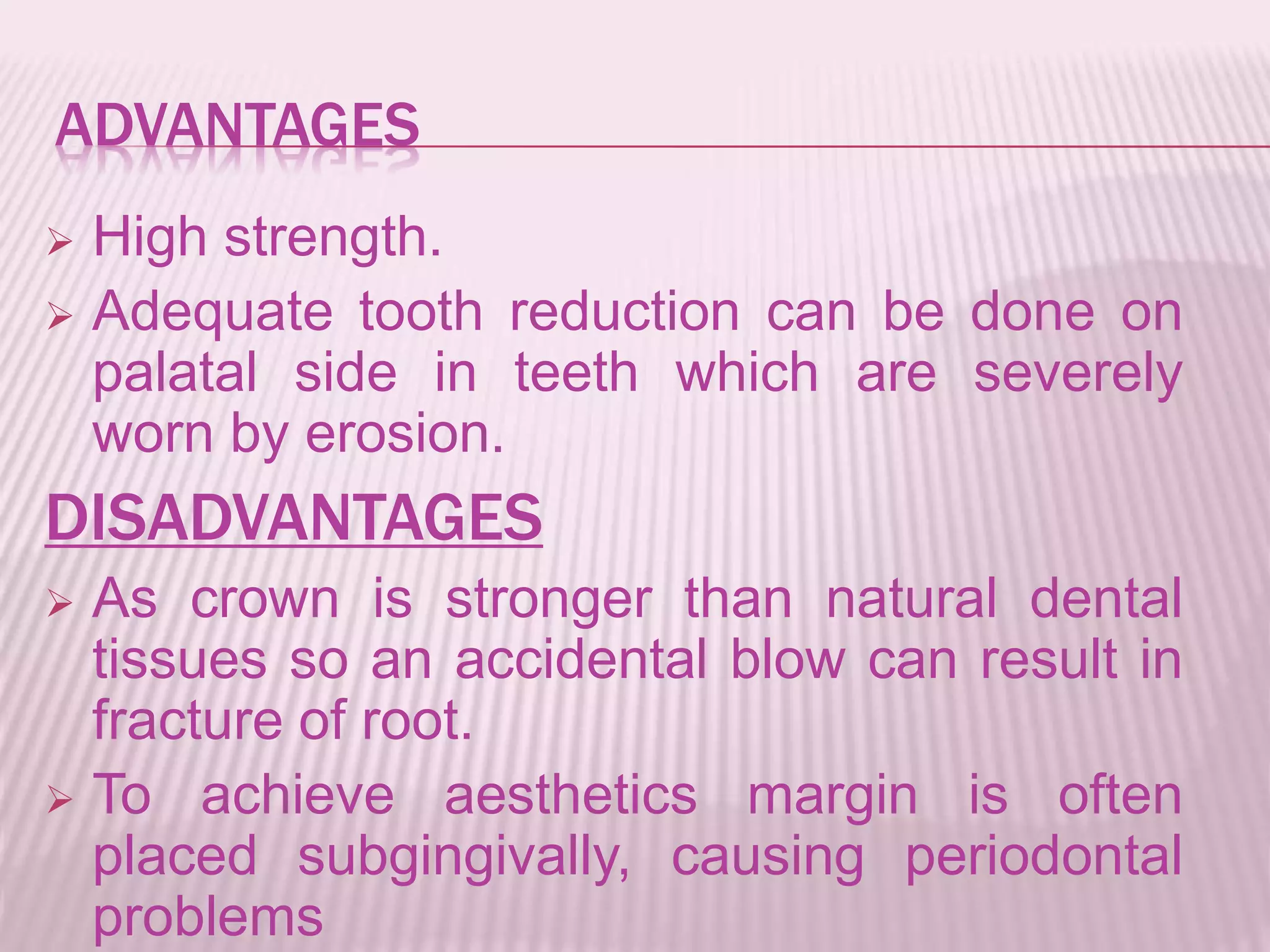
II) METAL CERAMIC CROWNS 
Dental porcelain can be bonded to a variety of 
metal alloys such as Gold, Silver, nickel etc
ADVANTAGES 
 High strength. 
 Adequate tooth reduction can be done on 
palatal side in teeth which are severely 
worn by erosion. 
DISADVANTAGES 
 As crown is stronger than natural dental 
tissues so an accidental blow can result in 
fracture of root. 
 To achieve aesthetics margin is often 
placed subgingivally, causing periodontal 
problems
INDICATIONS 
 Aesthetics 
 Can serve as a retainer for fixed dental 
prosthesis due to its metal substructure. 
CONTRAINDICATIONS 
 Active carious lesions & perio problems. 
 Young patients with large pulp chambers.
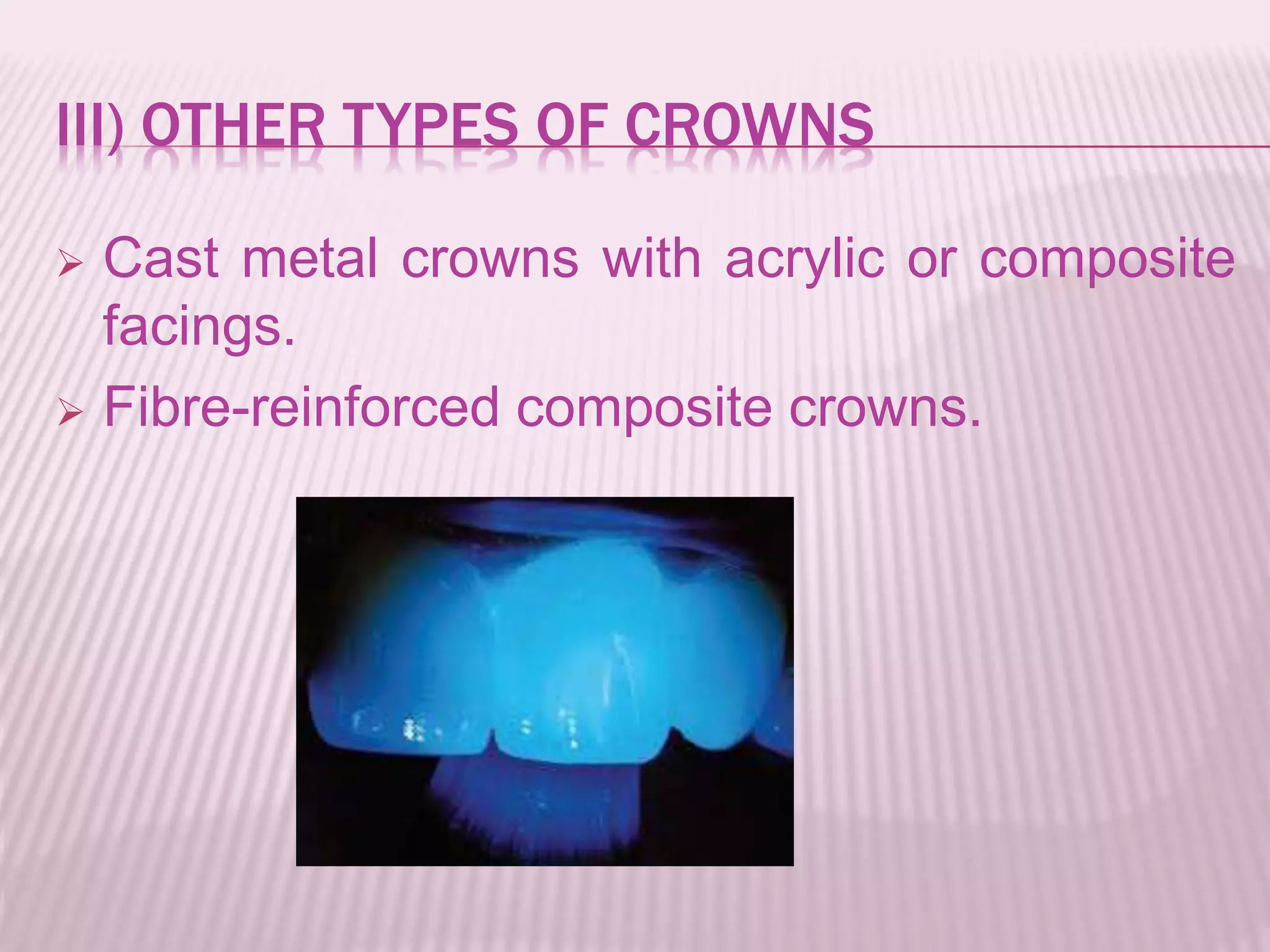
III) OTHER TYPES OF CROWNS 
 Cast metal crowns with acrylic or composite 
facings. 
 Fibre-reinforced composite crowns.
B) ANTERIOR CROWNS FOR ROOT FILLED TEETH 
 Composite core & crown 
 Post and core & separate crown 
 One-piece post crown 
 Other types (composite or metal-ceramic 
crown retained by pins)
C) POSTERIOR COMPLETE CROWNS 
I. Cast metal crowns 
II. Metal-ceramic crowns 
III. Ceramic crowns
I) CAST METAL CROWNS 
Traditionally a GOLD Alloy is used for posterior 
metal crowns but because of high cost many 
alternative alloys are introduced containing 
less gold and in some cases none.
ADVANTAGES 
 Greater retention and resistance 
 Less tooth preparation required. 
DISADVANTAGES 
 Poor esthetics
INDICATIONS 
 Tooth with extensive coronal destruction 
 On short clinical crowns 
 Where maximum retention and resistance 
is required 
CONTRAINDICATIONS 
 High aesthetic need
II) METAL CERAMIC CROWNS 
Advantages 
 Principal advantage is their 
appearance. 
 Porcelain can be used on 
buccal and occlusal surfaces 
of lower teeth and reverse is 
true for upper jaw. 
Disadvantages 
 In short clinical crowns there 
comes a problem of retention. 
 With an amalgam core greater 
reduction may expose the 
pins.
INDICATIONS 
 Aesthetics 
 Retention and resistance required 
CONTRA INDICATIONS 
 Active carious lesions & perio problems. 
 Young patients with large pulp chambers.
III) CERAMIC CROWNS 
ADVANTAGES 
 Reasonable to use with a post 
and core 
 Better appearance then a metal 
ceramic crown 
DISADVANTAGES 
 More tooth preparation is required
INDICATIONS 
 Aesthetic 
CONTRAINDICATIONS 
 Providing a shoulder of 1 mm would 
compromise support.
D) POSTERIOR PARTIAL CROWNS 
I. Three-Quarter Crowns 
II. Seven-Eighths Crowns
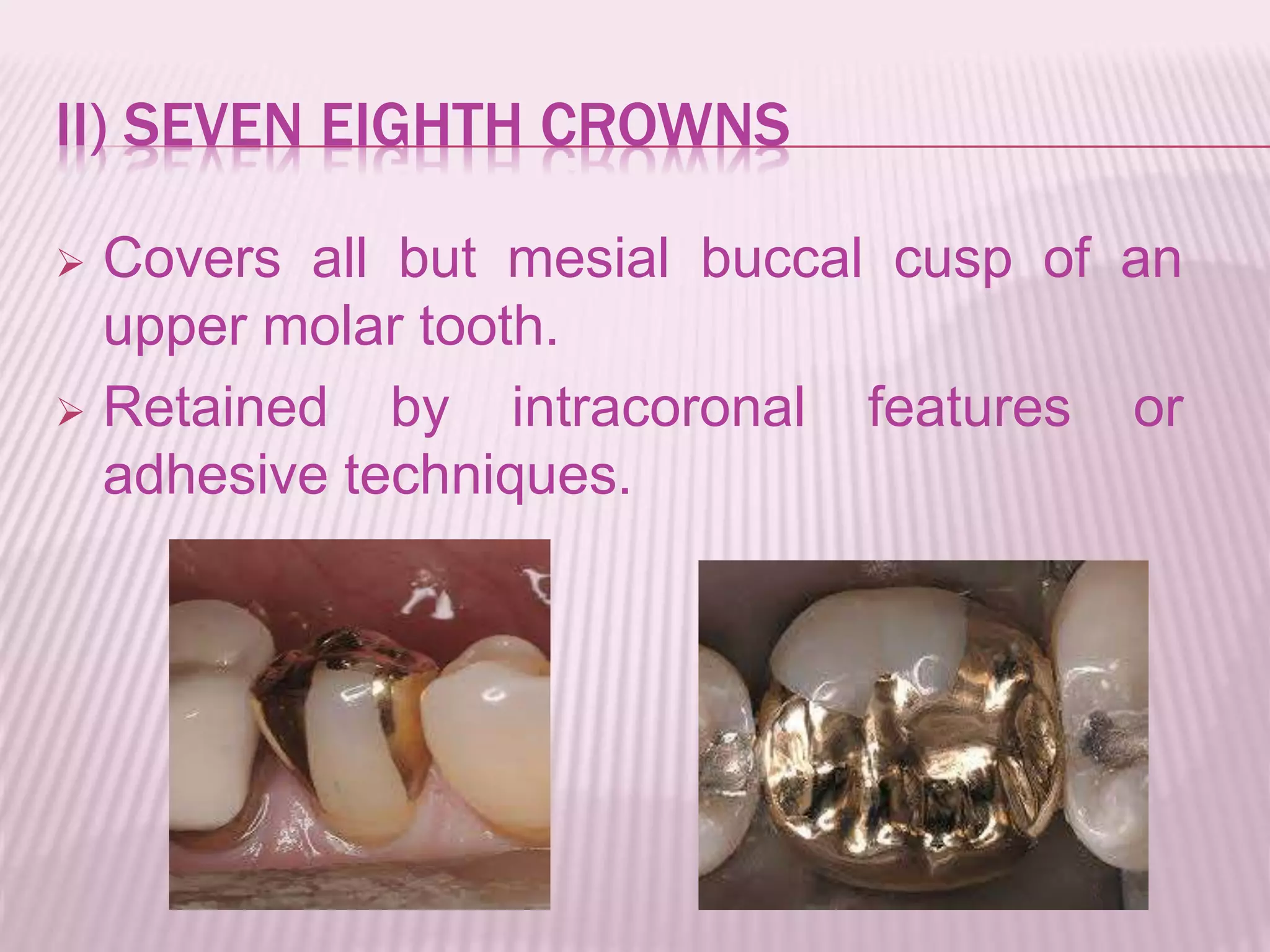
I) THREE-QUARTER CROWNS 
 They cover four-fifth 
of the tooth’s surface, 
buccal surface 
remains intact. 
 They are retained by 
grooves on mesial, 
distal and occlusal 
surfaces. 
 They are always 
made of cast metal.
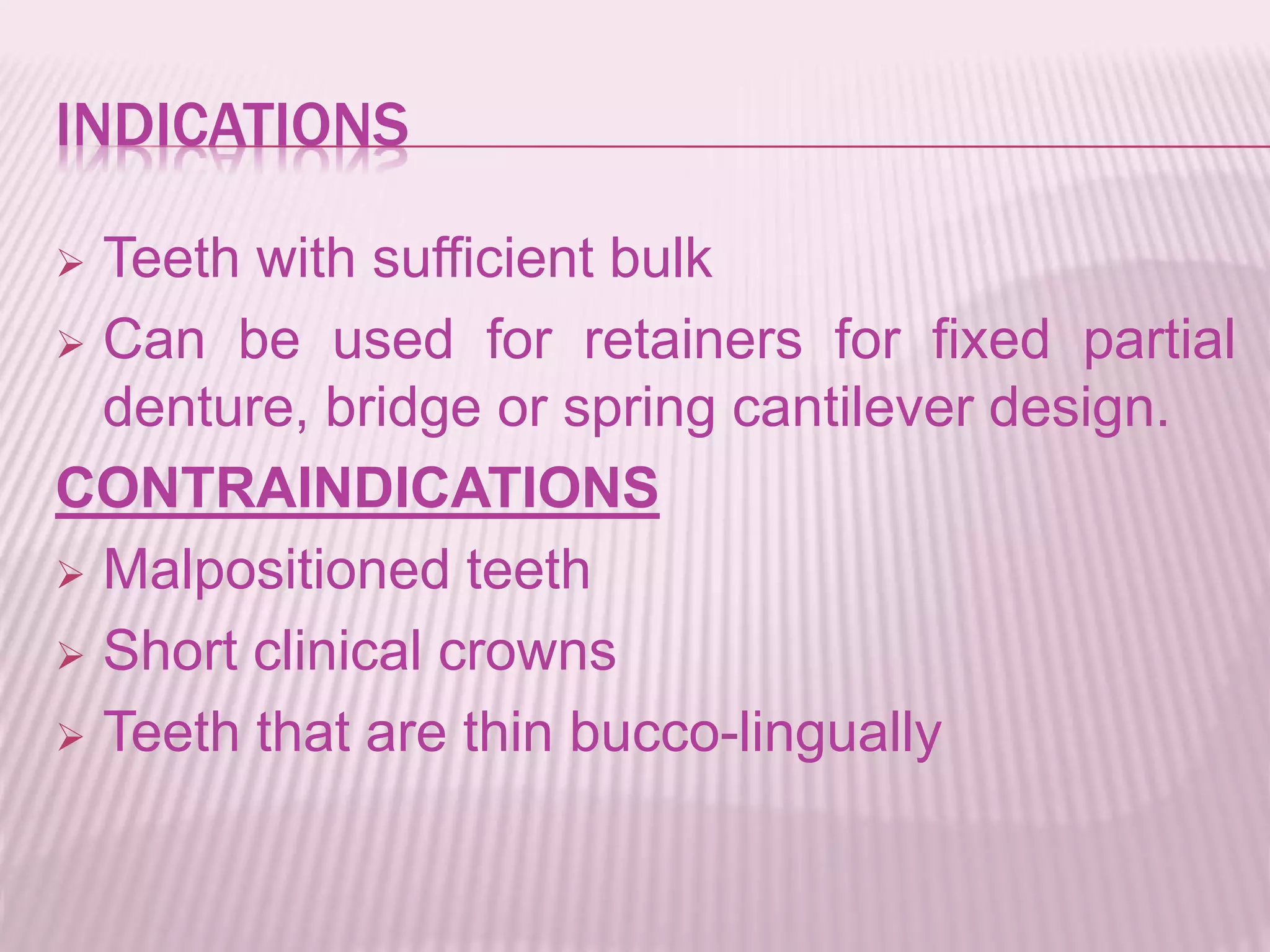
II) SEVEN EIGHTH CROWNS 
 Covers all but mesial buccal cusp of an 
upper molar tooth. 
 Retained by intracoronal features or 
adhesive techniques.
ADVANTAGES 
 More conservative 
 Possible to test vitality of tooth via buccal 
surface. 
 Periodontal problems are less. 
DISADVANTAGES 
 Preparation is bit difficult 
 Less retention
INDICATIONS 
 Teeth with sufficient bulk 
 Can be used for retainers for fixed partial 
denture, bridge or spring cantilever design. 
CONTRAINDICATIONS 
 Malpositioned teeth 
 Short clinical crowns 
 Teeth that are thin bucco-lingually
BRIDGES
DEFINITION OF BRIDGE 
Any dental prosthesis that is luted, screwed or 
mechanically attached to natural teeth, tooth 
roots and/or implant abutments that furnish 
primary support for dental prosthesis.
MATERIALS FOR CONSTRUCTION OF BRIDGE 
WORK 
 Metal 
 Metal-ceramic 
 All-ceramic 
 acrylic
DIFFERENT TYPES OF BRIDGES 
Fixed fixed 
Fixed movable 
Cantilever 
Spring cantilever
A) FIXED FIXED BRIDGE 
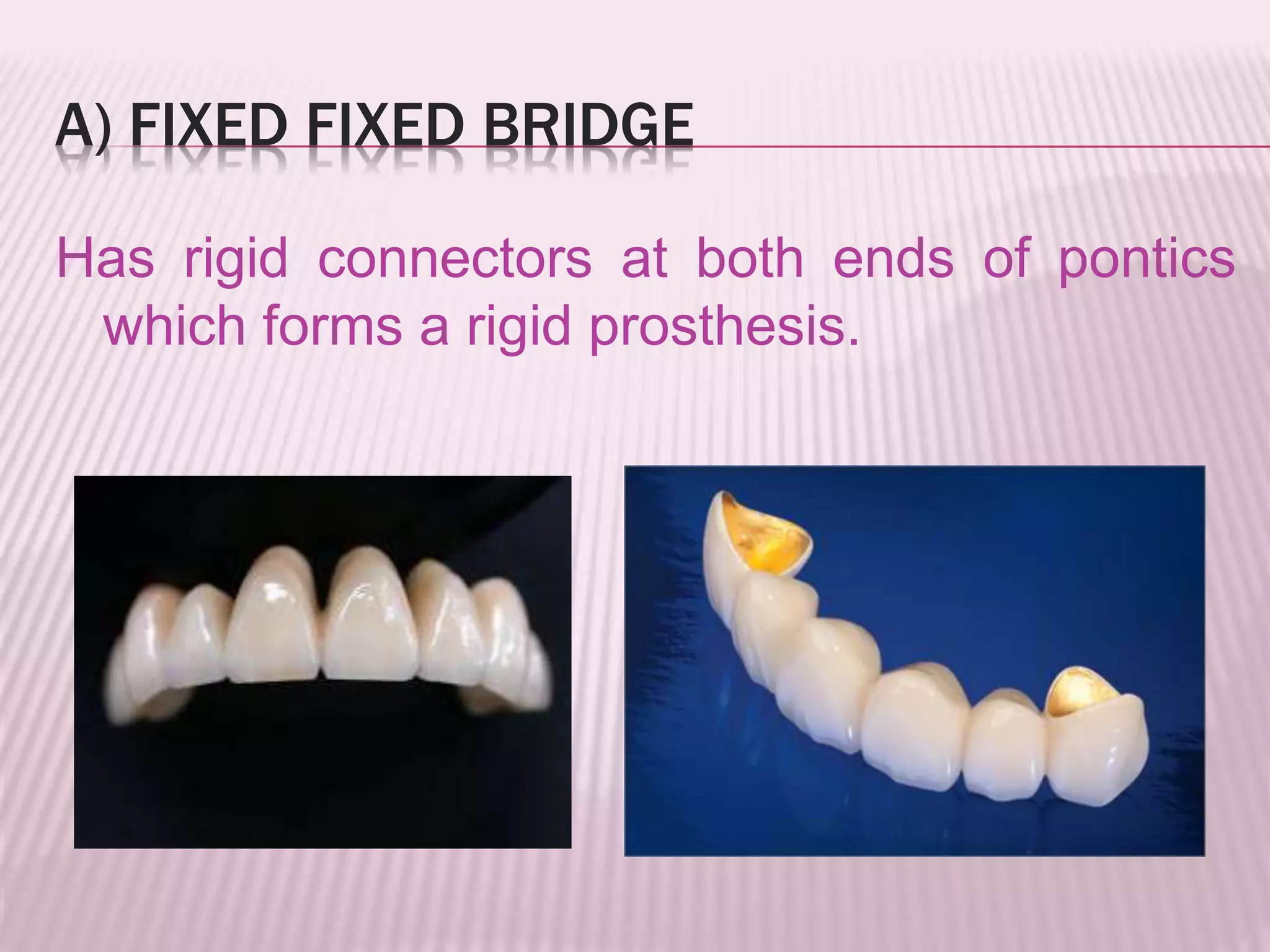
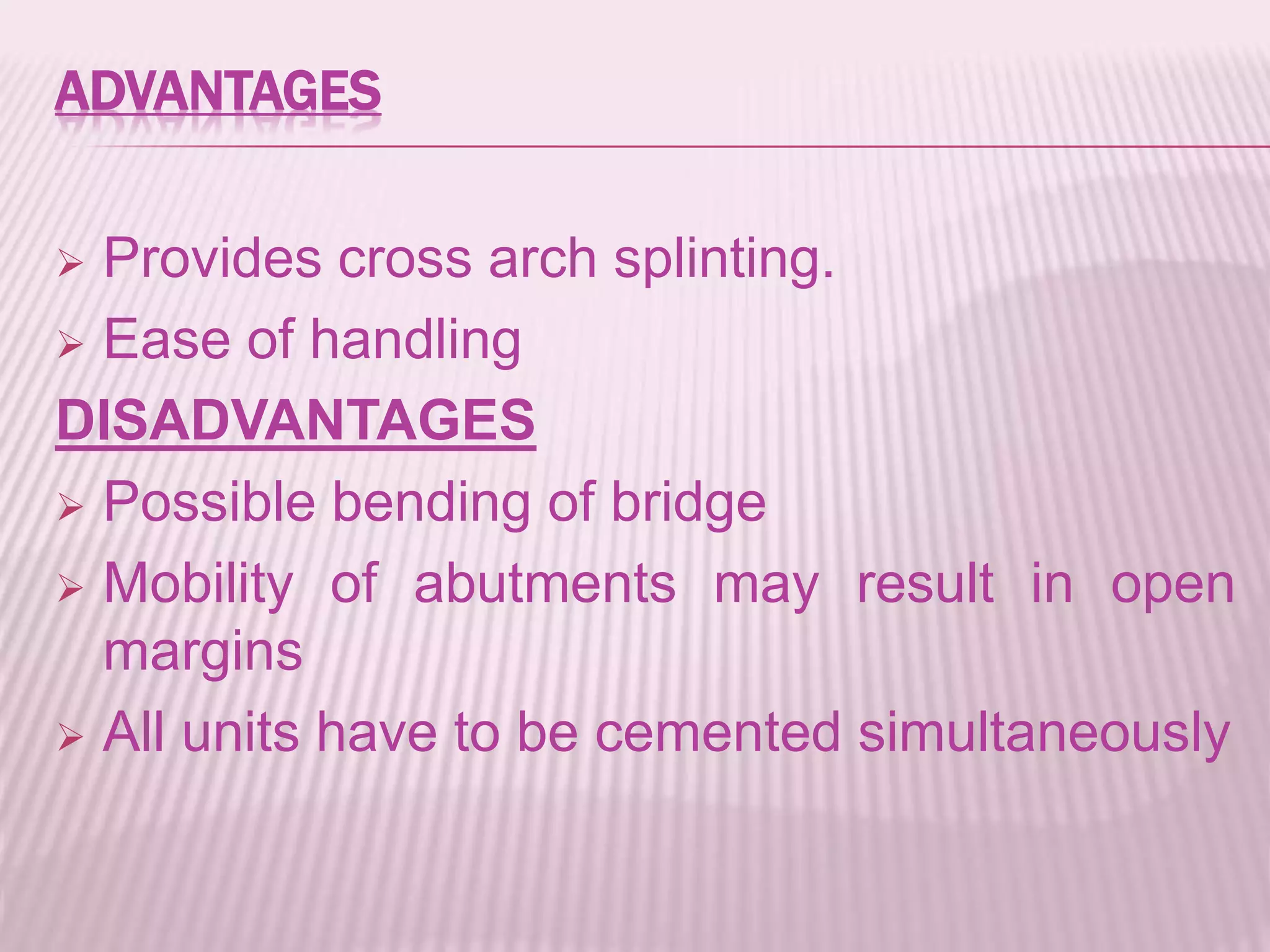
Has rigid connectors at both ends of pontics 
which forms a rigid prosthesis.
ADVANTAGES 
 Provides cross arch splinting. 
 Ease of handling 
DISADVANTAGES 
 Possible bending of bridge 
 Mobility of abutments may result in open 
margins 
 All units have to be cemented simultaneously
B) FIXED MOVABLE BRIDGE 
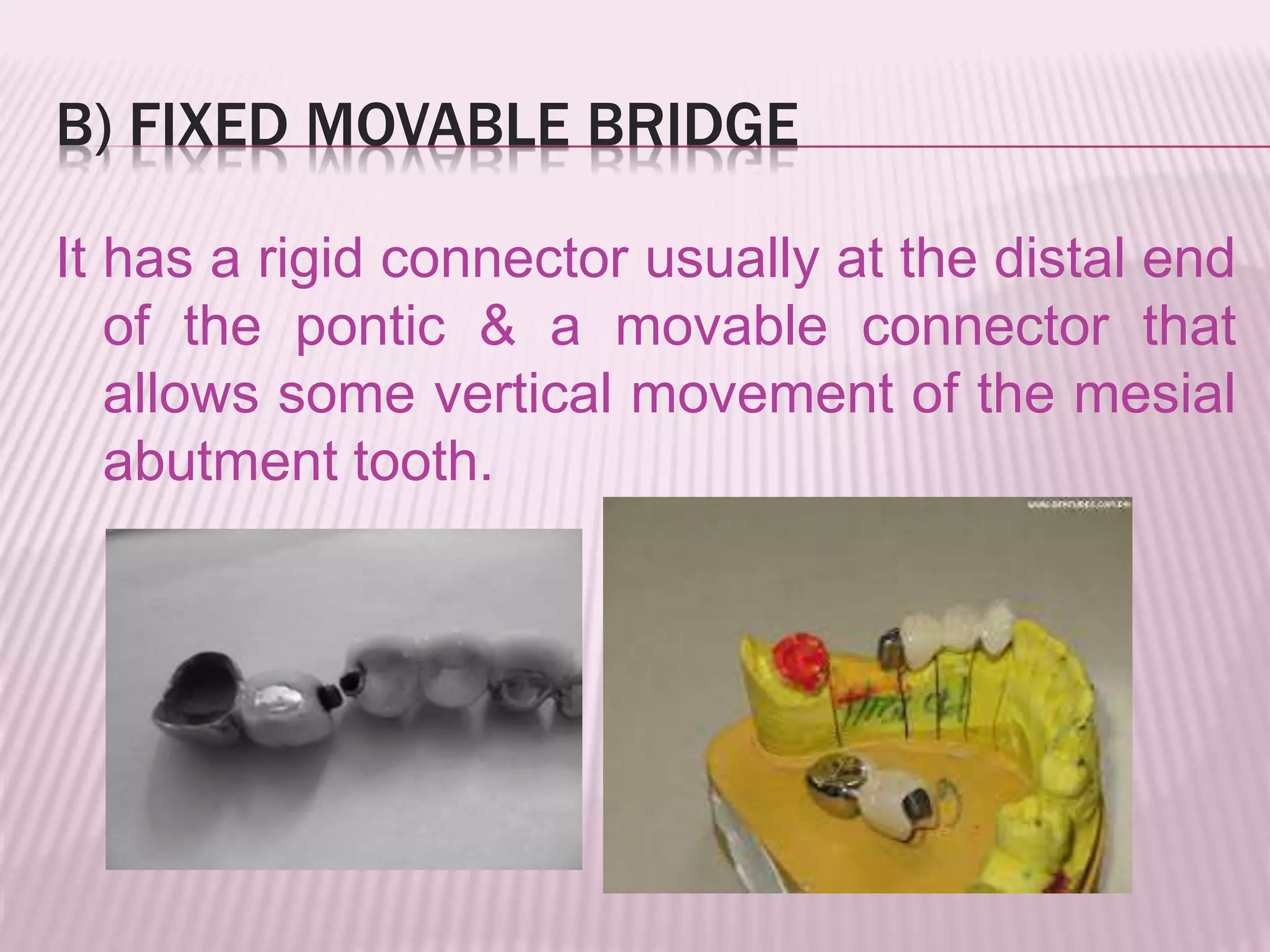
It has a rigid connector usually at the distal end 
of the pontic & a movable connector that 
allows some vertical movement of the mesial 
abutment tooth.
ADVANTAGES 
 Allows flexure of mandible 
 Allow units to be cemented as individual 
sections. 
DISADVANTAGES 
 More space required 
 Metal may show occlusally 
 Wear of joints
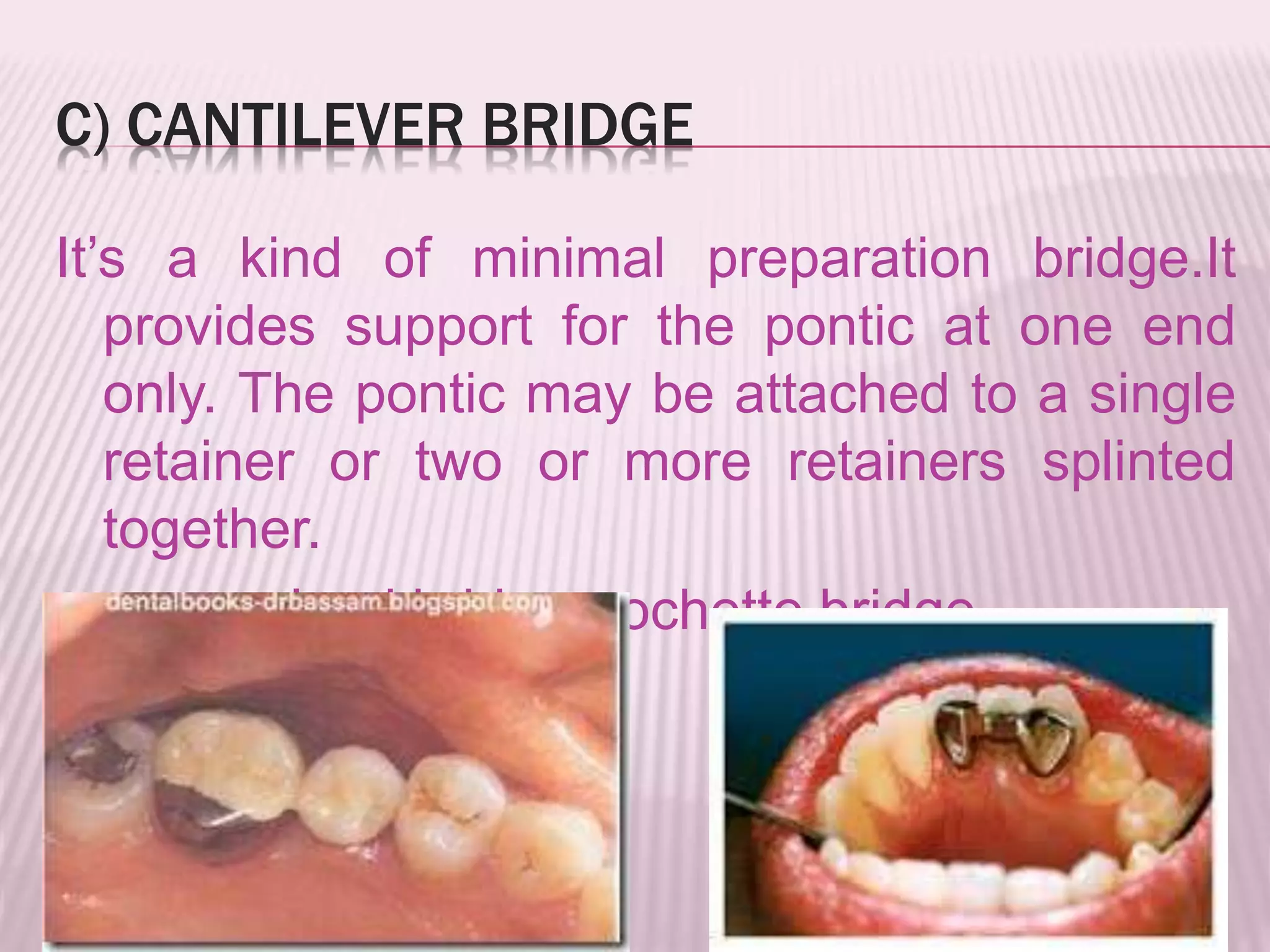
C) CANTILEVER BRIDGE 
It’s a kind of minimal preparation bridge.It 
provides support for the pontic at one end 
only. The pontic may be attached to a single 
retainer or two or more retainers splinted 
together. 
e.g: maryland bridge, rochette bridge
ADVANTAGES 
 Preserve tooth structure 
 Minimal pulp trauma 
 Rebond possible 
DISADVANTAGES 
 Length of span is limited to one pontic only. 
 Occlusal forces on the pontic encourage 
tilting of abutment tooth. 
 Not successful for posterior prosthesis.
D) SPRING CANTILEVER BRIDGES 
 They are restricted to the replacement of 
upper incisor teeth. Only one pontic could be 
supported by a spring cantilever bridge.
ADVANTAGES 
 Restoration of spaced dentition 
DISADVANTAGES 
 Food impaction under metal connector 
 Fracture of metal connector 
 Dislodgment of retainer
Types of crown & bridges

Types of crown & bridges

  • 2.
    TYPES OF CROWN& BRIDGE Dr Yumna Shaheen Ali
  • 3.
  • 4.
    DEFINITION OF CROWN An artificial replacement that restores missing tooth structure by surrounding part or all of remaining tooth structure with a material such as metal, porcelain or combination of materials such as metal and porcelain.
  • 5.
    DIFFERENT TYPES OFCROWNS Anterior complete crowns for vital teeth Anterior complete crowns for root filled teeth Posterior complete crowns Posterior partial crowns
  • 6.
    A) ANTERIOR COMPLETECROWNS FOR VITAL TEETH I. Ceramic Crowns II. Metal Ceramic Crowns III. Other types of Crowns
  • 7.
    I) CERAMIC CROWNS  Most esthetically pleasing  No metal to block light transmission  Can be virtually indistinguishable from unrestored teeth
  • 8.
    ADVANTAGES  Highlyaesthetic and high strength materials  Resist plaque accumulation.  Relative brittleness can be regarded as an advantage specially in class 2 div I patients where crown is most likely to fracture rather than root. DISADVANTAGES  More tooth reduction  Brittleness, in most cases is a disadvantage
  • 9.
    INDICATIONS  Wherethere are high aesthetic demands. (particularly in incisal area) CONTRAINDICATIONS  Where more conservative restoration can be carried out.(same for all crowns)  Providing a shoulder of 1 mm would compromise support. (it should be of 2mm)
  • 10.
    II) METAL CERAMICCROWNS Dental porcelain can be bonded to a variety of metal alloys such as Gold, Silver, nickel etc
  • 11.
    ADVANTAGES  Highstrength.  Adequate tooth reduction can be done on palatal side in teeth which are severely worn by erosion. DISADVANTAGES  As crown is stronger than natural dental tissues so an accidental blow can result in fracture of root.  To achieve aesthetics margin is often placed subgingivally, causing periodontal problems
  • 12.
    INDICATIONS  Aesthetics  Can serve as a retainer for fixed dental prosthesis due to its metal substructure. CONTRAINDICATIONS  Active carious lesions & perio problems.  Young patients with large pulp chambers.
  • 13.
    III) OTHER TYPESOF CROWNS  Cast metal crowns with acrylic or composite facings.  Fibre-reinforced composite crowns.
  • 14.
    B) ANTERIOR CROWNSFOR ROOT FILLED TEETH  Composite core & crown  Post and core & separate crown  One-piece post crown  Other types (composite or metal-ceramic crown retained by pins)
  • 15.
    C) POSTERIOR COMPLETECROWNS I. Cast metal crowns II. Metal-ceramic crowns III. Ceramic crowns
  • 16.
    I) CAST METALCROWNS Traditionally a GOLD Alloy is used for posterior metal crowns but because of high cost many alternative alloys are introduced containing less gold and in some cases none.
  • 17.
    ADVANTAGES  Greaterretention and resistance  Less tooth preparation required. DISADVANTAGES  Poor esthetics
  • 18.
    INDICATIONS  Toothwith extensive coronal destruction  On short clinical crowns  Where maximum retention and resistance is required CONTRAINDICATIONS  High aesthetic need
  • 19.
    II) METAL CERAMICCROWNS Advantages  Principal advantage is their appearance.  Porcelain can be used on buccal and occlusal surfaces of lower teeth and reverse is true for upper jaw. Disadvantages  In short clinical crowns there comes a problem of retention.  With an amalgam core greater reduction may expose the pins.
  • 20.
    INDICATIONS  Aesthetics  Retention and resistance required CONTRA INDICATIONS  Active carious lesions & perio problems.  Young patients with large pulp chambers.
  • 21.
    III) CERAMIC CROWNS ADVANTAGES  Reasonable to use with a post and core  Better appearance then a metal ceramic crown DISADVANTAGES  More tooth preparation is required
  • 22.
    INDICATIONS  Aesthetic CONTRAINDICATIONS  Providing a shoulder of 1 mm would compromise support.
  • 23.
    D) POSTERIOR PARTIALCROWNS I. Three-Quarter Crowns II. Seven-Eighths Crowns
  • 24.
    I) THREE-QUARTER CROWNS  They cover four-fifth of the tooth’s surface, buccal surface remains intact.  They are retained by grooves on mesial, distal and occlusal surfaces.  They are always made of cast metal.
  • 25.
    II) SEVEN EIGHTHCROWNS  Covers all but mesial buccal cusp of an upper molar tooth.  Retained by intracoronal features or adhesive techniques.
  • 26.
    ADVANTAGES  Moreconservative  Possible to test vitality of tooth via buccal surface.  Periodontal problems are less. DISADVANTAGES  Preparation is bit difficult  Less retention
  • 27.
    INDICATIONS  Teethwith sufficient bulk  Can be used for retainers for fixed partial denture, bridge or spring cantilever design. CONTRAINDICATIONS  Malpositioned teeth  Short clinical crowns  Teeth that are thin bucco-lingually
  • 28.
  • 29.
    DEFINITION OF BRIDGE Any dental prosthesis that is luted, screwed or mechanically attached to natural teeth, tooth roots and/or implant abutments that furnish primary support for dental prosthesis.
  • 30.
    MATERIALS FOR CONSTRUCTIONOF BRIDGE WORK  Metal  Metal-ceramic  All-ceramic  acrylic
  • 31.
    DIFFERENT TYPES OFBRIDGES Fixed fixed Fixed movable Cantilever Spring cantilever
  • 32.
    A) FIXED FIXEDBRIDGE Has rigid connectors at both ends of pontics which forms a rigid prosthesis.
  • 33.
    ADVANTAGES  Providescross arch splinting.  Ease of handling DISADVANTAGES  Possible bending of bridge  Mobility of abutments may result in open margins  All units have to be cemented simultaneously
  • 34.
    B) FIXED MOVABLEBRIDGE It has a rigid connector usually at the distal end of the pontic & a movable connector that allows some vertical movement of the mesial abutment tooth.
  • 35.
    ADVANTAGES  Allowsflexure of mandible  Allow units to be cemented as individual sections. DISADVANTAGES  More space required  Metal may show occlusally  Wear of joints
  • 36.
    C) CANTILEVER BRIDGE It’s a kind of minimal preparation bridge.It provides support for the pontic at one end only. The pontic may be attached to a single retainer or two or more retainers splinted together. e.g: maryland bridge, rochette bridge
  • 37.
    ADVANTAGES  Preservetooth structure  Minimal pulp trauma  Rebond possible DISADVANTAGES  Length of span is limited to one pontic only.  Occlusal forces on the pontic encourage tilting of abutment tooth.  Not successful for posterior prosthesis.
  • 38.
    D) SPRING CANTILEVERBRIDGES  They are restricted to the replacement of upper incisor teeth. Only one pontic could be supported by a spring cantilever bridge.
  • 39.
    ADVANTAGES  Restorationof spaced dentition DISADVANTAGES  Food impaction under metal connector  Fracture of metal connector  Dislodgment of retainer

Editor's Notes

  • #33 Connector: joint that connects pontic to a retainer