Submitted by
Anto Antony
  2006 Batch
Definition
                         
 1. Centric relation is the most posterior relation of
  the mandible to the maxilla when the condyles are in
  the most posterior unstrained position in the glenoid
  fossa from which lateral movements can be made at
  any given degree of jaw separation (GPT-4)
 2. The maxillomandibular relationship in which the
  condyles articulate with the thinnest avascular
  portion of their respective discs with the complex in
  the anterior superior position against the slopes of
  the articular eminence (GPT-5)
Significance of Centric
           Relation
                           
 1. It is a reproducible and recordable position, which
  can be repeatedly arrived at and thus serves as a
  reliable guide to develop centric occlusion in
  complete dentures.
 2.Centric relation become starting point to plan and
  execute the occlusion.
 3. Centric relation is related to terminal hinge axis. In
  centric relation, condyles exhibit pure rotation
  without any translation.

 4. This position is more definite than the vertical
  relation and is independent of the presence or
  absence of teeth.
 5. The final act of masticatory stroke ends in centric
  relation.
 6. It is a border position and the posterior limit of the
  envelope of motion
METHODS OF ASSISTING THE PATIENT TO
 MOVE THE MANDIBLE TO THE CENTRIC
            RELATION
                           
 1. The patient is instructed to let his or her jaw relax,
  pull it back and close slowly on the back teeth.
 2. The patient is instructed to get the feeling of
  pushing his upper jaw out and then close the mouth
  with back teeth in contact.
 3. Assist the patient to protrude and retrude the
  mandible repeatedly with the operator holding the
  finger lightly against the chin.

 4. Boo's series of stretch exercises: The patient is
  instructed to open the mouth wide and relax, to move
  the jaws to left and relax, to move the jaw to the right
  and relax and to move the jaw forward and relax in
  series of movements. The results to be expected are for
  the patient to be able to follow the dentist's directions in
  moving the jaw to centric relation and to the desired
  eccentric positions

 5. The patient can be instructed to turn the tongue
  towards the posterior border of the upper denture base
  and close the rims together until they meet. The
  disadvantage with this method is the likelihood of
  displacing the mandibular record base by the action of the
  tongue.

 6. The patient is told to swallow and conclude the act
  with the occlusal rims in contact. However, the person
  can swallow when the mandible is not completely
  retruded. This method must be verified by other
  techniques.
DIFFICULTIES IN GUIDING MANDIBLE TO
     CENTRIC RELATION POSITION


                         
 Biologic: It may arise due to lack of coordination of
  opposing muscles. When the patient is requested to
  close the jaws in the retruded position, the lack of
  synchronization between the protruding and
  retruding muscles may be caused by habitual
  eccentric jaw positions adopted by patients to
  accommodate to malocclusion..

 Psychological: The more the operator becomes
  irritated over the apparent lack of ability of the
  patient to retrude the mandible.Then dentist must be
  prepared to calmly spend adequate time in securing
  the centric relation records.

 Mechanical: It is essential that the denture bases on
  which the occlusal rims is made fit perfectly and do
  not interfere with each other. Failure of adaptation of
  denture base to the tissue surface may result in
  unevenly distributed pressure on the underlying
  resilient tissue leading to discrepancy in jaw relation
  recording.
VARIOUS METHODS OF RECORDING
      CENTRIC RELATION

                              
 Functional (Chew-in) methods
    Needle house method,
    Patterson's method.
    Meyer's method.
 Excursive methods (Graphic method)
    Intraoral tracing. [Intraoral balancer (Hanau co.), S-A gothic
     arch tracer (Tokyo shikasha)]
    Extra-oral tracing. [Height Tracer (Hanau co.)
 Tactile or interocclusal check records.
 Terminal hinge axis method

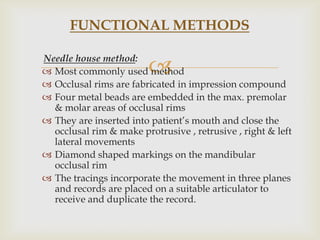
 Other methods.
   Heating the surface of one of the rims.
   Softened wax placed over the occlusal surfaces of the
    occlusal rim.
   Soft cones of wax placed on the lower denture trial bases
FUNCTIONAL METHODS


                         
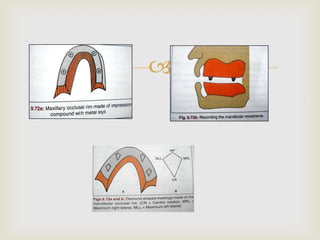
Needle house method:
 Most commonly used method
 Occlusal rims are fabricated in impression compound
 Four metal beads are embedded in the max. premolar
  & molar areas of occlusal rims
 They are inserted into patient’s mouth and close the
  occlusal rim & make protrusive , retrusive , right & left
  lateral movements
 Diamond shaped markings on the mandibular
  occlusal rim
 The tracings incorporate the movement in three planes
  and records are placed on a suitable articulator to
  receive and duplicate the record.

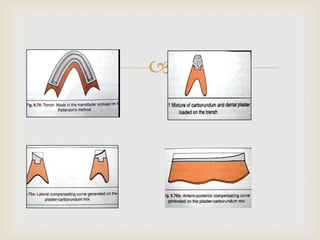
Patterson's method
 A trench is to be made in
 Wax occlusion rims are used.
                           the mandibular rim and a
  mixture of half plaster and half carborundum paste
  should be placed in the trench.
 The mandibular movements generate compensating
  curves in the plaster and carborundum paste.
 When the paste is reduced to the predetermined vertical
  height of occlusion, the patient is instructed to retrude
  the mandible and the occlusal rims are joined together
  with metal staples

Meyer's method
               
 Meyer's used soft wax on the occlusal rims to
  establish a generated path.
 Tin foil was placed over the wax and lubricated.
 The patient performed the functional movements to
  produce a wax path.
 The plaster index was made of the wax path and the
  teeth were set to the plaster index
EXCURSIVE METHODS

                          
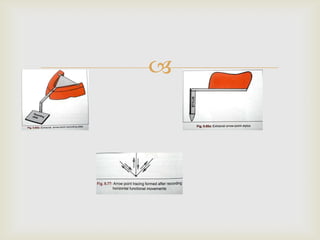
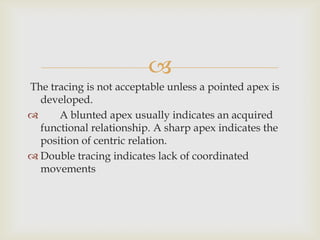
 The most common of the excursive recording is the
  gothic arch tracing.
 This can be employed intraorally or extra orally.
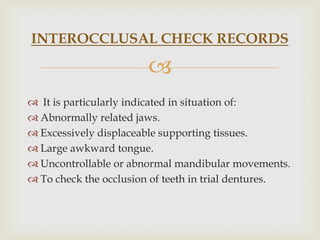
 This tracing is shaped like a gothic arch and so is
  referred to as Gothic arch tracing.
 It is also known as arrow point tracing.
 Intra oral
                         
 Central bearing devices are used(Central bearing
  point + Central bearing plate)
 Central bearing point attached to the max. occlusal
  rim & Central bearing plate to the mandibular
  occlusal rim
 Both are inserted to the patient’s mouth and asked to
  perform mandibular movements
 Arrow point with sharp apex is found on the central
  bearing plate

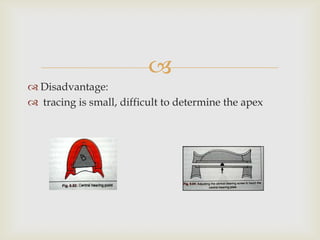
 Disadvantage:
 tracing is small, difficult to determine the apex

 Extra oral
 Central bearing point & plate is projected outside the
  mouth & arrow point tracing is made at the
  predetermined VD extra orally

 Advantage: - easy identification


The tracing is not acceptable unless a pointed apex is
  developed.
     A blunted apex usually indicates an acquired
  functional relationship. A sharp apex indicates the
  position of centric relation.
 Double tracing indicates lack of coordinated
  movements
INTEROCCLUSAL CHECK RECORDS

                       
 It is particularly indicated in situation of:
 Abnormally related jaws.
 Excessively displaceable supporting tissues.
 Large awkward tongue.
 Uncontrollable or abnormal mandibular movements.
 To check the occlusion of teeth in trial dentures.

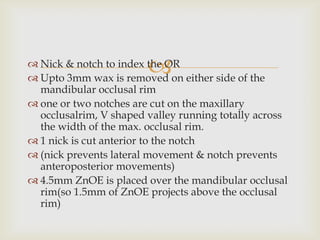
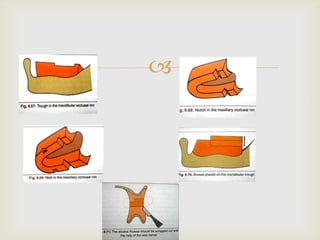
 Nick & notch to index the OR
 Upto 3mm wax is removed on either side of the
  mandibular occlusal rim
 one or two notches are cut on the maxillary
  occlusalrim, V shaped valley running totally across
  the width of the max. occlusal rim.
 1 nick is cut anterior to the notch
 (nick prevents lateral movement & notch prevents
  anteroposterior movements)
 4.5mm ZnOE is placed over the mandibular occlusal
  rim(so 1.5mm of ZnOE projects above the occlusal
  rim)

 The mand. Occlusal rim is softened & inserted into
  patient’s mouth & ask to close his mouth in centric
  relation
 ZnOE projecting above the trough of the mand. Rim
  flows into the nick & notches
 occlusal rims are placed in a cold water bath &
  excess is trimmed

TERMINAL HINGE AXIS:

                         
       As in the determination of the physiologic
  transverse hinge axis, the mandible is in its most
  posterior relation to the maxilla when the centric
  relation is recorded.
 Therefore, if the upper cast is correctly oriented to
  the hinge axis of the articulator by an accurate face
  bow transfer, the lower cast will also be correctly
  oriented to the opening axis of the instruments when
  it is transferred to the articulate with the accurate
  centric relation record.
Other methods
 Strips of celluloid
                      
 After adjusting the rim a strip of celluloid is placed
  between the rims and pulled. If it pulls out easily it
  indicates uneven contact . The rim is readjusted.
 Disadv : unequal pressure error may still be present.

 Softened wax is placed on the mandibular posterior
  teeth and maxillary teeth are closed into it.
 Adv: smaller surface contact instead of large flat wax
  surface
 Disadv: record has to be made at an increased
  vertical relation to avoid contact of teeth.
 Swallowing technique using soft cones of wax
  establish vertical as well as centric relation.
 Disadv: results are not consistent.
Eccentric jaw relation

                           
 Eccentric jaw relation to be recorded are protrusive and
  lateral.
 The graphic method of making maxillomandibular
  relation records is performed at same sitting position.
 After mandibular cast has been mounted in eccentric
  relation, the recording device is replaced in patients
  mouth.
 A distance of 5-6mm is measured from the apex of the
  arrow point tracing and the protrusive tracing is marked
 The patient is instructed to protrude until the point of
  stylus rests the mark.

 Quick setting dental stone is injected to seal the rims.
 Horizontal condylar guidance elements on
  articulator are released by turning the locknuts.
 Incisal guidance pin is raised to about one half from
  the top of the guide table.
 The record bases are seated on the cast and locknuts
  are manipulated on one side and then on the other
  side.
Lateral relation records.

                         
 Lateral relation can be recorded & used to establish
  lateral guidance on certain adjustable articulators,
  but they cannot be used like semi adjustable
  articulators.
 Graphic methods are used in the same manner as
  protrusive relation recorded except that records
  required are one of right laterals and one of left
  laterals.

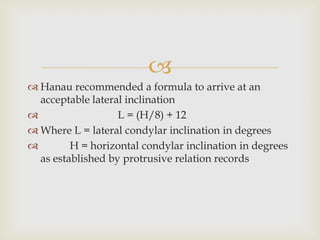
 Hanau recommended a formula to arrive at an
  acceptable lateral inclination
                  L = (H/8) + 12
 Where L = lateral condylar inclination in degrees
        H = horizontal condylar inclination in degrees
  as established by protrusive relation records
 Summary

                          
          Once the occlusal rims are individualized, the
  jaw relations are established& finally recorded.
  Establishing the jaw relation is an important step in
  the fabrication of complete dentures. Orienting the
  upper & lower denture in the correct horizontal &
  vertical relation to each other is important for the
  esthetics, health & comfort of the patient as well as
  proper functioning of the dentures. In final analysis
  it is the experience & judgment of the operator & to
  some extend the patient himself, which helps in
  determining what is right for the patient.
Referances
                  
 Essential of Complete denture prosthodontics :
  Sheldon Winkler
 Prosthodontic treatment for edentulous patient :
  Boucher
 Text book of Complete denture prosthodontics :
  Sarandha D.L.
 Complete denture prosthodontics : John Joy
  Manappallil
 Textbook of prosthodontics – Deepak Nallaswamy.



    THANK U…

Centric relation anto

  • 1.
  • 2.
    Definition   1. Centric relation is the most posterior relation of the mandible to the maxilla when the condyles are in the most posterior unstrained position in the glenoid fossa from which lateral movements can be made at any given degree of jaw separation (GPT-4)  2. The maxillomandibular relationship in which the condyles articulate with the thinnest avascular portion of their respective discs with the complex in the anterior superior position against the slopes of the articular eminence (GPT-5)
  • 3.
    Significance of Centric Relation   1. It is a reproducible and recordable position, which can be repeatedly arrived at and thus serves as a reliable guide to develop centric occlusion in complete dentures.  2.Centric relation become starting point to plan and execute the occlusion.  3. Centric relation is related to terminal hinge axis. In centric relation, condyles exhibit pure rotation without any translation.
  • 4.
      4. Thisposition is more definite than the vertical relation and is independent of the presence or absence of teeth.  5. The final act of masticatory stroke ends in centric relation.  6. It is a border position and the posterior limit of the envelope of motion
  • 5.
    METHODS OF ASSISTINGTHE PATIENT TO MOVE THE MANDIBLE TO THE CENTRIC RELATION   1. The patient is instructed to let his or her jaw relax, pull it back and close slowly on the back teeth.  2. The patient is instructed to get the feeling of pushing his upper jaw out and then close the mouth with back teeth in contact.  3. Assist the patient to protrude and retrude the mandible repeatedly with the operator holding the finger lightly against the chin.
  • 6.
      4. Boo'sseries of stretch exercises: The patient is instructed to open the mouth wide and relax, to move the jaws to left and relax, to move the jaw to the right and relax and to move the jaw forward and relax in series of movements. The results to be expected are for the patient to be able to follow the dentist's directions in moving the jaw to centric relation and to the desired eccentric positions
  • 7.
      5. Thepatient can be instructed to turn the tongue towards the posterior border of the upper denture base and close the rims together until they meet. The disadvantage with this method is the likelihood of displacing the mandibular record base by the action of the tongue.  6. The patient is told to swallow and conclude the act with the occlusal rims in contact. However, the person can swallow when the mandible is not completely retruded. This method must be verified by other techniques.
  • 8.
    DIFFICULTIES IN GUIDINGMANDIBLE TO CENTRIC RELATION POSITION   Biologic: It may arise due to lack of coordination of opposing muscles. When the patient is requested to close the jaws in the retruded position, the lack of synchronization between the protruding and retruding muscles may be caused by habitual eccentric jaw positions adopted by patients to accommodate to malocclusion..
  • 9.
      Psychological: Themore the operator becomes irritated over the apparent lack of ability of the patient to retrude the mandible.Then dentist must be prepared to calmly spend adequate time in securing the centric relation records.
  • 10.
      Mechanical: Itis essential that the denture bases on which the occlusal rims is made fit perfectly and do not interfere with each other. Failure of adaptation of denture base to the tissue surface may result in unevenly distributed pressure on the underlying resilient tissue leading to discrepancy in jaw relation recording.
  • 11.
    VARIOUS METHODS OFRECORDING CENTRIC RELATION   Functional (Chew-in) methods  Needle house method,  Patterson's method.  Meyer's method.  Excursive methods (Graphic method)  Intraoral tracing. [Intraoral balancer (Hanau co.), S-A gothic arch tracer (Tokyo shikasha)]  Extra-oral tracing. [Height Tracer (Hanau co.)  Tactile or interocclusal check records.  Terminal hinge axis method
  • 12.
      Other methods.  Heating the surface of one of the rims.  Softened wax placed over the occlusal surfaces of the occlusal rim.  Soft cones of wax placed on the lower denture trial bases
  • 13.
    FUNCTIONAL METHODS  Needle house method:  Most commonly used method  Occlusal rims are fabricated in impression compound  Four metal beads are embedded in the max. premolar & molar areas of occlusal rims  They are inserted into patient’s mouth and close the occlusal rim & make protrusive , retrusive , right & left lateral movements  Diamond shaped markings on the mandibular occlusal rim  The tracings incorporate the movement in three planes and records are placed on a suitable articulator to receive and duplicate the record.
  • 14.
  • 15.
    Patterson's method  Atrench is to be made in  Wax occlusion rims are used. the mandibular rim and a mixture of half plaster and half carborundum paste should be placed in the trench.  The mandibular movements generate compensating curves in the plaster and carborundum paste.  When the paste is reduced to the predetermined vertical height of occlusion, the patient is instructed to retrude the mandible and the occlusal rims are joined together with metal staples
  • 16.
  • 17.
    Meyer's method   Meyer's used soft wax on the occlusal rims to establish a generated path.  Tin foil was placed over the wax and lubricated.  The patient performed the functional movements to produce a wax path.  The plaster index was made of the wax path and the teeth were set to the plaster index
  • 18.
    EXCURSIVE METHODS   The most common of the excursive recording is the gothic arch tracing.  This can be employed intraorally or extra orally.  This tracing is shaped like a gothic arch and so is referred to as Gothic arch tracing.  It is also known as arrow point tracing.
  • 19.
     Intra oral   Central bearing devices are used(Central bearing point + Central bearing plate)  Central bearing point attached to the max. occlusal rim & Central bearing plate to the mandibular occlusal rim  Both are inserted to the patient’s mouth and asked to perform mandibular movements  Arrow point with sharp apex is found on the central bearing plate
  • 20.
      Disadvantage:  tracingis small, difficult to determine the apex
  • 21.
      Extra oral Central bearing point & plate is projected outside the mouth & arrow point tracing is made at the predetermined VD extra orally  Advantage: - easy identification
  • 22.
  • 23.
     The tracing isnot acceptable unless a pointed apex is developed.  A blunted apex usually indicates an acquired functional relationship. A sharp apex indicates the position of centric relation.  Double tracing indicates lack of coordinated movements
  • 24.
    INTEROCCLUSAL CHECK RECORDS   It is particularly indicated in situation of:  Abnormally related jaws.  Excessively displaceable supporting tissues.  Large awkward tongue.  Uncontrollable or abnormal mandibular movements.  To check the occlusion of teeth in trial dentures.
  • 25.
      Nick &notch to index the OR  Upto 3mm wax is removed on either side of the mandibular occlusal rim  one or two notches are cut on the maxillary occlusalrim, V shaped valley running totally across the width of the max. occlusal rim.  1 nick is cut anterior to the notch  (nick prevents lateral movement & notch prevents anteroposterior movements)  4.5mm ZnOE is placed over the mandibular occlusal rim(so 1.5mm of ZnOE projects above the occlusal rim)
  • 26.
      The mand.Occlusal rim is softened & inserted into patient’s mouth & ask to close his mouth in centric relation  ZnOE projecting above the trough of the mand. Rim flows into the nick & notches  occlusal rims are placed in a cold water bath & excess is trimmed
  • 27.
  • 28.
    TERMINAL HINGE AXIS:   As in the determination of the physiologic transverse hinge axis, the mandible is in its most posterior relation to the maxilla when the centric relation is recorded.  Therefore, if the upper cast is correctly oriented to the hinge axis of the articulator by an accurate face bow transfer, the lower cast will also be correctly oriented to the opening axis of the instruments when it is transferred to the articulate with the accurate centric relation record.
  • 29.
    Other methods  Stripsof celluloid   After adjusting the rim a strip of celluloid is placed between the rims and pulled. If it pulls out easily it indicates uneven contact . The rim is readjusted.  Disadv : unequal pressure error may still be present.
  • 30.
      Softened waxis placed on the mandibular posterior teeth and maxillary teeth are closed into it.  Adv: smaller surface contact instead of large flat wax surface  Disadv: record has to be made at an increased vertical relation to avoid contact of teeth.  Swallowing technique using soft cones of wax establish vertical as well as centric relation.  Disadv: results are not consistent.
  • 31.
    Eccentric jaw relation   Eccentric jaw relation to be recorded are protrusive and lateral.  The graphic method of making maxillomandibular relation records is performed at same sitting position.  After mandibular cast has been mounted in eccentric relation, the recording device is replaced in patients mouth.  A distance of 5-6mm is measured from the apex of the arrow point tracing and the protrusive tracing is marked  The patient is instructed to protrude until the point of stylus rests the mark.
  • 32.
      Quick settingdental stone is injected to seal the rims.  Horizontal condylar guidance elements on articulator are released by turning the locknuts.  Incisal guidance pin is raised to about one half from the top of the guide table.  The record bases are seated on the cast and locknuts are manipulated on one side and then on the other side.
  • 33.
    Lateral relation records.   Lateral relation can be recorded & used to establish lateral guidance on certain adjustable articulators, but they cannot be used like semi adjustable articulators.  Graphic methods are used in the same manner as protrusive relation recorded except that records required are one of right laterals and one of left laterals.
  • 34.
      Hanau recommendeda formula to arrive at an acceptable lateral inclination  L = (H/8) + 12  Where L = lateral condylar inclination in degrees  H = horizontal condylar inclination in degrees as established by protrusive relation records
  • 35.
     Summary   Once the occlusal rims are individualized, the jaw relations are established& finally recorded. Establishing the jaw relation is an important step in the fabrication of complete dentures. Orienting the upper & lower denture in the correct horizontal & vertical relation to each other is important for the esthetics, health & comfort of the patient as well as proper functioning of the dentures. In final analysis it is the experience & judgment of the operator & to some extend the patient himself, which helps in determining what is right for the patient.
  • 36.
    Referances   Essential of Complete denture prosthodontics : Sheldon Winkler  Prosthodontic treatment for edentulous patient : Boucher  Text book of Complete denture prosthodontics : Sarandha D.L.  Complete denture prosthodontics : John Joy Manappallil  Textbook of prosthodontics – Deepak Nallaswamy.
  • 37.
    THANK U…