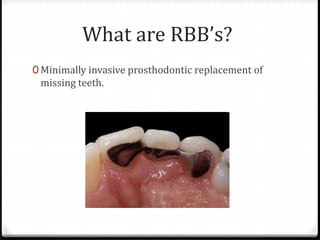
What are RBB’s?
0 Minimally invasive prosthodontic replacement of
missing teeth.
INDICATIONS
0 Short span edentulous areas
0 Pt unwilling or unsuitable for surgical treatment.
0 Needle phobic pts.
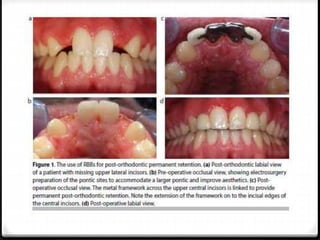
0 Post orthodontic fixed retention
0 In periodontally compromised - Splinting
CONTRA INDICATIONS
0 Heavily restored abutments
0 Small sized abutments – Peg Laterals
0 Mal-alligned abutments
0 Mobile abutments
0 Long span edentulous area
0 Allergy to base metal alloys
SUITABLE
ABUTMENT?
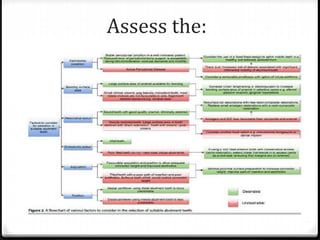
Assess the:
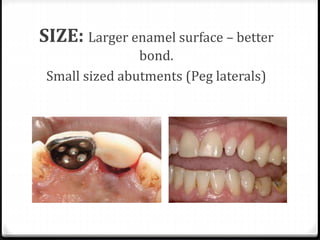
SIZE: Larger enamel surface – better
bond.
Small sized abutments (Peg laterals)
RESTORATIVE STATUS:
Minimally restored with good quality
enamel
Resurfacing old restorations
GIC/Amalgam = ?
Composite = ?
0ENDODONTIC STATUS: Vital
teeth, without any pulpal pathosis
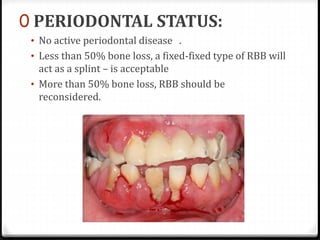
0 PERIODONTAL STATUS:
• No active periodontal disease .
• Less than 50% bone loss, a fixed-fixed type of RBB will
act as a splint – is acceptable
• More than 50% bone loss, RBB should be
reconsidered.
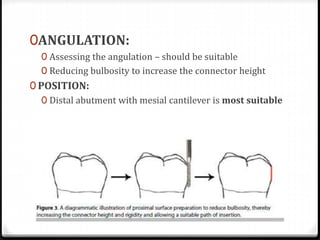
0ANGULATION:
0 Assessing the angulation – should be suitable
0 Reducing bulbosity to increase the connector height
0 POSITION:
0 Distal abutment with mesial cantilever is most suitable
DESIGNING THE RBB
Depends upon:
1. Degree of coverage
2. Number of abutments
3. Framework Rigidity
Degree of Coverage:
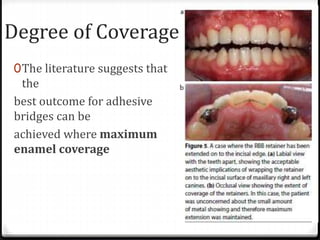
0The literature suggests that
the
best outcome for adhesive
bridges can be
achieved where maximum
enamel coverage
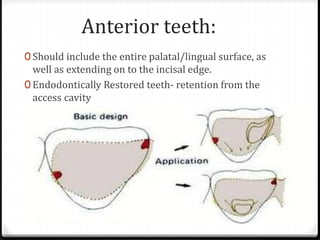
Anterior teeth:
0 Should include the entire palatal/lingual surface, as
well as extending on to the incisal edge.
0 Endodontically Restored teeth- retention from the
access cavity
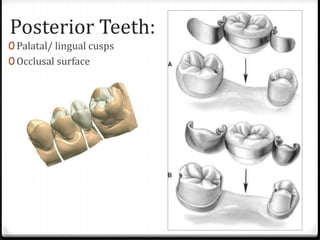
Posterior Teeth:
0 Palatal/ lingual cusps
0 Occlusal surface
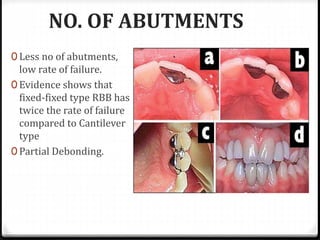
NO. OF ABUTMENTS
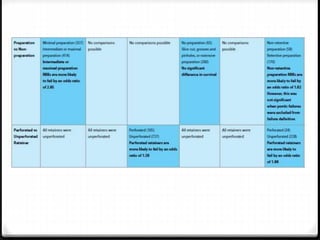
0 Less no of abutments,
low rate of failure.
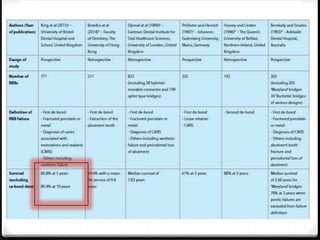
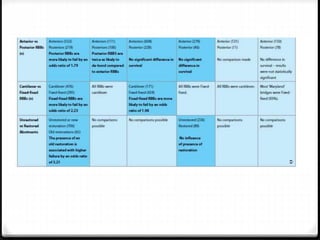
0 Evidence shows that
fixed-fixed type RBB has
twice the rate of failure
compared to Cantilever
type
0 Partial Debonding.
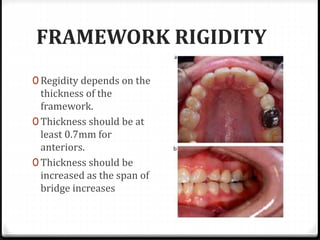
FRAMEWORK RIGIDITY
0 Regidity depends on the
thickness of the
framework.
0 Thickness should be at
least 0.7mm for
anteriors.
0 Thickness should be
increased as the span of
bridge increases
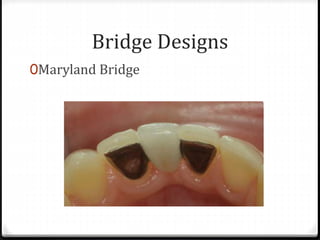
Bridge Designs
0Maryland Bridge
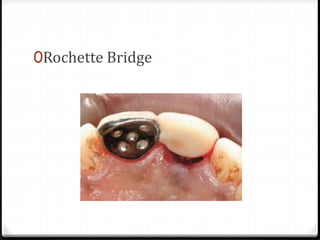
0Rochette Bridge
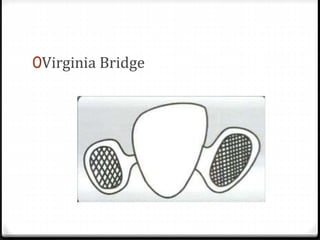
0Virginia Bridge
CONCLUSION
Like in all restorative cases, Careful case
selection and attention to detail are critical for
the successful provision of RBBs.

Resin Bonded Bridges

  • 3.
    What are RBB’s? 0Minimally invasive prosthodontic replacement of missing teeth.
  • 4.
    INDICATIONS 0 Short spanedentulous areas 0 Pt unwilling or unsuitable for surgical treatment. 0 Needle phobic pts. 0 Post orthodontic fixed retention 0 In periodontally compromised - Splinting
  • 6.
    CONTRA INDICATIONS 0 Heavilyrestored abutments 0 Small sized abutments – Peg Laterals 0 Mal-alligned abutments 0 Mobile abutments 0 Long span edentulous area 0 Allergy to base metal alloys
  • 7.
  • 8.
  • 9.
    SIZE: Larger enamelsurface – better bond. Small sized abutments (Peg laterals)
  • 10.
    RESTORATIVE STATUS: Minimally restoredwith good quality enamel Resurfacing old restorations GIC/Amalgam = ? Composite = ? 0ENDODONTIC STATUS: Vital teeth, without any pulpal pathosis
  • 11.
    0 PERIODONTAL STATUS: •No active periodontal disease . • Less than 50% bone loss, a fixed-fixed type of RBB will act as a splint – is acceptable • More than 50% bone loss, RBB should be reconsidered.
  • 12.
    0ANGULATION: 0 Assessing theangulation – should be suitable 0 Reducing bulbosity to increase the connector height 0 POSITION: 0 Distal abutment with mesial cantilever is most suitable
  • 16.
    DESIGNING THE RBB Dependsupon: 1. Degree of coverage 2. Number of abutments 3. Framework Rigidity
  • 17.
    Degree of Coverage: 0Theliterature suggests that the best outcome for adhesive bridges can be achieved where maximum enamel coverage
  • 18.
    Anterior teeth: 0 Shouldinclude the entire palatal/lingual surface, as well as extending on to the incisal edge. 0 Endodontically Restored teeth- retention from the access cavity
  • 19.
    Posterior Teeth: 0 Palatal/lingual cusps 0 Occlusal surface
  • 20.
    NO. OF ABUTMENTS 0Less no of abutments, low rate of failure. 0 Evidence shows that fixed-fixed type RBB has twice the rate of failure compared to Cantilever type 0 Partial Debonding.
  • 21.
    FRAMEWORK RIGIDITY 0 Regiditydepends on the thickness of the framework. 0 Thickness should be at least 0.7mm for anteriors. 0 Thickness should be increased as the span of bridge increases
  • 22.
  • 23.
  • 24.
  • 25.
    CONCLUSION Like in allrestorative cases, Careful case selection and attention to detail are critical for the successful provision of RBBs.