Submitted to-
DR. ANJUMAN ARA AKTER MAM
DR. AKM ASAD POLASH SIR
DR.SHAHEENA SOHELI SWEETY MAM
Department of Orthodontics,
Dental Unit,RMC
Submitted By –
Md. Zahirul Haque
Roll:07
Session:2012-13
Batch:24TH BDS
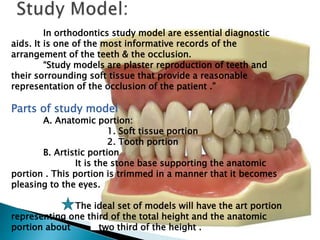
In orthodontics study model are essential diagnostic
aids. It is one of the most informative records of the
arrangement of the teeth & the occlusion.
“Study models are plaster reproduction of teeth and
their sorrounding soft tissue that provide a reasonable
representation of the occlusion of the patient .”
Parts of study model
A. Anatomic portion:
1. Soft tissue portion
2. Tooth portion
B. Artistic portion
It is the stone base supporting the anatomic
portion . This portion is trimmed in a manner that it becomes
pleasing to the eyes.
The ideal set of models will have the art portion
representing one third of the total height and the anatomic
portion about two third of the height .
 Models should accurately reproduce the teeth and their
surrounding soft tissues.
 Models are to trimmed so that they are symmetrical
and pleasing to the eye & so that an asymmetrical arch
form can be readily recognized.
 Models are to be trimmed in such a way that the dental
occlusion shows by setting the models on their backs.
 Models are to be trimmed such that they replicate the
measurements & angle proposed for trimming them.
 Models are to have clean, smooth, bubble free surface
with sharp angles where the cuts meet.

 The finished model should have a glossy marproof
finish
 Assess and record dental anatomy
 Asses and record intercuspation
 Asses and record the curves of occlussion
 Evaluate occlussion with the aid of articulators
 Measure progress during treatment
 Detect abnormality,eg-Localized enlargement
distortion of arch form etc.
 Calculate total space requirements/discrepancies
 Provide record before,immediately,after and several
years following treatment for the purpose of
studying treatment procedures and stability.
 Invaluable in planning treatment , as they are the
only three dimensional records of the pt’s
destination.
 Permit a more objective assessment of
malocclusion than clinical examination or
photograph.
 Occlusion can be visualized from lingual aspect.
 A permanent record of the pt’s malocclusion.
 Visual aid for the dentist as he monitors changes
taking place during tooth movement.
 Help motivate the patient as the pt can visualize
the treatment progress.
Occupy considerable strong space.
 Possibility of breakage of study
model.
 No detailed information obtained
about soft tissues in the oral cavity.
 Relationship of teeth to the facial
profile cannot be elicited.
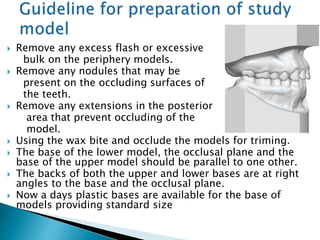
 Remove any excess flash or excessive
bulk on the periphery models.
 Remove any nodules that may be
present on the occluding surfaces of
the teeth.
 Remove any extensions in the posterior
area that prevent occluding of the
model.
 Using the wax bite and occlude the models for triming.
 The base of the lower model, the occlusal plane and the
base of the upper model should be parallel to one other.
 The backs of both the upper and lower bases are at right
angles to the base and the occlusal plane.
 Now a days plastic bases are available for the base of
models providing standard size
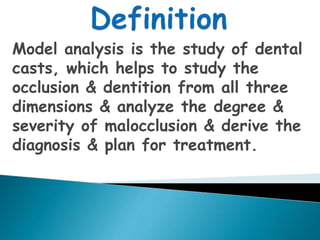
Model analysis is the study of dental
casts, which helps to study the
occlusion & dentition from all three
dimensions & analyze the degree &
severity of malocclusion & derive the
diagnosis & plan for treatment.
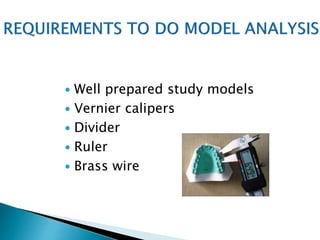
 Well prepared study models
 Vernier calipers
 Divider
 Ruler
 Brass wire
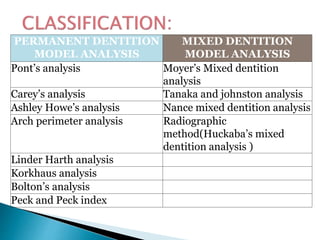
PERMANENT DENTITION
MODEL ANALYSIS
MIXED DENTITION
MODEL ANALYSIS
Pont’s analysis Moyer’s Mixed dentition
analysis
Carey’s analysis Tanaka and johnston analysis
Ashley Howe’s analysis Nance mixed dentition analysis
Arch perimeter analysis Radiographic
method(Huckaba’s mixed
dentition analysis )
Linder Harth analysis
Korkhaus analysis
Bolton’s analysis
Peck and Peck index
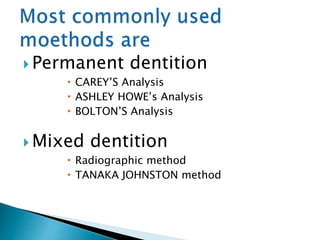
 Permanent dentition
 CAREY’S Analysis
 ASHLEY HOWE’s Analysis
 BOLTON’S Analysis
 Mixed dentition
 Radiographic method
 TANAKA JOHNSTON method
 The arch length-tooth material discrepancy is
the main cause for most malocclusions.
 This discrepancy can be calculated with the
help of Carey’s analysis.
 This analysis is usually carried out in the lower
arch.
 STEP I: DETERMINATION OF ARCH LENGTH
Measure the arch perimeter using brass wire.
The wire is placed the mesial surface of the first
permanent molar of one side and is passed over the
buccal cusps of the premolar and along the
anteriors and is continued on the opposite side in
the same way up to the mesial surface of the
opposite the first permanent molar.
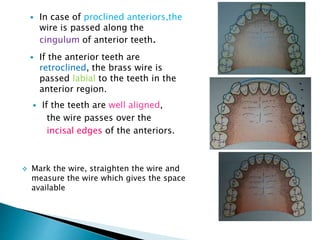
 In case of proclined anteriors,the
wire is passed along the
cingulum of anterior teeth.
 If the anterior teeth are
retroclined, the brass wire is
passed labial to the teeth in the
anterior region.
 If the teeth are well aligned,
the wire passes over the
incisal edges of the anteriors.
 Mark the wire, straighten the wire and
measure the wire which gives the space
available
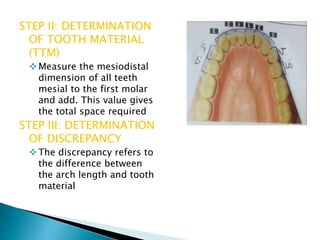
STEP II: DETERMINATION
OF TOOTH MATERIAL
(TTM)
Measure the mesiodistal
dimension of all teeth
mesial to the first molar
and add. This value gives
the total space required
STEP III: DETERMINATION
OF DISCREPANCY
The discrepancy refers to
the difference between
the arch length and tooth
material
ARCH LENGTH DISCREPANCY INFERENCE
0 to 2.5 mm Proximal stripping can be carried
out to reduce the minimal tooth
material excess
2.5 to 5 mm Extraction of second premolar is
indicated
Greater than 5mm
Extraction of first premolar is
usually required
 How’s considered tooth crowding to
be due to deficiency in arch width
rather than arch length
 He found a relationship to exist
between the total width of mesiodistal
diameter of teeth anterior to the
second permanent molar & the width
of the dental arch in the first premolar
region
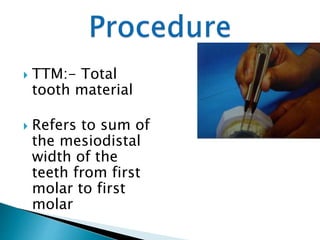
 TTM:- Total
tooth material
 Refers to sum of
the mesiodistal
width of the
teeth from first
molar to first
molar
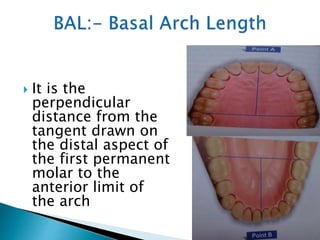
 It is the
perpendicular
distance from the
tangent drawn on
the distal aspect of
the first permanent
molar to the
anterior limit of
the arch
 Arch width
measured from
the buccal cusp
tips of the first
premolar on one
side to the buccal
cusp tip on other
side
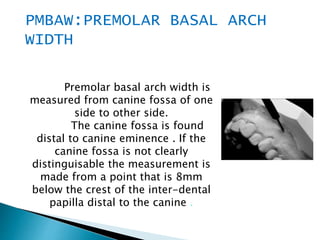
Premolar basal arch width is
measured from canine fossa of one
side to other side.
The canine fossa is found
distal to canine eminence . If the
canine fossa is not clearly
distinguisable the measurement is
made from a point that is 8mm
below the crest of the inter-dental
papilla distal to the canine .
PMBAW:PREMOLAR BASAL ARCH
WIDTH
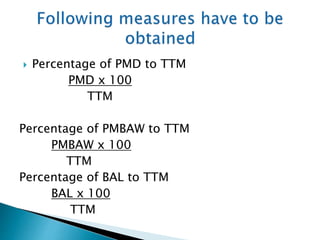
 Percentage of PMD to TTM
PMD x 100
TTM
Percentage of PMBAW to TTM
PMBAW x 100
TTM
Percentage of BAL to TTM
BAL x 100
TTM
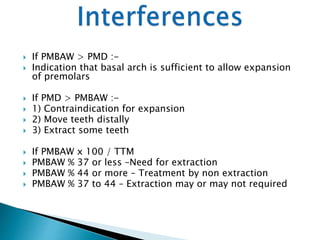
 If PMBAW > PMD :-
 Indication that basal arch is sufficient to allow expansion
of premolars
 If PMD > PMBAW :-
 1) Contraindication for expansion
 2) Move teeth distally
 3) Extract some teeth
 If PMBAW x 100 / TTM
 PMBAW % 37 or less –Need for extraction
 PMBAW % 44 or more – Treatment by non extraction
 PMBAW % 37 to 44 – Extraction may or may not required
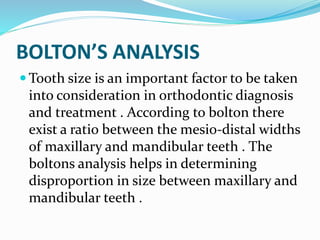
BOLTON’S ANALYSIS
 Tooth size is an important factor to be taken
into consideration in orthodontic diagnosis
and treatment . According to bolton there
exist a ratio between the mesio-distal widths
of maxillary and mandibular teeth . The
boltons analysis helps in determining
disproportion in size between maxillary and
mandibular teeth .
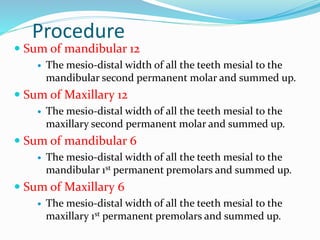
Procedure
 Sum of mandibular 12
 The mesio-distal width of all the teeth mesial to the
mandibular second permanent molar and summed up.
 Sum of Maxillary 12
 The mesio-distal width of all the teeth mesial to the
maxillary second permanent molar and summed up.
 Sum of mandibular 6
 The mesio-distal width of all the teeth mesial to the
mandibular 1st permanent premolars and summed up.
 Sum of Maxillary 6
 The mesio-distal width of all the teeth mesial to the
maxillary 1st permanent premolars and summed up.
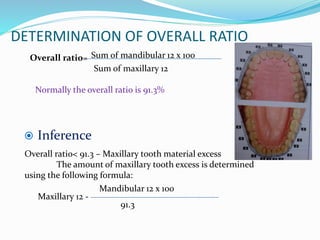
DETERMINATION OF OVERALL RATIO
Sum of mandibular 12 x 100Overall ratio=
Sum of maxillary 12
 Inference
Overall ratio< 91.3 – Maxillary tooth material excess
The amount of maxillary tooth excess is determined
using the following formula:
Maxillary 12 -
Mandibular 12 x 100
91.3
Normally the overall ratio is 91.3%
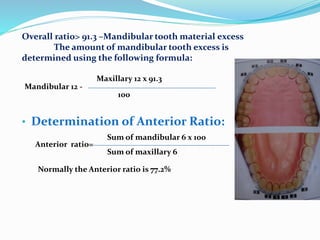
Overall ratio> 91.3 –Mandibular tooth material excess
The amount of mandibular tooth excess is
determined using the following formula:
Mandibular 12 -
Maxillary 12 x 91.3
100
• Determination of Anterior Ratio:
Sum of mandibular 6 x 100
Anterior ratio=
Sum of maxillary 6
Normally the Anterior ratio is 77.2%
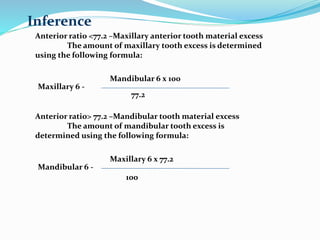
Inference
Anterior ratio <77.2 –Maxillary anterior tooth material excess
The amount of maxillary tooth excess is determined
using the following formula:
Maxillary 6 -
Mandibular 6 x 100
77.2
Anterior ratio> 77.2 –Mandibular tooth material excess
The amount of mandibular tooth excess is
determined using the following formula:
Mandibular 6 -
Maxillary 6 x 77.2
100
 The purpose of mixed dentition analysis is to
evaluate the amount of space available in the
arch for succeeding permanent teeth &
necessary occlusal adjustment.
 2 methods have been suggested-
 Those in which the sizes of unerrupted cuspids
& premolars are estimated from measurements
of the radiographic image.
 Those in which the sizes of the cuspids &
premolar are derived from knowledge of the
sizes of permanent teeth already erupted in the
mouth.
MIXED DENTITION ANALYSIS
 Tanaka & Johnston did a study to repeat
Moyer’s observation to validate its equation
on a new sample.
 The possibility of secular changes with in
the past 20 yrs was to be examined & they
found Moyer’s prediction table to be equally
appropriate for contemporary population.
 They have simplified Moyer’s 75% level
of prediction table into a formula
 Predicted width of maxillary canine to
premolar
Sum of mandibular incisors + 11
2
Predicted width of mandibular canine to
premolar
Sum of mandibular incisors +
10.5
2
 If most of the canines & premolars
have errupted & if one or two
succedaneous teeth are still
unerrupted an alternative prediction
method can be used to estimate the
mesiodistal width of the unerupted
permanent tooth.
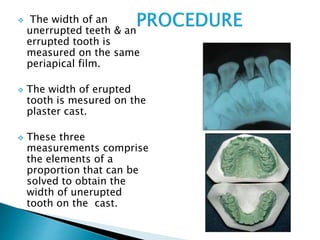
 The width of an
unerrupted teeth & an
errupted tooth is
measured on the same
periapical film.
 The width of erupted
tooth is mesured on the
plaster cast.
 These three
measurements comprise
the elements of a
proportion that can be
solved to obtain the
width of unerupted
tooth on the cast.
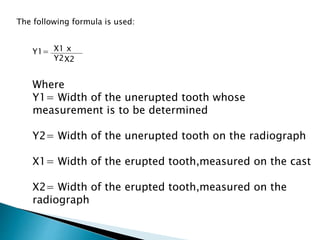
The following formula is used:
Y1= X1 x
Y2X2
Where
Y1= Width of the unerupted tooth whose
measurement is to be determined
Y2= Width of the unerupted tooth on the radiograph
X1= Width of the erupted tooth,measured on the cast
X2= Width of the erupted tooth,measured on the
radiograph
Orthodontic study model and model analysis

Orthodontic study model and model analysis

  • 1.
    Submitted to- DR. ANJUMANARA AKTER MAM DR. AKM ASAD POLASH SIR DR.SHAHEENA SOHELI SWEETY MAM Department of Orthodontics, Dental Unit,RMC Submitted By – Md. Zahirul Haque Roll:07 Session:2012-13 Batch:24TH BDS
  • 2.
    In orthodontics studymodel are essential diagnostic aids. It is one of the most informative records of the arrangement of the teeth & the occlusion. “Study models are plaster reproduction of teeth and their sorrounding soft tissue that provide a reasonable representation of the occlusion of the patient .” Parts of study model A. Anatomic portion: 1. Soft tissue portion 2. Tooth portion B. Artistic portion It is the stone base supporting the anatomic portion . This portion is trimmed in a manner that it becomes pleasing to the eyes. The ideal set of models will have the art portion representing one third of the total height and the anatomic portion about two third of the height .
  • 3.
     Models shouldaccurately reproduce the teeth and their surrounding soft tissues.  Models are to trimmed so that they are symmetrical and pleasing to the eye & so that an asymmetrical arch form can be readily recognized.  Models are to be trimmed in such a way that the dental occlusion shows by setting the models on their backs.  Models are to be trimmed such that they replicate the measurements & angle proposed for trimming them.  Models are to have clean, smooth, bubble free surface with sharp angles where the cuts meet.  The finished model should have a glossy marproof finish
  • 4.
     Assess andrecord dental anatomy  Asses and record intercuspation  Asses and record the curves of occlussion  Evaluate occlussion with the aid of articulators  Measure progress during treatment  Detect abnormality,eg-Localized enlargement distortion of arch form etc.  Calculate total space requirements/discrepancies  Provide record before,immediately,after and several years following treatment for the purpose of studying treatment procedures and stability.
  • 5.
     Invaluable inplanning treatment , as they are the only three dimensional records of the pt’s destination.  Permit a more objective assessment of malocclusion than clinical examination or photograph.  Occlusion can be visualized from lingual aspect.  A permanent record of the pt’s malocclusion.  Visual aid for the dentist as he monitors changes taking place during tooth movement.  Help motivate the patient as the pt can visualize the treatment progress.
  • 6.
    Occupy considerable strongspace.  Possibility of breakage of study model.  No detailed information obtained about soft tissues in the oral cavity.  Relationship of teeth to the facial profile cannot be elicited.
  • 7.
     Remove anyexcess flash or excessive bulk on the periphery models.  Remove any nodules that may be present on the occluding surfaces of the teeth.  Remove any extensions in the posterior area that prevent occluding of the model.  Using the wax bite and occlude the models for triming.  The base of the lower model, the occlusal plane and the base of the upper model should be parallel to one other.  The backs of both the upper and lower bases are at right angles to the base and the occlusal plane.  Now a days plastic bases are available for the base of models providing standard size
  • 9.
    Model analysis isthe study of dental casts, which helps to study the occlusion & dentition from all three dimensions & analyze the degree & severity of malocclusion & derive the diagnosis & plan for treatment.
  • 10.
     Well preparedstudy models  Vernier calipers  Divider  Ruler  Brass wire
  • 11.
    PERMANENT DENTITION MODEL ANALYSIS MIXEDDENTITION MODEL ANALYSIS Pont’s analysis Moyer’s Mixed dentition analysis Carey’s analysis Tanaka and johnston analysis Ashley Howe’s analysis Nance mixed dentition analysis Arch perimeter analysis Radiographic method(Huckaba’s mixed dentition analysis ) Linder Harth analysis Korkhaus analysis Bolton’s analysis Peck and Peck index
  • 12.
     Permanent dentition CAREY’S Analysis  ASHLEY HOWE’s Analysis  BOLTON’S Analysis  Mixed dentition  Radiographic method  TANAKA JOHNSTON method
  • 14.
     The archlength-tooth material discrepancy is the main cause for most malocclusions.  This discrepancy can be calculated with the help of Carey’s analysis.  This analysis is usually carried out in the lower arch.
  • 15.
     STEP I:DETERMINATION OF ARCH LENGTH Measure the arch perimeter using brass wire. The wire is placed the mesial surface of the first permanent molar of one side and is passed over the buccal cusps of the premolar and along the anteriors and is continued on the opposite side in the same way up to the mesial surface of the opposite the first permanent molar.
  • 16.
     In caseof proclined anteriors,the wire is passed along the cingulum of anterior teeth.  If the anterior teeth are retroclined, the brass wire is passed labial to the teeth in the anterior region.  If the teeth are well aligned, the wire passes over the incisal edges of the anteriors.  Mark the wire, straighten the wire and measure the wire which gives the space available
  • 17.
    STEP II: DETERMINATION OFTOOTH MATERIAL (TTM) Measure the mesiodistal dimension of all teeth mesial to the first molar and add. This value gives the total space required STEP III: DETERMINATION OF DISCREPANCY The discrepancy refers to the difference between the arch length and tooth material
  • 18.
    ARCH LENGTH DISCREPANCYINFERENCE 0 to 2.5 mm Proximal stripping can be carried out to reduce the minimal tooth material excess 2.5 to 5 mm Extraction of second premolar is indicated Greater than 5mm Extraction of first premolar is usually required
  • 19.
     How’s consideredtooth crowding to be due to deficiency in arch width rather than arch length  He found a relationship to exist between the total width of mesiodistal diameter of teeth anterior to the second permanent molar & the width of the dental arch in the first premolar region
  • 20.
     TTM:- Total toothmaterial  Refers to sum of the mesiodistal width of the teeth from first molar to first molar
  • 21.
     It isthe perpendicular distance from the tangent drawn on the distal aspect of the first permanent molar to the anterior limit of the arch
  • 22.
     Arch width measuredfrom the buccal cusp tips of the first premolar on one side to the buccal cusp tip on other side
  • 23.
    Premolar basal archwidth is measured from canine fossa of one side to other side. The canine fossa is found distal to canine eminence . If the canine fossa is not clearly distinguisable the measurement is made from a point that is 8mm below the crest of the inter-dental papilla distal to the canine . PMBAW:PREMOLAR BASAL ARCH WIDTH
  • 24.
     Percentage ofPMD to TTM PMD x 100 TTM Percentage of PMBAW to TTM PMBAW x 100 TTM Percentage of BAL to TTM BAL x 100 TTM
  • 25.
     If PMBAW> PMD :-  Indication that basal arch is sufficient to allow expansion of premolars  If PMD > PMBAW :-  1) Contraindication for expansion  2) Move teeth distally  3) Extract some teeth  If PMBAW x 100 / TTM  PMBAW % 37 or less –Need for extraction  PMBAW % 44 or more – Treatment by non extraction  PMBAW % 37 to 44 – Extraction may or may not required
  • 26.
    BOLTON’S ANALYSIS  Toothsize is an important factor to be taken into consideration in orthodontic diagnosis and treatment . According to bolton there exist a ratio between the mesio-distal widths of maxillary and mandibular teeth . The boltons analysis helps in determining disproportion in size between maxillary and mandibular teeth .
  • 27.
    Procedure  Sum ofmandibular 12  The mesio-distal width of all the teeth mesial to the mandibular second permanent molar and summed up.  Sum of Maxillary 12  The mesio-distal width of all the teeth mesial to the maxillary second permanent molar and summed up.  Sum of mandibular 6  The mesio-distal width of all the teeth mesial to the mandibular 1st permanent premolars and summed up.  Sum of Maxillary 6  The mesio-distal width of all the teeth mesial to the maxillary 1st permanent premolars and summed up.
  • 28.
    DETERMINATION OF OVERALLRATIO Sum of mandibular 12 x 100Overall ratio= Sum of maxillary 12  Inference Overall ratio< 91.3 – Maxillary tooth material excess The amount of maxillary tooth excess is determined using the following formula: Maxillary 12 - Mandibular 12 x 100 91.3 Normally the overall ratio is 91.3%
  • 29.
    Overall ratio> 91.3–Mandibular tooth material excess The amount of mandibular tooth excess is determined using the following formula: Mandibular 12 - Maxillary 12 x 91.3 100 • Determination of Anterior Ratio: Sum of mandibular 6 x 100 Anterior ratio= Sum of maxillary 6 Normally the Anterior ratio is 77.2%
  • 30.
    Inference Anterior ratio <77.2–Maxillary anterior tooth material excess The amount of maxillary tooth excess is determined using the following formula: Maxillary 6 - Mandibular 6 x 100 77.2 Anterior ratio> 77.2 –Mandibular tooth material excess The amount of mandibular tooth excess is determined using the following formula: Mandibular 6 - Maxillary 6 x 77.2 100
  • 31.
     The purposeof mixed dentition analysis is to evaluate the amount of space available in the arch for succeeding permanent teeth & necessary occlusal adjustment.  2 methods have been suggested-  Those in which the sizes of unerrupted cuspids & premolars are estimated from measurements of the radiographic image.  Those in which the sizes of the cuspids & premolar are derived from knowledge of the sizes of permanent teeth already erupted in the mouth. MIXED DENTITION ANALYSIS
  • 32.
     Tanaka &Johnston did a study to repeat Moyer’s observation to validate its equation on a new sample.  The possibility of secular changes with in the past 20 yrs was to be examined & they found Moyer’s prediction table to be equally appropriate for contemporary population.
  • 33.
     They havesimplified Moyer’s 75% level of prediction table into a formula  Predicted width of maxillary canine to premolar Sum of mandibular incisors + 11 2 Predicted width of mandibular canine to premolar Sum of mandibular incisors + 10.5 2
  • 34.
     If mostof the canines & premolars have errupted & if one or two succedaneous teeth are still unerrupted an alternative prediction method can be used to estimate the mesiodistal width of the unerupted permanent tooth.
  • 35.
     The widthof an unerrupted teeth & an errupted tooth is measured on the same periapical film.  The width of erupted tooth is mesured on the plaster cast.  These three measurements comprise the elements of a proportion that can be solved to obtain the width of unerupted tooth on the cast.
  • 36.
    The following formulais used: Y1= X1 x Y2X2 Where Y1= Width of the unerupted tooth whose measurement is to be determined Y2= Width of the unerupted tooth on the radiograph X1= Width of the erupted tooth,measured on the cast X2= Width of the erupted tooth,measured on the radiograph