Educational
Research and
Statistics
Course Code 6461
Asima shahzadi
asimashahzadi7@gmail.com
What is a Data Collection Tool
Data collection tools refer to the devices/instruments
used to collect data, such as a paper questionnaire or
computer-assisted interviewing system. Case Studies,
Checklists, Interviews, Observation sometimes, and
Surveys or Questionnaires are all tools used to collect
data.
1. Tests
2. Interview
3. Questionnaire
4. Observation
5. Checklist
6 top data collection methods and tools for
Academic, Opinion or Product Research
A test is a means of measuring the
knowledge, skill, feeling, intelligence, or
aptitude of an individual or group.
Test objectivity means that an individual’s
score is not affected by the person scoring
the test.
1. Test
Validity is the most important quality of any
test.
Validity is concerned with what a test
measures and for whom is appropriate ,
reliability refers to the consistency with
which a test measures whatever it measures.
Validity of the instrument
1) Achievement Tests
 Achievement test measure the current status of individual
with respect to proficiency in given areas of knowledge or skill.
 Standardize achievement tests are available for individual
curriculum areas such as reading and mathematics, and also
in the form of comprehensive batteries that measure
achievement in several different areas.
Types of Test
2) Aptitude Tests
Aptitude tests are used to predict how well someone is likely perform
in a future situation. Tests of general aptitude are variously referred
to as scholastic aptitude test, intelligence tests, and tests of general
mental ability.
General Aptitude Tests:
General aptitude tests typically ask the individual to perform a
variety of verbal and nonverbal tasks that measure the individual’s
ability to apply knowledge and solve problems.
Specific Aptitude Tests:
This type of tests attempt to predict the level of performance that can
be expected of an individual following future instruction or training
in a specific area or areas.
3) Personality Tests:
Tests of personality are designed to measure
characteristics of individual along a number of
dimensions and to assess feeling and attitudes
toward self , others, and a variety of others
activities, institutions, and situation.
They may well be the most used tests in education
research
It is a data gathering instrument through which
respondent, answer questions or respond to
statements in writing .
It consist of series of questions or statements
that are submitted to those from which
information is desired.
Questionnaire
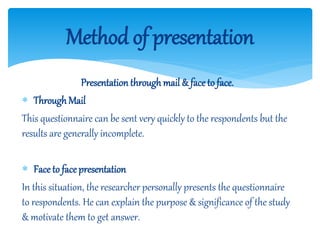
Presentation through mail & face to face.
 Through Mail
This questionnaire can be sent very quickly to the respondents but the
results are generally incomplete.
 Face to facepresentation
In this situation, the researcher personally presents the questionnaire
to respondents. He can explain the purpose & significance of the study
& motivate them to get answer.
Method of presentation
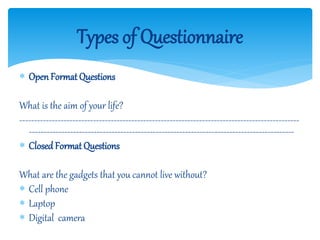
 OpenFormat Questions
What is the aim of your life?
-----------------------------------------------------------------------------------------------
------------------------------------------------------------------------------------------
 Closed Format Questions
What are the gadgets that you cannot live without?
 Cell phone
 Laptop
 Digital camera
Types of Questionnaire
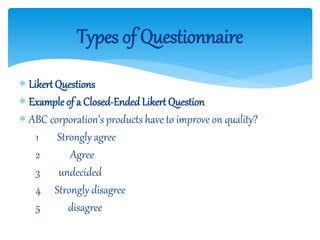
 Likert Questions
 Example of a Closed-Ended Likert Question
 ABC corporation’s products have to improve on quality?
1 Strongly agree
2 Agree
3 undecided
4 Strongly disagree
5 disagree
Types of Questionnaire
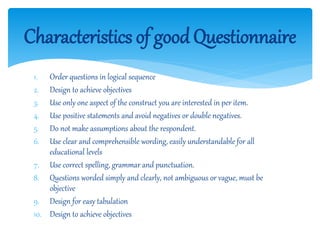
Characteristics of goodQuestionnaire
1. Order questions in logical sequence
2. Design to achieve objectives
3. Use only one aspect of the construct you are interested in per item.
4. Use positive statements and avoid negatives or double negatives.
5. Do not make assumptions about the respondent.
6. Use clear and comprehensible wording, easily understandable for all
educational levels
7. Use correct spelling, grammar and punctuation.
8. Questions worded simply and clearly, not ambiguous or vague, must be
objective
9. Design for easy tabulation
10. Design to achieve objectives
1. Can be administered in large numbers and is cost-effective.
2. It can be used to compare and contrast previous research to
measure change.
3. Easy to visualize and analyze.
4. Questionnaires offer actionable data.
5. Respondent identity is protected.
6. Questionnaires can cover all areas of a topic.
7. Relatively inexpensive.
Pros of Questionnaire
1. Answers may be dishonest or the respondents
lose interest midway.
2. Questionnaires can't produce qualitative data.
3. Questions might be left unanswered.
4. Respondents may have a hidden agenda.
5. Not all questions can be analyzed easily.
Cons of Questionnaire
Interview is a meeting of people face to face, especially
for consultation
Interviewee
Person being interviewed (answering the questions)
Interviewer
Person doing the interview (asking the questions)
Interview
1. to evaluate or assess a person in some respect.
2. to select or promote an employee
3. to effect therapeutic change, as in the psychiatric interview
4. to test or develop hypotheses
5. to gather data, as in surveys or experimental situations
6. to sample respondents’ opinions, as in doorstep interviews.
Purposes of the interview
 Unstructured (informal) interviews are like a casual conversation.
There are no set questions and the participant is given the
opportunity to raise whatever topics he/she feels are relevant and ask
them in their own way. In this kind of interview much qualitative
data is likely to be collected.
 Structured (formal) interviews are like a job interview. There is a
fixed, predetermined set of questions that are put to every
participant in the same order and in the same way. The interviewer
stays within their role and maintains social distance from the
interviewee.
Types of interviews
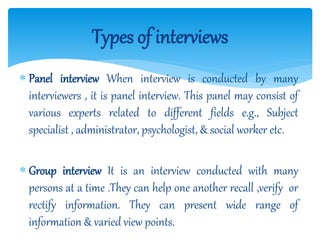
 Panel interview When interview is conducted by many
interviewers , it is panel interview. This panel may consist of
various experts related to different fields e.g., Subject
specialist , administrator, psychologist, & social worker etc.
 Group interview It is an interview conducted with many
persons at a time .They can help one another recall ,verify or
rectify information. They can present wide range of
information & varied view points.
Types of interviews
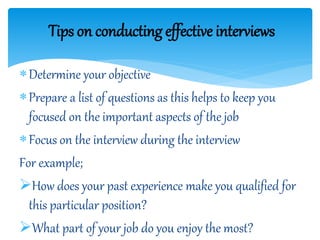
Determine your objective
Prepare a list of questions as this helps to keep you
focused on the important aspects of the job
Focus on the interview during the interview
For example;
How does your past experience make you qualified for
this particular position?
What part of your job do you enjoy the most?
Tips on conducting effective interviews
Advantages & disadvantages of interview
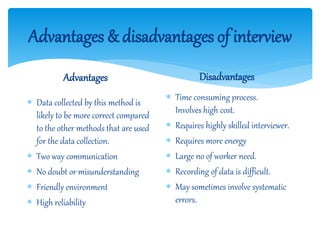
Advantages
 Data collected by this method is
likely to be more correct compared
to the other methods that are used
for the data collection.
 Two way communication
 No doubt or misunderstanding
 Friendly environment
 High reliability
Disadvantages
 Time consuming process.
Involves high cost.
 Requires highly skilled interviewer.
 Requires more energy
 Large no of worker need.
 Recording of data is difficult.
 May sometimes involve systematic
errors.
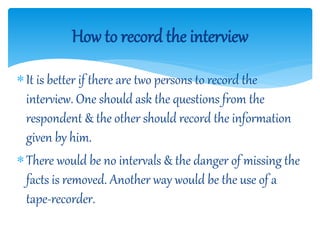
It is better if there are two persons to record the
interview. One should ask the questions from the
respondent & the other should record the information
given by him.
There would be no intervals & the danger of missing the
facts is removed. Another way would be the use of a
tape-recorder.
How to record the interview
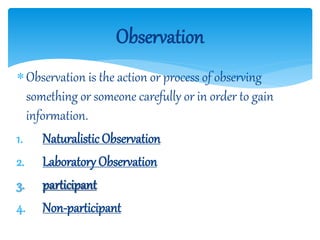
Observation is the action or process of observing
something or someone carefully or in order to gain
information.
1. Naturalistic Observation
2. Laboratory Observation
3. participant
4. Non-participant
Observation
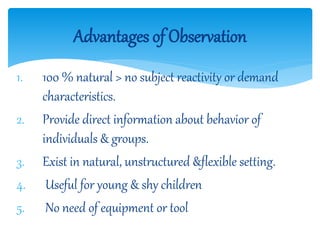
1. 100 % natural > no subject reactivity or demand
characteristics.
2. Provide direct information about behavior of
individuals & groups.
3. Exist in natural, unstructured &flexible setting.
4. Useful for young & shy children
5. No need of equipment or tool
Advantages of Observation
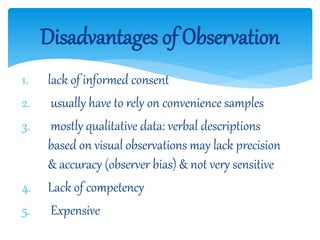
1. lack of informed consent
2. usually have to rely on convenience samples
3. mostly qualitative data: verbal descriptions
based on visual observations may lack precision
& accuracy (observer bias) & not very sensitive
4. Lack of competency
5. Expensive
Disadvantages of Observation
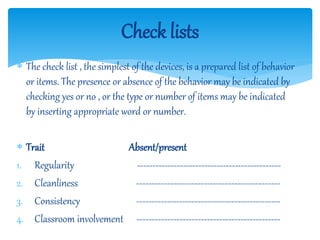
 The check list , the simplest of the devices, is a prepared list of behavior
or items. The presence or absence of the behavior may be indicated by
checking yes or no , or the type or number of items may be indicated
by inserting appropriate word or number.
 Trait Absent/present
1. Regularity -----------------------------------------------
2. Cleanliness -----------------------------------------------
3. Consistency -----------------------------------------------
4. Classroom involvement -----------------------------------------------
Check lists
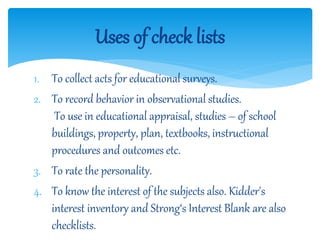
1. To collect acts for educational surveys.
2. To record behavior in observational studies.
To use in educational appraisal, studies – of school
buildings, property, plan, textbooks, instructional
procedures and outcomes etc.
3. To rate the personality.
4. To know the interest of the subjects also. Kidder's
interest inventory and Strong‘s Interest Blank are also
checklists.
Uses of check lists
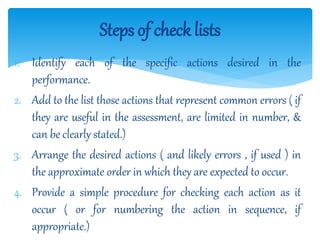
1. Identify each of the specific actions desired in the
performance.
2. Add to the list those actions that represent common errors ( if
they are useful in the assessment, are limited in number, &
can be clearly stated.)
3. Arrange the desired actions ( and likely errors , if used ) in
the approximate order in which they are expected to occur.
4. Provide a simple procedure for checking each action as it
occur ( or for numbering the action in sequence, if
appropriate.)
Steps of check lists
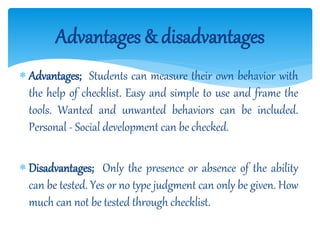
 Advantages; Students can measure their own behavior with
the help of checklist. Easy and simple to use and frame the
tools. Wanted and unwanted behaviors can be included.
Personal - Social development can be checked.
 Disadvantages; Only the presence or absence of the ability
can be tested. Yes or no type judgment can only be given. How
much can not be tested through checklist.
Advantages & disadvantages
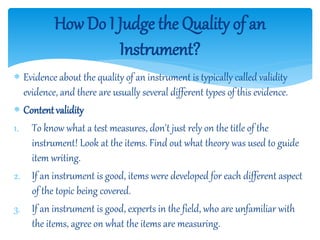
How Do I Judge the Quality of an
Instrument?
 Evidence about the quality of an instrument is typically called validity
evidence, and there are usually several different types of this evidence.
 Contentvalidity
1. To know what a test measures, don't just rely on the title of the
instrument! Look at the items. Find out what theory was used to guide
item writing.
2. If an instrument is good, items were developed for each different aspect
of the topic being covered.
3. If an instrument is good, experts in the field, who are unfamiliar with
the items, agree on what the items are measuring.
Internal-consistency validity
1. In a high-quality instrument, we should see patterns of item-responses
we expect based on what we think the items are measuring.
2. If items are measuring the same thing, students should respond to the
items similarly.
3. If items are measuring different things, students' responses to the
items should differ at least slightly.
4. Often internal-consistency validity is called reliability. Reliability refers
to how consistently an instrument measures something.
5. Reliability indices range from 0 to 1.0 with higher values indicating
that the measure is more reliable. Ideally, for program assessment we
look for reliability values of .70 or higher.
External validity
External validity is comprised of convergent and
discriminate validity.
Convergent validity: Scores on the instrument should
relate highly to scores on other instruments that
measure similar or highly related things.
Discriminate validity: Scores on the instrument should
relate weakly to scores on other instruments that
measure different or opposite things.
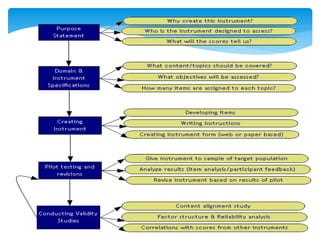
Instrument development can be time-consuming
and complex.
It is best to work alongside an assessment or
measurement professional.
Below is a general outline of the process to give
you an idea what is involved.
How Do I Create Instruments?
Unit 7 tolls of research