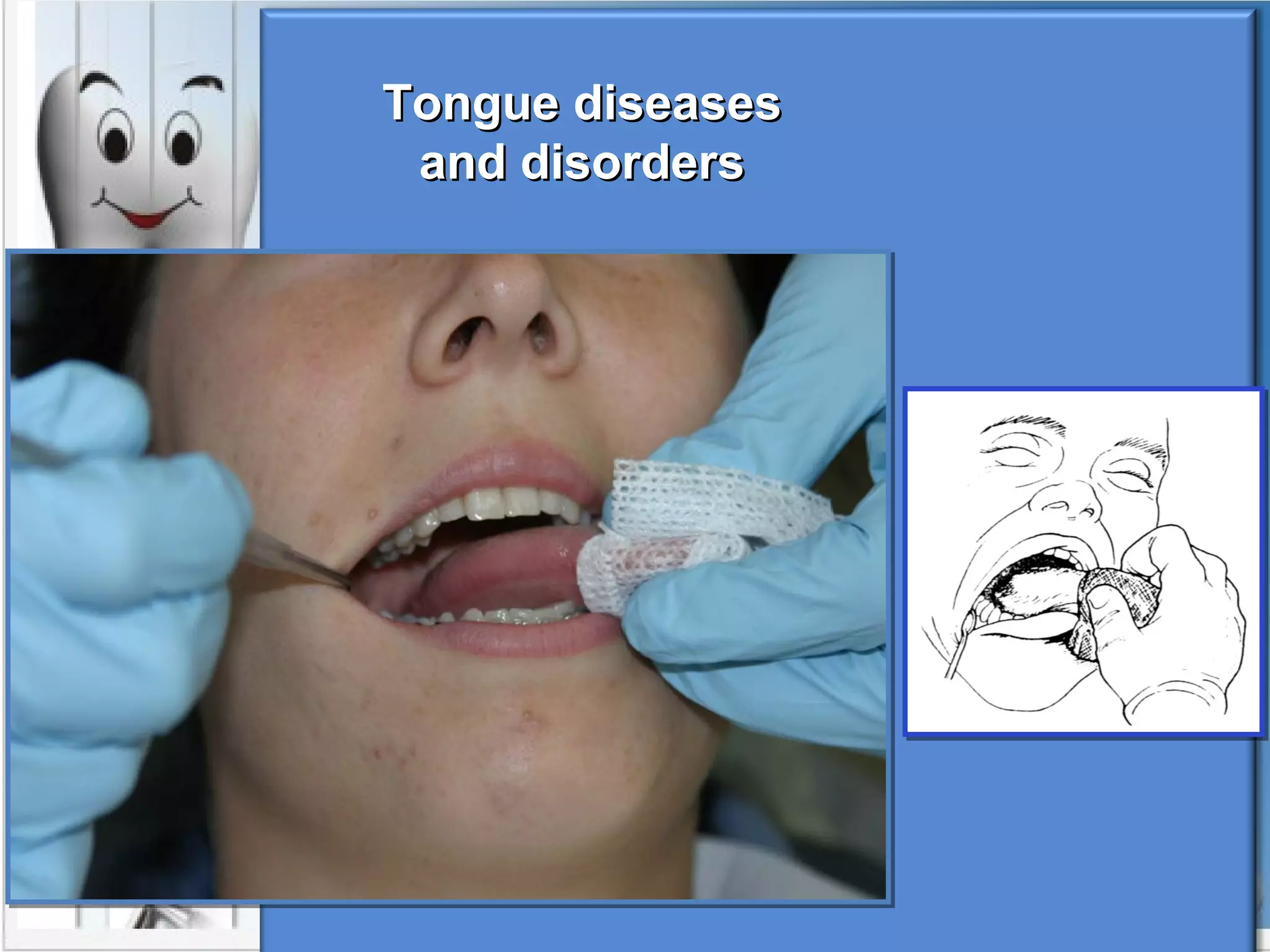
Tongue diseasesTongue diseases
and disordersand disorders
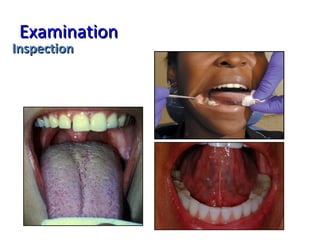
ExaminationExamination
InspectionInspection
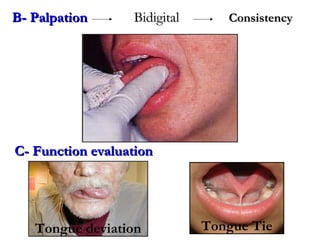
B- PalpationB- Palpation BidigitalBidigital ConsistencyConsistency
C- Function evaluationC- Function evaluation
Tongue TieTongue deviation
Disorders of Tongue
• Glossodynia (burning mouth syndrome)-
spontaneous burning, discomfort, pain,
irritation, or rawness of the tongue, has no
identifiable etiology most of the time
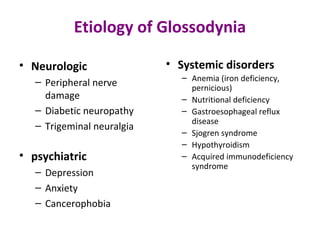
Etiology of Glossodynia
• Neurologic
– Peripheral nerve
damage
– Diabetic neuropathy
– Trigeminal neuralgia
• psychiatric
– Depression
– Anxiety
– Cancerophobia
• Systemic disorders
– Anemia (iron deficiency,
pernicious)
– Nutritional deficiency
– Gastroesophageal reflux
disease
– Sjogren syndrome
– Hypothyroidism
– Acquired immunodeficiency
syndrome
Treatment
• Tricyclic antidepressant
Disorders of Tongue…
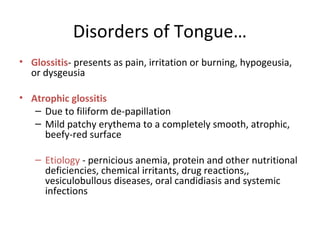
• Glossitis- presents as pain, irritation or burning, hypogeusia,
or dysgeusia
• Atrophic glossitis
– Due to filiform de-papillation
– Mild patchy erythema to a completely smooth, atrophic,
beefy-red surface
– Etiology - pernicious anemia, protein and other nutritional
deficiencies, chemical irritants, drug reactions,,
vesiculobullous diseases, oral candidiasis and systemic
infections
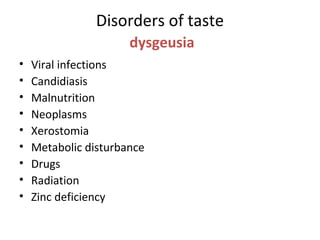
Disorders of taste
dysgeusia
• Viral infections
• Candidiasis
• Malnutrition
• Neoplasms
• Xerostomia
• Metabolic disturbance
• Drugs
• Radiation
• Zinc deficiency
COMMON LESIONS
Normal variations
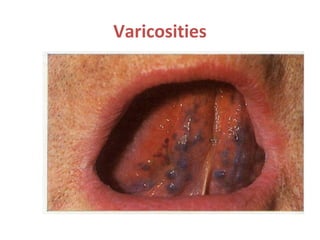
Varicosities
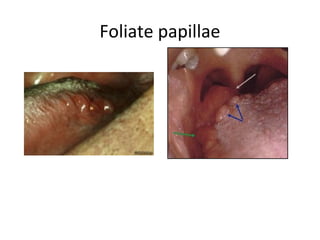
Foliate papillae
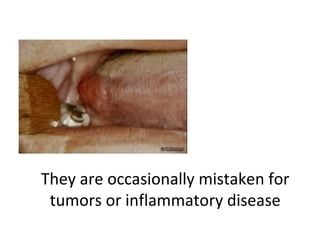
They are occasionally mistaken for
tumors or inflammatory disease
Developmental lesions
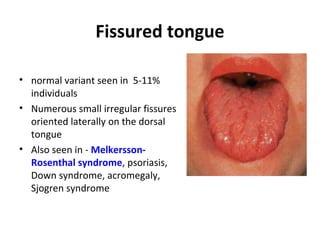
Fissured tongue
• normal variant seen in 5-11%
individuals
• Numerous small irregular fissures
oriented laterally on the dorsal
tongue
• Also seen in - Melkersson-
Rosenthal syndrome, psoriasis,
Down syndrome, acromegaly,
Sjogren syndrome
Macroglossia
• Congenital or acquired process, tongue is disproportionately
large relative to the patient’s jaw size
• Difficulty with mastication and speech and accidental tongue
biting are common
• Differential- Down syndrome, hypothyroidism,
haemangioma, neurofibromatosis, infection by mycobacteria,
or deep fungus, amyloidosis………
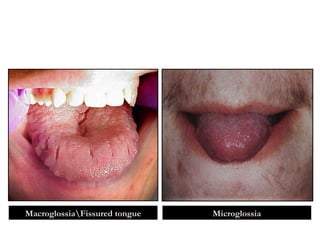
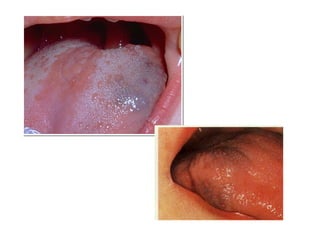
MicroglossiaMacroglossiaFissured tongue
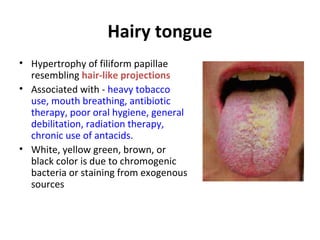
Hairy tongue
• Hypertrophy of filiform papillae
resembling hair-like projections
• Associated with - heavy tobacco
use, mouth breathing, antibiotic
therapy, poor oral hygiene, general
debilitation, radiation therapy,
chronic use of antacids.
• White, yellow green, brown, or
black color is due to chromogenic
bacteria or staining from exogenous
sources
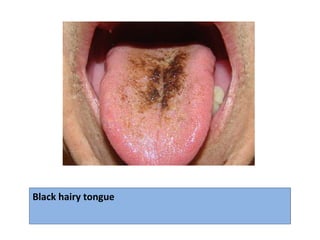
Black hairy tongue
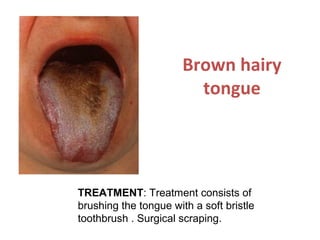
Brown hairy
tongue
TREATMENT: Treatment consists of
brushing the tongue with a soft bristle
toothbrush . Surgical scraping.
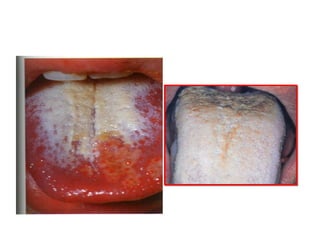
1. What is the clinical
diagnosis
2. What are the predisposing
factors?
3. What is the treatment?
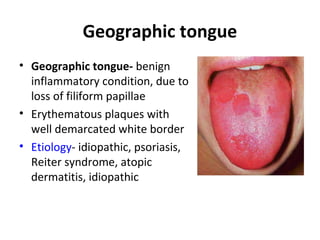
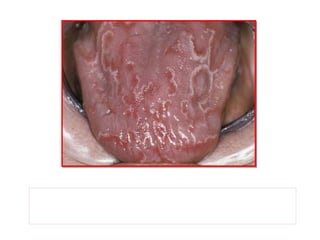
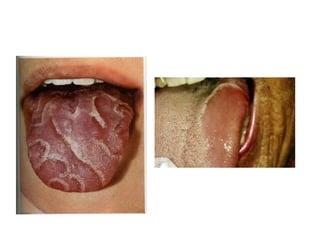
Geographic tongue
• Geographic tongue- benign
inflammatory condition, due to
loss of filiform papillae
• Erythematous plaques with
well demarcated white border
• Etiology- idiopathic, psoriasis,
Reiter syndrome, atopic
dermatitis, idiopathic
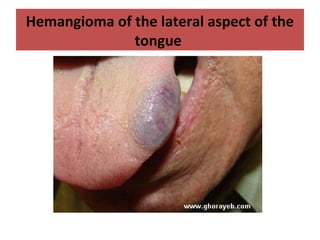
Hemangioma of the lateral aspect of the
tongue
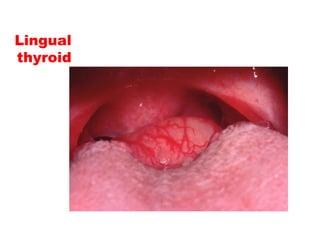
Lingual
thyroid
Other lesions
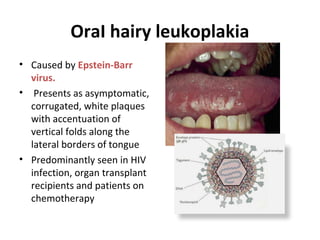
OraI hairy leukoplakia
• Caused by Epstein-Barr
virus.
• Presents as asymptomatic,
corrugated, white plaques
with accentuation of
vertical folds along the
lateral borders of tongue
• Predominantly seen in HIV
infection, organ transplant
recipients and patients on
chemotherapy
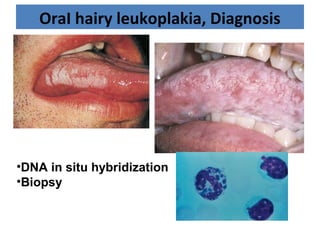
OraI hairy leukoplakia, Diagnosis
•DNA in situ hybridization
•Biopsy
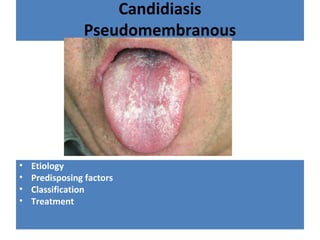
Candidiasis
Pseudomembranous
• Etiology
• Predisposing factors
• Classification
• Treatment
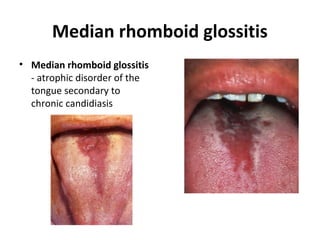
Median rhomboid glossitis
• Median rhomboid glossitis
- atrophic disorder of the
tongue secondary to
chronic candidiasis
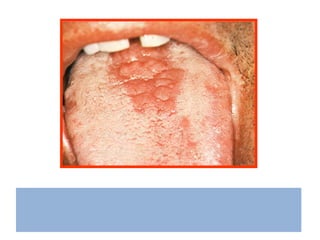
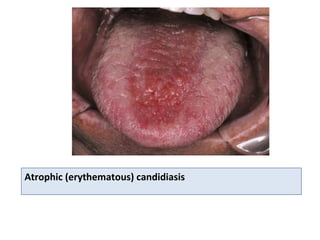
Atrophic (erythematous) candidiasis
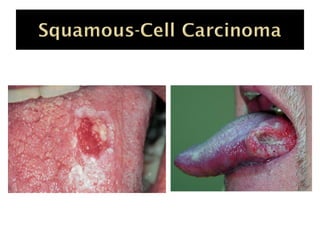
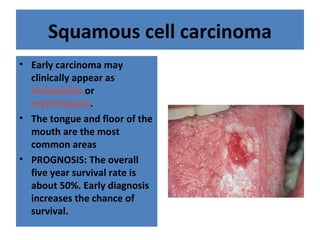
Squamous cell carcinoma
• Early carcinoma may
clinically appear as
leukoplakia or
erythroplasia.
• The tongue and floor of the
mouth are the most
common areas
• PROGNOSIS: The overall
five year survival rate is
about 50%. Early diagnosis
increases the chance of
survival.
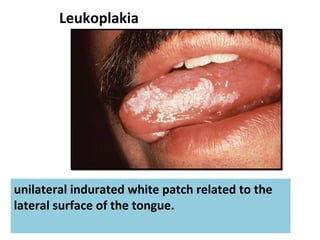
Leukoplakia
unilateral indurated white patch related to the
lateral surface of the tongue.
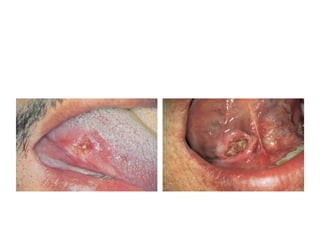
EARLY SQUAMOUS-CELL CARCINOMA
OF THE LATERAL BORDER OF THE
TONGUE
EARLY SQUAMOUS-CELL CARCINOMA
OF THE FLOOR OF THE MOUTH
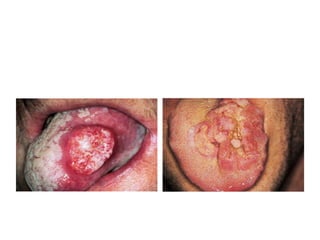
SQUAMOUS-CELL CARCINOMA PRESENTING
AS EXOPHYTIC ULCERATED TUMOR OF THE
LATERAL BORDER OF THE TONGUE.
.
LATE SQUAMOUS-CELL CARCINOMA
ON THE DORSUM OF THE TONGUE.
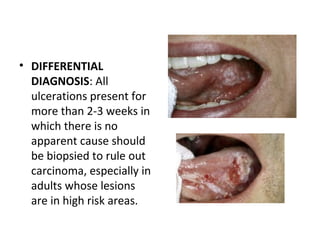
• DIFFERENTIAL
DIAGNOSIS: All
ulcerations present for
more than 2-3 weeks in
which there is no
apparent cause should
be biopsied to rule out
carcinoma, especially in
adults whose lesions
are in high risk areas.
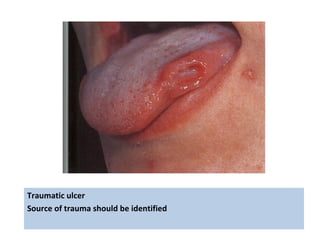
Traumatic ulcer
Source of trauma should be identified
Tongue lecture

Tongue lecture