



Chairperson – Dr. GAYATRI B H
Student – Dr. SUMANT BALGANDI
INTRODUCTION
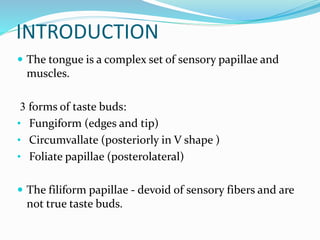
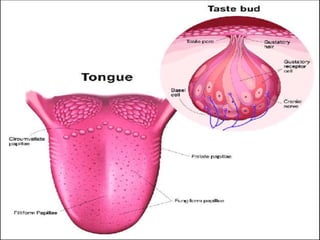
 The tongue is a complex set of sensory papillae and
muscles.
3 forms of taste buds:
• Fungiform (edges and tip)
• Circumvallate (posteriorly in V shape )
• Foliate papillae (posterolateral)
 The filiform papillae - devoid of sensory fibers and are
not true taste buds.
 APPEARANCE AND COLOUR
 SURFACE
 SIZE
 ULCERS
 MOVEMENTS OF TONGUE
 DEVELOPMENTAL ANOMALIES
 MISCELLANEOUS CONDITIONS
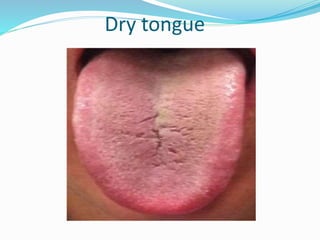
Dry tongue
• Prolonged fever
• Dehydration
• Mouth breathing
• Belladona or atropine effect
• Anxiety state
• Sjogrens syndrome-Bone dry tongue
• Sarcoidosis
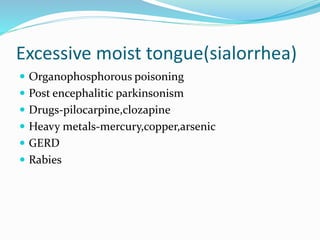
Excessive moist tongue(sialorrhea)
 Organophosphorous poisoning
 Post encephalitic parkinsonism
 Drugs-pilocarpine,clozapine
 Heavy metals-mercury,copper,arsenic
 GERD
 Rabies
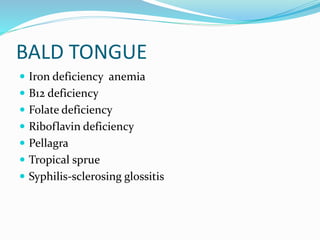
BALD TONGUE
 Iron deficiency anemia
 B12 deficiency
 Folate deficiency
 Riboflavin deficiency
 Pellagra
 Tropical sprue
 Syphilis-sclerosing glossitis
SCARLET RED TONGUE
Niacin deficiency
Irritants – sodium or potassium hydroxide
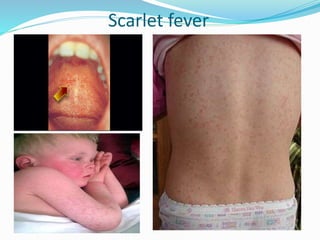
Acute infections like scarlet fever
SCARLET RED TONGUE
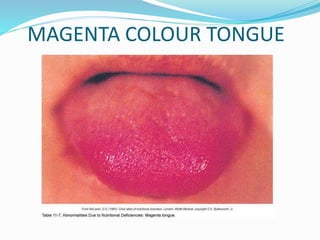
 MAGENTA COLOUR TONGUE
 Riboflavin deficiency
BLUE TONGUE
 Central Cyanosis
 Methhemoglobinemia
 sulphemoglobinemia
YELLOW TONGUE
 Jaundice
 Irritants- nitric or hydrochloric acid
WHITE TONGUE
 Centrally coating
 Leukoplakia
 Irritant substances-mercuric bichloride,carbolic
acid,sulphuric acid
 BROWN TONGUE
• Uremia
• Acute liver necrosis
• PURPLE TONGUE
• polycythemia
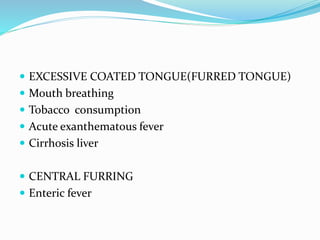
 EXCESSIVE COATED TONGUE(FURRED TONGUE)
 Mouth breathing
 Tobacco consumption
 Acute exanthematous fever
 Cirrhosis liver
 CENTRAL FURRING
 Enteric fever
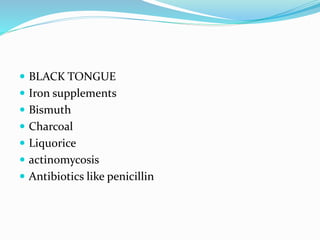
 BLACK TONGUE
 Iron supplements
 Bismuth
 Charcoal
 Liquorice
 actinomycosis
 Antibiotics like penicillin
MAGENTA COLOUR TONGUE
BLUE TONGUE
HAIRY TONGUE(lingua villosa)
• Also called as furred tongue
• Defective desquamation of the filiform papillae leading
to the retention hyperkeratosis.
HAIRY TONGUE
• Poor oral hygiene
• Smokers
• Mouth breathers low fiber diets
• Febrile patients.
• HIV infection
• Radiation treatment to head and neck
• Graft-versus host disease
• Drugs - most common being antibiotics-tetracyclines
atypical antipsychotics
antidepressants
anti-cholinergics.
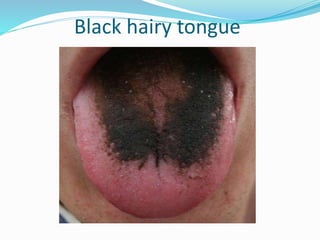
BLACK HAIRY TONGUE
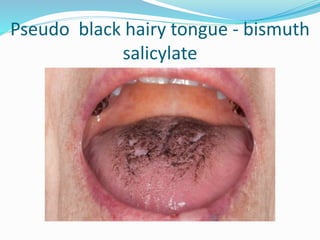
• Black hairy tongue seen as the complication of hairy
tongue
• Occurs when bacteria are trapped in the filiform papillae
and produce pigments causing a brown/black colour.
• The presence of other microbes such as candida, can
exacerbate this condition.
Black hairy tongue
Pseudo black hairy tongue - bismuth
salicylate
DD of Hairy tongue
• Pseudo-hairy black tongue,
• Oral hairy leukoplakia
• Premalignant leukoplakia
• Squamous cell carcinoma
• Acanthosis nigricans
• Hypertrophic herpes simplex virus infections
Workup for hairy tongue
• Unless there are stigmata of underlying disease or
symptoms, such as pain, no additional workup is needed.
• In refractory or atypical cases, a biopsy and cultures or
PCR for bacteria, fungus, and HSV may be warranted.
TREATMENT OF HAIRY TONGUE
• Regular brushing of the tongue using 1.5% hydrogen
peroxide (5 to 10 strokes daily) with a hard toothbrush.
• Topical retinoids, antifungals, and keratolytics.
• Oral therapy with antifungals, antibiotics and antivirals
for refractory cases with positive cultures.
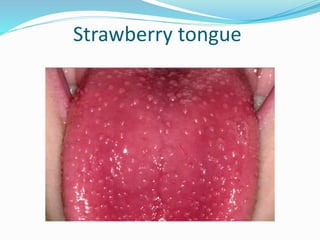
STRAWBERRY TONGUE
 Hypertrophy of fungiform papillae and then
desquamation
 Papillae appear as large red knobs giving the
appearance of stawberry tongue(rasberry tongue)
Seen in
Scarlet fever
Toxic shock syndrome
Kawasaki disease
Strawberry tongue
Scarlet fever
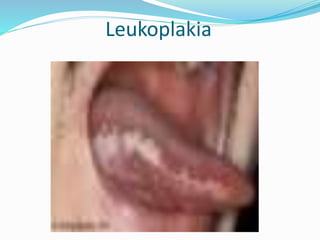
LEUKOPLAKIA
• It is a white patch in the mucosa of oral cavity that cannot
be characterised clinically or pathologically to any other
diseases.
• It is a premalignant condition
• Dysplasia and of dyskeratosis leading to formation of
thick , white and pearly raised plaques giving whitish
appearance of part of tongue.
• Predisposing factors
 Spices, betel nut chewing
 Smoking, tobacco chewing
 Infective or mechanical (dental irritation)
Leukoplakia
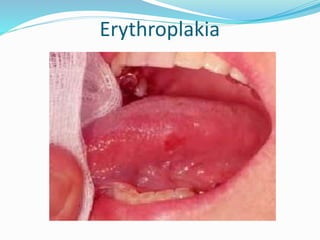
Erythroplakia
ORAL HAIRY LEUKOPLAKIA
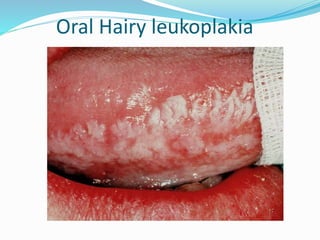
• Seen on lateral margins of tongue as several white areas
• Cannot be wiped off with gauze.
• Immuno-compromised patients-AIDS
• Associated with Epstein Barr virus
Oral Hairy leukoplakia
• It is painless
• Has no malignant potential.
• First line topical treatment includes topical retinoids,
podophyllin, and acyclovir
• The underlying HIV infection should be treated or the
immunosuppressed states should be modified.
PIGMENTATION OF TONGUE
 Dark brown or black patches on tongue
1. Addisons
2. Nelsons syndrome
3. Peutz jeghers
4. Malabsorption
5. Acanthosis nigricans
 YELLOWISH WHITE PATCHES
 Leucoplakia
 xanthelasma
Addison’s disease
Fissured Tongue(scrotal tongue)
• A normal variant seen in up to 20% to 30% of the
population
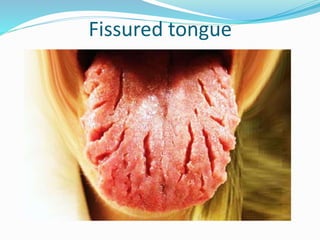
• Characterized by an increased number of fissures and
grooves at the central and lateral aspects of the tongue.
• Very severe fissuring is often referred to as “lingua
plicata.”
Fissured tongue
 Down’s syndrome
 Acromegaly
 Melkersson-Rosenthal syndrome
 Pernicious anemia
 Pachyonychia congenita
 Cowden’s syndrome
 Idiopathic
Fissured tongue
• Treatment
• Good oral hygiene with brushing deep into the fissures
in order to remove debris, lessen the microbial
burden, and reduce halitosis.
• If pain is present- therapy should be targeted at
reducing inflammation or eradication of the
infection.
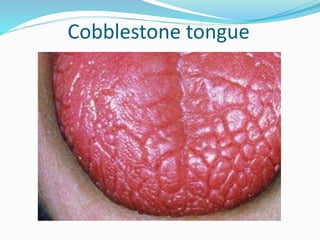
COBBLESTONE TONGUE
Due to hyperemic and hypertrophied papillae with
thickened epithelium
• Ariboflavinosis(with magenta colour)
• Syphilis
CROCODILE SKIN TONGUE
• In Sjogren’s syndrome, there is dorsal papillary
atrophy & furring of the tongue
Cobblestone tongue
SMOKER’S PATCH
• Small, raised, smooth, congested area frequently
covered with a crust on the dorsum of tongue
• White umbilicated papules with a central brown spot
on palatal mucosa
LEPROTIC NODULES
• May develop on anterior 2/3rd of tongue especially
near tip
CORLIN SIGN- Ehler danlos
syndrome
Benign Migratory Glossitis
• = GEOGRAPHIC TONGUE.
• Benign, inflammatory condition
• Prevalence-1 to 2% of the population ,more common in
young patients.
• Etiology-rapid loss and regrowth of filiform papillae
leading to denuded red patches wandering across the
tongue surface.
• It is more common in Psoriasis(14%), and some argue
that it is an oral manifestation of psoriasis
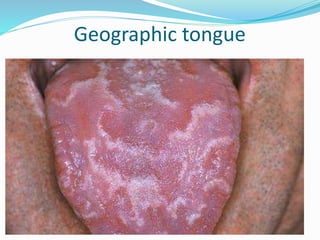
 It is characterized by an annular arrangement of
alternating raised, hyper keratotic plaques and smooth,
atrophic red patches.
 Red- atrophic filiform papillae
 White-hypertophic filiform papillae
 Dynamic and change over time creating a “migratory
pattern”

Geographic tongue
Treatment of geographic tongue
• Generally no treatment required.
• If burning pain or sensitivity to foods present -topical
corticosteroids as well as topical calcineurin inhibitors.
MEDIAN RHOMBOID GLOSSITIS
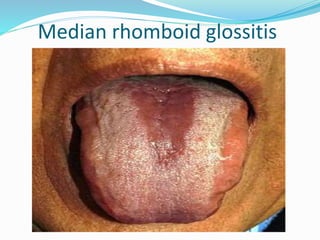
• Red depapillated area in the centre of dorsum of
tongue
• Believed to be associated with candidiasis and a
marker of underlying immunosuppression.
• Biopsy may show pseudo-epitheliomatous hyperplasia
• Responds to antifungal treatment
Median rhomboid glossitis
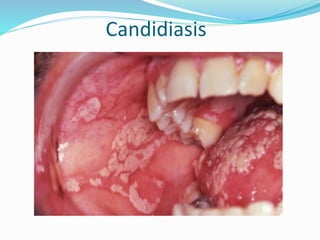
Oral candidiasis
 Creamy white curdlike patches that reveal a raw, bleeding
surface when scraped.
• Debilitated elderly patients
• High-dose glucocorticoids, broad-spectrum antibiotics
• Patients with AIDS
Candidiasis
MACROGLOSSIA
• Acromegaly
• Hypothyroidism
• Cretinism
• Down’s syndrome
• Hurler’s syndrome
• Mucopolysaccharidosis
• Beckwith–Wiedemann syndrome
• Amyloidosis
• Glycogen storage disease
• Angio edema
• Acute inflammation of tongue/abscess
• Haemangioma,lymphangioma
Macroglossia
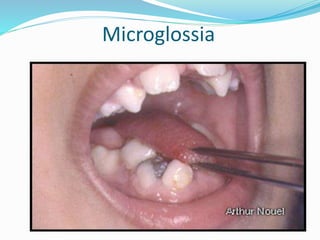
MICROGLOSSIA
• Starvation
• Atrophic glossitis
• Motor neuron disease
• Pseudobulbar palsy
• Cerebral diplegia
Microglossia
SINGLE ULCER
• Carcinomatous
• TB
• Syphilitic
• Ill fitted dentures
• Aphthous ulcer
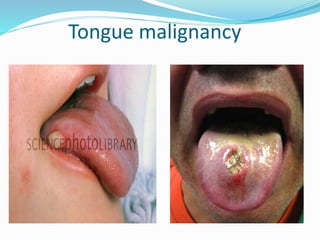
CARCINOMATOUS ULCER
• Usually single
• Common on side or tip of tongue
• Hard, indurated
• Irregular ,deep, raised everted margins
• Associated with slough
• Impaired mobility of tongue
• Regional lymphnode enlargement
Tongue malignancy
TUBERCULOUS ULCER
• Usually at or near tip
• Painful
• Small with a granulated base
• Thin undermined edges
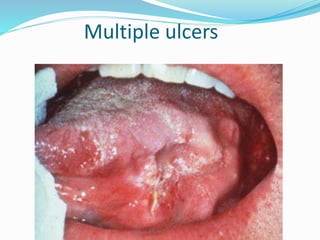
MULTIPLE ULCERS
• Dyspepsia
• Ulcerative stomatitis
• Secondary syphilis
• Herpes
• Chickenpox
• Eczema
• Vit B complex deficiency
Multiple ulcers
RECURRENT ULCERS
• Aphthous ulcer
• Lichen planus, pemphigus, eythema multiforme
• SLE
• Behcet’s syndrome (mouth ulcers, genital ulcers,
uveitis)
TREMOR
• Parkisonson disease
• Delirium tremens
• Thyrotoxicosis
• Anxiety neurosis
 LIZARD TONGUE(Jack-in-box tongue)
• chorea
 CHEWING TONGUE
• Athetosis
 FASCICULATION
• Motor neuron diseases
• Syringobulbia
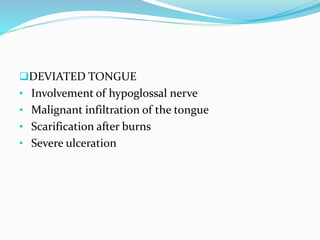
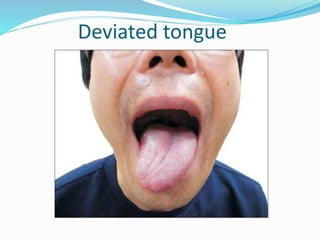
DEVIATED TONGUE
• Involvement of hypoglossal nerve
• Malignant infiltration of the tongue
• Scarification after burns
• Severe ulceration
Deviated tongue
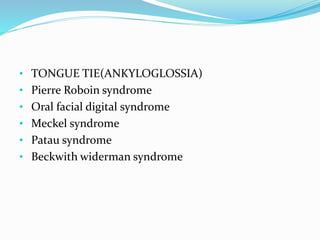
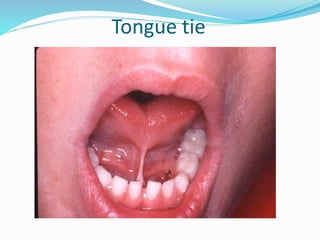
• TONGUE TIE(ANKYLOGLOSSIA)
• Pierre Roboin syndrome
• Oral facial digital syndrome
• Meckel syndrome
• Patau syndrome
• Beckwith widerman syndrome
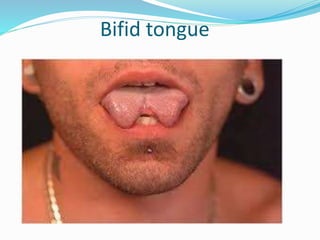
BIFID OR TRIFID TONGUE
• Orofacialdigital syndrome
• Klippel feil anomaly
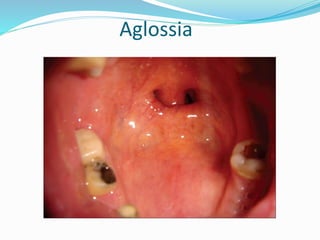
• AGLOSSIA
• Pierre robin syndrome
• Moebius syndrome
• Aglossia adactyly syndrome
Aglossia
Bifid tongue
Tongue tie
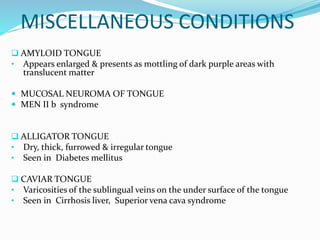
MISCELLANEOUS CONDITIONS
 AMYLOID TONGUE
• Appears enlarged & presents as mottling of dark purple areas with
translucent matter
 MUCOSAL NEUROMA OF TONGUE
 MEN II b syndrome
 ALLIGATOR TONGUE
• Dry, thick, furrowed & irregular tongue
• Seen in Diabetes mellitus
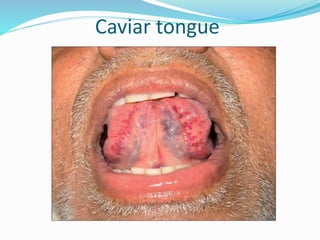
 CAVIAR TONGUE
• Varicosities of the sublingual veins on the under surface of the tongue
• Seen in Cirrhosis liver, Superior vena cava syndrome
Caviar tongue
REFRENCES
• A text book of symptoms and physical diagnosis. ASPI F
GOLWALLA - 5TH Edition
• HARRISON’S Principles of Internal Medicine - 20th
edition
• DAVIDSON principles and practice of medicine - 23rd
edition
• Manual of Practical medicine by R.Alagappan 4th edition
• SRB’s manual of surgery 4th edition
• Mangold Aaron R., Torgerson Rochelle R., Rogers Roy S.,
Diseases of the Tongue, Clinics in Dermatology (2016)
• Internet
Tongue and systemic diseases

Tongue and systemic diseases

  • 1.
    Chairperson – Dr.GAYATRI B H Student – Dr. SUMANT BALGANDI
  • 2.
    INTRODUCTION  The tongueis a complex set of sensory papillae and muscles. 3 forms of taste buds: • Fungiform (edges and tip) • Circumvallate (posteriorly in V shape ) • Foliate papillae (posterolateral)  The filiform papillae - devoid of sensory fibers and are not true taste buds.
  • 4.
     APPEARANCE ANDCOLOUR  SURFACE  SIZE  ULCERS  MOVEMENTS OF TONGUE  DEVELOPMENTAL ANOMALIES  MISCELLANEOUS CONDITIONS
  • 6.
  • 7.
    • Prolonged fever •Dehydration • Mouth breathing • Belladona or atropine effect • Anxiety state • Sjogrens syndrome-Bone dry tongue • Sarcoidosis
  • 8.
    Excessive moist tongue(sialorrhea) Organophosphorous poisoning  Post encephalitic parkinsonism  Drugs-pilocarpine,clozapine  Heavy metals-mercury,copper,arsenic  GERD  Rabies
  • 9.
    BALD TONGUE  Irondeficiency anemia  B12 deficiency  Folate deficiency  Riboflavin deficiency  Pellagra  Tropical sprue  Syphilis-sclerosing glossitis
  • 10.
    SCARLET RED TONGUE Niacindeficiency Irritants – sodium or potassium hydroxide Acute infections like scarlet fever
  • 11.
  • 12.
     MAGENTA COLOURTONGUE  Riboflavin deficiency BLUE TONGUE  Central Cyanosis  Methhemoglobinemia  sulphemoglobinemia YELLOW TONGUE  Jaundice  Irritants- nitric or hydrochloric acid
  • 13.
    WHITE TONGUE  Centrallycoating  Leukoplakia  Irritant substances-mercuric bichloride,carbolic acid,sulphuric acid  BROWN TONGUE • Uremia • Acute liver necrosis • PURPLE TONGUE • polycythemia
  • 14.
     EXCESSIVE COATEDTONGUE(FURRED TONGUE)  Mouth breathing  Tobacco consumption  Acute exanthematous fever  Cirrhosis liver  CENTRAL FURRING  Enteric fever
  • 15.
     BLACK TONGUE Iron supplements  Bismuth  Charcoal  Liquorice  actinomycosis  Antibiotics like penicillin
  • 16.
  • 17.
  • 18.
    HAIRY TONGUE(lingua villosa) •Also called as furred tongue • Defective desquamation of the filiform papillae leading to the retention hyperkeratosis.
  • 19.
    HAIRY TONGUE • Poororal hygiene • Smokers • Mouth breathers low fiber diets • Febrile patients. • HIV infection • Radiation treatment to head and neck • Graft-versus host disease • Drugs - most common being antibiotics-tetracyclines atypical antipsychotics antidepressants anti-cholinergics.
  • 20.
    BLACK HAIRY TONGUE •Black hairy tongue seen as the complication of hairy tongue • Occurs when bacteria are trapped in the filiform papillae and produce pigments causing a brown/black colour. • The presence of other microbes such as candida, can exacerbate this condition.
  • 21.
  • 22.
    Pseudo black hairytongue - bismuth salicylate
  • 23.
    DD of Hairytongue • Pseudo-hairy black tongue, • Oral hairy leukoplakia • Premalignant leukoplakia • Squamous cell carcinoma • Acanthosis nigricans • Hypertrophic herpes simplex virus infections
  • 24.
    Workup for hairytongue • Unless there are stigmata of underlying disease or symptoms, such as pain, no additional workup is needed. • In refractory or atypical cases, a biopsy and cultures or PCR for bacteria, fungus, and HSV may be warranted.
  • 25.
    TREATMENT OF HAIRYTONGUE • Regular brushing of the tongue using 1.5% hydrogen peroxide (5 to 10 strokes daily) with a hard toothbrush. • Topical retinoids, antifungals, and keratolytics. • Oral therapy with antifungals, antibiotics and antivirals for refractory cases with positive cultures.
  • 26.
    STRAWBERRY TONGUE  Hypertrophyof fungiform papillae and then desquamation  Papillae appear as large red knobs giving the appearance of stawberry tongue(rasberry tongue) Seen in Scarlet fever Toxic shock syndrome Kawasaki disease
  • 27.
  • 28.
  • 29.
    LEUKOPLAKIA • It isa white patch in the mucosa of oral cavity that cannot be characterised clinically or pathologically to any other diseases. • It is a premalignant condition • Dysplasia and of dyskeratosis leading to formation of thick , white and pearly raised plaques giving whitish appearance of part of tongue. • Predisposing factors  Spices, betel nut chewing  Smoking, tobacco chewing  Infective or mechanical (dental irritation)
  • 30.
  • 31.
  • 32.
    ORAL HAIRY LEUKOPLAKIA •Seen on lateral margins of tongue as several white areas • Cannot be wiped off with gauze. • Immuno-compromised patients-AIDS • Associated with Epstein Barr virus
  • 33.
  • 34.
    • It ispainless • Has no malignant potential. • First line topical treatment includes topical retinoids, podophyllin, and acyclovir • The underlying HIV infection should be treated or the immunosuppressed states should be modified.
  • 35.
    PIGMENTATION OF TONGUE Dark brown or black patches on tongue 1. Addisons 2. Nelsons syndrome 3. Peutz jeghers 4. Malabsorption 5. Acanthosis nigricans
  • 36.
     YELLOWISH WHITEPATCHES  Leucoplakia  xanthelasma
  • 37.
  • 39.
    Fissured Tongue(scrotal tongue) •A normal variant seen in up to 20% to 30% of the population • Characterized by an increased number of fissures and grooves at the central and lateral aspects of the tongue. • Very severe fissuring is often referred to as “lingua plicata.”
  • 40.
    Fissured tongue  Down’ssyndrome  Acromegaly  Melkersson-Rosenthal syndrome  Pernicious anemia  Pachyonychia congenita  Cowden’s syndrome  Idiopathic
  • 41.
  • 42.
    • Treatment • Goodoral hygiene with brushing deep into the fissures in order to remove debris, lessen the microbial burden, and reduce halitosis. • If pain is present- therapy should be targeted at reducing inflammation or eradication of the infection.
  • 43.
    COBBLESTONE TONGUE Due tohyperemic and hypertrophied papillae with thickened epithelium • Ariboflavinosis(with magenta colour) • Syphilis CROCODILE SKIN TONGUE • In Sjogren’s syndrome, there is dorsal papillary atrophy & furring of the tongue
  • 44.
  • 45.
    SMOKER’S PATCH • Small,raised, smooth, congested area frequently covered with a crust on the dorsum of tongue • White umbilicated papules with a central brown spot on palatal mucosa LEPROTIC NODULES • May develop on anterior 2/3rd of tongue especially near tip
  • 46.
    CORLIN SIGN- Ehlerdanlos syndrome
  • 47.
    Benign Migratory Glossitis •= GEOGRAPHIC TONGUE. • Benign, inflammatory condition • Prevalence-1 to 2% of the population ,more common in young patients. • Etiology-rapid loss and regrowth of filiform papillae leading to denuded red patches wandering across the tongue surface. • It is more common in Psoriasis(14%), and some argue that it is an oral manifestation of psoriasis
  • 48.
     It ischaracterized by an annular arrangement of alternating raised, hyper keratotic plaques and smooth, atrophic red patches.  Red- atrophic filiform papillae  White-hypertophic filiform papillae  Dynamic and change over time creating a “migratory pattern” 
  • 49.
  • 50.
    Treatment of geographictongue • Generally no treatment required. • If burning pain or sensitivity to foods present -topical corticosteroids as well as topical calcineurin inhibitors.
  • 51.
    MEDIAN RHOMBOID GLOSSITIS •Red depapillated area in the centre of dorsum of tongue • Believed to be associated with candidiasis and a marker of underlying immunosuppression. • Biopsy may show pseudo-epitheliomatous hyperplasia • Responds to antifungal treatment
  • 52.
  • 53.
    Oral candidiasis  Creamywhite curdlike patches that reveal a raw, bleeding surface when scraped. • Debilitated elderly patients • High-dose glucocorticoids, broad-spectrum antibiotics • Patients with AIDS
  • 54.
  • 56.
    MACROGLOSSIA • Acromegaly • Hypothyroidism •Cretinism • Down’s syndrome • Hurler’s syndrome • Mucopolysaccharidosis • Beckwith–Wiedemann syndrome • Amyloidosis • Glycogen storage disease • Angio edema • Acute inflammation of tongue/abscess • Haemangioma,lymphangioma
  • 57.
  • 58.
    MICROGLOSSIA • Starvation • Atrophicglossitis • Motor neuron disease • Pseudobulbar palsy • Cerebral diplegia
  • 59.
  • 61.
    SINGLE ULCER • Carcinomatous •TB • Syphilitic • Ill fitted dentures • Aphthous ulcer
  • 62.
    CARCINOMATOUS ULCER • Usuallysingle • Common on side or tip of tongue • Hard, indurated • Irregular ,deep, raised everted margins • Associated with slough • Impaired mobility of tongue • Regional lymphnode enlargement
  • 63.
  • 64.
    TUBERCULOUS ULCER • Usuallyat or near tip • Painful • Small with a granulated base • Thin undermined edges
  • 65.
    MULTIPLE ULCERS • Dyspepsia •Ulcerative stomatitis • Secondary syphilis • Herpes • Chickenpox • Eczema • Vit B complex deficiency
  • 66.
  • 67.
    RECURRENT ULCERS • Aphthousulcer • Lichen planus, pemphigus, eythema multiforme • SLE • Behcet’s syndrome (mouth ulcers, genital ulcers, uveitis)
  • 69.
    TREMOR • Parkisonson disease •Delirium tremens • Thyrotoxicosis • Anxiety neurosis
  • 70.
     LIZARD TONGUE(Jack-in-boxtongue) • chorea  CHEWING TONGUE • Athetosis  FASCICULATION • Motor neuron diseases • Syringobulbia
  • 71.
    DEVIATED TONGUE • Involvementof hypoglossal nerve • Malignant infiltration of the tongue • Scarification after burns • Severe ulceration
  • 72.
  • 74.
    • TONGUE TIE(ANKYLOGLOSSIA) •Pierre Roboin syndrome • Oral facial digital syndrome • Meckel syndrome • Patau syndrome • Beckwith widerman syndrome
  • 75.
    BIFID OR TRIFIDTONGUE • Orofacialdigital syndrome • Klippel feil anomaly • AGLOSSIA • Pierre robin syndrome • Moebius syndrome • Aglossia adactyly syndrome
  • 76.
  • 77.
  • 78.
  • 79.
    MISCELLANEOUS CONDITIONS  AMYLOIDTONGUE • Appears enlarged & presents as mottling of dark purple areas with translucent matter  MUCOSAL NEUROMA OF TONGUE  MEN II b syndrome  ALLIGATOR TONGUE • Dry, thick, furrowed & irregular tongue • Seen in Diabetes mellitus  CAVIAR TONGUE • Varicosities of the sublingual veins on the under surface of the tongue • Seen in Cirrhosis liver, Superior vena cava syndrome
  • 80.
  • 81.
    REFRENCES • A textbook of symptoms and physical diagnosis. ASPI F GOLWALLA - 5TH Edition • HARRISON’S Principles of Internal Medicine - 20th edition • DAVIDSON principles and practice of medicine - 23rd edition • Manual of Practical medicine by R.Alagappan 4th edition • SRB’s manual of surgery 4th edition • Mangold Aaron R., Torgerson Rochelle R., Rogers Roy S., Diseases of the Tongue, Clinics in Dermatology (2016) • Internet

Editor's Notes

  • #19 Normal papillae are 1 mm in length; however, in HT there is defective desquamation of cells in the central column of the filiform papillae, causing an increase in length 10 to 20 times normal