


MATRICING
DEFINITION
• Matricing is the procedure whereby a
temporary wall is created opposite to axial
walls, surrounding areas of tooth structure
that were lost during preparation.
»PARTS OF MATRIX
• Band
• Retainer
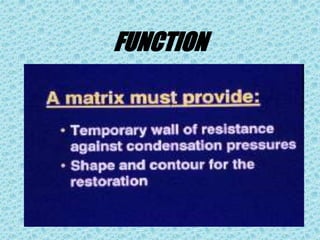
FUNCTION
FUNCTION
•To restore anatomic contours and contact areas
Qualities of a good matrix
•Rigidity
•Establishment of proper anatomic contour
•Restoration of correct proximal contact relation
•Prevention of gingival excess
•Convenient application & ease of removal
TYPES OF MATRICES
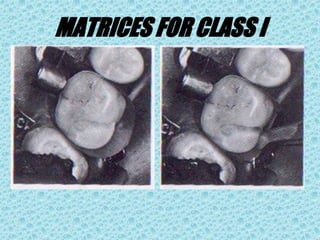
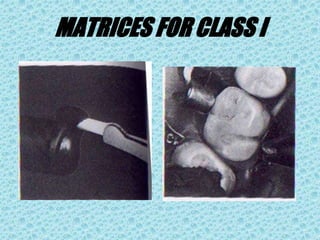
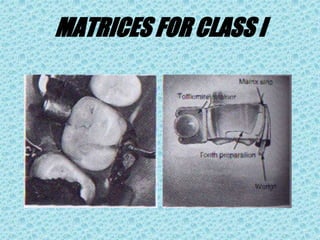
MATRICES FOR CLASS I
• Ivory matrix band
no.8
MATRICES FOR CLASS I
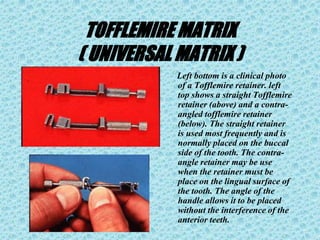
TOFFLEMIRE MATRIX
( UNIVERSAL MATRIX )
Left bottom is a clinical photo
of a Tofflemire retainer. left
top shows a straight Tofflemire
retainer (above) and a contra-
angled tofflemire retainer
(below). The straight retainer
is used most frequently and is
normally placed on the buccal
side of the tooth. The contra-
angle retainer may be use
when the retainer must be
place on the lingual surface of
the tooth. The angle of the
handle allows it to be placed
without the interference of the
anterior teeth.
TOFFLEMIRE MATRIX
( UNIVERSAL MATRIX )
TYPES
[1] Straight: placed
buccaly
[2] Contra angled: can
also be placed lingually
TOFFLEMIRE MATRIX
( UNIVERSAL MATRIX )
• INDICATION
[1] MOD preparation
filling of posterior
teeth
[2] Also for MO or DO
class II restoration
TOFFLEMIRE MATRIX
( UNIVERSAL MATRIX )
• Advantage
[1] The retainer and band
are stable when in
place
[2] Easy seperation of
retainer from band
which makes easy
removal of band
[3]Less time required for
placement
[4]Help to hold the cotton roll
in place
Disadvantages
[1] Proximal surfaces restored using
the tofflemire matrix requir more
carving than those restored with the
compound supported matrix.
[2] Contouring of matrix band is
required.
TOFFLEMIRE MATRIX
( UNIVERSAL MATRIX )
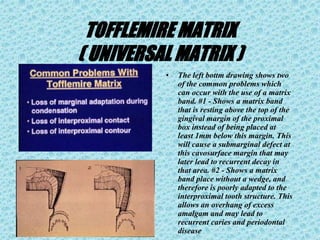
• The left bottm drawing shows two
of the common problems which
can occur with the use of a matrix
band. #1 - Shows a matrix band
that is resting above the top of the
gingival margin of the proximal
box instead of being placed at
least 1mm below this margin. This
will cause a submarginal defect at
this cavosurface margin that may
later lead to recurrent decay in
that area. #2 - Shows a matrix
band place without a wedge, and
therefore is poorly adapted to the
interproximal tooth structure. This
allows an overhang of excess
amalgam and may lead to
recurrent caries and periodontal
disease
TOFFLEMIRE MATRIX
( UNIVERSAL MATRIX )
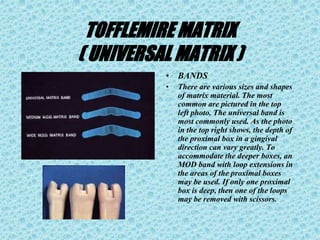
• BANDS
• There are various sizes and shapes
of matrix material. The most
common are pictured in the top
left photo. The universal band is
most commonly used. As the photo
in the top right shows, the depth of
the proximal box in a gingival
direction can vary greatly. To
accommodate the deeper boxes, an
MOD band with loop extensions in
the areas of the proximal boxes
may be used. If only one proximal
box is deep, then one of the loops
may be removed with scissors.
TOFFLEMIRE MATRIX
( UNIVERSAL MATRIX )
• PARTS
[1] HEAD
[2] SLIDING
BODY(SLOTED
VICE)
[3] ROTATING
SPINDLE(
[4] SET SCREW
TOFFLEMIRE MATRIX
( UNIVERSAL MATRIX )
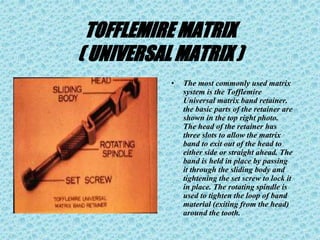
• The most commonly used matrix
system is the Tofflemire
Universal matrix band retainer.
the basic parts of the retainer are
shown in the top right photo.
The head of the retainer has
three slots to allow the matrix
band to exit out of the head to
either side or straight ahead. The
band is held in place by passing
it through the sliding body and
tightening the set screw to lock it
in place. The rotating spindle is
used to tighten the loop of band
material (exiting from the head)
around the tooth.
TOFFLEMIRE MATRIX
TECHNIQUE
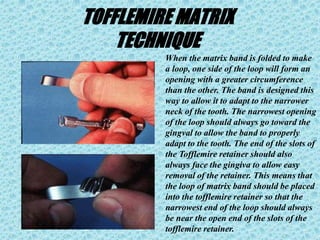
When the matrix band is folded to make
a loop, one side of the loop will form an
opening with a greater circumference
than the other. The band is designed this
way to allow it to adapt to the narrower
neck of the tooth. The narrowest opening
of the loop should always go toward the
gingval to allow the band to properly
adapt to the tooth. The end of the slots of
the Tofflemire retainer should also
always face the gingiva to allow easy
removal of the retainer. This means that
the loop of matrix band should be placed
into the tofflemire retainer so that the
narrowest end of the loop should always
be near the open end of the slots of the
tofflemire retainer.
TOFFLEMIRE MATRIX
TECHNIQUE
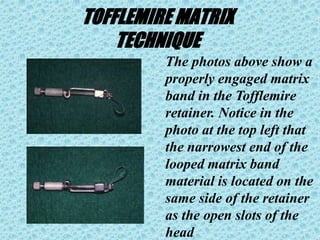
The photos above show a
properly engaged matrix
band in the Tofflemire
retainer. Notice in the
photo at the top left that
the narrowest end of the
looped matrix band
material is located on the
same side of the retainer
as the open slots of the
head
TOFFLEMIRE MATRIX
TECHNIQUE
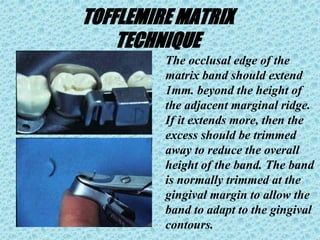
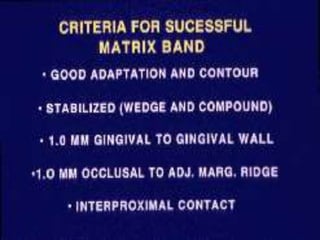
The occlusal edge of the
matrix band should extend
1mm. beyond the height of
the adjacent marginal ridge.
If it extends more, then the
excess should be trimmed
away to reduce the overall
height of the band. The band
is normally trimmed at the
gingival margin to allow the
band to adapt to the gingival
contours.
TOFFLEMIRE MATRIX
TECHNIQUE
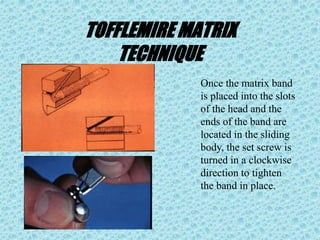
Once the matrix band
is placed into the slots
of the head and the
ends of the band are
located in the sliding
body, the set screw is
turned in a clockwise
direction to tighten
the band in place.
MATRICES FOR CLASS II
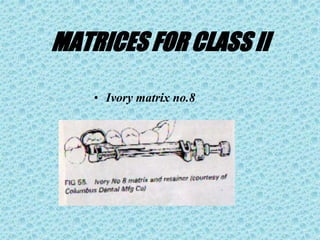
• Ivory matrix no.8
MATRICES FOR CLASS II
• Ivory matrix no.1
MATRICES FOR CLASS II
• Black’s matrices
[1] For simple cases
[2] With a gingival
extension to cover the
gingival margin of
subgingival cavity
MATRICES FOR CLASS II
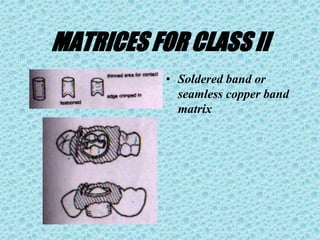
• Soldered band or
seamless copper band
matrix
MATRICES FOR CLASS II
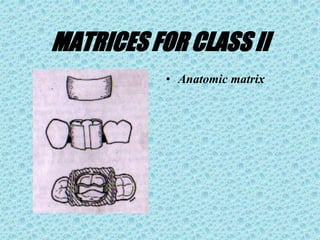
• Anatomic matrix
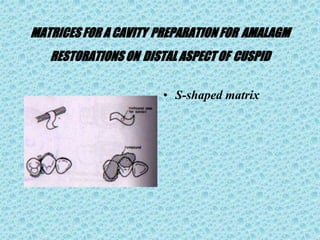
MATRICES FOR A CAVITY PREPARATION FOR AMALAGM
RESTORATIONS ON DISTAL ASPECT OF CUSPID
• S-shaped matrix
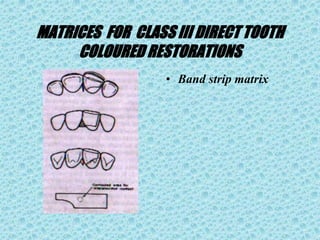
MATRICES FOR CLASS III DIRECT TOOTH
COLOURED RESTORATIONS
• Band strip matrix
MATRICES FOR CLASS III DIRECT TOOTH
COLOURED RESTORATIONS
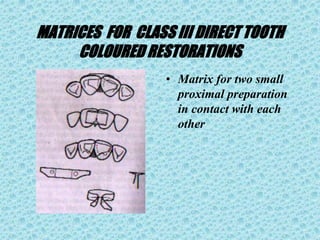
• Matrix for two small
proximal preparation
in contact with each
other
MATRICES FOR CLASS IV PREPARATIONS
FOR DIRECT TOOTH COLORED MATERIALS
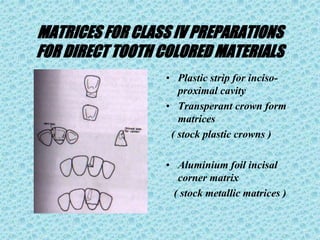
• Plastic strip for inciso-
proximal cavity
• Transperant crown form
matrices
( stock plastic crowns )
• Aluminium foil incisal
corner matrix
( stock metallic matrices )
MATRICES FOR CLASS V PREPARATIONS
FOR DIRECT TOOTH COLOURED MATERIALS
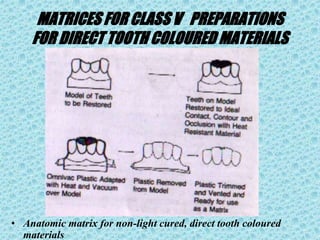
• Anatomic matrix for non-light cured, direct tooth coloured
materials
MATRICES FOR CLASS V PREPARATIONS
FOR DIRECT TOOTH COLOURED MATERIALS
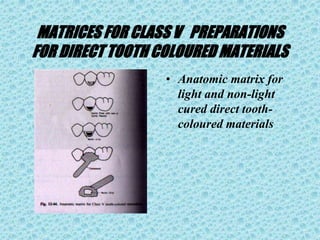
• Anatomic matrix for
light and non-light
cured direct tooth-
coloured materials
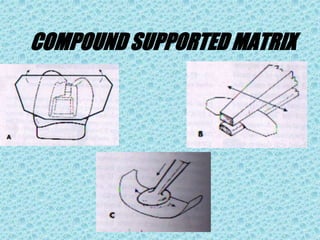
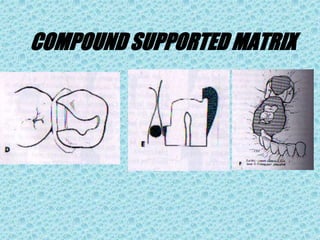
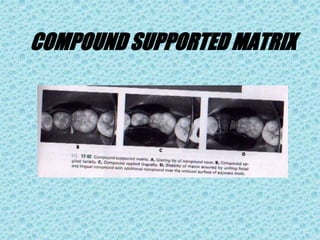
COMPOUND SUPPORTED MATRIX
AUTOMATRIX
• It is a retainerless matrix
system with four types of
bands that are designed
to fit all teeth, regardless
of circumference.
• TYPES
(1) Narrow regular
(2) Wide regular
(3) Medium thin
(4) medium regular
AUTOMATRIX
• DIMENSION
Height: 4.7 to 7.9 mm
Thickness:
[1] 0.038mm
[2] 0.050mm
• INDICATION
Extensive class II
preparation, especially
those replacing two or
more cusps.
AUTOMATRIX
• ADVANTAGES
Auto-lock loop can be
positioned either on the facial
or lingual surfaces with ease.
• DISADVANTAGE
Bands are not pre
contoured and
development of
physiological proximal
contours is difficult
THANK YOU

Matricing

  • 1.
  • 2.
    DEFINITION • Matricing isthe procedure whereby a temporary wall is created opposite to axial walls, surrounding areas of tooth structure that were lost during preparation. »PARTS OF MATRIX • Band • Retainer
  • 3.
  • 4.
    FUNCTION •To restore anatomiccontours and contact areas Qualities of a good matrix •Rigidity •Establishment of proper anatomic contour •Restoration of correct proximal contact relation •Prevention of gingival excess •Convenient application & ease of removal
  • 6.
  • 7.
    MATRICES FOR CLASSI • Ivory matrix band no.8
  • 8.
  • 9.
  • 10.
  • 11.
    TOFFLEMIRE MATRIX ( UNIVERSALMATRIX ) Left bottom is a clinical photo of a Tofflemire retainer. left top shows a straight Tofflemire retainer (above) and a contra- angled tofflemire retainer (below). The straight retainer is used most frequently and is normally placed on the buccal side of the tooth. The contra- angle retainer may be use when the retainer must be place on the lingual surface of the tooth. The angle of the handle allows it to be placed without the interference of the anterior teeth.
  • 12.
    TOFFLEMIRE MATRIX ( UNIVERSALMATRIX ) TYPES [1] Straight: placed buccaly [2] Contra angled: can also be placed lingually
  • 13.
    TOFFLEMIRE MATRIX ( UNIVERSALMATRIX ) • INDICATION [1] MOD preparation filling of posterior teeth [2] Also for MO or DO class II restoration
  • 14.
    TOFFLEMIRE MATRIX ( UNIVERSALMATRIX ) • Advantage [1] The retainer and band are stable when in place [2] Easy seperation of retainer from band which makes easy removal of band [3]Less time required for placement [4]Help to hold the cotton roll in place Disadvantages [1] Proximal surfaces restored using the tofflemire matrix requir more carving than those restored with the compound supported matrix. [2] Contouring of matrix band is required.
  • 15.
    TOFFLEMIRE MATRIX ( UNIVERSALMATRIX ) • The left bottm drawing shows two of the common problems which can occur with the use of a matrix band. #1 - Shows a matrix band that is resting above the top of the gingival margin of the proximal box instead of being placed at least 1mm below this margin. This will cause a submarginal defect at this cavosurface margin that may later lead to recurrent decay in that area. #2 - Shows a matrix band place without a wedge, and therefore is poorly adapted to the interproximal tooth structure. This allows an overhang of excess amalgam and may lead to recurrent caries and periodontal disease
  • 16.
    TOFFLEMIRE MATRIX ( UNIVERSALMATRIX ) • BANDS • There are various sizes and shapes of matrix material. The most common are pictured in the top left photo. The universal band is most commonly used. As the photo in the top right shows, the depth of the proximal box in a gingival direction can vary greatly. To accommodate the deeper boxes, an MOD band with loop extensions in the areas of the proximal boxes may be used. If only one proximal box is deep, then one of the loops may be removed with scissors.
  • 17.
    TOFFLEMIRE MATRIX ( UNIVERSALMATRIX ) • PARTS [1] HEAD [2] SLIDING BODY(SLOTED VICE) [3] ROTATING SPINDLE( [4] SET SCREW
  • 18.
    TOFFLEMIRE MATRIX ( UNIVERSALMATRIX ) • The most commonly used matrix system is the Tofflemire Universal matrix band retainer. the basic parts of the retainer are shown in the top right photo. The head of the retainer has three slots to allow the matrix band to exit out of the head to either side or straight ahead. The band is held in place by passing it through the sliding body and tightening the set screw to lock it in place. The rotating spindle is used to tighten the loop of band material (exiting from the head) around the tooth.
  • 19.
    TOFFLEMIRE MATRIX TECHNIQUE When thematrix band is folded to make a loop, one side of the loop will form an opening with a greater circumference than the other. The band is designed this way to allow it to adapt to the narrower neck of the tooth. The narrowest opening of the loop should always go toward the gingval to allow the band to properly adapt to the tooth. The end of the slots of the Tofflemire retainer should also always face the gingiva to allow easy removal of the retainer. This means that the loop of matrix band should be placed into the tofflemire retainer so that the narrowest end of the loop should always be near the open end of the slots of the tofflemire retainer.
  • 20.
    TOFFLEMIRE MATRIX TECHNIQUE The photosabove show a properly engaged matrix band in the Tofflemire retainer. Notice in the photo at the top left that the narrowest end of the looped matrix band material is located on the same side of the retainer as the open slots of the head
  • 21.
    TOFFLEMIRE MATRIX TECHNIQUE The occlusaledge of the matrix band should extend 1mm. beyond the height of the adjacent marginal ridge. If it extends more, then the excess should be trimmed away to reduce the overall height of the band. The band is normally trimmed at the gingival margin to allow the band to adapt to the gingival contours.
  • 22.
    TOFFLEMIRE MATRIX TECHNIQUE Once thematrix band is placed into the slots of the head and the ends of the band are located in the sliding body, the set screw is turned in a clockwise direction to tighten the band in place.
  • 23.
    MATRICES FOR CLASSII • Ivory matrix no.8
  • 24.
    MATRICES FOR CLASSII • Ivory matrix no.1
  • 25.
    MATRICES FOR CLASSII • Black’s matrices [1] For simple cases [2] With a gingival extension to cover the gingival margin of subgingival cavity
  • 26.
    MATRICES FOR CLASSII • Soldered band or seamless copper band matrix
  • 27.
    MATRICES FOR CLASSII • Anatomic matrix
  • 28.
    MATRICES FOR ACAVITY PREPARATION FOR AMALAGM RESTORATIONS ON DISTAL ASPECT OF CUSPID • S-shaped matrix
  • 29.
    MATRICES FOR CLASSIII DIRECT TOOTH COLOURED RESTORATIONS • Band strip matrix
  • 30.
    MATRICES FOR CLASSIII DIRECT TOOTH COLOURED RESTORATIONS • Matrix for two small proximal preparation in contact with each other
  • 31.
    MATRICES FOR CLASSIV PREPARATIONS FOR DIRECT TOOTH COLORED MATERIALS • Plastic strip for inciso- proximal cavity • Transperant crown form matrices ( stock plastic crowns ) • Aluminium foil incisal corner matrix ( stock metallic matrices )
  • 32.
    MATRICES FOR CLASSV PREPARATIONS FOR DIRECT TOOTH COLOURED MATERIALS • Anatomic matrix for non-light cured, direct tooth coloured materials
  • 33.
    MATRICES FOR CLASSV PREPARATIONS FOR DIRECT TOOTH COLOURED MATERIALS • Anatomic matrix for light and non-light cured direct tooth- coloured materials
  • 34.
  • 35.
  • 36.
  • 37.
    AUTOMATRIX • It isa retainerless matrix system with four types of bands that are designed to fit all teeth, regardless of circumference. • TYPES (1) Narrow regular (2) Wide regular (3) Medium thin (4) medium regular
  • 38.
    AUTOMATRIX • DIMENSION Height: 4.7to 7.9 mm Thickness: [1] 0.038mm [2] 0.050mm • INDICATION Extensive class II preparation, especially those replacing two or more cusps.
  • 39.
    AUTOMATRIX • ADVANTAGES Auto-lock loopcan be positioned either on the facial or lingual surfaces with ease. • DISADVANTAGE Bands are not pre contoured and development of physiological proximal contours is difficult
  • 40.