MERCURY HAZARDS
AND
TOXICITY
Under the guidance of :
Dept of conservative dentistry and endodontics
NORTH BENGAL DENTAL COLLEGE AND HOSPITAL
INTRODUCTION
• Mercury is a known toxic , bio accumulative
substance and it often finds its way into body
through dental amalgams, which is used to
restore cavitated tooth.
• The mercury release in body and negatively
affect brain, nervous system, kidney etc.
 The silver fillings used by dentists to restore teeth are composed of a
metal "amalgam" containing roughly 50% elemental mercury and 50%
other metals (mostly silver with some tin and copper).
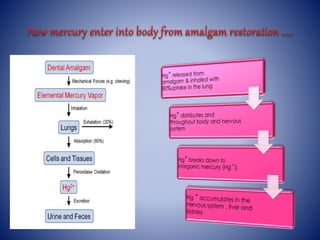
 The mercury found in amalgam fillings has raised some safety
concerns over the years. Amalgam can release small amounts of
mercury vapor over time, and patients can absorb these vapors by
inhaling or ingesting them.
 Dentists all over the world remove millions of amalgam fillings every
day, with no regard for the possible mercury exposure that can result
from grinding them out.
 Taking out fillings with a high speed dental bur generates a cloud of
particles, at least 65% of which are one micron or less in size. These
are fully respirable, get deep into the lungs, where the microscopic
particles are broken down and the mercury is systemically absorbed
within a few days.
MERCURY EXPOSURE IN DENTAL OFFICE
Mercury exposure in dental office can occur-
 When Amalgam raw material being stored in use.
 During trituration , insertion & intraoral hardening.
 From amalgam scrap.
 During finishing & polishing.
 Removal of old restoration.
 Amount of exposure.
 Length of exposure.
 Length of mercury accumulation in body.
 Amount of accumulated mercury
 Overall health of the patient ( for detoxification).
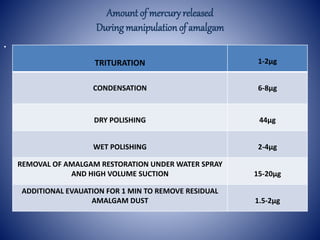
Amount of mercury released
During manipulationof amalgam
TRITURATION 1-2µg
CONDENSATION 6-8µg
DRY POLISHING 44µg
WET POLISHING 2-4µg
REMOVAL OF AMALGAM RESTORATION UNDER WATER SPRAY
AND HIGH VOLUME SUCTION 15-20µg
ADDITIONAL EVAUATION FOR 1 MIN TO REMOVE RESIDUAL
AMALGAM DUST 1.5-2µg
.
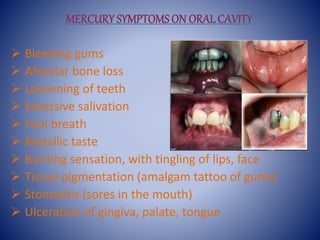
 Bleeding gums
 Alveolar bone loss
 Loosening of teeth
 Excessive salivation
 Foul breath
 Metallic taste
 Burning sensation, with tingling of lips, face
 Tissue pigmentation (amalgam tattoo of gums)
 Stomatitis (sores in the mouth)
 Ulceration of gingiva, palate, tongue
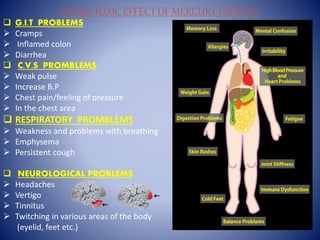
OTHER TOXIC EFFECT OF MERCURY ON BODY
 G.I.T PROBLEMS
 Cramps
 Inflamed colon
 Diarrhea
 C.V.S PROMBLEMS
 Weak pulse
 Increase B.P
 Chest pain/feeling of pressure
 In the chest area
 RESPIRATORY PROMBLEMS
 Weakness and problems with breathing
 Emphysema
 Persistent cough
 NEUROLOGICAL PROBLEMS
 Headaches
 Vertigo
 Tinnitus
 Twitching in various areas of the body
(eyelid, feet etc.)
DENTALMERCURY Hygiene RECOMMENDATIONS
 Ventilation: Provide proper ventilation in the place
by having fresh air exchanges and periodic
replacement of filters, which may act as traps for
mercury .
Monitor office: Monitor the hg vapor level in the
office periodically. This may be done by using
dosimeter badges & vapor analyzer(limit –
50µg/m³ 8 hr shift over 40 hr work week).
Monitor personnel: monitor office by
periodic analysis.
Office design: Use proper work area design to
facilitate spill containment and cleanup .
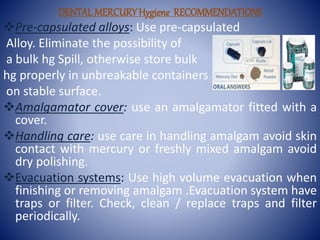
DENTALMERCURYHygiene RECOMMENDATIONS
Pre-capsulated alloys: Use pre-capsulated
Alloy. Eliminate the possibility of
a bulk hg Spill, otherwise store bulk
hg properly in unbreakable containers
on stable surface.
Amalgamator cover: use an amalgamator fitted with a
cover.
Handling care: use care in handling amalgam avoid skin
contact with mercury or freshly mixed amalgam avoid
dry polishing.
Evacuation systems: Use high volume evacuation when
finishing or removing amalgam .Evacuation system have
traps or filter. Check, clean / replace traps and filter
periodically.
DENTALMERCURYHygiene RECOMMENDATIONS
Masks: Change mask as necessary when removing
amalgam restoration.
Contaminated items: Dispose of Hg contaminated
items in sealed bags according to applicable
regulation .
Spills: clean up Hg properly by using bottle tapes/
fresh mixes of amalgam to pick- up droplets/ use
commercial clean up kits. Do not use household
vacuum cleaner.
Select an appropriate alloy: Proper Hg: alloy ratio to
avoid the need to remove excess Hg before packing.
DENTALMERCURYHygiene RECOMMENDATIONS
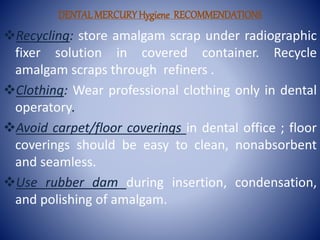
Recycling: store amalgam scrap under radiographic
fixer solution in covered container. Recycle
amalgam scraps through refiners .
Clothing: Wear professional clothing only in dental
operatory.
Avoid carpet/floor coverings in dental office ; floor
coverings should be easy to clean, nonabsorbent
and seamless.
Use rubber dam during insertion, condensation,
and polishing of amalgam.
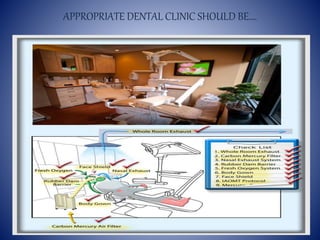
APPROPRIATE DENTAL CLINIC SHOULD BE….
 Gallium based alloy:
- Gallium was discovered in 1875 .it is metal
With similar atomic structure and characteristics
To mercury and has a melting temp of 29˚c. Hence , by 1928
Puttkammer suggested Gallium as a substitute for mercury
It is available as :
1. Gallium Alloy
2. Galloy
 DISADVATAGES
. Handling characteristics of alloy not favorable
. High level of corrosion is seen which causes loss of strength
marginal disintegration and marginal fracture in chunks.
. Dimensional change of 21.5%
. Poor biocompatibility
. Costly.
OTHER OPTION TO REDUCE MERCURY HAZARDS:
MERCURY FREE ALLOYS
TREATMENT OF MERCURY TOXICITY
• Chelation therapy is the administration of
chelating agents to remove heavy metals from the
body.
Chelation agent are chemical substances that
contain molecules capable of bonding securely to
minute particles of metal called ions. In addition
to directly supporting vital body functions, this
bonding process---called Chelation---provides a
means of trapping harmful metals in your
bloodstream and making them susceptible to safe
excretion in urine. The process of Chelation, called
Chelation therapy, is commonly used in the
treatment of heavy metal poisoning
A chelating agent could be given orally, intramuscularly, or
intravenously.
Chelation therapy for acute inorganic mercury poisoning can
be done with DMSA, 2,3-dimercapto-1-propanesulfonic acid
(DMPS), D-penicillamine (DPCN), or dimercaprol (BAL).[1]
Only DMSA is FDA-approved for use in children for treating
mercury poisoning.
correct dosage is required, as inappropriate dosages
increase toxicity.
Reference:
1) sturdevant’s
art and science of operative dentistry.
2) textbook of operative dentistry
nisha garg, amit garg.
Mercury hazards and toxicity

Mercury hazards and toxicity

  • 1.
    MERCURY HAZARDS AND TOXICITY Under theguidance of : Dept of conservative dentistry and endodontics NORTH BENGAL DENTAL COLLEGE AND HOSPITAL
  • 2.
    INTRODUCTION • Mercury isa known toxic , bio accumulative substance and it often finds its way into body through dental amalgams, which is used to restore cavitated tooth. • The mercury release in body and negatively affect brain, nervous system, kidney etc.
  • 3.
     The silverfillings used by dentists to restore teeth are composed of a metal "amalgam" containing roughly 50% elemental mercury and 50% other metals (mostly silver with some tin and copper).  The mercury found in amalgam fillings has raised some safety concerns over the years. Amalgam can release small amounts of mercury vapor over time, and patients can absorb these vapors by inhaling or ingesting them.  Dentists all over the world remove millions of amalgam fillings every day, with no regard for the possible mercury exposure that can result from grinding them out.  Taking out fillings with a high speed dental bur generates a cloud of particles, at least 65% of which are one micron or less in size. These are fully respirable, get deep into the lungs, where the microscopic particles are broken down and the mercury is systemically absorbed within a few days.
  • 4.
    MERCURY EXPOSURE INDENTAL OFFICE Mercury exposure in dental office can occur-  When Amalgam raw material being stored in use.  During trituration , insertion & intraoral hardening.  From amalgam scrap.  During finishing & polishing.  Removal of old restoration.
  • 5.
     Amount ofexposure.  Length of exposure.  Length of mercury accumulation in body.  Amount of accumulated mercury  Overall health of the patient ( for detoxification).
  • 6.
    Amount of mercuryreleased During manipulationof amalgam TRITURATION 1-2µg CONDENSATION 6-8µg DRY POLISHING 44µg WET POLISHING 2-4µg REMOVAL OF AMALGAM RESTORATION UNDER WATER SPRAY AND HIGH VOLUME SUCTION 15-20µg ADDITIONAL EVAUATION FOR 1 MIN TO REMOVE RESIDUAL AMALGAM DUST 1.5-2µg .
  • 8.
     Bleeding gums Alveolar bone loss  Loosening of teeth  Excessive salivation  Foul breath  Metallic taste  Burning sensation, with tingling of lips, face  Tissue pigmentation (amalgam tattoo of gums)  Stomatitis (sores in the mouth)  Ulceration of gingiva, palate, tongue
  • 9.
    OTHER TOXIC EFFECTOF MERCURY ON BODY  G.I.T PROBLEMS  Cramps  Inflamed colon  Diarrhea  C.V.S PROMBLEMS  Weak pulse  Increase B.P  Chest pain/feeling of pressure  In the chest area  RESPIRATORY PROMBLEMS  Weakness and problems with breathing  Emphysema  Persistent cough  NEUROLOGICAL PROBLEMS  Headaches  Vertigo  Tinnitus  Twitching in various areas of the body (eyelid, feet etc.)
  • 10.
    DENTALMERCURY Hygiene RECOMMENDATIONS Ventilation: Provide proper ventilation in the place by having fresh air exchanges and periodic replacement of filters, which may act as traps for mercury . Monitor office: Monitor the hg vapor level in the office periodically. This may be done by using dosimeter badges & vapor analyzer(limit – 50µg/m³ 8 hr shift over 40 hr work week). Monitor personnel: monitor office by periodic analysis. Office design: Use proper work area design to facilitate spill containment and cleanup .
  • 11.
    DENTALMERCURYHygiene RECOMMENDATIONS Pre-capsulated alloys:Use pre-capsulated Alloy. Eliminate the possibility of a bulk hg Spill, otherwise store bulk hg properly in unbreakable containers on stable surface. Amalgamator cover: use an amalgamator fitted with a cover. Handling care: use care in handling amalgam avoid skin contact with mercury or freshly mixed amalgam avoid dry polishing. Evacuation systems: Use high volume evacuation when finishing or removing amalgam .Evacuation system have traps or filter. Check, clean / replace traps and filter periodically.
  • 12.
    DENTALMERCURYHygiene RECOMMENDATIONS Masks: Changemask as necessary when removing amalgam restoration. Contaminated items: Dispose of Hg contaminated items in sealed bags according to applicable regulation . Spills: clean up Hg properly by using bottle tapes/ fresh mixes of amalgam to pick- up droplets/ use commercial clean up kits. Do not use household vacuum cleaner. Select an appropriate alloy: Proper Hg: alloy ratio to avoid the need to remove excess Hg before packing.
  • 13.
    DENTALMERCURYHygiene RECOMMENDATIONS Recycling: storeamalgam scrap under radiographic fixer solution in covered container. Recycle amalgam scraps through refiners . Clothing: Wear professional clothing only in dental operatory. Avoid carpet/floor coverings in dental office ; floor coverings should be easy to clean, nonabsorbent and seamless. Use rubber dam during insertion, condensation, and polishing of amalgam.
  • 14.
  • 15.
     Gallium basedalloy: - Gallium was discovered in 1875 .it is metal With similar atomic structure and characteristics To mercury and has a melting temp of 29˚c. Hence , by 1928 Puttkammer suggested Gallium as a substitute for mercury It is available as : 1. Gallium Alloy 2. Galloy  DISADVATAGES . Handling characteristics of alloy not favorable . High level of corrosion is seen which causes loss of strength marginal disintegration and marginal fracture in chunks. . Dimensional change of 21.5% . Poor biocompatibility . Costly. OTHER OPTION TO REDUCE MERCURY HAZARDS: MERCURY FREE ALLOYS
  • 16.
    TREATMENT OF MERCURYTOXICITY • Chelation therapy is the administration of chelating agents to remove heavy metals from the body. Chelation agent are chemical substances that contain molecules capable of bonding securely to minute particles of metal called ions. In addition to directly supporting vital body functions, this bonding process---called Chelation---provides a means of trapping harmful metals in your bloodstream and making them susceptible to safe excretion in urine. The process of Chelation, called Chelation therapy, is commonly used in the treatment of heavy metal poisoning
  • 17.
    A chelating agentcould be given orally, intramuscularly, or intravenously. Chelation therapy for acute inorganic mercury poisoning can be done with DMSA, 2,3-dimercapto-1-propanesulfonic acid (DMPS), D-penicillamine (DPCN), or dimercaprol (BAL).[1] Only DMSA is FDA-approved for use in children for treating mercury poisoning. correct dosage is required, as inappropriate dosages increase toxicity.
  • 18.
    Reference: 1) sturdevant’s art andscience of operative dentistry. 2) textbook of operative dentistry nisha garg, amit garg.