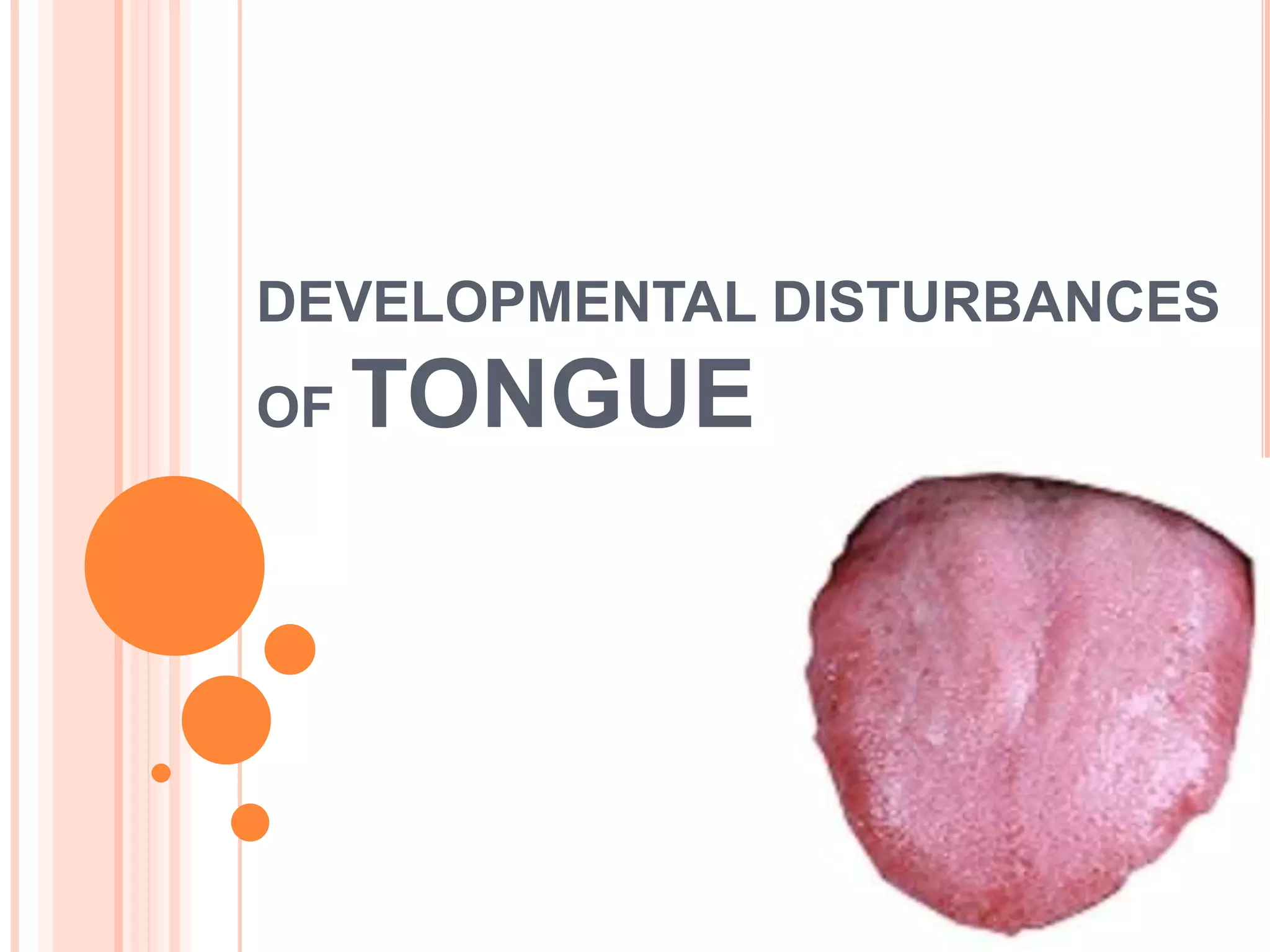
DEVELOPMENTAL DISTURBANCES
OF TONGUE
 1. Microglossia
 2. Macroglossia
 3. Ankyloglossia
 4. Cleft tongue
 5. Fissured tongue
 6. Median rhomboid glossitis
 7. Benign migratory glossitis
 8. Hairy tongue
 9. Lingual varices
 10. Lingual thyroid nodule
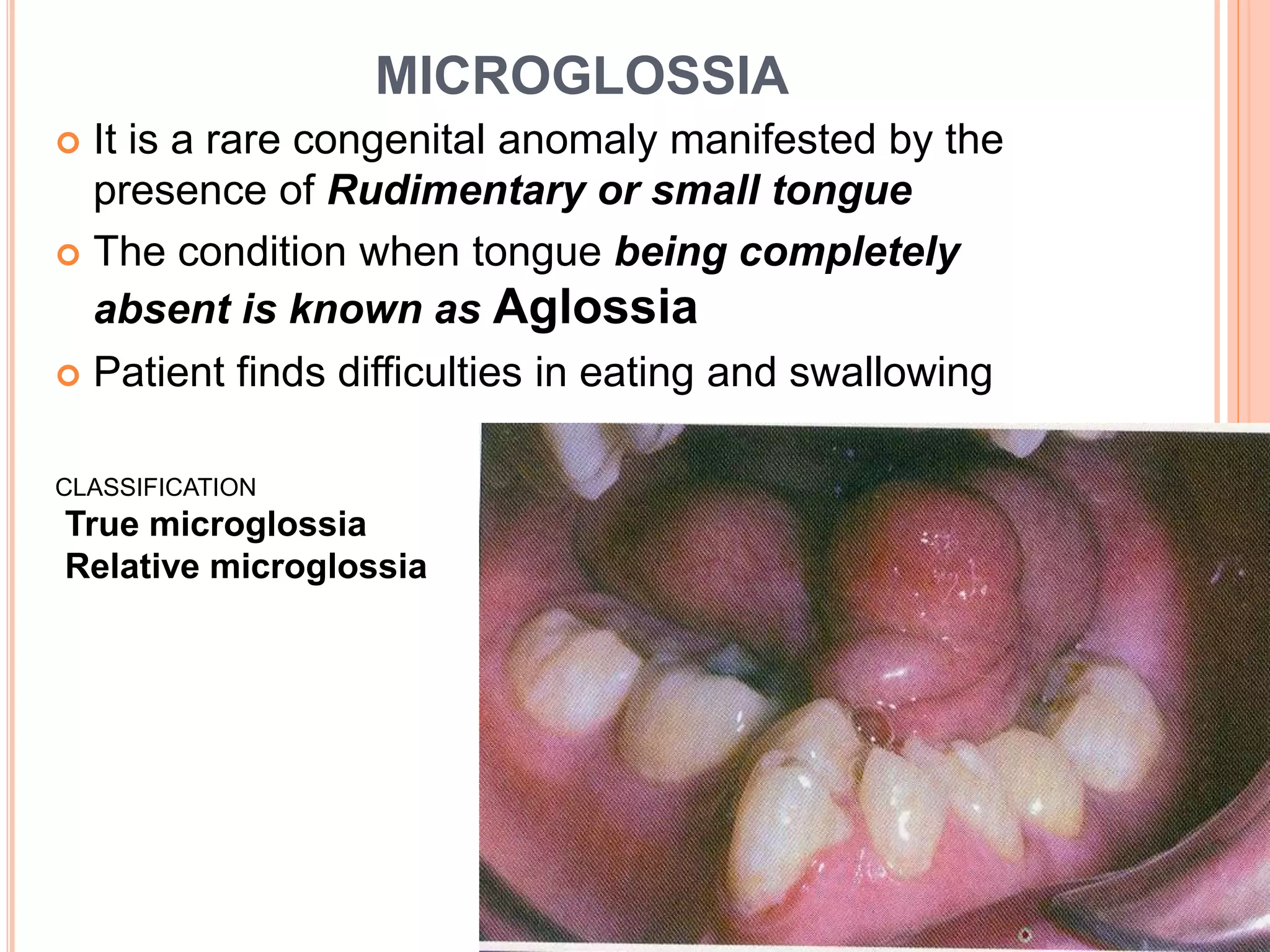
MICROGLOSSIA
 It is a rare congenital anomaly manifested by the
presence of Rudimentary or small tongue
 The condition when tongue being completely
absent is known as Aglossia
 Patient finds difficulties in eating and swallowing
CLASSIFICATION
True microglossia
Relative microglossia
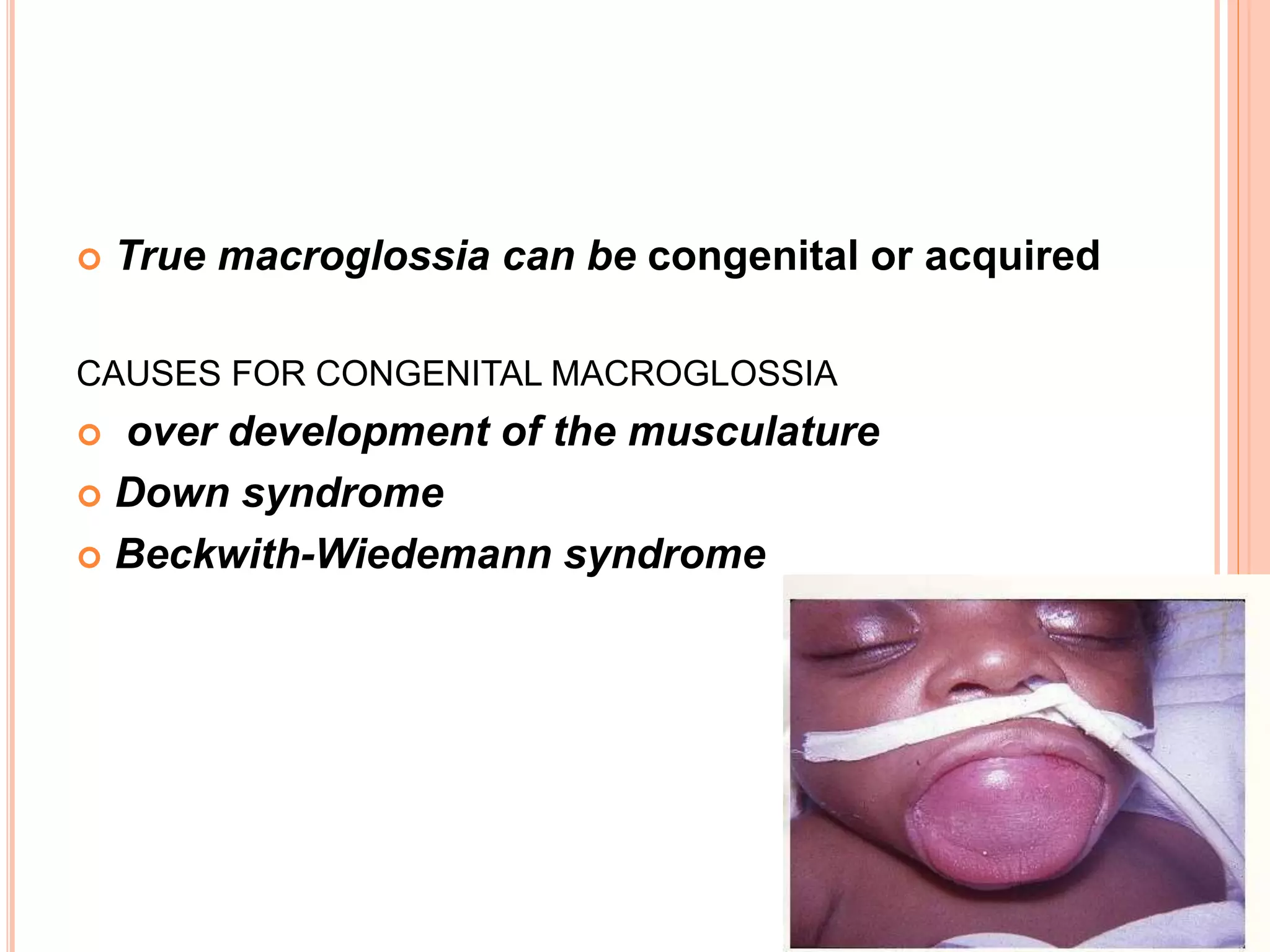
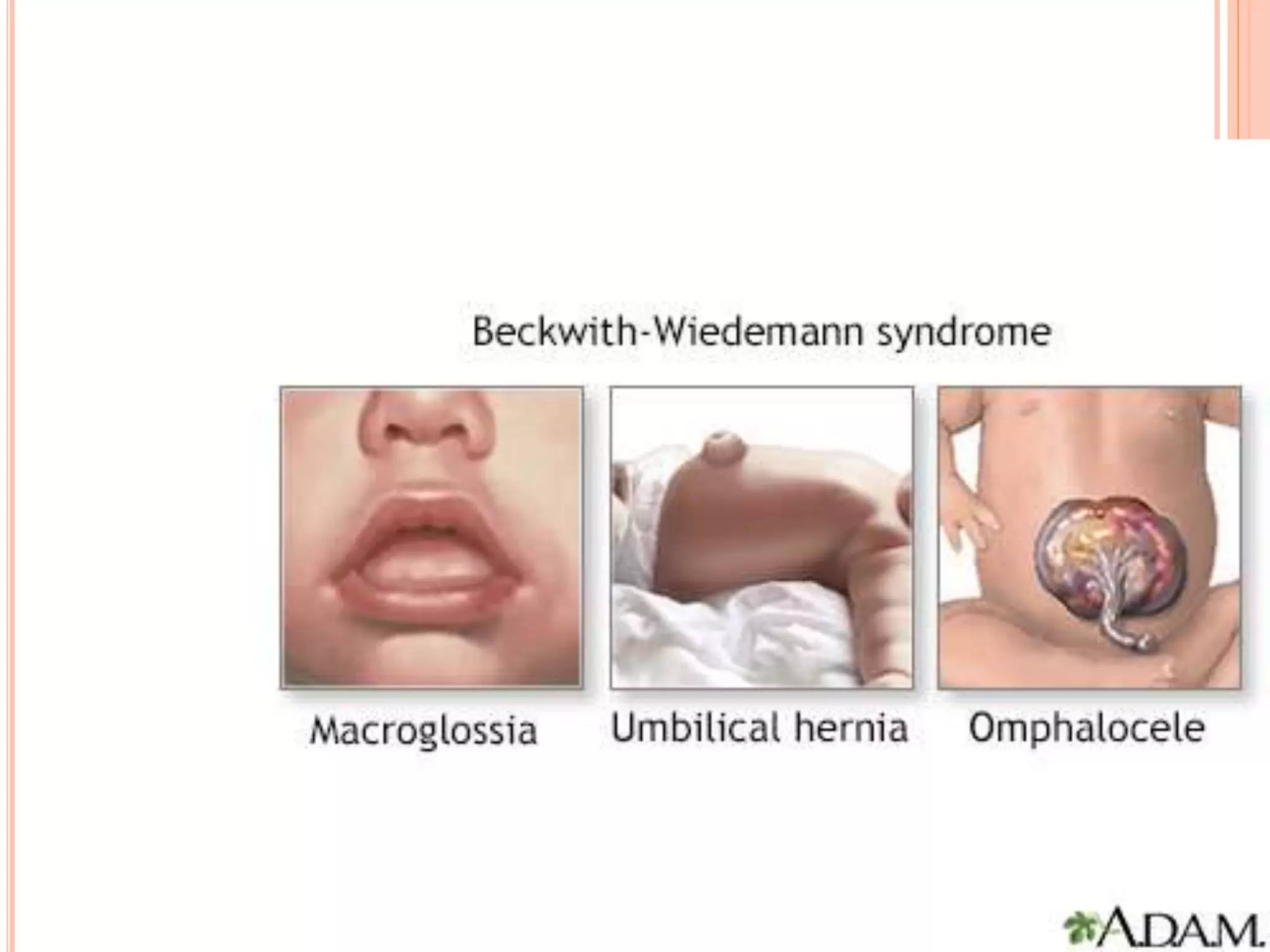
MACROGLOSSIA
 It is a condition when patient have an enlarged tongue
 True macroglossia and pseudomacroglossia
 Pseudomacroglossia includes any of the following
conditions, which force the tongue to sit in an abnormal
position:
 habitual posturing of the tongue,
 enlarged tonsils/adenoids,
 low palate and decreased oral cavity volume displacing
tongue,
severe mandibular deficiency( retrognathism),
neoplasms displacing tongue,
hypotonia of the tongue.
 True macroglossia can be congenital or acquired
CAUSES FOR CONGENITAL MACROGLOSSIA
 over development of the musculature
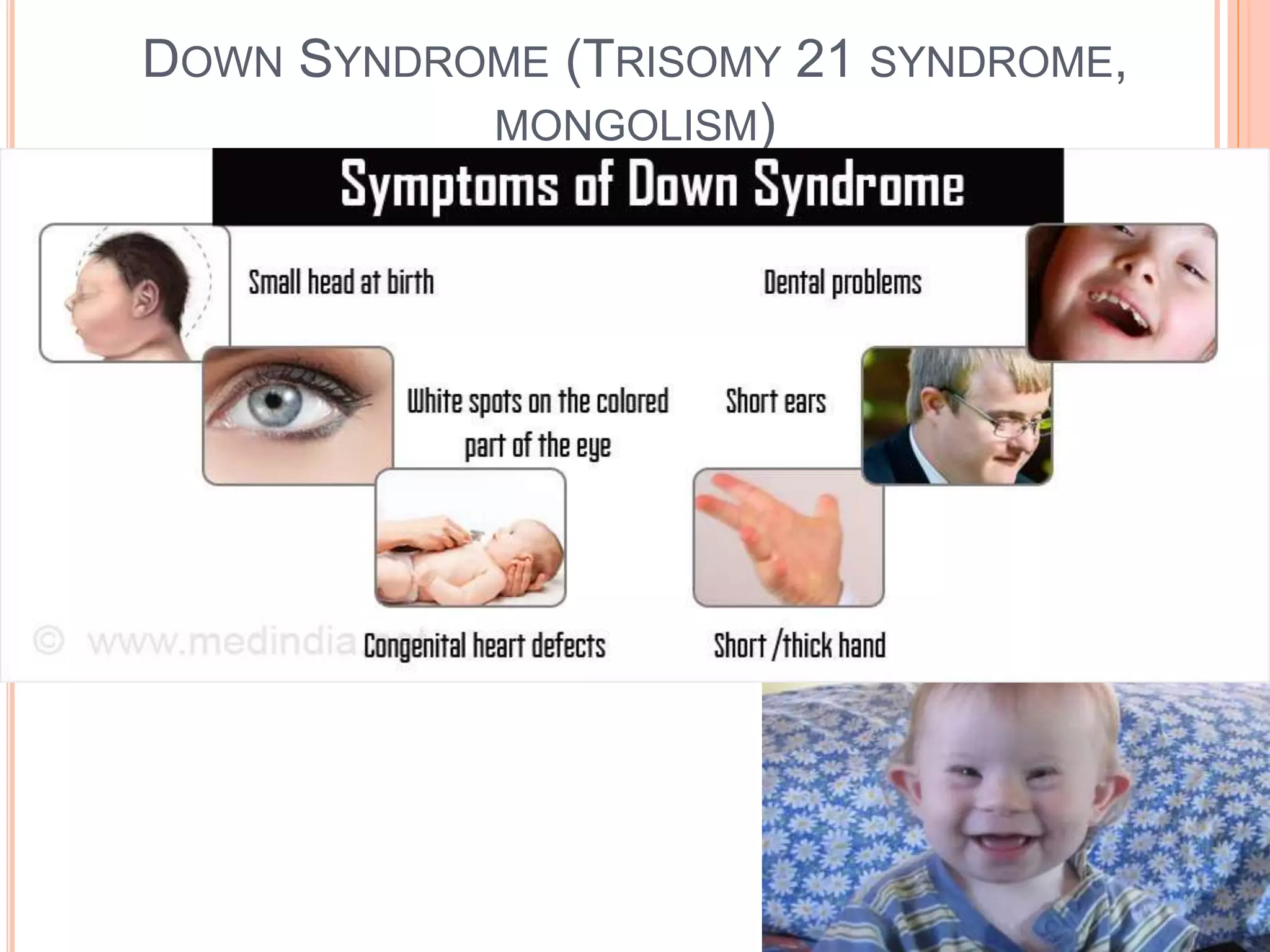
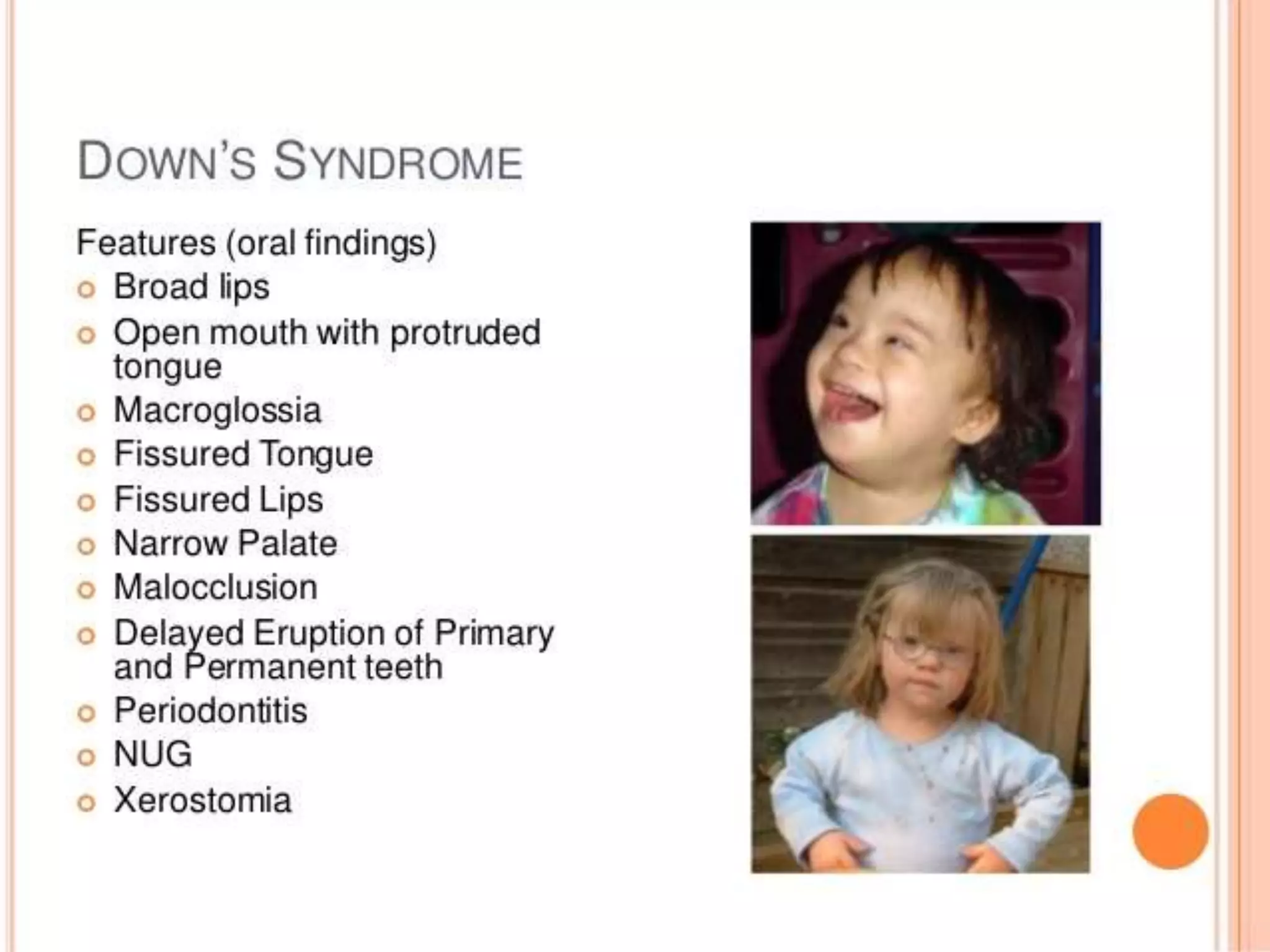
 Down syndrome
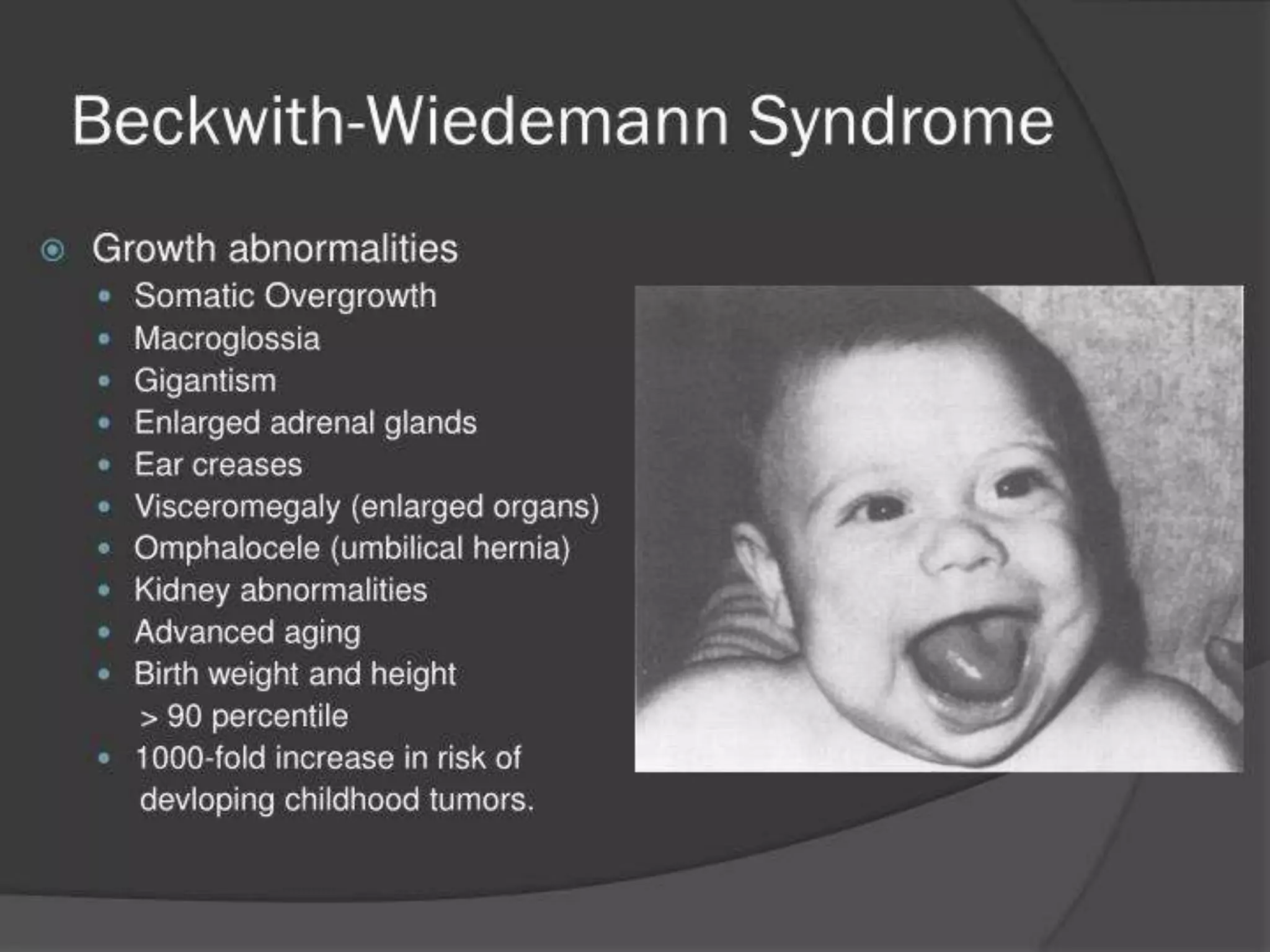
 Beckwith-Wiedemann syndrome
DOWN SYNDROME (TRISOMY 21 SYNDROME,
MONGOLISM)
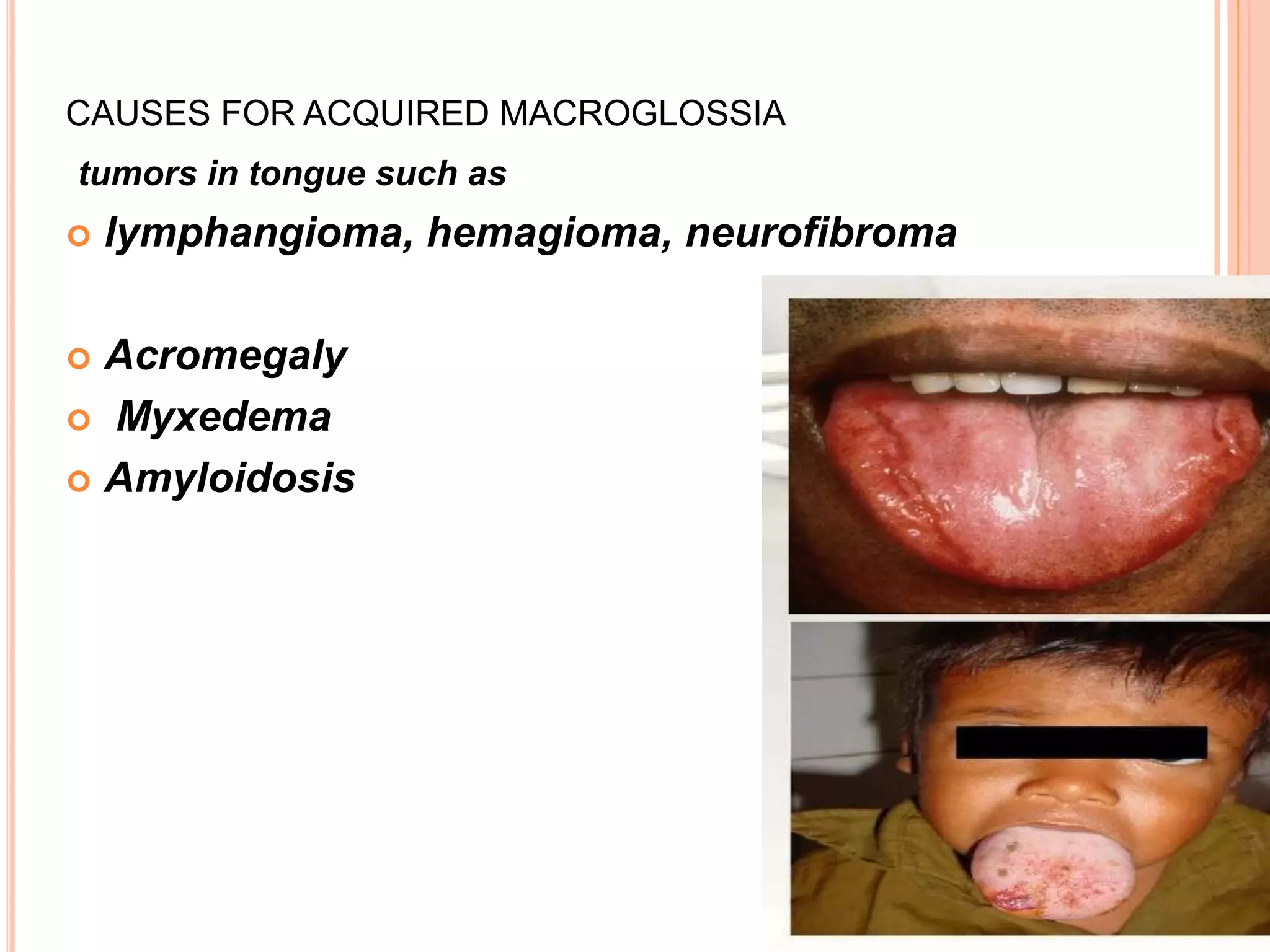
CAUSES FOR ACQUIRED MACROGLOSSIA
tumors in tongue such as
 lymphangioma, hemagioma, neurofibroma
 Acromegaly
 Myxedema
 Amyloidosis
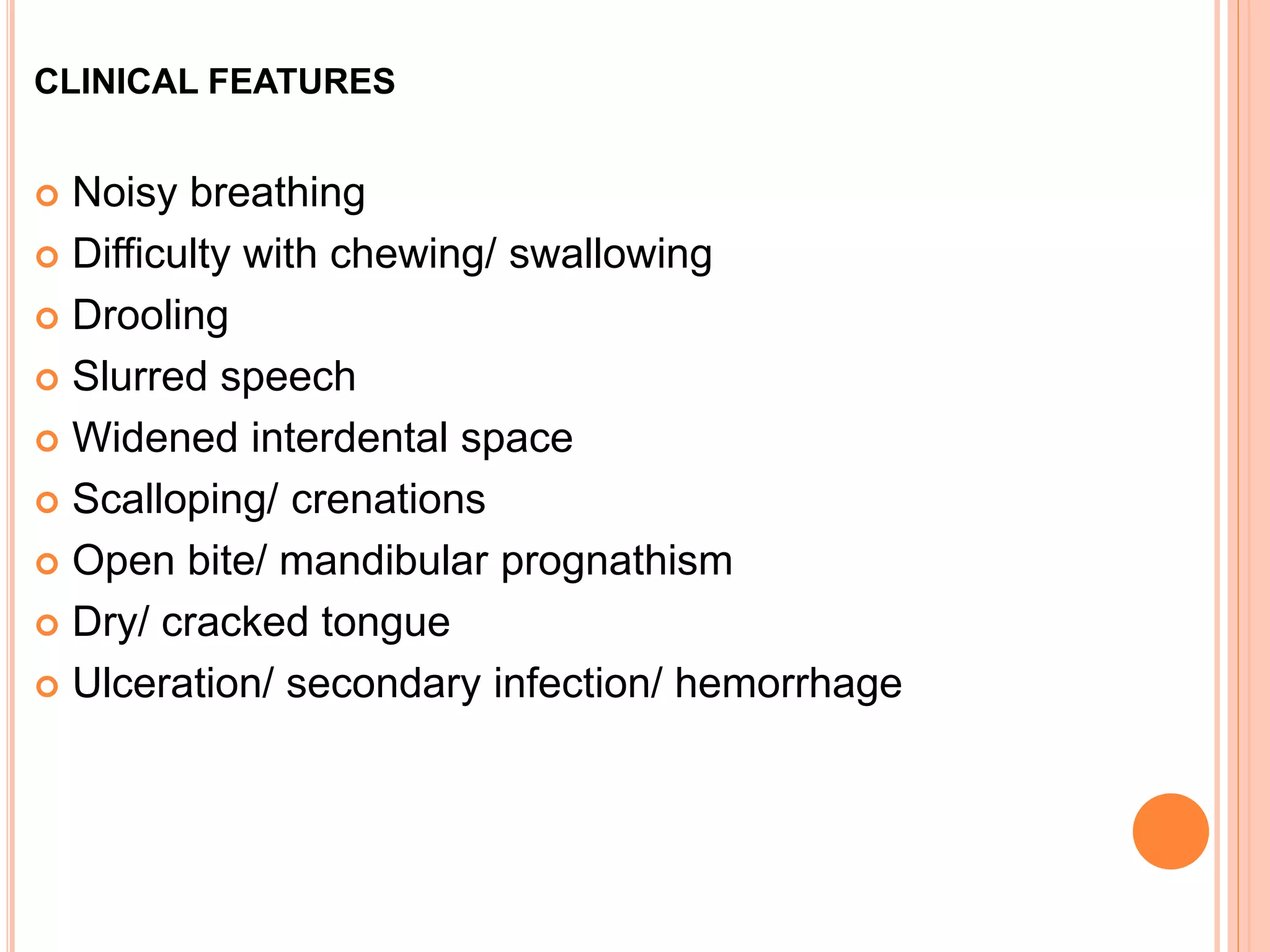
CLINICAL FEATURES
 Noisy breathing
 Difficulty with chewing/ swallowing
 Drooling
 Slurred speech
 Widened interdental space
 Scalloping/ crenations
 Open bite/ mandibular prognathism
 Dry/ cracked tongue
 Ulceration/ secondary infection/ hemorrhage
TREATMENT
 Surgical reduction or trimming may be required
when macroglossia disturbs the oropharyngeal
function.
ANKYLOGLOSSIA
 It can be defined as a developmental condition
characterized by fixation of tongue to the floor of the
mouth, causing restricted movement
 It can be either complete ankyloglossia or partial
ankyloglossia (tongue tie)
 Complete ankyloglossia occurs as a result of
fusion between the tongue and the floor of the
mouth
 Partial ankyloglossia occurs as a result of short
lingual frenum or due to a frenum which attaches
too near to the tip of the tongue
CLINICAL FEATURES
 speech disorders
 deformities in occlusion
 Difficulties in swallowing
TREATMENT
 Partial ankyloglossia are self
corrective
 Complete ankyloglossia can be
surgically treated by frenulectomy
CLASS TEST – 24-03-2018
Topics- short notes and short essays
 Developmental disturbances affecting-
 Lip
 Palate
 Jaw
 Gingiva
 Salivary gland
 Tongue
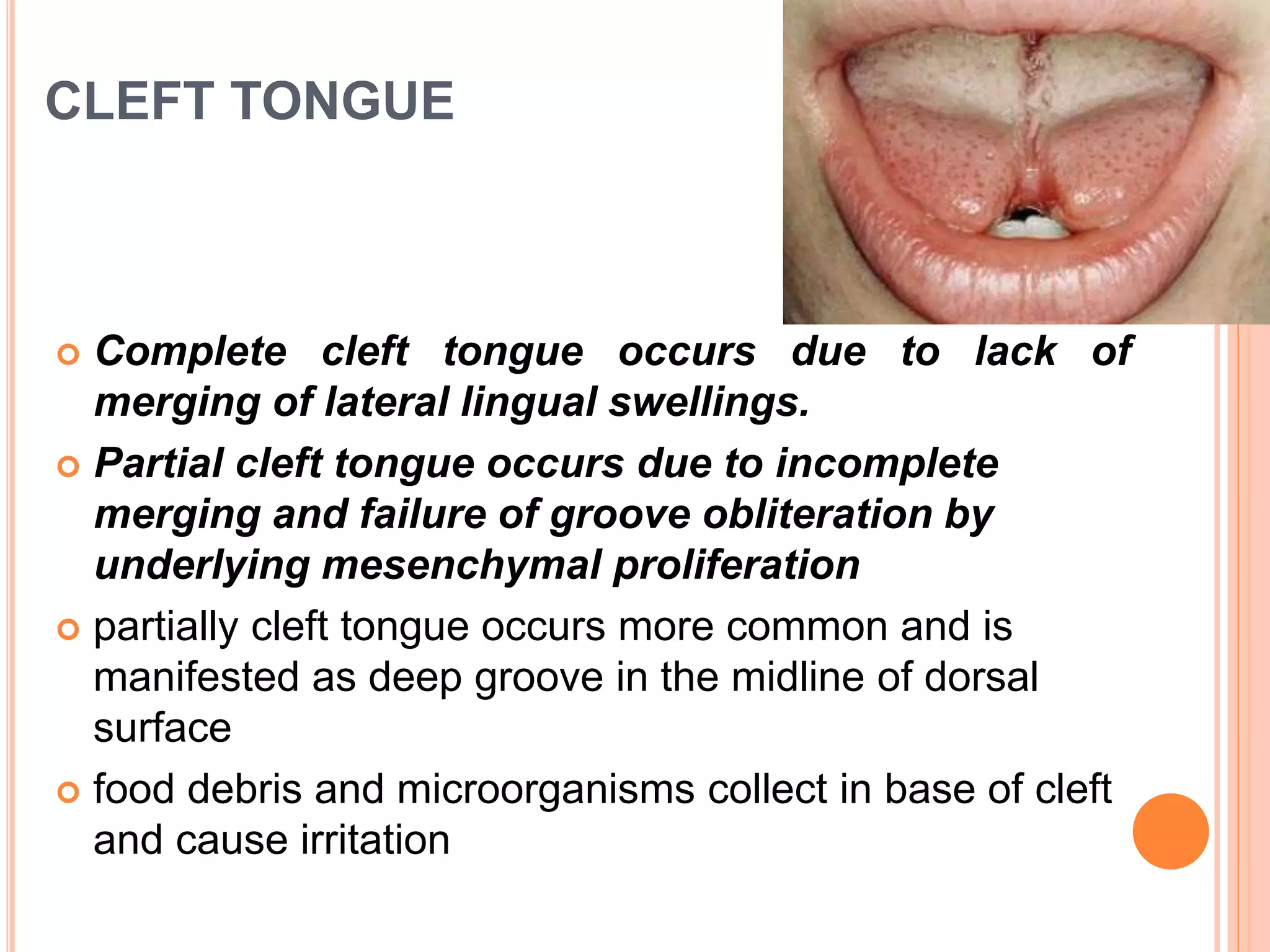
CLEFT TONGUE
 Complete cleft tongue occurs due to lack of
merging of lateral lingual swellings.
 Partial cleft tongue occurs due to incomplete
merging and failure of groove obliteration by
underlying mesenchymal proliferation
 partially cleft tongue occurs more common and is
manifested as deep groove in the midline of dorsal
surface
 food debris and microorganisms collect in base of cleft
and cause irritation
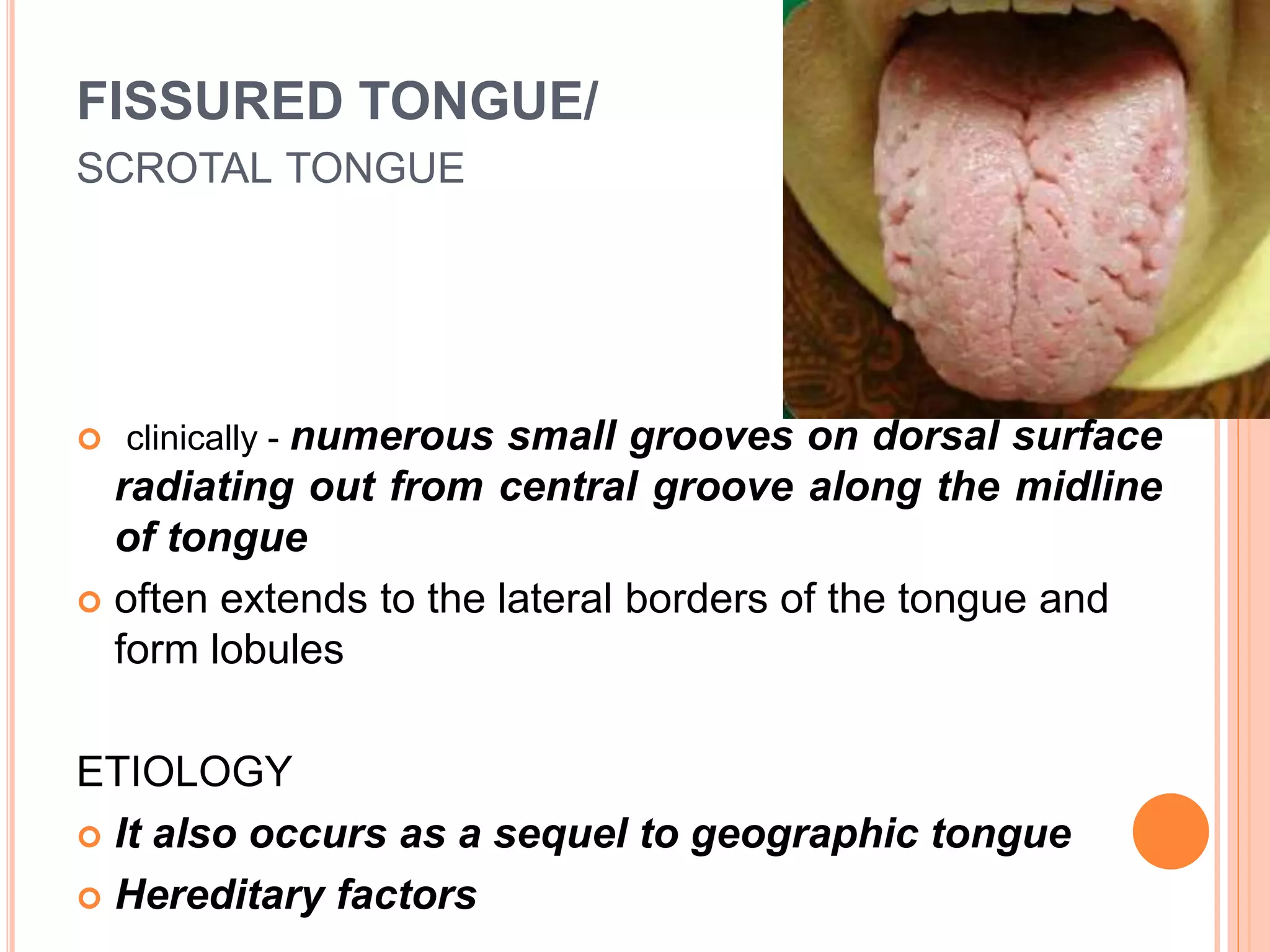
FISSURED TONGUE/
SCROTAL TONGUE
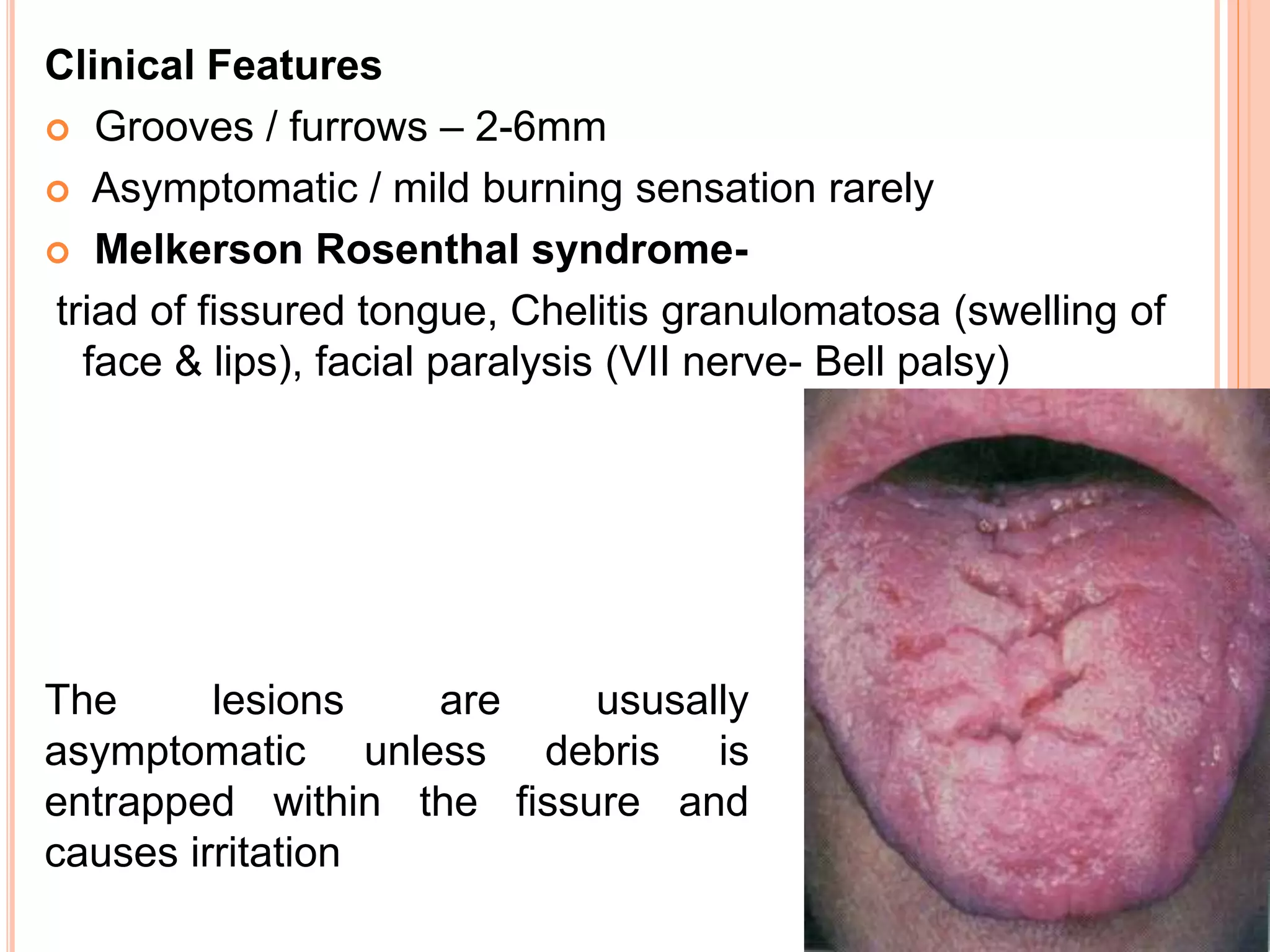
 clinically - numerous small grooves on dorsal surface
radiating out from central groove along the midline
of tongue
 often extends to the lateral borders of the tongue and
form lobules
ETIOLOGY
 It also occurs as a sequel to geographic tongue
 Hereditary factors
Clinical Features
 Grooves / furrows – 2-6mm
 Asymptomatic / mild burning sensation rarely
 Melkerson Rosenthal syndrome-
triad of fissured tongue, Chelitis granulomatosa (swelling of
face & lips), facial paralysis (VII nerve- Bell palsy)
The lesions are ususally
asymptomatic unless debris is
entrapped within the fissure and
causes irritation
MEDIAN RHOMBOID GLOSSITIS
central papillary atrophy of the tongue /
posterior lingual papillary atrophy
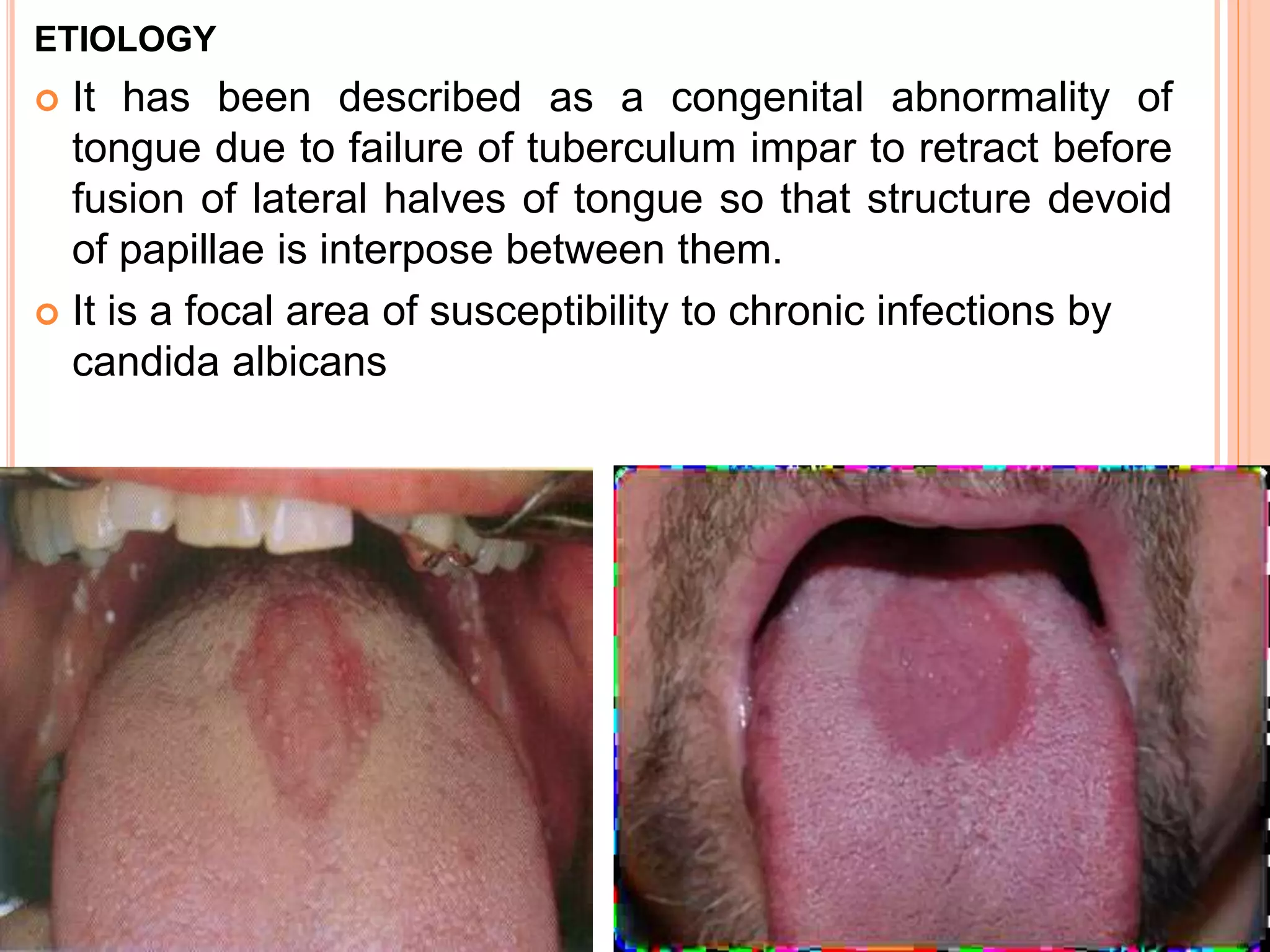
 It is an asymptomatic elongated erythematous patch of
atrophic mucosa on the mid dorsal surface of the
tongue.
ETIOLOGY
 It has been described as a congenital abnormality of
tongue due to failure of tuberculum impar to retract before
fusion of lateral halves of tongue so that structure devoid
of papillae is interpose between them.
 It is a focal area of susceptibility to chronic infections by
candida albicans
CLINICAL FEATURES
 Lesion appears Ovoid, diamond, rhomboid shaped
reddish patch on dorsal surface of tongue immediately
anterior to circumvallate papillae.
 it appears as a flat or slightly elevated area and stands out
distinctly from rest of tongue because it has no filiform
papillae
 Seen mostly in females in a ratio 3:1 when compared with
males
 Kissing lesions are seen (midline soft palate erythema in
the area of contact with tongue)
H/P:
 atrophic stratified squamous epithelium; occasionally
pseudoepitheliomatous hyperplasia, presence of
fungal hyphae, loss of papillae, elongated rete ridges
and lymphocytic infiltration.
TREATMENT
antifungal agents-amphotericin B or nystatin
BENIGN MIGRATORY
GLOSSITIS
Geographic tongue,
erythema migrans,
wandering rash of
tongue
ETIOLOGY
 The exact etiology remains
unknown.
 It may be genetic.
 However many believe that
emotional stress may
precipitate this condition
CLINICAL FEATURES
 The lesion occurs in about 1 to 3 % of population
 Females are affected more frequently than males by a 2:1
ratio
 seen on the anterior two third of the dorsal tongue
mucosa
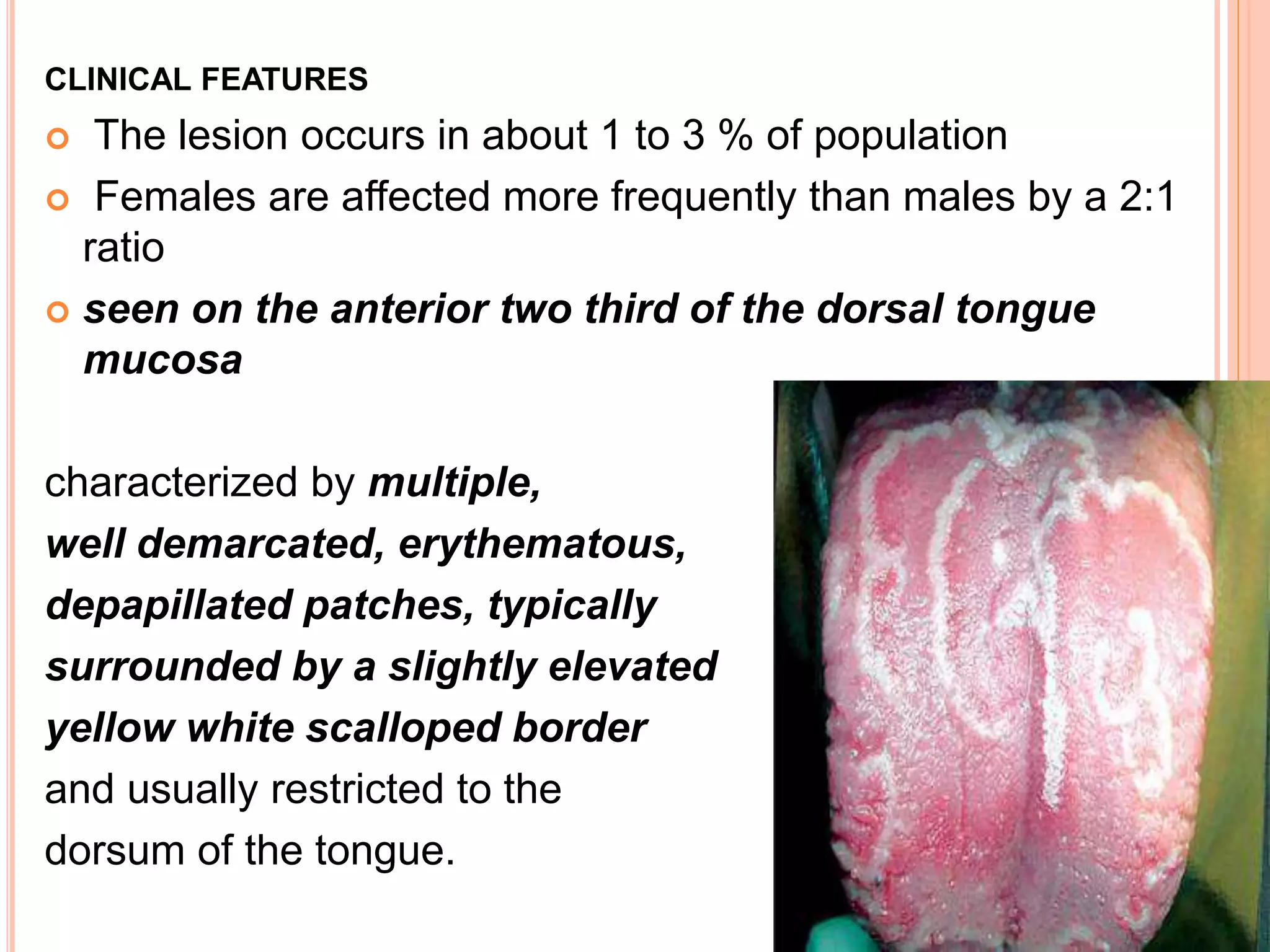
characterized by multiple,
well demarcated, erythematous,
depapillated patches, typically
surrounded by a slightly elevated
yellow white scalloped border
and usually restricted to the
dorsum of the tongue.
H/P:
 hyperparakeratosis, spongiosis, acanthosis, elongated
rete ridges
 Red areas- keratin desquamated, neutrophils and
lymphocytes in epithelium
 Monro’s abscess (micro abscess in the keratin and
spinous layer)
TREATMENT
 no specific treatment
 heavy doses of vitamins and topical steroids
HAIRY TONGUE
BLACK HAIRY TONGUE, LINGUA NIGRA,
LINGUA VILLOSA
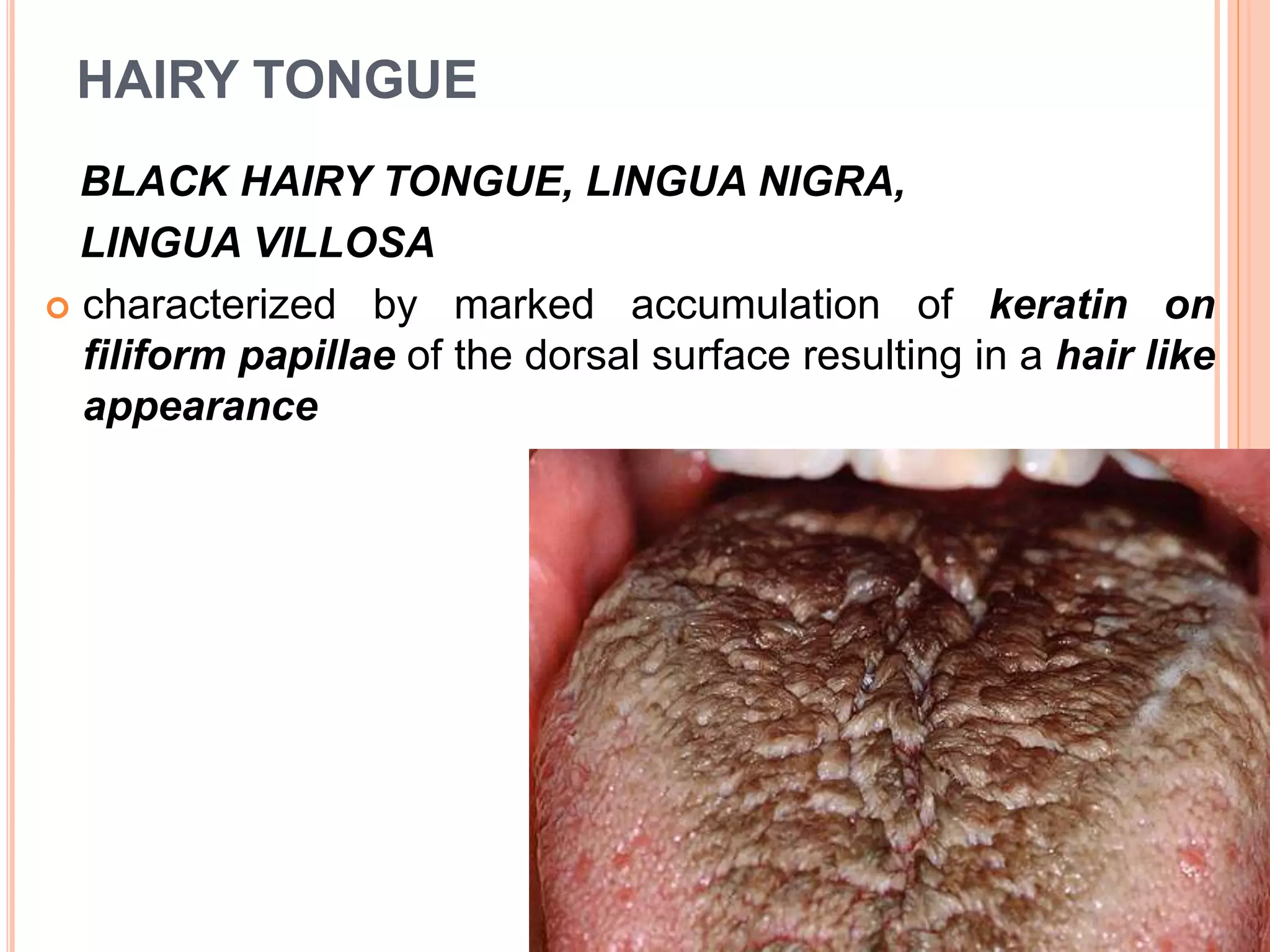
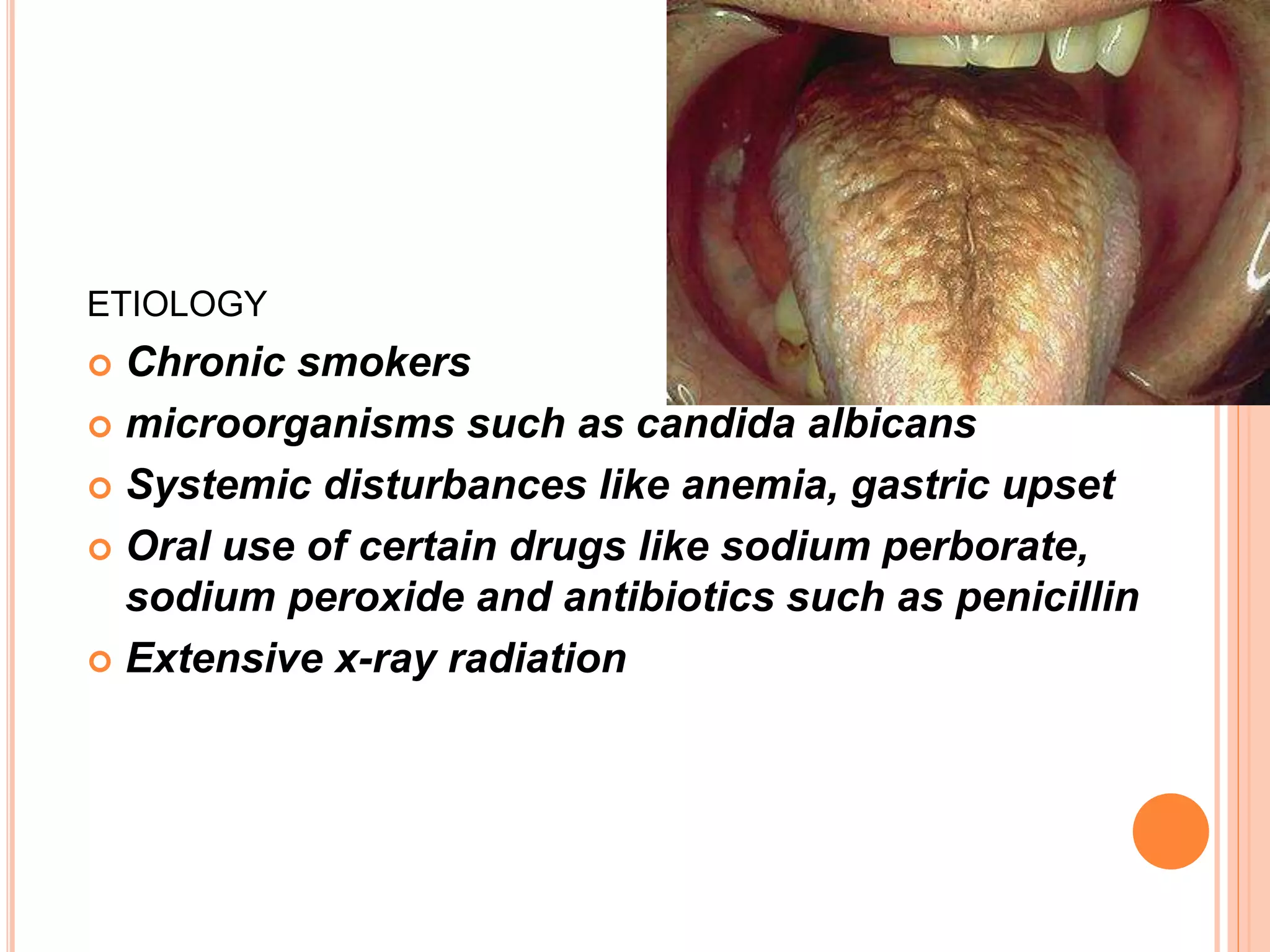
 characterized by marked accumulation of keratin on
filiform papillae of the dorsal surface resulting in a hair like
appearance
ETIOLOGY
 Chronic smokers
 microorganisms such as candida albicans
 Systemic disturbances like anemia, gastric upset
 Oral use of certain drugs like sodium perborate,
sodium peroxide and antibiotics such as penicillin
 Extensive x-ray radiation
CLINICAL FEATURES
 formation of a pigmented thick matted layer on the tongue
surface, heavily coated with bacteria and fungi
 Hair like appearence
 Halitosis
 Irritation of tongue due to accumulation of food debris
 Candidal over growth may cause
glossopyrosis ( burning tongue)
LINGUAL VARICES
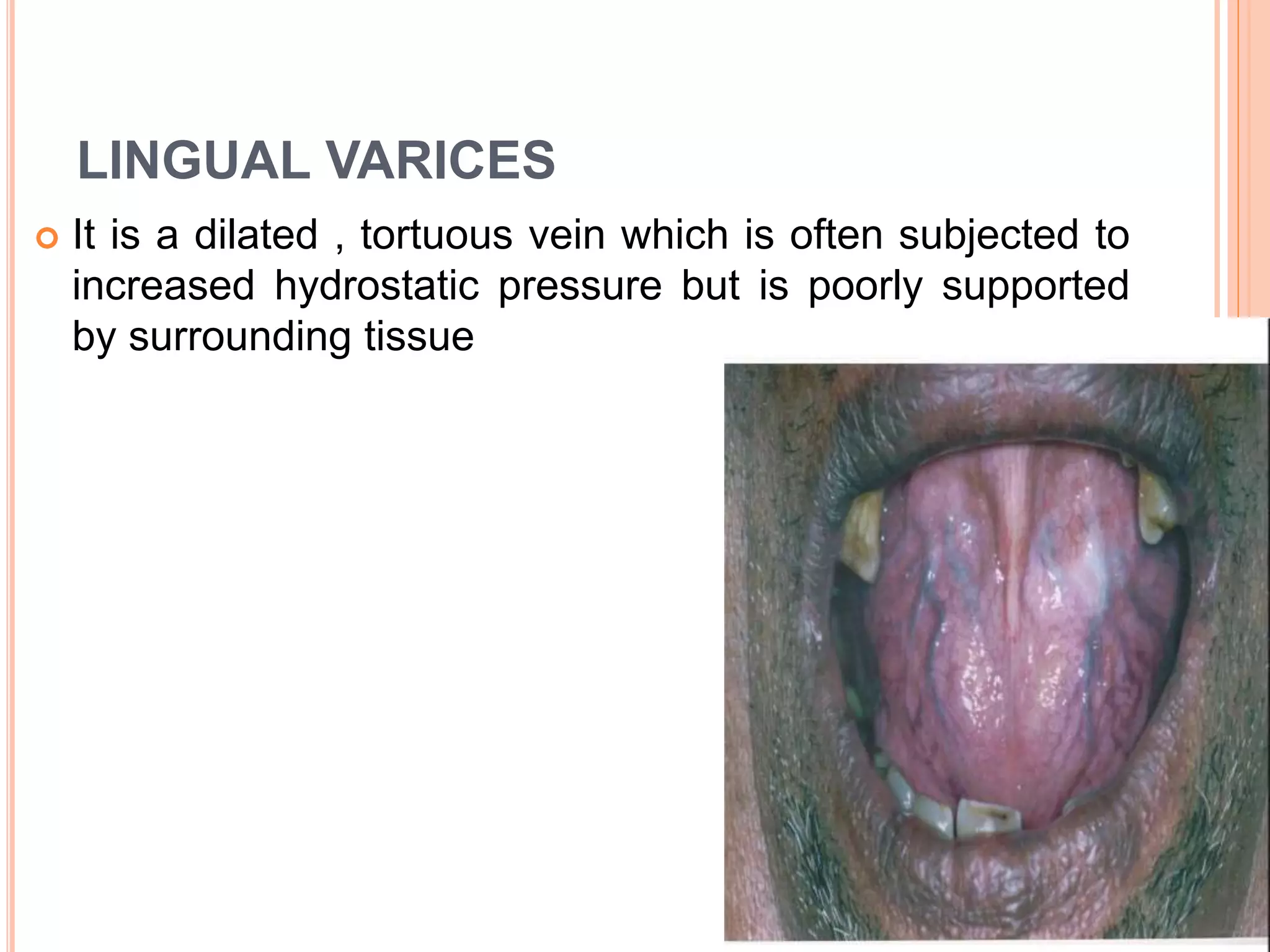
 It is a dilated , tortuous vein which is often subjected to
increased hydrostatic pressure but is poorly supported
by surrounding tissue
CLINICAL FEATURES
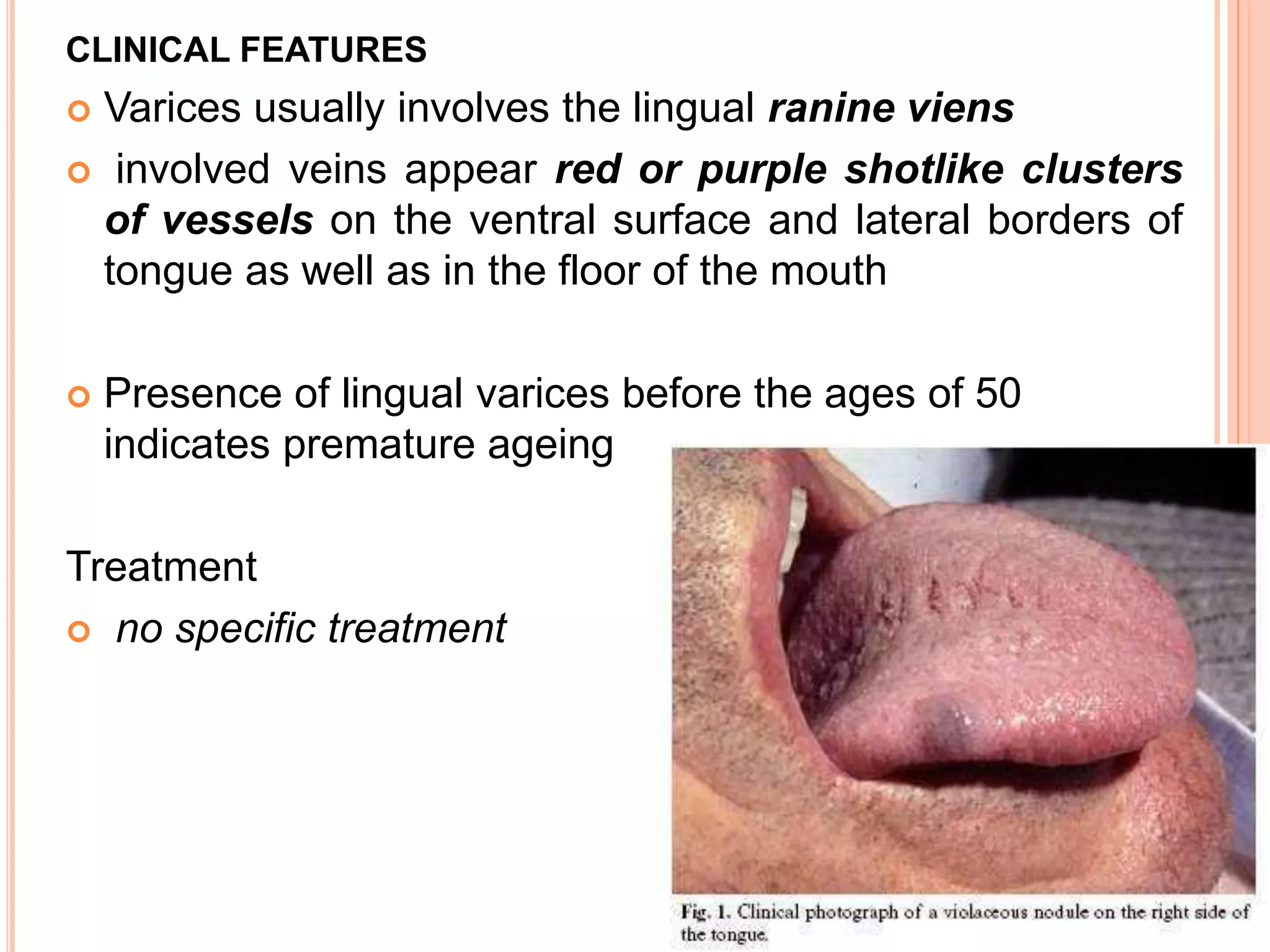
 Varices usually involves the lingual ranine viens
 involved veins appear red or purple shotlike clusters
of vessels on the ventral surface and lateral borders of
tongue as well as in the floor of the mouth
 Presence of lingual varices before the ages of 50
indicates premature ageing
Treatment
 no specific treatment
LINGUAL THYROID
NODULE
follicles of thyroid tissue are
found in the substance of the
tongue.
ETIOLOGY
 It occurs when thyroid anlage that failed to migrate to
its predestined position or from anlage remnants that
became detached and were left behind.
 (the rudimentary basis of a particular organ or other part,
especially in an embryo.)
CLINICAL FEATURES
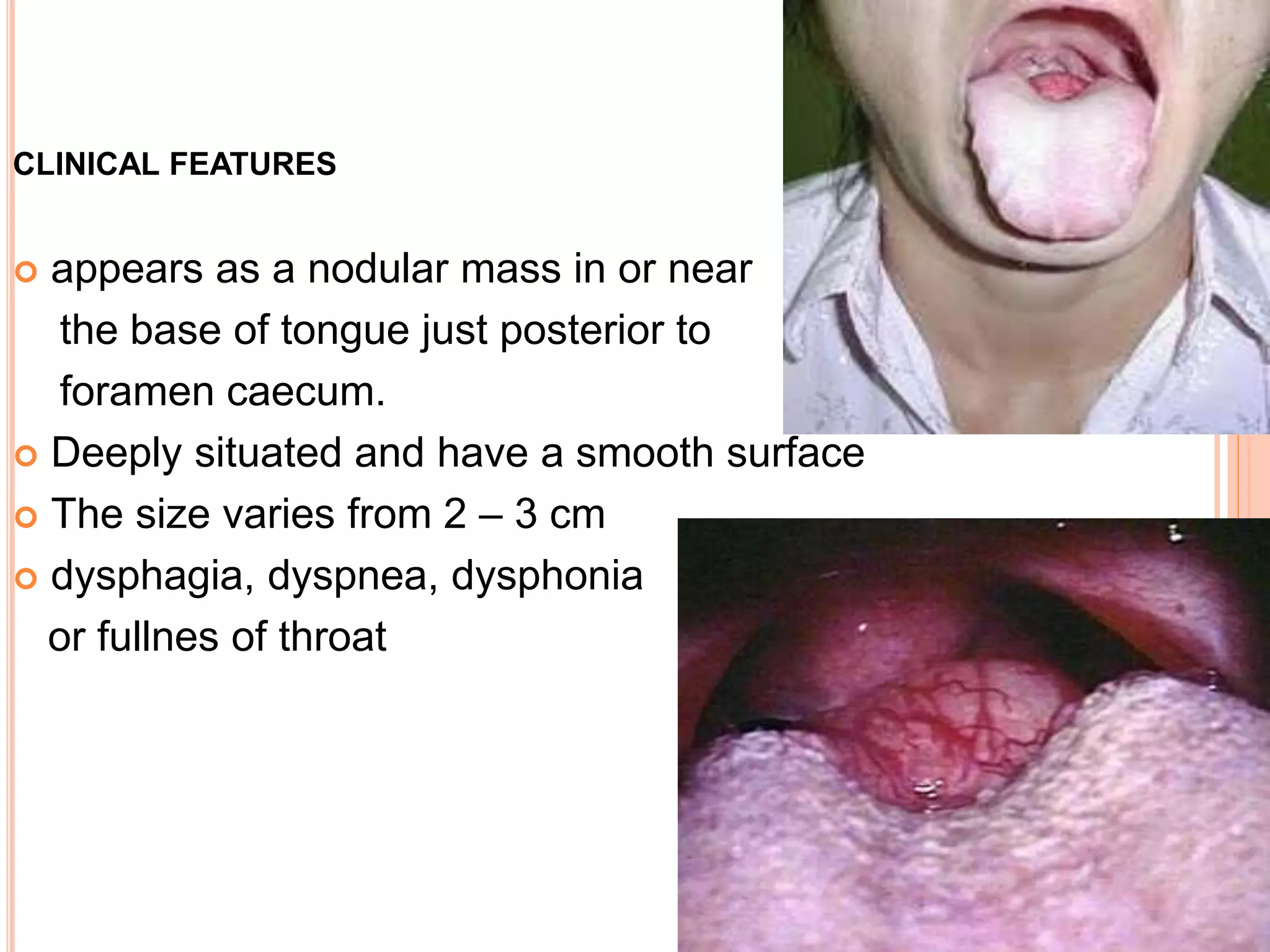
 appears as a nodular mass in or near
the base of tongue just posterior to
foramen caecum.
 Deeply situated and have a smooth surface
 The size varies from 2 – 3 cm
 dysphagia, dyspnea, dysphonia
or fullnes of throat
Sagittal reconstruction of CT scan of the neck,
showing the lingual thyroid at the base of the
tongue.
HISTOPATHOLOGY
 Lingual thyroid nodule consist of normal mature thyroid
tissue
 Occasionally thyroid nodules may exhibit colloid
degeneration
DIFFERNTIAL DIAGNOSIS
 Thyroglossal tract cyst
 Neoplasms
TREATMENT
 Surgical excision
 Suppresive therapy - supplemental thyroid hormone can
reduce the size of the lesion
Developmental disturbances of tongue

Developmental disturbances of tongue

  • 1.
  • 2.
     1. Microglossia 2. Macroglossia  3. Ankyloglossia  4. Cleft tongue  5. Fissured tongue  6. Median rhomboid glossitis  7. Benign migratory glossitis  8. Hairy tongue  9. Lingual varices  10. Lingual thyroid nodule
  • 3.
    MICROGLOSSIA  It isa rare congenital anomaly manifested by the presence of Rudimentary or small tongue  The condition when tongue being completely absent is known as Aglossia  Patient finds difficulties in eating and swallowing CLASSIFICATION True microglossia Relative microglossia
  • 4.
    MACROGLOSSIA  It isa condition when patient have an enlarged tongue  True macroglossia and pseudomacroglossia  Pseudomacroglossia includes any of the following conditions, which force the tongue to sit in an abnormal position:  habitual posturing of the tongue,  enlarged tonsils/adenoids,  low palate and decreased oral cavity volume displacing tongue, severe mandibular deficiency( retrognathism), neoplasms displacing tongue, hypotonia of the tongue.
  • 5.
     True macroglossiacan be congenital or acquired CAUSES FOR CONGENITAL MACROGLOSSIA  over development of the musculature  Down syndrome  Beckwith-Wiedemann syndrome
  • 6.
    DOWN SYNDROME (TRISOMY21 SYNDROME, MONGOLISM)
  • 10.
    CAUSES FOR ACQUIREDMACROGLOSSIA tumors in tongue such as  lymphangioma, hemagioma, neurofibroma  Acromegaly  Myxedema  Amyloidosis
  • 11.
    CLINICAL FEATURES  Noisybreathing  Difficulty with chewing/ swallowing  Drooling  Slurred speech  Widened interdental space  Scalloping/ crenations  Open bite/ mandibular prognathism  Dry/ cracked tongue  Ulceration/ secondary infection/ hemorrhage
  • 12.
    TREATMENT  Surgical reductionor trimming may be required when macroglossia disturbs the oropharyngeal function.
  • 13.
    ANKYLOGLOSSIA  It canbe defined as a developmental condition characterized by fixation of tongue to the floor of the mouth, causing restricted movement  It can be either complete ankyloglossia or partial ankyloglossia (tongue tie)  Complete ankyloglossia occurs as a result of fusion between the tongue and the floor of the mouth  Partial ankyloglossia occurs as a result of short lingual frenum or due to a frenum which attaches too near to the tip of the tongue
  • 14.
    CLINICAL FEATURES  speechdisorders  deformities in occlusion  Difficulties in swallowing TREATMENT  Partial ankyloglossia are self corrective  Complete ankyloglossia can be surgically treated by frenulectomy
  • 15.
    CLASS TEST –24-03-2018 Topics- short notes and short essays  Developmental disturbances affecting-  Lip  Palate  Jaw  Gingiva  Salivary gland  Tongue
  • 16.
    CLEFT TONGUE  Completecleft tongue occurs due to lack of merging of lateral lingual swellings.  Partial cleft tongue occurs due to incomplete merging and failure of groove obliteration by underlying mesenchymal proliferation  partially cleft tongue occurs more common and is manifested as deep groove in the midline of dorsal surface  food debris and microorganisms collect in base of cleft and cause irritation
  • 17.
    FISSURED TONGUE/ SCROTAL TONGUE clinically - numerous small grooves on dorsal surface radiating out from central groove along the midline of tongue  often extends to the lateral borders of the tongue and form lobules ETIOLOGY  It also occurs as a sequel to geographic tongue  Hereditary factors
  • 18.
    Clinical Features  Grooves/ furrows – 2-6mm  Asymptomatic / mild burning sensation rarely  Melkerson Rosenthal syndrome- triad of fissured tongue, Chelitis granulomatosa (swelling of face & lips), facial paralysis (VII nerve- Bell palsy) The lesions are ususally asymptomatic unless debris is entrapped within the fissure and causes irritation
  • 19.
    MEDIAN RHOMBOID GLOSSITIS centralpapillary atrophy of the tongue / posterior lingual papillary atrophy  It is an asymptomatic elongated erythematous patch of atrophic mucosa on the mid dorsal surface of the tongue.
  • 20.
    ETIOLOGY  It hasbeen described as a congenital abnormality of tongue due to failure of tuberculum impar to retract before fusion of lateral halves of tongue so that structure devoid of papillae is interpose between them.  It is a focal area of susceptibility to chronic infections by candida albicans
  • 21.
    CLINICAL FEATURES  Lesionappears Ovoid, diamond, rhomboid shaped reddish patch on dorsal surface of tongue immediately anterior to circumvallate papillae.  it appears as a flat or slightly elevated area and stands out distinctly from rest of tongue because it has no filiform papillae  Seen mostly in females in a ratio 3:1 when compared with males  Kissing lesions are seen (midline soft palate erythema in the area of contact with tongue)
  • 22.
    H/P:  atrophic stratifiedsquamous epithelium; occasionally pseudoepitheliomatous hyperplasia, presence of fungal hyphae, loss of papillae, elongated rete ridges and lymphocytic infiltration. TREATMENT antifungal agents-amphotericin B or nystatin
  • 23.
    BENIGN MIGRATORY GLOSSITIS Geographic tongue, erythemamigrans, wandering rash of tongue ETIOLOGY  The exact etiology remains unknown.  It may be genetic.  However many believe that emotional stress may precipitate this condition
  • 24.
    CLINICAL FEATURES  Thelesion occurs in about 1 to 3 % of population  Females are affected more frequently than males by a 2:1 ratio  seen on the anterior two third of the dorsal tongue mucosa characterized by multiple, well demarcated, erythematous, depapillated patches, typically surrounded by a slightly elevated yellow white scalloped border and usually restricted to the dorsum of the tongue.
  • 25.
    H/P:  hyperparakeratosis, spongiosis,acanthosis, elongated rete ridges  Red areas- keratin desquamated, neutrophils and lymphocytes in epithelium  Monro’s abscess (micro abscess in the keratin and spinous layer) TREATMENT  no specific treatment  heavy doses of vitamins and topical steroids
  • 26.
    HAIRY TONGUE BLACK HAIRYTONGUE, LINGUA NIGRA, LINGUA VILLOSA  characterized by marked accumulation of keratin on filiform papillae of the dorsal surface resulting in a hair like appearance
  • 27.
    ETIOLOGY  Chronic smokers microorganisms such as candida albicans  Systemic disturbances like anemia, gastric upset  Oral use of certain drugs like sodium perborate, sodium peroxide and antibiotics such as penicillin  Extensive x-ray radiation
  • 28.
    CLINICAL FEATURES  formationof a pigmented thick matted layer on the tongue surface, heavily coated with bacteria and fungi  Hair like appearence  Halitosis  Irritation of tongue due to accumulation of food debris  Candidal over growth may cause glossopyrosis ( burning tongue)
  • 29.
    LINGUAL VARICES  Itis a dilated , tortuous vein which is often subjected to increased hydrostatic pressure but is poorly supported by surrounding tissue
  • 30.
    CLINICAL FEATURES  Varicesusually involves the lingual ranine viens  involved veins appear red or purple shotlike clusters of vessels on the ventral surface and lateral borders of tongue as well as in the floor of the mouth  Presence of lingual varices before the ages of 50 indicates premature ageing Treatment  no specific treatment
  • 31.
    LINGUAL THYROID NODULE follicles ofthyroid tissue are found in the substance of the tongue. ETIOLOGY  It occurs when thyroid anlage that failed to migrate to its predestined position or from anlage remnants that became detached and were left behind.  (the rudimentary basis of a particular organ or other part, especially in an embryo.)
  • 32.
    CLINICAL FEATURES  appearsas a nodular mass in or near the base of tongue just posterior to foramen caecum.  Deeply situated and have a smooth surface  The size varies from 2 – 3 cm  dysphagia, dyspnea, dysphonia or fullnes of throat
  • 33.
    Sagittal reconstruction ofCT scan of the neck, showing the lingual thyroid at the base of the tongue.
  • 34.
    HISTOPATHOLOGY  Lingual thyroidnodule consist of normal mature thyroid tissue  Occasionally thyroid nodules may exhibit colloid degeneration DIFFERNTIAL DIAGNOSIS  Thyroglossal tract cyst  Neoplasms TREATMENT  Surgical excision  Suppresive therapy - supplemental thyroid hormone can reduce the size of the lesion