BY DR N.PRAVEENA
Disorders of tongue
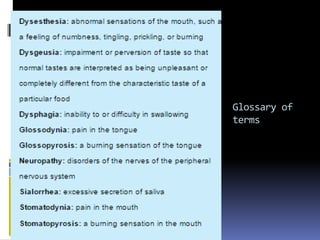
Glossary of
terms
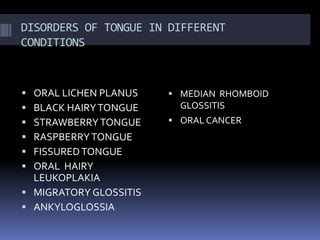
DISORDERS OF TONGUE IN DIFFERENT
CONDITIONS
 ORAL LICHEN PLANUS
 BLACK HAIRYTONGUE
 STRAWBERRYTONGUE
 RASPBERRYTONGUE
 FISSUREDTONGUE
 ORAL HAIRY
LEUKOPLAKIA
 MIGRATORY GLOSSITIS
 ANKYLOGLOSSIA
 MEDIAN RHOMBOID
GLOSSITIS
 ORAL CANCER
Oral hairy leukoplakia
 OHL – corrugated white lesion seen on
ventral and lateral surfaces of tongue
 Commonly associated with HIV
 EBV – causative agent
 Lesions are shaggy and frayed
 Plaque like and often bilateral
 Microscopy – reveals viral nuclear inclusions
with a rim of chromatin
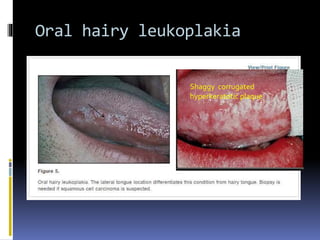
Oral hairy leukoplakia
Shaggy corrugated
hyperkeratotic plaque
Treatment
 N o treatment is rquired
 Resolves with- zidovudine. Acyclovir, gancyclovir
 Topically application of- podophyllin resin and tretinion
 OHL is highly predictive of AIDS development
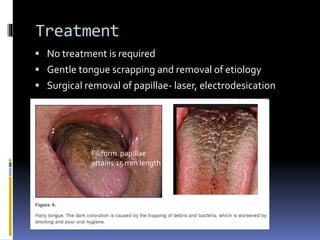
Hairy tongue/ lingua
villosa/Lingua nigra
 Defective desquamation of filiform papillae
 Accumulation of excess keratin on filiform papillae of the
dorsal part of tongue
 Dark color results from trapping of debris and bacteria
 Use of broad spectrum antibiotics
 Radiation therapy
 Seen in smokers and persons with poor oral hygeine
 Increased coffee and tea drinking
Treatment
 No treatment is required
 Gentle tongue scrapping and removal of etiology
 Surgical removal of papillae- laser, electrodesication
Filiform papillae
attains 15 mm length
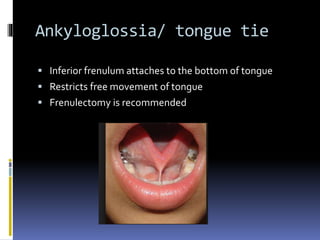
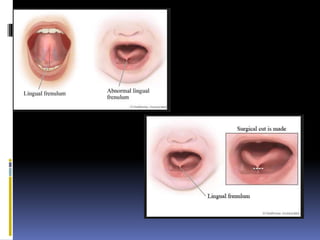
Ankyloglossia/ tongue tie
 Inferior frenulum attaches to the bottom of tongue
 Restricts free movement of tongue
 Frenulectomy is recommended
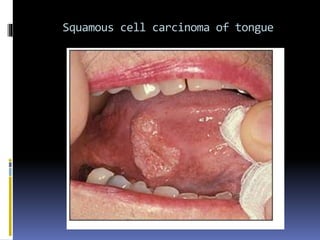
Squamous cell carcinoma of tongue
SCC of tongue
 Smoking, alcohol abuse are risk factors for
SCC of tongue
 HPV is implicated in tongue cancer
 Seen in anterior two thirds of tongue
 Usually painless
 Presents as a non healing ulcer
 Nodal metastasis is common due to
lymphatic drainage of tongue
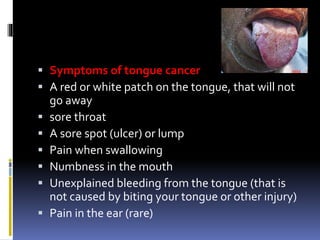
 Symptoms of tongue cancer
 A red or white patch on the tongue, that will not
go away
 sore throat
 A sore spot (ulcer) or lump
 Pain when swallowing
 Numbness in the mouth
 Unexplained bleeding from the tongue (that is
not caused by biting your tongue or other injury)
 Pain in the ear (rare)
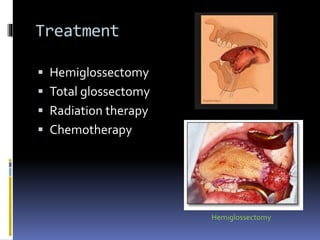
Treatment
 Hemiglossectomy
 Total glossectomy
 Radiation therapy
 Chemotherapy
Hemiglossectomy
Strawberry tongue
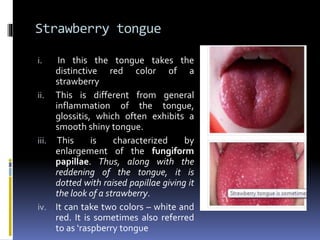
i. In this the tongue takes the
distinctive red color of a
strawberry
ii. This is different from general
inflammation of the tongue,
glossitis, which often exhibits a
smooth shiny tongue.
iii. This is characterized by
enlargement of the fungiform
papillae. Thus, along with the
reddening of the tongue, it is
dotted with raised papillae giving it
the look of a strawberry.
iv. It can take two colors – white and
red. It is sometimes also referred
to as ‘raspberry tongue
Strawberry tongue
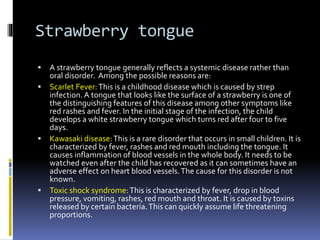
 A strawberry tongue generally reflects a systemic disease rather than
oral disorder. Among the possible reasons are:
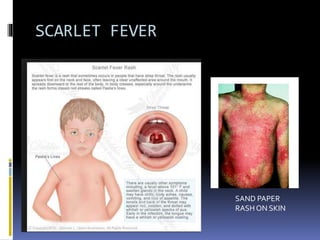
 Scarlet Fever:This is a childhood disease which is caused by strep
infection. A tongue that looks like the surface of a strawberry is one of
the distinguishing features of this disease among other symptoms like
red rashes and fever. In the initial stage of the infection, the child
develops a white strawberry tongue which turns red after four to five
days.
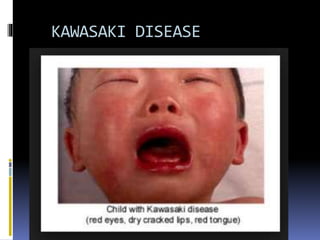
 Kawasaki disease:This is a rare disorder that occurs in small children. It is
characterized by fever, rashes and red mouth including the tongue. It
causes inflammation of blood vessels in the whole body. It needs to be
watched even after the child has recovered as it can sometimes have an
adverse effect on heart blood vessels.The cause for this disorder is not
known.
 Toxic shock syndrome:This is characterized by fever, drop in blood
pressure, vomiting, rashes, red mouth and throat. It is caused by toxins
released by certain bacteria.This can quickly assume life threatening
proportions.
SCARLET FEVER
SAND PAPER
RASH ON SKIN
KAWASAKI DISEASE
PERNICIOUS ANEMIA
 Chronic haematologic disease
 Caused by Lack of intrinsic factor used for gastric
secretions
 Traid of symptoms
 1. generalized weakness
 2. sore painful tongue
 3. tingling of extremities
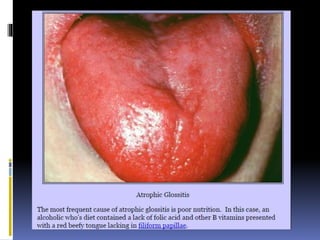
Red and beefy tongue in pernicious anemia
Glossitis
Glossodynia
Glossopyrosis leads
to bald tongue
treatment
 Administration of vit B12
 Folic acid
 Delayed treatment causes anemia,
neurological complications
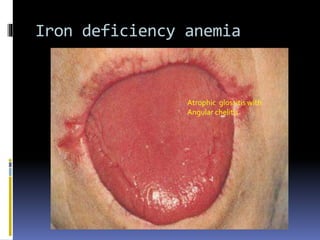
Iron deficiency anemia
Atrophic glossitis with
Angular chelitis
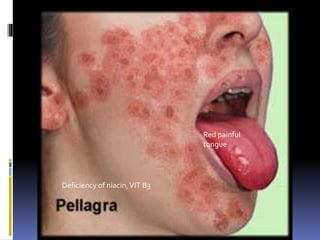
Red painful
tongue
Deficiency of niacin,VIT B3
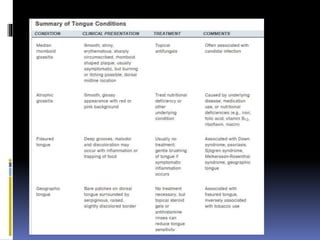
Median rhomboid glossitis
 Central papillary atrophy of tongue- defective
fusion of lingual tubercles at the midline
 Susceptibility for candidiasis
 Absence of filiform papilllae
 Presents – at posterior midline of dorsum of
tongue
 soft palate eythema at the area of contact
with the underlying tongue- kissing lesion
Treatment
 No treatment is necessary
 Antifungal therapy- reduce clinical erythema
and inflammation in candida infection
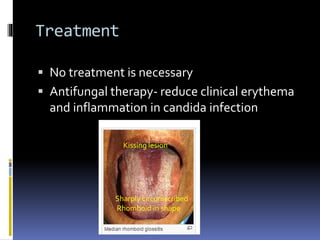
Kissing lesion
Sharply circumscribed
Rhomboid in shape
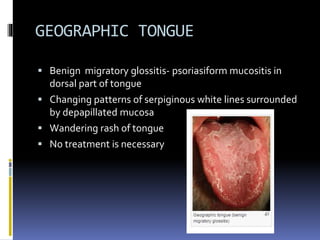
GEOGRAPHIC TONGUE
 Benign migratory glossitis- psoriasiform mucositis in
dorsal part of tongue
 Changing patterns of serpiginous white lines surrounded
by depapillated mucosa
 Wandering rash of tongue
 No treatment is necessary
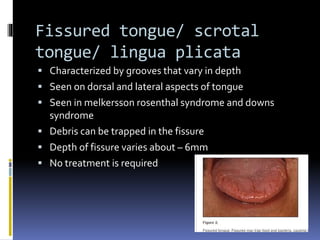
Fissured tongue/ scrotal
tongue/ lingua plicata
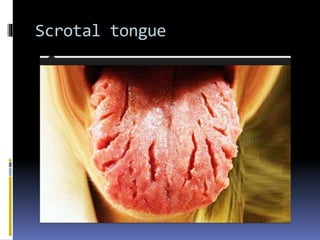
 Characterized by grooves that vary in depth
 Seen on dorsal and lateral aspects of tongue
 Seen in melkersson rosenthal syndrome and downs
syndrome
 Debris can be trapped in the fissure
 Depth of fissure varies about – 6mm
 No treatment is required
Scrotal tongue
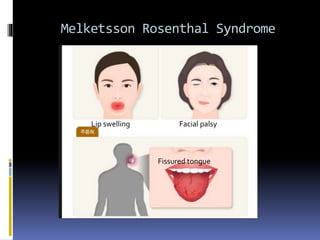
Melketsson Rosenthal Syndrome
Lip swelling Facial palsy
Fissured tongue
BMS
 Burning Mouth Syndrome
 Burning mouth syndrome (also called oral dysesthesia) occurs most
commonly in women after menopause.
 The most commonly affected part of the mouth is the tongue (pain
in the tongue is termed glossodynia)
 . A painful burning sensation may affect the entire mouth
(particularly the tongue, lips, and roof of the mouth [palate]) or just
the tongue
 The sensation may be continuous or intermittent and may gradually
increase throughout the day.
 Symptoms that commonly accompany the burning sensation
include a dry mouth, thirst, and altered taste
 Possible consequences include changes in eating habits, irritability,
depression, and avoidance of other people.
 Burning mouth syndrome is not the same as the
temporary discomfort that many people experience
after eating irritating or acidic foods. Burning mouth
syndrome is poorly understood. It probably
represents a number of different conditions with
different causes but a common symptom.
 A common cause is the use of antibiotics, which
alters the balance of bacteria in the mouth, leading
to an overgrowth of the fungus Candida (a condition
called thrush). Ill-fitting dentures and allergies to
dental materials may be causes as well.
Tongue disorders

Tongue disorders

  • 1.
  • 2.
  • 3.
    DISORDERS OF TONGUEIN DIFFERENT CONDITIONS  ORAL LICHEN PLANUS  BLACK HAIRYTONGUE  STRAWBERRYTONGUE  RASPBERRYTONGUE  FISSUREDTONGUE  ORAL HAIRY LEUKOPLAKIA  MIGRATORY GLOSSITIS  ANKYLOGLOSSIA  MEDIAN RHOMBOID GLOSSITIS  ORAL CANCER
  • 4.
    Oral hairy leukoplakia OHL – corrugated white lesion seen on ventral and lateral surfaces of tongue  Commonly associated with HIV  EBV – causative agent  Lesions are shaggy and frayed  Plaque like and often bilateral  Microscopy – reveals viral nuclear inclusions with a rim of chromatin
  • 5.
    Oral hairy leukoplakia Shaggycorrugated hyperkeratotic plaque
  • 6.
    Treatment  N otreatment is rquired  Resolves with- zidovudine. Acyclovir, gancyclovir  Topically application of- podophyllin resin and tretinion  OHL is highly predictive of AIDS development
  • 7.
    Hairy tongue/ lingua villosa/Linguanigra  Defective desquamation of filiform papillae  Accumulation of excess keratin on filiform papillae of the dorsal part of tongue  Dark color results from trapping of debris and bacteria  Use of broad spectrum antibiotics  Radiation therapy  Seen in smokers and persons with poor oral hygeine  Increased coffee and tea drinking
  • 8.
    Treatment  No treatmentis required  Gentle tongue scrapping and removal of etiology  Surgical removal of papillae- laser, electrodesication Filiform papillae attains 15 mm length
  • 9.
    Ankyloglossia/ tongue tie Inferior frenulum attaches to the bottom of tongue  Restricts free movement of tongue  Frenulectomy is recommended
  • 12.
  • 13.
    SCC of tongue Smoking, alcohol abuse are risk factors for SCC of tongue  HPV is implicated in tongue cancer  Seen in anterior two thirds of tongue  Usually painless  Presents as a non healing ulcer  Nodal metastasis is common due to lymphatic drainage of tongue
  • 14.
     Symptoms oftongue cancer  A red or white patch on the tongue, that will not go away  sore throat  A sore spot (ulcer) or lump  Pain when swallowing  Numbness in the mouth  Unexplained bleeding from the tongue (that is not caused by biting your tongue or other injury)  Pain in the ear (rare)
  • 15.
    Treatment  Hemiglossectomy  Totalglossectomy  Radiation therapy  Chemotherapy Hemiglossectomy
  • 16.
    Strawberry tongue i. Inthis the tongue takes the distinctive red color of a strawberry ii. This is different from general inflammation of the tongue, glossitis, which often exhibits a smooth shiny tongue. iii. This is characterized by enlargement of the fungiform papillae. Thus, along with the reddening of the tongue, it is dotted with raised papillae giving it the look of a strawberry. iv. It can take two colors – white and red. It is sometimes also referred to as ‘raspberry tongue
  • 17.
    Strawberry tongue  Astrawberry tongue generally reflects a systemic disease rather than oral disorder. Among the possible reasons are:  Scarlet Fever:This is a childhood disease which is caused by strep infection. A tongue that looks like the surface of a strawberry is one of the distinguishing features of this disease among other symptoms like red rashes and fever. In the initial stage of the infection, the child develops a white strawberry tongue which turns red after four to five days.  Kawasaki disease:This is a rare disorder that occurs in small children. It is characterized by fever, rashes and red mouth including the tongue. It causes inflammation of blood vessels in the whole body. It needs to be watched even after the child has recovered as it can sometimes have an adverse effect on heart blood vessels.The cause for this disorder is not known.  Toxic shock syndrome:This is characterized by fever, drop in blood pressure, vomiting, rashes, red mouth and throat. It is caused by toxins released by certain bacteria.This can quickly assume life threatening proportions.
  • 18.
  • 19.
  • 20.
    PERNICIOUS ANEMIA  Chronichaematologic disease  Caused by Lack of intrinsic factor used for gastric secretions  Traid of symptoms  1. generalized weakness  2. sore painful tongue  3. tingling of extremities
  • 21.
    Red and beefytongue in pernicious anemia Glossitis Glossodynia Glossopyrosis leads to bald tongue
  • 23.
    treatment  Administration ofvit B12  Folic acid  Delayed treatment causes anemia, neurological complications
  • 24.
    Iron deficiency anemia Atrophicglossitis with Angular chelitis
  • 25.
  • 26.
    Median rhomboid glossitis Central papillary atrophy of tongue- defective fusion of lingual tubercles at the midline  Susceptibility for candidiasis  Absence of filiform papilllae  Presents – at posterior midline of dorsum of tongue  soft palate eythema at the area of contact with the underlying tongue- kissing lesion
  • 27.
    Treatment  No treatmentis necessary  Antifungal therapy- reduce clinical erythema and inflammation in candida infection Kissing lesion Sharply circumscribed Rhomboid in shape
  • 28.
    GEOGRAPHIC TONGUE  Benignmigratory glossitis- psoriasiform mucositis in dorsal part of tongue  Changing patterns of serpiginous white lines surrounded by depapillated mucosa  Wandering rash of tongue  No treatment is necessary
  • 29.
    Fissured tongue/ scrotal tongue/lingua plicata  Characterized by grooves that vary in depth  Seen on dorsal and lateral aspects of tongue  Seen in melkersson rosenthal syndrome and downs syndrome  Debris can be trapped in the fissure  Depth of fissure varies about – 6mm  No treatment is required
  • 30.
  • 31.
    Melketsson Rosenthal Syndrome Lipswelling Facial palsy Fissured tongue
  • 32.
    BMS  Burning MouthSyndrome  Burning mouth syndrome (also called oral dysesthesia) occurs most commonly in women after menopause.  The most commonly affected part of the mouth is the tongue (pain in the tongue is termed glossodynia)  . A painful burning sensation may affect the entire mouth (particularly the tongue, lips, and roof of the mouth [palate]) or just the tongue  The sensation may be continuous or intermittent and may gradually increase throughout the day.  Symptoms that commonly accompany the burning sensation include a dry mouth, thirst, and altered taste  Possible consequences include changes in eating habits, irritability, depression, and avoidance of other people.
  • 33.
     Burning mouthsyndrome is not the same as the temporary discomfort that many people experience after eating irritating or acidic foods. Burning mouth syndrome is poorly understood. It probably represents a number of different conditions with different causes but a common symptom.  A common cause is the use of antibiotics, which alters the balance of bacteria in the mouth, leading to an overgrowth of the fungus Candida (a condition called thrush). Ill-fitting dentures and allergies to dental materials may be causes as well.