Reactive white lesions
Faisal Moteq Al-Qahtani
431803127
Reactive white lesions
1. Linea Alba (White Line)
2. Frictional (Traumatic) Keratosis
3. Cheek Chewing
4. Chemical Injuries of the Oral
Mucosa
5. Actinic Keratosis (Cheilitis)
6. Smokeless Tobacco–Induced
Keratosis
7. Nicotine Stomatitis
8. Sanguinaria-Induced Leukoplakia
Linea Alba (White Line)
 Definition
• It is a horizontal streak on the buccal mucosa at
the level of the occlusal plane.
• It is a very common finding most likely
associated with pressure, frictional irritation, or
sucking trauma from the facial surfaces of the
teeth.
Linea Alba (White Line)
a horizontal streak at the level occlusal
plane.
Linea Alba (White Line)
 Tretment
• No treatment is indicated for patients with
linea alba.
• The white streak may disappear spontaneously
in some people.
Frictional (Traumatic) Keratosis
 Definition
• defined as a white plaque with a rough and
frayed surface that is clearly related to an
identifiable source of mechanical irritation
• Usually resolve on elimination of the irritant.
Frictional (Traumatic) Keratosis
Leukoplakic-appearing area of frictional
keratosis from an ill-fitting denture.
Frictional (Traumatic) Keratosis
 Tretment
• Upon removal of the offending agent, the
lesion should resolve.
• within 2 weeks, Biopsies should be performed
on lesions that do not heal to rule out a
dysplastic lesion.
Cheek biting
 Definition
• Ragged, irregular white tissue of the buccal
mucosa in the line of occlusion
• May be ulcerated
• Due to chewing or biting the cheeks
• May also be seen on labial mucosa
Cheek biting
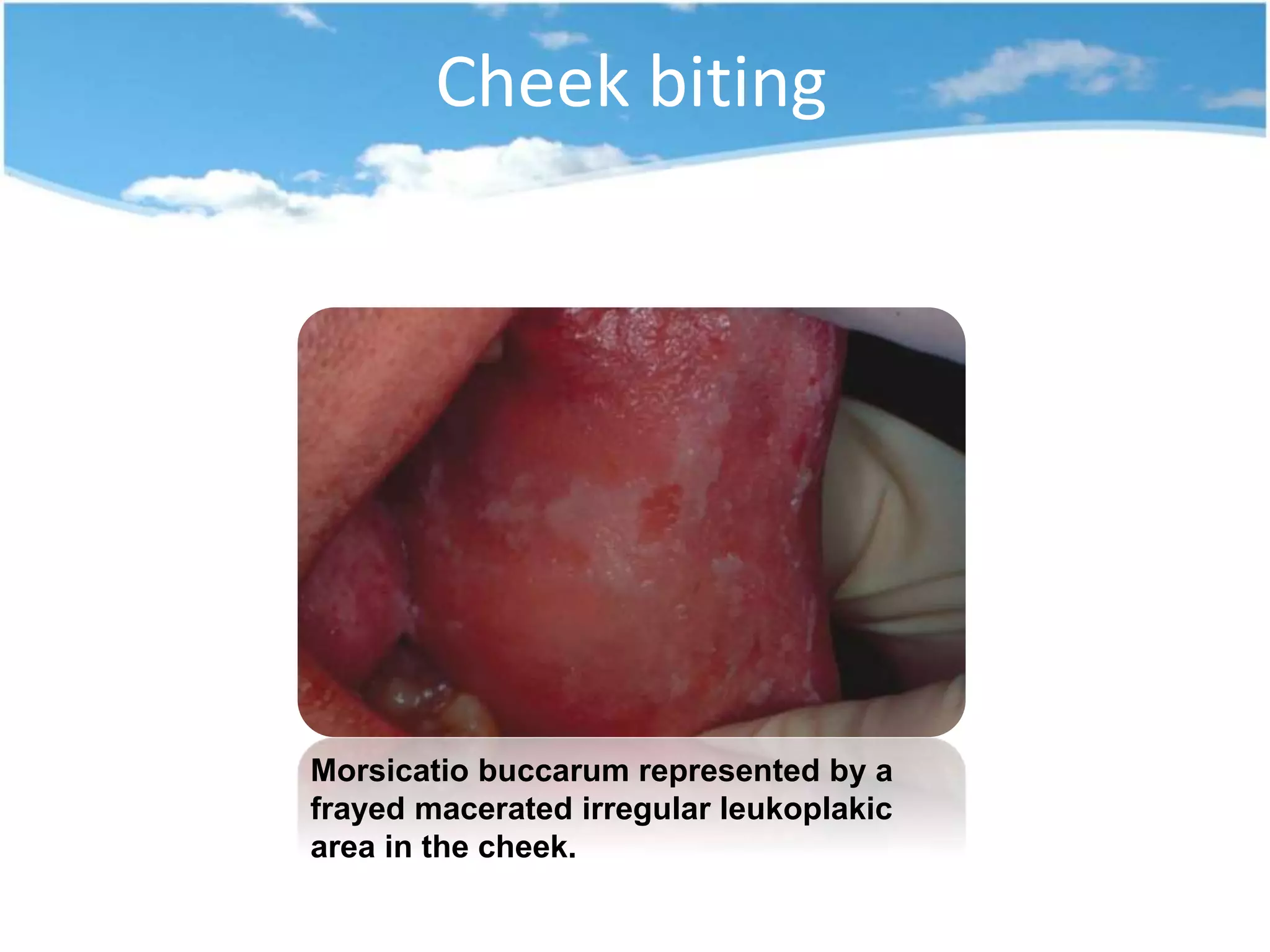
Morsicatio buccarum represented by a
frayed macerated irregular leukoplakic
area in the cheek.
Cheek biting
 Tretment
• Since the lesions result from an unconscious
and/or nervous habit, no treatment is
indicated.
• For those desiring treatment and unable to
stop the chewing habit, a plastic occlusal night
guard may be fabricated.
Chemical Injuries of the Oral Mucosa
 Definition
• Transient nonkeratotic white lesions of the oral
mucosa .
• Are often a result of chemical injuries caused by
a variety of caustic agents retained in the mouth
for long periods of time.
• The white lesions are attributable to the
formation of a superficial pseudomembrane
composed of a necrotic surface tissue and an
inflammatory exudates.
Chemical Injuries of the Oral Mucosa
B- Aspirin burn, creating
a pseudomembranous
necrotic white area.
C- Extensive tissue
necrosis caused by
injudicious use of
silver nitrate.
A- Severe ulceration
and sloughing of
mucosa, caused by
use of a cinnamon-
containing dentifrice
A B C
Chemical Injuries of the Oral Mucosa
 Tretment
• The best treatment of chemical burns of the oral
cavity is prevention.
• Most superficial burns heal within 1 or 2 weeks.
• A protective emollient agent such as a film of
methyl cellulose may provide relief.
• However, deep-tissue burns and necrosis may
require careful débridement of the surface,
followed by antibiotic coverage
Actinic Keratosis (Cheilitis)
 Definition
• Actinic (or solar) keratosis is a premalignant
epithelial lesion directly related to long-term
sun exposure
• classically found on the vermilion border of
the lower lip as well as on other sun-exposed
areas of the skin.
• A small percentage of these lesions will
transform into squamous cell carcinoma.
Actinic Keratosis (Cheilitis)
Distinctive raised white plaque, representing
actinic cheilitis.
Actinic Keratosis (Cheilitis)
Tretment
• The mainstay of treatment of actinic keratosis
is surgery.
• Chemotherapeutic agents such as topical 5-
fluorouracil have been used with some
success.
• Patients treated with nonsurgical methods
therefore require long-term follow-up, about
10% of these lesions will undergo malignant
transformation.
Nicotine Stomatitis
 Definition
• Palate initially becomes diffusely erythematous
and eventually turns grayish white secondary
to hyperkeratosis .
• multiple keratotic papules with depressed red
centers correspond to dilated and inflamed
excretory duct openings of the minor salivary
glands .
Nicotine Stomatitis
A B
A- Histologic appearance of
nicotine stomatitis, showing
hyperkeratosis and acanthosis
with squamous metaplasia of the
dilated salivary duct.
B- Nicotine stomatitis with diffuse
white change in the palatal
mucosa, along with elevated
papules with red centers.
Nicotine Stomatitis
 Tretment
• Nicotine stomatitis is completely reversible once
the habit is discontinued.
• The lesions usually resolve within 2 weeks of
cessation of smoking.
• Biopsy of nicotine stomatitis is rarely indicated
except to reassure the patient.
• biopsy should be performed on any white lesion
of the palatal mucosa that persists after month
of discontinuation of smoking habit
Smokeless Tobacco–Induced Keratosis
 Definition
• Chewing tobacco is an important established risk
factor for the development of oral carcinoma .
• Smokeless tobacco keratosis is the term for white
plaques that form on the oral mucosa, usually
vestibule, and the gingiva in the areas which
habitually come into direct contact with tobacco
in a smokeless tobacco user .
• These lesions are characterized by thickened,
white mucosa that is typically wrinkled.
Smokeless Tobacco–Induced Keratosis
A B C
C- Snuff pouch
showing extensive
periodontal tissue
destruction and a
thickened area of
leukoplakia.
B- Snuff pouch with a
white wrinkled
mucosal surface.
A- White leathery
nodular tobacco pouch.
These thickened areas
are more worrisome for
malignant
transformation
Smokeless Tobacco–Induced Keratosis
 Tretment
• Cessation of use almost always leads to a normal
mucosal appearance within 1 to 2 weeks.
• The risk of malignant transformation is increased
fourfold for chronic smokeless tobacco users
Sanguinaria-Induced Leukoplakia
 Definition
• a mixture of benzophenanthridine alkaloids
derived from the common bloodroot plant (
Sanguinaria canadensis ), has been used in oral
rinses and toothpaste.
• The most widely used product with Sanguinaria,
Viadent, has been shown, through extensive
clinical trials, to be effective against plaque
buildup and gingivitis.
Sanguinaria-Induced Leukoplakia
A- Typical white corrugated
leukoplakia in the maxillary
vestibule, associated with
sanguinaria use.
A B
B- Mandibular vestibular lesion in
the same patient
Sanguinaria-Induced Leukoplakia
 Tretment
• No appropriate treatment has been established
for sanguinariainduced leukoplakia .
• In all cases, complete discontinuation of
Sanguinaria-containing products and cessation
of any other harmful habits such as tobacco or
alcohol use is mandatory.
• All patients should be given careful clinical
followup, with a biopsy of any recurrent or
worsening lesion(s).
be careful !!

Reactive white lesions oral pathology

  • 1.
    Reactive white lesions FaisalMoteq Al-Qahtani 431803127
  • 2.
    Reactive white lesions 1.Linea Alba (White Line) 2. Frictional (Traumatic) Keratosis 3. Cheek Chewing 4. Chemical Injuries of the Oral Mucosa 5. Actinic Keratosis (Cheilitis) 6. Smokeless Tobacco–Induced Keratosis 7. Nicotine Stomatitis 8. Sanguinaria-Induced Leukoplakia
  • 3.
    Linea Alba (WhiteLine)  Definition • It is a horizontal streak on the buccal mucosa at the level of the occlusal plane. • It is a very common finding most likely associated with pressure, frictional irritation, or sucking trauma from the facial surfaces of the teeth.
  • 4.
    Linea Alba (WhiteLine) a horizontal streak at the level occlusal plane.
  • 5.
    Linea Alba (WhiteLine)  Tretment • No treatment is indicated for patients with linea alba. • The white streak may disappear spontaneously in some people.
  • 6.
    Frictional (Traumatic) Keratosis Definition • defined as a white plaque with a rough and frayed surface that is clearly related to an identifiable source of mechanical irritation • Usually resolve on elimination of the irritant.
  • 7.
    Frictional (Traumatic) Keratosis Leukoplakic-appearingarea of frictional keratosis from an ill-fitting denture.
  • 8.
    Frictional (Traumatic) Keratosis Tretment • Upon removal of the offending agent, the lesion should resolve. • within 2 weeks, Biopsies should be performed on lesions that do not heal to rule out a dysplastic lesion.
  • 9.
    Cheek biting  Definition •Ragged, irregular white tissue of the buccal mucosa in the line of occlusion • May be ulcerated • Due to chewing or biting the cheeks • May also be seen on labial mucosa
  • 10.
    Cheek biting Morsicatio buccarumrepresented by a frayed macerated irregular leukoplakic area in the cheek.
  • 11.
    Cheek biting  Tretment •Since the lesions result from an unconscious and/or nervous habit, no treatment is indicated. • For those desiring treatment and unable to stop the chewing habit, a plastic occlusal night guard may be fabricated.
  • 12.
    Chemical Injuries ofthe Oral Mucosa  Definition • Transient nonkeratotic white lesions of the oral mucosa . • Are often a result of chemical injuries caused by a variety of caustic agents retained in the mouth for long periods of time. • The white lesions are attributable to the formation of a superficial pseudomembrane composed of a necrotic surface tissue and an inflammatory exudates.
  • 13.
    Chemical Injuries ofthe Oral Mucosa B- Aspirin burn, creating a pseudomembranous necrotic white area. C- Extensive tissue necrosis caused by injudicious use of silver nitrate. A- Severe ulceration and sloughing of mucosa, caused by use of a cinnamon- containing dentifrice A B C
  • 14.
    Chemical Injuries ofthe Oral Mucosa  Tretment • The best treatment of chemical burns of the oral cavity is prevention. • Most superficial burns heal within 1 or 2 weeks. • A protective emollient agent such as a film of methyl cellulose may provide relief. • However, deep-tissue burns and necrosis may require careful débridement of the surface, followed by antibiotic coverage
  • 15.
    Actinic Keratosis (Cheilitis) Definition • Actinic (or solar) keratosis is a premalignant epithelial lesion directly related to long-term sun exposure • classically found on the vermilion border of the lower lip as well as on other sun-exposed areas of the skin. • A small percentage of these lesions will transform into squamous cell carcinoma.
  • 16.
    Actinic Keratosis (Cheilitis) Distinctiveraised white plaque, representing actinic cheilitis.
  • 17.
    Actinic Keratosis (Cheilitis) Tretment •The mainstay of treatment of actinic keratosis is surgery. • Chemotherapeutic agents such as topical 5- fluorouracil have been used with some success. • Patients treated with nonsurgical methods therefore require long-term follow-up, about 10% of these lesions will undergo malignant transformation.
  • 18.
    Nicotine Stomatitis  Definition •Palate initially becomes diffusely erythematous and eventually turns grayish white secondary to hyperkeratosis . • multiple keratotic papules with depressed red centers correspond to dilated and inflamed excretory duct openings of the minor salivary glands .
  • 19.
    Nicotine Stomatitis A B A-Histologic appearance of nicotine stomatitis, showing hyperkeratosis and acanthosis with squamous metaplasia of the dilated salivary duct. B- Nicotine stomatitis with diffuse white change in the palatal mucosa, along with elevated papules with red centers.
  • 20.
    Nicotine Stomatitis  Tretment •Nicotine stomatitis is completely reversible once the habit is discontinued. • The lesions usually resolve within 2 weeks of cessation of smoking. • Biopsy of nicotine stomatitis is rarely indicated except to reassure the patient. • biopsy should be performed on any white lesion of the palatal mucosa that persists after month of discontinuation of smoking habit
  • 21.
    Smokeless Tobacco–Induced Keratosis Definition • Chewing tobacco is an important established risk factor for the development of oral carcinoma . • Smokeless tobacco keratosis is the term for white plaques that form on the oral mucosa, usually vestibule, and the gingiva in the areas which habitually come into direct contact with tobacco in a smokeless tobacco user . • These lesions are characterized by thickened, white mucosa that is typically wrinkled.
  • 22.
    Smokeless Tobacco–Induced Keratosis AB C C- Snuff pouch showing extensive periodontal tissue destruction and a thickened area of leukoplakia. B- Snuff pouch with a white wrinkled mucosal surface. A- White leathery nodular tobacco pouch. These thickened areas are more worrisome for malignant transformation
  • 23.
    Smokeless Tobacco–Induced Keratosis Tretment • Cessation of use almost always leads to a normal mucosal appearance within 1 to 2 weeks. • The risk of malignant transformation is increased fourfold for chronic smokeless tobacco users
  • 24.
    Sanguinaria-Induced Leukoplakia  Definition •a mixture of benzophenanthridine alkaloids derived from the common bloodroot plant ( Sanguinaria canadensis ), has been used in oral rinses and toothpaste. • The most widely used product with Sanguinaria, Viadent, has been shown, through extensive clinical trials, to be effective against plaque buildup and gingivitis.
  • 25.
    Sanguinaria-Induced Leukoplakia A- Typicalwhite corrugated leukoplakia in the maxillary vestibule, associated with sanguinaria use. A B B- Mandibular vestibular lesion in the same patient
  • 26.
    Sanguinaria-Induced Leukoplakia  Tretment •No appropriate treatment has been established for sanguinariainduced leukoplakia . • In all cases, complete discontinuation of Sanguinaria-containing products and cessation of any other harmful habits such as tobacco or alcohol use is mandatory. • All patients should be given careful clinical followup, with a biopsy of any recurrent or worsening lesion(s).
  • 27.