Diseases of the tongue
GROUP 1
ODONTOLOGY
PRESENTATION
Amoud
University
Group 1
1.Abdiaziz Ahmed Mohamed
2. Abdiaziz isse Ahmed
3.Abdifatah Barkhad Mohamed
4. Abdikani Ibrahim Nour
5. Abdirashid Ahmed Duale
6. Abdirisak Mohamed H.Abdi
7.Zakariye Aadan Faarah
8. Abdishakur Hassan Ismail
9.Ifrah Bade Osman
10. Iidle Mohamed Said
Diseases of the
tongue
Topics we are going to cover
1 Glossitis
2 Vascular and lymphatic lesions
 Infantile hemangiomas
 Oral varices
3 Reactive and inflammatory processes
 hairy tongue
 Fissured tongue
4. Infectious conditions
 Oral hairy leukoplakia
 Candidiasis
5 systemic disease
 Pernicous anemia
6. Malignant neoplasms
 Squamous cell carcinoma
7 strawberry tongue
Introduction

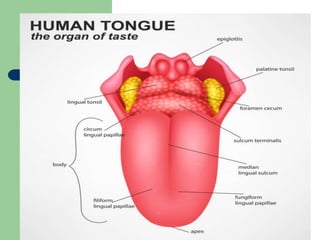
The tongue is a complex organ involved in
speech and expression as well as in
gustation, mastication, and deglutition.
 The oral cavity and the tongue are sites of
neoplasms, reactive processes, and
infections and may be a harbinger of
systemic diseases
Functions of the tongue
 Speech
 Sucking
 Taste
 Digestion
 Maintenance of oral hygiene
Glossitis
 Glossitis is the term used for the red, smooth
and sore tongue
 particularly characteristic of anaemia. These
features are a
 combination of signs (redness and
smoothness) and a symptoms (soreness)
which are not always associated.
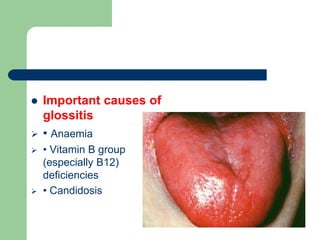
 Important causes of
glossitis
 • Anaemia
 • Vitamin B group
(especially B12)
deficiencies
 • Candidosis
Inx
 Detailed haematological examination is
essential.
Treatment
 treatment of specific causes quickly relieves
the symptoms.
Vascular and lymphatic lesions
(Infantile hemangiomas)
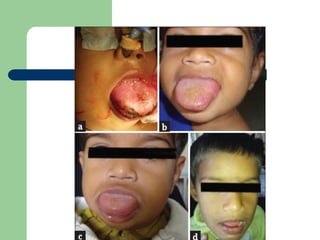
 Infantile hemangiomas (IHs) are benign
vascular neoplasms and are the most
common soft tissue tumors in childhood
 They are more prevalent in girls and most
commonly affect the head and neck region
 The majority of growth of IHs is seen in the
first 2 months of life
Clinical features
Although oral IHs are rare relative to the skin, they
represent one of the most common lesions in the oral
cavity of children and often affect the tongue, buccal
mucosa, lips (soft tissue mass, pain, swelling and/or
discoloration)
the clinical differential diagnosis is dependent on the tumor
depth and includes pyogenic granuloma, angiosarcoma,
and other vascular tumors
Treatment
 The treatment of IHs is dependent on the risk
of compromise of vital organs and structures
as well as cosmesis.
 Oral propranolol is now Food and Drug
Administration approved for IHs and has
become the gold standard for treatment
 Response rates for propranolol are 98% with
a goal dose of 2mg/kg/day and 6 months of
therapy
Oral varices
 Oral varices are a common developmental
anomaly noted in older adults.
 The etiology of oral varicosities remains
unknown. Although the data are
controversial, there may be an association
with old age, smoking, and cardiovascular
disease
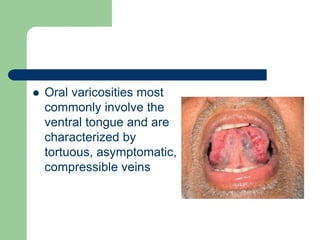
 Oral varicosities most
commonly involve the
ventral tongue and are
characterized by
tortuous, asymptomatic,
compressible veins
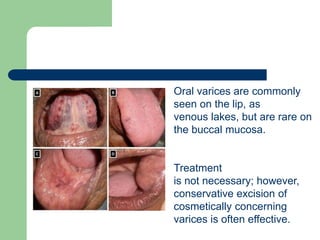
Oral varices are commonly
seen on the lip, as
venous lakes, but are rare on
the buccal mucosa.
Treatment
is not necessary; however,
conservative excision of
cosmetically concerning
varices is often effective.
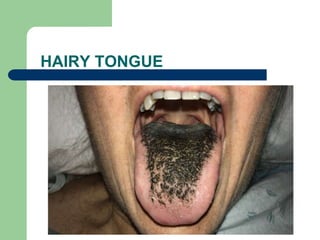
HAIRY TONGUE
 The filiform papillae which are the cone-shaped
structures that don't contain taste buds, so have no
taste function
 These filiform papillae can become elongated and
hair-like forming a thick fur on the dorsum of the
tongue.
 The filaments may be up to half a centimetre long
and pale brown to black in colour Adults are affected
but the cause is unknown.
HAIRY TONGUE
Risk factors
 Heavy smoking, excessive use of antiseptic
mouthwashes, and
 defective diet have been blamed, but their effect is
questionable
 Treatment
 The measure most likely to succeed is to persuade
the patient to scrape off the hyperplastic papillae and
vigorously cleanse the dorsum of the tongue with a
firm toothbrush.
 Surgical removal by electrodessication
Fissured tongue
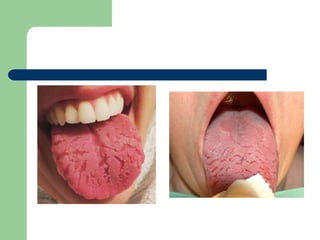
 Fissured tongue (FT) is
a normal variant seen
in up to 20-30% of the
population,
characterized by an
increased number of
fissures and grooves at
the central and lateral
aspects of the tongue
This condition is idiopathic,
more common
in older individuals, and
thought to be a reactive
process
FT is the most common
tongue finding, seen in up to
one third of patients with
psoriasis
 Clinically, FT is
characterized by
multiple,
asymptomatic 2- to 3-
mm grooves and
fissures on the dorsal
surface of the tongue
There is no effective
treatment for FT;
however, we recommend
good oral hygiene with
brushing deep into the
fissures to remove
debris, lessen the
microbial burden, and
reduce halitosis .
Infectious conditions
 Oral hairy leukoplakia
OHL is a corrugated white lesion seen on
ventral and lateral surfaces of the tongue
Commonly associated with HIV
EBV is the causative agent
Clinical features
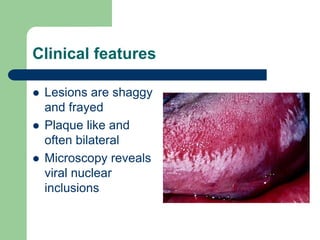
 Lesions are shaggy
and frayed
 Plaque like and
often bilateral
 Microscopy reveals
viral nuclear
inclusions
Treatment
 No treatment is required usually but….
 Resolves with Zidovudine, Acyclovir,
gancyclovir
 Topical application of podophyllin and
tretinion
 OHL is highly predictive of AIDS
development.
Oral candidiasis
 Oral candidiasis is most commonly caused
by Candida albicans.
 Median rhomboid glossitis is a unique form of
candidiasis that is characterized by large
rhomboidal, atrophic plaques on the
posterior-central tongue anterior .
 The surface of the tongue may be lobulated
or smooth, and the lesions .
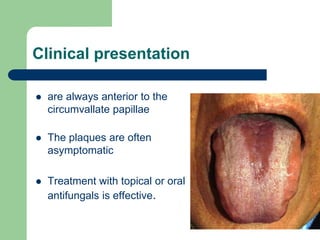
Clinical presentation
 are always anterior to the
circumvallate papillae
 The plaques are often
asymptomatic
 Treatment with topical or oral
antifungals is effective.
Pernitious anemia
 Chronic hematologic disease
 Caused by lack of intrinsic factor used for
gastric sectretions
 Triad of symptoms
1. Generalized weakness
2. Sore painful tongue
3. Tingling of extremities
Treatment
 Adminstration of vit b12
 Follic acid
delayed treatment causes anemia and
neurological symptoms
Malignant neoplasms
(Squamous cell carcinoma)
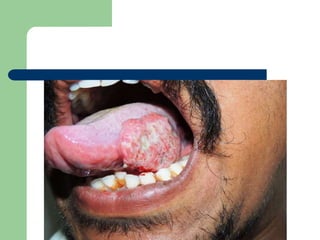
 SCC is the most common oral malignancy and is a
significant worldwide health issue.
 Oral SCC is more common in men and in those older
than age 40 .
 Extrinsic risk factors include tobacco, alcohol, and sun
exposure (if on the lip).
 Intrinsic risk factors include immunosuppression,
longstanding
inflammation, LP, HPV infection, HIV infection, and
nutritional deficiencies
clinical presentation
 The clinical presentation of oral SCCs is highly
variable; therefore, one should maintain a high index
of suspicion , perform a biopsy early in the disease
course, and perform repeat biopsies in refractory oral
inflammatory diseases
 Clues to the diagnosis include longstanding lesions,
irregular and ulcerated papules, nodules, and
plaques that extend above the normal epithelium
 The most common sites are the posterior
lateral and ventral surface of the tongue.
 The floor of the mouth is the second most
common location, whereas SCC of the dorsal
surface of the tongue is rare.
Treatment
 Multimodal therapy with surgical excision,
chemotherapy,
 Or
 radiation remains the standard of care.
Recurrence is high in oral SCC; therefore,
long-term monitoring is required
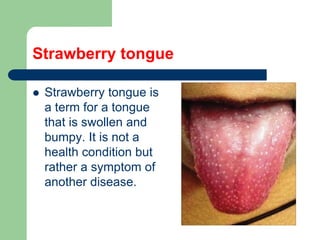
Strawberry tongue
 Strawberry tongue is
a term for a tongue
that is swollen and
bumpy. It is not a
health condition but
rather a symptom of
another disease.
Causes
 Kawasaki Disease
 Scarlet Fever
 Toxic Shock Syndrome
 Yellow Fever
 Recurrent Toxin-Mediated Perianal Erythema
 Recalcitrant Erythematous Desquamating
Disorder
symptoms
 Strawberry tongue typically presents with the
following symptoms
 Tongue rash
 Swollen tongue
 Increased tongue size
 Small bumps on the tongue that look like strawberry
seeds
 Redness on the tongue
Treatment
 How to treat strawberry tongue depends on the
cause
 Antibiotics (for bacterial infections)
 IV immune globulin and aspirin (for Kawasaki
disease)
 IV fluids
 Pain relievers and fever reducers (for yellow fever)9
 Antihistamines (for allergies)
 Typically, the symptoms will also disappear when the
condition causing strawberry tongue resolves.
group_1_denta.pptx.ppt

group_1_denta.pptx.ppt

  • 1.
    Diseases of thetongue GROUP 1 ODONTOLOGY PRESENTATION
  • 2.
    Amoud University Group 1 1.Abdiaziz AhmedMohamed 2. Abdiaziz isse Ahmed 3.Abdifatah Barkhad Mohamed 4. Abdikani Ibrahim Nour 5. Abdirashid Ahmed Duale 6. Abdirisak Mohamed H.Abdi 7.Zakariye Aadan Faarah 8. Abdishakur Hassan Ismail 9.Ifrah Bade Osman 10. Iidle Mohamed Said Diseases of the tongue
  • 3.
    Topics we aregoing to cover 1 Glossitis 2 Vascular and lymphatic lesions  Infantile hemangiomas  Oral varices 3 Reactive and inflammatory processes  hairy tongue  Fissured tongue 4. Infectious conditions  Oral hairy leukoplakia  Candidiasis 5 systemic disease  Pernicous anemia 6. Malignant neoplasms  Squamous cell carcinoma 7 strawberry tongue
  • 4.
    Introduction  The tongue isa complex organ involved in speech and expression as well as in gustation, mastication, and deglutition.  The oral cavity and the tongue are sites of neoplasms, reactive processes, and infections and may be a harbinger of systemic diseases
  • 6.
    Functions of thetongue  Speech  Sucking  Taste  Digestion  Maintenance of oral hygiene
  • 7.
    Glossitis  Glossitis isthe term used for the red, smooth and sore tongue  particularly characteristic of anaemia. These features are a  combination of signs (redness and smoothness) and a symptoms (soreness) which are not always associated.
  • 8.
     Important causesof glossitis  • Anaemia  • Vitamin B group (especially B12) deficiencies  • Candidosis
  • 9.
    Inx  Detailed haematologicalexamination is essential. Treatment  treatment of specific causes quickly relieves the symptoms.
  • 10.
    Vascular and lymphaticlesions (Infantile hemangiomas)  Infantile hemangiomas (IHs) are benign vascular neoplasms and are the most common soft tissue tumors in childhood  They are more prevalent in girls and most commonly affect the head and neck region  The majority of growth of IHs is seen in the first 2 months of life
  • 11.
    Clinical features Although oralIHs are rare relative to the skin, they represent one of the most common lesions in the oral cavity of children and often affect the tongue, buccal mucosa, lips (soft tissue mass, pain, swelling and/or discoloration) the clinical differential diagnosis is dependent on the tumor depth and includes pyogenic granuloma, angiosarcoma, and other vascular tumors
  • 13.
    Treatment  The treatmentof IHs is dependent on the risk of compromise of vital organs and structures as well as cosmesis.  Oral propranolol is now Food and Drug Administration approved for IHs and has become the gold standard for treatment  Response rates for propranolol are 98% with a goal dose of 2mg/kg/day and 6 months of therapy
  • 14.
    Oral varices  Oralvarices are a common developmental anomaly noted in older adults.  The etiology of oral varicosities remains unknown. Although the data are controversial, there may be an association with old age, smoking, and cardiovascular disease
  • 15.
     Oral varicositiesmost commonly involve the ventral tongue and are characterized by tortuous, asymptomatic, compressible veins
  • 16.
    Oral varices arecommonly seen on the lip, as venous lakes, but are rare on the buccal mucosa. Treatment is not necessary; however, conservative excision of cosmetically concerning varices is often effective.
  • 17.
    HAIRY TONGUE  Thefiliform papillae which are the cone-shaped structures that don't contain taste buds, so have no taste function  These filiform papillae can become elongated and hair-like forming a thick fur on the dorsum of the tongue.  The filaments may be up to half a centimetre long and pale brown to black in colour Adults are affected but the cause is unknown.
  • 18.
  • 19.
    Risk factors  Heavysmoking, excessive use of antiseptic mouthwashes, and  defective diet have been blamed, but their effect is questionable  Treatment  The measure most likely to succeed is to persuade the patient to scrape off the hyperplastic papillae and vigorously cleanse the dorsum of the tongue with a firm toothbrush.  Surgical removal by electrodessication
  • 20.
    Fissured tongue  Fissuredtongue (FT) is a normal variant seen in up to 20-30% of the population, characterized by an increased number of fissures and grooves at the central and lateral aspects of the tongue This condition is idiopathic, more common in older individuals, and thought to be a reactive process FT is the most common tongue finding, seen in up to one third of patients with psoriasis
  • 22.
     Clinically, FTis characterized by multiple, asymptomatic 2- to 3- mm grooves and fissures on the dorsal surface of the tongue There is no effective treatment for FT; however, we recommend good oral hygiene with brushing deep into the fissures to remove debris, lessen the microbial burden, and reduce halitosis .
  • 23.
    Infectious conditions  Oralhairy leukoplakia OHL is a corrugated white lesion seen on ventral and lateral surfaces of the tongue Commonly associated with HIV EBV is the causative agent
  • 24.
    Clinical features  Lesionsare shaggy and frayed  Plaque like and often bilateral  Microscopy reveals viral nuclear inclusions
  • 25.
    Treatment  No treatmentis required usually but….  Resolves with Zidovudine, Acyclovir, gancyclovir  Topical application of podophyllin and tretinion  OHL is highly predictive of AIDS development.
  • 26.
    Oral candidiasis  Oralcandidiasis is most commonly caused by Candida albicans.  Median rhomboid glossitis is a unique form of candidiasis that is characterized by large rhomboidal, atrophic plaques on the posterior-central tongue anterior .  The surface of the tongue may be lobulated or smooth, and the lesions .
  • 27.
    Clinical presentation  arealways anterior to the circumvallate papillae  The plaques are often asymptomatic  Treatment with topical or oral antifungals is effective.
  • 28.
    Pernitious anemia  Chronichematologic disease  Caused by lack of intrinsic factor used for gastric sectretions  Triad of symptoms 1. Generalized weakness 2. Sore painful tongue 3. Tingling of extremities
  • 29.
    Treatment  Adminstration ofvit b12  Follic acid delayed treatment causes anemia and neurological symptoms
  • 30.
    Malignant neoplasms (Squamous cellcarcinoma)  SCC is the most common oral malignancy and is a significant worldwide health issue.  Oral SCC is more common in men and in those older than age 40 .  Extrinsic risk factors include tobacco, alcohol, and sun exposure (if on the lip).  Intrinsic risk factors include immunosuppression, longstanding inflammation, LP, HPV infection, HIV infection, and nutritional deficiencies
  • 32.
    clinical presentation  Theclinical presentation of oral SCCs is highly variable; therefore, one should maintain a high index of suspicion , perform a biopsy early in the disease course, and perform repeat biopsies in refractory oral inflammatory diseases  Clues to the diagnosis include longstanding lesions, irregular and ulcerated papules, nodules, and plaques that extend above the normal epithelium
  • 33.
     The mostcommon sites are the posterior lateral and ventral surface of the tongue.  The floor of the mouth is the second most common location, whereas SCC of the dorsal surface of the tongue is rare.
  • 34.
    Treatment  Multimodal therapywith surgical excision, chemotherapy,  Or  radiation remains the standard of care. Recurrence is high in oral SCC; therefore, long-term monitoring is required
  • 35.
    Strawberry tongue  Strawberrytongue is a term for a tongue that is swollen and bumpy. It is not a health condition but rather a symptom of another disease.
  • 36.
    Causes  Kawasaki Disease Scarlet Fever  Toxic Shock Syndrome  Yellow Fever  Recurrent Toxin-Mediated Perianal Erythema  Recalcitrant Erythematous Desquamating Disorder
  • 37.
    symptoms  Strawberry tonguetypically presents with the following symptoms  Tongue rash  Swollen tongue  Increased tongue size  Small bumps on the tongue that look like strawberry seeds  Redness on the tongue
  • 38.
    Treatment  How totreat strawberry tongue depends on the cause  Antibiotics (for bacterial infections)  IV immune globulin and aspirin (for Kawasaki disease)  IV fluids  Pain relievers and fever reducers (for yellow fever)9  Antihistamines (for allergies)  Typically, the symptoms will also disappear when the condition causing strawberry tongue resolves.