Acute gingival conditions
Dr. Enas Elgendy
Ass. Professor of Oral Medicine,
Periodontology& Oral Diagnosis
Faculty of Dentistry
Kafrelsheikh University
Acute gingival conditions
 Acute necrotizing ulcerative gingivitis
(NUG)
 Acute herpetic gingivostomatitis
 Thermal, electrical and chemical
gingivostomatitis
 Pericoronitits
 Gingival abscess
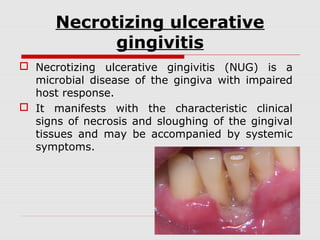
Necrotizing ulcerative
gingivitis
 Necrotizing ulcerative gingivitis (NUG) is a
microbial disease of the gingiva with impaired
host response.
 It manifests with the characteristic clinical
signs of necrosis and sloughing of the gingival
tissues and may be accompanied by systemic
symptoms.
Necrotizing ulcerative gingivitis has
been called many names:
 Trench mouth
 Vincent’s Stomatitis
 Vincent’s Infection
 Fusospirochetal Gingivitis
 Acute Ulcerative Gingivitis
 Necrotizing Gingivitis
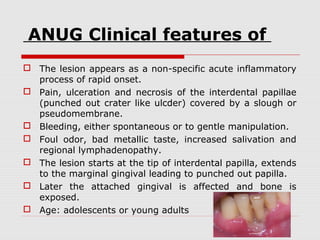
ANUG Clinical features of
 The lesion appears as a non-specific acute inflammatory
process of rapid onset.
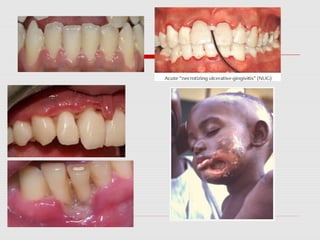
 Pain, ulceration and necrosis of the interdental papillae
(punched out crater like ulcder) covered by a slough or
pseudomembrane.
 Bleeding, either spontaneous or to gentle manipulation.
 Foul odor, bad metallic taste, increased salivation and
regional lymphadenopathy.
 The lesion starts at the tip of interdental papilla, extends
to the marginal gingival leading to punched out papilla.
 Later the attached gingival is affected and bone is
exposed.
 Age: adolescents or young adults
Stages of ANUG progression (Horning
and Cohen 1995)
STAGE 1: Necrosis of tip of Inter dental papilla
STAGE 2: Necrosis of entire papilla
STAGE 3: Necrosis extending to the gingival margin
STAGE 4: Necrosis extending to Attached gingiva
STAGE 5: Necrosis into Buccal/Labial Mucosa
STAGE 6: Necrosis exposing Alveolar Bone
STAGE 7: Necrosis perforating skin of cheek
Predisposing factors of ANUG
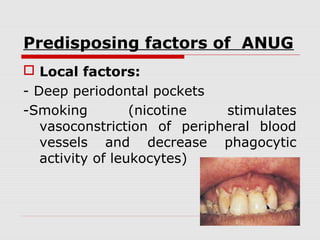
 Local factors:
- Deep periodontal pockets
-Smoking (nicotine stimulates
vasoconstriction of peripheral blood
vessels and decrease phagocytic
activity of leukocytes)
Predisposing factors of ANUG
Systemic factors: as altered host
response:
Systemic disease, such as anemia,
leukemia and AIDS
Nutritional deficiency states (Poor
nutritional habits and insufficient protein
intake, vitamin C, B deficiencies)
Stress
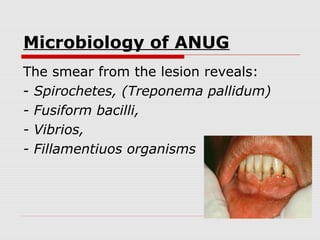
Microbiology of ANUG
The smear from the lesion reveals:
- Spirochetes, (Treponema pallidum)
- Fusiform bacilli,
- Vibrios,
- Fillamentiuos organisms
Microscopically of ANUG
 Ulceration of the gingival epithelium
with necrosis of C.T
 The pseudomembrane contains
- dead epithelial cells,
- inflammatory cells,
- a fibrin meshwork
- various microorganisms.
Zone I: Bacterial zone, it is the most
superficial zone consists of varied bacteria
including spirochetes.
Zone II: Neutrophil zone, contains
numerous leukocytes predominantly
neutrophil and bacteria including spirochetes.
Zone III: Necrotic zone consists of a dead
tissue cells, remnant of connective tissue
fragments and bacteria including spirochetes.
Zone IV: Zone of spirochetes infiltration:
consists of a well preserved tissue infiltration
with spirochetes without other organism.
Four zone of ANAG
Diagnosis of ANUG
 Based on clinical findings of pain,
ulceration and bleeding.
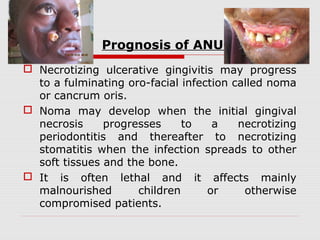
Prognosis of ANUG
 Necrotizing ulcerative gingivitis may progress
to a fulminating oro-facial infection called noma
or cancrum oris.
 Noma may develop when the initial gingival
necrosis progresses to a necrotizing
periodontitis and thereafter to necrotizing
stomatitis when the infection spreads to other
soft tissues and the bone.
 It is often lethal and it affects mainly
malnourished children or otherwise
compromised patients.
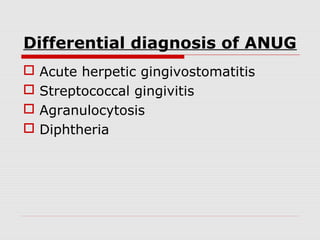
Differential diagnosis of ANUG
 Acute herpetic gingivostomatitis
 Streptococcal gingivitis
 Agranulocytosis
 Diphtheria
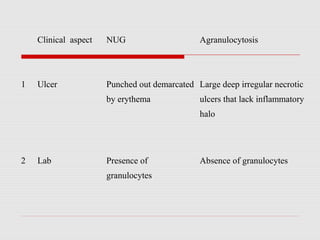
Clinical aspect NUG Agranulocytosis
1 Ulcer Punched out demarcated
by erythema
Large deep irregular necrotic
ulcers that lack inflammatory
halo
2 Lab Presence of
granulocytes
Absence of granulocytes
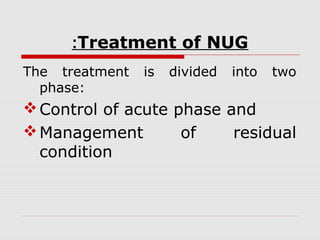
Treatment of NUG:
The treatment is divided into two
phase:
Control of acute phase and
Management of residual
condition
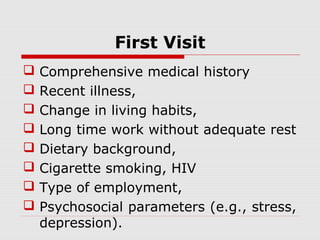
First Visit
 Comprehensive medical history
 Recent illness,
 Change in living habits,
 Long time work without adequate rest
 Dietary background,
 Cigarette smoking, HIV
 Type of employment,
 Psychosocial parameters (e.g., stress,
depression).
First Visit
 Is the disease recurrent?
 Are the recurrences associated with
specific factors, such as
menstruation, particular foods,
exhaustion, or mental stress?
 Has there been any previous
treatment? When and for how long?
First Visit
The examination of the patient should
include:
 general appearance,
 presence of halitosis,
 presence of skin lesions,
 vital signs including temperature, and
palpation for the presence of enlarged
lymph nodes, especially submaxillary
and submental nodes then:
First Visit
 Isolate the area with cotton rolls and dried.
 A topical anesthetic is applied, and after 2 or 3 minutes
the areas are gently swabbed with a moistened cotton
pellet to remove the pseudomembrane and non-attached
surface debris. Bleeding may be profuse. Each cotton
pellet is used in a small area, and then discarded;
sweeping motions over large areas with a single pellet
are not recommended.
 The superficial calculus is removed. Ultrasonic scalers
are very useful for this purpose because they do not
elicit pain, and the water jet and cavitation aid in lavage
of the area. Subgingival scaling and curettage are
contraindicated at this time because these procedures
may extend the infection into the deeper tissues and
may also cause bacteremia.
First Visit
 Patients with moderate or severe NUG
and local lymphadenopathy or other
systemic signs or symptoms are placed
on an antibiotic regimen of amoxicillin,
500 mg orally every 6 hours for 10 days.
For amoxicillin sensitive patients,
erythromycin (500 mg every 6 hours) or
metronidazole (500 mg twice daily for 7
days) may used. Systemic complications
should subside in 1 to 3 days.
First Visit
 The patient is discharged with the following
instructions:
1. Avoid tobacco, alcohol, and condiments.
2. Rinse with a glassful of an equal mixture of 3%
hydrogen peroxide and warm water every 2
hours and/or twice daily with 0.12%
chlorhexidine solution.
3. An analgesic, such as a nonsteroidal anti-
inflammatory drug (NSAID; e.g., ibuprofen), is
appropriate for pain relief.
Second Visit
 At the second visit, 1 or 2 days after the first visit,
the patient’s condition is usually improved.
 The pain is diminished or no longer present.
 The gingival margins of the involved areas are
erythematous, but without a superficial
pseudomembrane.
 Scaling is performed if necessary and sensitivity
permits. Shrinkage of the gingiva may expose
previously covered calculus, which is gently
removed.
 The instructions to the patient are the same as
those given previously.
Third Visit
 At the next visit, approximately 5 days
after the second visit, the patient should
be essentially symptom free. Some
erythema may still be present in the
involved areas, and the gingiva may be
slightly painful on tactile stimulation.
 The patient is instructed in plaque
control procedures which are essential
for the success of the treatment and the
maintenance of periodontal health.
Third Visit
 The hydrogen peroxide rinses are
discontinued, but chlorhexidine rinses
can be maintained for 2 or 3 weeks.
Scaling and root planing are repeated if
necessary.
 The patient should be reevaluated at 1
month to determine compliance with
oral hygiene, health habits, psychosocial
factors, the potential need for
reconstructive or esthetic surgery.
Acute herpetic gingivostomatitis
 Due to primary infection with Herpes simplex
virus
 Age: < 2years
 Transmitted by droplet infection
 The incubation period is 5-10 days
 It is self limiting (1-2 weeks) and heals
spontaneously without scars.
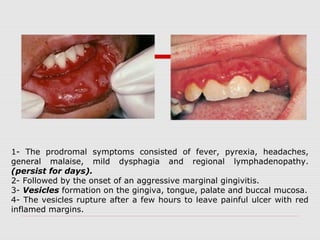
1- The prodromal symptoms consisted of fever, pyrexia, headaches,
general malaise, mild dysphagia and regional lymphadenopathy.
(persist for days).
2- Followed by the onset of an aggressive marginal gingivitis.
3- Vesicles formation on the gingiva, tongue, palate and buccal mucosa.
4- The vesicles rupture after a few hours to leave painful ulcer with red
inflamed margins.
Treatment
 1- Mainly palliative including: bed rest,
soft diet and maintain fluid in take.
 2- Paracetamol suspension is given for
pyrexia.
 3- In severe cases acyclovir suspension
is given five times daily for five days
(200mg).
 4- Plaque control by chlorhexidine spray.
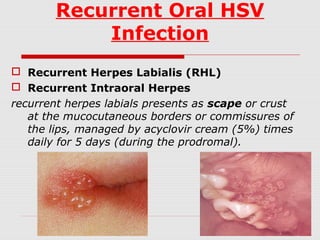
Recurrent Oral HSV Infection
Latent herpes viruses dormant in
sensory ganglia and reactivated by
1. Fever
2. Stress
3. Exposure to sunlight
4. Trauma
5. Hormonal alterations.
6. Nutritional deficiency
7. systemic upset.
Recurrent Oral HSV
Infection
 Recurrent Herpes Labialis (RHL)
 Recurrent Intraoral Herpes
recurrent herpes labials presents as scape or crust
at the mucocutaneous borders or commissures of
the lips, managed by acyclovir cream (5%) times
daily for 5 days (during the prodromal).
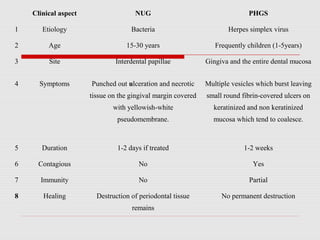
Clinical aspect NUG PHGS
1 Etiology Bacteria Herpes simplex virus
2 Age 15-30 years Frequently children (1-5years)
3 Site Interdental papillae Gingiva and the entire dental mucosa
4 Symptoms Punched out ulceration and necrotic
tissue on the gingival margin covered
with yellowish-white
pseudomembrane.
Multiple vesicles which burst leaving
small round fibrin-covered ulcers on
keratinized and non keratinized
mucosa which tend to coalesce.
5 Duration 1-2 days if treated 1-2 weeks
6 Contagious No Yes
7 Immunity No Partial
8 Healing Destruction of periodontal tissue
remains
No permanent destruction
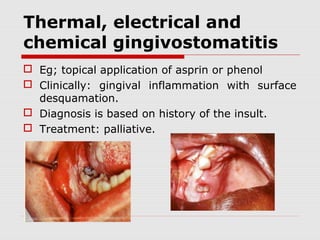
Thermal, electrical and
chemical gingivostomatitis
 Eg; topical application of asprin or phenol
 Clinically: gingival inflammation with surface
desquamation.
 Diagnosis is based on history of the insult.
 Treatment: palliative.
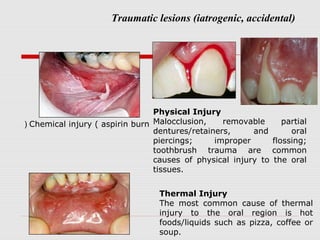
Traumatic lesions (iatrogenic, accidental)
Chemical injury ( aspirin burn(
Physical Injury
Malocclusion, removable partial
dentures/retainers, and oral
piercings; improper flossing;
toothbrush trauma are common
causes of physical injury to the oral
tissues.
Thermal Injury
The most common cause of thermal
injury to the oral region is hot
foods/liquids such as pizza, coffee or
soup.
Pericoronitits
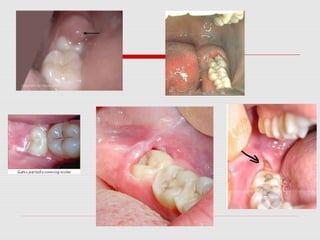
 Inflammation of the gingival covering the
crown of partially erupted tooth (mostly
mandibular 3rd
molar).
 Inflammation is due to accumulation of food
debris and bacterial growth.
 Inflammatory edema increases the bulk of the
gingival leading to more trauma.
 Pain may radiate to the ear, throat or floor of
the mouth.
 Systemic manifestations may be associated.
Gingival Abscess
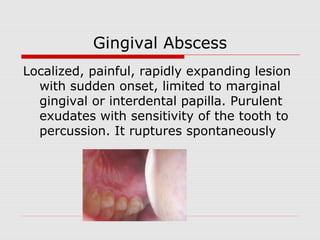
Localized, painful, rapidly expanding lesion
with sudden onset, limited to marginal
gingival or interdental papilla. Purulent
exudates with sensitivity of the tooth to
percussion. It ruptures spontaneously
Gingival Abscess
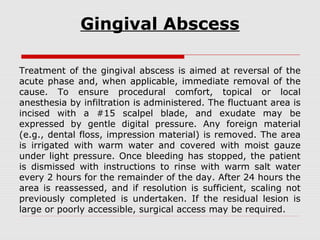
Treatment of the gingival abscess is aimed at reversal of the
acute phase and, when applicable, immediate removal of the
cause. To ensure procedural comfort, topical or local
anesthesia by infiltration is administered. The fluctuant area is
incised with a #15 scalpel blade, and exudate may be
expressed by gentle digital pressure. Any foreign material
(e.g., dental floss, impression material) is removed. The area
is irrigated with warm water and covered with moist gauze
under light pressure. Once bleeding has stopped, the patient
is dismissed with instructions to rinse with warm salt water
every 2 hours for the remainder of the day. After 24 hours the
area is reassessed, and if resolution is sufficient, scaling not
previously completed is undertaken. If the residual lesion is
large or poorly accessible, surgical access may be required.
Acute gingival conditions

Acute gingival conditions

  • 1.
    Acute gingival conditions Dr.Enas Elgendy Ass. Professor of Oral Medicine, Periodontology& Oral Diagnosis Faculty of Dentistry Kafrelsheikh University
  • 2.
    Acute gingival conditions Acute necrotizing ulcerative gingivitis (NUG)  Acute herpetic gingivostomatitis  Thermal, electrical and chemical gingivostomatitis  Pericoronitits  Gingival abscess
  • 3.
    Necrotizing ulcerative gingivitis  Necrotizingulcerative gingivitis (NUG) is a microbial disease of the gingiva with impaired host response.  It manifests with the characteristic clinical signs of necrosis and sloughing of the gingival tissues and may be accompanied by systemic symptoms.
  • 4.
    Necrotizing ulcerative gingivitishas been called many names:  Trench mouth  Vincent’s Stomatitis  Vincent’s Infection  Fusospirochetal Gingivitis  Acute Ulcerative Gingivitis  Necrotizing Gingivitis
  • 5.
    ANUG Clinical featuresof  The lesion appears as a non-specific acute inflammatory process of rapid onset.  Pain, ulceration and necrosis of the interdental papillae (punched out crater like ulcder) covered by a slough or pseudomembrane.  Bleeding, either spontaneous or to gentle manipulation.  Foul odor, bad metallic taste, increased salivation and regional lymphadenopathy.  The lesion starts at the tip of interdental papilla, extends to the marginal gingival leading to punched out papilla.  Later the attached gingival is affected and bone is exposed.  Age: adolescents or young adults
  • 6.
    Stages of ANUGprogression (Horning and Cohen 1995) STAGE 1: Necrosis of tip of Inter dental papilla STAGE 2: Necrosis of entire papilla STAGE 3: Necrosis extending to the gingival margin STAGE 4: Necrosis extending to Attached gingiva STAGE 5: Necrosis into Buccal/Labial Mucosa STAGE 6: Necrosis exposing Alveolar Bone STAGE 7: Necrosis perforating skin of cheek
  • 8.
    Predisposing factors ofANUG  Local factors: - Deep periodontal pockets -Smoking (nicotine stimulates vasoconstriction of peripheral blood vessels and decrease phagocytic activity of leukocytes)
  • 9.
    Predisposing factors ofANUG Systemic factors: as altered host response: Systemic disease, such as anemia, leukemia and AIDS Nutritional deficiency states (Poor nutritional habits and insufficient protein intake, vitamin C, B deficiencies) Stress
  • 10.
    Microbiology of ANUG Thesmear from the lesion reveals: - Spirochetes, (Treponema pallidum) - Fusiform bacilli, - Vibrios, - Fillamentiuos organisms
  • 11.
    Microscopically of ANUG Ulceration of the gingival epithelium with necrosis of C.T  The pseudomembrane contains - dead epithelial cells, - inflammatory cells, - a fibrin meshwork - various microorganisms.
  • 12.
    Zone I: Bacterialzone, it is the most superficial zone consists of varied bacteria including spirochetes. Zone II: Neutrophil zone, contains numerous leukocytes predominantly neutrophil and bacteria including spirochetes. Zone III: Necrotic zone consists of a dead tissue cells, remnant of connective tissue fragments and bacteria including spirochetes. Zone IV: Zone of spirochetes infiltration: consists of a well preserved tissue infiltration with spirochetes without other organism. Four zone of ANAG
  • 13.
    Diagnosis of ANUG Based on clinical findings of pain, ulceration and bleeding.
  • 14.
    Prognosis of ANUG Necrotizing ulcerative gingivitis may progress to a fulminating oro-facial infection called noma or cancrum oris.  Noma may develop when the initial gingival necrosis progresses to a necrotizing periodontitis and thereafter to necrotizing stomatitis when the infection spreads to other soft tissues and the bone.  It is often lethal and it affects mainly malnourished children or otherwise compromised patients.
  • 15.
    Differential diagnosis ofANUG  Acute herpetic gingivostomatitis  Streptococcal gingivitis  Agranulocytosis  Diphtheria
  • 16.
    Clinical aspect NUGAgranulocytosis 1 Ulcer Punched out demarcated by erythema Large deep irregular necrotic ulcers that lack inflammatory halo 2 Lab Presence of granulocytes Absence of granulocytes
  • 17.
    Treatment of NUG: Thetreatment is divided into two phase: Control of acute phase and Management of residual condition
  • 18.
    First Visit  Comprehensivemedical history  Recent illness,  Change in living habits,  Long time work without adequate rest  Dietary background,  Cigarette smoking, HIV  Type of employment,  Psychosocial parameters (e.g., stress, depression).
  • 19.
    First Visit  Isthe disease recurrent?  Are the recurrences associated with specific factors, such as menstruation, particular foods, exhaustion, or mental stress?  Has there been any previous treatment? When and for how long?
  • 20.
    First Visit The examinationof the patient should include:  general appearance,  presence of halitosis,  presence of skin lesions,  vital signs including temperature, and palpation for the presence of enlarged lymph nodes, especially submaxillary and submental nodes then:
  • 21.
    First Visit  Isolatethe area with cotton rolls and dried.  A topical anesthetic is applied, and after 2 or 3 minutes the areas are gently swabbed with a moistened cotton pellet to remove the pseudomembrane and non-attached surface debris. Bleeding may be profuse. Each cotton pellet is used in a small area, and then discarded; sweeping motions over large areas with a single pellet are not recommended.  The superficial calculus is removed. Ultrasonic scalers are very useful for this purpose because they do not elicit pain, and the water jet and cavitation aid in lavage of the area. Subgingival scaling and curettage are contraindicated at this time because these procedures may extend the infection into the deeper tissues and may also cause bacteremia.
  • 22.
    First Visit  Patientswith moderate or severe NUG and local lymphadenopathy or other systemic signs or symptoms are placed on an antibiotic regimen of amoxicillin, 500 mg orally every 6 hours for 10 days. For amoxicillin sensitive patients, erythromycin (500 mg every 6 hours) or metronidazole (500 mg twice daily for 7 days) may used. Systemic complications should subside in 1 to 3 days.
  • 23.
    First Visit  Thepatient is discharged with the following instructions: 1. Avoid tobacco, alcohol, and condiments. 2. Rinse with a glassful of an equal mixture of 3% hydrogen peroxide and warm water every 2 hours and/or twice daily with 0.12% chlorhexidine solution. 3. An analgesic, such as a nonsteroidal anti- inflammatory drug (NSAID; e.g., ibuprofen), is appropriate for pain relief.
  • 24.
    Second Visit  Atthe second visit, 1 or 2 days after the first visit, the patient’s condition is usually improved.  The pain is diminished or no longer present.  The gingival margins of the involved areas are erythematous, but without a superficial pseudomembrane.  Scaling is performed if necessary and sensitivity permits. Shrinkage of the gingiva may expose previously covered calculus, which is gently removed.  The instructions to the patient are the same as those given previously.
  • 25.
    Third Visit  Atthe next visit, approximately 5 days after the second visit, the patient should be essentially symptom free. Some erythema may still be present in the involved areas, and the gingiva may be slightly painful on tactile stimulation.  The patient is instructed in plaque control procedures which are essential for the success of the treatment and the maintenance of periodontal health.
  • 26.
    Third Visit  Thehydrogen peroxide rinses are discontinued, but chlorhexidine rinses can be maintained for 2 or 3 weeks. Scaling and root planing are repeated if necessary.  The patient should be reevaluated at 1 month to determine compliance with oral hygiene, health habits, psychosocial factors, the potential need for reconstructive or esthetic surgery.
  • 27.
    Acute herpetic gingivostomatitis Due to primary infection with Herpes simplex virus  Age: < 2years  Transmitted by droplet infection  The incubation period is 5-10 days  It is self limiting (1-2 weeks) and heals spontaneously without scars.
  • 28.
    1- The prodromalsymptoms consisted of fever, pyrexia, headaches, general malaise, mild dysphagia and regional lymphadenopathy. (persist for days). 2- Followed by the onset of an aggressive marginal gingivitis. 3- Vesicles formation on the gingiva, tongue, palate and buccal mucosa. 4- The vesicles rupture after a few hours to leave painful ulcer with red inflamed margins.
  • 29.
    Treatment  1- Mainlypalliative including: bed rest, soft diet and maintain fluid in take.  2- Paracetamol suspension is given for pyrexia.  3- In severe cases acyclovir suspension is given five times daily for five days (200mg).  4- Plaque control by chlorhexidine spray.
  • 30.
    Recurrent Oral HSVInfection Latent herpes viruses dormant in sensory ganglia and reactivated by 1. Fever 2. Stress 3. Exposure to sunlight 4. Trauma 5. Hormonal alterations. 6. Nutritional deficiency 7. systemic upset.
  • 31.
    Recurrent Oral HSV Infection Recurrent Herpes Labialis (RHL)  Recurrent Intraoral Herpes recurrent herpes labials presents as scape or crust at the mucocutaneous borders or commissures of the lips, managed by acyclovir cream (5%) times daily for 5 days (during the prodromal).
  • 32.
    Clinical aspect NUGPHGS 1 Etiology Bacteria Herpes simplex virus 2 Age 15-30 years Frequently children (1-5years) 3 Site Interdental papillae Gingiva and the entire dental mucosa 4 Symptoms Punched out ulceration and necrotic tissue on the gingival margin covered with yellowish-white pseudomembrane. Multiple vesicles which burst leaving small round fibrin-covered ulcers on keratinized and non keratinized mucosa which tend to coalesce. 5 Duration 1-2 days if treated 1-2 weeks 6 Contagious No Yes 7 Immunity No Partial 8 Healing Destruction of periodontal tissue remains No permanent destruction
  • 33.
    Thermal, electrical and chemicalgingivostomatitis  Eg; topical application of asprin or phenol  Clinically: gingival inflammation with surface desquamation.  Diagnosis is based on history of the insult.  Treatment: palliative.
  • 34.
    Traumatic lesions (iatrogenic,accidental) Chemical injury ( aspirin burn( Physical Injury Malocclusion, removable partial dentures/retainers, and oral piercings; improper flossing; toothbrush trauma are common causes of physical injury to the oral tissues. Thermal Injury The most common cause of thermal injury to the oral region is hot foods/liquids such as pizza, coffee or soup.
  • 35.
    Pericoronitits  Inflammation ofthe gingival covering the crown of partially erupted tooth (mostly mandibular 3rd molar).  Inflammation is due to accumulation of food debris and bacterial growth.  Inflammatory edema increases the bulk of the gingival leading to more trauma.  Pain may radiate to the ear, throat or floor of the mouth.  Systemic manifestations may be associated.
  • 37.
    Gingival Abscess Localized, painful,rapidly expanding lesion with sudden onset, limited to marginal gingival or interdental papilla. Purulent exudates with sensitivity of the tooth to percussion. It ruptures spontaneously
  • 38.
    Gingival Abscess Treatment ofthe gingival abscess is aimed at reversal of the acute phase and, when applicable, immediate removal of the cause. To ensure procedural comfort, topical or local anesthesia by infiltration is administered. The fluctuant area is incised with a #15 scalpel blade, and exudate may be expressed by gentle digital pressure. Any foreign material (e.g., dental floss, impression material) is removed. The area is irrigated with warm water and covered with moist gauze under light pressure. Once bleeding has stopped, the patient is dismissed with instructions to rinse with warm salt water every 2 hours for the remainder of the day. After 24 hours the area is reassessed, and if resolution is sufficient, scaling not previously completed is undertaken. If the residual lesion is large or poorly accessible, surgical access may be required.