
Syphilis
• Caused by Treponema pallidum
• It is transmitted by direct contact with a
clinically-detectable lesion and forms a
variety of wide-spread lesions.
• The syphilis organism is motile, can pass
through minute skin/mucosal abrasions,
and probably can pass through intact skin/
mucous membrane.
• While it is theoretically possible for a
• dentist or dental hygienist to contract the
disease from contact with an active oral
lesion, this rarely happens.
• Now proper barrier techniques are used
in dental practice (asepsis, gloves, masks,
and gowns), transmission to dental
personnel should never occur.
Pathogenesis
• Within days the spirochetes have
multiplied dramatically (spirochetemia).
• In spite of the widespread infection, the
patient has no fever and otherwise feels
just fine.
• The spirochetemia persists for months to
years; the reason for this wide variation is
unknown.
Patterns of Infection
• There are two basic forms of syphilis: 1)
syphilis “acquired” after birth—acquired
syphilis
• and 2) syphilis present at birth—
congenital syphilis.
• The disease passes through two
distinctive phases and, if not treated, may
enter a third fatal stage.
• Penicillin will kill T. pallidum.
Clinical features
• The lesions of syphilis vary in location and
appearance.
• Four stages are recognized: 1, 2, latent,
and 3.
• Not all of those infected develop the final
stage
Primary Acquired Syphilis
• “primary chancre.”
• Genitalia. In the mouth, it may be located
on the lips, the tongue, the palate or, for
that matter, anywhere else.
• Spirochetes are present in these lesions—
they are potentially infective.
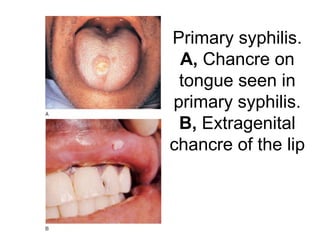
Primary syphilis.
A, Chancre on
tongue seen in
primary syphilis.
B, Extragenital
chancre of the lip
• The chancre starts as a raised hard, firm
elevation which soon becomes necrotic and
ulcerated.
• The classic lesion is cratered lesion surrounded
by an elevated rim measuring about 1.0 cm in
diameter
• When occurring in the mouth, it most closely
resembles the appearance of an invasive
squamous cell carcinoma.
• Lymphadenopathy without fever.
Secondary Acquired Syphilis
• In one to three months after, lesions of secondary syphilis appear.
• The locations of these new lesions are not related to the type or
location of original contact—they may appear anywhere.
• Most prominent is a widespread itchless rash that may appear on
the face, the trunk, and/or the extremities. In addition, circular
lesions may appear around the genitalia and anus; these are called
“condyloma latum.”
• Finally, white lesions may appear in the mouth: on the tongue, the
lips, the floor of the mouth, or elsewhere—they are known as
“mucous patches.”
• Since spirochetes abound in all these lesions, they, like the primary
chancres, are infective.
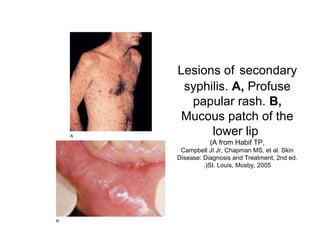
Lesions of secondary
syphilis. A, Profuse
papular rash. B,
Mucous patch of the
lower lip
(A from Habif TP,
Campbell JI Jr, Chapman MS, et al. Skin
Disease: Diagnosis and Treatment, 2nd ed.
St. Louis, Mosby, 2005.(
Latent Acquired Syphilis
• Symptom and sign-free stage
• Last months, years, or decades. Most still
harbor the spirochete and all still test
positive for nontreponemal and treponema
antibodies.
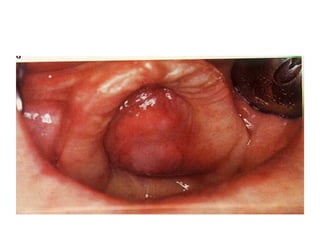
Tertiary Acquired Syphilis
“gummas.”
the stage in which disabilities, psychoses,
and deaths occur
• About 80% develop a destructive process
in the thoracic aorta causing its expansion
and rupture (thoracic aortic aneurysm(.
• Ten percent (10%( experience severe
central nervous system lesions.
Congenital Syphilis
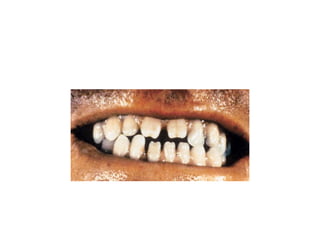
• Hutchinson’s Incisors Screwdriver-
shaped central incisors seen in
congenital syphilis.
• Mulberry Molars Berry-like molars seen
in congenital syphilis.
Diagnosis
• VDRL. This antibody not only rises with
syphilis but also may rise in other
conditions (e.g., SLE and infectious
mononucleosis)
• The fluorescent treponemal antibody test
(FTA)
• Dark Field Examination
Oral Manifestations of SYPHILIS
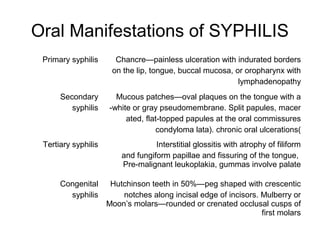
Primary syphilis Chancre—painless ulceration with indurated borders
on the lip, tongue, buccal mucosa, or oropharynx with
lymphadenopathy
Secondary
syphilis
Mucous patches—oval plaques on the tongue with a
white or gray pseudomembrane. Split papules, macer-
ated, flat-topped papules at the oral commissures
(condyloma lata). chronic oral ulcerations
Tertiary syphilis Interstitial glossitis with atrophy of filiform
and fungiform papillae and fissuring of the tongue,
Pre-malignant leukoplakia, gummas involve palate
Congenital
syphilis
Hutchinson teeth in 50%—peg shaped with crescentic
notches along incisal edge of incisors. Mulberry or
Moon’s molars—rounded or crenated occlusal cusps of
first molars
Psoriasis
• Psoriasis is an inflammatory and hyperplastic disease of
the skin, characterised by erythema and scale.
• Affects about 0.5% to 3% of different population groups.
• It is strongly familial.
• The presentation is variable and the course frequently
difficult to predict.
• The clinical manifestations are numerous and from minor
inflammation at 1 or 2 sites on the skin to total skin
involvement with pustulation and constitutional
symptoms.
• There is an associated arthritis in up to 7% of patients.
Etiology
• The primary defect may be an abnormally
activated immune response in the skin.
• The psoriatic process seems to be a complex
interaction between keratinocytes and T-
lymphocytes. Cytokines and epidermal growth
factors cause proliferation and inflammation.
• Common trigger factors are infections
(streptococcal, viral including human
immunodeficiency virus), trauma to the skin ,
psychological stress and drugs.
There may be an association between
certain types of psoriasis
(especially pustular psoriasis) and
geographic tongue
Treatment
• In a mild case, emollients or a weak
topical corticosteroid may suffice, but
disabling or disfiguring psoriasis may
warrant the use of systemic drugs such as
immunosuppressants

Dermatology

  • 2.
  • 3.
    • Caused byTreponema pallidum • It is transmitted by direct contact with a clinically-detectable lesion and forms a variety of wide-spread lesions. • The syphilis organism is motile, can pass through minute skin/mucosal abrasions, and probably can pass through intact skin/ mucous membrane.
  • 4.
    • While itis theoretically possible for a • dentist or dental hygienist to contract the disease from contact with an active oral lesion, this rarely happens. • Now proper barrier techniques are used in dental practice (asepsis, gloves, masks, and gowns), transmission to dental personnel should never occur.
  • 5.
    Pathogenesis • Within daysthe spirochetes have multiplied dramatically (spirochetemia). • In spite of the widespread infection, the patient has no fever and otherwise feels just fine. • The spirochetemia persists for months to years; the reason for this wide variation is unknown.
  • 6.
    Patterns of Infection •There are two basic forms of syphilis: 1) syphilis “acquired” after birth—acquired syphilis • and 2) syphilis present at birth— congenital syphilis.
  • 7.
    • The diseasepasses through two distinctive phases and, if not treated, may enter a third fatal stage. • Penicillin will kill T. pallidum.
  • 8.
    Clinical features • Thelesions of syphilis vary in location and appearance. • Four stages are recognized: 1, 2, latent, and 3. • Not all of those infected develop the final stage
  • 9.
    Primary Acquired Syphilis •“primary chancre.” • Genitalia. In the mouth, it may be located on the lips, the tongue, the palate or, for that matter, anywhere else. • Spirochetes are present in these lesions— they are potentially infective.
  • 10.
    Primary syphilis. A, Chancreon tongue seen in primary syphilis. B, Extragenital chancre of the lip
  • 11.
    • The chancrestarts as a raised hard, firm elevation which soon becomes necrotic and ulcerated. • The classic lesion is cratered lesion surrounded by an elevated rim measuring about 1.0 cm in diameter • When occurring in the mouth, it most closely resembles the appearance of an invasive squamous cell carcinoma. • Lymphadenopathy without fever.
  • 12.
    Secondary Acquired Syphilis •In one to three months after, lesions of secondary syphilis appear. • The locations of these new lesions are not related to the type or location of original contact—they may appear anywhere. • Most prominent is a widespread itchless rash that may appear on the face, the trunk, and/or the extremities. In addition, circular lesions may appear around the genitalia and anus; these are called “condyloma latum.” • Finally, white lesions may appear in the mouth: on the tongue, the lips, the floor of the mouth, or elsewhere—they are known as “mucous patches.” • Since spirochetes abound in all these lesions, they, like the primary chancres, are infective.
  • 13.
    Lesions of secondary syphilis.A, Profuse papular rash. B, Mucous patch of the lower lip (A from Habif TP, Campbell JI Jr, Chapman MS, et al. Skin Disease: Diagnosis and Treatment, 2nd ed. St. Louis, Mosby, 2005.(
  • 14.
    Latent Acquired Syphilis •Symptom and sign-free stage • Last months, years, or decades. Most still harbor the spirochete and all still test positive for nontreponemal and treponema antibodies.
  • 15.
    Tertiary Acquired Syphilis “gummas.” thestage in which disabilities, psychoses, and deaths occur • About 80% develop a destructive process in the thoracic aorta causing its expansion and rupture (thoracic aortic aneurysm(. • Ten percent (10%( experience severe central nervous system lesions.
  • 17.
    Congenital Syphilis • Hutchinson’sIncisors Screwdriver- shaped central incisors seen in congenital syphilis. • Mulberry Molars Berry-like molars seen in congenital syphilis.
  • 19.
    Diagnosis • VDRL. Thisantibody not only rises with syphilis but also may rise in other conditions (e.g., SLE and infectious mononucleosis) • The fluorescent treponemal antibody test (FTA) • Dark Field Examination
  • 20.
    Oral Manifestations ofSYPHILIS Primary syphilis Chancre—painless ulceration with indurated borders on the lip, tongue, buccal mucosa, or oropharynx with lymphadenopathy Secondary syphilis Mucous patches—oval plaques on the tongue with a white or gray pseudomembrane. Split papules, macer- ated, flat-topped papules at the oral commissures (condyloma lata). chronic oral ulcerations Tertiary syphilis Interstitial glossitis with atrophy of filiform and fungiform papillae and fissuring of the tongue, Pre-malignant leukoplakia, gummas involve palate Congenital syphilis Hutchinson teeth in 50%—peg shaped with crescentic notches along incisal edge of incisors. Mulberry or Moon’s molars—rounded or crenated occlusal cusps of first molars
  • 21.
    Psoriasis • Psoriasis isan inflammatory and hyperplastic disease of the skin, characterised by erythema and scale. • Affects about 0.5% to 3% of different population groups. • It is strongly familial. • The presentation is variable and the course frequently difficult to predict. • The clinical manifestations are numerous and from minor inflammation at 1 or 2 sites on the skin to total skin involvement with pustulation and constitutional symptoms. • There is an associated arthritis in up to 7% of patients.
  • 22.
    Etiology • The primarydefect may be an abnormally activated immune response in the skin. • The psoriatic process seems to be a complex interaction between keratinocytes and T- lymphocytes. Cytokines and epidermal growth factors cause proliferation and inflammation. • Common trigger factors are infections (streptococcal, viral including human immunodeficiency virus), trauma to the skin , psychological stress and drugs.
  • 23.
    There may bean association between certain types of psoriasis (especially pustular psoriasis) and geographic tongue
  • 24.
    Treatment • In amild case, emollients or a weak topical corticosteroid may suffice, but disabling or disfiguring psoriasis may warrant the use of systemic drugs such as immunosuppressants