TONGUE
DR SHUBHAM PARMAR
1ST YEAR MDS
DEPARTMENT OF PROSTHODONTICS
RURAL DENTAL COLLEGE, LONI
CONTENTS
 Introduction
 Development
 Anatomy
 Histology
 Clinical examination of tongue
 Disorders of tongue
2
 Applied anatomy
 Prosthetic implications
 Conclusion
 References
3
Introduction
 Tongue is a highly muscular organ
 Helps in speech, deglutition and taste
 Dorsal mucosa is covered by numerous
papillae, some of which bear taste buds
 The oral and pharyngeal parts of the tongue
differ in their mucosa, innervation and
developmental origins
4
Development Of Tongue
 Development - 4th week of gestation
 Tongue develops in relation to the
pharyngeal arches in the floor of the
developing mouth
5
Anterior 2/3rd of tongue
 Formed by fusion of –
 2 lateral lingual swellings
 Tuberculum impar
 Derived from 1st branchial
arch
 Supplied by lingual nerve
and chorda tympani
6
Posterior 1/3rd of tongue
 Formed from the cranial part of the
hypobranchial eminence
 Formed by 3rd arch
Development of posterior most part
is by the 4th arch
7
8
Embryonic derivation of parts of tongue
Epithelium over anterior 2/3rd 1st arch
Epithelium over posterior 1/3rd 3rd arch
Epithelium over posterior most part 4th arch
Muscles Occipital Myotomes
Anatomy of Tongue
 It has a root, apex, dorsal and a ventral
surface
 Attaches to the hyoid bone, mandible,
styloid processes, soft palate and the
pharyngeal wall by its muscles
 Intrinsic and an extrinsic group of muscles
present
9
 Dorsum
Oral
Pharyngeal
 The limbs of the sulcus terminalis run
anterolaterally to the palatoglossal arches
 The dorsal mucosa has a longitudinal median
sulcus and is covered by papillae
10
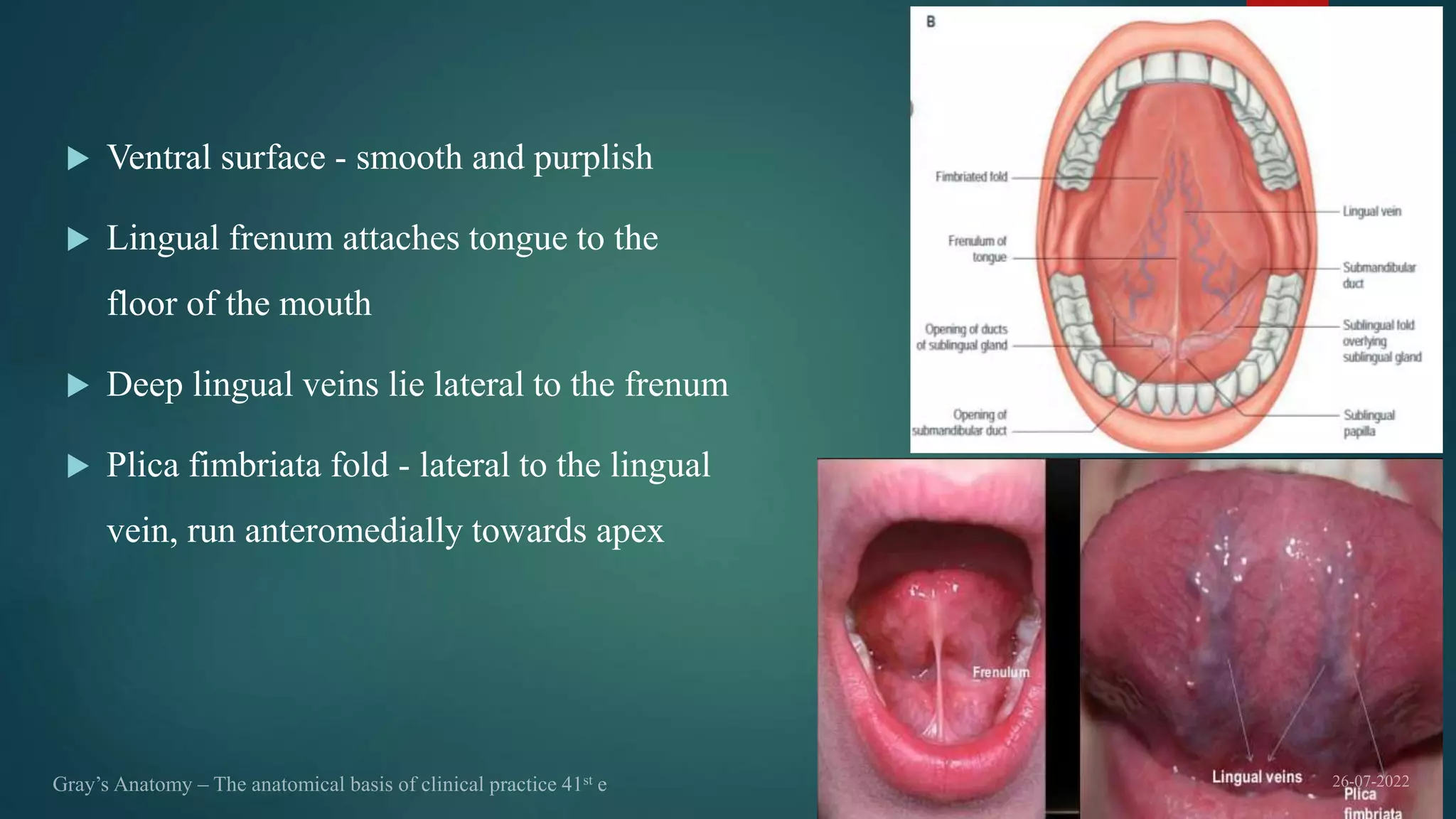
 Ventral surface - smooth and purplish
 Lingual frenum attaches tongue to the
floor of the mouth
 Deep lingual veins lie lateral to the frenum
 Plica fimbriata fold - lateral to the lingual
vein, run anteromedially towards apex
11
 The posterior part of the tongue lies
posterior to the palatoglossal arches
 Forms the anterior wall of the oropharynx
 The pharyngeal part of the tongue is devoid
of papillae
12
Muscles of Tongue
 Median fibrous septum separates tongue
into halves
 The tongue consists of 4 intrinsic and
extrinsic muscles in each half
 Intrinsic muscles - wholly within the
tongue
 Extrinsic muscles - outside the tongue
13
Extrinsic muscles 14
Genioglossus
 Genioglossus is triangular in sagittal
section
 Lies parallel to the midline
 It fans out upwards and backwards
from the origin
 Origin – Short tendon attached to the
genial tubercle
15
 Inferior fibres of genioglossus
attach to the upper anterior
surface of the hyoid body by a
thin aponeurosis near the
midline
 The Intermediate fibres pass
backwards into the posterior part
of the tongue
 The superior fibres ascend
forwards to enter the ventral
surface of the tongue
16
 Action
 Protrusion of tongue
 Depress the dorsum and make it
concave
 Deviate tongue to opposite side
 Vascular supply
 Sublingual branch of lingual artery
 Submental branch of facial artery
 Nerve Supply
 Hypoglossal nerve
17
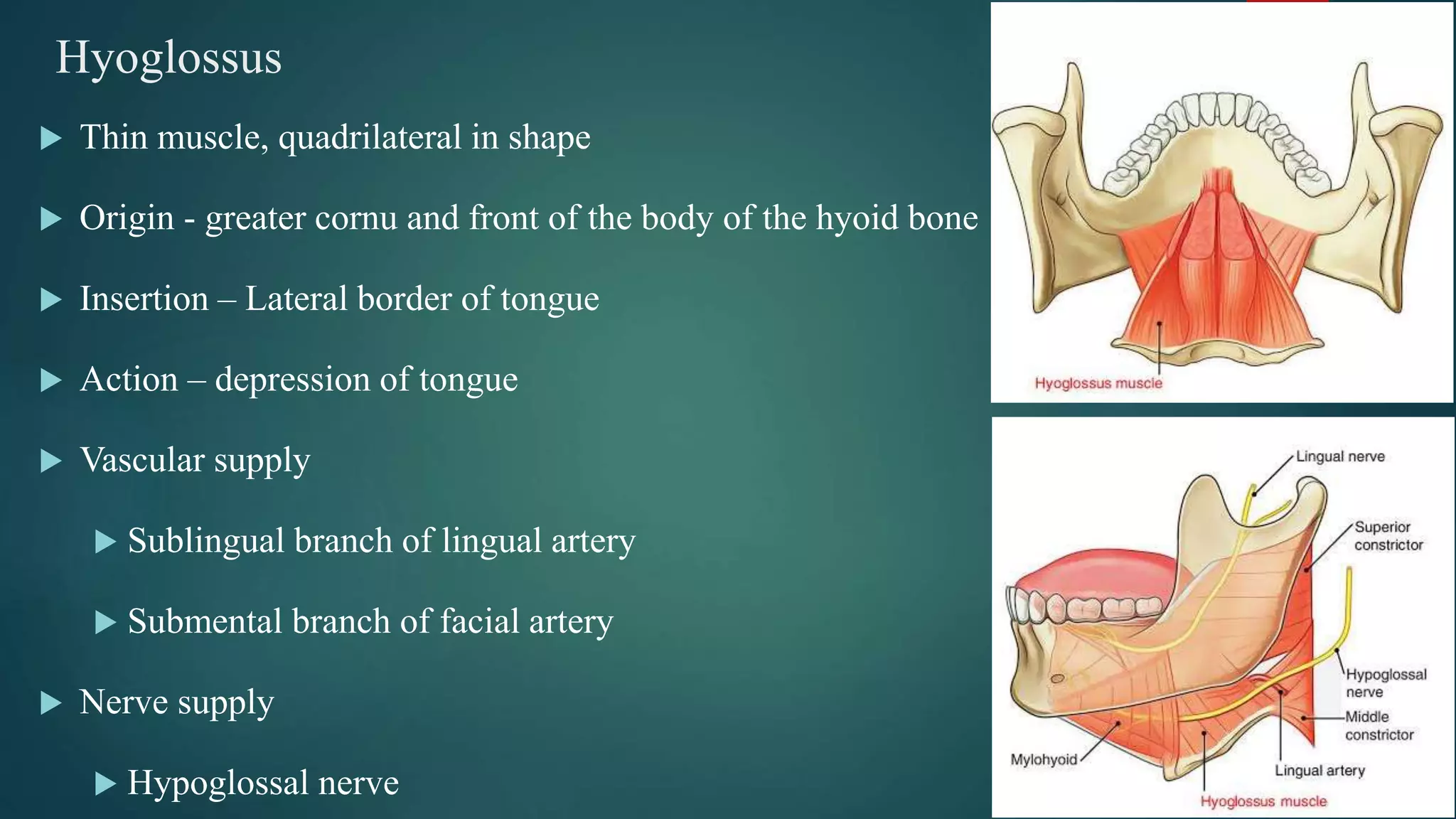
Hyoglossus
 Thin muscle, quadrilateral in shape
 Origin - greater cornu and front of the body of the hyoid bone
 Insertion – Lateral border of tongue
 Action – depression of tongue
 Vascular supply
 Sublingual branch of lingual artery
 Submental branch of facial artery
 Nerve supply
 Hypoglossal nerve
18
Styloglossus
 Shortest and smallest muscles
attached to styloid
 Origin – anterolateral aspect of the
styloid process
 Insertion – lateral border of tongue
 Action – moves the tongue
upwards and backwards
 Vascular supply - sublingual branch
of the lingual artery
 Nerve supply – hypoglossal nerve
19
Palatoglossus
 Origin – Inferior surface of palatine aponeurosis
 Insertion – lateral surface of tongue
 Action – elevates root, approximates palatoglossal arch,
closes oropharyngeal isthmus
 Vascular supply
 Ascending palatine branch of the facial artery
 Ascending pharyngeal artery
 Nerve supply
 Pharyngeal plexus
20
Intrinsic muscles of tongue 21
22
Muscle Origin Insertion action
Superior Longitudinal Submucous fibrous
tissue near the
epiglottis
Median lingual septum
Lingual margins
mucous membranes
Shortens the tongue
Pulls apex upwards
Dorsum concave
Inferior Longitudinal Root of the tongue Apex of tongue Shortens tongue
Pulls apex downwards
Dorsum convex
Transverse Median septum of
tongue
Submucous fibrous
tissue of the lingual
margin
Narrowing and
elongation of tongue
Vertical Dorsal part of tongue Ventral part of tongue Makes tongue flatter
and wider
Vascular Supply
23
External Carotid Artery
Lingual Artery
Dorsal lingual
arteries -
posterior part
Deep lingual
artery -
anterior part
Sublingual artery -
sublingual gland
and floor of mouth
Venous drainage 24
Dorsal Lingual Vein
- dorsum and side of
tongue
Deep Lingual Vein – tip of
tongue
Internal Jugular Vein
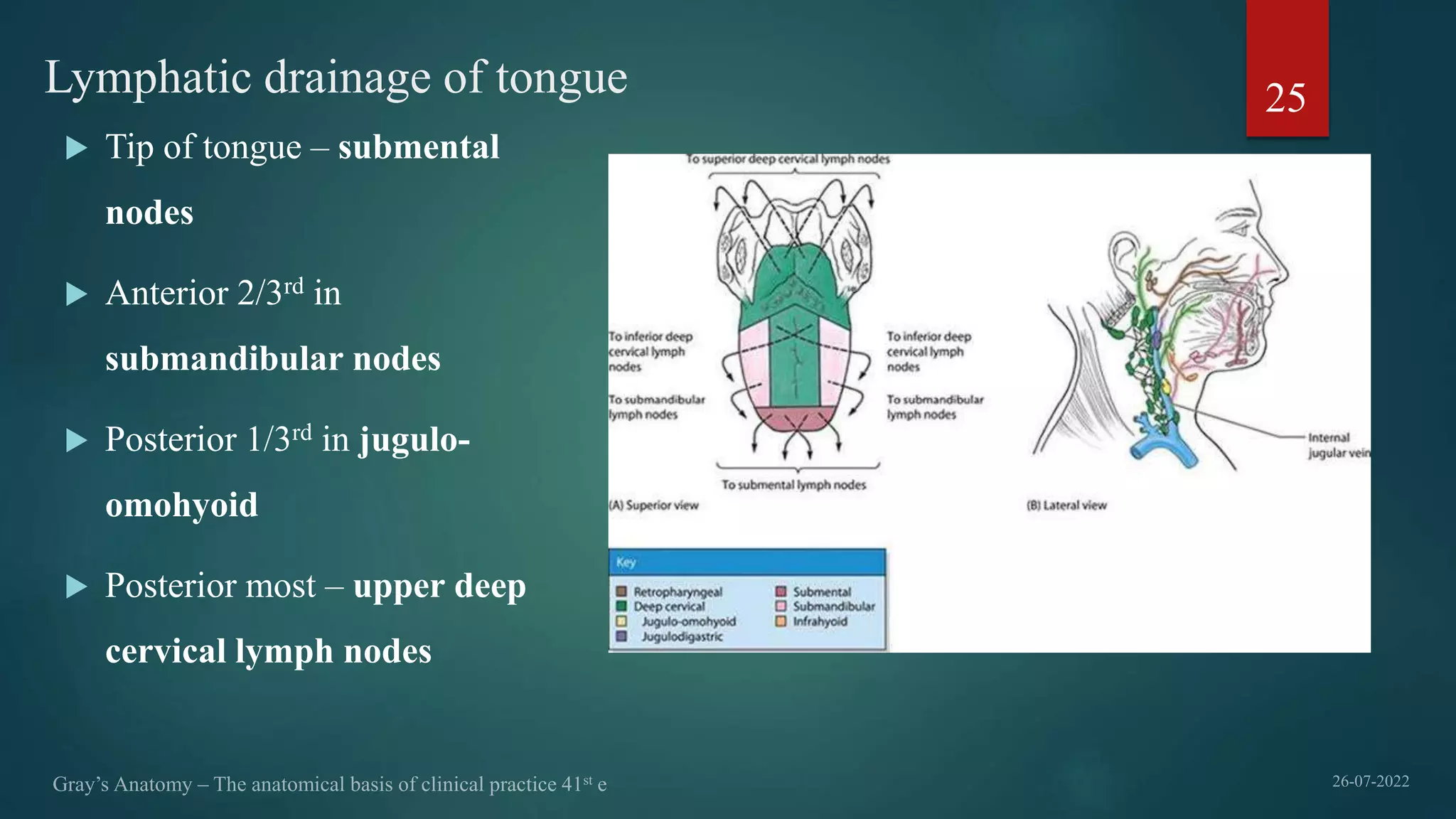
Lymphatic drainage of tongue
 Tip of tongue – submental
nodes
 Anterior 2/3rd in
submandibular nodes
 Posterior 1/3rd in jugulo-
omohyoid
 Posterior most – upper deep
cervical lymph nodes
25
Nerve supply of tongue
 Sensory – it is of 2 types
 General somatic afferent (GSA) Touch/ temperature
 Special visceral afferent (SVA) Taste
 Motor – Hypoglossal nerve and pharyngeal plexus
26
Nerve supply Anterior 2/3rd Posterior 1/3rd Posterior most part
GSA Lingual nerve Glossopharyngeal Internal laryngeal
SVA Chorda tympani Glossopharyngeal Internal laryngeal
Papillae of tongue
 The epithelium on the dorsal surface of the tongue is irregular due to numerous
elevations or projections called papillae
 All papillae on the tongue are covered by stratified squamous epithelium
 Shows partial or complete keratinization
27
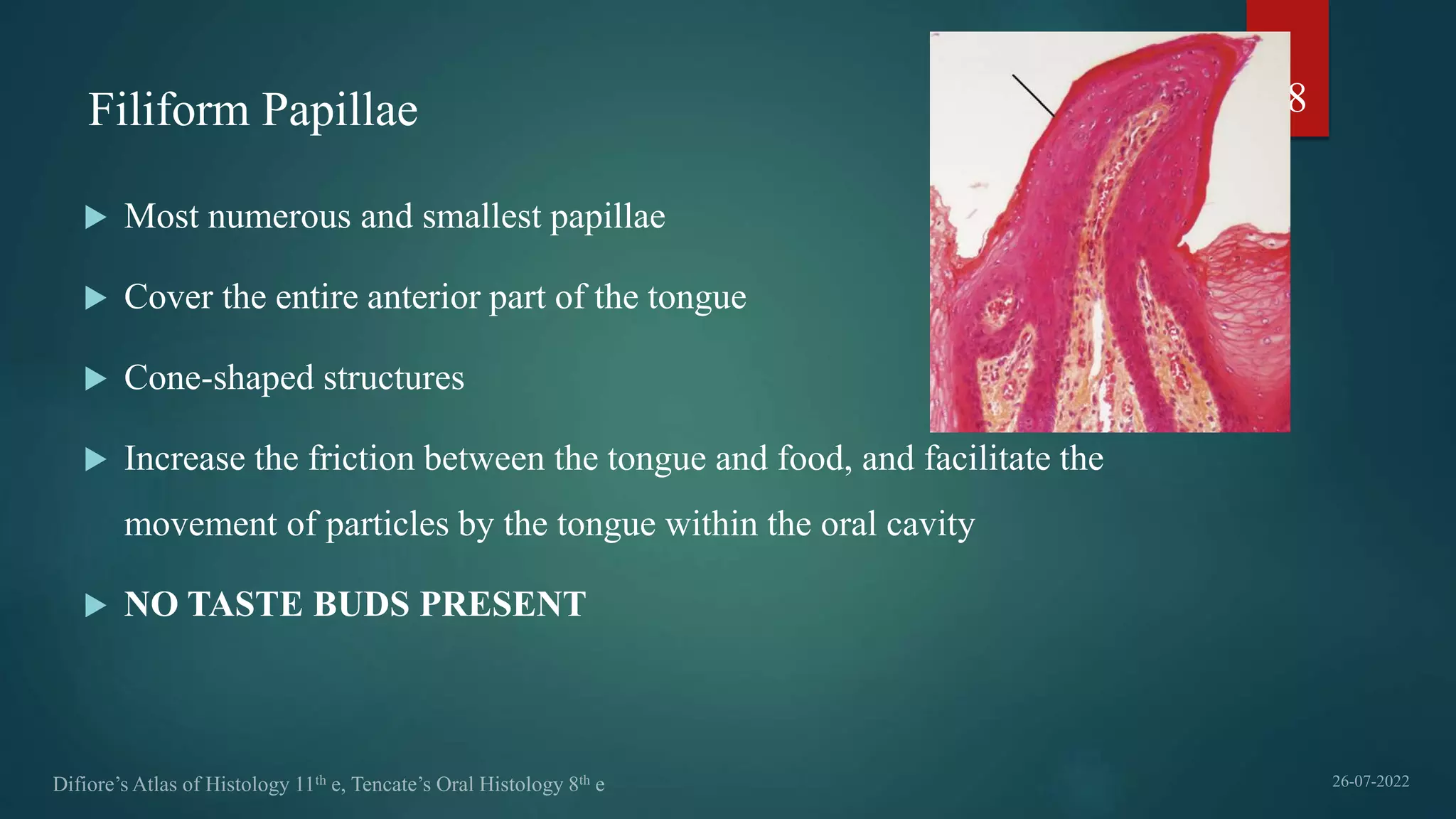
Filiform Papillae
 Most numerous and smallest papillae
 Cover the entire anterior part of the tongue
 Cone-shaped structures
 Increase the friction between the tongue and food, and facilitate the
movement of particles by the tongue within the oral cavity
 NO TASTE BUDS PRESENT
28
Fungiform papillae
 Fungiform papillae are smooth, round structures
 Exhibit a mushroom-like shape
 Interspersed among the filiform papillae
 More prevalent in the anterior region of the tongue
 Appear red in colour because of their highly
vascular connective tissue core
29
Circumvallate papillae
 Circumvallate papillae are large cylindrical structures
 8 to 12 in number, 1–2 mm in diameter
 Form a V-shaped row in front of the sulcus terminalis
 Characterized by deep moats or furrows that encircle them
 Excretory ducts from Von Ebner’s glands empty into the base of
the furrows
30
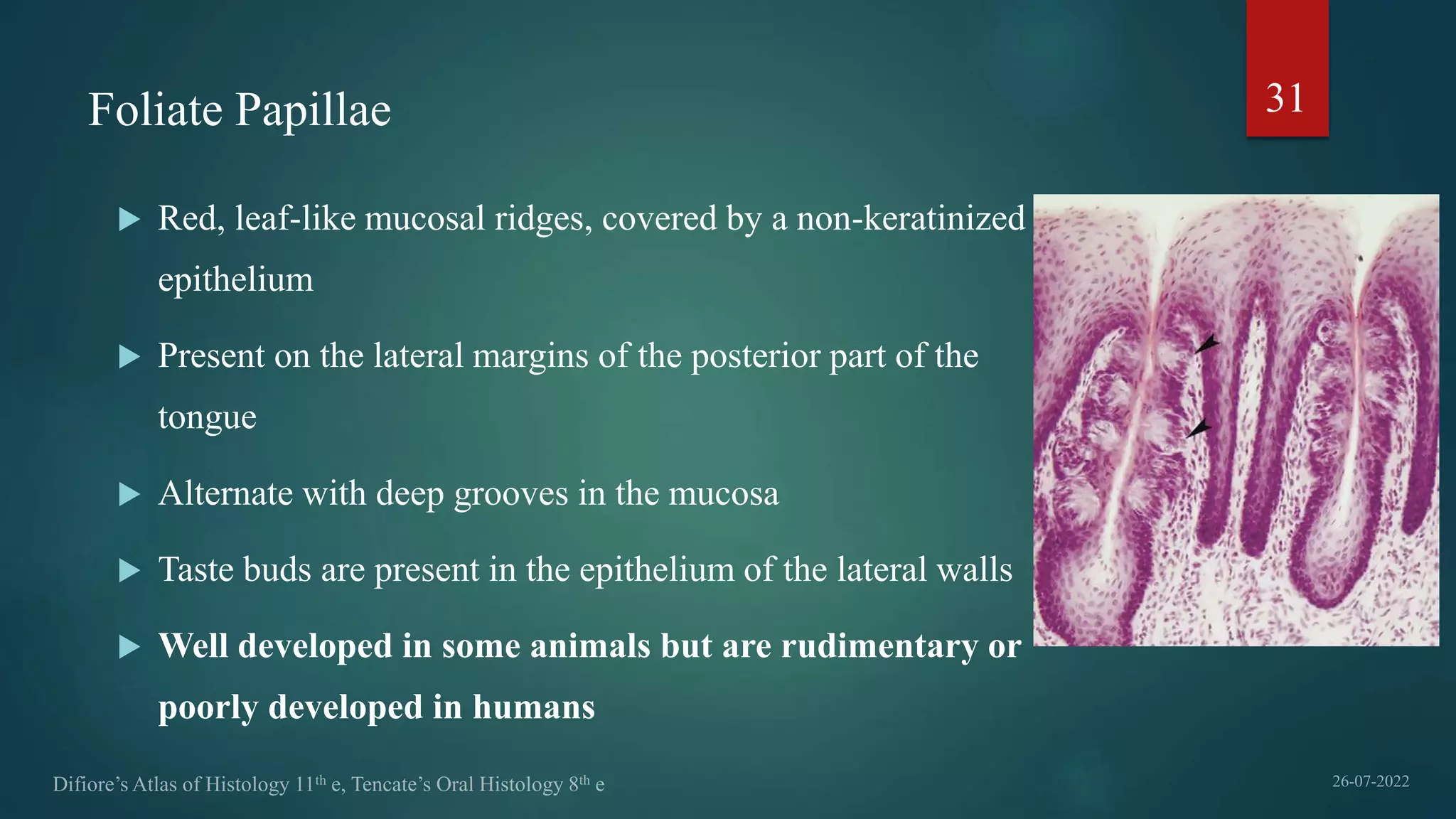
Foliate Papillae
 Red, leaf-like mucosal ridges, covered by a non-keratinized
epithelium
 Present on the lateral margins of the posterior part of the
tongue
 Alternate with deep grooves in the mucosa
 Taste buds are present in the epithelium of the lateral walls
 Well developed in some animals but are rudimentary or
poorly developed in humans
31
Glands of Blandin and Nuhn
 Anterior lingual glands
 Deeply placed seromucous glands
 Located on tip of tongue on each side of lingual frenum
 Found on ventral surface of apex of tongue
32
Glands Of Von Ebner
 Serous salivary
 Adjacent to the circumvallate and foliate papillae
 Secrete lingual lipase
 Secretion flushes material from base of the grooves to enable the
taste buds to respond rapidly to changing stimuli
33
Histology of tongue
 Dorsal mucosa thicker than the ventral and lateral mucosae
 Directly adherent to underlying muscular tissue with no discernible
submucosa
 The epithelium consists of non-keratinized stratified squamous
epithelium posteriorly and fully keratinized epithelium anteriorly
 The underlying lamina propria is a dense fibrous connective tissue,
with numerous elastic fibres
34
Taste Buds
 Barrel shaped
 Contain chemosensory cells
 Often referred to as paraneurones
 Seen on all papillae except filiform papillae
 Most abundant on posterior part of tongue
 Scattered over almost the entire dorsal and lateral surfaces of the tongue
 Average of 250 taste buds for 8–12 papillae
35
Structure of taste buds
36
Neural pathway of taste
37
Clinical Examination of tongue
 Colour
 Size
 Frenal attachment
 Swelling
 Ulcer
 Coating
 Crenations
 Fissures
38
39
Eiti Reteactor TCL self Retaining
Retractor
Nira Dry Field System
Tongue Retractors
40
Minnesota
Retractor
Austin
Retractor
Weider Retractor
Heartmann
Retractor
41
42
Developmental Anomalies Of Tongue
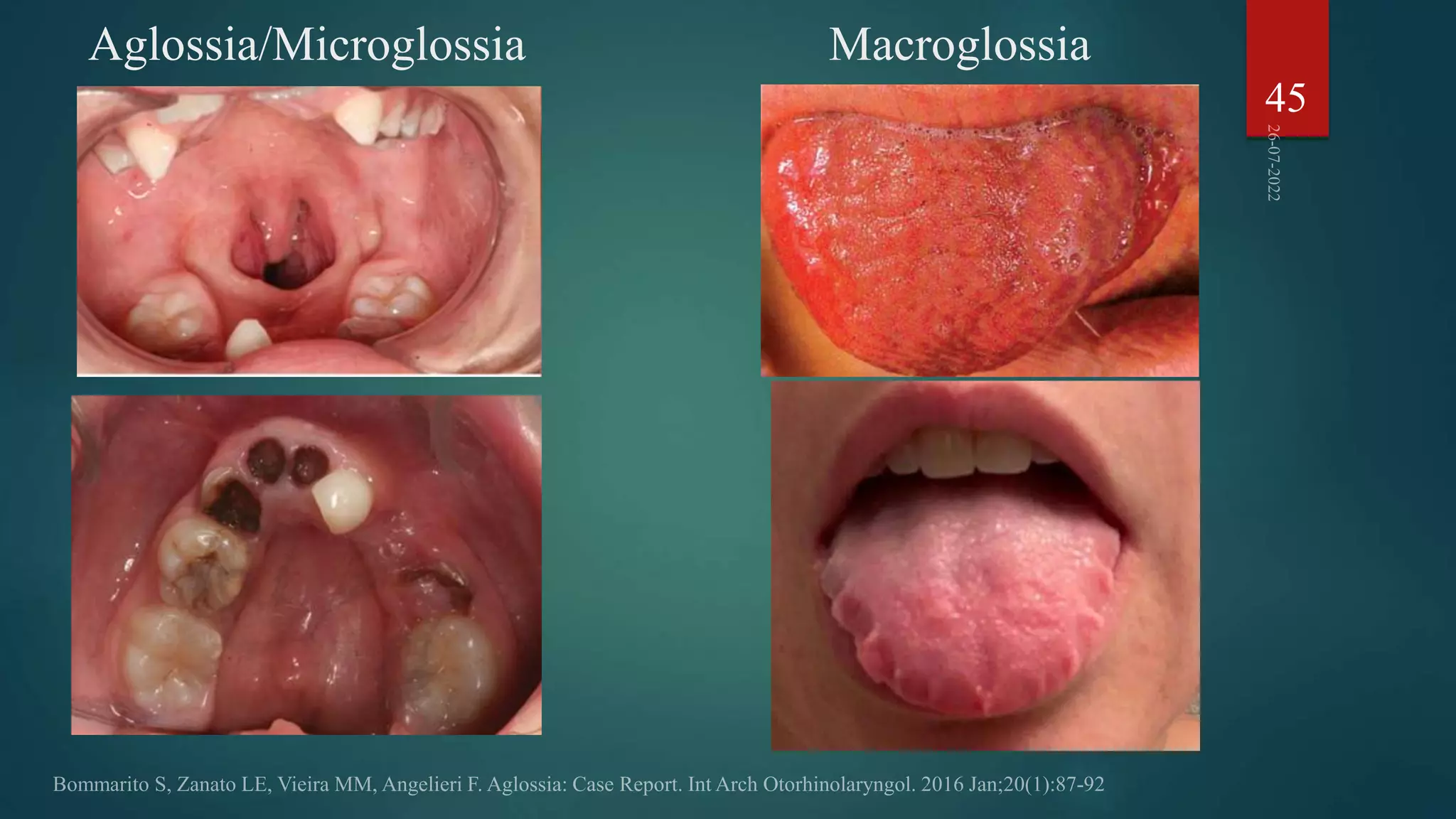
 Aglossia/Microglossia
 Macroglossia
 Ankyloglossia
 Bifid Tongue
 Fissured Tongue
 Median Rhomboid Glossitis
 Hairy Tongue
 Lingual Thyroid Nodule
43
44
Aglossia/Microglossia Macroglossia
45
Ankyloglossia Bifid Tongue 46
Fissured Tongue Median Rhomboid
Glossitis
47
Hairy Tongue Lingual Thyroid
Nodule
48
• Proper designing of the lingual flange in the wax up
stage
• Add very little wax behind the incisors region, while a
flat or slightly concave surface behind the premolars is
established
• Narrower posterior teeth
Macroglossia
• Thick lingual flange in mandibular denture to obtain the
lingual seal
• Placement of wider posterior teeth
Microglossia
• Surgical excision of the tongue tie
• Fabrication of mandibular denture before surgery
• Prevent reattachment of frenum by acting as a barrier
Ankyloglossia
49
Prosthodontic consideration related to abnormalities of tongue
Prosthodontic considerations
50
Prosthodontic considerations
 Tongue and its role in impression making for complete denture
 Affect of tongue in phonetics of complete denture patients
 Neutral zone
 Tongue prothesis
51
Role of tongue during impression making
 For stability and retention of complete denture, border seal in the
floor of the mouth compliment seals in the vestibular space.
 Tongue movements during border molding procedures also play an
important role in positioning of the denture borders, designing of
denture flange thus influencing stability of the mandibular denture
52
Recording border seal anterior lingual sulcus 53
Protrusion
of tongue
Anterior region
of mouth raised
Height of anterior
lingual sulcus
recorded
Activation of
posterior fibres
of genioglossus
Activation of
anterior fibres
of
genioglossus
Retraction
of tongue
Greenstick
compressed
between
ventral surface
of tongue and
lingual surface
of mandible
Width of
anterior lingual
sulcus recorded
Mylohyoid region
 Extends from pre mylohyoid fossa to distal end of mylohyoid ridge
 Mylohyoid muscles directly influences denture border in this region
Protrusion of tongue followed by swallowing action
Mylohyoid muscle activated Floor of mouth raised
Border molded by action of mylohyoid
54
Retro Mylohyoid Region
 Superior constrictor
 Medial pterygoid
Add material to distolingual aspect
protrude tongue and close lower jaw
Superior constrictor muscle activated
Distolingual border recorded
55
Muscles influencing denture border in
RMC region
Retromolar pad
 Region under influence of many muscles
laterally by buccinator
Postero superiorly by temporalis
Pterygomandibular raphae
Medially by sup. constrictor of pharynx
The denture base should extend half to 2/3rd of retromolar pad
56
 The final lingual border should be so shaped
that it guides the tongue into the same position
it will occupy in relation to the finished
denture
 Tray should not dislodge when the tip of the
tongue is in contact with the Vermilion border
of the upper lips
 The final borders of the denture should be in
harmony with the anatomy of the floor of the
mouth interest and in function
57
Phonetics in Denture
58
Classification of consonants based on their place of
production
 Consonants are most important from dental point of view
 Palatolingual sounds – tongue and hard/ soft palate
 Linguodental sounds – tongue and teeth
 Labio dental sounds – lips and teeth
 Bilabial sounds - lips
59
Palatolingual sounds
 S, T, D, N, L are the palatolingual sounds
 ‘S’ sounds is formed by a hiss of air as it escapes the median groove
of the tongue when the tongue is behind the upper incisors
60
 Deeper grove - whistling sound
 Shallower groove - lisping or ‘Shh’sound – stigamtismus lateralis
 Further shallowing of groove - ‘th’sound
 Can be used to check proper placement of anterior teeth
 Can be used to check thickness of base
 Silverman used this word to establish proper vertical dimension of
occlusion
61
 T, D, N, L – rugae is very important for the production of these
sounds
 Tongue placed firmly against the anterior part of hard palate
 Teeth too lingual – T sounds like D
 Teeth to labial – D sounds like T
62
 K, ng, g represent palatolingual sounds
 Sounds is formed by raising the back of the tongue to occlude with
the soft palate and then suddenly depressing the middle portion of
the back of the tongue releasing the air in a puff
 If posterior area is over extended or no tissue contact is there K
sounds like Ch
63
Linguodental Sounds
 ‘Th’ sound - linguodental sound
 Made with the tip of tongue extending slightly between upper and
lower anterior teeth
 Sound is actually made closer to alveolus than the tip of teeth
 Careful observation of the amount of tongue that can be seen with
the words This, that, there this, will provide information as to the
Labio-lingual position of anterior teeth
64
 <3mm of tongue visible - anterior teeth are too far forward
 >6mm of tongue visible - teeth too lingual
65
Labiodental sounds
 Formed by contact of lips and teeth
 F and V
Upper teeth too high – V sounds like F
Upper teeth too down – F sounds like V
66
Post insertion speech apdaption
 Speech adaption to new prosthesis takes 2-4 weeks of regular usage
 Old dentures can act as guidance
 Bilabial, labiodental, linguodental and linguoalveolar sounds most
affected
 Patient must practice speaking with the new prosthesis in place
67
Neutral zone
 The potential space between the
lips and cheeks on one side and the
tongue on the other; that area or
position where the forces between
the tongue and cheeks or lips are
equal – GPT 9
68
 Aim of neutral zone - construct a denture in muscle balance
 Neutral zone concept is used for - highly atrophic mandible, partial
glossectomy, mandibulectomy, motor nerve damage to tongue
 Muscles influencing Neutral zone
 Modiolus
 Buccinator
 Orbicularis Oris and mentalis
 Tongue muscles
69
Effect of dental prosthesis on taste perception
 Principal taste centres located on lateral and posterior part of tongue
 Sense of taste of sweet and salty diminishes, and sour is more
pronounced
 Sense of taste may be interrupted by the interjection of an outside
stimulus such as a denture
 Thickness of denture, lack of rugae, insulation against heat and cold
 Irritation, pressure or substance on the surface of lower denture
70
Tongue prosthesis
 A total glossectomy or laryngectomy results in loss of basic vital
function and loss of speech
 In these patients fabrication of a mandibular tongue prosthesis can
be done
 Tongue prosthesis can be made for
 Swallowing
 Speech
71
72
73
Conclusion
 Knowledge of anatomy, physiology and functions of tongue is an
essence to understand the complex morphological and fuctional
changes in the tongue with aging or with complete and partial
edentulism
 This knowledge will help us to reach optimal prosthetic success, as
tongue plays a significant and perhaps dictating role in affevting the
stablility and retention of prosthesis
 So we can conclude a proper diagnosis of tongue is must before
proceeding and planning any type of dental prosthesis
74
References
 Gray’s Anatomy – the anatomical basis of clinical practice 41st e
 B D Chaurasia, Human Anatomy 4th e
 Guyton and Hall textbook of medical physiology 13st e
 Difiore’s atlas of Histology 11th e
 Inderbir Singh’s Human Embryology 11th e
 Tencate’s Oral Histology 8th e
 Shafer’s Textbook of oral Pathology 7th e
75
 Textbook of Prosthodontics, V Rangarajan 2nd e
 Johnson PF, Taybos GM, Grisius RJ. Prosthodontics diagnostic, treatment
planning and prognostic considerations. DCNA
 Bommarito S, Zanato LE, Vieira MM, Angelieri F. Aglossia: Case Report. Int
Arch Otorhinolaryngol. 2016 Jan;20(1):87-92
 Daniel-Spiegel E, Ben-Ami M. Bifid tongue, a rare congenital malformation,
is a prenatal clue for secondary cleft palate. J Ultrasound Med. 2012
Mar;31(3):505-7
 Thomas G, Hoilat R, Daniels JS, Kalagie W. Ectopic lingual thyroid: a case
report. Int J Oral Maxillofac Surg. 2003 Apr;32(2):219-2
76
 Beresin VE, Schiesser FJ. The neutral zone in complete dentures. J
Prosthet Dent. 1976 Oct;36(4):356-6
 Dhananjay G, Siddiqui A, Gangadhar SA and Lagdive SB. Anatomy
Of The Lingual Vestibule And Its Influence On Denture Borders.
Anat Phyiol.2013;3;122
 Kaur B, Gupta G, Sandhu N, Sandhu Sarabjeet Kaur, Gupta T.
Tongue : The Most Disturbing Element In Manibular Denture- How
To Handle It ?. Annals Of Dental Research 2012; 2(1):36-43
 Rotham R; Phonetic consideration in denture prosthesis, J Prosthet
Dent;1961;11:214-223
77
 Balasubramaniam MK, Chidambaranathan AS, Shanmugam G, Tah
R. Rehabilitation of Glossectomy Cases with Tongue Prosthesis: A
Literature Review. J Clin Diagn Res. 2016 Feb;10(2):ZE01-4
78

Tongue and it's Prosthodontics Importance

  • 1.
    TONGUE DR SHUBHAM PARMAR 1STYEAR MDS DEPARTMENT OF PROSTHODONTICS RURAL DENTAL COLLEGE, LONI
  • 2.
    CONTENTS  Introduction  Development Anatomy  Histology  Clinical examination of tongue  Disorders of tongue 2
  • 3.
     Applied anatomy Prosthetic implications  Conclusion  References 3
  • 4.
    Introduction  Tongue isa highly muscular organ  Helps in speech, deglutition and taste  Dorsal mucosa is covered by numerous papillae, some of which bear taste buds  The oral and pharyngeal parts of the tongue differ in their mucosa, innervation and developmental origins 4
  • 5.
    Development Of Tongue Development - 4th week of gestation  Tongue develops in relation to the pharyngeal arches in the floor of the developing mouth 5
  • 6.
    Anterior 2/3rd oftongue  Formed by fusion of –  2 lateral lingual swellings  Tuberculum impar  Derived from 1st branchial arch  Supplied by lingual nerve and chorda tympani 6
  • 7.
    Posterior 1/3rd oftongue  Formed from the cranial part of the hypobranchial eminence  Formed by 3rd arch Development of posterior most part is by the 4th arch 7
  • 8.
    8 Embryonic derivation ofparts of tongue Epithelium over anterior 2/3rd 1st arch Epithelium over posterior 1/3rd 3rd arch Epithelium over posterior most part 4th arch Muscles Occipital Myotomes
  • 9.
    Anatomy of Tongue It has a root, apex, dorsal and a ventral surface  Attaches to the hyoid bone, mandible, styloid processes, soft palate and the pharyngeal wall by its muscles  Intrinsic and an extrinsic group of muscles present 9
  • 10.
     Dorsum Oral Pharyngeal  Thelimbs of the sulcus terminalis run anterolaterally to the palatoglossal arches  The dorsal mucosa has a longitudinal median sulcus and is covered by papillae 10
  • 11.
     Ventral surface- smooth and purplish  Lingual frenum attaches tongue to the floor of the mouth  Deep lingual veins lie lateral to the frenum  Plica fimbriata fold - lateral to the lingual vein, run anteromedially towards apex 11
  • 12.
     The posteriorpart of the tongue lies posterior to the palatoglossal arches  Forms the anterior wall of the oropharynx  The pharyngeal part of the tongue is devoid of papillae 12
  • 13.
    Muscles of Tongue Median fibrous septum separates tongue into halves  The tongue consists of 4 intrinsic and extrinsic muscles in each half  Intrinsic muscles - wholly within the tongue  Extrinsic muscles - outside the tongue 13
  • 14.
  • 15.
    Genioglossus  Genioglossus istriangular in sagittal section  Lies parallel to the midline  It fans out upwards and backwards from the origin  Origin – Short tendon attached to the genial tubercle 15
  • 16.
     Inferior fibresof genioglossus attach to the upper anterior surface of the hyoid body by a thin aponeurosis near the midline  The Intermediate fibres pass backwards into the posterior part of the tongue  The superior fibres ascend forwards to enter the ventral surface of the tongue 16
  • 17.
     Action  Protrusionof tongue  Depress the dorsum and make it concave  Deviate tongue to opposite side  Vascular supply  Sublingual branch of lingual artery  Submental branch of facial artery  Nerve Supply  Hypoglossal nerve 17
  • 18.
    Hyoglossus  Thin muscle,quadrilateral in shape  Origin - greater cornu and front of the body of the hyoid bone  Insertion – Lateral border of tongue  Action – depression of tongue  Vascular supply  Sublingual branch of lingual artery  Submental branch of facial artery  Nerve supply  Hypoglossal nerve 18
  • 19.
    Styloglossus  Shortest andsmallest muscles attached to styloid  Origin – anterolateral aspect of the styloid process  Insertion – lateral border of tongue  Action – moves the tongue upwards and backwards  Vascular supply - sublingual branch of the lingual artery  Nerve supply – hypoglossal nerve 19
  • 20.
    Palatoglossus  Origin –Inferior surface of palatine aponeurosis  Insertion – lateral surface of tongue  Action – elevates root, approximates palatoglossal arch, closes oropharyngeal isthmus  Vascular supply  Ascending palatine branch of the facial artery  Ascending pharyngeal artery  Nerve supply  Pharyngeal plexus 20
  • 21.
  • 22.
    22 Muscle Origin Insertionaction Superior Longitudinal Submucous fibrous tissue near the epiglottis Median lingual septum Lingual margins mucous membranes Shortens the tongue Pulls apex upwards Dorsum concave Inferior Longitudinal Root of the tongue Apex of tongue Shortens tongue Pulls apex downwards Dorsum convex Transverse Median septum of tongue Submucous fibrous tissue of the lingual margin Narrowing and elongation of tongue Vertical Dorsal part of tongue Ventral part of tongue Makes tongue flatter and wider
  • 23.
    Vascular Supply 23 External CarotidArtery Lingual Artery Dorsal lingual arteries - posterior part Deep lingual artery - anterior part Sublingual artery - sublingual gland and floor of mouth
  • 24.
    Venous drainage 24 DorsalLingual Vein - dorsum and side of tongue Deep Lingual Vein – tip of tongue Internal Jugular Vein
  • 25.
    Lymphatic drainage oftongue  Tip of tongue – submental nodes  Anterior 2/3rd in submandibular nodes  Posterior 1/3rd in jugulo- omohyoid  Posterior most – upper deep cervical lymph nodes 25
  • 26.
    Nerve supply oftongue  Sensory – it is of 2 types  General somatic afferent (GSA) Touch/ temperature  Special visceral afferent (SVA) Taste  Motor – Hypoglossal nerve and pharyngeal plexus 26 Nerve supply Anterior 2/3rd Posterior 1/3rd Posterior most part GSA Lingual nerve Glossopharyngeal Internal laryngeal SVA Chorda tympani Glossopharyngeal Internal laryngeal
  • 27.
    Papillae of tongue The epithelium on the dorsal surface of the tongue is irregular due to numerous elevations or projections called papillae  All papillae on the tongue are covered by stratified squamous epithelium  Shows partial or complete keratinization 27
  • 28.
    Filiform Papillae  Mostnumerous and smallest papillae  Cover the entire anterior part of the tongue  Cone-shaped structures  Increase the friction between the tongue and food, and facilitate the movement of particles by the tongue within the oral cavity  NO TASTE BUDS PRESENT 28
  • 29.
    Fungiform papillae  Fungiformpapillae are smooth, round structures  Exhibit a mushroom-like shape  Interspersed among the filiform papillae  More prevalent in the anterior region of the tongue  Appear red in colour because of their highly vascular connective tissue core 29
  • 30.
    Circumvallate papillae  Circumvallatepapillae are large cylindrical structures  8 to 12 in number, 1–2 mm in diameter  Form a V-shaped row in front of the sulcus terminalis  Characterized by deep moats or furrows that encircle them  Excretory ducts from Von Ebner’s glands empty into the base of the furrows 30
  • 31.
    Foliate Papillae  Red,leaf-like mucosal ridges, covered by a non-keratinized epithelium  Present on the lateral margins of the posterior part of the tongue  Alternate with deep grooves in the mucosa  Taste buds are present in the epithelium of the lateral walls  Well developed in some animals but are rudimentary or poorly developed in humans 31
  • 32.
    Glands of Blandinand Nuhn  Anterior lingual glands  Deeply placed seromucous glands  Located on tip of tongue on each side of lingual frenum  Found on ventral surface of apex of tongue 32
  • 33.
    Glands Of VonEbner  Serous salivary  Adjacent to the circumvallate and foliate papillae  Secrete lingual lipase  Secretion flushes material from base of the grooves to enable the taste buds to respond rapidly to changing stimuli 33
  • 34.
    Histology of tongue Dorsal mucosa thicker than the ventral and lateral mucosae  Directly adherent to underlying muscular tissue with no discernible submucosa  The epithelium consists of non-keratinized stratified squamous epithelium posteriorly and fully keratinized epithelium anteriorly  The underlying lamina propria is a dense fibrous connective tissue, with numerous elastic fibres 34
  • 35.
    Taste Buds  Barrelshaped  Contain chemosensory cells  Often referred to as paraneurones  Seen on all papillae except filiform papillae  Most abundant on posterior part of tongue  Scattered over almost the entire dorsal and lateral surfaces of the tongue  Average of 250 taste buds for 8–12 papillae 35
  • 36.
  • 37.
  • 38.
    Clinical Examination oftongue  Colour  Size  Frenal attachment  Swelling  Ulcer  Coating  Crenations  Fissures 38
  • 39.
    39 Eiti Reteactor TCLself Retaining Retractor Nira Dry Field System Tongue Retractors
  • 40.
  • 41.
  • 42.
  • 43.
    Developmental Anomalies OfTongue  Aglossia/Microglossia  Macroglossia  Ankyloglossia  Bifid Tongue  Fissured Tongue  Median Rhomboid Glossitis  Hairy Tongue  Lingual Thyroid Nodule 43
  • 44.
  • 45.
  • 46.
  • 47.
    Fissured Tongue MedianRhomboid Glossitis 47
  • 48.
    Hairy Tongue LingualThyroid Nodule 48
  • 49.
    • Proper designingof the lingual flange in the wax up stage • Add very little wax behind the incisors region, while a flat or slightly concave surface behind the premolars is established • Narrower posterior teeth Macroglossia • Thick lingual flange in mandibular denture to obtain the lingual seal • Placement of wider posterior teeth Microglossia • Surgical excision of the tongue tie • Fabrication of mandibular denture before surgery • Prevent reattachment of frenum by acting as a barrier Ankyloglossia 49 Prosthodontic consideration related to abnormalities of tongue
  • 50.
  • 51.
    Prosthodontic considerations  Tongueand its role in impression making for complete denture  Affect of tongue in phonetics of complete denture patients  Neutral zone  Tongue prothesis 51
  • 52.
    Role of tongueduring impression making  For stability and retention of complete denture, border seal in the floor of the mouth compliment seals in the vestibular space.  Tongue movements during border molding procedures also play an important role in positioning of the denture borders, designing of denture flange thus influencing stability of the mandibular denture 52
  • 53.
    Recording border sealanterior lingual sulcus 53 Protrusion of tongue Anterior region of mouth raised Height of anterior lingual sulcus recorded Activation of posterior fibres of genioglossus Activation of anterior fibres of genioglossus Retraction of tongue Greenstick compressed between ventral surface of tongue and lingual surface of mandible Width of anterior lingual sulcus recorded
  • 54.
    Mylohyoid region  Extendsfrom pre mylohyoid fossa to distal end of mylohyoid ridge  Mylohyoid muscles directly influences denture border in this region Protrusion of tongue followed by swallowing action Mylohyoid muscle activated Floor of mouth raised Border molded by action of mylohyoid 54
  • 55.
    Retro Mylohyoid Region Superior constrictor  Medial pterygoid Add material to distolingual aspect protrude tongue and close lower jaw Superior constrictor muscle activated Distolingual border recorded 55 Muscles influencing denture border in RMC region
  • 56.
    Retromolar pad  Regionunder influence of many muscles laterally by buccinator Postero superiorly by temporalis Pterygomandibular raphae Medially by sup. constrictor of pharynx The denture base should extend half to 2/3rd of retromolar pad 56
  • 57.
     The finallingual border should be so shaped that it guides the tongue into the same position it will occupy in relation to the finished denture  Tray should not dislodge when the tip of the tongue is in contact with the Vermilion border of the upper lips  The final borders of the denture should be in harmony with the anatomy of the floor of the mouth interest and in function 57
  • 58.
  • 59.
    Classification of consonantsbased on their place of production  Consonants are most important from dental point of view  Palatolingual sounds – tongue and hard/ soft palate  Linguodental sounds – tongue and teeth  Labio dental sounds – lips and teeth  Bilabial sounds - lips 59
  • 60.
    Palatolingual sounds  S,T, D, N, L are the palatolingual sounds  ‘S’ sounds is formed by a hiss of air as it escapes the median groove of the tongue when the tongue is behind the upper incisors 60
  • 61.
     Deeper grove- whistling sound  Shallower groove - lisping or ‘Shh’sound – stigamtismus lateralis  Further shallowing of groove - ‘th’sound  Can be used to check proper placement of anterior teeth  Can be used to check thickness of base  Silverman used this word to establish proper vertical dimension of occlusion 61
  • 62.
     T, D,N, L – rugae is very important for the production of these sounds  Tongue placed firmly against the anterior part of hard palate  Teeth too lingual – T sounds like D  Teeth to labial – D sounds like T 62
  • 63.
     K, ng,g represent palatolingual sounds  Sounds is formed by raising the back of the tongue to occlude with the soft palate and then suddenly depressing the middle portion of the back of the tongue releasing the air in a puff  If posterior area is over extended or no tissue contact is there K sounds like Ch 63
  • 64.
    Linguodental Sounds  ‘Th’sound - linguodental sound  Made with the tip of tongue extending slightly between upper and lower anterior teeth  Sound is actually made closer to alveolus than the tip of teeth  Careful observation of the amount of tongue that can be seen with the words This, that, there this, will provide information as to the Labio-lingual position of anterior teeth 64
  • 65.
     <3mm oftongue visible - anterior teeth are too far forward  >6mm of tongue visible - teeth too lingual 65
  • 66.
    Labiodental sounds  Formedby contact of lips and teeth  F and V Upper teeth too high – V sounds like F Upper teeth too down – F sounds like V 66
  • 67.
    Post insertion speechapdaption  Speech adaption to new prosthesis takes 2-4 weeks of regular usage  Old dentures can act as guidance  Bilabial, labiodental, linguodental and linguoalveolar sounds most affected  Patient must practice speaking with the new prosthesis in place 67
  • 68.
    Neutral zone  Thepotential space between the lips and cheeks on one side and the tongue on the other; that area or position where the forces between the tongue and cheeks or lips are equal – GPT 9 68
  • 69.
     Aim ofneutral zone - construct a denture in muscle balance  Neutral zone concept is used for - highly atrophic mandible, partial glossectomy, mandibulectomy, motor nerve damage to tongue  Muscles influencing Neutral zone  Modiolus  Buccinator  Orbicularis Oris and mentalis  Tongue muscles 69
  • 70.
    Effect of dentalprosthesis on taste perception  Principal taste centres located on lateral and posterior part of tongue  Sense of taste of sweet and salty diminishes, and sour is more pronounced  Sense of taste may be interrupted by the interjection of an outside stimulus such as a denture  Thickness of denture, lack of rugae, insulation against heat and cold  Irritation, pressure or substance on the surface of lower denture 70
  • 71.
    Tongue prosthesis  Atotal glossectomy or laryngectomy results in loss of basic vital function and loss of speech  In these patients fabrication of a mandibular tongue prosthesis can be done  Tongue prosthesis can be made for  Swallowing  Speech 71
  • 72.
  • 73.
  • 74.
    Conclusion  Knowledge ofanatomy, physiology and functions of tongue is an essence to understand the complex morphological and fuctional changes in the tongue with aging or with complete and partial edentulism  This knowledge will help us to reach optimal prosthetic success, as tongue plays a significant and perhaps dictating role in affevting the stablility and retention of prosthesis  So we can conclude a proper diagnosis of tongue is must before proceeding and planning any type of dental prosthesis 74
  • 75.
    References  Gray’s Anatomy– the anatomical basis of clinical practice 41st e  B D Chaurasia, Human Anatomy 4th e  Guyton and Hall textbook of medical physiology 13st e  Difiore’s atlas of Histology 11th e  Inderbir Singh’s Human Embryology 11th e  Tencate’s Oral Histology 8th e  Shafer’s Textbook of oral Pathology 7th e 75
  • 76.
     Textbook ofProsthodontics, V Rangarajan 2nd e  Johnson PF, Taybos GM, Grisius RJ. Prosthodontics diagnostic, treatment planning and prognostic considerations. DCNA  Bommarito S, Zanato LE, Vieira MM, Angelieri F. Aglossia: Case Report. Int Arch Otorhinolaryngol. 2016 Jan;20(1):87-92  Daniel-Spiegel E, Ben-Ami M. Bifid tongue, a rare congenital malformation, is a prenatal clue for secondary cleft palate. J Ultrasound Med. 2012 Mar;31(3):505-7  Thomas G, Hoilat R, Daniels JS, Kalagie W. Ectopic lingual thyroid: a case report. Int J Oral Maxillofac Surg. 2003 Apr;32(2):219-2 76
  • 77.
     Beresin VE,Schiesser FJ. The neutral zone in complete dentures. J Prosthet Dent. 1976 Oct;36(4):356-6  Dhananjay G, Siddiqui A, Gangadhar SA and Lagdive SB. Anatomy Of The Lingual Vestibule And Its Influence On Denture Borders. Anat Phyiol.2013;3;122  Kaur B, Gupta G, Sandhu N, Sandhu Sarabjeet Kaur, Gupta T. Tongue : The Most Disturbing Element In Manibular Denture- How To Handle It ?. Annals Of Dental Research 2012; 2(1):36-43  Rotham R; Phonetic consideration in denture prosthesis, J Prosthet Dent;1961;11:214-223 77
  • 78.
     Balasubramaniam MK,Chidambaranathan AS, Shanmugam G, Tah R. Rehabilitation of Glossectomy Cases with Tongue Prosthesis: A Literature Review. J Clin Diagn Res. 2016 Feb;10(2):ZE01-4 78

Editor's Notes

  • #5 The anterior part is also known as presulcal part and posterior known as postsulcal part The anterior part forms 2/3rd of the tongue while the posterior forms 1/3rd of the tongue
  • #6 Development continues uptil 8th week
  • #7 lingual swellings are partially separated from each other behind the tuberculum impar, the epithelium proliferates to form a downgrowth (thyroglossal duct) from which the thyroid gland develops. The site of this downgrowth is subsequently marked by a depression called the foramen cecum 1st arch also known as mandibular arch The nerve which runs along cranial border of arch – post trematic Caudal border – pre trematic
  • #8 Another, midline swelling is seen in relation to the medial ends of the second, third and fourth arches. This swelling is called the hypobranchial eminence or copula of His. The eminence soon shows a subdivision into a cranial part related to the second and third arches (called the copula) and a caudal part related to the fourth arch. The caudal part forms the epiglottis. In this situation, the second arch mesoderm gets buried below the surface. The third arch mesoderm grows over it to fuse with the mesoderm of the first arch
  • #11 The foramen caecum is midline depression on the tongue which marks the upper end of the thyroglossal duct or the initial developmental site of thyroid gland filiform, fungiform and circumvallate papillae
  • #12 Plica fimbriata are fringed mucosal folds
  • #13 Its mucosa is reflected laterally on to the palatine tonsils and pharyngeal wall, posteriorly on to the epiglottis by a median and two lateral glossoepiglottic folds
  • #14 Tongue has total of 16 muscles All muscles of tongue are supplied by hypoglossal nerve cn12 except palatoglossus Muscles develop from occipital myotomes and supplied by cn12 except palatoglossus as developed from mesoderm of 6th arch Median fibrous septum, attached to the body of the hyoid bone separates tongue into halves and help in altering its shape and help in its bodily movement
  • #17 The attachment of the genioglossi to the genial tubercles prevents the tongue from sinking back and obstructing respiration Safety muscle of tongue
  • #18 Depresses dorsum when bilaterally both muscles act Deviates tongue to opposite side when acted unilaterally Deviation of tongue to injured side
  • #19 Chondroglossus Sometimes described as a part of hyoglossus, this muscle is separated from it by some fibres of genioglossus, It is about 2 cm long, arises from the medial side and base of the lesser cornu and the adjoining part of the body of the hyoid. It ascends to merge into the intrinsic musculature between hyoglossus and genioglossus.
  • #21 paired muscle of soft palate Right and left muscles create ridges in the lateral pharyngeal wall – palatoglossal arch
  • #26 Final nodes to be involved are jugulo omohyoid and deep cervical
  • #27 Lingual nerve - 5 trigeminal Glossopharyngeal 9 Internal laryngeal - vagus 10 Chorda tympani 7 facial
  • #29 Hairy tongue
  • #30 Less numerous but larger, broader, and taller than the filiform papillae appear red, visible through a thin, nonkeratinized covering epithelium
  • #31 larger than the fungiform or filiform papillae. Von ebner located in the connective tissue, Epithelium covering the lateral walls contains taste buds
  • #35 These features probably reflect the fact that the apex of the tongue is subject to greater dehydration than the posterior and ventral parts and is subject to more abrasion during mastication.
  • #36 Chemosensory cells are in synaptic contact of gustatory nerves Taste buds are not restricted to the papillae
  • #53 Adequate degree of tongue freedom and tissue reflection with accurate border molding in the vestibular spaces is a prime requisite