SPECIAL IMPRESSION PROCEDURES
IN
REMOVABLE PARTIAL DENTURE
• www.asiandentalacademy.org
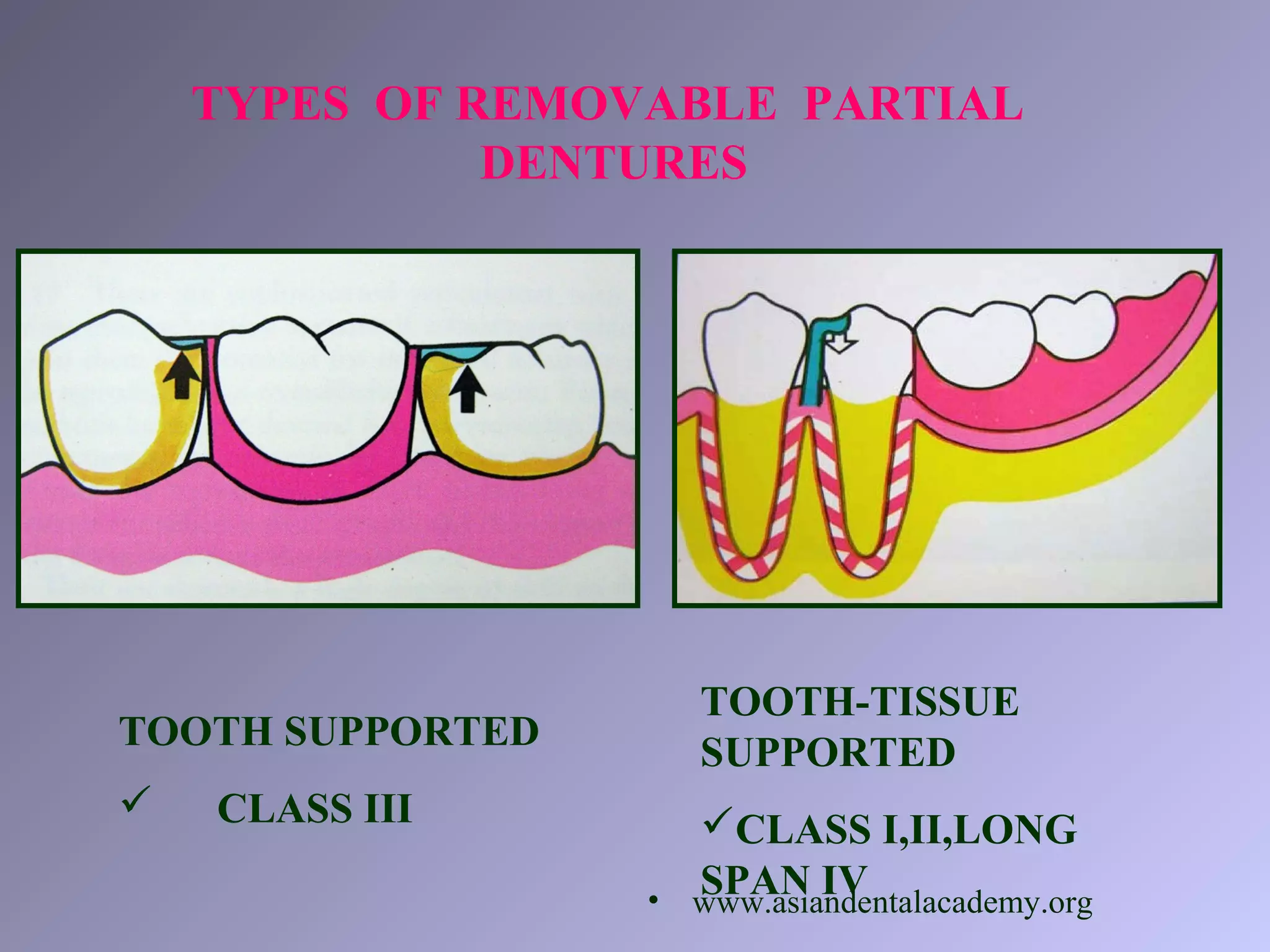
TYPES OF REMOVABLE PARTIAL
DENTURES
TOOTH SUPPORTED
 CLASS III
TOOTH-TISSUE
SUPPORTED
CLASS I,II,LONG
SPAN IV• www.asiandentalacademy.org
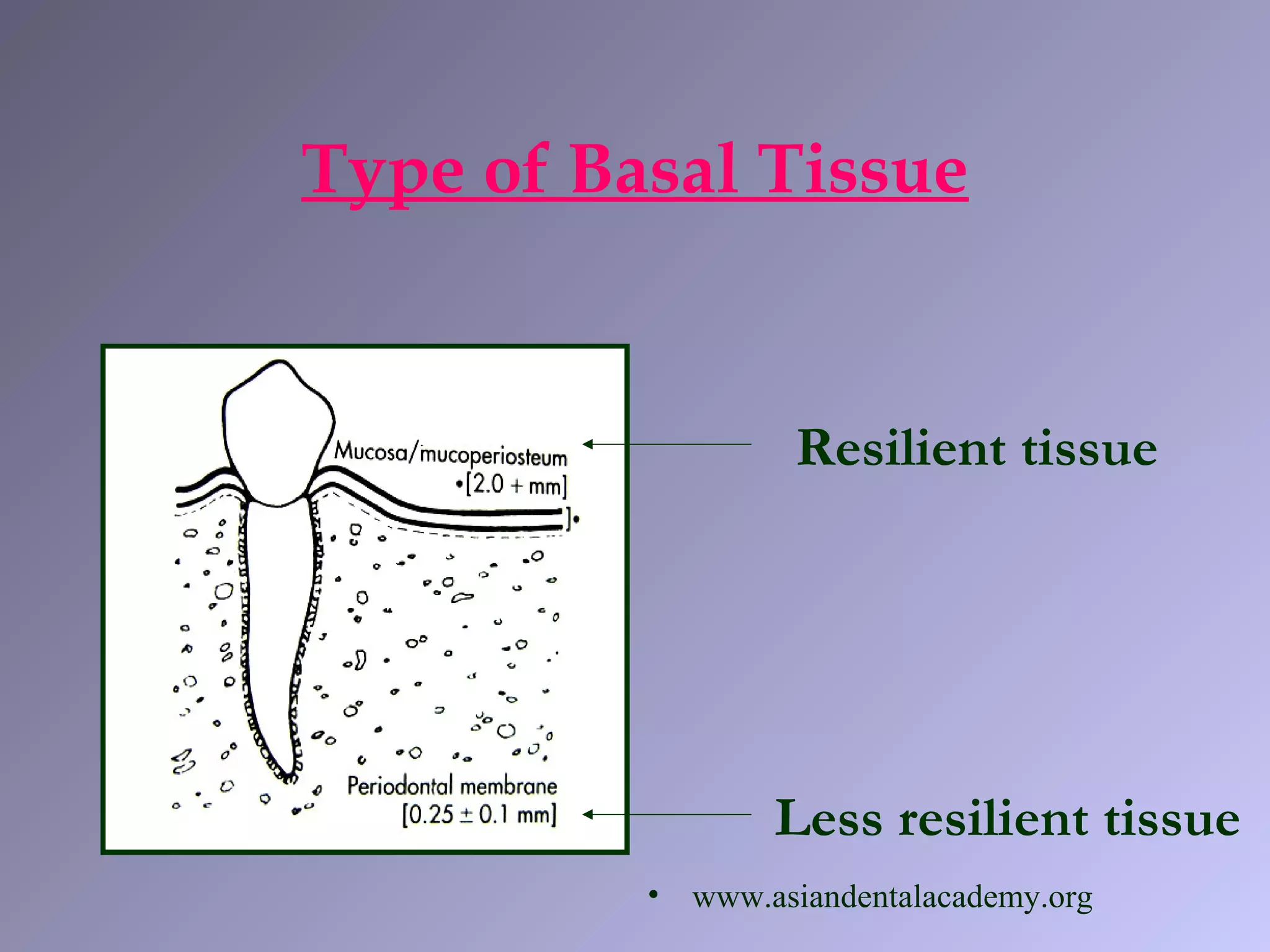
Type of Basal Tissue
Resilient tissue
Less resilient tissue
• www.asiandentalacademy.org
FormForm OOf Basal Tissuesf Basal Tissues
Supporting or functional form
Anatomic or rest form
• www.asiandentalacademy.org
IMPRESSIONS FOR REMOVABLE PARTIAL
DENTURE
ANATOMIC –
for mainly TOOTH SUPPORTED CASES
 FUNCTIONAL-
for TOOTH-TISSUE SUPPORTED
CASES
• www.asiandentalacademy.org
FACTORS AFFECTING DISPLACIBILITY
OF MUCOSA IN DISTAL EXTENSION CASES
 Quality of soft tissue covering edentulous ridge
Soft tissues are compressible to varying degree.
Firm tightly attached mucosa several millimeters
thick will offer great support.
• www.asiandentalacademy.org
 Type of bone making up the denture
bearing area
Cancellous bone is less able to resist vertical
forces than Cortical bone since its irregular
surface irritates overlying soft tissue causing
patient discomfort & bone resorption.
• www.asiandentalacademy.org
 Amount of tissue coverage of denture base
Should be maximum possible within physiological limits
to allow broader stress distribution.
Overextensions- lifting of the denture torquing of the
clasped abutments & possible orthodontic movement of
teeth anterior to fulcrum line.
• www.asiandentalacademy.org
 Design of partial denture
Use of indirect retainers to avoid movement
around fulcrum line.
 Amount of occlusal force
• www.asiandentalacademy.org
OBJECTIVES:
 Record and relate tissues under same
loading
 Distribute the load over as large area as
possible.
 Delineate accurately the peripheral
extension of denture base.
• www.asiandentalacademy.org
EQUILISATION OF STRESSES
between
RESILIENT AND NON-RESILIENT
TISSUES…..
• www.asiandentalacademy.org
REVIEW OF LITERATURE
Impression techniques
• CUMMER 1928– Sectional compound impression
technique where edentulous ridges were recorded first in
compound & then secondary compound impression of teeth
was made.
• MCLEAN 1936- McLean's Technique
• SPRENG 1936- Chewing impression
soft gutta percha in vulcanite tray molded by chewing pressure
& related to metal framework by plaster impression.
• www.asiandentalacademy.org
REVIEW OF LITERATURE
Impression techniques
•APPLEGATE 1937- Fluid wax technique
•HINDLES 1952- Hindle’s technique
•STEFFEL 1954- Functional reline impression
•BOUCHER 1963- Tissue conditioners as functional
impression materials
• www.asiandentalacademy.org
• LEUOPOLD,
KRATOCHVIL 1965 -Altered cast procedure
•Individual trays are attached to the minor connector
covering denture base after metal try in. relief wax under
trays provides space for impression material.
•Border molding with low fusing compound , wash with
ZnOE while framework is positively seated in the mouth.
REVIEW OF LITERATURE
Impression techniques
• HOLMES 1970- Similar procedure but impression
material was light bodied elastomer.• www.asiandentalacademy.org
• PREISKEL 1971
BLATTERFEIN 1980- Functional impression technique
for distal extension cases having
precision attachment.
•Acrylic resin tray is made on master cast covering edentulous
ridges , with a U shaped resin strut contacting teeth at 3 points.
•Impression is made in wax , altered cast is made after sectioning.
• RAPUNO 1970- - Single tray dual impression
technique
• www.asiandentalacademy.org
• HENDERSON AND STEFFEL 1973 – Discussed Selective
pressure technique in order to get functional form of the tissues.
• AKERLY 1978- Technique combining corrective impression
and functional occlusal registration.
Metal framework adjusted , resin trays attached to it. Low
fusing compound border molding is done & ZnOE wash is
made.
Compound occlusal rims are attached to this tray& centric
relation is recorded, occlusal surface is then reduced by 1 mm
& wax is placed on these rims & functional paths are recorded
as well.
Provides optimum occlusion & mucosal support.
• www.asiandentalacademy.org
• BAUMAN 1982- Modification of altered cast technique in
order to overcome the problem of sectioning of the master
cast.
Trays attached to framework in edentulous region.
Border molding with low fusing compound & impression
with elastic material.
Wax occlusal rim attached to superior surface of the tray,
reduced short of contact with opposing teeth & low fusing
compound is added & CR recorded.
With tray & rims in mouth an overall alginate impression is
made in stock tray.
Reproduces functional form of the ridge, anatomic form of
teeth & jaw relation record as well.
• www.asiandentalacademy.org
• FITZOLF 1984- Used thermoplastic resinous materials
e.g. Adaptol and Stalite when placed in water bath become
fluid , can be painted on the surface of the tray & functional
molding is carried out.
REVIEW OF LITERATURE
Impression techniques
• MILLER 1986- Nylon spacer 1 mm thick under the trays
which are attached to the metal framework for making
functional impression by altered cast tech. Nylon does not
interfere with compound border molding and maintains
uniform thickness of material.
• www.asiandentalacademy.org
REVIEW OF LITERATURE
Impression techniques
• JAMES 1985 CHEN 1987 - Alternative to altered cast
technique to overcome problems of sectioning master cast.
Functional impression by attaching trays in edentulous arch.
Pick up impression of entire arch in stock tray.
• www.asiandentalacademy.org
REVIEW OF LITERATURE
Mucosal displacement by impression
procedures
• APPLEGATE 1954- stated that tissues of the residual ridge
are not uniformly compressible & base made from mucostatic
impression will result in firmer areas doing all the work ; weaker
areas receiving little /no stimuli.
• METTY 1958- Used strain gauges to record the movements
of 4 distal extension RPD bases during loading. Alginate &
fluid waxes were used. He maintained that fluid wax allows
transient displacement of tissue bulk & provide a stable base.
• www.asiandentalacademy.org
REVIEW OF LITERATURE
Mucosal displacement by impression
procedures
• LYTLE 1962 –
Measured the magnitude of soft tissue displacement beneath
complete dentures and distal extension partial dentures. He
concluded that under-extended partial dentures caused gross
soft tissue displacement. Greatest magnitude of displacement
occurred in the area farthest from rest support, i.e. the
retromolar pad area.
• www.asiandentalacademy.org
REVIEW OF LITERATURE
Mucosal displacement by impression
procedures
• LEUPOLD 1966- Compared mucosal displacement & denture
base adaptation with anatomic impression in alginate &
functional impression with altered cast technique.
He concluded that alginate impression distorted loose mucosal
tissue more than altered cast procedure. Distortion is maximum
in retromolar region. Denture bases on altered cast showed
better adaptation.
• www.asiandentalacademy.org
REVIEW OF LITERATURE
Mucosal displacement by impression
procedures
• CECCONI, JASLOW 1971-
Observed the pressure exerted by the bases clinically , in
the edentulous areas adjacent to the clear resin bases at the
insertion of framework & after 48 hour.
Tissue blanching was evident at both periods regardless of
type of impression material used for corrective impression.
• www.asiandentalacademy.org
REVIEW OF LITERATURE
Mucosal displacement by impression
procedures
• FISHER 1983- studied type of impression registration with
respect to material used.materials were ZnOE paste , light or
regular body rubber base and fluid wax.
The denture base stability was best with rubber base
elastomer than the other two.
• www.asiandentalacademy.org
• Richard J. Leupold et al 1992Richard J. Leupold et al 1992
Compared of vertical movement occuring during loading of distalCompared of vertical movement occuring during loading of distal
extension removable partial denture bases made by three impressionextension removable partial denture bases made by three impression
techniquetechnique::Impression techniques compared were
•Altered cast impression
•An impression made from a border molded custom tray
•Stock tray irreversible hydrocolloid impression
• The 0.19mm difference between altered cast & border molded
custom tray was statistically significant but clinically irrelevant
REVIEW OF LITERATURE
Mucosal displacement by impression
procedures
• www.asiandentalacademy.org
REVIEW OF LITERATURE
Mucosal displacement by impression
procedures
• JARVIS 1995- Soft tissue displacement during
impression making may partially be controlled through
placement of relief and escape holes in the tray.
Viscosity of the impression material also determines the
displacement of soft tissue.
• www.asiandentalacademy.org
when to
go for
it???
• www.asiandentalacademy.org
INDICATIONS
 Distal extension cases – Kennedy's Class I, II
 Kennedy’s class IV - Long span anterior
edentulous ridge ( > 6 anterior teeth)
• www.asiandentalacademy.org
Clinical test: no 1.
 Acrylic resin bases are attached to the framework
 It is then placed in mouth
 Pressure is applied on the bases
 If the indirect retainer or linguo-plate lifts from their
position there is a need for functional impression.
• www.asiandentalacademy.org
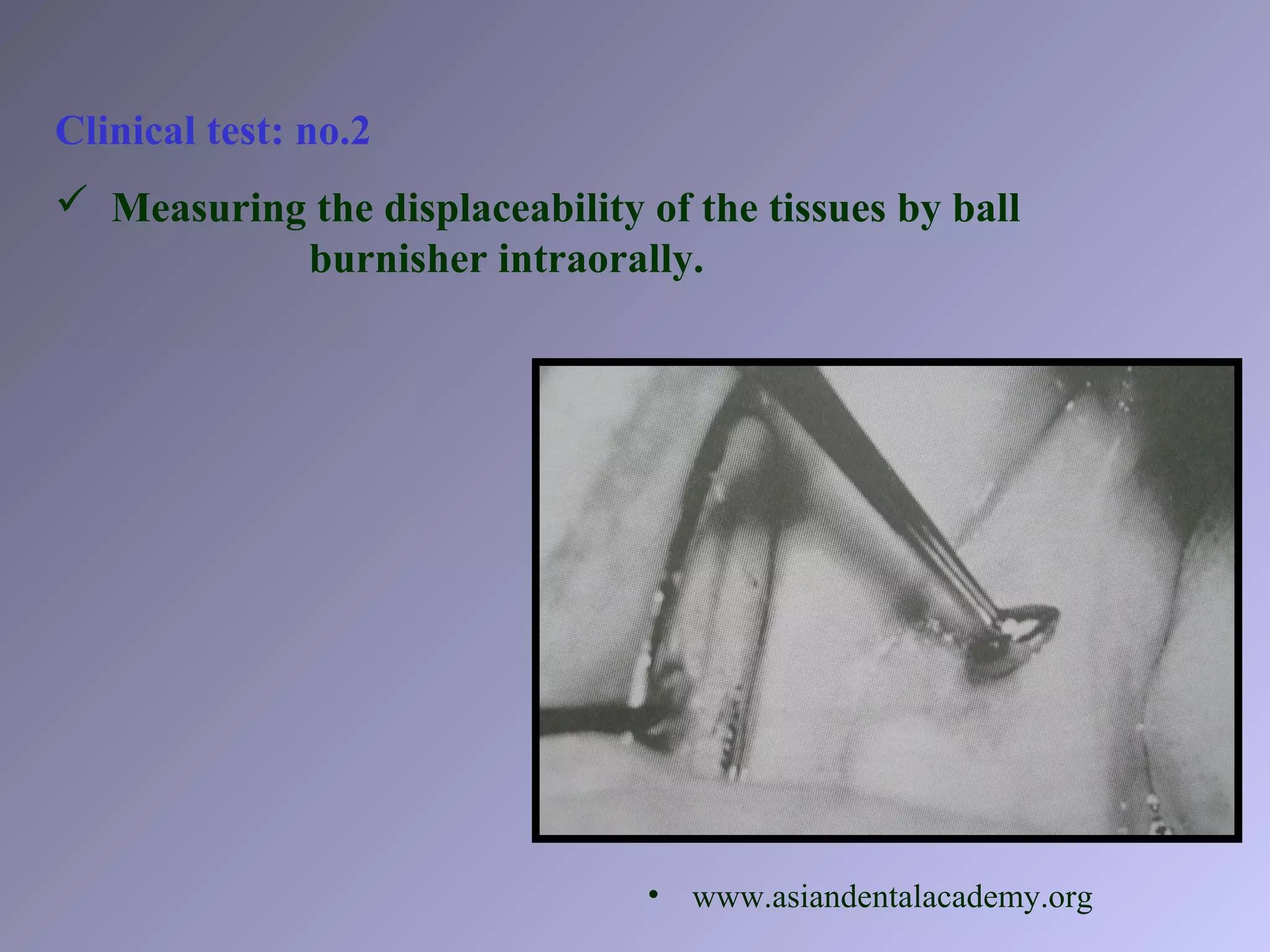
Clinical test: no.2
 Measuring the displaceability of the tissues by ball
burnisher intraorally.
• www.asiandentalacademy.org
IMPRESSION TRAYS
PRE-FABRICATED TRAYS
CUSTOM TRAYS
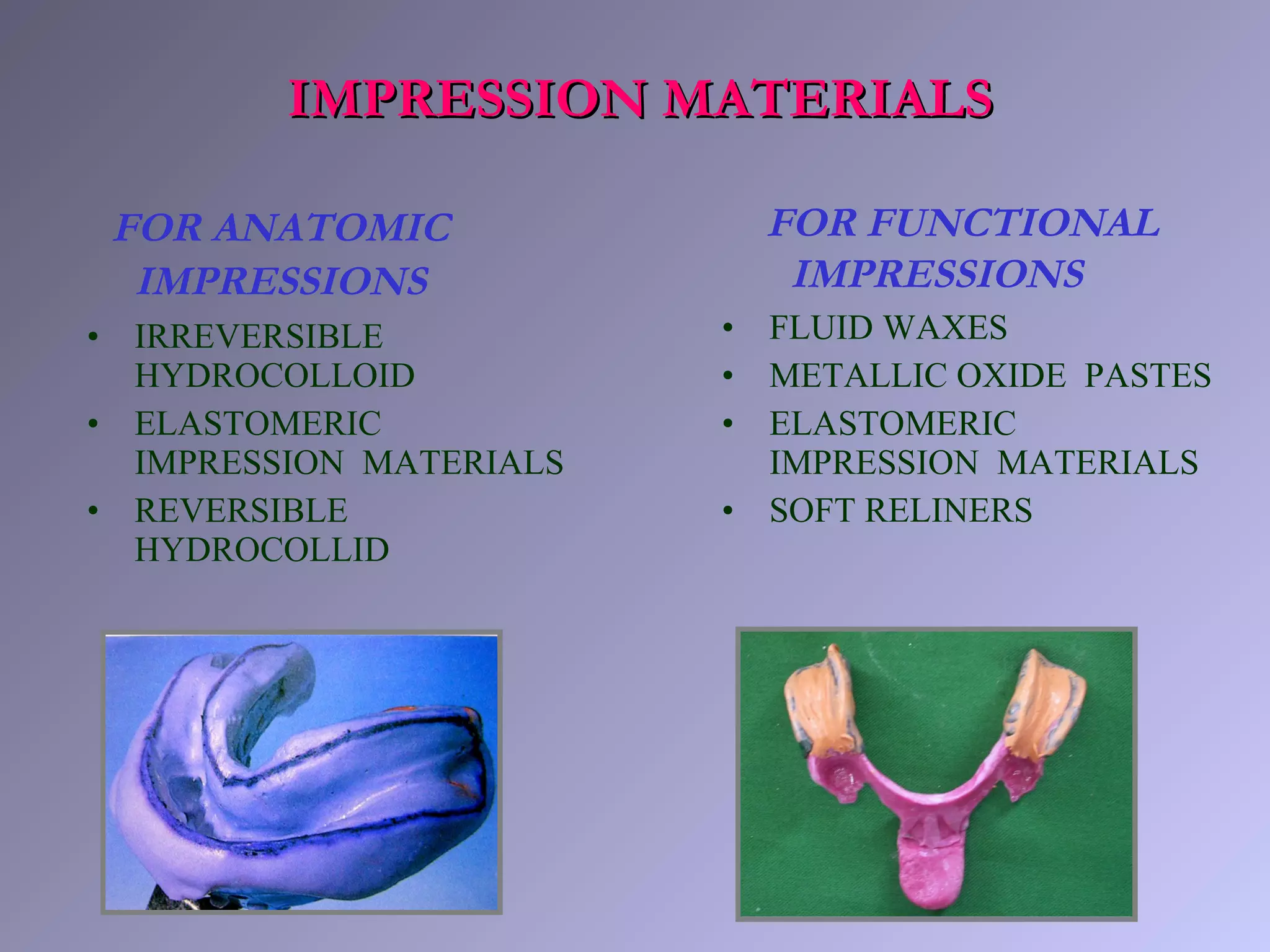
FOR ANATOMIC
IMPRESSIONS
• IRREVERSIBLE
HYDROCOLLOID
• ELASTOMERIC
IMPRESSION MATERIALS
• REVERSIBLE
HYDROCOLLID
FOR FUNCTIONAL
IMPRESSIONS
• FLUID WAXES
• METALLIC OXIDE PASTES
• ELASTOMERIC
IMPRESSION MATERIALS
• SOFT RELINERS
IMPRESSION MATERIALSIMPRESSION MATERIALS
CHOICE OF MATERIAL:
•CLINICAL SITUATION
•AVAILABILITY
•KNOWLWDGE & SKILL OF CLINICIAN
GOOD TECHNIQUE PAYS
OFF…!!
• www.asiandentalacademy.org
FUNCTIONAL OR DUALFUNCTIONAL OR DUAL
IMPRESSIONSIMPRESSIONS
1 Functional & anatomic impression made
together in a pick up impression
2 Altered cast obtained by correctable impression
• www.asiandentalacademy.org
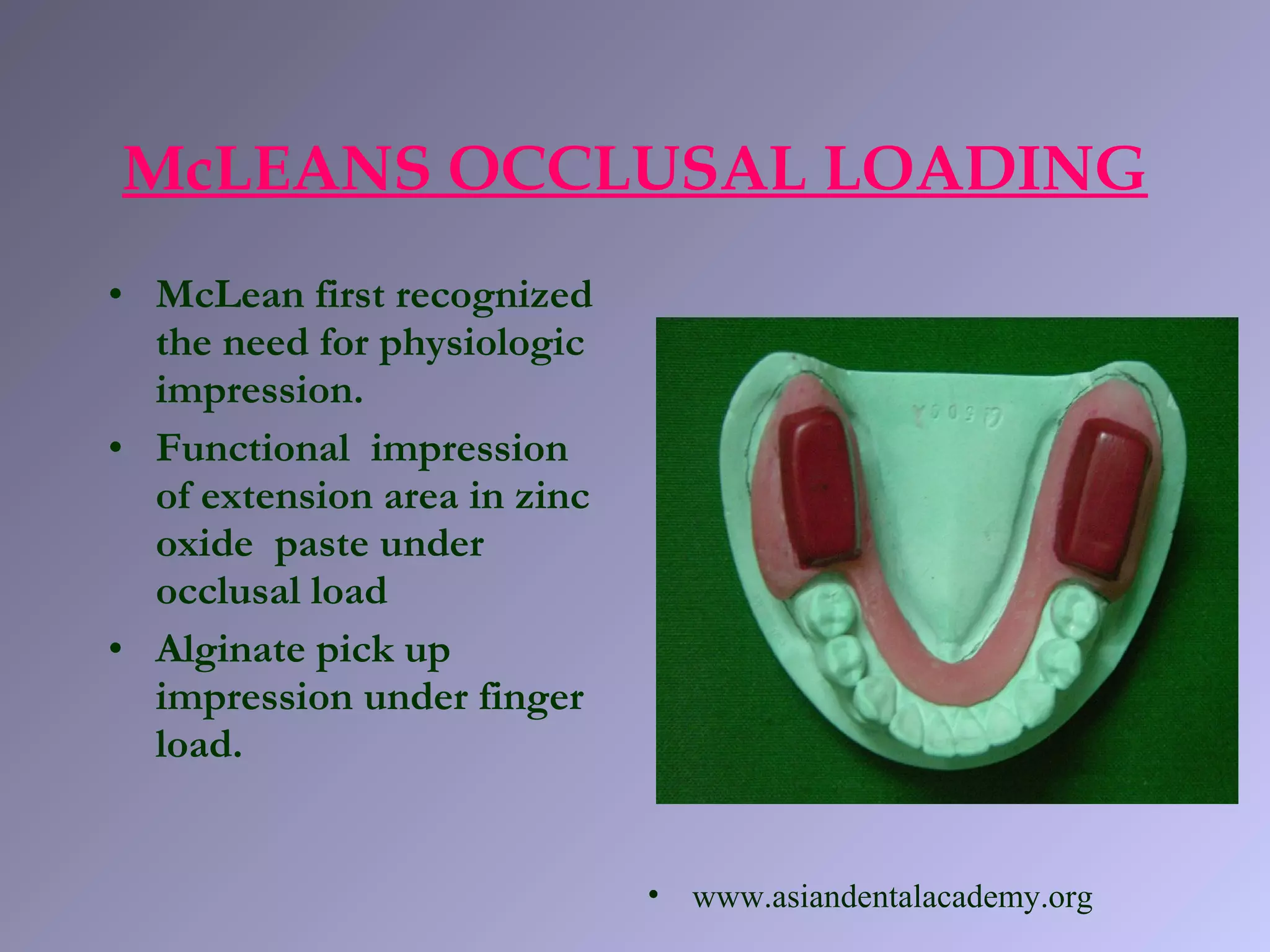
• McLean first recognized
the need for physiologic
impression.
• Functional impression
of extension area in zinc
oxide paste under
occlusal load
• Alginate pick up
impression under finger
load.
McLEANS OCCLUSAL LOADING
• www.asiandentalacademy.org
• Disadvantages:
 Finger pressure not equal to biting
pressure
 Alginate between stock tray and occlusal
rim acts as buffer. May not transfer entire
load to special tray.
McLEANS OCCLUSAL LOADING
• www.asiandentalacademy.org
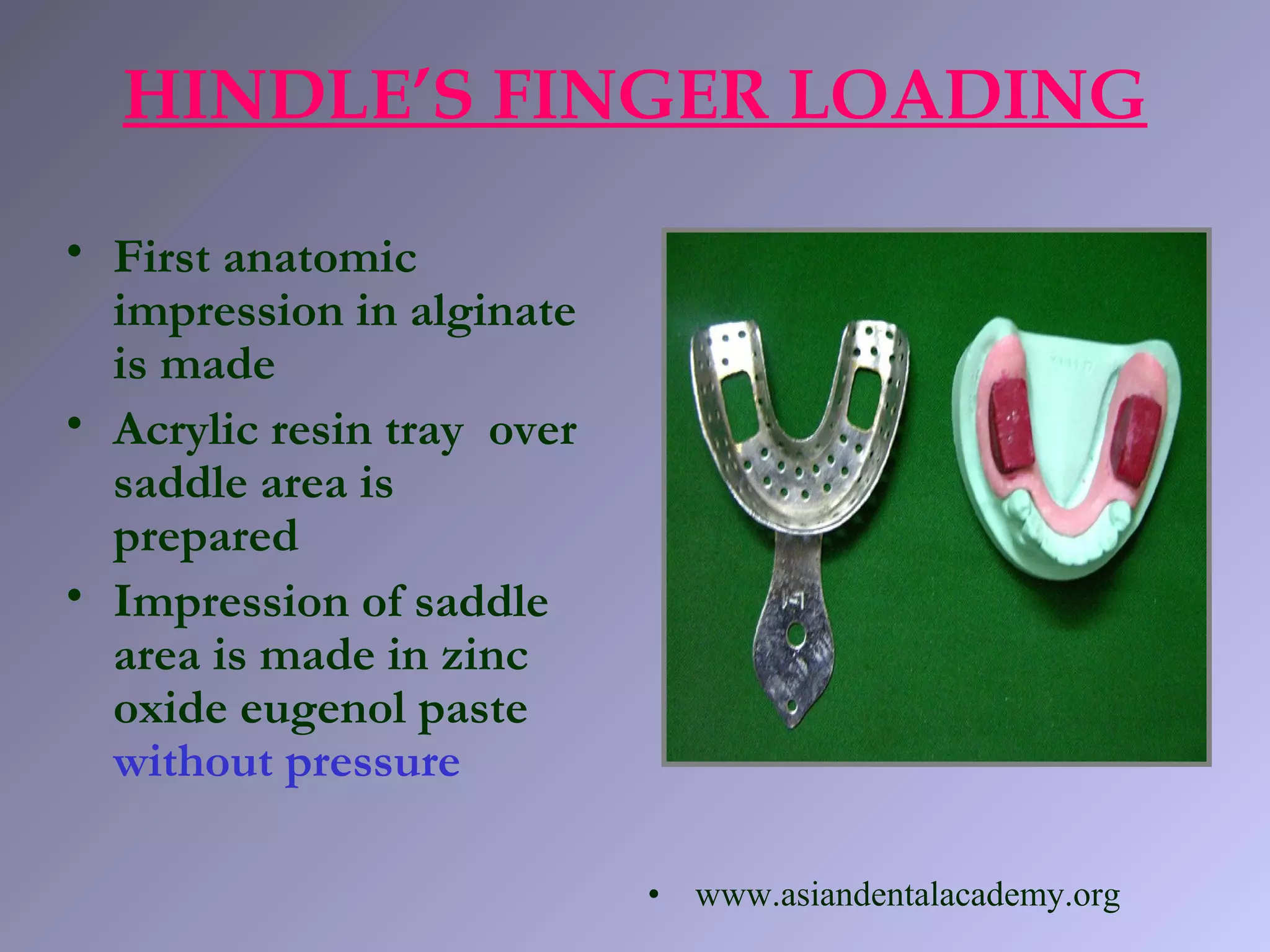
HINDLE’S FINGER LOADING
• First anatomic
impression in alginate
is made
• Acrylic resin tray over
saddle area is
prepared
• Impression of saddle
area is made in zinc
oxide eugenol paste
without pressure
• www.asiandentalacademy.org
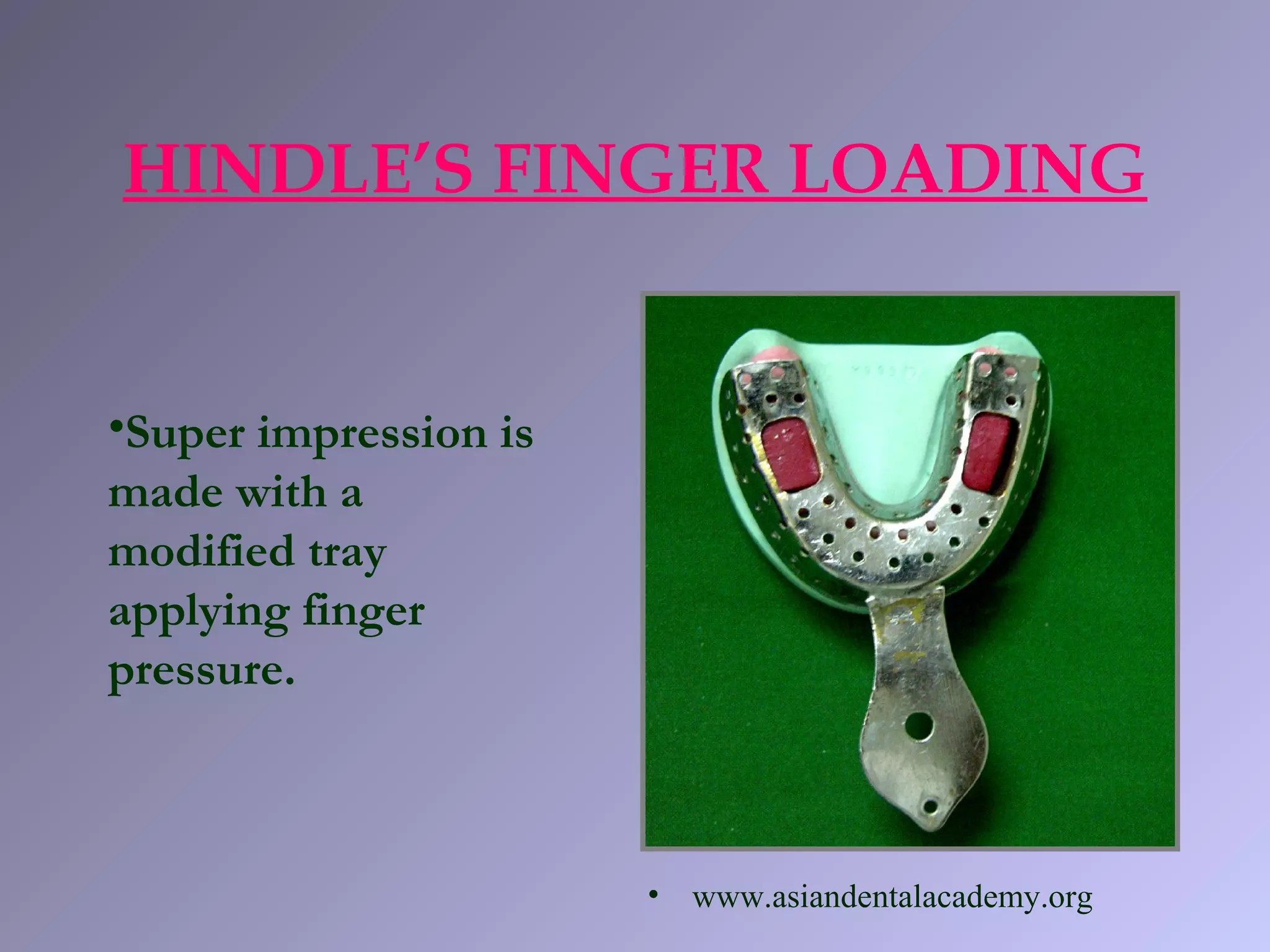
HINDLE’S FINGER LOADING
•Super impression is
made with a
modified tray
applying finger
pressure.
• www.asiandentalacademy.org
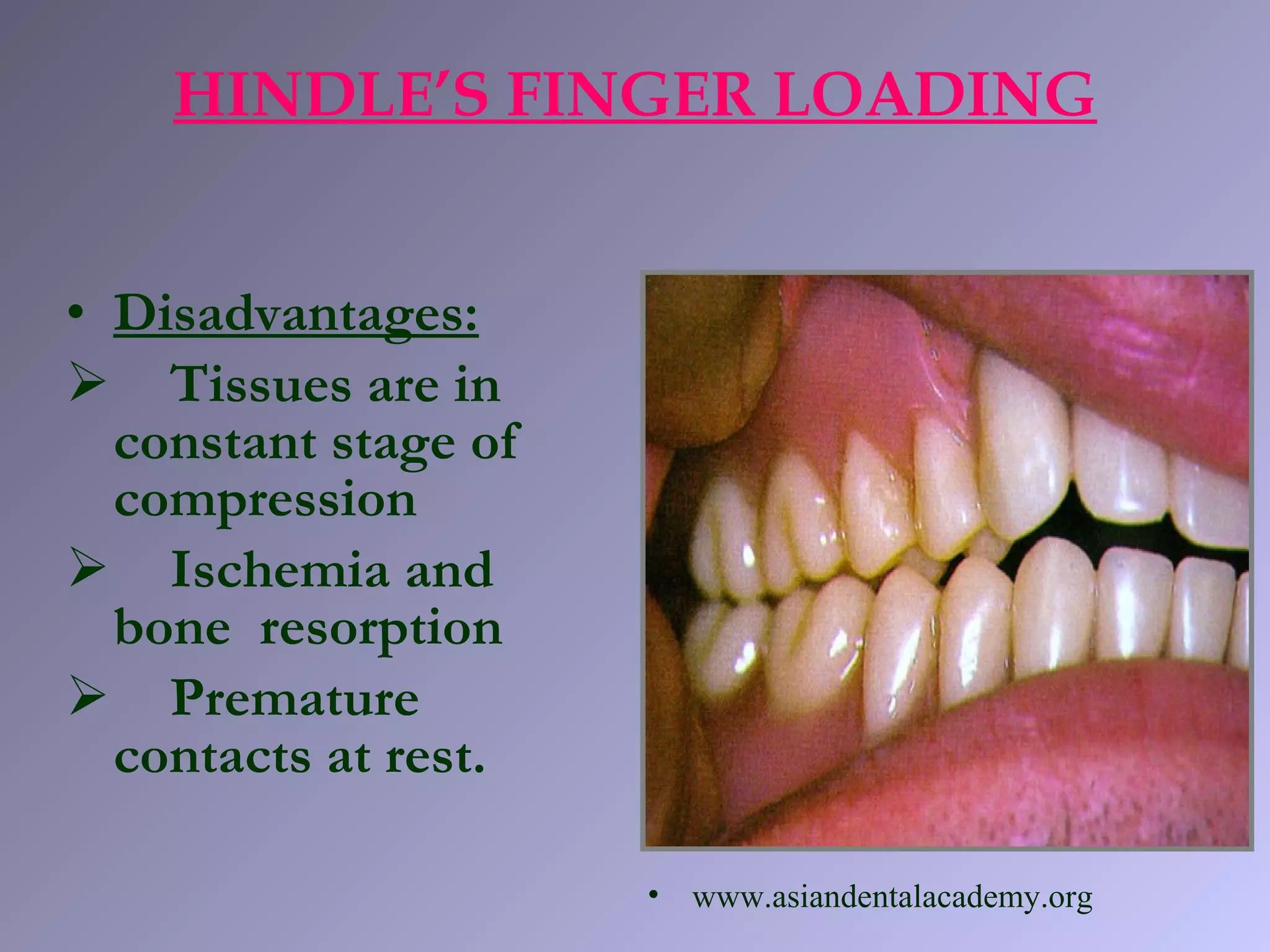
• Disadvantages:
 Tissues are in
constant stage of
compression
 Ischemia and
bone resorption
 Premature
contacts at rest.
HINDLE’S FINGER LOADING
• www.asiandentalacademy.org
• First anatomic impression is made in alginate
• A resin tray is prepared close fitting in saddle
areas but considerable relief is provided in
dentulous area tray has a window in dentulous
area.
• A zinc oxide paste impression of the saddle is
made .With the tray firmly held in position
alginate is injected into the box of the tray.
RAPUNO’S SINGLE TRAY DUAL
IMPRESSION TECHNIQUE
• www.asiandentalacademy.org
• Maximum coverage of mandibular ridge &
adequate for maxillary ridge
• Traumatic impact on any area must be avoided
• At rest there must be no islands of ischemia
• Under work loads all areas must receive
massage stimuli
OBJECTIVES OF CORRECTABLE
IMPRESSION By O.C. Applegate
• www.asiandentalacademy.org
•The base and occlusal rest must support
simultaneously . So pressure should be exerted on
pdl membrane while making impression
• www.asiandentalacademy.org
Mouth temperature / fluid waxes
so called since they are firm at
room temp. & can flow at mouth
temp.
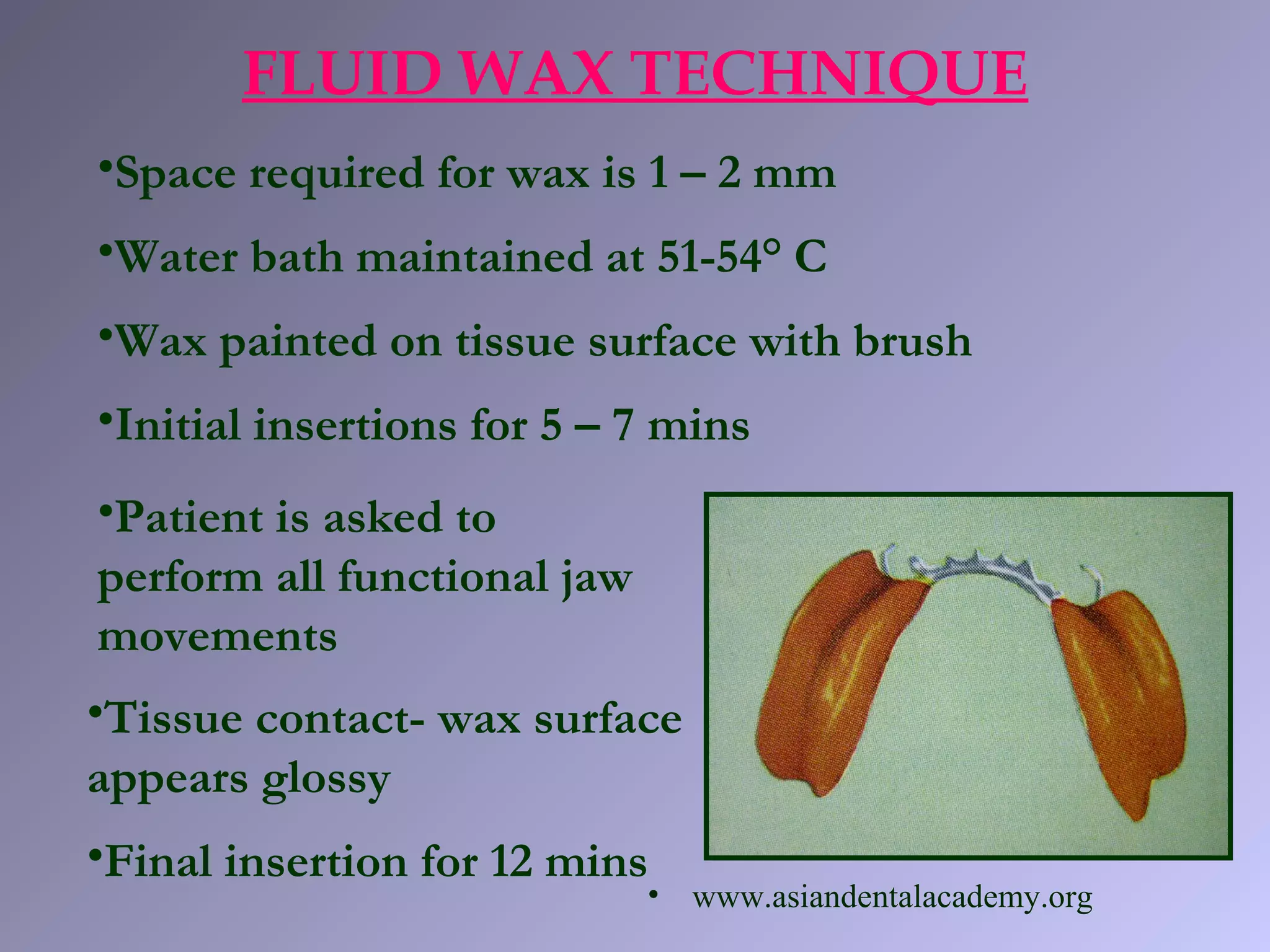
FLUID WAX TECHNIQUE
•Korrecta no. IV - tissue surface [orange]
•Korrecta no. I – reinforcement of borders [pink]
By Dr. O.C. Applegate & Dr. S.G.Applegate
• www.asiandentalacademy.org
KEY FACTORS IN USE-
SPACE- Amount of relief provided thin layer
flows less readily than a thick layer
TIME - Each layer should remain in place
for 5-7 min to allow the wax to flow & prevent
buildup of excessive stresses resulting in
distortion of tissues.
• www.asiandentalacademy.org
FLUID WAX TECHNIQUE
•Space required for wax is 1 – 2 mm
•Water bath maintained at 51-54° C
•Wax painted on tissue surface with brush
•Initial insertions for 5 – 7 mins
•Patient is asked to
perform all functional jaw
movements
•Tissue contact- wax surface
appears glossy
•Final insertion for 12 mins
• www.asiandentalacademy.org
 Less tissue displacement
 Physiological border molding
 Time consuming
 Technique sensitive
 Availability of material.
• www.asiandentalacademy.org
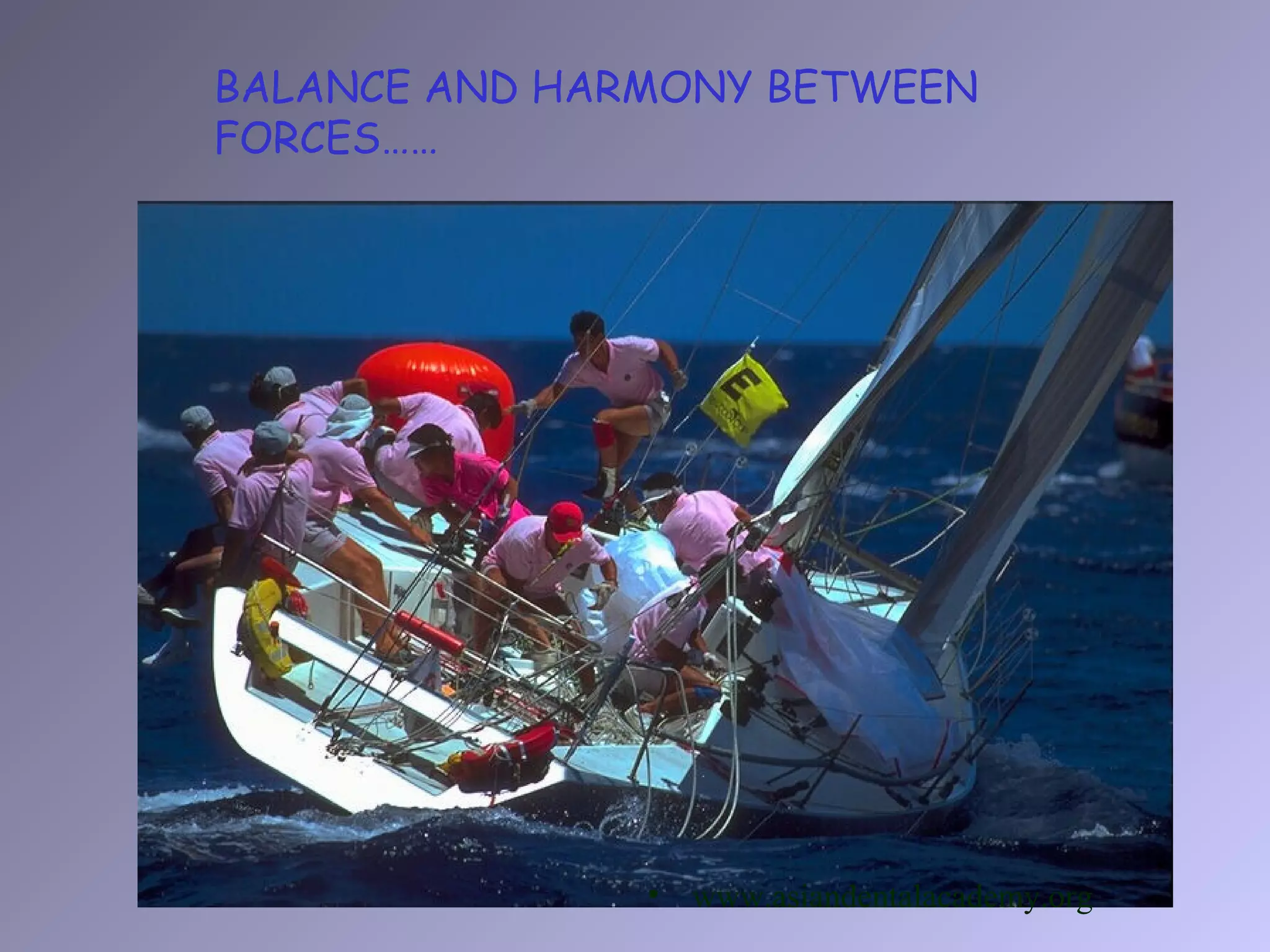
BALANCE AND HARMONY BETWEEN
FORCES……
• www.asiandentalacademy.org
• Techniques discussed until now caused generalized
displacement of mucosa to a greater or lesser degree.
Selective tissue as described by Henderson and Steffel
1973 attempts to
Direct forces to those portions of the ridge that are
better able to respond to these stresses without any
adverse response
To protect the areas of ridge least able to bear the
forces.
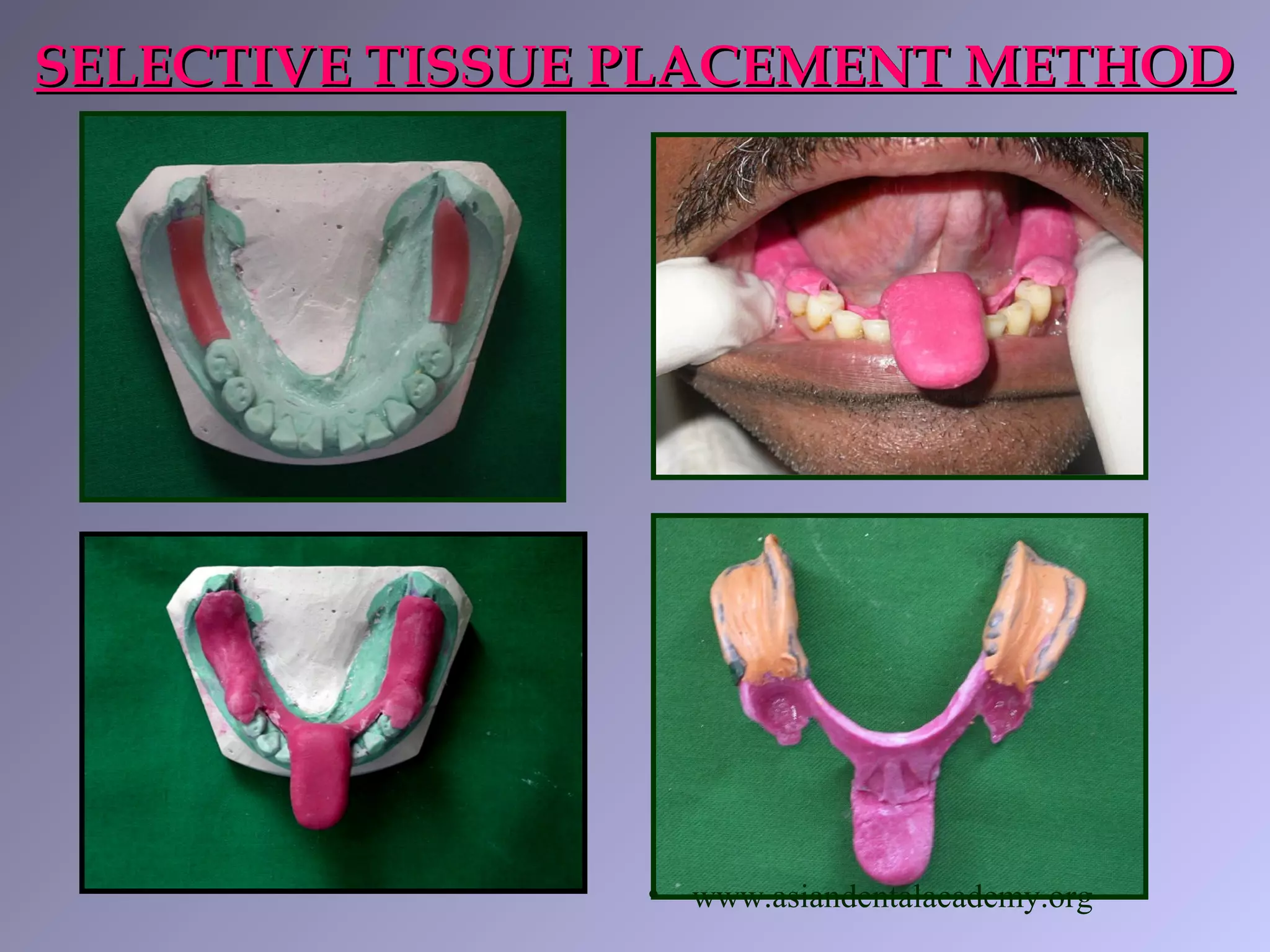
SELECTIVE TISSUE PLACEMENT METHODSELECTIVE TISSUE PLACEMENT METHOD
• www.asiandentalacademy.org
 Ridge crest - Relief
 Buccal shelf – Primary stress bearing area hence no
relief.
 Lingual slope of mandibular ridge – Resists
horizontal & rotational forces.
 These two areas are recorded in slightly displaced
form.
SELECTIVE TISSUE PLACEMENT METHODSELECTIVE TISSUE PLACEMENT METHOD
 Some patients with tissue covering ridge is softer &
more easily displaced to obtain more relief escape
holes are placed through the tray to permit material to
flow & dissipate pressure.
• www.asiandentalacademy.org
SELECTIVE TISSUE PLACEMENT METHODSELECTIVE TISSUE PLACEMENT METHOD
Impression material:
•Zinc oxide eugenol paste- Accurate impression
Minimum time
Also effective when soft flabby tissues
are involved.
Material of choice when ridge is free of
gross undercuts.
•Elastomers – Particularly indicated for patients having
ridges with gross bony undercuts.
• www.asiandentalacademy.org
SELECTIVE TISSUE PLACEMENT METHODSELECTIVE TISSUE PLACEMENT METHOD
• www.asiandentalacademy.org
SELECTIVE TISSUE PLACEMENT METHOD
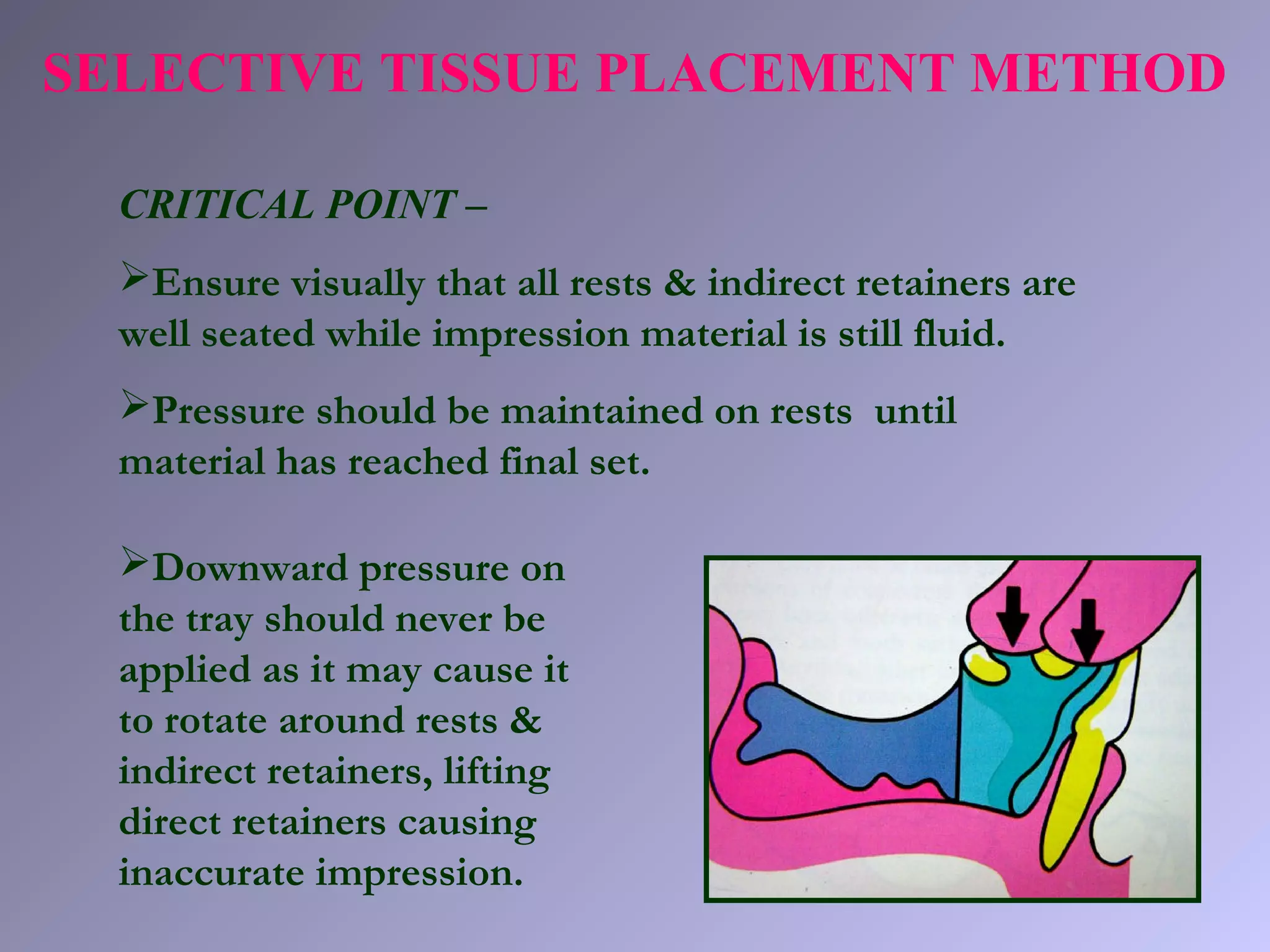
CRITICAL POINT –
Ensure visually that all rests & indirect retainers are
well seated while impression material is still fluid.
Pressure should be maintained on rests until
material has reached final set.
Downward pressure on
the tray should never be
applied as it may cause it
to rotate around rests &
indirect retainers, lifting
direct retainers causing
inaccurate impression.
SELECTIVE TISSUE PLACEMENT METHOD
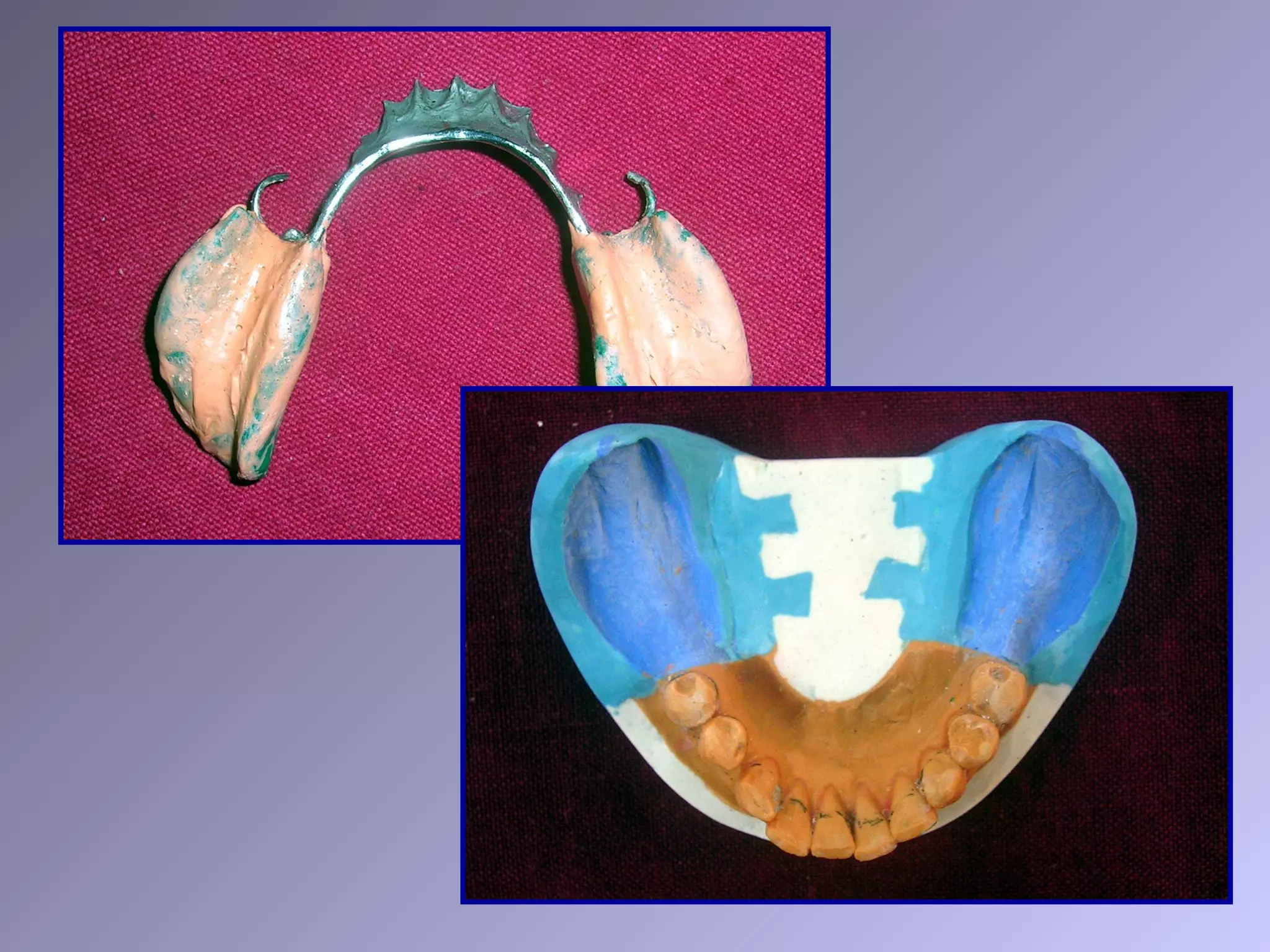
• Require trays attached to metallic framework or
individualized acrylic resin tray
• Spacer of one thickness base plate wax is adapted
• Tray is kept 2 – 3 mm short of reflection.
• Low fusing impression compound is used for border
molding
• Tissue surface is scrapped by 1 mm except in buccal
shelf area , borders are shortened by 1 – 1.5 mm
• Wash impression is made in elastomeric imp.material
or zinc oxide paste
• www.asiandentalacademy.org
FUNCTIONAL RELINE METHODFUNCTIONAL RELINE METHOD
 Performed after the partial denture fabrication on
an anatomic cast
 Partial denture is relined before the insertion
appointment or later.
 Relining of partial dentures possible after bone
resorption
• www.asiandentalacademy.org
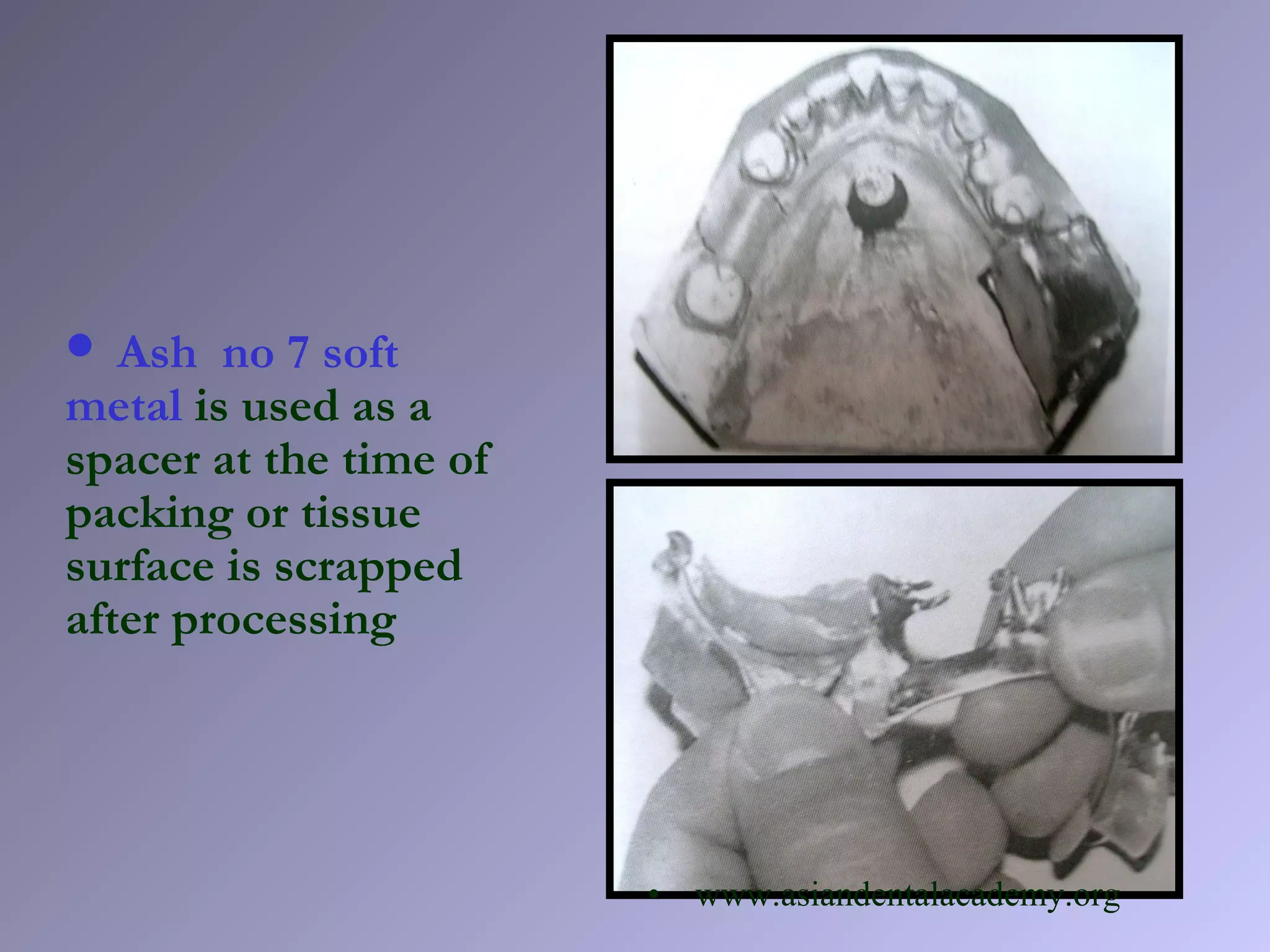
 Ash no 7 soft
metal is used as a
spacer at the time of
packing or tissue
surface is scrapped
after processing
• www.asiandentalacademy.org
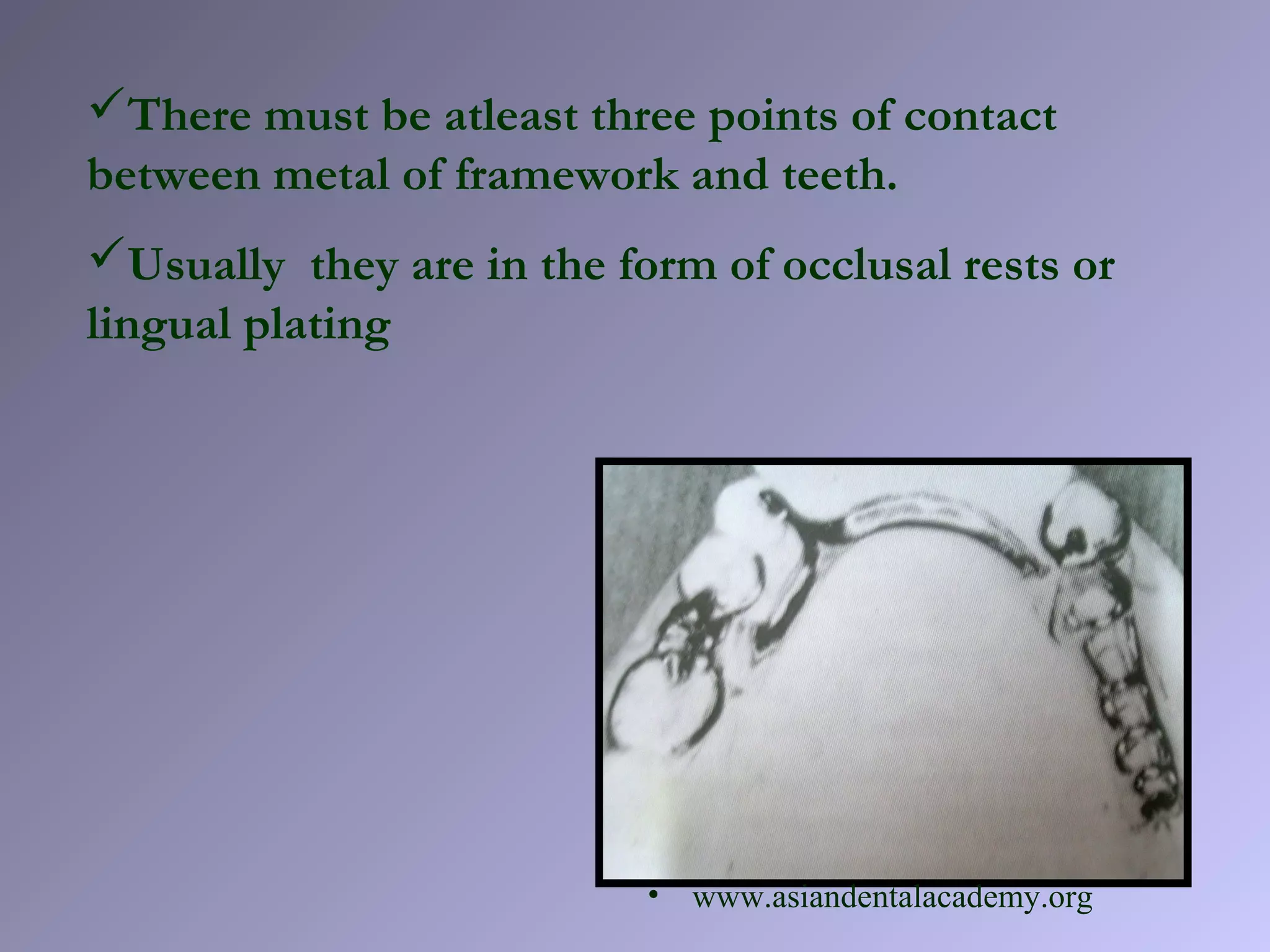
There must be atleast three points of contact
between metal of framework and teeth.
Usually they are in the form of occlusal rests or
lingual plating
• www.asiandentalacademy.org
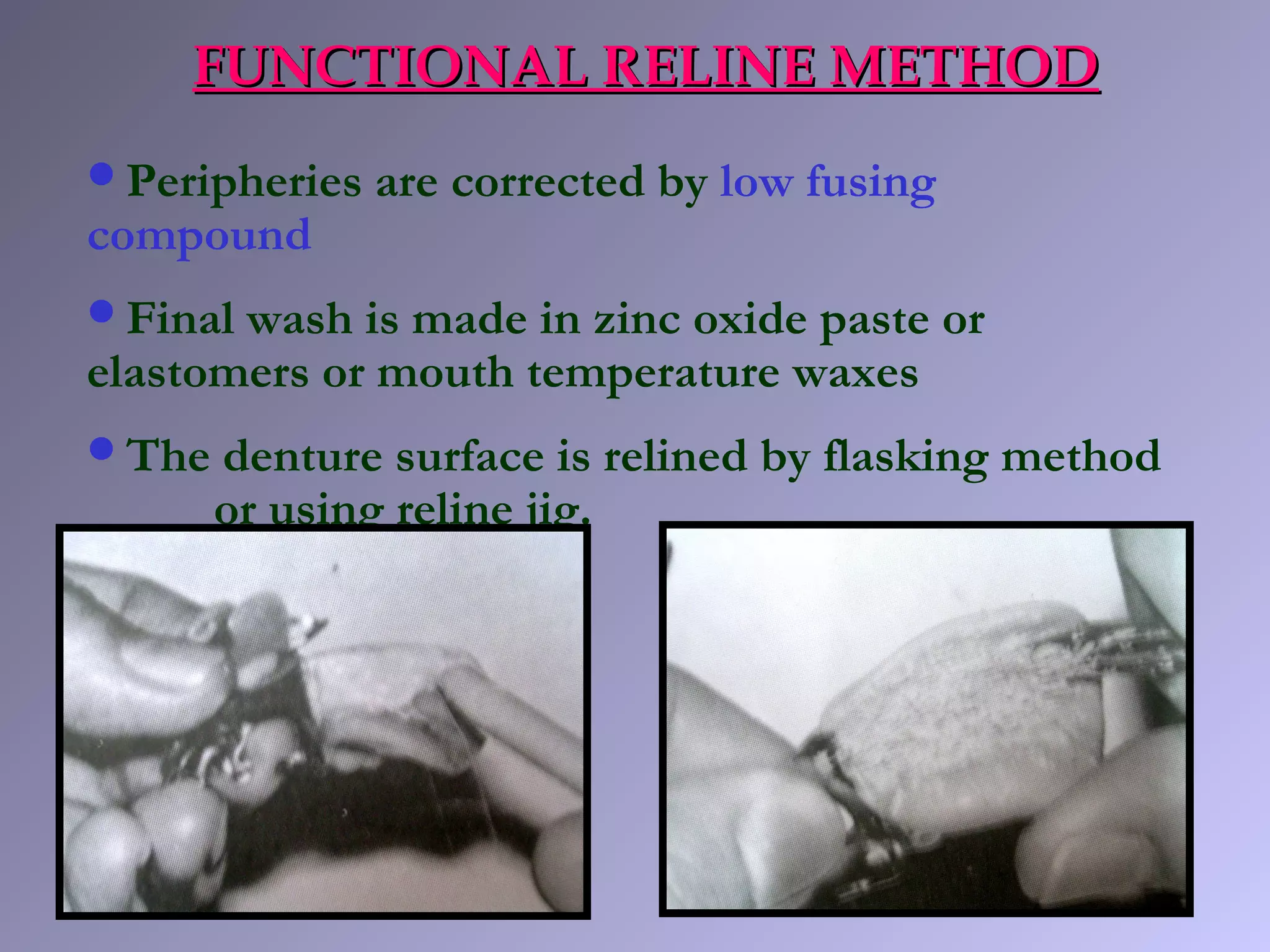
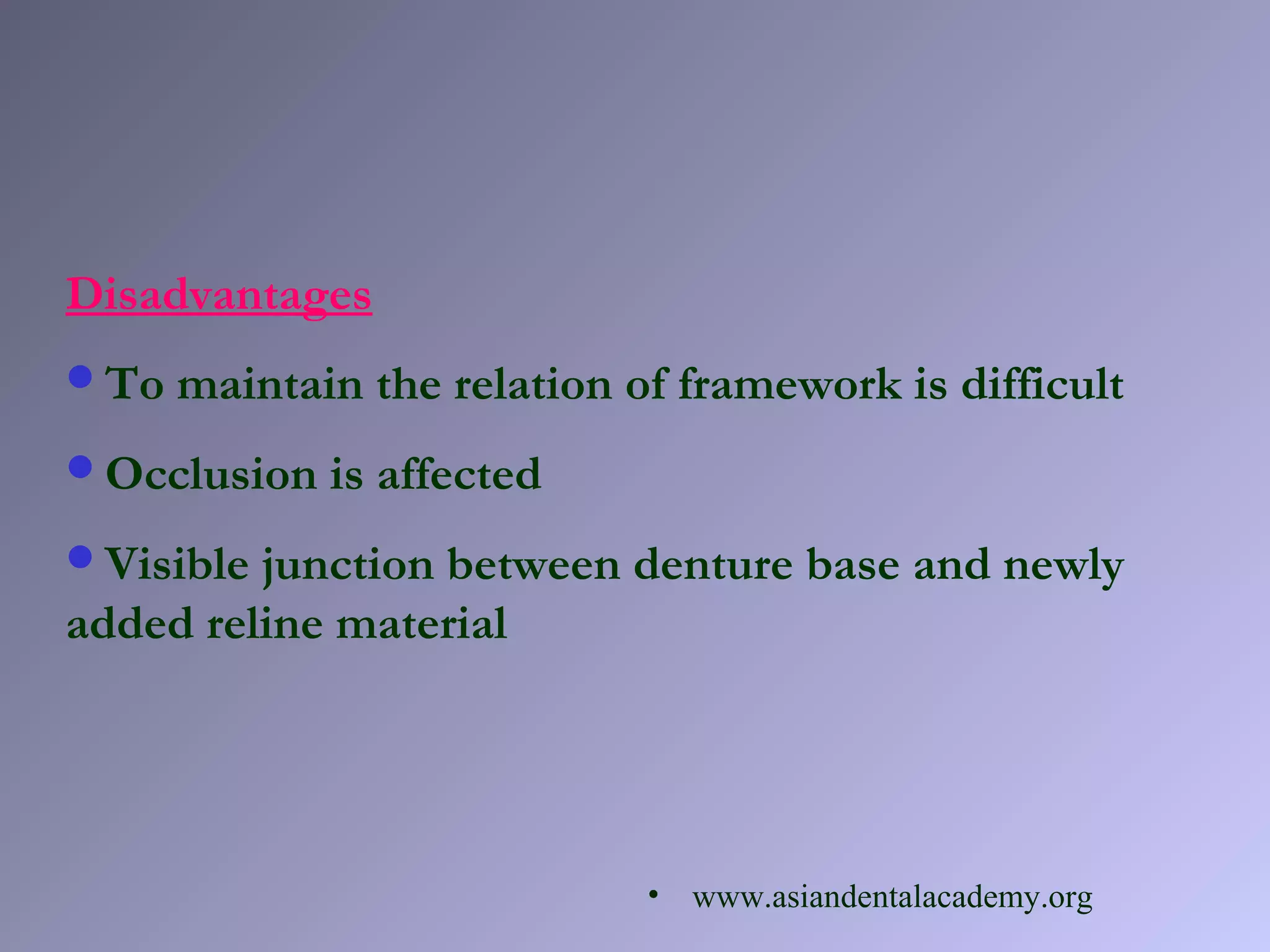
FUNCTIONAL RELINE METHODFUNCTIONAL RELINE METHOD
Peripheries are corrected by low fusing
compound
Final wash is made in zinc oxide paste or
elastomers or mouth temperature waxes
The denture surface is relined by flasking method
or using reline jig.
Disadvantages
To maintain the relation of framework is difficult
Occlusion is affected
Visible junction between denture base and newly
added reline material
• www.asiandentalacademy.org
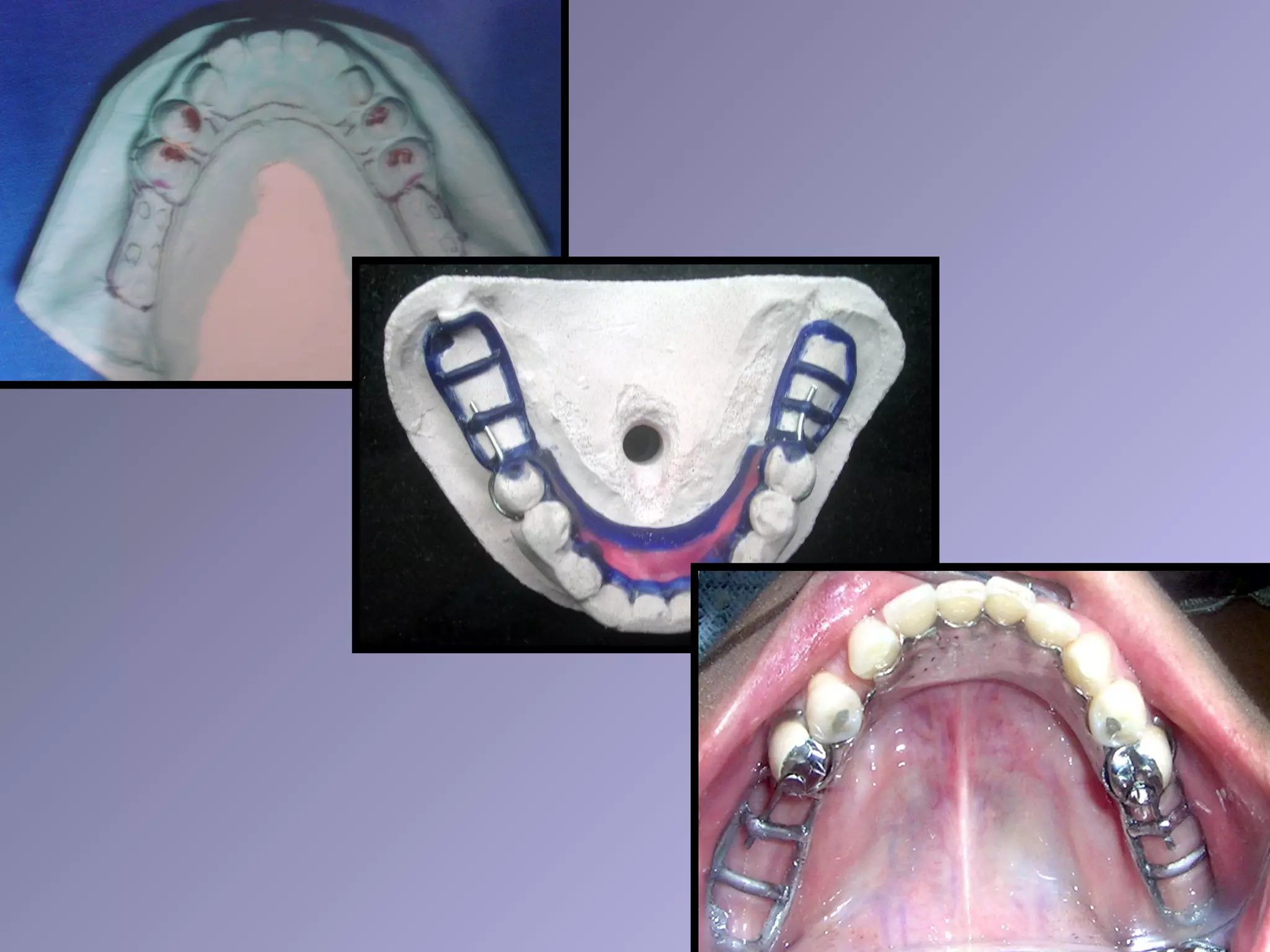
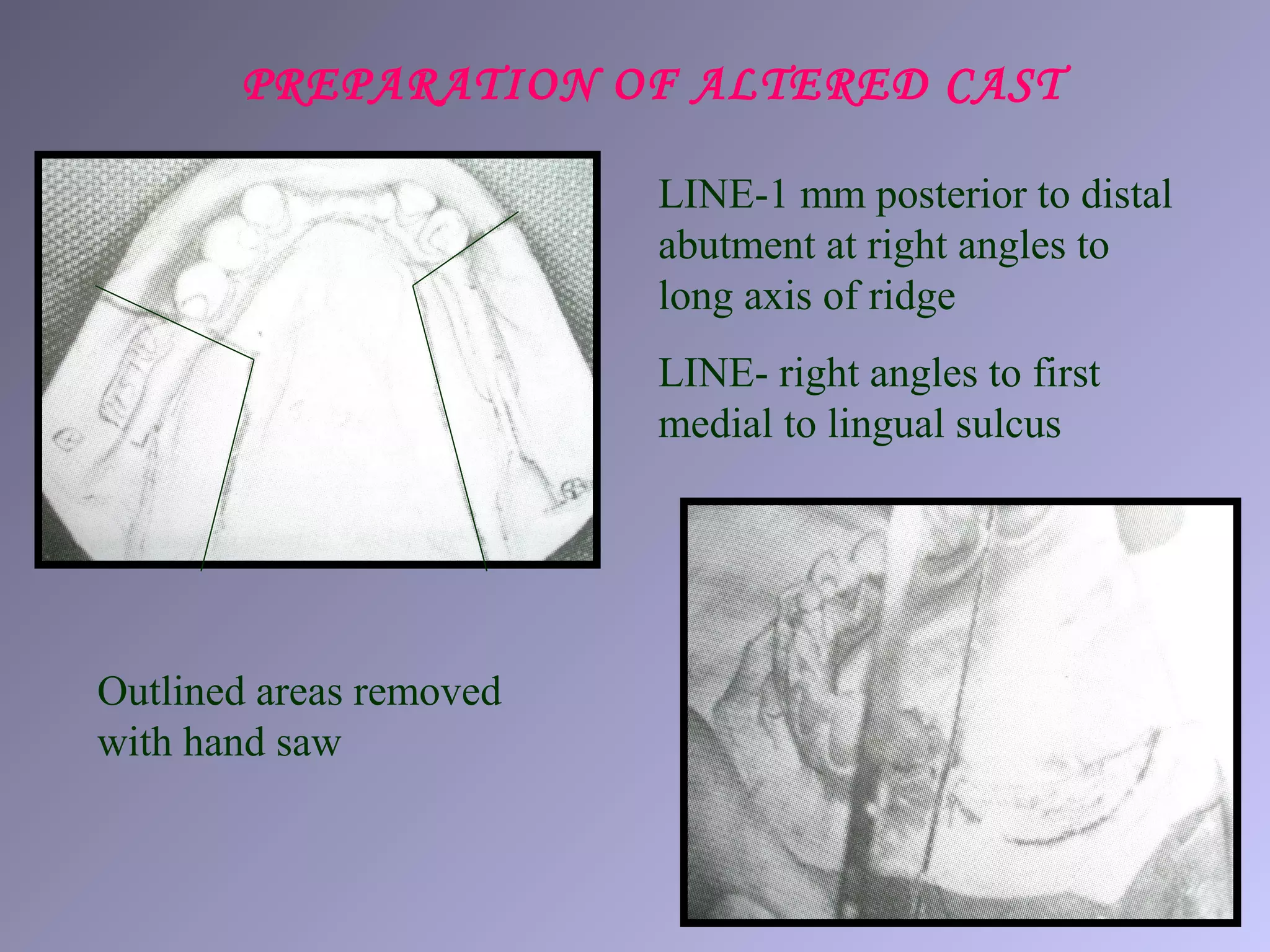
PREPARATION OF ALTERED CAST
LINE-1 mm posterior to distal
abutment at right angles to
long axis of ridge
LINE- right angles to first
medial to lingual sulcus
Outlined areas removed
with hand saw
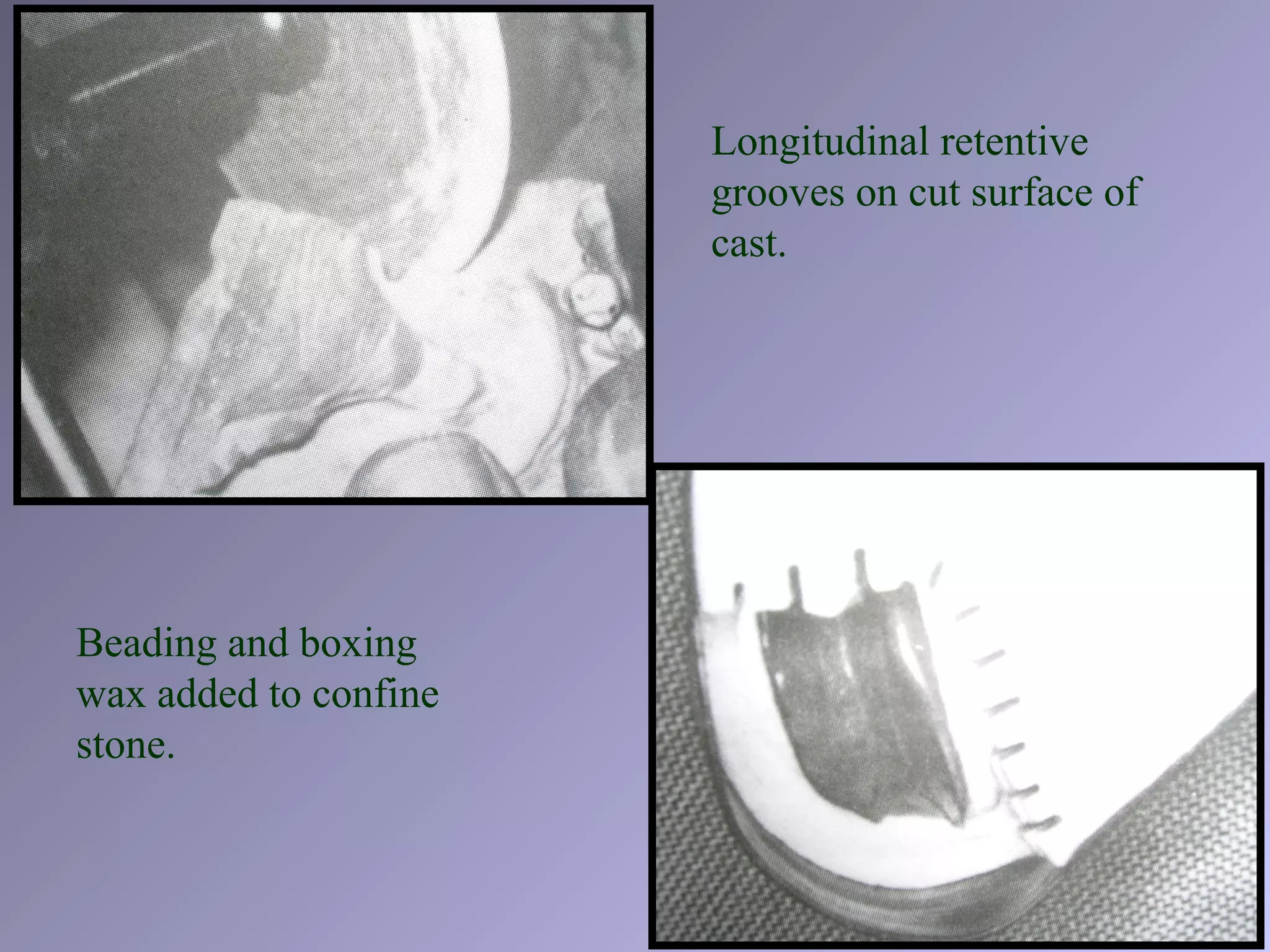
Longitudinal retentive
grooves on cut surface of
cast.
Beading and boxing
wax added to confine
stone.
FUNCTIONAL IMPRESSION WITH TISSUE
CONDITIONERS
Advantages:
•Early flow followed by a degree of plasticity that will
contain the material within denture & permit it to
change shape according to differing soft tissue
contours under varying occlusal loads.
•During this period it’s elastic memory increases to
enable final record of soft tissue contours to reflect
varying shapes under various conditions.
• www.asiandentalacademy.org
Critical properties expected from the material:
•Dimensional stability upon removal from mouth
•Accuracy in reproduction of detail.
•Compatibility with gypsum products.
Disadvantages:
• Behaviour depends upon material composition.
1. amount of plasticizer content
2. molecular weight of polymer
• www.asiandentalacademy.org
•There are no specifications for manufacturing these
materials by any association.
•There are no standardized techniques for its use as a
functional impression material.
•There are no clinical studies performed on efficacy &
comparative analysis with rest of the materials.
• www.asiandentalacademy.org
Altered cast procedure does not offer significant advantages
over one piece cast
Following standards should be met
 Complete extension of impression
 Use of magnification to adjust and ensure
complete seating of the framework
 Coverage of retromolar pad and buccal shelf area by the
base
CLINICAL OUTCOME OF ALTERED CASTCLINICAL OUTCOME OF ALTERED CAST
IMPRESSION PROCEDURE COMPAREDIMPRESSION PROCEDURE COMPARED
WITH USE OF A ONE PIECE CASTWITH USE OF A ONE PIECE CAST
Richard P. Frank et al J Prosthet dent 2004;91:468-76Richard P. Frank et al J Prosthet dent 2004;91:468-76
• www.asiandentalacademy.org
• Tissue displaceability depends upon
1. Histological characteristics of tissue
2. Impression technique employed.
• Altered cast technique caused more
displacement of tissues than single impression.
• Adaptation of denture base is better in altered
cast made with proper technique.
• Placement of tissues by altered cast improves
support for distal extension base.movement of
base can thus be minimized.this tissue
placement is within physiologic limits & will not
adversely affect tissue health.• www.asiandentalacademy.org
• www.asiandentalacademy.org

Impression techniques in removable partial dentures

  • 2.
    SPECIAL IMPRESSION PROCEDURES IN REMOVABLEPARTIAL DENTURE • www.asiandentalacademy.org
  • 3.
    TYPES OF REMOVABLEPARTIAL DENTURES TOOTH SUPPORTED  CLASS III TOOTH-TISSUE SUPPORTED CLASS I,II,LONG SPAN IV• www.asiandentalacademy.org
  • 4.
    Type of BasalTissue Resilient tissue Less resilient tissue • www.asiandentalacademy.org
  • 5.
    FormForm OOf BasalTissuesf Basal Tissues Supporting or functional form Anatomic or rest form • www.asiandentalacademy.org
  • 6.
    IMPRESSIONS FOR REMOVABLEPARTIAL DENTURE ANATOMIC – for mainly TOOTH SUPPORTED CASES  FUNCTIONAL- for TOOTH-TISSUE SUPPORTED CASES • www.asiandentalacademy.org
  • 7.
    FACTORS AFFECTING DISPLACIBILITY OFMUCOSA IN DISTAL EXTENSION CASES  Quality of soft tissue covering edentulous ridge Soft tissues are compressible to varying degree. Firm tightly attached mucosa several millimeters thick will offer great support. • www.asiandentalacademy.org
  • 8.
     Type ofbone making up the denture bearing area Cancellous bone is less able to resist vertical forces than Cortical bone since its irregular surface irritates overlying soft tissue causing patient discomfort & bone resorption. • www.asiandentalacademy.org
  • 9.
     Amount oftissue coverage of denture base Should be maximum possible within physiological limits to allow broader stress distribution. Overextensions- lifting of the denture torquing of the clasped abutments & possible orthodontic movement of teeth anterior to fulcrum line. • www.asiandentalacademy.org
  • 10.
     Design ofpartial denture Use of indirect retainers to avoid movement around fulcrum line.  Amount of occlusal force • www.asiandentalacademy.org
  • 11.
    OBJECTIVES:  Record andrelate tissues under same loading  Distribute the load over as large area as possible.  Delineate accurately the peripheral extension of denture base. • www.asiandentalacademy.org
  • 12.
    EQUILISATION OF STRESSES between RESILIENTAND NON-RESILIENT TISSUES….. • www.asiandentalacademy.org
  • 13.
    REVIEW OF LITERATURE Impressiontechniques • CUMMER 1928– Sectional compound impression technique where edentulous ridges were recorded first in compound & then secondary compound impression of teeth was made. • MCLEAN 1936- McLean's Technique • SPRENG 1936- Chewing impression soft gutta percha in vulcanite tray molded by chewing pressure & related to metal framework by plaster impression. • www.asiandentalacademy.org
  • 14.
    REVIEW OF LITERATURE Impressiontechniques •APPLEGATE 1937- Fluid wax technique •HINDLES 1952- Hindle’s technique •STEFFEL 1954- Functional reline impression •BOUCHER 1963- Tissue conditioners as functional impression materials • www.asiandentalacademy.org
  • 15.
    • LEUOPOLD, KRATOCHVIL 1965-Altered cast procedure •Individual trays are attached to the minor connector covering denture base after metal try in. relief wax under trays provides space for impression material. •Border molding with low fusing compound , wash with ZnOE while framework is positively seated in the mouth. REVIEW OF LITERATURE Impression techniques • HOLMES 1970- Similar procedure but impression material was light bodied elastomer.• www.asiandentalacademy.org
  • 16.
    • PREISKEL 1971 BLATTERFEIN1980- Functional impression technique for distal extension cases having precision attachment. •Acrylic resin tray is made on master cast covering edentulous ridges , with a U shaped resin strut contacting teeth at 3 points. •Impression is made in wax , altered cast is made after sectioning. • RAPUNO 1970- - Single tray dual impression technique • www.asiandentalacademy.org
  • 17.
    • HENDERSON ANDSTEFFEL 1973 – Discussed Selective pressure technique in order to get functional form of the tissues. • AKERLY 1978- Technique combining corrective impression and functional occlusal registration. Metal framework adjusted , resin trays attached to it. Low fusing compound border molding is done & ZnOE wash is made. Compound occlusal rims are attached to this tray& centric relation is recorded, occlusal surface is then reduced by 1 mm & wax is placed on these rims & functional paths are recorded as well. Provides optimum occlusion & mucosal support. • www.asiandentalacademy.org
  • 18.
    • BAUMAN 1982-Modification of altered cast technique in order to overcome the problem of sectioning of the master cast. Trays attached to framework in edentulous region. Border molding with low fusing compound & impression with elastic material. Wax occlusal rim attached to superior surface of the tray, reduced short of contact with opposing teeth & low fusing compound is added & CR recorded. With tray & rims in mouth an overall alginate impression is made in stock tray. Reproduces functional form of the ridge, anatomic form of teeth & jaw relation record as well. • www.asiandentalacademy.org
  • 19.
    • FITZOLF 1984-Used thermoplastic resinous materials e.g. Adaptol and Stalite when placed in water bath become fluid , can be painted on the surface of the tray & functional molding is carried out. REVIEW OF LITERATURE Impression techniques • MILLER 1986- Nylon spacer 1 mm thick under the trays which are attached to the metal framework for making functional impression by altered cast tech. Nylon does not interfere with compound border molding and maintains uniform thickness of material. • www.asiandentalacademy.org
  • 20.
    REVIEW OF LITERATURE Impressiontechniques • JAMES 1985 CHEN 1987 - Alternative to altered cast technique to overcome problems of sectioning master cast. Functional impression by attaching trays in edentulous arch. Pick up impression of entire arch in stock tray. • www.asiandentalacademy.org
  • 21.
    REVIEW OF LITERATURE Mucosaldisplacement by impression procedures • APPLEGATE 1954- stated that tissues of the residual ridge are not uniformly compressible & base made from mucostatic impression will result in firmer areas doing all the work ; weaker areas receiving little /no stimuli. • METTY 1958- Used strain gauges to record the movements of 4 distal extension RPD bases during loading. Alginate & fluid waxes were used. He maintained that fluid wax allows transient displacement of tissue bulk & provide a stable base. • www.asiandentalacademy.org
  • 22.
    REVIEW OF LITERATURE Mucosaldisplacement by impression procedures • LYTLE 1962 – Measured the magnitude of soft tissue displacement beneath complete dentures and distal extension partial dentures. He concluded that under-extended partial dentures caused gross soft tissue displacement. Greatest magnitude of displacement occurred in the area farthest from rest support, i.e. the retromolar pad area. • www.asiandentalacademy.org
  • 23.
    REVIEW OF LITERATURE Mucosaldisplacement by impression procedures • LEUPOLD 1966- Compared mucosal displacement & denture base adaptation with anatomic impression in alginate & functional impression with altered cast technique. He concluded that alginate impression distorted loose mucosal tissue more than altered cast procedure. Distortion is maximum in retromolar region. Denture bases on altered cast showed better adaptation. • www.asiandentalacademy.org
  • 24.
    REVIEW OF LITERATURE Mucosaldisplacement by impression procedures • CECCONI, JASLOW 1971- Observed the pressure exerted by the bases clinically , in the edentulous areas adjacent to the clear resin bases at the insertion of framework & after 48 hour. Tissue blanching was evident at both periods regardless of type of impression material used for corrective impression. • www.asiandentalacademy.org
  • 25.
    REVIEW OF LITERATURE Mucosaldisplacement by impression procedures • FISHER 1983- studied type of impression registration with respect to material used.materials were ZnOE paste , light or regular body rubber base and fluid wax. The denture base stability was best with rubber base elastomer than the other two. • www.asiandentalacademy.org
  • 26.
    • Richard J.Leupold et al 1992Richard J. Leupold et al 1992 Compared of vertical movement occuring during loading of distalCompared of vertical movement occuring during loading of distal extension removable partial denture bases made by three impressionextension removable partial denture bases made by three impression techniquetechnique::Impression techniques compared were •Altered cast impression •An impression made from a border molded custom tray •Stock tray irreversible hydrocolloid impression • The 0.19mm difference between altered cast & border molded custom tray was statistically significant but clinically irrelevant REVIEW OF LITERATURE Mucosal displacement by impression procedures • www.asiandentalacademy.org
  • 27.
    REVIEW OF LITERATURE Mucosaldisplacement by impression procedures • JARVIS 1995- Soft tissue displacement during impression making may partially be controlled through placement of relief and escape holes in the tray. Viscosity of the impression material also determines the displacement of soft tissue. • www.asiandentalacademy.org
  • 28.
    when to go for it??? •www.asiandentalacademy.org
  • 29.
    INDICATIONS  Distal extensioncases – Kennedy's Class I, II  Kennedy’s class IV - Long span anterior edentulous ridge ( > 6 anterior teeth) • www.asiandentalacademy.org
  • 30.
    Clinical test: no1.  Acrylic resin bases are attached to the framework  It is then placed in mouth  Pressure is applied on the bases  If the indirect retainer or linguo-plate lifts from their position there is a need for functional impression. • www.asiandentalacademy.org
  • 31.
    Clinical test: no.2 Measuring the displaceability of the tissues by ball burnisher intraorally. • www.asiandentalacademy.org
  • 32.
  • 33.
    FOR ANATOMIC IMPRESSIONS • IRREVERSIBLE HYDROCOLLOID •ELASTOMERIC IMPRESSION MATERIALS • REVERSIBLE HYDROCOLLID FOR FUNCTIONAL IMPRESSIONS • FLUID WAXES • METALLIC OXIDE PASTES • ELASTOMERIC IMPRESSION MATERIALS • SOFT RELINERS IMPRESSION MATERIALSIMPRESSION MATERIALS
  • 34.
    CHOICE OF MATERIAL: •CLINICALSITUATION •AVAILABILITY •KNOWLWDGE & SKILL OF CLINICIAN GOOD TECHNIQUE PAYS OFF…!! • www.asiandentalacademy.org
  • 35.
    FUNCTIONAL OR DUALFUNCTIONALOR DUAL IMPRESSIONSIMPRESSIONS 1 Functional & anatomic impression made together in a pick up impression 2 Altered cast obtained by correctable impression • www.asiandentalacademy.org
  • 36.
    • McLean firstrecognized the need for physiologic impression. • Functional impression of extension area in zinc oxide paste under occlusal load • Alginate pick up impression under finger load. McLEANS OCCLUSAL LOADING • www.asiandentalacademy.org
  • 37.
    • Disadvantages:  Fingerpressure not equal to biting pressure  Alginate between stock tray and occlusal rim acts as buffer. May not transfer entire load to special tray. McLEANS OCCLUSAL LOADING • www.asiandentalacademy.org
  • 38.
    HINDLE’S FINGER LOADING •First anatomic impression in alginate is made • Acrylic resin tray over saddle area is prepared • Impression of saddle area is made in zinc oxide eugenol paste without pressure • www.asiandentalacademy.org
  • 39.
    HINDLE’S FINGER LOADING •Superimpression is made with a modified tray applying finger pressure. • www.asiandentalacademy.org
  • 40.
    • Disadvantages:  Tissuesare in constant stage of compression  Ischemia and bone resorption  Premature contacts at rest. HINDLE’S FINGER LOADING • www.asiandentalacademy.org
  • 41.
    • First anatomicimpression is made in alginate • A resin tray is prepared close fitting in saddle areas but considerable relief is provided in dentulous area tray has a window in dentulous area. • A zinc oxide paste impression of the saddle is made .With the tray firmly held in position alginate is injected into the box of the tray. RAPUNO’S SINGLE TRAY DUAL IMPRESSION TECHNIQUE • www.asiandentalacademy.org
  • 42.
    • Maximum coverageof mandibular ridge & adequate for maxillary ridge • Traumatic impact on any area must be avoided • At rest there must be no islands of ischemia • Under work loads all areas must receive massage stimuli OBJECTIVES OF CORRECTABLE IMPRESSION By O.C. Applegate • www.asiandentalacademy.org
  • 43.
    •The base andocclusal rest must support simultaneously . So pressure should be exerted on pdl membrane while making impression • www.asiandentalacademy.org
  • 44.
    Mouth temperature /fluid waxes so called since they are firm at room temp. & can flow at mouth temp. FLUID WAX TECHNIQUE •Korrecta no. IV - tissue surface [orange] •Korrecta no. I – reinforcement of borders [pink] By Dr. O.C. Applegate & Dr. S.G.Applegate • www.asiandentalacademy.org
  • 45.
    KEY FACTORS INUSE- SPACE- Amount of relief provided thin layer flows less readily than a thick layer TIME - Each layer should remain in place for 5-7 min to allow the wax to flow & prevent buildup of excessive stresses resulting in distortion of tissues. • www.asiandentalacademy.org
  • 46.
    FLUID WAX TECHNIQUE •Spacerequired for wax is 1 – 2 mm •Water bath maintained at 51-54° C •Wax painted on tissue surface with brush •Initial insertions for 5 – 7 mins •Patient is asked to perform all functional jaw movements •Tissue contact- wax surface appears glossy •Final insertion for 12 mins • www.asiandentalacademy.org
  • 47.
     Less tissuedisplacement  Physiological border molding  Time consuming  Technique sensitive  Availability of material. • www.asiandentalacademy.org
  • 48.
    BALANCE AND HARMONYBETWEEN FORCES…… • www.asiandentalacademy.org
  • 49.
    • Techniques discusseduntil now caused generalized displacement of mucosa to a greater or lesser degree. Selective tissue as described by Henderson and Steffel 1973 attempts to Direct forces to those portions of the ridge that are better able to respond to these stresses without any adverse response To protect the areas of ridge least able to bear the forces. SELECTIVE TISSUE PLACEMENT METHODSELECTIVE TISSUE PLACEMENT METHOD • www.asiandentalacademy.org
  • 50.
     Ridge crest- Relief  Buccal shelf – Primary stress bearing area hence no relief.  Lingual slope of mandibular ridge – Resists horizontal & rotational forces.  These two areas are recorded in slightly displaced form. SELECTIVE TISSUE PLACEMENT METHODSELECTIVE TISSUE PLACEMENT METHOD  Some patients with tissue covering ridge is softer & more easily displaced to obtain more relief escape holes are placed through the tray to permit material to flow & dissipate pressure. • www.asiandentalacademy.org
  • 51.
    SELECTIVE TISSUE PLACEMENTMETHODSELECTIVE TISSUE PLACEMENT METHOD Impression material: •Zinc oxide eugenol paste- Accurate impression Minimum time Also effective when soft flabby tissues are involved. Material of choice when ridge is free of gross undercuts. •Elastomers – Particularly indicated for patients having ridges with gross bony undercuts. • www.asiandentalacademy.org
  • 52.
    SELECTIVE TISSUE PLACEMENTMETHODSELECTIVE TISSUE PLACEMENT METHOD • www.asiandentalacademy.org
  • 53.
    SELECTIVE TISSUE PLACEMENTMETHOD CRITICAL POINT – Ensure visually that all rests & indirect retainers are well seated while impression material is still fluid. Pressure should be maintained on rests until material has reached final set. Downward pressure on the tray should never be applied as it may cause it to rotate around rests & indirect retainers, lifting direct retainers causing inaccurate impression.
  • 54.
    SELECTIVE TISSUE PLACEMENTMETHOD • Require trays attached to metallic framework or individualized acrylic resin tray • Spacer of one thickness base plate wax is adapted • Tray is kept 2 – 3 mm short of reflection. • Low fusing impression compound is used for border molding • Tissue surface is scrapped by 1 mm except in buccal shelf area , borders are shortened by 1 – 1.5 mm • Wash impression is made in elastomeric imp.material or zinc oxide paste • www.asiandentalacademy.org
  • 55.
    FUNCTIONAL RELINE METHODFUNCTIONALRELINE METHOD  Performed after the partial denture fabrication on an anatomic cast  Partial denture is relined before the insertion appointment or later.  Relining of partial dentures possible after bone resorption • www.asiandentalacademy.org
  • 56.
     Ash no7 soft metal is used as a spacer at the time of packing or tissue surface is scrapped after processing • www.asiandentalacademy.org
  • 57.
    There must beatleast three points of contact between metal of framework and teeth. Usually they are in the form of occlusal rests or lingual plating • www.asiandentalacademy.org
  • 58.
    FUNCTIONAL RELINE METHODFUNCTIONALRELINE METHOD Peripheries are corrected by low fusing compound Final wash is made in zinc oxide paste or elastomers or mouth temperature waxes The denture surface is relined by flasking method or using reline jig.
  • 59.
    Disadvantages To maintain therelation of framework is difficult Occlusion is affected Visible junction between denture base and newly added reline material • www.asiandentalacademy.org
  • 60.
    PREPARATION OF ALTEREDCAST LINE-1 mm posterior to distal abutment at right angles to long axis of ridge LINE- right angles to first medial to lingual sulcus Outlined areas removed with hand saw
  • 61.
    Longitudinal retentive grooves oncut surface of cast. Beading and boxing wax added to confine stone.
  • 63.
    FUNCTIONAL IMPRESSION WITHTISSUE CONDITIONERS Advantages: •Early flow followed by a degree of plasticity that will contain the material within denture & permit it to change shape according to differing soft tissue contours under varying occlusal loads. •During this period it’s elastic memory increases to enable final record of soft tissue contours to reflect varying shapes under various conditions. • www.asiandentalacademy.org
  • 64.
    Critical properties expectedfrom the material: •Dimensional stability upon removal from mouth •Accuracy in reproduction of detail. •Compatibility with gypsum products. Disadvantages: • Behaviour depends upon material composition. 1. amount of plasticizer content 2. molecular weight of polymer • www.asiandentalacademy.org
  • 65.
    •There are nospecifications for manufacturing these materials by any association. •There are no standardized techniques for its use as a functional impression material. •There are no clinical studies performed on efficacy & comparative analysis with rest of the materials. • www.asiandentalacademy.org
  • 66.
    Altered cast proceduredoes not offer significant advantages over one piece cast Following standards should be met  Complete extension of impression  Use of magnification to adjust and ensure complete seating of the framework  Coverage of retromolar pad and buccal shelf area by the base CLINICAL OUTCOME OF ALTERED CASTCLINICAL OUTCOME OF ALTERED CAST IMPRESSION PROCEDURE COMPAREDIMPRESSION PROCEDURE COMPARED WITH USE OF A ONE PIECE CASTWITH USE OF A ONE PIECE CAST Richard P. Frank et al J Prosthet dent 2004;91:468-76Richard P. Frank et al J Prosthet dent 2004;91:468-76 • www.asiandentalacademy.org
  • 67.
    • Tissue displaceabilitydepends upon 1. Histological characteristics of tissue 2. Impression technique employed. • Altered cast technique caused more displacement of tissues than single impression. • Adaptation of denture base is better in altered cast made with proper technique. • Placement of tissues by altered cast improves support for distal extension base.movement of base can thus be minimized.this tissue placement is within physiologic limits & will not adversely affect tissue health.• www.asiandentalacademy.org
  • 68.