PULP PROTECTION
DEPARTMENT OF CONSERVATIVE DENTISTRY AND ENDODONTICS
THIRD YEAR
SHUBHAM PARMAR
INTRODUCTION
• Basic goal of conservative dentistry is to preserve the health of dental pulp
• Dental pulp is a soft connective tissue of mesenchymal origin present within the pulp
chamber and root canals of teeth
• Pulp protection is important as most restorative materials themselves are not protective
to pulp
• Pulp is subjected to various insults due to caries, materials and operative procedures
• Pulp protection also helps pulp recovery in case of deep defects
• For this reason the use of pulp protecting agents such as sealers, liners and bases is
important
PULPAL IRRITANTS
• Disease process itself – Caries, trauma, attrition, abrasion
• Mechanical Irritation – Excessive heat during cavity preparation
• Chemical irritation – Phosphoric acid of zinc phosphate cement
• Thermal Irritation – Due to heat conducted by metallic
restorations
• Microleakage
REMAINING DENTIN THICKNESS (RDT)
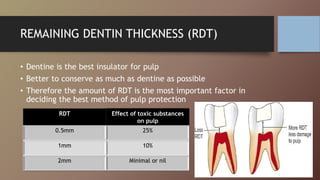
• Dentine is the best insulator for pulp
• Better to conserve as much as dentine as possible
• Therefore the amount of RDT is the most important factor in
deciding the best method of pulp protection
RDT Effect of toxic substances
on pulp
0.5mm 25%
1mm 10%
2mm Minimal or nil
PULP PROTECTION AGENTS
• Pulp protection agents are selected on the basis of –
• The restorative material being used
• The RDTbetween the pulp and the pulpal or axial walls of the final tooth preparation
• PULP PROTECTION AGENTS INCLUDE :
• Cavity Sealers – Varnish and Bonding Agents
• Cavity Liners
• Cavity Bases
CAVITY SEALERS
• These are materials that are applied to walls of prepared tooth and seal
the interface between the tooth and the restoration
• Liners are used to seal the dentinal tubules
• Do not possess mechanical strength nor provide any significant thermal
insulation
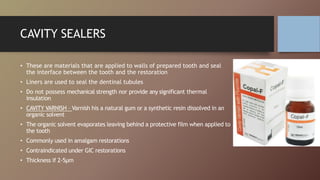
• CAVITY VARNISH – Varnish his a natural gum or a synthetic resin dissolved in an
organic solvent
• The organic solvent evaporates leaving behind a protective film when applied to
the tooth
• Commonly used in amalgam restorations
• Contraindicated under GIC restorations
• Thickness if 2-5µm
CAVITY SEALERS
• RESIN BONDING AGENTS- currently accepted method of bonding
composite to tooth structure
• Also help in cavity sealing
CAVITY LINERS
• Cement coating of minimal thickness which serve as a physical barrier to bacteria
• Applied only to the dentinal walls of preparation close to the pulp
• Traditionally liners were used to medicate pulp in deep preparations
• Liners are more fluid than bases,and used in thin layers (approximately 0.5 mm)
• Currently used liners – Calcium Hydroxide, Glass Ionomer Cement
CAVITY LINERS
• CALCIUM HYDROXIDE is used as a liner for the following reasons
Pulpal compatibility
Stimulate reparative dentine formation
Antibacterial activity
• Disadvantages of Calcium Hydroxide
• Low strength
• High solubility
• Undergoes softening
CAVITY LINERS
• GLASS IONOMER CEMENT
• Advantages
• Fluoride release
• Chemical adhesion to tooth structure
• Biocompatible
CAVITY BASES
• Used to replace missing dentine
• Block out undercut for indirect restorations
• Thickness usually 0.5-2mm
• Applied on pulpal and axial walls of cavity
• Provide thermal protection to pulp
• Materials used –
• Zinc Phosphate Cement
• Zinc polycarboxylate
• Glass ionomer cement (Type III)
CAVITY BASES
Zinc Phosphate
Traditionally material of
choice under metallic
restorations
Superior physical properties
Excellent thermal
insulation
Zinc Polycarboxylate
More biocompatible than
Zinc Phosphate
Adhesive to tooth structure
Glass Ionomer
Most popular base
Fluoride releasing property
Can be used under a variety
of materials
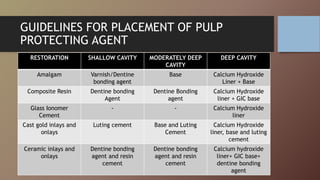
GUIDELINES FOR PLACEMENT OF PULP
PROTECTING AGENT
RESTORATION SHALLOW CAVITY MODERATELY DEEP
CAVITY
DEEP CAVITY
Amalgam Varnish/Dentine
bonding agent
Base Calcium Hydroxide
Liner + Base
Composite Resin Dentine bonding
Agent
Dentine Bonding
agent
Calcium Hydroxide
liner + GIC base
Glass Ionomer
Cement
- - Calcium Hydroxide
liner
Cast gold inlays and
onlays
Luting cement Base and Luting
Cement
Calcium Hydroxide
liner, base and luting
cement
Ceramic inlays and
onlays
Dentine bonding
agent and resin
cement
Dentine bonding
agent and resin
cement
Calcium hydroxide
liner+ GIC base+
dentine bonding
agent
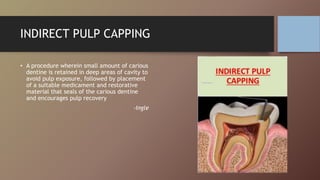
INDIRECT PULP CAPPING
• A procedure wherein small amount of carious
dentine is retained in deep areas of cavity to
avoid pulp exposure, followed by placement
of a suitable medicament and restorative
material that seals of the carious dentine
and encourages pulp recovery
-Ingle
INDIRECT PULP CAPPING
• OBJECTIVES OF INDIRECT PULP CAPPING
• Given by Eidelman in 1965
• Arresting the carious process
• Promoting dentine sclerosis
• Stimulating tertiary dentine formation
• Remineralization of carious dentine
INDIRECT PULP CAPPING
• INDICATIONS
Deep carious lesion near the pulp tissue but not involving it
No mobility of tooth
No history of spontaneous toothache
No tenderness to percussion
No radiographic evidence of pulp pathology
No root resorption or radicular disease should be present
radiographically
INDIRECT PULP CAPPING
• CONTRINDICATIONS
• Sharp penetrating pain
• Spontaneous pain
• Night pain
• Mobility
• Discoloured tooth
• Break in lamina dura
• Widened PDL space
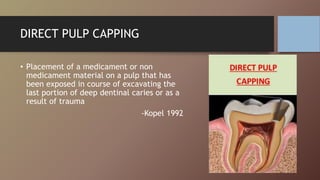
DIRECT PULP CAPPING
• Placement of a medicament or non
medicament material on a pulp that has
been exposed in course of excavating the
last portion of deep dentinal caries or as a
result of trauma
-Kopel 1992
DIRECT PULP CAPPING
• OBJECTIVES
• Create new dentine in area of exposed pulp
• Healing of pulp
• RATIONALE – To achieve biologic closure of
exposure site by formation of dentine bridge
DIRECT PULP CAPPING
• INDICATIONS
• Small mechanical exposure
• Asymptomatic vital primary teeth
• Bright red haemorrhage
• Easily controlled
• Pin point exposure
• CONTRINDICATIONS
• Night pain
• Spontaneous pain
• Mobility
• Periapical lesion
• Excessive haemorrhage
• Root resorption
References
• Sturvedant’s Art And Science Of Operative Dentistry 6e
• Clinical Operative Dentistry Principles And Practice By Ramya
Raghu 2e
• Textbook Of Paediatric Dentistry By Nikhil Marwah 4e
• Google Images

Pulp protection

  • 1.
    PULP PROTECTION DEPARTMENT OFCONSERVATIVE DENTISTRY AND ENDODONTICS THIRD YEAR SHUBHAM PARMAR
  • 2.
    INTRODUCTION • Basic goalof conservative dentistry is to preserve the health of dental pulp • Dental pulp is a soft connective tissue of mesenchymal origin present within the pulp chamber and root canals of teeth • Pulp protection is important as most restorative materials themselves are not protective to pulp • Pulp is subjected to various insults due to caries, materials and operative procedures • Pulp protection also helps pulp recovery in case of deep defects • For this reason the use of pulp protecting agents such as sealers, liners and bases is important
  • 3.
    PULPAL IRRITANTS • Diseaseprocess itself – Caries, trauma, attrition, abrasion • Mechanical Irritation – Excessive heat during cavity preparation • Chemical irritation – Phosphoric acid of zinc phosphate cement • Thermal Irritation – Due to heat conducted by metallic restorations • Microleakage
  • 4.
    REMAINING DENTIN THICKNESS(RDT) • Dentine is the best insulator for pulp • Better to conserve as much as dentine as possible • Therefore the amount of RDT is the most important factor in deciding the best method of pulp protection RDT Effect of toxic substances on pulp 0.5mm 25% 1mm 10% 2mm Minimal or nil
  • 5.
    PULP PROTECTION AGENTS •Pulp protection agents are selected on the basis of – • The restorative material being used • The RDTbetween the pulp and the pulpal or axial walls of the final tooth preparation • PULP PROTECTION AGENTS INCLUDE : • Cavity Sealers – Varnish and Bonding Agents • Cavity Liners • Cavity Bases
  • 6.
    CAVITY SEALERS • Theseare materials that are applied to walls of prepared tooth and seal the interface between the tooth and the restoration • Liners are used to seal the dentinal tubules • Do not possess mechanical strength nor provide any significant thermal insulation • CAVITY VARNISH – Varnish his a natural gum or a synthetic resin dissolved in an organic solvent • The organic solvent evaporates leaving behind a protective film when applied to the tooth • Commonly used in amalgam restorations • Contraindicated under GIC restorations • Thickness if 2-5µm
  • 7.
    CAVITY SEALERS • RESINBONDING AGENTS- currently accepted method of bonding composite to tooth structure • Also help in cavity sealing
  • 8.
    CAVITY LINERS • Cementcoating of minimal thickness which serve as a physical barrier to bacteria • Applied only to the dentinal walls of preparation close to the pulp • Traditionally liners were used to medicate pulp in deep preparations • Liners are more fluid than bases,and used in thin layers (approximately 0.5 mm) • Currently used liners – Calcium Hydroxide, Glass Ionomer Cement
  • 9.
    CAVITY LINERS • CALCIUMHYDROXIDE is used as a liner for the following reasons Pulpal compatibility Stimulate reparative dentine formation Antibacterial activity • Disadvantages of Calcium Hydroxide • Low strength • High solubility • Undergoes softening
  • 10.
    CAVITY LINERS • GLASSIONOMER CEMENT • Advantages • Fluoride release • Chemical adhesion to tooth structure • Biocompatible
  • 11.
    CAVITY BASES • Usedto replace missing dentine • Block out undercut for indirect restorations • Thickness usually 0.5-2mm • Applied on pulpal and axial walls of cavity • Provide thermal protection to pulp • Materials used – • Zinc Phosphate Cement • Zinc polycarboxylate • Glass ionomer cement (Type III)
  • 12.
    CAVITY BASES Zinc Phosphate Traditionallymaterial of choice under metallic restorations Superior physical properties Excellent thermal insulation Zinc Polycarboxylate More biocompatible than Zinc Phosphate Adhesive to tooth structure Glass Ionomer Most popular base Fluoride releasing property Can be used under a variety of materials
  • 13.
    GUIDELINES FOR PLACEMENTOF PULP PROTECTING AGENT RESTORATION SHALLOW CAVITY MODERATELY DEEP CAVITY DEEP CAVITY Amalgam Varnish/Dentine bonding agent Base Calcium Hydroxide Liner + Base Composite Resin Dentine bonding Agent Dentine Bonding agent Calcium Hydroxide liner + GIC base Glass Ionomer Cement - - Calcium Hydroxide liner Cast gold inlays and onlays Luting cement Base and Luting Cement Calcium Hydroxide liner, base and luting cement Ceramic inlays and onlays Dentine bonding agent and resin cement Dentine bonding agent and resin cement Calcium hydroxide liner+ GIC base+ dentine bonding agent
  • 14.
    INDIRECT PULP CAPPING •A procedure wherein small amount of carious dentine is retained in deep areas of cavity to avoid pulp exposure, followed by placement of a suitable medicament and restorative material that seals of the carious dentine and encourages pulp recovery -Ingle
  • 15.
    INDIRECT PULP CAPPING •OBJECTIVES OF INDIRECT PULP CAPPING • Given by Eidelman in 1965 • Arresting the carious process • Promoting dentine sclerosis • Stimulating tertiary dentine formation • Remineralization of carious dentine
  • 16.
    INDIRECT PULP CAPPING •INDICATIONS Deep carious lesion near the pulp tissue but not involving it No mobility of tooth No history of spontaneous toothache No tenderness to percussion No radiographic evidence of pulp pathology No root resorption or radicular disease should be present radiographically
  • 17.
    INDIRECT PULP CAPPING •CONTRINDICATIONS • Sharp penetrating pain • Spontaneous pain • Night pain • Mobility • Discoloured tooth • Break in lamina dura • Widened PDL space
  • 18.
    DIRECT PULP CAPPING •Placement of a medicament or non medicament material on a pulp that has been exposed in course of excavating the last portion of deep dentinal caries or as a result of trauma -Kopel 1992
  • 19.
    DIRECT PULP CAPPING •OBJECTIVES • Create new dentine in area of exposed pulp • Healing of pulp • RATIONALE – To achieve biologic closure of exposure site by formation of dentine bridge
  • 20.
    DIRECT PULP CAPPING •INDICATIONS • Small mechanical exposure • Asymptomatic vital primary teeth • Bright red haemorrhage • Easily controlled • Pin point exposure • CONTRINDICATIONS • Night pain • Spontaneous pain • Mobility • Periapical lesion • Excessive haemorrhage • Root resorption
  • 21.
    References • Sturvedant’s ArtAnd Science Of Operative Dentistry 6e • Clinical Operative Dentistry Principles And Practice By Ramya Raghu 2e • Textbook Of Paediatric Dentistry By Nikhil Marwah 4e • Google Images