The document covers various aspects of impression making in dentistry, including definitions, techniques, and materials used. It details the differences between preliminary and final impressions, as well as different impression techniques such as mucostatic and mucocompressive. Additionally, it discusses the management of compromised situations and provides insights into patient care and the importance of various impression materials.
Introduction to impressions, definitions, and types of impressions, focusing on complete and preliminary impressions.
Basic anatomy and techniques required for effective impression making, including stability, esthetics, and preservation of oral structures.
Different methods of classifying impressions by technique, purpose, and type of tray used, including mucostatic and mucocompressive impressions. Overview of various impression materials, categorizing them into preliminary and final types, emphasizing alginate and silicone.
Discussion on techniques like conventional and functional impressions for producing accurate dental impressions.
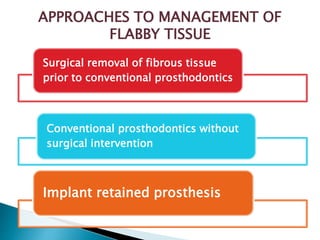
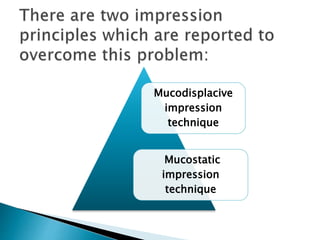
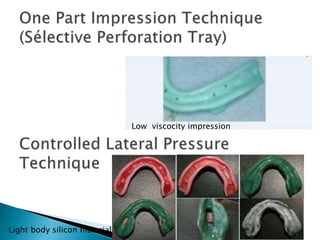
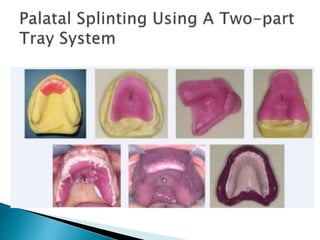
Approaches for managing fibrous tissue and techniques for ensuring functional support while making impressions.
Step-by-step guidelines for creating sectional impressions, involving tray design and patient handling for successful outcomes.
INTRODUCTION
DEFINITIONS
BASIC REQUIREMENTS FOR IMPRESSION
MAKING
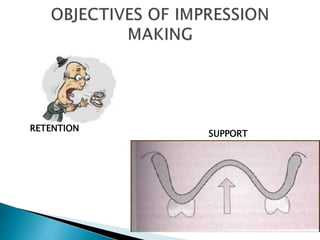
OBJECTIVES OF IMPRESSION MAKING
CLASSIFICATION OF IMPRESSIONS
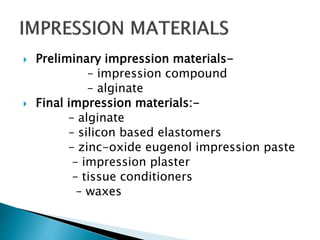
IMPRESSION MATERIALS
IMPRESSION TECHNIQUES IN COMPROMISED
SITUATIONS
3.
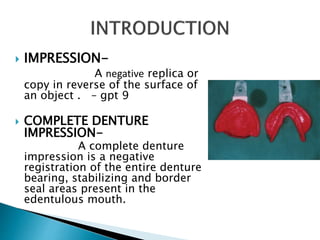
IMPRESSION-
A negativereplica or
copy in reverse of the surface of
an object . – gpt 9
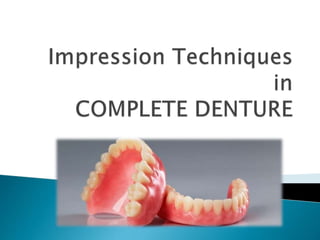
COMPLETE DENTURE
IMPRESSION-
A complete denture
impression is a negative
registration of the entire denture
bearing, stabilizing and border
seal areas present in the
edentulous mouth.
4.
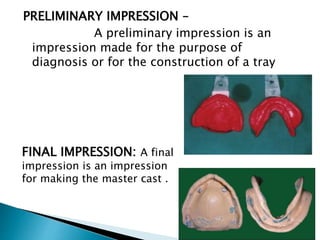
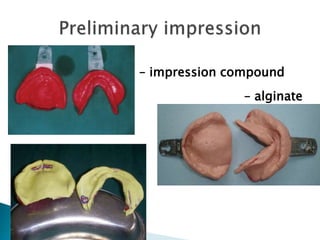
PRELIMINARY IMPRESSION –
Apreliminary impression is an
impression made for the purpose of
diagnosis or for the construction of a tray
FINAL IMPRESSION: A final
impression is an impression
for making the master cast .
5.
Knowledge ofBasic anatomy
Knowledge of basic reliable technique
Knowledge and understanding of impression
materials
Skill
Patient management
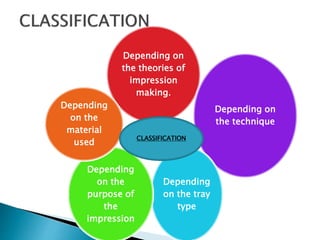
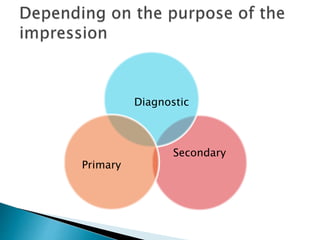
Depending on
the theoriesof
impression
making.
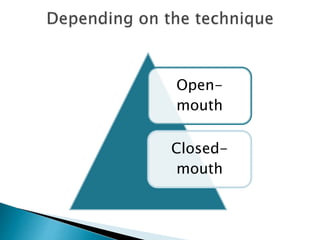
Depending on
the technique
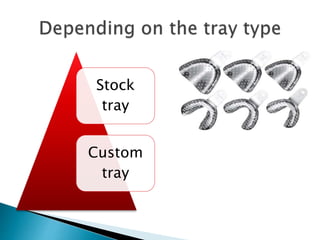
Depending
on the tray
type
Depending
on the
purpose of
the
impression
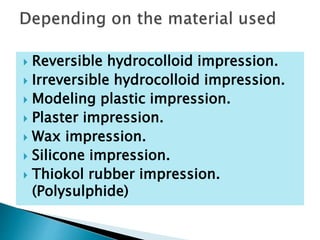
Depending
on the
material
used
CLASSIFICATION
10.
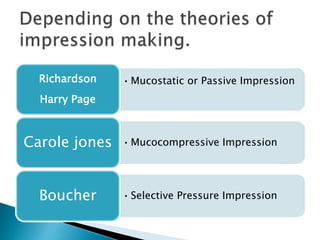
•Mucostatic or PassiveImpressionRichardson
Harry Page
•Mucocompressive ImpressionCarole jones
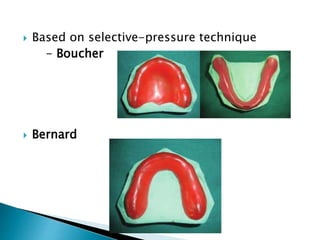
•Selective Pressure ImpressionBoucher
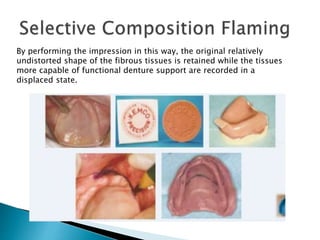
By performing theimpression in this way, the original relatively
undistorted shape of the fibrous tissues is retained while the tissues
more capable of functional denture support are recorded in a
displaced state.
38.
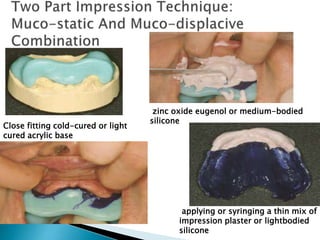
Close fitting cold-curedor light
cured acrylic base
applying or syringing a thin mix of
impression plaster or lightbodied
silicone
zinc oxide eugenol or medium-bodied
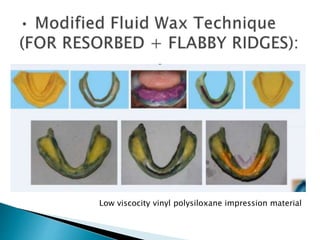
silicone
39.
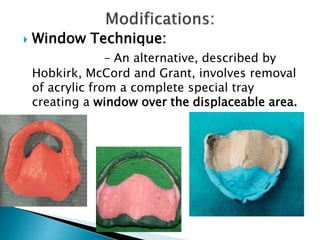
Window Technique:
–An alternative, described by
Hobkirk, McCord and Grant, involves removal
of acrylic from a complete special tray
creating a window over the displaceable area.
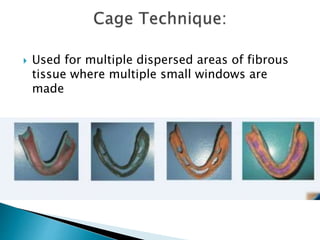
40.
Used formultiple dispersed areas of fibrous
tissue where multiple small windows are
made
Curaet alJ Prosthet Dent
Baker et al
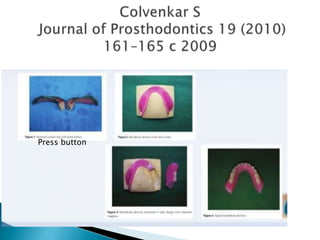
Colvenkar S
Moghadam BK
Hegde C. et al
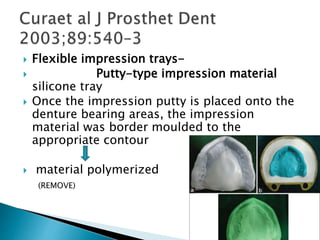
44.
Flexible impressiontrays-
Putty-type impression material
silicone tray
Once the impression putty is placed onto the
denture bearing areas, the impression
material was border moulded to the
appropriate contour
material polymerized
(REMOVE)
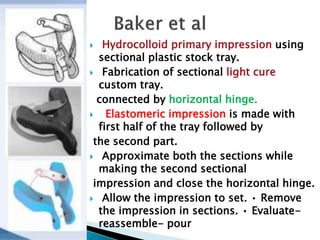
45.
Hydrocolloid primaryimpression using
sectional plastic stock tray.
Fabrication of sectional light cure
custom tray.
connected by horizontal hinge.
Elastomeric impression is made with
first half of the tray followed by
the second part.
Approximate both the sections while
making the second sectional
impression and close the horizontal hinge.
Allow the impression to set. • Remove
the impression in sections. • Evaluate-
reassemble- pour
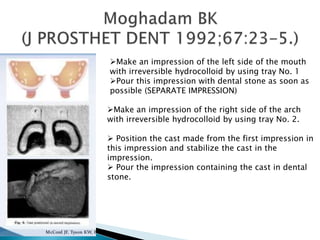
Make an impressionof the left side of the mouth
with irreversible hydrocolloid by using tray No. 1
Pour this impression with dental stone as soon as
possible (SEPARATE IMPRESSION)
Make an impression of the right side of the arch
with irreversible hydrocolloid by using tray No. 2.
Position the cast made from the first impression in
this impression and stabilize the cast in the
impression.
Pour the impression containing the cast in dental
stone.
48.
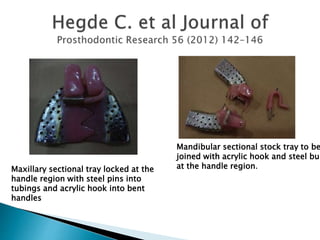
Maxillary sectional traylocked at the
handle region with steel pins into
tubings and acrylic hook into bent
handles
Mandibular sectional stock tray to be
joined with acrylic hook and steel bur
at the handle region.
51.
Also called“marble technique” •
Involves 7 visits
1st visit: 5 marbles placed in mouth, patient
instructed to keep them for 1 week
2nd visit: ability to tolerate marbles evaluated
3rd visit: before making impressions, topical
anaestheticapplied , primary impression
made, base plates made with a rough finish
4th visit: lower base plate inserted , 3
marbles placed and a “training bead”
52.
5th visit:upper base plate inserted , asked to
discontinue marbles
6th visit: patient able to endure the presence
of both base plates , occlusal rims
constructed Jaw relation taken , try in
completed.
7th visit: completed lower denture inserted
first + upper base plate + a training bead.
Next upper denture inserted
53.
If stocktrays are used, a posterior dam can
be constructed in the tray using wax or
silicone putty
history of gagging, consider using a less
fluid impression material with faster setting
characteristics.
Avoid overloading trays and initially seat the
tray posteriorly.
Use of sectional impression trays