Tongue
Priyanka Doshi
M.D.S Part 1
Introduction
Pharyngeal part
Terminal sulcus
Hypobrachial eminence
Starts to develop near the end of the fourth week
Parts and surfaces of the tongue
Ventral surface 
 Lies behind the
palatoglossal arches
 Forms the anterior wall
of the oropharynx
 Devoid of papillae
 Underlying lymphoid
nodules embedded in
the submucosa
collectively called as
lingual tonsils
Pharyngeal Part
Epiglottis
Lingual
tonsil
Median
epiglotic fold
Lateral
epiglotic fold
valleculae
Palatine tonsil
Muscles of the tongue
 Intrinsic muscles
 Superior longitudinal
 Inferior longitudinal
 Transverse
 Vertical
 Extrinsic muscles
 Styloglossus
 Hyoglossus
 Genioglossus
 Palatoglossus
 Intrinsic muscles
MUSCLES ORIGIN INSERTION ACTION(S)
Genioglossus
Upper genial tubercle
of mandible
Upper fibres: tip of
the tongue
Middle fibres: dorsum
Lower fibres: hyoid
bone
Upper fibres: retract
the tip
Middle fibres: depress
the tongue
Lower fibres: pull the
posterior part forward
(thus protrusion of the
tongue from the
mouth)
Hyoglossus
Greater cornu, front
of lateral part of body
of hyoid bone
Side of tongue
Depress the tongue
Retracting the
protruded tongue
Styloglossus
Tip, anterior surface
of styloid process
Side of tongue
Pulls the tongue
upwards and
backwards during
swallowing
Palatoglossus
Oral surface of
palatine aponeurosis
Side of tongue
(junction of oral and
pharygeal part)
Pulls up root of
tongue, approximates
palatoglossal arches,
closes oropharyngeal
isthmus
Intrinsic muscles
Superior longitudinalSuperior longitudinal
• Origin: submucous fibrous
layer below the dorsum of
the tongue and lingual
septum
• Insertion: extends to the
lingual margin
• ActionAction
• Turns the apex and sides of
the tongue upward to make
the dorsum concave
Inferior longitudinalInferior longitudinal
• Narrow band close to the
inferior surface of the
tongue
• Origin: root of tongue and
body of hyoid bone
• Insertion: apex of tongue
• ActionAction
• Curls the tip inferiorly and
shortens the tongue
TransverseTransverse
• Origin: median fibrous
septum
• Insertion: fibrous tissue at
the margins of tongue
• ActionAction
• Narrows and elongates the
tongue
VerticalVertical
• Origin: dorsum surface of
the borders of the tongue
• Insertion: ventral surface
of the borders of the
tongue
• ActionAction
• Flattens and broadens the
tongue
Vascular supply of the tongue
Lingual arteryLingual artery
•A branch of external carotid
artery(after passing deep to the
hyoglossus muscles)
•Divides into :
•Dorsal lingual arteriesDorsal lingual arteries: supply
posterior part
•Deep lingual arteryDeep lingual artery : supplies
the anterior part
•Sublingual arterySublingual artery : supplies the
sublingual gland and floor of
the mouth
• Dorsal lingual vein-Dorsal lingual vein-
drains the dorsum and
sides of the tongue
• Deep lingual veinsDeep lingual veins -
drains the tip of the
tongue and join
sublingual veinssublingual veins from
sublingual salivary
gland
• All these veins
terminate directly or
indirectly into internalinternal
jugular veinsjugular veins
Lymphatic DrainageLymphatic Drainage
Innervation of the tongue
Nerve Supply
 Motor: all muscles of the tongue (intrinsic and extrinsic) are
supplied by hypoglossal nerve except palatoglossus which is
supplied by pharyngeal plexus
Sensory:
 anterior 2/3 of the tongue:
 general sensation: lingual nerve - branch of the
mandibular nerve (with cell bodies in the trigeminal
ganglion)
 taste: chorda tympani (with cell bodies in the geniculate
ganglion of facial nerve)
 posterior 1/3 of the tongue: innervated by the
glossopharyngeal nerve (both general sensation and
taste), with cell bodies in the glossopharyngeal ganglia
in the jugular foramen
 posterior most part of the tongue: innervated by the
vagus nerve through the internal laryngeal branch
(with cell bodies in the inferior vagal ganglion)
HISTOLOGY OF TONGUE 
Mucous Membrane on Ventral Surface
 It is thin, smooth and
loosely attached to the
underlying Connective
Tissue
 It is freely mobile and not
raised into papillae
because epithelium is
closely adherent to
underlying muscle by a
thin lamina propria.
 It is covered with non-
keratinized stratified
squamous epithelium.
.
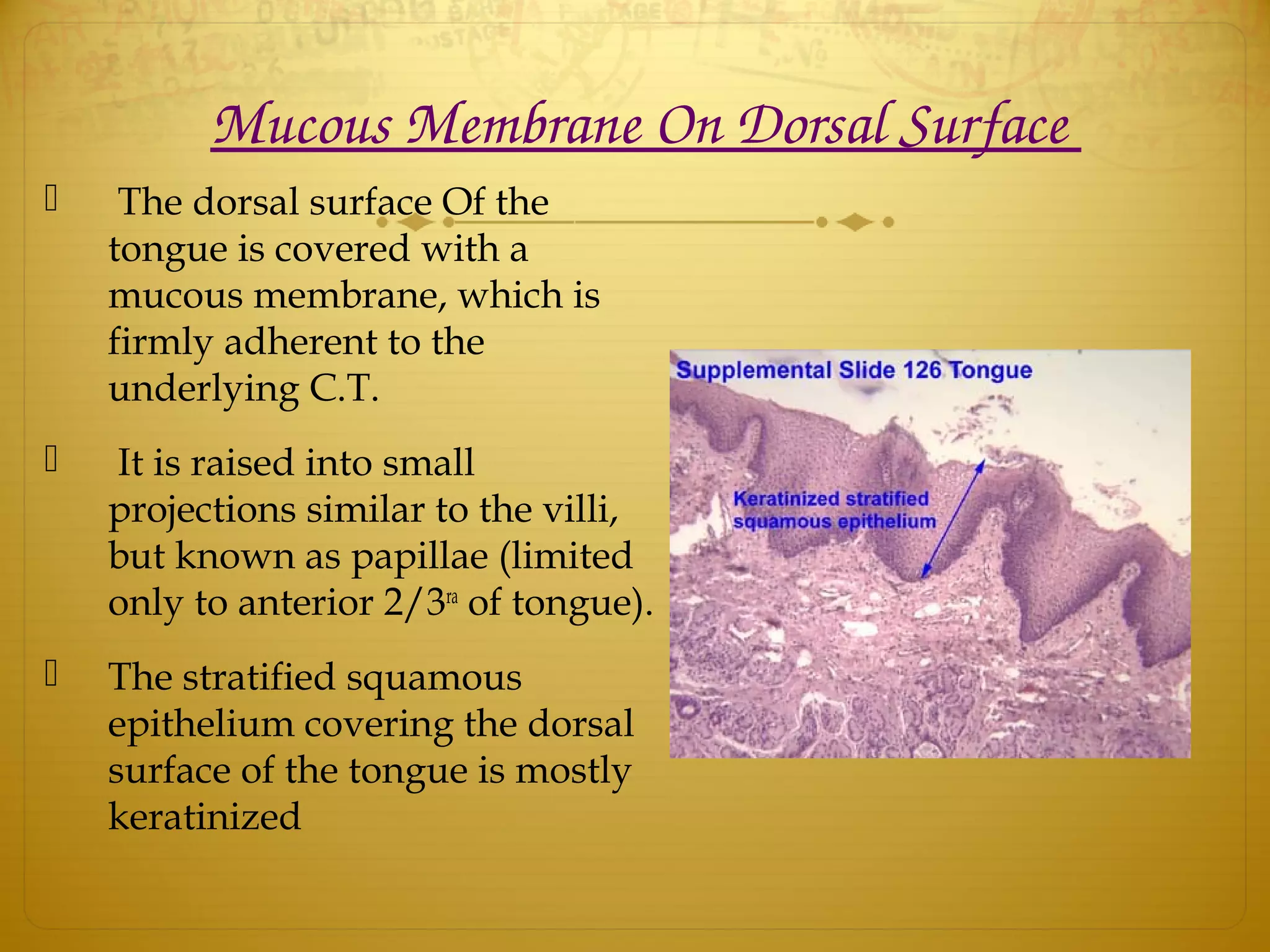
Mucous Membrane On Dorsal Surface 
 The dorsal surface Of the
tongue is covered with a
mucous membrane, which is
firmly adherent to the
underlying C.T.
 It is raised into small
projections similar to the villi,
but known as papillae (limited
only to anterior 2/3ra
of tongue).
 The stratified squamous
epithelium covering the dorsal
surface of the tongue is mostly
keratinized
Papillae of tongue
They are 4 varieties
Filiform
Fungiform
Foliate
Circumvallate
Filiform papillaFiliform papilla 
• Minute, conical, cylindrical
projections which cover
most of the presulcul dorsal
area.
• Give it a velvety appearanceGive it a velvety appearance
• Increase the friction between
the tongue and food
• Smallest and most
numerous.
• Each is pointed and covered
with keratin.
Fungiform papillaFungiform papilla
 These are mushroom
shaped, more numerous
near tip & margins of
tongue but some of them
scattered over the dorsum
 Smaller than vallate but
larger than filliform.
 Differ from filiform because
are larger, rounded and
deep red in colour
 Bears one or more taste
buds on its apical surface
Foliate papillaFoliate papilla
 Red leaf-like mucosal
ridges
 Bilaterally at the sides
of the tongue near
sulcus terminalis
 Bear numerous taste
buds
Circumvallate papillaCircumvallate papilla
 Large cylindrical structures
 1-2mm in diameter
 8 to 12 in number
 Form a ‘V’ shaped row in front
of sulcus terminalis on the
dorsal surface of the tongue
 The entire structure is covered
with squamous epithelium, in
both sulcal walls & taste buds
around
Taste budsTaste buds
• Present in relation to
cirumvallate papilla,
fungiform papillae and
foliate papilla
• Also present on the soft
palate, the epiglottis, the
palatoglossal arches, and
the posterior wall of the
oropharynx
 Neuroepithelial taste cells or gustatory cells in taste buds:
 They are modified columnar elongated cells which act as
receptors. They have darkly-stained' elongated central nuclei.
The superficial part of these cells is provided with short hairs
(hairlets or microvilli). These hairlets project into the taste
pore. The base of the taste cells is surrounded by sensory
nerve fibres, carry the impulses of taste sensation to the
brain.
 Supporting cells in taste buds : They are elongated columnar
cells with dark cytoplasm but lightly-stained nuclei.
They form the outer wall of the taste bud. They have
long microvilli that extend from their surfaces into the
taste pore.
 Basal cells are present at the base of the taste bud. They
act as stem cells for renewal of taste cells and
supporting cells.
Taste discrimination
 Gustatory receptors detect
four main types of taste
sensation
 Sweet: tip
 Sour: middle
 Salty: anterolateral
 Bitter: base
 However recent evidence
indicates that all areas of
tongue are responsive to all
taste stimuli
Clinical considerations
Injury to hypoglossal nerveInjury to hypoglossal nerve
• Trauma like fractured mandible may injure hypoglossal nerve
• Paralysis ,atrophy of one side of tongue
• Tongue deviates to paralyzed side during protrusion due to action
of unaffected genioglossus muscles.
Paralysis of genioglossus muscleParalysis of genioglossus muscle
• Muscle tends to fall backward, obstructing airway
• Total relaxation of genioglossus occur during general
anaesthesia so airway is inserted to prevent tongue
from relapsing
Sublingual absorption of drugsSublingual absorption of drugs
• For quick absorption, pill or spray is put under the
tongue where it dissolves and enter the lingual veins
Diseases of the tongue
 Inherited, congenital, and developmental anomalies
 Disorders of the lingual mucosa
 Malignant tumors of the tongue
Inherited, congenital, and developmental 
anomalies
 Variation in morphology
 Ankyloglossia
 Fissured tongue
 Macroglossia
 Hypoglossia
Ankyloglossia (tongue­tie)Ankyloglossia (tongue­tie)
• Tongue tie can be classified
as:
• Milder formMilder form: do not influence
jaw development, tooth
position or phonation
• Severe formSevere form: exhibit
Midline mandibular
diastema,
periodontal defects
• Extreme formExtreme form: complete
attachment of tongue to the
floor of the mouth or alveolar
gingiva
Microglossia (hypoglossia)Microglossia (hypoglossia) 
 Uncommon developmental condition of unknown origin
characterized by abnormally small tongue
 Entire tongue may be missing (aglossia)
 length of the mandibular arch will be smaller due to the
smaller size of the tongue.
    MacroglossiaMacroglossia 
Fissured, plicated, or scrotal tongueFissured, plicated, or scrotal tongue
Disorders of lingual mucosa
• Geographic tongueGeographic tongue
• Hairy tongueHairy tongue
• Nonkeratotic and keratotic white lesionsNonkeratotic and keratotic white lesions
– Candidiasis
– Leukoplakia, hairy leukoplakia
Geographic tongueGeographic tongue::
• Psoriasiform mucositis of the dorsum of
the tongue
• Dominant characteristic is constantly
changing pettern of sepiginious white
lines surrounding areas of smooth,
depappilated areas.
• Prevalence is 1% to 2%
• Irregular reddish areas of depapillation
• thinning of the dorsal tongue epithelium
usually surrounded by a narrow zone of
regenerating papillae -whiter than the
surrounding tongue surface
Hairy tongueHairy tongue
Malignant tumors Of Tongue              Malignant tumors Of Tongue              
Squamous cell carcinoma
Squamous cell carcinoma of the tongueSquamous cell carcinoma of the tongue
 Most common intraoral site
 60% of lesions arise from the anterior 2/3rd
of the tongue
 The affected side of the tongue is removed surgically.
 All the deep cervical lymph nodes are also removed, i.e. block
dissection of neck.
 Unilateral block dissection of the neck should be efficacious for
early carcinoma of the lateral border of the tongue but because of
the bilateral lymphatic drainage bilateral dissection should be
performed if the tip of the tongue, the frenulum ,or the dorsum
of the tongue is involved.
Tongue

Tongue

Editor's Notes

  • #2 Today I m going to give u a brief idea about development of tongue, normal anatomy of tongue, muscles nerve and vascular suuply of tongue , histology of tongue and clinical consideration of tongue.
  • #3 The tongue is muscular hydrostat on the floors of the mouth which manipulates food for mastication. It is the primary organ of taste. In humans a secondary function of the tongue is phonetic articulation. it serves as a natural means of cleaning one's teeth. Also helps in maintaining equilibrium and development of proper occlusion It s avg length is 10 cm or 4inches from the oropharynx. Tongue has root, tip, body. Body has curved upper surface(dorsum) nd inferior surface. Inferior surface is confined to the oral part only. Root is attached to the mandible soft palate above and hyoid bone below. Between 2 bones it is related to geniohyoid and mylohyoid muscles. Tip ios free and rest behind upper incisor teeth.
  • #4 Medial most part of mandibular arch-proliferate-2 lingual swelling-partially seprate by another swelling in midline-tuberculum impair. Very quickly swelling enlarge-merges each other to form large mass from which mucous membrane of ant.23 of tongue develops. Immediately behind TI epithelium proliferate-form downgrowth-marked by a depression-called foramen canceum-thyroid gland develops.-thyroglossal duct Arch 1- anterior 2/3rd foramen caecum – the site from which the thyroid diverticulum grows down in an embryoi Arch 2- initial contribution is lost Arch 3- posterior 1/3 (pharyngeal) Arch 4- epiglottis n adjacent structures
  • #5 Another midline swelling seen in relation-2 3 4 arch- called hypobrachial aminence-soon shows-subdivision-cranial nd caudal Cranial-related to 2 nd 3 arch-post 13 derived from it. Caudal-4th-forms epiglottis-post. Most part of tongue 2nd arch mesoderm gets buried below surface-3rd arch mesoderm grows over it to fuse with mesoderm of 1st arch.
  • #6 Oral part placed in the floor of the mouth.just infront of the palatoglossal arch .
  • #7 Ventral surface is smooth purplish and reflected onto oral floor and gums The thin strip of tissue that runs vertically from the floor of the mouth to the undersurface of the tongue is called the lingual frenulum. It tends to limit the movement of the tongue. On either side of frenulum there is a prominence produced by deep lingual veins. more laterally there is a fold called plica fimbriata.
  • #8 Posterior most part of the tongue is connected to the epiglottis by 3 folds of mucous membrane –medial n lateral epiglottic fold On either side of the median folds there is a depression called as vallecula Lateral folds separate the vallecula from the piriform fossa
  • #9 Tongue is divided into two halfes by a median fibrous septum . Each half consists EXTRINSIC – ATTACHED TO THE BONE INTRINSIC- WITHIN THE TONGUE WHOLLY NOT ATTACHED TO THE BONE. Alter the shape of the tongue
  • #10 1.Genioglossus –life saving muscle- fan shaped bulcky muscle ori:Upper genial tubercle of mandible Ins:Upper fibres: tip of the tongue Middle fibres: dorsum Lower fibres: hyoid bone Act:Upper fibres: retract the tip Middle fibres: depress the tongue Lower fibres: pull the posterior part forward (thus protrusion of the tongue from the mouth) 2.Hyoglossus Ori:Greater cornu, front of lateral part of body of hyoid bone Ins:Side of tongue Act:Depress the tongue Retractes the protruded tongue 3.Styloglossus Ori:Tip, anterior surface of styloid process Ins:Side of tongue Act:Pulls the tongue upwards and backwards during swallowing 4.Palatoglossus Ori:Oral surface of palatine aponeurosis Ins:Side of tongue (junction of oral and pharygeal part) Act:Pulls up root of tongue, approximates palatoglossal arches, closes oropharyngeal isthmus
  • #17 Root – tonsillar and ascending pharyngeal arteries
  • #19 Lymph from the posterior third – superior deep cervical lymphnodes on both sides Lymph from the medial part of the anterior two third – inferior deep cervical lymph nodes The deep cervical nodes usually involved: jugulodigastric and jugulo-omohyoid nodes All lymph from the tongue is believed to eventually drain through the jugulo-omohyoid node before reaching the thoracic duct or right lymphatic duct
  • #21 The pharyngeal plexus is a plexus of nerves formed by: • The pharyngeal branch of the vagus, which includes the cranial root of the accessory. This provides the motor supply to the muscles except for the tensor palati which is supplied by the mandibular division of the trigeminal. • The glossopharyngeal nerve, which provides the sensory supply to the pharynx. • Branches from the sympathetic trunk.
  • #23 MUCOUS MEMBRANE of tongue (covering both the surfaces) is formed of stratified squamous epithelium. The superficial cells of the mucous membrane of the tongue are continually shed off and are replaced by new cells
  • #34 The distribution of taste was basically published by a PHD student Dr.hanig in his thesis. His mapping had a very rough picture of the taste distribution without any concrete data but it began to be passed down the generations. A few scientists tried correcting it nd finally 1974 virginia collins set it right n alsofound taste buds in other locations 5 taste – umami as found in 1901 – japaneses scientist ikeda – taste of sea vegetable , soy sauce , ripe tomato or monosodium glutamate
  • #35 Color variation – white: leukoplakia, oral thrush , lichen planus : purple- vitamin b2 def; blue-copd , cyanosis Red- scarlet fever , vitamin deficiency ,; yellow-preceds black hairytongue, jaundice Black-hairy Swelling- food allergies, yellow fever , anaphylaxis , hereditary angioedema , glossitis Ulcer-cancer , lp , behcets Coating – lp , oral thrush, leukoplakia
  • #36 nitroglycerin_- angina pectoris
  • #39 after the formation of tongue massive cell degeneration occurs between the tongue and the floor of the mouth and the only part attaching them is the lingual frenum . Congenital shortness of the lingual frenum or the frenal attachment that extends nearly to the tip of the tongue binding the tongue to the floor of the mouth and restricting its extension Treatment: frenulectomy. Difficulties: speech, persistent gap btwn man. Incisor, feeding
  • #40 Rx – frenulectomy
  • #41 Mostly associated with other malformations – hands n feet , clefts Severe dentoskeletal malocclusion can result due to lack of muscular stimulation.
  • #42 A relatively common condition characterized by an increase in the size of tongue. Either true or psuedo Characteristic – indentations on the lateral margins Syndrome- downs , beckwith – wiedemann Surgical intervention to get normal size and function – mastication , articulation , speech Treatment: surgery
  • #43 Scrotal or lingua plicata due to lack of merging of lingual swelling Characterized by grooves that vary in depth upto 6mm in diameter dorsal and lateral aspects of the tongue accumulation of food debris n micro-organism Ssen in melkerson rosenthal(chilitis granulomatosa,bellsp alsy,fissuerd tongue) syndrome nd down.
  • #45 Benign migratory glossitis or Wandering rash—stress Rx-topical or systemic for symptomatic lesion
  • #46 Lingua nigra /villosa Hypertrophy of the filliform papilla of the dorsum of the tongue normally 1 mm bt in this 15mm in length Results from failure of normal desquamation of tongue papillae and epithelium Presipitating factors-poor oral hygiene , tobacco Hiv Cf- halitosis -food debris rx- surgical – electrodessication, co2 laser
  • #47 Most common oral cancer – SCC , other kaposis sarcoma
  • #48 Etiology – oncogenes – mutation genetic ; premalignant lesions , tobacco , alcohol, HPV Survival – 5yrs- us 63% Cf- non healing ulcer more that 14 days, small , painless, pale or, white or red patch: burning sensation and pain when tumour advances …………difficulty in tongue movement , swallowing , pain and parasthesia. Dignosis – clinical examination , biopsy ,