Chapter III:
Geometry Dimensioning
Tolerance
គុណភាព​និង សភាព​ននផ្ទៃទលិតទលមេកានិច
Prepared by: Sry Vannei
 Review of Interchangeable:
It uses for producing the mechanical production in series.
They are made to specifications that they are so nearly identical
which will fit into any device of the same type. One such part
can freely replace another, without any custom fitting. This
interchangeability allows easy assembly of new devices, and
easier repair of existing devices, while minimizing both the time
and skill required of the person doing the assembly or repair.
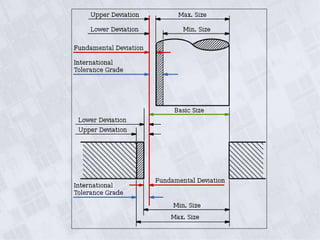
Dimensional Tolerances:
It is defined as the permissible or acceptable variation
in the dimensions (height, width, depth, diameter,
angles) of a part. The root of the word tolerance is the
Lantin tolerance, meaning to endure or put up with.
Tolerances are unavoidable because it is virtually
impossible to manufacture two parts that have
precisely the same dimensions. Furthermore, because
close dimensional tolerances can significantly increase
the product cost, a narrow tolerance range is
undesirable economically. However, for some parts,
close tolerances are necessary for proper functioning,
and are therefore worth the added expense associated
with narrow tolerance ranges. Examples are precision
measuring instruments and gages, hydraulic pistons,
and bearings for aircraft engines.
Fitting:
Dimensional tolerances become important only
when a part is to be assembled or mated with
another part. Surfaces that are free and not
functional do not need close tolerance control.
Importance of Dimensional Tolerance Control:
Dimensional tolerances become important only
when a part is to be assembled or mated with
another part. Surfaces that are free and not
functional do not need close tolerance control.
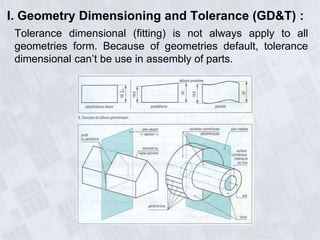
Tolerance dimensional (fitting) is not always apply to all
geometries form. Because of geometries default, tolerance
dimensional can’t be use in assembly of parts.
I. Geometry Dimensioning and Tolerance (GD&T) :
What is GD&T ?
GD&T is a symbolic language. It is used to specify
the size, shape, form, orientation, and location of
features on a part. Features toleranced with GD&T
reflect the actual relationship between mating parts.
Drawings with properly applied geometric tolerancing
provide the best opportunity for uniform interpretation
and cost-effective assembly. GD&T was created to
insure the proper assembly of mating parts, to
improve quality, and to reduce cost.
When should GD&T be used?
Designers should tolerance parts with GD&T when:
 Drawing delineation and interpretation need to be the
same.
 Features are critical to function or interchangeability.
 It is important to stop scrapping perfectly good parts.
 It is important to reduce drawing changes.
 Automated equipment is used.
 Functional gaging is required.
 It is important to increase productivity.
 Companies want across-the-board savings.
 Advantages of GD&T over Coordinate Dimensioning
and Tolerance :
Plus or minus tolerancing system for tolerancing drawings have
several limitation:
 The plus or minus tolerancing system generates rectangular
tolerance zones. Rectangular tolerance zones do not have a
uniform distance from the center to the outer edge.
 Size features can only be specified at the location tolerance
of feature size condition and if the size of the features
change, there is no way to specify location of tolerance.
 Datums are usually not specified where the plus or minus
tolerancing system is used.
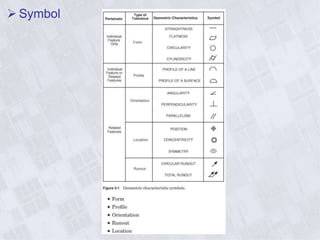
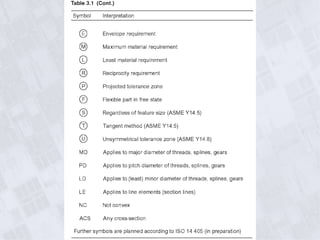
 Symbol
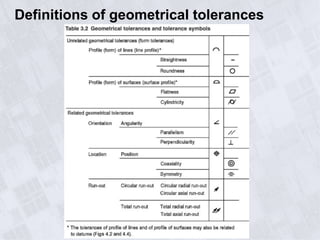
Definitions of geometrical tolerances
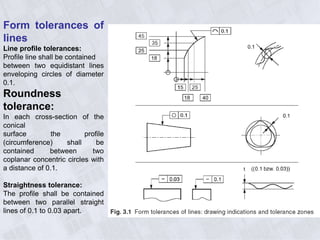
Form tolerances of
lines
Line profile tolerances:
Profile line shall be contained
between two equidistant lines
enveloping circles of diameter
0.1.
Roundness
tolerance:
In each cross-section of the
conical
surface the profile
(circumference) shall be
contained between two
coplanar concentric circles with
a distance of 0.1.
Straightness tolerance:
The profile shall be contained
between two parallel straight
lines of 0.1 to 0.03 apart.
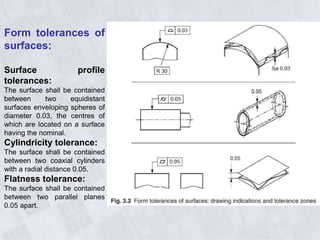
Form tolerances of
surfaces:
Surface profile
tolerances:
The surface shall be contained
between two equidistant
surfaces enveloping spheres of
diameter 0.03, the centres of
which are located on a surface
having the nominal.
Cylindricity tolerance:
The surface shall be contained
between two coaxial cylinders
with a radial distance 0.05.
Flatness tolerance:
The surface shall be contained
between two parallel planes
0.05 apart.
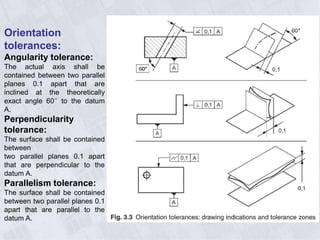
Orientation
tolerances:
Angularity tolerance:
The actual axis shall be
contained between two parallel
planes 0.1 apart that are
inclined at the theoretically
exact angle 60°to the datum
A.
Perpendicularity
tolerance:
The surface shall be contained
between
two parallel planes 0.1 apart
that are perpendicular to the
datum A.
Parallelism tolerance:
The surface shall be contained
between two parallel planes 0.1
apart that are parallel to the
datum A.
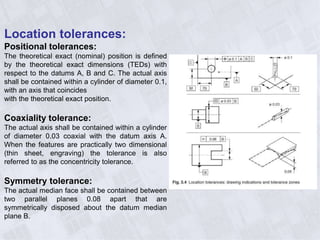
Location tolerances:
Positional tolerances:
The theoretical exact (nominal) position is defined
by the theoretical exact dimensions (TEDs) with
respect to the datums A, B and C. The actual axis
shall be contained within a cylinder of diameter 0.1,
with an axis that coincides
with the theoretical exact position.
Coaxiality tolerance:
The actual axis shall be contained within a cylinder
of diameter 0.03 coaxial with the datum axis A.
When the features are practically two dimensional
(thin sheet, engraving) the tolerance is also
referred to as the concentricity tolerance.
Symmetry tolerance:
The actual median face shall be contained between
two parallel planes 0.08 apart that are
symmetrically disposed about the datum median
plane B.
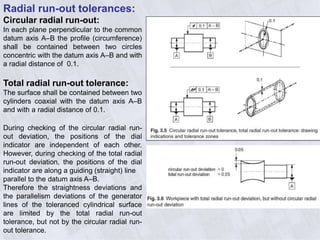
Radial run-out tolerances:
Circular radial run-out:
In each plane perpendicular to the common
datum axis A–B the profile (circumference)
shall be contained between two circles
concentric with the datum axis A–B and with
a radial distance of 0.1.
Total radial run-out tolerance:
The surface shall be contained between two
cylinders coaxial with the datum axis A–B
and with a radial distance of 0.1.
During checking of the circular radial run-
out deviation, the positions of the dial
indicator are independent of each other.
However, during checking of the total radial
run-out deviation, the positions of the dial
indicator are along a guiding (straight) line
parallel to the datum axis A–B.
Therefore the straightness deviations and
the parallelism deviations of the generator
lines of the toleranced cylindrical surface
are limited by the total radial run-out
tolerance, but not by the circular radial run-
out tolerance.
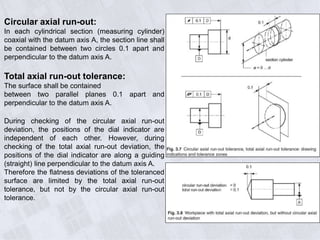
Circular axial run-out:
In each cylindrical section (measuring cylinder)
coaxial with the datum axis A, the section line shall
be contained between two circles 0.1 apart and
perpendicular to the datum axis A.
Total axial run-out tolerance:
The surface shall be contained
between two parallel planes 0.1 apart and
perpendicular to the datum axis A.
During checking of the circular axial run-out
deviation, the positions of the dial indicator are
independent of each other. However, during
checking of the total axial run-out deviation, the
positions of the dial indicator are along a guiding
(straight) line perpendicular to the datum axis A.
Therefore the flatness deviations of the toleranced
surface are limited by the total axial run-out
tolerance, but not by the circular axial run-out
tolerance.
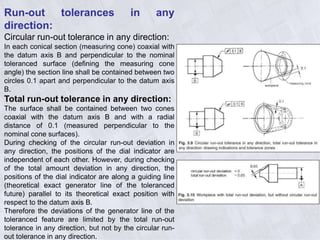
Run-out tolerances in any
direction:
Circular run-out tolerance in any direction:
In each conical section (measuring cone) coaxial with
the datum axis B and perpendicular to the nominal
toleranced surface (defining the measuring cone
angle) the section line shall be contained between two
circles 0.1 apart and perpendicular to the datum axis
B.
Total run-out tolerance in any direction:
The surface shall be contained between two cones
coaxial with the datum axis B and with a radial
distance of 0.1 (measured perpendicular to the
nominal cone surfaces).
During checking of the circular run-out deviation in
any direction, the positions of the dial indicator are
independent of each other. However, during checking
of the total amount deviation in any direction, the
positions of the dial indicator are along a guiding line
(theoretical exact generator line of the toleranced
future) parallel to its theoretical exact position with
respect to the datum axis B.
Therefore the deviations of the generator line of the
toleranced feature are limited by the total run-out
tolerance in any direction, but not by the circular run-
out tolerance in any direction.
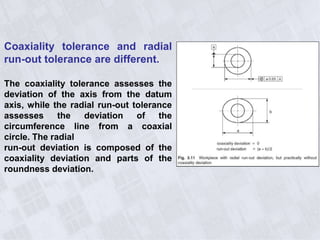
Coaxiality tolerance and radial
run-out tolerance are different.
The coaxiality tolerance assesses the
deviation of the axis from the datum
axis, while the radial run-out tolerance
assesses the deviation of the
circumference line from a coaxial
circle. The radial
run-out deviation is composed of the
coaxiality deviation and parts of the
roundness deviation.
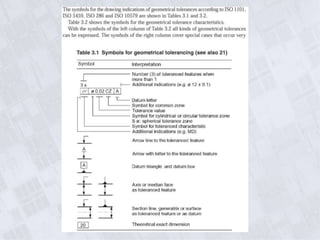
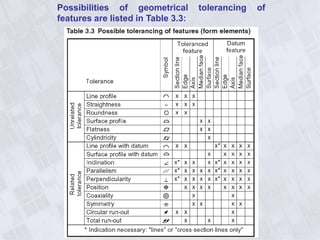
Possibilities of geometrical tolerancing of
features are listed in Table 3.3:
Tolerance Zone:
Form of the tolerance zone:
Depending on the toleranced characteristic and depending on the
drawing indication the tolerance zone is one of the following:
Area within a circle:
Area between two concentric circles:
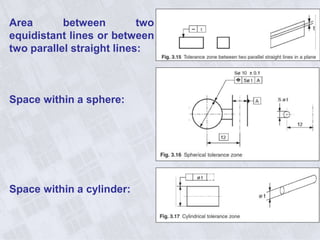
Area between two
equidistant lines or between
two parallel straight lines:
Space within a sphere:
Space within a cylinder:
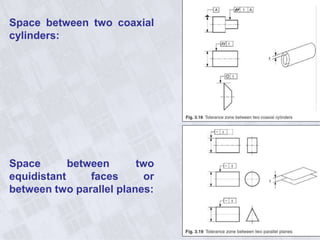
Space between two coaxial
cylinders:
Space between two
equidistant faces or
between two parallel planes:
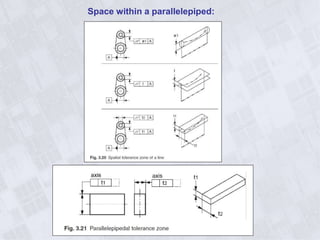
Space within a parallelepiped:

Tolerance geometry

  • 1.
    Chapter III: Geometry Dimensioning Tolerance គុណភាព​និងសភាព​ននផ្ទៃទលិតទលមេកានិច Prepared by: Sry Vannei
  • 2.
     Review ofInterchangeable: It uses for producing the mechanical production in series. They are made to specifications that they are so nearly identical which will fit into any device of the same type. One such part can freely replace another, without any custom fitting. This interchangeability allows easy assembly of new devices, and easier repair of existing devices, while minimizing both the time and skill required of the person doing the assembly or repair.
  • 3.
    Dimensional Tolerances: It isdefined as the permissible or acceptable variation in the dimensions (height, width, depth, diameter, angles) of a part. The root of the word tolerance is the Lantin tolerance, meaning to endure or put up with. Tolerances are unavoidable because it is virtually impossible to manufacture two parts that have precisely the same dimensions. Furthermore, because close dimensional tolerances can significantly increase the product cost, a narrow tolerance range is undesirable economically. However, for some parts, close tolerances are necessary for proper functioning, and are therefore worth the added expense associated with narrow tolerance ranges. Examples are precision measuring instruments and gages, hydraulic pistons, and bearings for aircraft engines.
  • 5.
    Fitting: Dimensional tolerances becomeimportant only when a part is to be assembled or mated with another part. Surfaces that are free and not functional do not need close tolerance control. Importance of Dimensional Tolerance Control: Dimensional tolerances become important only when a part is to be assembled or mated with another part. Surfaces that are free and not functional do not need close tolerance control.
  • 6.
    Tolerance dimensional (fitting)is not always apply to all geometries form. Because of geometries default, tolerance dimensional can’t be use in assembly of parts. I. Geometry Dimensioning and Tolerance (GD&T) :
  • 7.
    What is GD&T? GD&T is a symbolic language. It is used to specify the size, shape, form, orientation, and location of features on a part. Features toleranced with GD&T reflect the actual relationship between mating parts. Drawings with properly applied geometric tolerancing provide the best opportunity for uniform interpretation and cost-effective assembly. GD&T was created to insure the proper assembly of mating parts, to improve quality, and to reduce cost.
  • 8.
    When should GD&Tbe used? Designers should tolerance parts with GD&T when:  Drawing delineation and interpretation need to be the same.  Features are critical to function or interchangeability.  It is important to stop scrapping perfectly good parts.  It is important to reduce drawing changes.  Automated equipment is used.  Functional gaging is required.  It is important to increase productivity.  Companies want across-the-board savings.
  • 9.
     Advantages ofGD&T over Coordinate Dimensioning and Tolerance : Plus or minus tolerancing system for tolerancing drawings have several limitation:  The plus or minus tolerancing system generates rectangular tolerance zones. Rectangular tolerance zones do not have a uniform distance from the center to the outer edge.  Size features can only be specified at the location tolerance of feature size condition and if the size of the features change, there is no way to specify location of tolerance.  Datums are usually not specified where the plus or minus tolerancing system is used.
  • 10.
  • 14.
  • 15.
    Form tolerances of lines Lineprofile tolerances: Profile line shall be contained between two equidistant lines enveloping circles of diameter 0.1. Roundness tolerance: In each cross-section of the conical surface the profile (circumference) shall be contained between two coplanar concentric circles with a distance of 0.1. Straightness tolerance: The profile shall be contained between two parallel straight lines of 0.1 to 0.03 apart.
  • 16.
    Form tolerances of surfaces: Surfaceprofile tolerances: The surface shall be contained between two equidistant surfaces enveloping spheres of diameter 0.03, the centres of which are located on a surface having the nominal. Cylindricity tolerance: The surface shall be contained between two coaxial cylinders with a radial distance 0.05. Flatness tolerance: The surface shall be contained between two parallel planes 0.05 apart.
  • 17.
    Orientation tolerances: Angularity tolerance: The actualaxis shall be contained between two parallel planes 0.1 apart that are inclined at the theoretically exact angle 60°to the datum A. Perpendicularity tolerance: The surface shall be contained between two parallel planes 0.1 apart that are perpendicular to the datum A. Parallelism tolerance: The surface shall be contained between two parallel planes 0.1 apart that are parallel to the datum A.
  • 18.
    Location tolerances: Positional tolerances: Thetheoretical exact (nominal) position is defined by the theoretical exact dimensions (TEDs) with respect to the datums A, B and C. The actual axis shall be contained within a cylinder of diameter 0.1, with an axis that coincides with the theoretical exact position. Coaxiality tolerance: The actual axis shall be contained within a cylinder of diameter 0.03 coaxial with the datum axis A. When the features are practically two dimensional (thin sheet, engraving) the tolerance is also referred to as the concentricity tolerance. Symmetry tolerance: The actual median face shall be contained between two parallel planes 0.08 apart that are symmetrically disposed about the datum median plane B.
  • 19.
    Radial run-out tolerances: Circularradial run-out: In each plane perpendicular to the common datum axis A–B the profile (circumference) shall be contained between two circles concentric with the datum axis A–B and with a radial distance of 0.1. Total radial run-out tolerance: The surface shall be contained between two cylinders coaxial with the datum axis A–B and with a radial distance of 0.1. During checking of the circular radial run- out deviation, the positions of the dial indicator are independent of each other. However, during checking of the total radial run-out deviation, the positions of the dial indicator are along a guiding (straight) line parallel to the datum axis A–B. Therefore the straightness deviations and the parallelism deviations of the generator lines of the toleranced cylindrical surface are limited by the total radial run-out tolerance, but not by the circular radial run- out tolerance.
  • 20.
    Circular axial run-out: Ineach cylindrical section (measuring cylinder) coaxial with the datum axis A, the section line shall be contained between two circles 0.1 apart and perpendicular to the datum axis A. Total axial run-out tolerance: The surface shall be contained between two parallel planes 0.1 apart and perpendicular to the datum axis A. During checking of the circular axial run-out deviation, the positions of the dial indicator are independent of each other. However, during checking of the total axial run-out deviation, the positions of the dial indicator are along a guiding (straight) line perpendicular to the datum axis A. Therefore the flatness deviations of the toleranced surface are limited by the total axial run-out tolerance, but not by the circular axial run-out tolerance.
  • 21.
    Run-out tolerances inany direction: Circular run-out tolerance in any direction: In each conical section (measuring cone) coaxial with the datum axis B and perpendicular to the nominal toleranced surface (defining the measuring cone angle) the section line shall be contained between two circles 0.1 apart and perpendicular to the datum axis B. Total run-out tolerance in any direction: The surface shall be contained between two cones coaxial with the datum axis B and with a radial distance of 0.1 (measured perpendicular to the nominal cone surfaces). During checking of the circular run-out deviation in any direction, the positions of the dial indicator are independent of each other. However, during checking of the total amount deviation in any direction, the positions of the dial indicator are along a guiding line (theoretical exact generator line of the toleranced future) parallel to its theoretical exact position with respect to the datum axis B. Therefore the deviations of the generator line of the toleranced feature are limited by the total run-out tolerance in any direction, but not by the circular run- out tolerance in any direction.
  • 22.
    Coaxiality tolerance andradial run-out tolerance are different. The coaxiality tolerance assesses the deviation of the axis from the datum axis, while the radial run-out tolerance assesses the deviation of the circumference line from a coaxial circle. The radial run-out deviation is composed of the coaxiality deviation and parts of the roundness deviation.
  • 23.
    Possibilities of geometricaltolerancing of features are listed in Table 3.3:
  • 24.
    Tolerance Zone: Form ofthe tolerance zone: Depending on the toleranced characteristic and depending on the drawing indication the tolerance zone is one of the following: Area within a circle: Area between two concentric circles:
  • 25.
    Area between two equidistantlines or between two parallel straight lines: Space within a sphere: Space within a cylinder:
  • 26.
    Space between twocoaxial cylinders: Space between two equidistant faces or between two parallel planes:
  • 27.
    Space within aparallelepiped: