Symbols of GD&T (in detail)
SREELAKSHMY V.U (B.E)
There are 14 geometrical characteristics symbol which controls the
features in GD&T. They are classified under five controls and are
given:
1. FORM
• Straightness
• Flatness
• Circularity
• Cylindricity
2. ORIENTATION
• Angularity
• Perpendicularity
• Parallelism
3. LOCATION
• Position
• Concentricity
• Symmetry
4. PROFILE
• Profile of a line
• Profile of a surface
5. RUN OUT
• Circular Run out
• Total Run out
Straightness
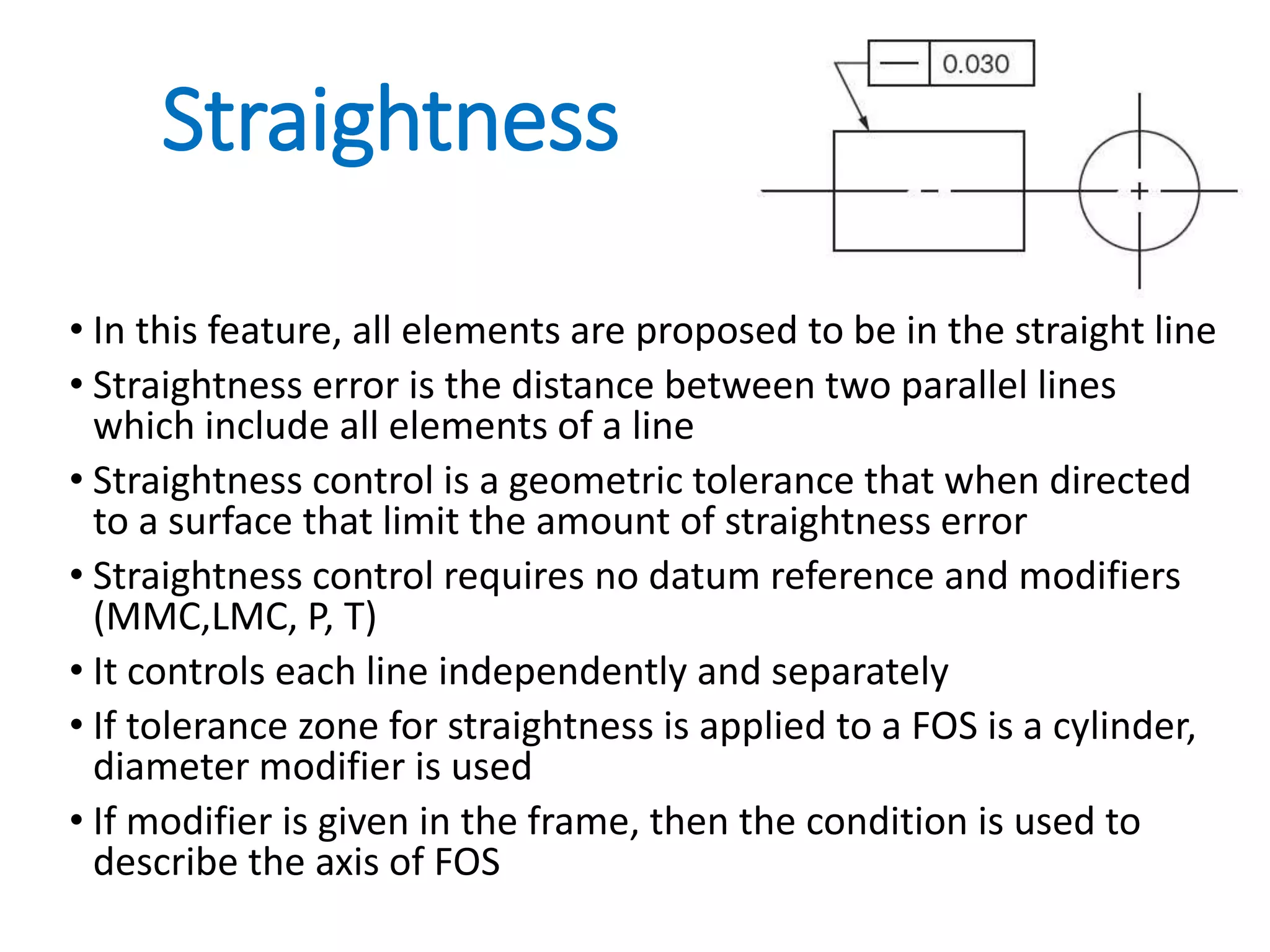
• In this feature, all elements are proposed to be in the straight line
• Straightness error is the distance between two parallel lines
which include all elements of a line
• Straightness control is a geometric tolerance that when directed
to a surface that limit the amount of straightness error
• Straightness control requires no datum reference and modifiers
(MMC,LMC, P, T)
• It controls each line independently and separately
• If tolerance zone for straightness is applied to a FOS is a cylinder,
diameter modifier is used
• If modifier is given in the frame, then the condition is used to
describe the axis of FOS
Flatness
• In this feature, all elements are supposed to be in one plane
• Flatness error is the distance between two parallel planes
which include all elements of a surface (High and low points)
• Flatness control is a geometric tolerance that limits the
amount of flatness error
• Flatness feature requires no datum and no modifiers. And it
must be applied to a planar surface
• The distance between the parallel plane is determined by the
flatness control tolerance value
Circularity
• It is a condition where all points of a surface of
revolution at any section perpendicular to an axis are
equidistant from the axis
• Circularity error is the radial distance between two co-
axial diameters which include all elements of a circular
feature
• Circularity control limits the amount of circularity error
• Circularity feature requires no datum reference,
modifiers (M,L,P,T)
• It controls each circular element independently
• Tolerance zone for a circularity control applies to a
diameter in two co-axial circles
• Circularity control do not over ride Rule #1
Cylindricity
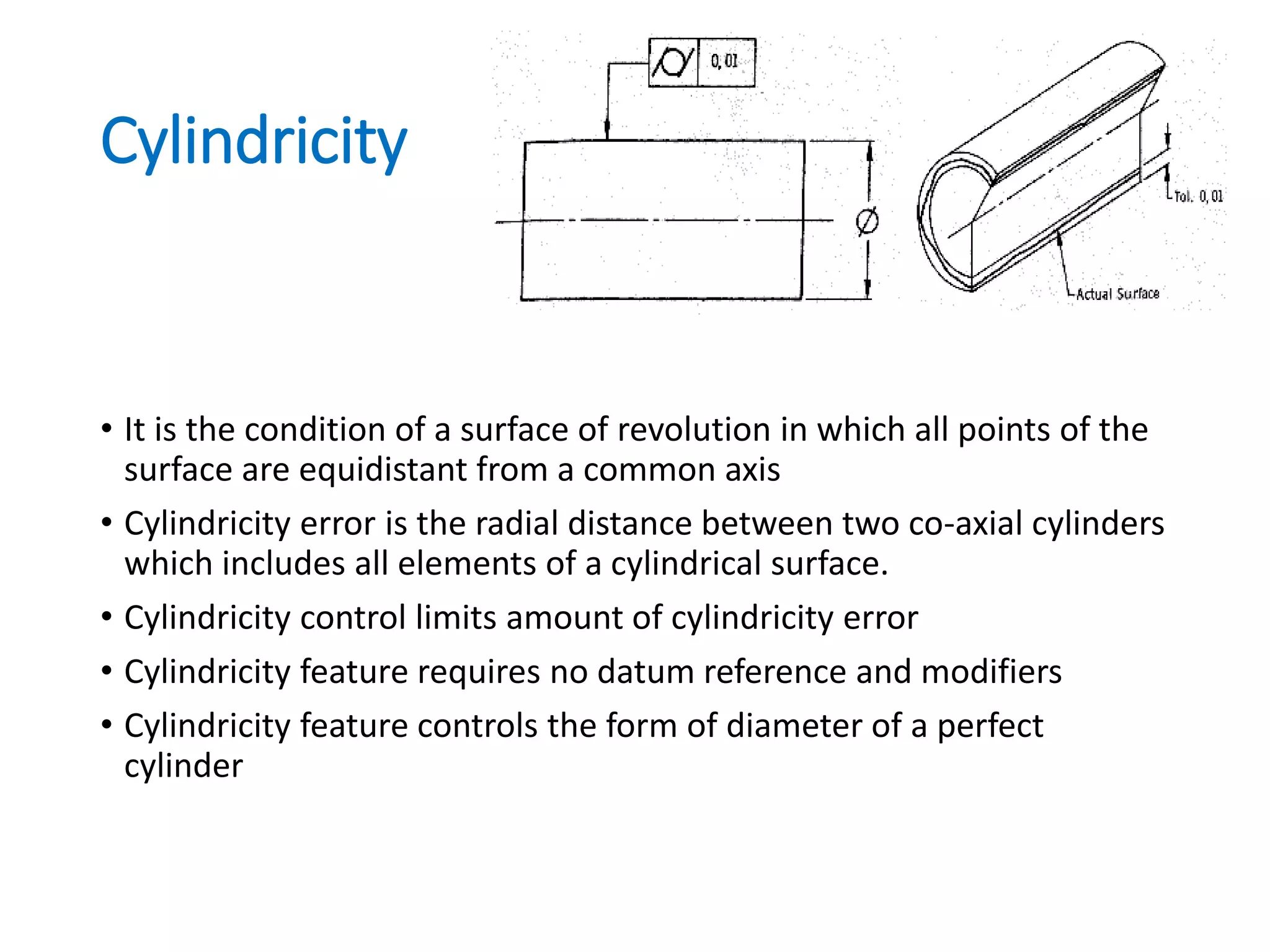
• It is the condition of a surface of revolution in which all points of the
surface are equidistant from a common axis
• Cylindricity error is the radial distance between two co-axial cylinders
which includes all elements of a cylindrical surface.
• Cylindricity control limits amount of cylindricity error
• Cylindricity feature requires no datum reference and modifiers
• Cylindricity feature controls the form of diameter of a perfect
cylinder
Angularity
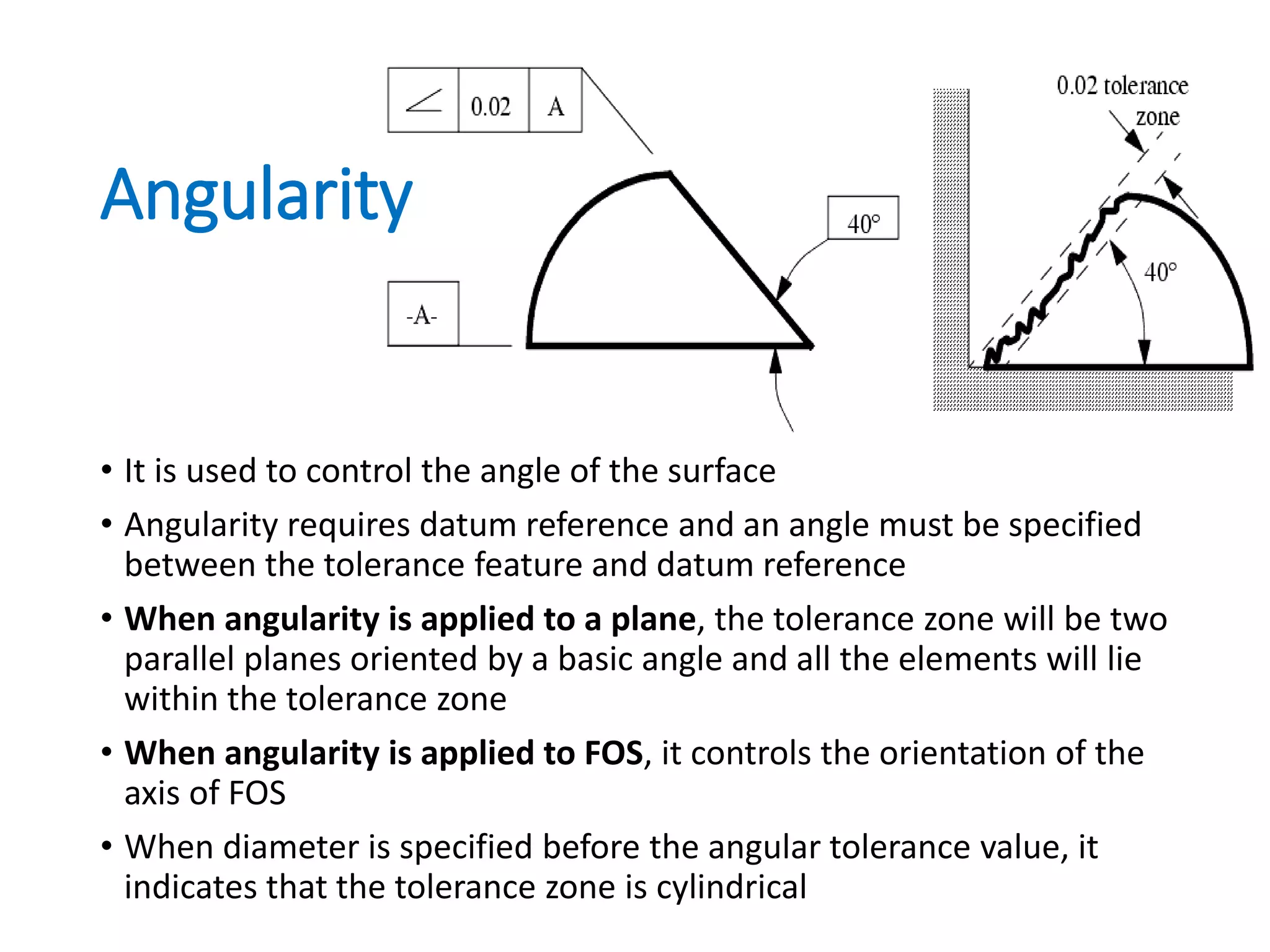
• It is used to control the angle of the surface
• Angularity requires datum reference and an angle must be specified
between the tolerance feature and datum reference
• When angularity is applied to a plane, the tolerance zone will be two
parallel planes oriented by a basic angle and all the elements will lie
within the tolerance zone
• When angularity is applied to FOS, it controls the orientation of the
axis of FOS
• When diameter is specified before the angular tolerance value, it
indicates that the tolerance zone is cylindrical
Perpendicularity
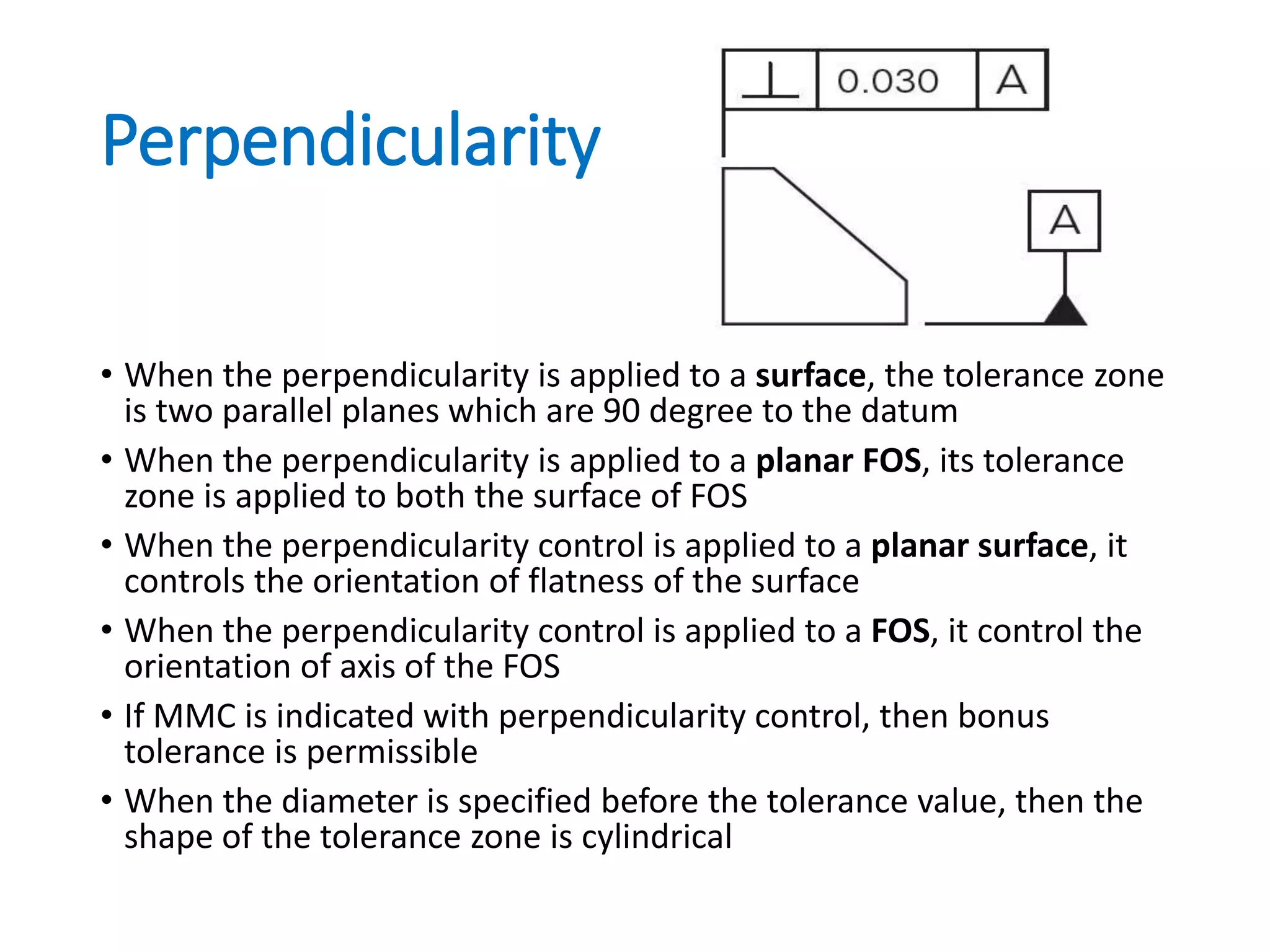
• When the perpendicularity is applied to a surface, the tolerance zone
is two parallel planes which are 90 degree to the datum
• When the perpendicularity is applied to a planar FOS, its tolerance
zone is applied to both the surface of FOS
• When the perpendicularity control is applied to a planar surface, it
controls the orientation of flatness of the surface
• When the perpendicularity control is applied to a FOS, it control the
orientation of axis of the FOS
• If MMC is indicated with perpendicularity control, then bonus
tolerance is permissible
• When the diameter is specified before the tolerance value, then the
shape of the tolerance zone is cylindrical
Parallelism
• When parallelism is applied to a planar surface, the tolerance zone is
two parallel planes which are parallel to the datum plane.
• When parallelism is applied to a FOS, its tolerance zone is applied to
the axis or center plane of the FOS.
• When the diameter is specified before the tolerance value, then the
shape of the tolerance zone is cylindrical
• When the parallelism control contains a diameter symbol in front of
the tolerance value, the shape of tolerance value will be cylindrical
• The axis of the tolerance diameter must be within the tolerance zone
• the tolerance zone may float within the allowable location tolerance
zone
Position
• Tolerance of position (TOP)
• It is used to control the location of the FOS or a pattern of FOS
• True position is the theoretically exact location of a FOS
• TOP control is a geometric tolerance that defines the location tolerance of
FOS from its true position.
• Modifiers and datum references are used when TOP is used
• When Modifier is given for a part with TOP, then the tolerance is applied only
to that modifier condition
• When TOP is applied on MMC, bonus tolerance and datum shift is permitted
Concentricity
• It is the condition where the
mid points of all diametrically
opposed elements of a
surface of revolution are
congruent with the axis of a
datum feature.
• All the median points of the
tolerance diameter must be
within the tolerance zone.
• A concentricity control,
datum references are always
applied at RFS
• Concentricity requires datum
reference and must be
applied to a cylindrical FOS
and at RFS
• The tolerance zone for a
concentricity control is a
cylinder that is co axial with
the datum
Symmetry
• It is the condition where the median points of all opposed elements of two or
more feature surfaces are congruent with the datum axis or datum center
plane of a datum feature
• The symmetry control requires datum reference and it must be applied to a
planar FOS and RFS
• The symmetry tolerance value determines the size of tolerance zone
• The tolerance zone for a symmetry control is two parallel planes centered
about the datum center plane
• The distance between the plane is equal to the symmetry control tolerance
value
• Median points of tolerance feature must be within the tolerance zone
Profile of a line
• Profile of a line establishes a two-dimensional tolerance zone that
controls individual line elements of a feature or surface. Profile of a
line is usually applied to parts with varying cross-sections, or to
specific cross sections critical to a part's function.
• Profile control is a geometric tolerance which specifies a uniform
boundary along the true profile that elements of a surface must lie
within
• When a profile of a line control is specified the tolerance zone is two
uniform lines. The tolerance zone applies for each line element of the
surface
• It has 2D tolerance zone
• It can be used with the datum feature as a related feature control and
without a datum reference as a form control
Profile of a surface
• It is a powerful geometric tolerance which is used to control the part
surface
• It controls the size, location, orientation and form
• When the profile of a surface control is specified, tolerance zone is
uniform boundary. The boundary applies for the full length and width
of the surface
• It must have a datum reference and should be applied to a true
profile
• It has 3D tolerance zone and it can be used to tolerance a polygon,
conical feature
Circular Run out
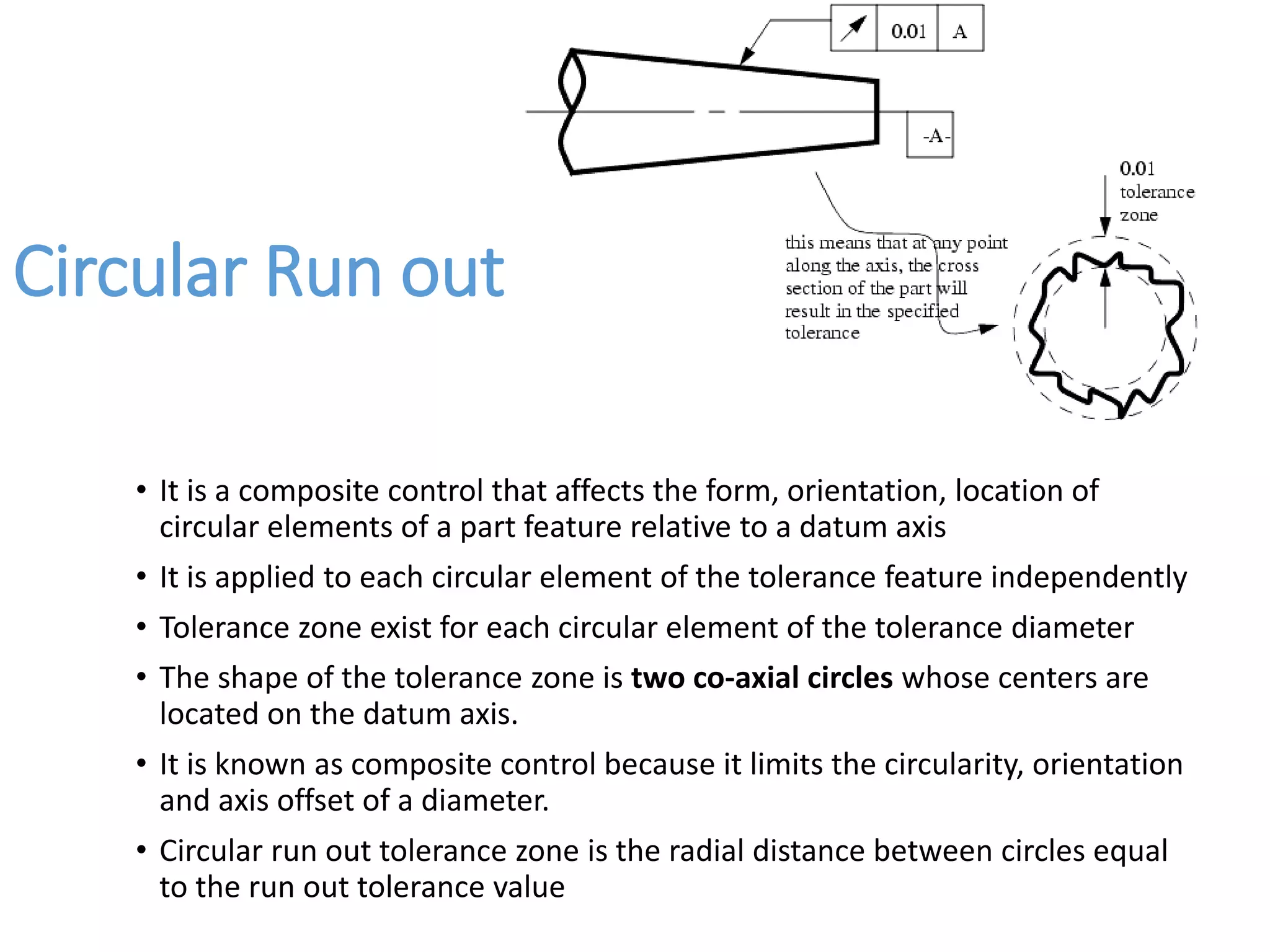
• It is a composite control that affects the form, orientation, location of
circular elements of a part feature relative to a datum axis
• It is applied to each circular element of the tolerance feature independently
• Tolerance zone exist for each circular element of the tolerance diameter
• The shape of the tolerance zone is two co-axial circles whose centers are
located on the datum axis.
• It is known as composite control because it limits the circularity, orientation
and axis offset of a diameter.
• Circular run out tolerance zone is the radial distance between circles equal
to the run out tolerance value
Total Run out
• It is a composite control that affects the form, orientation, location of all
surface elements of a diameter relative to a datum axis
• Total run out requires a datum reference and it must be applied at RFS
• The run out tolerance value is equal to the radial distance between the
two cylinders
• The tolerance zone of a total run out is the two co-axial cylinders whose
centers are located on the datum axis
• It is also a composite control as it limits the location, orientation and
cylindricity
THANK YOU 

14 symbols of gd&t

  • 1.
    Symbols of GD&T(in detail) SREELAKSHMY V.U (B.E)
  • 2.
    There are 14geometrical characteristics symbol which controls the features in GD&T. They are classified under five controls and are given: 1. FORM • Straightness • Flatness • Circularity • Cylindricity 2. ORIENTATION • Angularity • Perpendicularity • Parallelism 3. LOCATION • Position • Concentricity • Symmetry 4. PROFILE • Profile of a line • Profile of a surface 5. RUN OUT • Circular Run out • Total Run out
  • 3.
    Straightness • In thisfeature, all elements are proposed to be in the straight line • Straightness error is the distance between two parallel lines which include all elements of a line • Straightness control is a geometric tolerance that when directed to a surface that limit the amount of straightness error • Straightness control requires no datum reference and modifiers (MMC,LMC, P, T) • It controls each line independently and separately • If tolerance zone for straightness is applied to a FOS is a cylinder, diameter modifier is used • If modifier is given in the frame, then the condition is used to describe the axis of FOS
  • 4.
    Flatness • In thisfeature, all elements are supposed to be in one plane • Flatness error is the distance between two parallel planes which include all elements of a surface (High and low points) • Flatness control is a geometric tolerance that limits the amount of flatness error • Flatness feature requires no datum and no modifiers. And it must be applied to a planar surface • The distance between the parallel plane is determined by the flatness control tolerance value
  • 5.
    Circularity • It isa condition where all points of a surface of revolution at any section perpendicular to an axis are equidistant from the axis • Circularity error is the radial distance between two co- axial diameters which include all elements of a circular feature • Circularity control limits the amount of circularity error • Circularity feature requires no datum reference, modifiers (M,L,P,T) • It controls each circular element independently • Tolerance zone for a circularity control applies to a diameter in two co-axial circles • Circularity control do not over ride Rule #1
  • 6.
    Cylindricity • It isthe condition of a surface of revolution in which all points of the surface are equidistant from a common axis • Cylindricity error is the radial distance between two co-axial cylinders which includes all elements of a cylindrical surface. • Cylindricity control limits amount of cylindricity error • Cylindricity feature requires no datum reference and modifiers • Cylindricity feature controls the form of diameter of a perfect cylinder
  • 7.
    Angularity • It isused to control the angle of the surface • Angularity requires datum reference and an angle must be specified between the tolerance feature and datum reference • When angularity is applied to a plane, the tolerance zone will be two parallel planes oriented by a basic angle and all the elements will lie within the tolerance zone • When angularity is applied to FOS, it controls the orientation of the axis of FOS • When diameter is specified before the angular tolerance value, it indicates that the tolerance zone is cylindrical
  • 8.
    Perpendicularity • When theperpendicularity is applied to a surface, the tolerance zone is two parallel planes which are 90 degree to the datum • When the perpendicularity is applied to a planar FOS, its tolerance zone is applied to both the surface of FOS • When the perpendicularity control is applied to a planar surface, it controls the orientation of flatness of the surface • When the perpendicularity control is applied to a FOS, it control the orientation of axis of the FOS • If MMC is indicated with perpendicularity control, then bonus tolerance is permissible • When the diameter is specified before the tolerance value, then the shape of the tolerance zone is cylindrical
  • 9.
    Parallelism • When parallelismis applied to a planar surface, the tolerance zone is two parallel planes which are parallel to the datum plane. • When parallelism is applied to a FOS, its tolerance zone is applied to the axis or center plane of the FOS. • When the diameter is specified before the tolerance value, then the shape of the tolerance zone is cylindrical • When the parallelism control contains a diameter symbol in front of the tolerance value, the shape of tolerance value will be cylindrical • The axis of the tolerance diameter must be within the tolerance zone • the tolerance zone may float within the allowable location tolerance zone
  • 10.
    Position • Tolerance ofposition (TOP) • It is used to control the location of the FOS or a pattern of FOS • True position is the theoretically exact location of a FOS • TOP control is a geometric tolerance that defines the location tolerance of FOS from its true position. • Modifiers and datum references are used when TOP is used • When Modifier is given for a part with TOP, then the tolerance is applied only to that modifier condition • When TOP is applied on MMC, bonus tolerance and datum shift is permitted
  • 11.
    Concentricity • It isthe condition where the mid points of all diametrically opposed elements of a surface of revolution are congruent with the axis of a datum feature. • All the median points of the tolerance diameter must be within the tolerance zone. • A concentricity control, datum references are always applied at RFS • Concentricity requires datum reference and must be applied to a cylindrical FOS and at RFS • The tolerance zone for a concentricity control is a cylinder that is co axial with the datum
  • 12.
    Symmetry • It isthe condition where the median points of all opposed elements of two or more feature surfaces are congruent with the datum axis or datum center plane of a datum feature • The symmetry control requires datum reference and it must be applied to a planar FOS and RFS • The symmetry tolerance value determines the size of tolerance zone • The tolerance zone for a symmetry control is two parallel planes centered about the datum center plane • The distance between the plane is equal to the symmetry control tolerance value • Median points of tolerance feature must be within the tolerance zone
  • 13.
    Profile of aline • Profile of a line establishes a two-dimensional tolerance zone that controls individual line elements of a feature or surface. Profile of a line is usually applied to parts with varying cross-sections, or to specific cross sections critical to a part's function. • Profile control is a geometric tolerance which specifies a uniform boundary along the true profile that elements of a surface must lie within • When a profile of a line control is specified the tolerance zone is two uniform lines. The tolerance zone applies for each line element of the surface • It has 2D tolerance zone • It can be used with the datum feature as a related feature control and without a datum reference as a form control
  • 14.
    Profile of asurface • It is a powerful geometric tolerance which is used to control the part surface • It controls the size, location, orientation and form • When the profile of a surface control is specified, tolerance zone is uniform boundary. The boundary applies for the full length and width of the surface • It must have a datum reference and should be applied to a true profile • It has 3D tolerance zone and it can be used to tolerance a polygon, conical feature
  • 15.
    Circular Run out •It is a composite control that affects the form, orientation, location of circular elements of a part feature relative to a datum axis • It is applied to each circular element of the tolerance feature independently • Tolerance zone exist for each circular element of the tolerance diameter • The shape of the tolerance zone is two co-axial circles whose centers are located on the datum axis. • It is known as composite control because it limits the circularity, orientation and axis offset of a diameter. • Circular run out tolerance zone is the radial distance between circles equal to the run out tolerance value
  • 16.
    Total Run out •It is a composite control that affects the form, orientation, location of all surface elements of a diameter relative to a datum axis • Total run out requires a datum reference and it must be applied at RFS • The run out tolerance value is equal to the radial distance between the two cylinders • The tolerance zone of a total run out is the two co-axial cylinders whose centers are located on the datum axis • It is also a composite control as it limits the location, orientation and cylindricity
  • 17.