
StudentDevelopment Institute
Faculty of Arts, Humanities and Languages
Adjective Clause
Submitted to : Soun Ngoun Y
Students Kum visal
Hong kimhorn
Tolos vasiah
Khim sreyvin
Sovann mengly
Batch II, Group I , Year IV, Semester I
Academic year 2017-2018
Content
I. Adjective clause
II. Relative pronoun
III. Adjective clause with prepositions
IV. Restrictive and Nonrestrictive clause
V. Reduction of Adjective clause
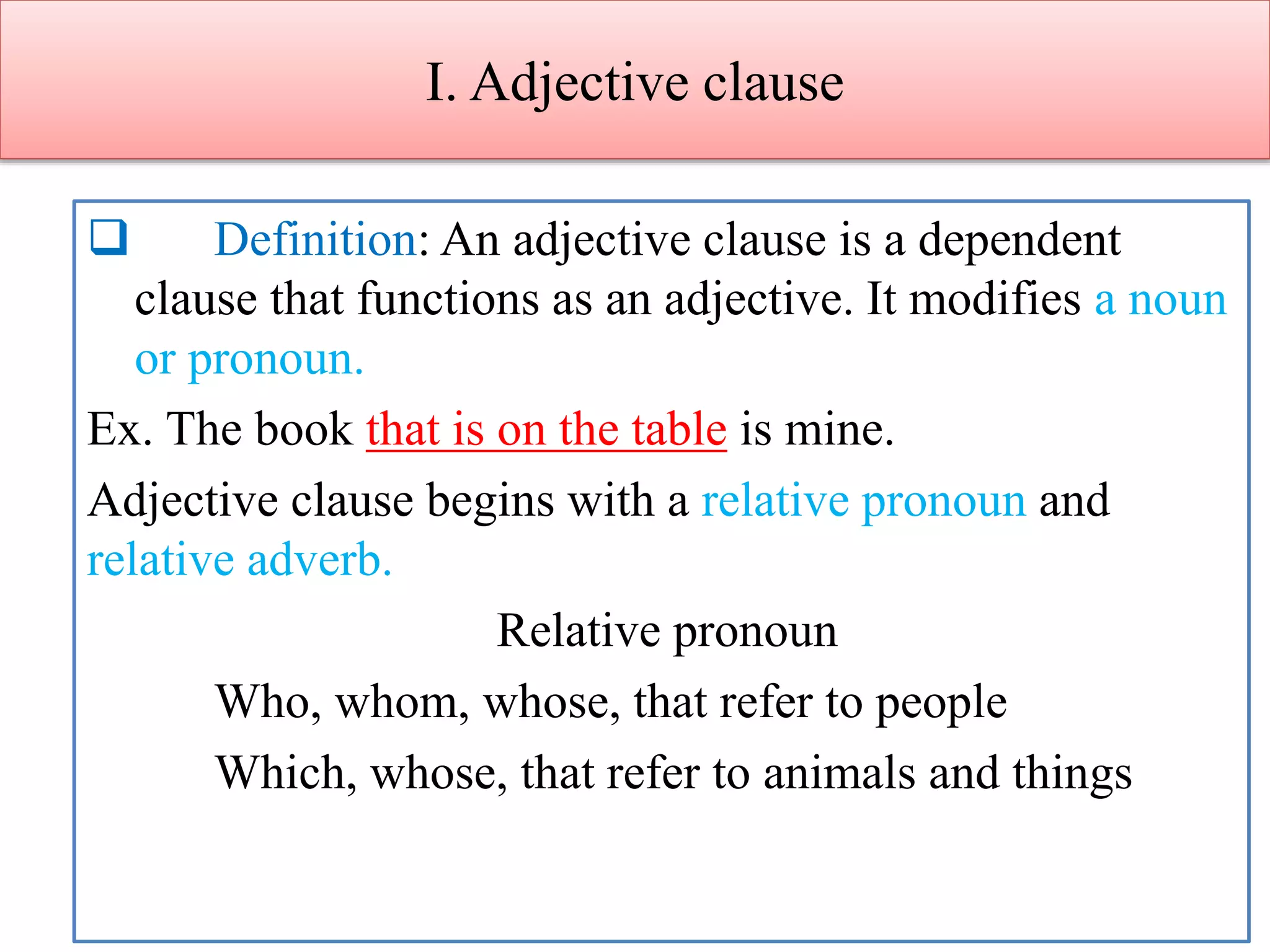
I. Adjective clause
 Definition: An adjective clause is a dependent
clause that functions as an adjective. It modifies a noun
or pronoun.
Ex. The book that is on the table is mine.
Adjective clause begins with a relative pronoun and
relative adverb.
Relative pronoun
Who, whom, whose, that refer to people
Which, whose, that refer to animals and things
II. Relative Pronoun
Who refers to people
 Subject
Ex. The tribes who lived in the Great Plains used smoke
signal
 Object
Ex. The man who is playing the drums is well-known
Whom refers to people
 Object
Ex. The student whom we criticized was made a
suicide.
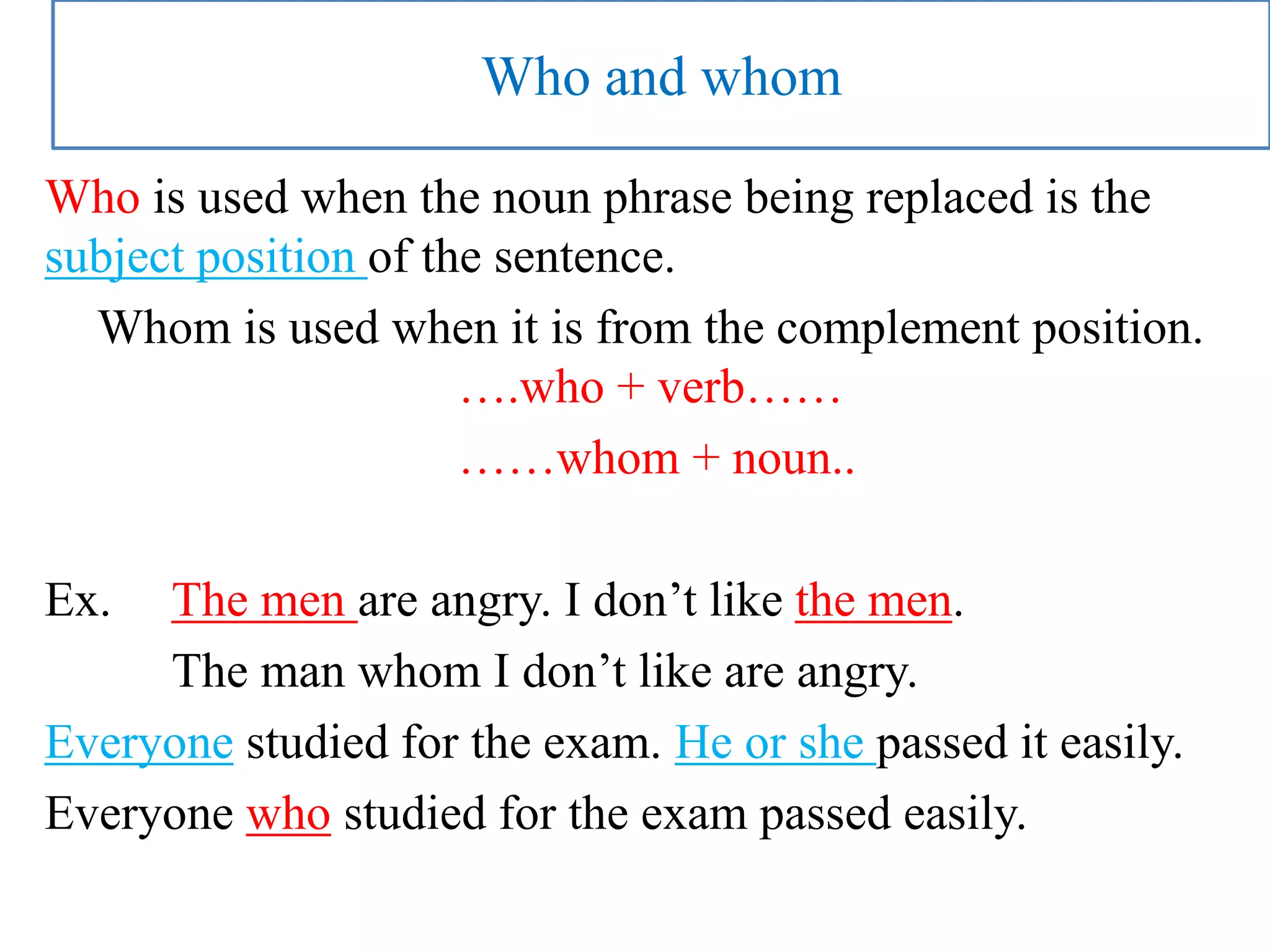
Who and whom
Who is used when the noun phrase being replaced is the
subject position of the sentence.
Whom is used when it is from the complement position.
….who + verb……
……whom + noun..
Ex. The men are angry. I don’t like the men.
The man whom I don’t like are angry.
Everyone studied for the exam. He or she passed it easily.
Everyone who studied for the exam passed easily.
Whose and Which
Whose refers to people and thing
 Possessive
Ex. Families whose incomes are below a certain level
pay non income tax.
Which refers to things
 Subject
Ex. My English books, which are bought at market, are
very interesting.
 Object
The building which we built was very famous
That
• That refers to people and thing
 Object
The apache is a tribe that I will research.
 Subject
The smoke that you see is from the hills.
Ex. We bought the stereo. The stereo had been
Duplicate noun phrase
advertised at a reduced price
We bought the stereo that had been advertised at
a reduced price.
Relative Adverb
When and Where
• When refers to time
Ex1. That is the day when we get the signal.
Ex2. The restaurant where the customers were shot had
closed permanently.
• Where refers to place
Ex1. That is the valley where the tribe lived
Ex2. The day when John married was wonderful
III. ADJECTIVE CLAUSES with PREPOSITIONS
Let's practice FORMAL adjective clauses.
Ex: 1 I know the man. Mary is talking to him.
--> I know the man to whom Mary is talking.
I saw the picture. You were pointing at it.
-->I saw the picture at which you were pointing.
Ex: 2 The teacher gave me good advice. I spoke to her
yesterday.
--> The teacher to whom I spoke yesterday gave me
good advice. Or The teacher whom I spoke to yesterday
gave me good advice
Phrasal Verbs
Ex: The house that they are looking at.
 Following the step
• Write to
• Live with
• Ask for
• Work in
• Look at
• Pay for
IV. Restrictive and Nonrestrictive clause
A nonrestrictive is set off from the other clause by
commas and a restrictive clause is not. Who, which and
whom can be used in res- and nonres-. That can only be
used in a res-
Ex. Families whose incomes are below a certain level
pay non income tax
Ex. My family, whose income is more than $500, pays
about 10% income tax.
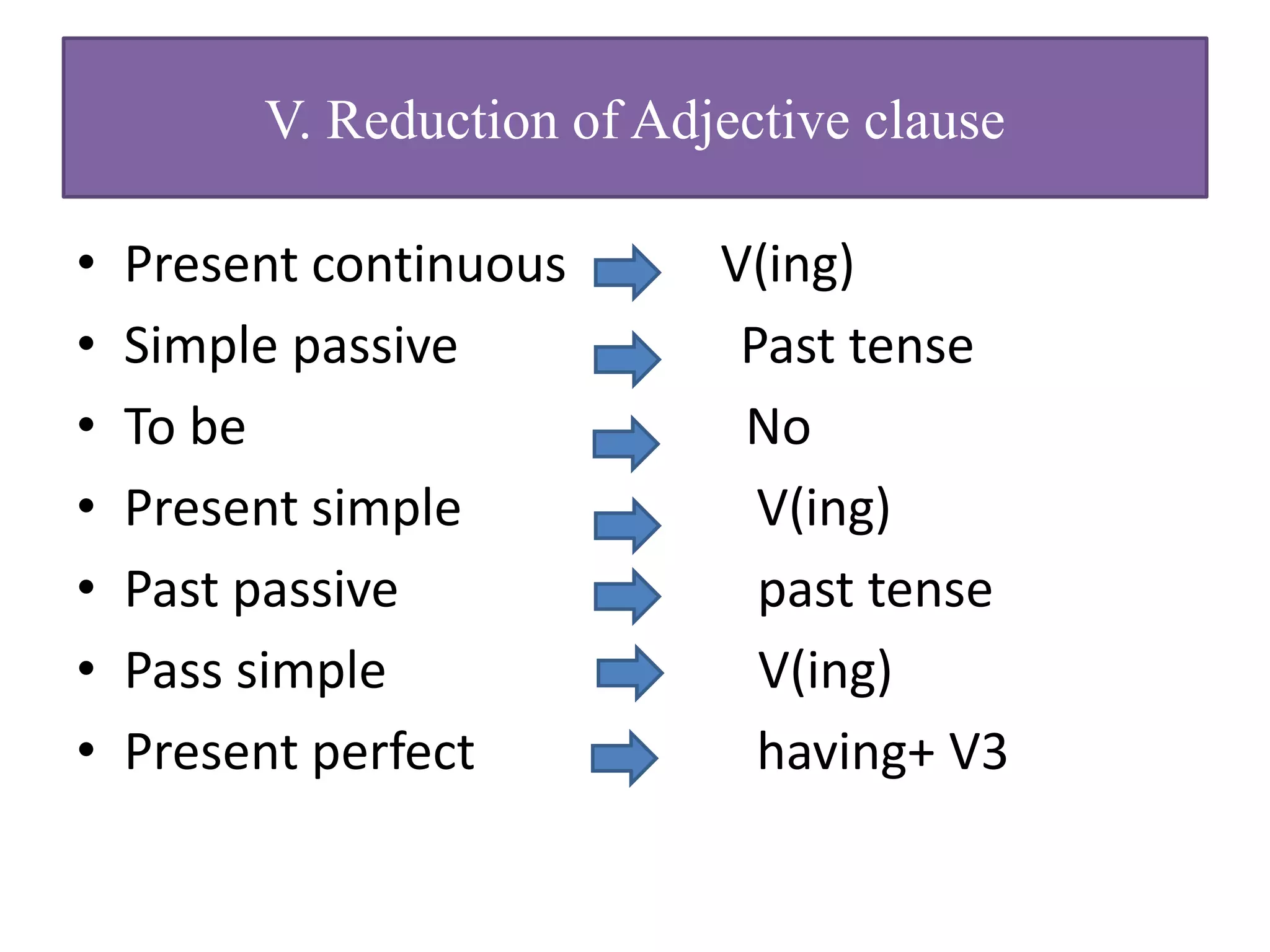
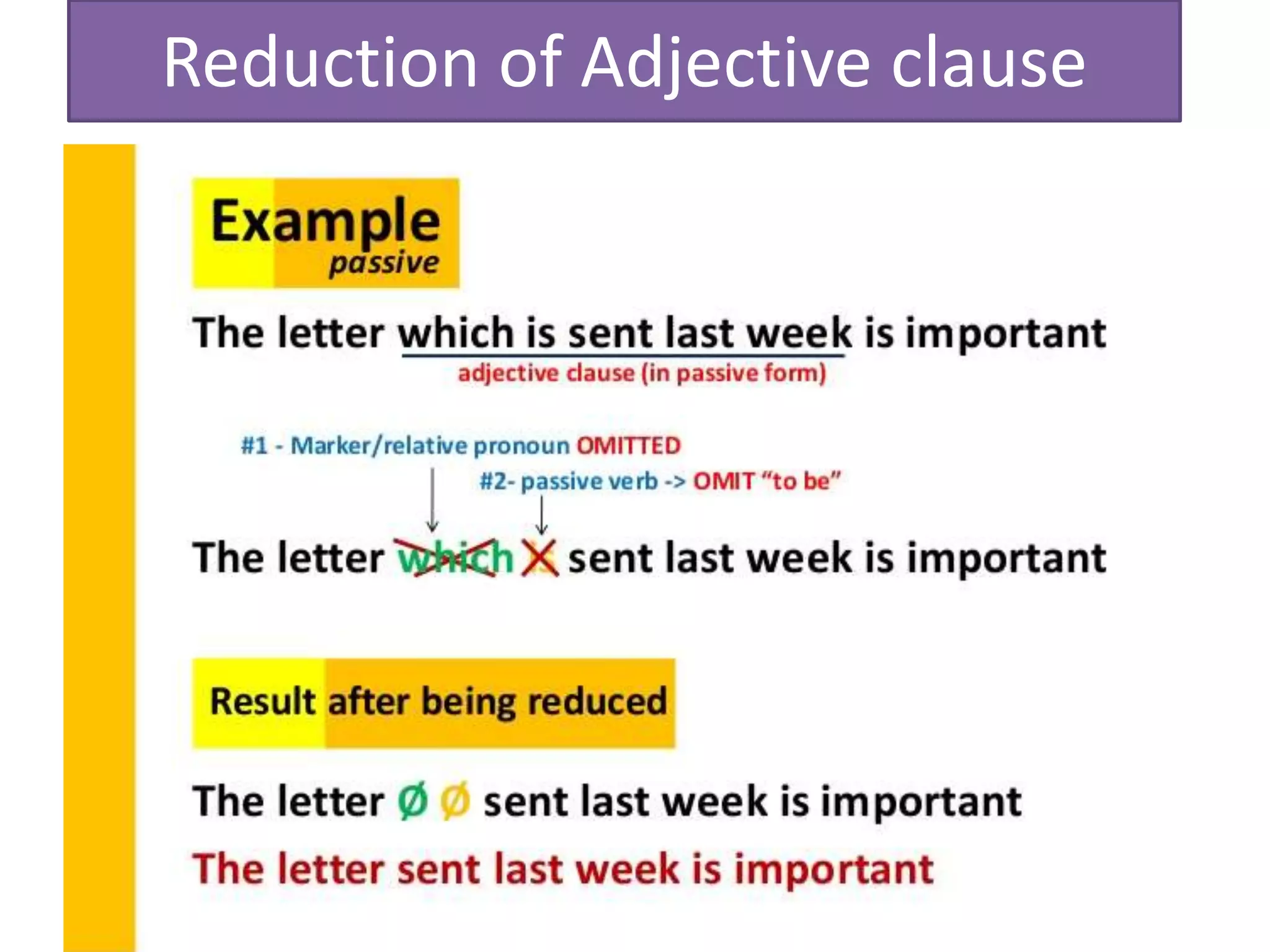
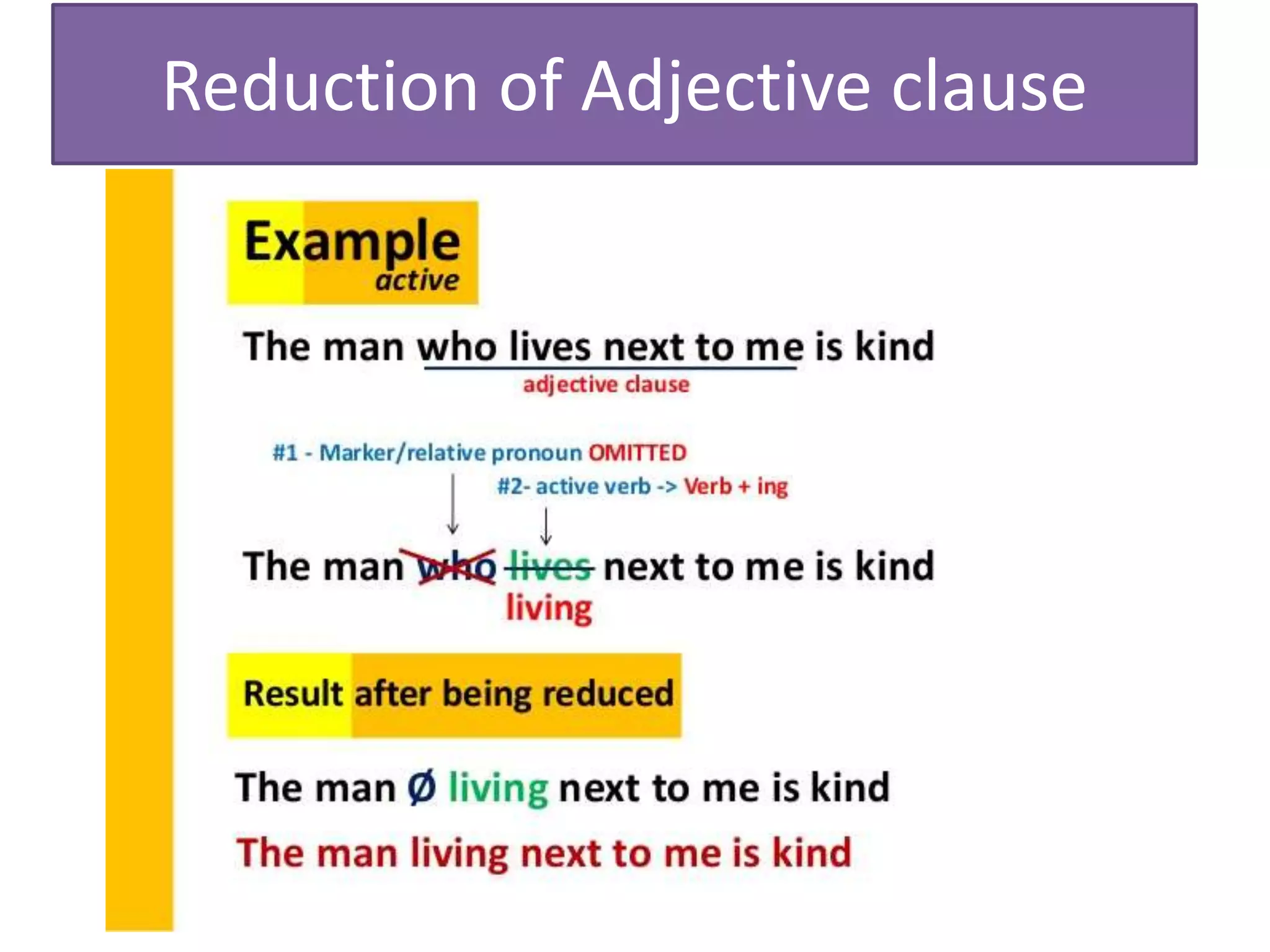
V. Reduction of Adjective clause
• Present continuous V(ing)
• Simple passive Past tense
• To be No
• Present simple V(ing)
• Past passive past tense
• Pass simple V(ing)
• Present perfect having+ V3
Reduction of Adjective clause
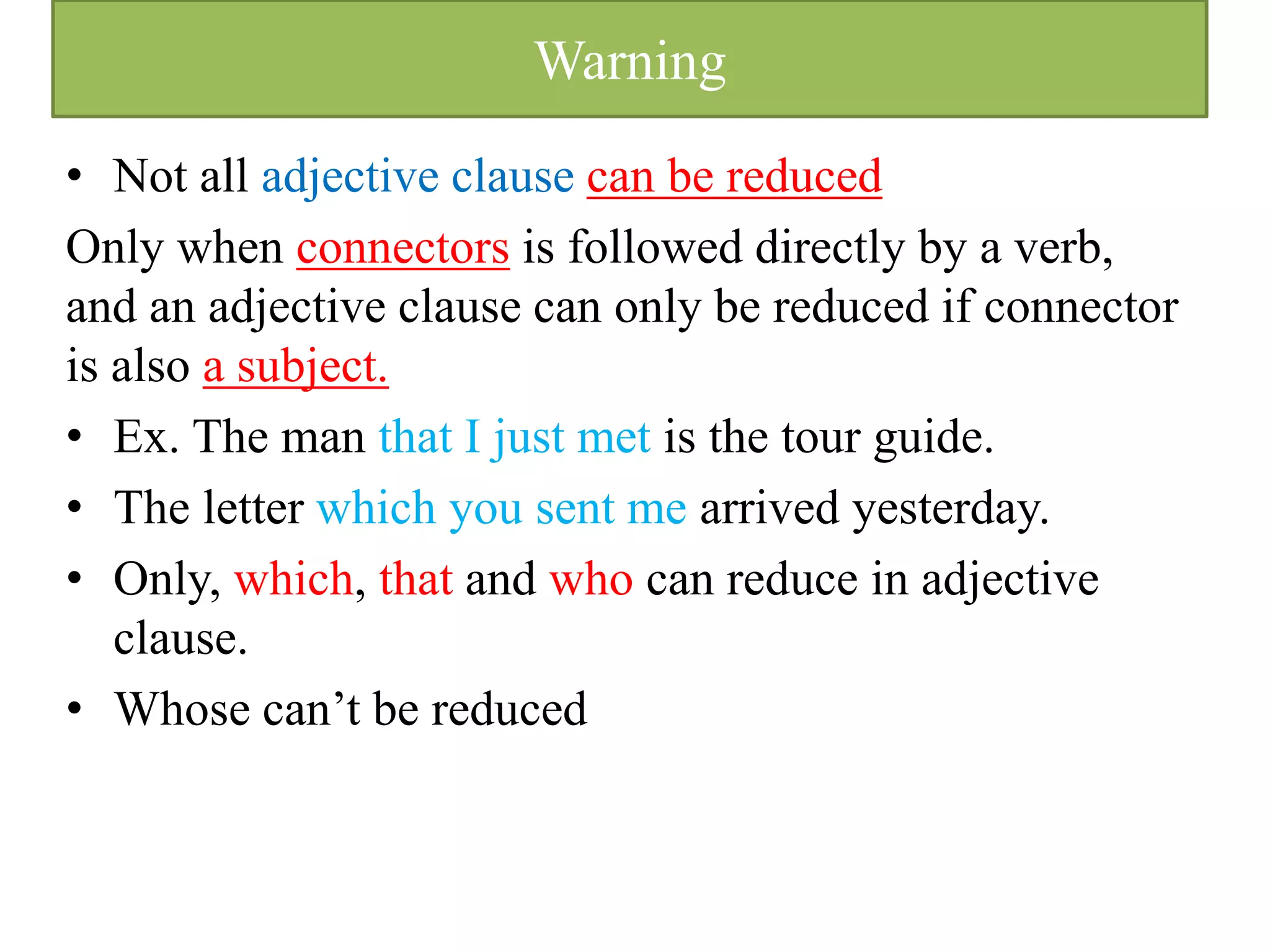
Warning
• Not all adjective clause can be reduced
Only when connectors is followed directly by a verb,
and an adjective clause can only be reduced if connector
is also a subject.
• Ex. The man that I just met is the tour guide.
• The letter which you sent me arrived yesterday.
• Only, which, that and who can reduce in adjective
clause.
• Whose can’t be reduced
Exercises

English grammar "Adjective clause"

  • 1.
    StudentDevelopment Institute Faculty ofArts, Humanities and Languages Adjective Clause Submitted to : Soun Ngoun Y Students Kum visal Hong kimhorn Tolos vasiah Khim sreyvin Sovann mengly Batch II, Group I , Year IV, Semester I Academic year 2017-2018
  • 2.
    Content I. Adjective clause II.Relative pronoun III. Adjective clause with prepositions IV. Restrictive and Nonrestrictive clause V. Reduction of Adjective clause
  • 3.
    I. Adjective clause Definition: An adjective clause is a dependent clause that functions as an adjective. It modifies a noun or pronoun. Ex. The book that is on the table is mine. Adjective clause begins with a relative pronoun and relative adverb. Relative pronoun Who, whom, whose, that refer to people Which, whose, that refer to animals and things
  • 4.
    II. Relative Pronoun Whorefers to people  Subject Ex. The tribes who lived in the Great Plains used smoke signal  Object Ex. The man who is playing the drums is well-known Whom refers to people  Object Ex. The student whom we criticized was made a suicide.
  • 5.
    Who and whom Whois used when the noun phrase being replaced is the subject position of the sentence. Whom is used when it is from the complement position. ….who + verb…… ……whom + noun.. Ex. The men are angry. I don’t like the men. The man whom I don’t like are angry. Everyone studied for the exam. He or she passed it easily. Everyone who studied for the exam passed easily.
  • 6.
    Whose and Which Whoserefers to people and thing  Possessive Ex. Families whose incomes are below a certain level pay non income tax. Which refers to things  Subject Ex. My English books, which are bought at market, are very interesting.  Object The building which we built was very famous
  • 7.
    That • That refersto people and thing  Object The apache is a tribe that I will research.  Subject The smoke that you see is from the hills. Ex. We bought the stereo. The stereo had been Duplicate noun phrase advertised at a reduced price We bought the stereo that had been advertised at a reduced price.
  • 8.
    Relative Adverb When andWhere • When refers to time Ex1. That is the day when we get the signal. Ex2. The restaurant where the customers were shot had closed permanently. • Where refers to place Ex1. That is the valley where the tribe lived Ex2. The day when John married was wonderful
  • 9.
    III. ADJECTIVE CLAUSESwith PREPOSITIONS Let's practice FORMAL adjective clauses. Ex: 1 I know the man. Mary is talking to him. --> I know the man to whom Mary is talking. I saw the picture. You were pointing at it. -->I saw the picture at which you were pointing. Ex: 2 The teacher gave me good advice. I spoke to her yesterday. --> The teacher to whom I spoke yesterday gave me good advice. Or The teacher whom I spoke to yesterday gave me good advice
  • 10.
    Phrasal Verbs Ex: Thehouse that they are looking at.  Following the step • Write to • Live with • Ask for • Work in • Look at • Pay for
  • 11.
    IV. Restrictive andNonrestrictive clause A nonrestrictive is set off from the other clause by commas and a restrictive clause is not. Who, which and whom can be used in res- and nonres-. That can only be used in a res- Ex. Families whose incomes are below a certain level pay non income tax Ex. My family, whose income is more than $500, pays about 10% income tax.
  • 12.
    V. Reduction ofAdjective clause • Present continuous V(ing) • Simple passive Past tense • To be No • Present simple V(ing) • Past passive past tense • Pass simple V(ing) • Present perfect having+ V3
  • 13.
  • 14.
  • 15.
    Warning • Not alladjective clause can be reduced Only when connectors is followed directly by a verb, and an adjective clause can only be reduced if connector is also a subject. • Ex. The man that I just met is the tour guide. • The letter which you sent me arrived yesterday. • Only, which, that and who can reduce in adjective clause. • Whose can’t be reduced
  • 18.