Tissue EngineeringMSE503 Seminar02/18/2009Deepak RajputGraduate Research AssistantUniversity of Tennessee Space InstituteTullahoma, Tennessee 37388-9700Email: drajput@utsi.edu  Web: http://drajput.com
Outline Definition of tissue engineering
 Cells
 Stem cells
 Tissues
Bioartificial Liver
Bioartificial Pancreas2MSE 503 Seminar: Tissue Engineering   Feb 18, 2009   UT Space Institute, Tullahoma, TN 37388-9700
DefinitionThe term “regenerative medicine” is often used synonymously with tissue engineering, although those involved in regenerative medicine place more emphasis on the use of stem cells to produce tissues.
The use of a combination of cells, engineering and materials methods, and suitable biochemical and physico-chemical factors to improve or replace biological functions.
An interdisciplinary field that applies the principles of engineering and life sciences toward the development of biological substitutes that restore, maintain, or improve tissue function or a whole organ – Langer and Vacanti3MSE 503 Seminar: Tissue Engineering   Feb 18, 2009   UT Space Institute, Tullahoma, TN 37388-9700
CellThe structural and functional unit of all known living organisms.
The smallest unit of an organism that is classified as living.
The building block of life.
Bacteria: unicellular (single cell)
Humans: multicellular (100 trillion cells; cell size ~10 microns).
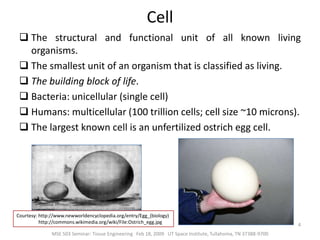
The largest known cell is an unfertilized ostrich egg cell. Courtesy: http://www.newworldencyclopedia.org/entry/Egg_(biology)                  http://commons.wikimedia.org/wiki/File:Ostrich_egg.jpg4MSE 503 Seminar: Tissue Engineering   Feb 18, 2009   UT Space Institute, Tullahoma, TN 37388-9700
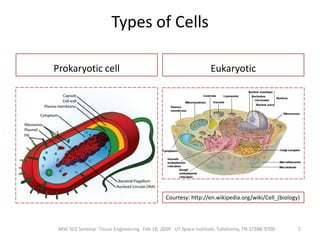
Types of CellsProkaryotic cellEukaryoticCourtesy: http://en.wikipedia.org/wiki/Cell_(biology)5MSE 503 Seminar: Tissue Engineering   Feb 18, 2009   UT Space Institute, Tullahoma, TN 37388-9700
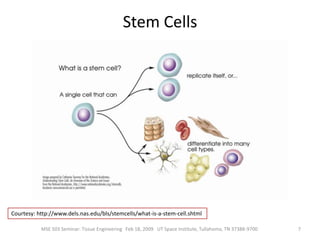
Stem CellsStem cells are the master cells of the human body.They can divide to produce copies of themselves and many other types of cells.Stem cells taken from embryos that are just a few days old, can turn into any of the 300 different types of cell that make up the adult body.6MSE 503 Seminar: Tissue Engineering   Feb 18, 2009   UT Space Institute, Tullahoma, TN 37388-9700
Stem CellsCourtesy: http://www.dels.nas.edu/bls/stemcells/what-is-a-stem-cell.shtml7MSE 503 Seminar: Tissue Engineering   Feb 18, 2009   UT Space Institute, Tullahoma, TN 37388-9700
Types of Stem Cells8MSE 503 Seminar: Tissue Engineering   Feb 18, 2009   UT Space Institute, Tullahoma, TN 37388-9700
BlastocystCourtesy: http://en.wikipedia.org/wiki/File:Blastocyst_English.svg9MSE 503 Seminar: Tissue Engineering   Feb 18, 2009   UT Space Institute, Tullahoma, TN 37388-9700
Sources of Stem CellsEmbryonic stem cells - are harvested from the inner cell mass of the blastocyst seven to ten days after fertilization.Fetal stem cells - are taken from the germline tissues that will make up the gonads of aborted fetuses.Umbilical cord stem cells - Umbilical cord blood contains stem cells similar to those found in bone marrow.Placenta derived stem cells - up to ten times as many stem cells can be harvested from a placenta as from cord blood. Adult stem cells - Many adult tissues contain stem cells that can be isolated. 10MSE 503 Seminar: Tissue Engineering   Feb 18, 2009   UT Space Institute, Tullahoma, TN 37388-9700
TissuesTissue is a cellular organizational level intermediate between cells and a complete organism. Hence, a tissue is an ensemble of cells, not necessarily identical, but from the same origin, that together carry out a specific function. Organs are then formed by the functional grouping together of multiple tissues.The study of tissue is known as histology or, in connection with disease, histopathology.The classical tools for studying tissues are the paraffin block in which tissue is embedded and then sectioned, the histological stain, and the optical microscope11MSE 503 Seminar: Tissue Engineering   Feb 18, 2009   UT Space Institute, Tullahoma, TN 37388-9700
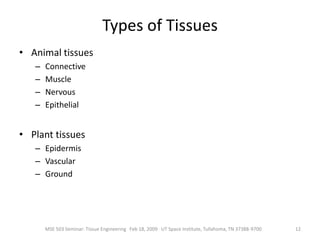
Types of TissuesAnimal tissuesConnectiveMuscleNervousEpithelialPlant tissuesEpidermisVascularGround12MSE 503 Seminar: Tissue Engineering   Feb 18, 2009   UT Space Institute, Tullahoma, TN 37388-9700
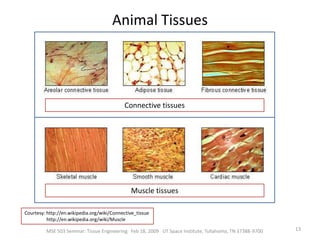
Animal TissuesConnective tissuesMuscle tissuesCourtesy: http://en.wikipedia.org/wiki/Connective_tissue                  http://en.wikipedia.org/wiki/Muscle13MSE 503 Seminar: Tissue Engineering   Feb 18, 2009   UT Space Institute, Tullahoma, TN 37388-9700
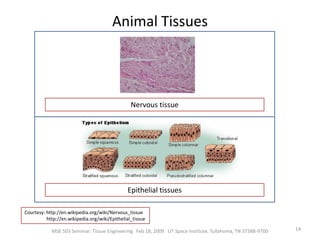
Animal TissuesNervous tissueEpithelial tissuesCourtesy: http://en.wikipedia.org/wiki/Nervous_tissue                  http://en.wikipedia.org/wiki/Epithelial_tissue14MSE 503 Seminar: Tissue Engineering   Feb 18, 2009   UT Space Institute, Tullahoma, TN 37388-9700
ExamplesBioartificial liver deviceArtificial pancreasArtificial bladdersCartilageArtificial skinArtificial bone marrowHeart (Doris Taylor)15MSE 503 Seminar: Tissue Engineering   Feb 18, 2009   UT Space Institute, Tullahoma, TN 37388-9700
Bioartificial Liver Device (BAL)An artificial extracorporeal supportive device.It serves as a temperory supportive device.It is essentially a bioreactor with embedded hepatocytes.It processes oxygenated blood plasma, which is separated from the other blood constituents.There are many different types of BALs (including hollow fiber systems and flat membrane sheet systems).16MSE 503 Seminar: Tissue Engineering   Feb 18, 2009   UT Space Institute, Tullahoma, TN 37388-9700
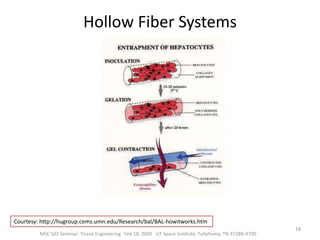
Hollow Fiber SystemsIt employs a hollow fiber cartridge.Hepatocytes are suspended in a gel solution, such as collagen, which is injected into a series of hollow fibers. In the case of collagen, the suspension is then gelled within the fibers, usually by a temperature change. The hepatocytes then contract the gel by their attachment to the collagen matrix, reducing the volume of the suspension and creating a flow space within the fibers. Nutrient media is circulated through the fibers to sustain the cells. During use, a patient's blood is fed into the space surrounding the fibers. The fibers, which are composed of a semi-permeable membrane, facilitate transfer of toxins, nutrients and other chemicals between the blood and the suspended cells.17MSE 503 Seminar: Tissue Engineering   Feb 18, 2009   UT Space Institute, Tullahoma, TN 37388-9700
Hollow Fiber SystemsCourtesy: http://hugroup.cems.umn.edu/Research/bal/BAL-howitworks.htm18MSE 503 Seminar: Tissue Engineering   Feb 18, 2009   UT Space Institute, Tullahoma, TN 37388-9700
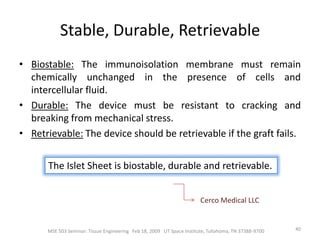
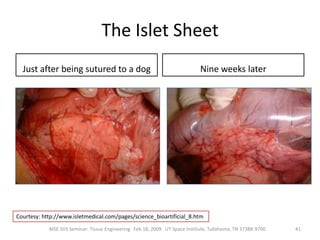
Bioartificial PancreasIt controls the blood glucose level by providing the substitute endocrine functionality of a healthy pancreas.It is fabricated from living and nonliving components. The living component is islets of Langerhans, which sense glucose levels and secrete insulin. The nonliving component protects the islets from the diabetic's body yet permits the islets inside to thrive.The lack of insulin production is the motivation to develop a substitute. 19MSE 503 Seminar: Tissue Engineering   Feb 18, 2009   UT Space Institute, Tullahoma, TN 37388-9700
Bioartificial PancreasTwo goals:To improve insulin replacement therapy until glycemic control is practically normal as evident by the avoidance of the complications of hyperglycemia.
To ease the burden of therapy for the insulin-dependent.Three major approaches:The medical equipment approach
The bioengineering approach
The gene therapy approach20MSE 503 Seminar: Tissue Engineering   Feb 18, 2009   UT Space Institute, Tullahoma, TN 37388-9700
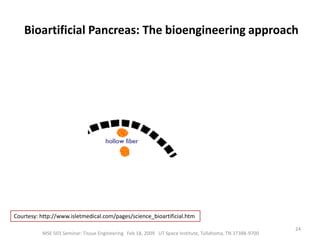
Bioartificial Pancreas: The bioengineering approachA biological approach to the artificial pancreas is to implant bioengineered tissue containing islet cells.
They secrete the amount on insulin, amylin, and glucagon needed in response to sensed glucose.
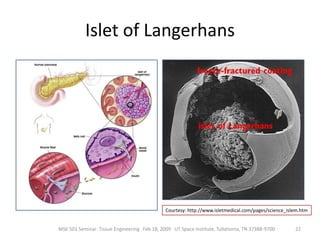
Islets of Langerhans is the area in which the endocrine (i.e., hormone-producing) cells of the pancreas are grouped.
After German pathological anatomist Paul Langerhans in 1869.21MSE 503 Seminar: Tissue Engineering   Feb 18, 2009   UT Space Institute, Tullahoma, TN 37388-9700
Islet of LangerhansCourtesy: http://www.isletmedical.com/pages/science_islem.htm22MSE 503 Seminar: Tissue Engineering   Feb 18, 2009   UT Space Institute, Tullahoma, TN 37388-9700
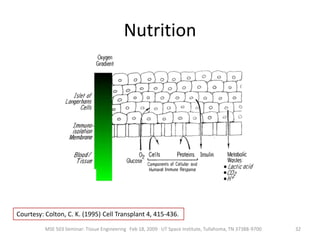
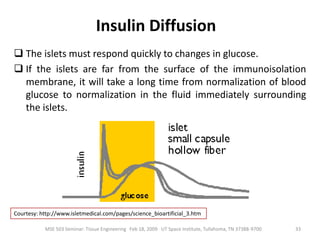
Bioartificial Pancreas: The bioengineering approachA bioartificial endocrine pancreas replaces nonfunctioning islets of Langerhans.
It responds to changing blood composition with release of hormones including insulin.
A bio-artificial pancreas is implanted into the peritoneal cavity of the diabetic and contains two to three million cells.

Tissue Engineering

  • 1.
    Tissue EngineeringMSE503 Seminar02/18/2009DeepakRajputGraduate Research AssistantUniversity of Tennessee Space InstituteTullahoma, Tennessee 37388-9700Email: drajput@utsi.edu Web: http://drajput.com
  • 2.
    Outline Definition oftissue engineering
  • 3.
  • 4.
  • 5.
  • 6.
  • 7.
    Bioartificial Pancreas2MSE 503Seminar: Tissue Engineering Feb 18, 2009 UT Space Institute, Tullahoma, TN 37388-9700
  • 8.
    DefinitionThe term “regenerativemedicine” is often used synonymously with tissue engineering, although those involved in regenerative medicine place more emphasis on the use of stem cells to produce tissues.
  • 9.
    The use ofa combination of cells, engineering and materials methods, and suitable biochemical and physico-chemical factors to improve or replace biological functions.
  • 10.
    An interdisciplinary fieldthat applies the principles of engineering and life sciences toward the development of biological substitutes that restore, maintain, or improve tissue function or a whole organ – Langer and Vacanti3MSE 503 Seminar: Tissue Engineering Feb 18, 2009 UT Space Institute, Tullahoma, TN 37388-9700
  • 11.
    CellThe structural andfunctional unit of all known living organisms.
  • 12.
    The smallest unitof an organism that is classified as living.
  • 13.
  • 14.
  • 15.
    Humans: multicellular (100trillion cells; cell size ~10 microns).
  • 16.
    The largest knowncell is an unfertilized ostrich egg cell. Courtesy: http://www.newworldencyclopedia.org/entry/Egg_(biology) http://commons.wikimedia.org/wiki/File:Ostrich_egg.jpg4MSE 503 Seminar: Tissue Engineering Feb 18, 2009 UT Space Institute, Tullahoma, TN 37388-9700
  • 17.
    Types of CellsProkaryoticcellEukaryoticCourtesy: http://en.wikipedia.org/wiki/Cell_(biology)5MSE 503 Seminar: Tissue Engineering Feb 18, 2009 UT Space Institute, Tullahoma, TN 37388-9700
  • 18.
    Stem CellsStem cellsare the master cells of the human body.They can divide to produce copies of themselves and many other types of cells.Stem cells taken from embryos that are just a few days old, can turn into any of the 300 different types of cell that make up the adult body.6MSE 503 Seminar: Tissue Engineering Feb 18, 2009 UT Space Institute, Tullahoma, TN 37388-9700
  • 19.
    Stem CellsCourtesy: http://www.dels.nas.edu/bls/stemcells/what-is-a-stem-cell.shtml7MSE503 Seminar: Tissue Engineering Feb 18, 2009 UT Space Institute, Tullahoma, TN 37388-9700
  • 20.
    Types of StemCells8MSE 503 Seminar: Tissue Engineering Feb 18, 2009 UT Space Institute, Tullahoma, TN 37388-9700
  • 21.
    BlastocystCourtesy: http://en.wikipedia.org/wiki/File:Blastocyst_English.svg9MSE 503Seminar: Tissue Engineering Feb 18, 2009 UT Space Institute, Tullahoma, TN 37388-9700
  • 22.
    Sources of StemCellsEmbryonic stem cells - are harvested from the inner cell mass of the blastocyst seven to ten days after fertilization.Fetal stem cells - are taken from the germline tissues that will make up the gonads of aborted fetuses.Umbilical cord stem cells - Umbilical cord blood contains stem cells similar to those found in bone marrow.Placenta derived stem cells - up to ten times as many stem cells can be harvested from a placenta as from cord blood. Adult stem cells - Many adult tissues contain stem cells that can be isolated. 10MSE 503 Seminar: Tissue Engineering Feb 18, 2009 UT Space Institute, Tullahoma, TN 37388-9700
  • 23.
    TissuesTissue is acellular organizational level intermediate between cells and a complete organism. Hence, a tissue is an ensemble of cells, not necessarily identical, but from the same origin, that together carry out a specific function. Organs are then formed by the functional grouping together of multiple tissues.The study of tissue is known as histology or, in connection with disease, histopathology.The classical tools for studying tissues are the paraffin block in which tissue is embedded and then sectioned, the histological stain, and the optical microscope11MSE 503 Seminar: Tissue Engineering Feb 18, 2009 UT Space Institute, Tullahoma, TN 37388-9700
  • 24.
    Types of TissuesAnimaltissuesConnectiveMuscleNervousEpithelialPlant tissuesEpidermisVascularGround12MSE 503 Seminar: Tissue Engineering Feb 18, 2009 UT Space Institute, Tullahoma, TN 37388-9700
  • 25.
    Animal TissuesConnective tissuesMuscletissuesCourtesy: http://en.wikipedia.org/wiki/Connective_tissue http://en.wikipedia.org/wiki/Muscle13MSE 503 Seminar: Tissue Engineering Feb 18, 2009 UT Space Institute, Tullahoma, TN 37388-9700
  • 26.
    Animal TissuesNervous tissueEpithelialtissuesCourtesy: http://en.wikipedia.org/wiki/Nervous_tissue http://en.wikipedia.org/wiki/Epithelial_tissue14MSE 503 Seminar: Tissue Engineering Feb 18, 2009 UT Space Institute, Tullahoma, TN 37388-9700
  • 27.
    ExamplesBioartificial liver deviceArtificialpancreasArtificial bladdersCartilageArtificial skinArtificial bone marrowHeart (Doris Taylor)15MSE 503 Seminar: Tissue Engineering Feb 18, 2009 UT Space Institute, Tullahoma, TN 37388-9700
  • 28.
    Bioartificial Liver Device(BAL)An artificial extracorporeal supportive device.It serves as a temperory supportive device.It is essentially a bioreactor with embedded hepatocytes.It processes oxygenated blood plasma, which is separated from the other blood constituents.There are many different types of BALs (including hollow fiber systems and flat membrane sheet systems).16MSE 503 Seminar: Tissue Engineering Feb 18, 2009 UT Space Institute, Tullahoma, TN 37388-9700
  • 29.
    Hollow Fiber SystemsItemploys a hollow fiber cartridge.Hepatocytes are suspended in a gel solution, such as collagen, which is injected into a series of hollow fibers. In the case of collagen, the suspension is then gelled within the fibers, usually by a temperature change. The hepatocytes then contract the gel by their attachment to the collagen matrix, reducing the volume of the suspension and creating a flow space within the fibers. Nutrient media is circulated through the fibers to sustain the cells. During use, a patient's blood is fed into the space surrounding the fibers. The fibers, which are composed of a semi-permeable membrane, facilitate transfer of toxins, nutrients and other chemicals between the blood and the suspended cells.17MSE 503 Seminar: Tissue Engineering Feb 18, 2009 UT Space Institute, Tullahoma, TN 37388-9700
  • 30.
    Hollow Fiber SystemsCourtesy:http://hugroup.cems.umn.edu/Research/bal/BAL-howitworks.htm18MSE 503 Seminar: Tissue Engineering Feb 18, 2009 UT Space Institute, Tullahoma, TN 37388-9700
  • 31.
    Bioartificial PancreasIt controlsthe blood glucose level by providing the substitute endocrine functionality of a healthy pancreas.It is fabricated from living and nonliving components. The living component is islets of Langerhans, which sense glucose levels and secrete insulin. The nonliving component protects the islets from the diabetic's body yet permits the islets inside to thrive.The lack of insulin production is the motivation to develop a substitute. 19MSE 503 Seminar: Tissue Engineering Feb 18, 2009 UT Space Institute, Tullahoma, TN 37388-9700
  • 32.
    Bioartificial PancreasTwo goals:Toimprove insulin replacement therapy until glycemic control is practically normal as evident by the avoidance of the complications of hyperglycemia.
  • 33.
    To ease theburden of therapy for the insulin-dependent.Three major approaches:The medical equipment approach
  • 34.
  • 35.
    The gene therapyapproach20MSE 503 Seminar: Tissue Engineering Feb 18, 2009 UT Space Institute, Tullahoma, TN 37388-9700
  • 36.
    Bioartificial Pancreas: Thebioengineering approachA biological approach to the artificial pancreas is to implant bioengineered tissue containing islet cells.
  • 37.
    They secrete theamount on insulin, amylin, and glucagon needed in response to sensed glucose.
  • 38.
    Islets of Langerhansis the area in which the endocrine (i.e., hormone-producing) cells of the pancreas are grouped.
  • 39.
    After German pathologicalanatomist Paul Langerhans in 1869.21MSE 503 Seminar: Tissue Engineering Feb 18, 2009 UT Space Institute, Tullahoma, TN 37388-9700
  • 40.
    Islet of LangerhansCourtesy:http://www.isletmedical.com/pages/science_islem.htm22MSE 503 Seminar: Tissue Engineering Feb 18, 2009 UT Space Institute, Tullahoma, TN 37388-9700
  • 41.
    Bioartificial Pancreas: Thebioengineering approachA bioartificial endocrine pancreas replaces nonfunctioning islets of Langerhans.
  • 42.
    It responds tochanging blood composition with release of hormones including insulin.
  • 43.
    A bio-artificial pancreasis implanted into the peritoneal cavity of the diabetic and contains two to three million cells.