Synthesis of diamond-like carbon films with super-low friction and wear properties A. Erdemir, O.L. Eryilmaz, and G. Fenske J. Vac. Sci. Technol. A 18(4), Jul/Aug 2000 1987-1992 MSE676 All Things Carbon | Fall 2009 Deepak Rajput Center for Laser Applications University of Tennessee Space Institute Tullahoma, Tennessee 37388-9700, USA Email:  [email_address]  | Web:  http://drajput.com
Introduction Unique mechanical, chemical, optical, and electrical properties. Quite hard, strong, and stiff.  Most DLC films are electronically insulating and can be made optically transparent to visible and ultraviolet light. DLC films are chemically inert and impervious to acidic and saline media.  They are amorphous and made of sp 2 - and sp 3 - bonded carbon atoms.
Introduction DLC films may also have large amounts of hydrogen in their amorphous structures.  Hydrogen-free DLC films can also be deposited. Doping DLC films to achieve better electrical and mechanical properties is also possible.  DLC films deposition range: subzero to 400 o C. Processes: plasma or ion beam- PVD and CVD.  Carbon source: hydrocarbon gas like CH 4 , C 2 H 2 .
Tribology The mechanical and tribological properties depend on microstructures, chemistry, hydrogen content, sp 2 /sp 3  bonded carbon. Test conditions strongly influence the friction and wear performance. Friction coefficients of the DLC films: 0.01 to >0.5  Relative humidity has the greatest effect on the friction of DLC films.  Low humidity: 0.01; high humidity: 0.1 – 0.3
Tribology Hydrogen-free DLC films: best in humid air Hydrogenated DLC films: best in dry or inert conditions.  At high temperatures, most undoped DLC films undergo permanent chemical and microstructural changes that degrade their friction and wear behavior (e.g., graphitization).  A new DLC film with coefficient of friction 0.001 – 0.003 in inert-gas environments.
Experimental Process: Plasma Enhanced Chemical Vapor Deposition (PE-CVD) at room temperature.  Coated with 50-70 nm silicon bond layer prior to deposition on AISI M50 balls, H13 steel disks, and sapphire balls and disks. Source gas:  Pure methane Mixture of methane and increasing hydrogen Film thickness: 1  μ m
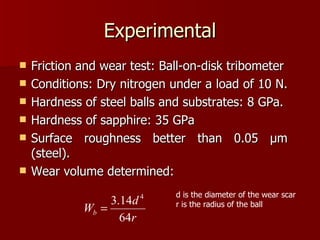
Experimental Friction and wear test: Ball-on-disk tribometer Conditions: Dry nitrogen under a load of 10 N.  Hardness of steel balls and substrates: 8 GPa.  Hardness of sapphire: 35 GPa Surface roughness better than 0.05  μ m (steel). Wear volume determined: d is the diameter of the wear scar r is the radius of the ball
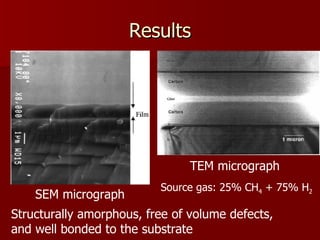
Results Source gas: 25% CH 4  + 75% H 2 SEM micrograph TEM micrograph Structurally amorphous, free of volume defects, and well bonded to the substrate
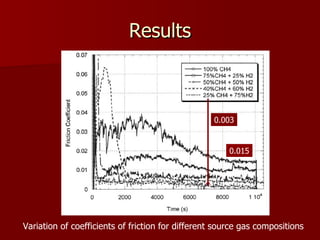
Results Variation of coefficients of friction for different source gas compositions 0.015 0.003
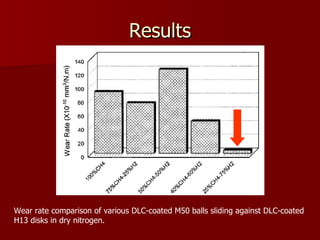
Results Wear rate comparison of various DLC-coated M50 balls sliding against DLC-coated H13 disks in dry nitrogen.
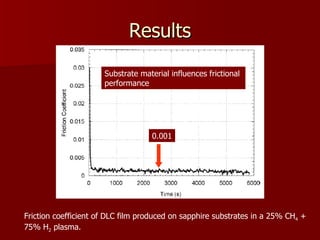
Results Friction coefficient of DLC film produced on sapphire substrates in a 25% CH 4  + 75% H 2  plasma. 0.001 Substrate material influences frictional  performance
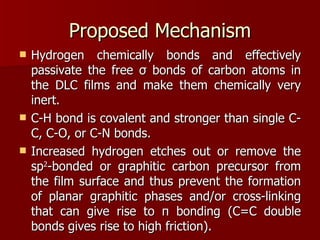
Proposed Mechanism Hydrogen chemically bonds and effectively passivate the free  σ   bonds of carbon atoms in the DLC films and make them chemically very inert. C-H bond is covalent and stronger than single C-C, C-O, or C-N bonds. Increased hydrogen etches out or remove the sp 2 -bonded or graphitic carbon precursor from the film surface and thus prevent the formation of planar graphitic phases and/or cross-linking that can give rise to  π   bonding (C=C double bonds gives rise to high friction).
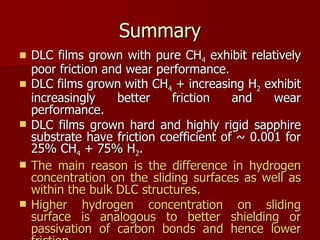
Summary DLC films grown with pure CH 4  exhibit relatively poor friction and wear performance. DLC films grown with CH 4  + increasing H 2  exhibit increasingly better friction and wear performance. DLC films grown hard and highly rigid sapphire substrate have friction coefficient of ~ 0.001 for 25% CH 4  + 75% H 2 .  The main reason is the difference in hydrogen concentration on the sliding surfaces as well as within the bulk DLC structures. Higher hydrogen concentration on sliding surface is analogous to better shielding or passivation of carbon bonds and hence lower friction.
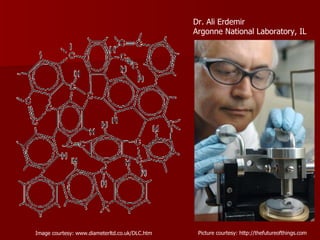
Picture courtesy: http://thefutureofthings.com Image courtesy: www.diameterltd.co.uk/DLC.htm  Dr. Ali Erdemir Argonne National Laboratory, IL

Super low friction DLC films

  • 1.
    Synthesis of diamond-likecarbon films with super-low friction and wear properties A. Erdemir, O.L. Eryilmaz, and G. Fenske J. Vac. Sci. Technol. A 18(4), Jul/Aug 2000 1987-1992 MSE676 All Things Carbon | Fall 2009 Deepak Rajput Center for Laser Applications University of Tennessee Space Institute Tullahoma, Tennessee 37388-9700, USA Email: [email_address] | Web: http://drajput.com
  • 2.
    Introduction Unique mechanical,chemical, optical, and electrical properties. Quite hard, strong, and stiff. Most DLC films are electronically insulating and can be made optically transparent to visible and ultraviolet light. DLC films are chemically inert and impervious to acidic and saline media. They are amorphous and made of sp 2 - and sp 3 - bonded carbon atoms.
  • 3.
    Introduction DLC filmsmay also have large amounts of hydrogen in their amorphous structures. Hydrogen-free DLC films can also be deposited. Doping DLC films to achieve better electrical and mechanical properties is also possible. DLC films deposition range: subzero to 400 o C. Processes: plasma or ion beam- PVD and CVD. Carbon source: hydrocarbon gas like CH 4 , C 2 H 2 .
  • 4.
    Tribology The mechanicaland tribological properties depend on microstructures, chemistry, hydrogen content, sp 2 /sp 3 bonded carbon. Test conditions strongly influence the friction and wear performance. Friction coefficients of the DLC films: 0.01 to >0.5 Relative humidity has the greatest effect on the friction of DLC films. Low humidity: 0.01; high humidity: 0.1 – 0.3
  • 5.
    Tribology Hydrogen-free DLCfilms: best in humid air Hydrogenated DLC films: best in dry or inert conditions. At high temperatures, most undoped DLC films undergo permanent chemical and microstructural changes that degrade their friction and wear behavior (e.g., graphitization). A new DLC film with coefficient of friction 0.001 – 0.003 in inert-gas environments.
  • 6.
    Experimental Process: PlasmaEnhanced Chemical Vapor Deposition (PE-CVD) at room temperature. Coated with 50-70 nm silicon bond layer prior to deposition on AISI M50 balls, H13 steel disks, and sapphire balls and disks. Source gas: Pure methane Mixture of methane and increasing hydrogen Film thickness: 1 μ m
  • 7.
    Experimental Friction andwear test: Ball-on-disk tribometer Conditions: Dry nitrogen under a load of 10 N. Hardness of steel balls and substrates: 8 GPa. Hardness of sapphire: 35 GPa Surface roughness better than 0.05 μ m (steel). Wear volume determined: d is the diameter of the wear scar r is the radius of the ball
  • 8.
    Results Source gas:25% CH 4 + 75% H 2 SEM micrograph TEM micrograph Structurally amorphous, free of volume defects, and well bonded to the substrate
  • 9.
    Results Variation ofcoefficients of friction for different source gas compositions 0.015 0.003
  • 10.
    Results Wear ratecomparison of various DLC-coated M50 balls sliding against DLC-coated H13 disks in dry nitrogen.
  • 11.
    Results Friction coefficientof DLC film produced on sapphire substrates in a 25% CH 4 + 75% H 2 plasma. 0.001 Substrate material influences frictional performance
  • 12.
    Proposed Mechanism Hydrogenchemically bonds and effectively passivate the free σ bonds of carbon atoms in the DLC films and make them chemically very inert. C-H bond is covalent and stronger than single C-C, C-O, or C-N bonds. Increased hydrogen etches out or remove the sp 2 -bonded or graphitic carbon precursor from the film surface and thus prevent the formation of planar graphitic phases and/or cross-linking that can give rise to π bonding (C=C double bonds gives rise to high friction).
  • 13.
    Summary DLC filmsgrown with pure CH 4 exhibit relatively poor friction and wear performance. DLC films grown with CH 4 + increasing H 2 exhibit increasingly better friction and wear performance. DLC films grown hard and highly rigid sapphire substrate have friction coefficient of ~ 0.001 for 25% CH 4 + 75% H 2 . The main reason is the difference in hydrogen concentration on the sliding surfaces as well as within the bulk DLC structures. Higher hydrogen concentration on sliding surface is analogous to better shielding or passivation of carbon bonds and hence lower friction.
  • 14.
    Picture courtesy: http://thefutureofthings.comImage courtesy: www.diameterltd.co.uk/DLC.htm Dr. Ali Erdemir Argonne National Laboratory, IL