Laser Processing on Graphite   MSE 503 Seminar - Fall 2009  08-27-2009 CLA Conference Room, UT Space Institute, Tullahoma, TN - 37388, USA Deepak Rajput Graduate Research Assistant Center for Laser Applications University of Tennessee Space Institute Tullahoma, Tennessee 37388-9700 Email:  [email_address]   Web:  http:// drajput.com
Outline Introduction to Graphite Problems and Possible Solutions Laser Processing Results & Discussion Summary Future work
Carbon (Atomic number: 6 / 1s 2 2s 2 2p 2 ) Carbon: Introduction Graphite (sp 2 ) Diamond (sp 3 ) Fullerenes (molecular form / cage-like structure)
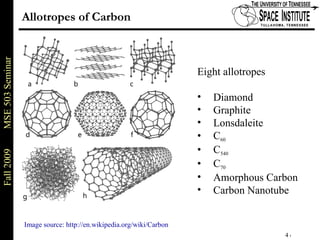
Allotropes of Carbon Eight allotropes Diamond Graphite Lonsdaleite C 60 C 540 C 70 Amorphous Carbon Carbon Nanotube Image source: http://en.wikipedia.org/wiki/Carbon
Graphite: Introduction Low specific gravity High resistance to thermal shock High thermal conductivity Low modulus of elasticity High strength (doubles at 2500 o C * ) “High temperature structural material” * Malmstrom C., et al (1951) Journal of Applied Physics 22(5) 593-600
Graphite: Introduction Low resistance to oxidation at high temperatures Erosion by particle and gas streams Solution: Well-adhered surface protective coatings !! Adherence:    (1) the ability of the coating elements to  wet  the surface of the carbon material (wettability). (2) the  difference  in the values of coefficient of thermal  expansion  of the coating and that of the carbon material.
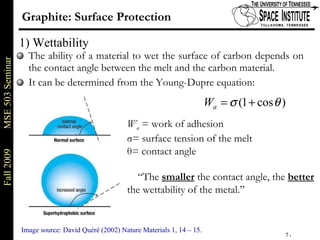
Graphite: Surface Protection The ability of a material to wet the surface of carbon depends on the contact angle between the melt and the carbon material.  It can be determined from the Young-Dupre equation: W a  = work of adhesion σ = surface tension of the melt θ = contact angle “ The  smaller  the contact angle, the  better the wettability of the metal.” 1) Wettability Image source: David Quéré (2002) Nature Materials 1, 14 – 15.
Graphite: Surface Protection When the melt solidifies on the carbon substrate, significant internal stresses develop at the coating-substrate interface. If the interfacial stress are large enough, the interface fails and the coating delaminates. The reason for this failure is the weak cohesive strength of the coating surface. The cohesive strength of the coating depends on the difference in the values of coefficient of thermal expansion of the coating and that of the substrate. The larger the difference, the weaker the cohesive strength of the coating. 2) Thermal Expansion
Graphite: Surface Protection The ideal coating material for a carbon material: One that can wet the carbon material and Whose coefficient of thermal expansion is close to that of the carbon substrate. The coefficient of thermal expansion of a carbon material depends on the its method of preparation. Transition metals wet the carbon materials efficiently. UTSI: Semiconductor grade graphite (7.9 x 10 -6  m/m  o C)
Graphite: Surface Protection Transition metals have partly-filled d orbitals. They can combine strongly with carbon. They form strong covalent bonds with carbon. Transition metals and their carbides, nitrides, oxides, and borides have been deposited on carbon materials. Non-transition metal coatings like silicon carbide, silicon oxy-carbide, boron nitride, lanthanum hexaboride, glazing coatings, and alumina have also been deposited.  Methods used: chemical vapor deposition, physical vapor deposition, photochemical vapor deposition, thermal spraying, PIRAC, and metal infiltration.
Graphite: Laser Processing CLA (UTSI): the first to demonstrate laser deposition on graphite.  Early attempts were to make bulk coatings to avoid dilution in the coating due to melting of the substrate. Graphite does not melt, but sublimates at room pressure.  Laser fusion coatings on carbon-carbon composites. Problems with cracking. CLA process: LISI TM  !! LISI TM  is a registered trademark of the University of Tennessee Research Corporation. LISI: Laser Induced Surface Improvement
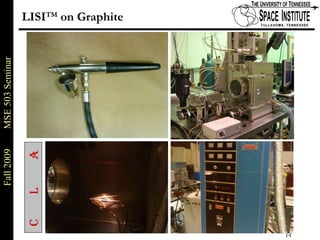
LISI TM  on Graphite Prepare a precursor mixture by mixing metal particles and a binder.  Spray the precursor mixture with an air spray gun on polished graphite substrates (6 mm thick).  Dry for a couple of hours under a heat lamp before laser processing. Carbide forming ability among transition metals: Fe<Mn<Cr<Mo<W<V< Nb <Ta< Ti < Zr <Hf  Titanium (<44  μ m), zirconium (2-5  μ m), niobium (<10  μ m), titanium-40 wt% aluminum (-325 mesh), tantalum, W-TiC, chromium, vanadium, silicon, iron, etc.  Precursor thickness: Ti (75  μ m), Zr (150  μ m), Nb (125  μ m).  Contains binder and moisture in pores.
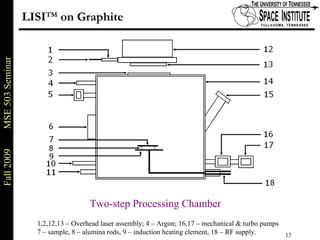
LISI TM  on Graphite 1,2,12,13 – Overhead laser assembly; 4 – Argon; 16,17 – mechanical & turbo pumps  7 – sample, 8 – alumina rods, 9 – induction heating element, 18 – RF supply.  Two-step Processing Chamber
LISI TM  on Graphite C  L  A
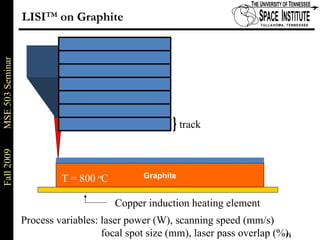
LISI TM  on Graphite Process variables: laser power (W), scanning speed (mm/s) focal spot size (mm), laser pass overlap (%),  T = 800  o C Copper induction heating element Graphite track
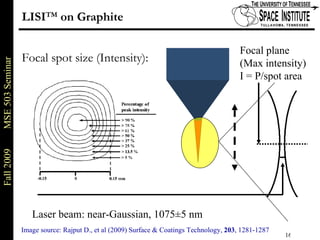
Focal spot size (Intensity):  LISI TM  on Graphite Focal plane (Max intensity) I = P/spot area Laser beam: near-Gaussian, 1075 ±5 nm Image source: Rajput D., et al (2009) Surface & Coatings Technology,  203 , 1281-1287
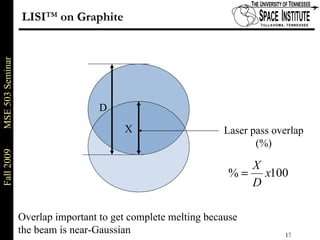
LISI TM  on Graphite Laser pass overlap (%) X D Overlap important to get complete melting because  the beam is near-Gaussian
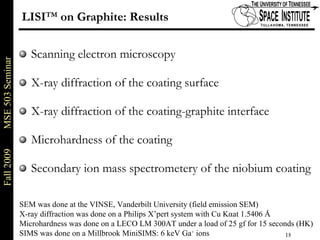
LISI TM  on Graphite: Results Scanning electron microscopy X-ray diffraction of the coating surface X-ray diffraction of the coating-graphite interface Microhardness of the coating Secondary ion mass spectrometery of the niobium coating SEM was done at the VINSE, Vanderbilt University (field emission SEM) X-ray diffraction was done on a Philips X’pert system with Cu K α at 1.5406  Å Microhardness was done on a LECO LM 300AT under a load of 25 gf for 15 seconds (HK) SIMS was done on a Millbrook MiniSIMS: 6 keV Ga +  ions
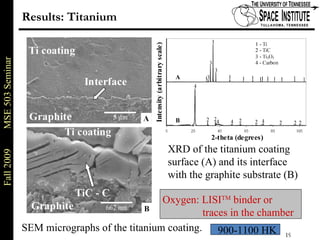
Results: Titanium  SEM micrographs of the titanium coating. XRD of the titanium coating  surface (A) and its interface with the graphite substrate (B)  Oxygen: LISI TM  binder or traces in the chamber 900-1100 HK
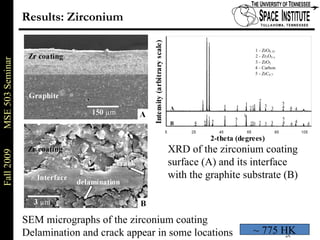
Results: Zirconium SEM micrographs of the zirconium coating Delamination and crack appear in some locations XRD of the zirconium coating  surface (A) and its interface with the graphite substrate (B)  ~ 775 HK
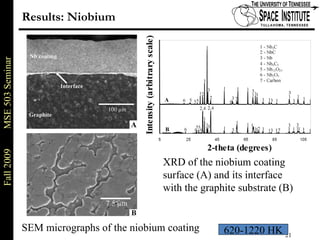
Results: Niobium SEM micrographs of the niobium coating XRD of the niobium coating  surface (A) and its interface with the graphite substrate (B)  620-1220 HK
Proposed Mechanism Self-propagating high temperature synthesis (SHS) aided by laser heating. It is also called as combustion synthesis. Once ignited by the laser heating, the highly exothermic reaction advances as a reaction front that propagates through the powder mixture. This mechanism strongly depends on the starting particle size. In the present study, the average particle size is <25  μ m.  The coefficient of thermal expansion of titanium carbide is close to that of the graphite substrate than those of zirconium carbide and niobium carbide. Hence, titanium coating did not delaminate.
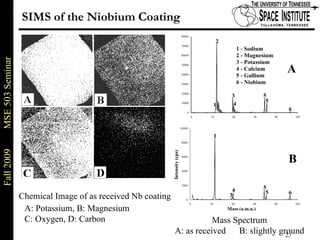
SIMS of the Niobium Coating A: Potassium, B: Magnesium C: Oxygen, D: Carbon Mass Spectrum A: as received  B: slightly ground Chemical Image of as received Nb coating
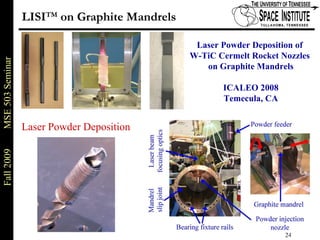
LISI TM  on Graphite Mandrels Laser Powder Deposition Laser Powder Deposition of  W-TiC Cermelt Rocket Nozzles  on  Graphite Mandrels ICALEO 2008 Temecula, CA
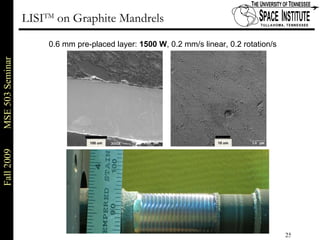
0.6 mm pre-placed layer:  1500 W , 0.2 mm/s linear, 0.2 rotation/s 100 um 10 um LISI TM  on Graphite Mandrels
Summary Successfully deposited  fully dense  and  crack-free  transition metal coatings on graphite substrates. All the coating interfaces contain  carbide  phases. Laser assisted self-propagating high temperature synthesis (SHS) has been proposed to be the possible reason for the formation of all the coatings. SIMS analysis proved that LISI TM  binder forms a thin slag layer at the top of the coating surface post laser processing.
Future Work Heat treatment Advanced characterization (oxidation analysis) Calculation of various thermodynamic quantities Publish the results in a good journal
Questions ?? (or may be suggestions)
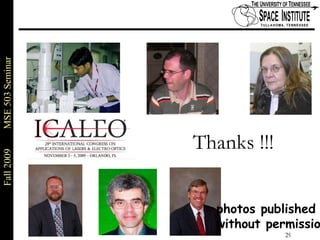
Thanks !!! photos published without permission

Laser Processing on Graphite

  • 1.
    Laser Processing onGraphite   MSE 503 Seminar - Fall 2009 08-27-2009 CLA Conference Room, UT Space Institute, Tullahoma, TN - 37388, USA Deepak Rajput Graduate Research Assistant Center for Laser Applications University of Tennessee Space Institute Tullahoma, Tennessee 37388-9700 Email: [email_address] Web: http:// drajput.com
  • 2.
    Outline Introduction toGraphite Problems and Possible Solutions Laser Processing Results & Discussion Summary Future work
  • 3.
    Carbon (Atomic number:6 / 1s 2 2s 2 2p 2 ) Carbon: Introduction Graphite (sp 2 ) Diamond (sp 3 ) Fullerenes (molecular form / cage-like structure)
  • 4.
    Allotropes of CarbonEight allotropes Diamond Graphite Lonsdaleite C 60 C 540 C 70 Amorphous Carbon Carbon Nanotube Image source: http://en.wikipedia.org/wiki/Carbon
  • 5.
    Graphite: Introduction Lowspecific gravity High resistance to thermal shock High thermal conductivity Low modulus of elasticity High strength (doubles at 2500 o C * ) “High temperature structural material” * Malmstrom C., et al (1951) Journal of Applied Physics 22(5) 593-600
  • 6.
    Graphite: Introduction Lowresistance to oxidation at high temperatures Erosion by particle and gas streams Solution: Well-adhered surface protective coatings !! Adherence: (1) the ability of the coating elements to wet the surface of the carbon material (wettability). (2) the difference in the values of coefficient of thermal expansion of the coating and that of the carbon material.
  • 7.
    Graphite: Surface ProtectionThe ability of a material to wet the surface of carbon depends on the contact angle between the melt and the carbon material. It can be determined from the Young-Dupre equation: W a = work of adhesion σ = surface tension of the melt θ = contact angle “ The smaller the contact angle, the better the wettability of the metal.” 1) Wettability Image source: David Quéré (2002) Nature Materials 1, 14 – 15.
  • 8.
    Graphite: Surface ProtectionWhen the melt solidifies on the carbon substrate, significant internal stresses develop at the coating-substrate interface. If the interfacial stress are large enough, the interface fails and the coating delaminates. The reason for this failure is the weak cohesive strength of the coating surface. The cohesive strength of the coating depends on the difference in the values of coefficient of thermal expansion of the coating and that of the substrate. The larger the difference, the weaker the cohesive strength of the coating. 2) Thermal Expansion
  • 9.
    Graphite: Surface ProtectionThe ideal coating material for a carbon material: One that can wet the carbon material and Whose coefficient of thermal expansion is close to that of the carbon substrate. The coefficient of thermal expansion of a carbon material depends on the its method of preparation. Transition metals wet the carbon materials efficiently. UTSI: Semiconductor grade graphite (7.9 x 10 -6 m/m o C)
  • 10.
    Graphite: Surface ProtectionTransition metals have partly-filled d orbitals. They can combine strongly with carbon. They form strong covalent bonds with carbon. Transition metals and their carbides, nitrides, oxides, and borides have been deposited on carbon materials. Non-transition metal coatings like silicon carbide, silicon oxy-carbide, boron nitride, lanthanum hexaboride, glazing coatings, and alumina have also been deposited. Methods used: chemical vapor deposition, physical vapor deposition, photochemical vapor deposition, thermal spraying, PIRAC, and metal infiltration.
  • 11.
    Graphite: Laser ProcessingCLA (UTSI): the first to demonstrate laser deposition on graphite. Early attempts were to make bulk coatings to avoid dilution in the coating due to melting of the substrate. Graphite does not melt, but sublimates at room pressure. Laser fusion coatings on carbon-carbon composites. Problems with cracking. CLA process: LISI TM !! LISI TM is a registered trademark of the University of Tennessee Research Corporation. LISI: Laser Induced Surface Improvement
  • 12.
    LISI TM on Graphite Prepare a precursor mixture by mixing metal particles and a binder. Spray the precursor mixture with an air spray gun on polished graphite substrates (6 mm thick). Dry for a couple of hours under a heat lamp before laser processing. Carbide forming ability among transition metals: Fe<Mn<Cr<Mo<W<V< Nb <Ta< Ti < Zr <Hf Titanium (<44 μ m), zirconium (2-5 μ m), niobium (<10 μ m), titanium-40 wt% aluminum (-325 mesh), tantalum, W-TiC, chromium, vanadium, silicon, iron, etc. Precursor thickness: Ti (75 μ m), Zr (150 μ m), Nb (125 μ m). Contains binder and moisture in pores.
  • 13.
    LISI TM on Graphite 1,2,12,13 – Overhead laser assembly; 4 – Argon; 16,17 – mechanical & turbo pumps 7 – sample, 8 – alumina rods, 9 – induction heating element, 18 – RF supply. Two-step Processing Chamber
  • 14.
    LISI TM on Graphite C L A
  • 15.
    LISI TM on Graphite Process variables: laser power (W), scanning speed (mm/s) focal spot size (mm), laser pass overlap (%), T = 800 o C Copper induction heating element Graphite track
  • 16.
    Focal spot size(Intensity): LISI TM on Graphite Focal plane (Max intensity) I = P/spot area Laser beam: near-Gaussian, 1075 ±5 nm Image source: Rajput D., et al (2009) Surface & Coatings Technology, 203 , 1281-1287
  • 17.
    LISI TM on Graphite Laser pass overlap (%) X D Overlap important to get complete melting because the beam is near-Gaussian
  • 18.
    LISI TM on Graphite: Results Scanning electron microscopy X-ray diffraction of the coating surface X-ray diffraction of the coating-graphite interface Microhardness of the coating Secondary ion mass spectrometery of the niobium coating SEM was done at the VINSE, Vanderbilt University (field emission SEM) X-ray diffraction was done on a Philips X’pert system with Cu K α at 1.5406 Å Microhardness was done on a LECO LM 300AT under a load of 25 gf for 15 seconds (HK) SIMS was done on a Millbrook MiniSIMS: 6 keV Ga + ions
  • 19.
    Results: Titanium SEM micrographs of the titanium coating. XRD of the titanium coating surface (A) and its interface with the graphite substrate (B) Oxygen: LISI TM binder or traces in the chamber 900-1100 HK
  • 20.
    Results: Zirconium SEMmicrographs of the zirconium coating Delamination and crack appear in some locations XRD of the zirconium coating surface (A) and its interface with the graphite substrate (B) ~ 775 HK
  • 21.
    Results: Niobium SEMmicrographs of the niobium coating XRD of the niobium coating surface (A) and its interface with the graphite substrate (B) 620-1220 HK
  • 22.
    Proposed Mechanism Self-propagatinghigh temperature synthesis (SHS) aided by laser heating. It is also called as combustion synthesis. Once ignited by the laser heating, the highly exothermic reaction advances as a reaction front that propagates through the powder mixture. This mechanism strongly depends on the starting particle size. In the present study, the average particle size is <25 μ m. The coefficient of thermal expansion of titanium carbide is close to that of the graphite substrate than those of zirconium carbide and niobium carbide. Hence, titanium coating did not delaminate.
  • 23.
    SIMS of theNiobium Coating A: Potassium, B: Magnesium C: Oxygen, D: Carbon Mass Spectrum A: as received B: slightly ground Chemical Image of as received Nb coating
  • 24.
    LISI TM on Graphite Mandrels Laser Powder Deposition Laser Powder Deposition of W-TiC Cermelt Rocket Nozzles on Graphite Mandrels ICALEO 2008 Temecula, CA
  • 25.
    0.6 mm pre-placedlayer: 1500 W , 0.2 mm/s linear, 0.2 rotation/s 100 um 10 um LISI TM on Graphite Mandrels
  • 26.
    Summary Successfully deposited fully dense and crack-free transition metal coatings on graphite substrates. All the coating interfaces contain carbide phases. Laser assisted self-propagating high temperature synthesis (SHS) has been proposed to be the possible reason for the formation of all the coatings. SIMS analysis proved that LISI TM binder forms a thin slag layer at the top of the coating surface post laser processing.
  • 27.
    Future Work Heattreatment Advanced characterization (oxidation analysis) Calculation of various thermodynamic quantities Publish the results in a good journal
  • 28.
    Questions ?? (ormay be suggestions)
  • 29.
    Thanks !!! photospublished without permission