LIVER TISSUE
ENGINEERING
Kolla Srivalli
201709010
MSc Systems Biology
Manipal School of Lifesciences
Liver
• Liver is large meaty organ which sits on right side
of belly.
• Contain gall bladder which is used for the
synthesis of bile juice.
• Functions
- Biochemical defense
- Synthesis of bile
- Regulator of plasma glucose and ammonia levels
- Optimal function of brain
• Loss of liver function leads to “hepatic
encephalopathy” and sometimes leads to coma.
Liver cells
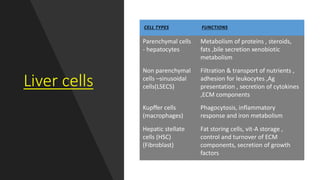
CELL TYPES FUNCTIONS
Parenchymal cells
- hepatocytes
Metabolism of proteins , steroids,
fats ,bile secretion xenobiotic
metabolism
Non parenchymal
cells –sinusoidal
cells(LSECS)
Filtration & transport of nutrients ,
adhesion for leukocytes ,Ag
presentation , secretion of cytokines
,ECM components
Kupffer cells
(macrophages)
Phagocytosis, inflammatory
response and iron metabolism
Hepatic stellate
cells (HSC)
(Fibroblast)
Fat storing cells, vit-A storage ,
control and turnover of ECM
components, secretion of growth
factors
Complications of liver
• Hepatitis – liver inflammation
• Cirrhosis – long term damage to liver which
lead to permanent scarring
• Liver failure – may be due to infection,
genetic diseases and excessive alcohol
• Ascites – liver leaks fluids into belly
• Gall stones – gall stone stuck can result in
hepatitis and bile duct infection
• Hemochromatosis – iron deposition in liver
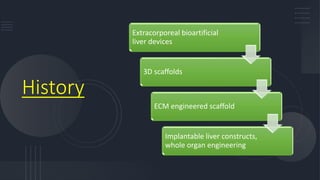
History
Extracorporeal bioartificial
liver devices
3D scaffolds
ECM engineered scaffold
Implantable liver constructs,
whole organ engineering
Implantable technologies for liver
therapies
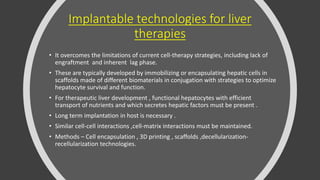
• It overcomes the limitations of current cell-therapy strategies, including lack of
engraftment and inherent lag phase.
• These are typically developed by immobilizing or encapsulating hepatic cells in
scaffolds made of different biomaterials in conjugation with strategies to optimize
hepatocyte survival and function.
• For therapeutic liver development , functional hepatocytes with efficient
transport of nutrients and which secretes hepatic factors must be present .
• Long term implantation in host is necessary .
• Similar cell-cell interactions ,cell-matrix interactions must be maintained.
• Methods – Cell encapsulation , 3D printing , scaffolds ,decellularization-
recellularization technologies.
1. Cell encapsulation
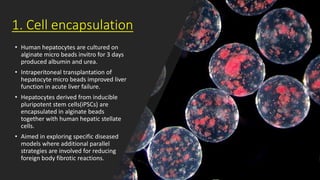
• Human hepatocytes are cultured on
alginate micro beads invitro for 3 days
produced albumin and urea.
• Intraperitoneal transplantation of
hepatocyte micro beads improved liver
function in acute liver failure.
• Hepatocytes derived from inducible
pluripotent stem cells(iPSCs) are
encapsulated in alginate beads
together with human hepatic stellate
cells.
• Aimed in exploring specific diseased
models where additional parallel
strategies are involved for reducing
foreign body fibrotic reactions.
2. 3D- Printing
• Uses ink which support cell differentiation and function.
• Techniques to 3D print hepatic-like structures are biomimicry
and mini tissue building blocks.
• Cells of hepatic cell line Hepg2 were printed with alginate as
the crosslinking agent.
• Gelatin is used to ensure the control of ink thickness and
higher printability.
• 3D-printed tissues were fabricated using iPSC-derived
hepatocytes mixed with alginate hydrogels. It increased level
of metabolic function during in vitro development.
• Ideal bio ink – analyze the composition and distribution of
ECM proteins in decellularized tissue scaffold.
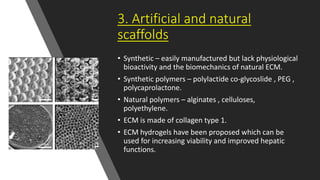
3. Artificial and natural
scaffolds
• Synthetic – easily manufactured but lack physiological
bioactivity and the biomechanics of natural ECM.
• Synthetic polymers – polylactide co-glycoslide , PEG ,
polycaprolactone.
• Natural polymers – alginates , celluloses,
polyethylene.
• ECM is made of collagen type 1.
• ECM hydrogels have been proposed which can be
used for increasing viability and improved hepatic
functions.
4.Decellularization
and whole organ
engineering
• Used for development of perfusable ECM
derived scaffolds with preserved vascular
integrity.
• Liver bioengineering can be used for
transplantation and drug toxicity testing in
3D in invitro cultures.
• Decellularization–recellularization
technologies provide a valuable platform
for liver bioengineering through the
repopulation of liver ECM scaffolds with
parenchymal and nonparenchymal liver
cells.
• Tissues from other organisms may lead to
incompatibility and hence human
organisms’ tissues must be collected and
engineered.
Decellularization
• First decellularization was done to develop
acellular heart from mice by using
retrograde coronary perfusion at constant
pressure.
• Decellularization – removal of cellular
material while preserving vascular network ,
ECM composition, and 3D architecture of
native tissue.
• Liver decellularization used antegrade
perfusion through portal vein at constant
flow rate which obtained the translucent
acellular tissue.
• The first successful decellularization of a
human liver was done by using a novel
retrograde, two-step, perfusion flow-rate
methodology able to preserve the fine 3D
hepatic architecture and the liver ECM
biochemical composition is same.
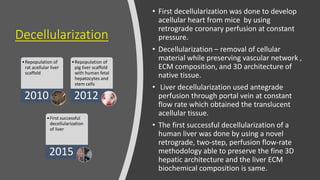
•Repopulation of
rat acellular liver
scaffold
2010
•Repopulation of
pig liver scaffold
with human fetal
hepatocytes and
stem cells
2012
•First successful
decellularization
of liver
2015
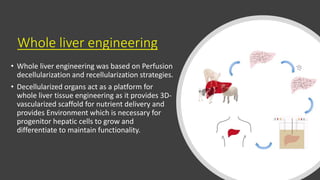
Whole liver engineering
• Whole liver engineering was based on Perfusion
decellularization and recellularization strategies.
• Decellularized organs act as a platform for
whole liver tissue engineering as it provides 3D-
vascularized scaffold for nutrient delivery and
provides Environment which is necessary for
progenitor hepatic cells to grow and
differentiate to maintain functionality.
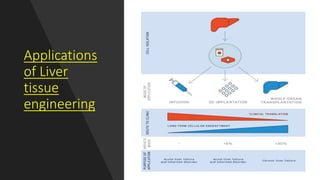
Applications
of Liver
tissue
engineering
Happy
Liver

Liver tissue engineering

  • 1.
    LIVER TISSUE ENGINEERING Kolla Srivalli 201709010 MScSystems Biology Manipal School of Lifesciences
  • 2.
    Liver • Liver islarge meaty organ which sits on right side of belly. • Contain gall bladder which is used for the synthesis of bile juice. • Functions - Biochemical defense - Synthesis of bile - Regulator of plasma glucose and ammonia levels - Optimal function of brain • Loss of liver function leads to “hepatic encephalopathy” and sometimes leads to coma.
  • 3.
    Liver cells CELL TYPESFUNCTIONS Parenchymal cells - hepatocytes Metabolism of proteins , steroids, fats ,bile secretion xenobiotic metabolism Non parenchymal cells –sinusoidal cells(LSECS) Filtration & transport of nutrients , adhesion for leukocytes ,Ag presentation , secretion of cytokines ,ECM components Kupffer cells (macrophages) Phagocytosis, inflammatory response and iron metabolism Hepatic stellate cells (HSC) (Fibroblast) Fat storing cells, vit-A storage , control and turnover of ECM components, secretion of growth factors
  • 4.
    Complications of liver •Hepatitis – liver inflammation • Cirrhosis – long term damage to liver which lead to permanent scarring • Liver failure – may be due to infection, genetic diseases and excessive alcohol • Ascites – liver leaks fluids into belly • Gall stones – gall stone stuck can result in hepatitis and bile duct infection • Hemochromatosis – iron deposition in liver
  • 5.
    History Extracorporeal bioartificial liver devices 3Dscaffolds ECM engineered scaffold Implantable liver constructs, whole organ engineering
  • 6.
    Implantable technologies forliver therapies • It overcomes the limitations of current cell-therapy strategies, including lack of engraftment and inherent lag phase. • These are typically developed by immobilizing or encapsulating hepatic cells in scaffolds made of different biomaterials in conjugation with strategies to optimize hepatocyte survival and function. • For therapeutic liver development , functional hepatocytes with efficient transport of nutrients and which secretes hepatic factors must be present . • Long term implantation in host is necessary . • Similar cell-cell interactions ,cell-matrix interactions must be maintained. • Methods – Cell encapsulation , 3D printing , scaffolds ,decellularization- recellularization technologies.
  • 7.
    1. Cell encapsulation •Human hepatocytes are cultured on alginate micro beads invitro for 3 days produced albumin and urea. • Intraperitoneal transplantation of hepatocyte micro beads improved liver function in acute liver failure. • Hepatocytes derived from inducible pluripotent stem cells(iPSCs) are encapsulated in alginate beads together with human hepatic stellate cells. • Aimed in exploring specific diseased models where additional parallel strategies are involved for reducing foreign body fibrotic reactions.
  • 8.
    2. 3D- Printing •Uses ink which support cell differentiation and function. • Techniques to 3D print hepatic-like structures are biomimicry and mini tissue building blocks. • Cells of hepatic cell line Hepg2 were printed with alginate as the crosslinking agent. • Gelatin is used to ensure the control of ink thickness and higher printability. • 3D-printed tissues were fabricated using iPSC-derived hepatocytes mixed with alginate hydrogels. It increased level of metabolic function during in vitro development. • Ideal bio ink – analyze the composition and distribution of ECM proteins in decellularized tissue scaffold.
  • 9.
    3. Artificial andnatural scaffolds • Synthetic – easily manufactured but lack physiological bioactivity and the biomechanics of natural ECM. • Synthetic polymers – polylactide co-glycoslide , PEG , polycaprolactone. • Natural polymers – alginates , celluloses, polyethylene. • ECM is made of collagen type 1. • ECM hydrogels have been proposed which can be used for increasing viability and improved hepatic functions.
  • 10.
    4.Decellularization and whole organ engineering •Used for development of perfusable ECM derived scaffolds with preserved vascular integrity. • Liver bioengineering can be used for transplantation and drug toxicity testing in 3D in invitro cultures. • Decellularization–recellularization technologies provide a valuable platform for liver bioengineering through the repopulation of liver ECM scaffolds with parenchymal and nonparenchymal liver cells. • Tissues from other organisms may lead to incompatibility and hence human organisms’ tissues must be collected and engineered.
  • 11.
    Decellularization • First decellularizationwas done to develop acellular heart from mice by using retrograde coronary perfusion at constant pressure. • Decellularization – removal of cellular material while preserving vascular network , ECM composition, and 3D architecture of native tissue. • Liver decellularization used antegrade perfusion through portal vein at constant flow rate which obtained the translucent acellular tissue. • The first successful decellularization of a human liver was done by using a novel retrograde, two-step, perfusion flow-rate methodology able to preserve the fine 3D hepatic architecture and the liver ECM biochemical composition is same. •Repopulation of rat acellular liver scaffold 2010 •Repopulation of pig liver scaffold with human fetal hepatocytes and stem cells 2012 •First successful decellularization of liver 2015
  • 12.
    Whole liver engineering •Whole liver engineering was based on Perfusion decellularization and recellularization strategies. • Decellularized organs act as a platform for whole liver tissue engineering as it provides 3D- vascularized scaffold for nutrient delivery and provides Environment which is necessary for progenitor hepatic cells to grow and differentiate to maintain functionality.
  • 13.
  • 14.