CYTOTOXICITY
Shabnam Ameenudeen
M. Tech Biotechnology
Shabnam.jamaliyath@gmail.com
Introduction
• Cytotoxicity- ‘cyto’ means cell and ‘toxicity’ means poison.
• The ability of drugs or chemical molecules or mediator cells to
destroy the living cells.
• This is mediated by
i. Chemical stimuli (drugs)
ii. Targeted by other cells (immune cells- NK and T-cells)
iii. Environmental condition- radiation, temperature, etc.
Cellular Fates
• Cytotoxicity can result in one of the possible cellular fates
i. Necrosis- it results in rapid loss of membrane integrity and
cell lysis
ii. Apoptosis- slower, orderly and genetically controlled
iii. Cytostasis- cells remain avail but the growth is inhibited
In-vitro Assay
• It has helped with the traditional study of whole animal/plant
model toxicity study.
• It is done to exclude cytotoxicity in specific cells or to test for
specialized function.
• They are suitable test systems to determine the cytotoxicity
changes that affects the cell cycle.
• To look for adequate compound/condition for therapeutic
purpose.
Possible Cellular Alterations
• Cell morphology- membrane blebbing, vacuolization, etc
• Cell viability- the ability to take up or exclude cells
• Cell growth- cell count, plating efficiency, DNA or protein
content
• Metabolic parameters- O2 consumption, NADH-NAD
conversion and pool of DNA or RNA precursors
End- Point Assessment
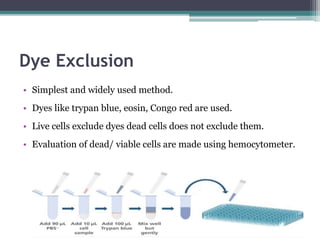
Dye Exclusion
• Simplest and widely used method.
• Dyes like trypan blue, eosin, Congo red are used.
• Live cells exclude dyes dead cells does not exclude them.
• Evaluation of dead/ viable cells are made using hemocytometer.
Colorimetric Assay
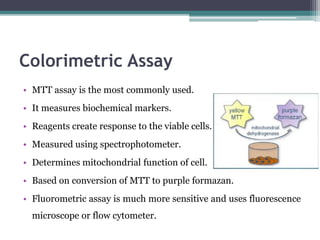
• MTT assay is the most commonly used.
• It measures biochemical markers.
• Reagents create response to the viable cells.
• Measured using spectrophotometer.
• Determines mitochondrial function of cell.
• Based on conversion of MTT to purple formazan.
• Fluorometric assay is much more sensitive and uses fluorescence
microscope or flow cytometer.
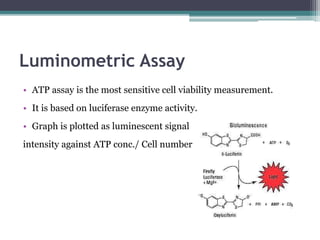
Luminometric Assay
• ATP assay is the most sensitive cell viability measurement.
• It is based on luciferase enzyme activity.
• Graph is plotted as luminescent signal
intensity against ATP conc./ Cell number
Nanotoxicology
• Nanotoxicology is a branch of bioscience which deals with the
study and application of toxicity of nanomaterials.
• It determines the extent at which the nanomaterial becomes
threat to the environment and human being.
• Nanotoxicity is the effect.
• Smaller the size higher the surface area to volume ratio and
quantum effects possess threat.
• Nanomaterials made of inert materials like gold, silver are also
toxic.
Nanomaterials Classification
• Dimensionality- zero, one , two and three dimensions
• Morphology- nanowires, nanospheres, nanotubes, etc
• Composition- single material or composite based
• Uniformity/ Agglomeration state- dispersed and aggregated
• Strongly bound uncontrolled agglomerates influences the cell-
particle interaction.
• It hinders the actual cytotoxicity study.
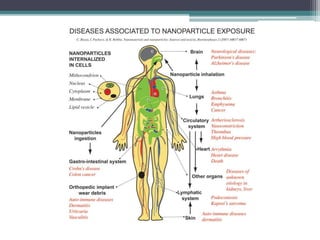
Nano-cytotoxicity
• Aluminium oxide NPs used in fuels and paints alters mitochondrial
function, creates oxidative stress and damages the blood brain barrier.
• It is also associated with genotoxicity.
• Silver NPs are associated with blood diseases and in colon cancer.
• Metallic NPs can easily pass through the circulation and can cause
blood clotting.
• Fe, Cu, Zn NPs are associated with neurodegenerative diseases.
• Iron oxide NPs are targeted against adenocarcinoma cells.
Nanoparticle Inhalation
• Small concentration of NPs- distributed to brain, heart and
kidney
• High concentration of NPs- aggregates >100nm gets
phagocytosed
• Very high concentration of NPs- results in lung overload
Cytotoxicity
Cytotoxicity

Cytotoxicity

  • 1.
    CYTOTOXICITY Shabnam Ameenudeen M. TechBiotechnology Shabnam.jamaliyath@gmail.com
  • 2.
    Introduction • Cytotoxicity- ‘cyto’means cell and ‘toxicity’ means poison. • The ability of drugs or chemical molecules or mediator cells to destroy the living cells. • This is mediated by i. Chemical stimuli (drugs) ii. Targeted by other cells (immune cells- NK and T-cells) iii. Environmental condition- radiation, temperature, etc.
  • 3.
    Cellular Fates • Cytotoxicitycan result in one of the possible cellular fates i. Necrosis- it results in rapid loss of membrane integrity and cell lysis ii. Apoptosis- slower, orderly and genetically controlled iii. Cytostasis- cells remain avail but the growth is inhibited
  • 4.
    In-vitro Assay • Ithas helped with the traditional study of whole animal/plant model toxicity study. • It is done to exclude cytotoxicity in specific cells or to test for specialized function. • They are suitable test systems to determine the cytotoxicity changes that affects the cell cycle. • To look for adequate compound/condition for therapeutic purpose.
  • 5.
    Possible Cellular Alterations •Cell morphology- membrane blebbing, vacuolization, etc • Cell viability- the ability to take up or exclude cells • Cell growth- cell count, plating efficiency, DNA or protein content • Metabolic parameters- O2 consumption, NADH-NAD conversion and pool of DNA or RNA precursors
  • 6.
  • 7.
    Dye Exclusion • Simplestand widely used method. • Dyes like trypan blue, eosin, Congo red are used. • Live cells exclude dyes dead cells does not exclude them. • Evaluation of dead/ viable cells are made using hemocytometer.
  • 8.
    Colorimetric Assay • MTTassay is the most commonly used. • It measures biochemical markers. • Reagents create response to the viable cells. • Measured using spectrophotometer. • Determines mitochondrial function of cell. • Based on conversion of MTT to purple formazan. • Fluorometric assay is much more sensitive and uses fluorescence microscope or flow cytometer.
  • 9.
    Luminometric Assay • ATPassay is the most sensitive cell viability measurement. • It is based on luciferase enzyme activity. • Graph is plotted as luminescent signal intensity against ATP conc./ Cell number
  • 10.
    Nanotoxicology • Nanotoxicology isa branch of bioscience which deals with the study and application of toxicity of nanomaterials. • It determines the extent at which the nanomaterial becomes threat to the environment and human being. • Nanotoxicity is the effect. • Smaller the size higher the surface area to volume ratio and quantum effects possess threat. • Nanomaterials made of inert materials like gold, silver are also toxic.
  • 11.
    Nanomaterials Classification • Dimensionality-zero, one , two and three dimensions • Morphology- nanowires, nanospheres, nanotubes, etc • Composition- single material or composite based • Uniformity/ Agglomeration state- dispersed and aggregated • Strongly bound uncontrolled agglomerates influences the cell- particle interaction. • It hinders the actual cytotoxicity study.
  • 14.
    Nano-cytotoxicity • Aluminium oxideNPs used in fuels and paints alters mitochondrial function, creates oxidative stress and damages the blood brain barrier. • It is also associated with genotoxicity. • Silver NPs are associated with blood diseases and in colon cancer. • Metallic NPs can easily pass through the circulation and can cause blood clotting. • Fe, Cu, Zn NPs are associated with neurodegenerative diseases. • Iron oxide NPs are targeted against adenocarcinoma cells.
  • 15.
    Nanoparticle Inhalation • Smallconcentration of NPs- distributed to brain, heart and kidney • High concentration of NPs- aggregates >100nm gets phagocytosed • Very high concentration of NPs- results in lung overload